




We use cookies on this website, you can read about cookies and GDPR Privacy Policy here
Coddan CPM Ltd. – Company Registration Agent in the UK

Follow the six steps to understand how a UK Company Limited by Guarantee (CLG) is formed, identify your organisation’s requirements, and prepare for registration and ongoing compliance.

Step 1
Understand CLG Formation
Step 2
Identify Your Requirements
Step 3
Prepare Company Information
Step 4
Select Formation Package
Step 5
Submit Registration Application
Step 6
Plan Ongoing Compliance
Companies Registry's e-Services Portal Non-For-Profit Companies Forming a Limited by Guarantee Company in the UK through a Company Formation Agent from £119.99

Forming a Limited by Guarantee Company in the UK through a Company Formation Agent from £119.99

Understand the structure. Choose suitable support.

Company Limited by Guarantee – Pros and Cons of a Non-For-Profit Business Registration

Deciding whether a company limited by guarantee is right for your club, association, membership body or community organisation? Compare its benefits and responsibilities here. Coddan helps you clarify the arrangements, choose suitable articles and prepare the formation if a CLG fits your plans—with professional review and personal help, not just an online form.

Starting a charity, club, or social enterprise (SE)? A Private Company Limited by Guarantee could be exactly the structure you need. Unlike a standard limited company, it has no shares or shareholders; instead, members act as guarantors, each pledging a nominal amount (often just £1) if the company ever winds up. Coddan CPM Ltd makes the process straightforward: you can register a new Private Limited by Guarantee Enterprise online in under 24 hours, provided you have an acceptable name, at least one guarantor and director, a UK registered office, a registered email address, and suitable articles. This rapid and secure Nonprofit Organisation start-up route is fully incorporated at Companies House, giving your venture the credibility and legal standing it deserves — without unnecessary complexity. Simple, official, and done before you know it.

A separate legal identity and member-based governance can support your organisation’s continuity. Weigh those benefits against company-law duties, public filings and running costs. Charity registration and tax treatment are separate. Compare the alternatives, then choose your formation package or discuss your plans with us.

Personal-manager assistance with every formation order. Your assigned manager helps with information requests, questions, approvals and next steps by phone or email during working hours. This assistance is separate from paid priority handling and continuing support.

01 · Affordable preparation

A suitable start, without unnecessary complexity

Suitable established articles can make formation approachable and affordable for a straightforward club or association. You describe your organisation; Coddan helps identify the preparation needed. Bring your purposes or prepared articles if you have them. We explain the suitable work and any further drafting before you decide, so you can choose services matched to your needs.

| ✓ Includes £100 Statutory Fee | ✓ Professional Application Review Before Submission | ✓ Credas Checks Where Separately Ordered; Coddan Reviews and Confirms Verification When Satisfied; Companies House Issues the Personal Code | ✓ Complete Set of Digital Company Documents

02 · Cost-effective NPO entity incorporation

Know what your formation package provides

CLGEssential™ is £119.99 + VAT, including the £100 Companies House incorporation fee, using your own suitable England and Wales registered office. It provides professional preparation, review and digital incorporation documents. Compare the published packages and choose printed or combined documents, address arrangements or later support where useful. Clear inclusions help you buy the work your organisation needs.

03 · Easy to start the new NPO business formation

Ask first, or begin your order online

You can ask about the legal requirements for incorporation before ordering. If you are ready, start online 24/7 using the single-page form, with the requirements and choices together. Prepare your company and participant details first. Your manager helps with questions; preparation, review, approval and submission take place before Companies House processes the application.

04 · Simple to arrange the new NPO business creation

Choose the help your organisation needs

Explain any membership, director, funding or property arrangements that need attention. You do not have to diagnose bespoke drafting. Coddan can discuss articles, addresses, company records and later administration together, then confirm a suitable package or agreed combination. Choose the services you need now, with further help available as your organisation develops.

05 · Experienced formation support

Listed company formation agent

Coddan CPM Limited is on the Companies House formation-agent list and has provided formation and business-support services since 2005. That experience supports practical preparation: suitable documents, checked company information and submission of your approved application through Companies House-integrated software. You have experienced people handling the work behind your order, with a named contact for questions.

06 · Separate, relevant provider roles

HMRC-supervised TCSP and registered ACSP

Coddan carries out AML customer checks as an HMRC-supervised trust or company service provider. Our separate Companies House ACSP role enables identity-verification assistance when selected: we review evidence and submit confirmation; Companies House issues your Personal Code. Direct Companies House verification is also available. We help connect the relevant identity steps with your formation.

Your organisation, formation and later support through Coddan

Tell us what the organisation will do, who will participate, how decisions should be made and any relevant deadline. Email your purposes, existing rules or prepared articles to info@coddan.co.uk. We explain suitable work and confirm the price before you decide whether to order. An enquiry does not commit you to a purchase.

Discuss private limited by guarantee (LBG) company formation alongside addresses, initial company records, documents or later company-secretarial support. Choose the services you need rather than a compulsory bundle. A written service agreement is available for formation and separately instructed address, SAIL or secretarial services, identifying the work, charges and service period. Use Coddan’s secure process for identity evidence and confidential codes.


Start Your Business Today: Fast Formation Services to Meet All Compliance Standards
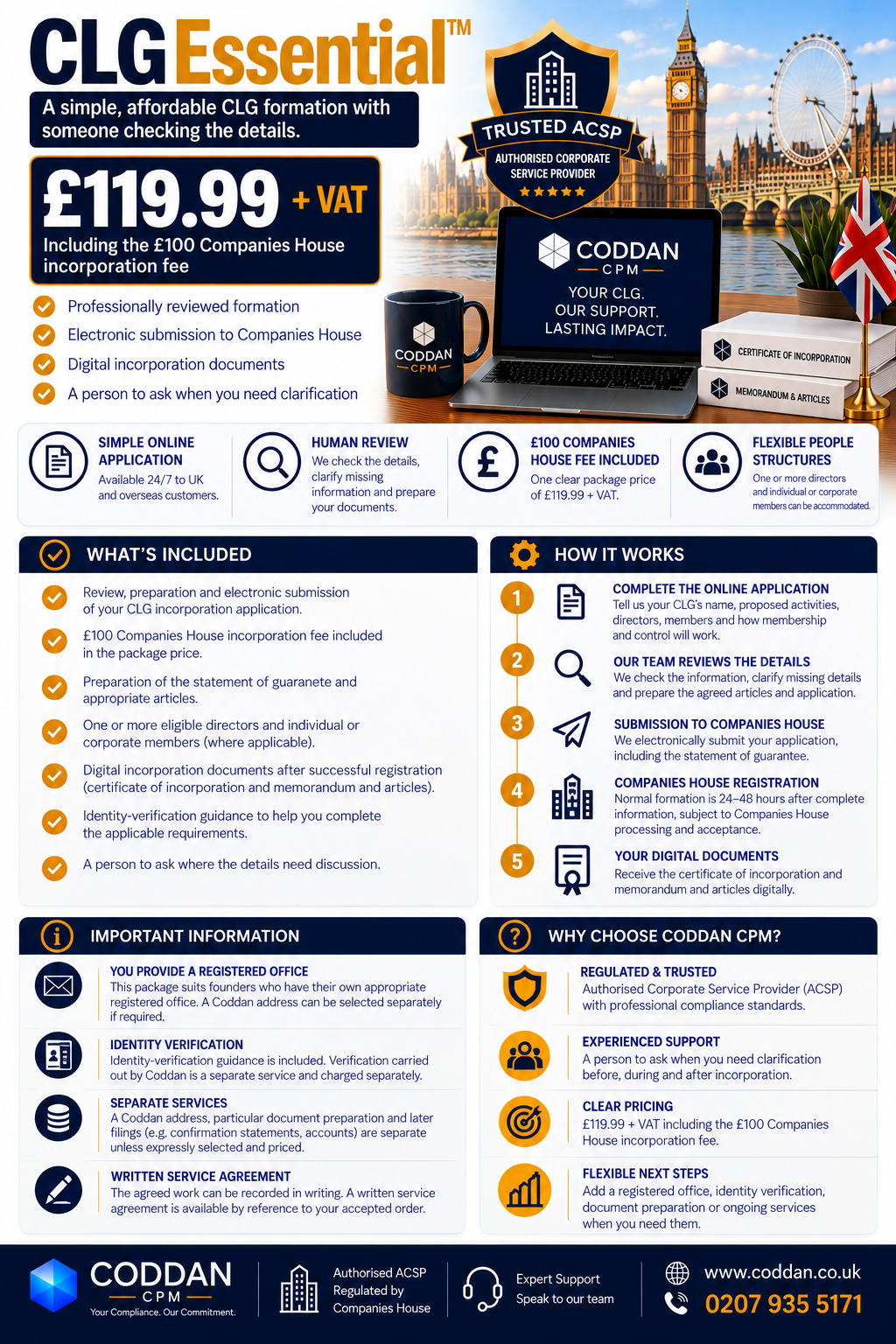
£119.99
+VAT

“CLGEssential™”

Recommended for

1
package

Buy Now Professional CLG formation, using your own registered office. CLGEssential™ suits founders who want an experienced company formation agent to prepare, check and submit their application. Tell us the purpose, directors, guarantor-members and voting arrangements; Coddan explains missing information, prepares the agreed articles and submits the application with your approval. You receive digital incorporation documents after registration. Personal-manager assistance is available with every formation order. Start through our 24/7 formation portal, read what we check, and see how our formation-agent, TCSP and ACSP roles support your order.

£119.99 + VAT includes the £100 incorporation fee, formation preparation, electronic submission and digital documents. Additional directors, individual or corporate members and supplied company objects do not automatically increase the formation charge. Supply accurate details, a monitored registered email and required Personal Codes. From our 20 years’ experience, about 90% receive approval and the certificate within 1–3 working hours after our expert checks and submits the application; allow 24–48 hours for standard processing. Identity-verification guidance is included; Coddan-performed verification is separately charged. See verification requirements. Choose formation with your own address, or compare CLG AddressPro™. Additional document work and later filings are separately ordered. A written agreement is available; see additional-service prices.


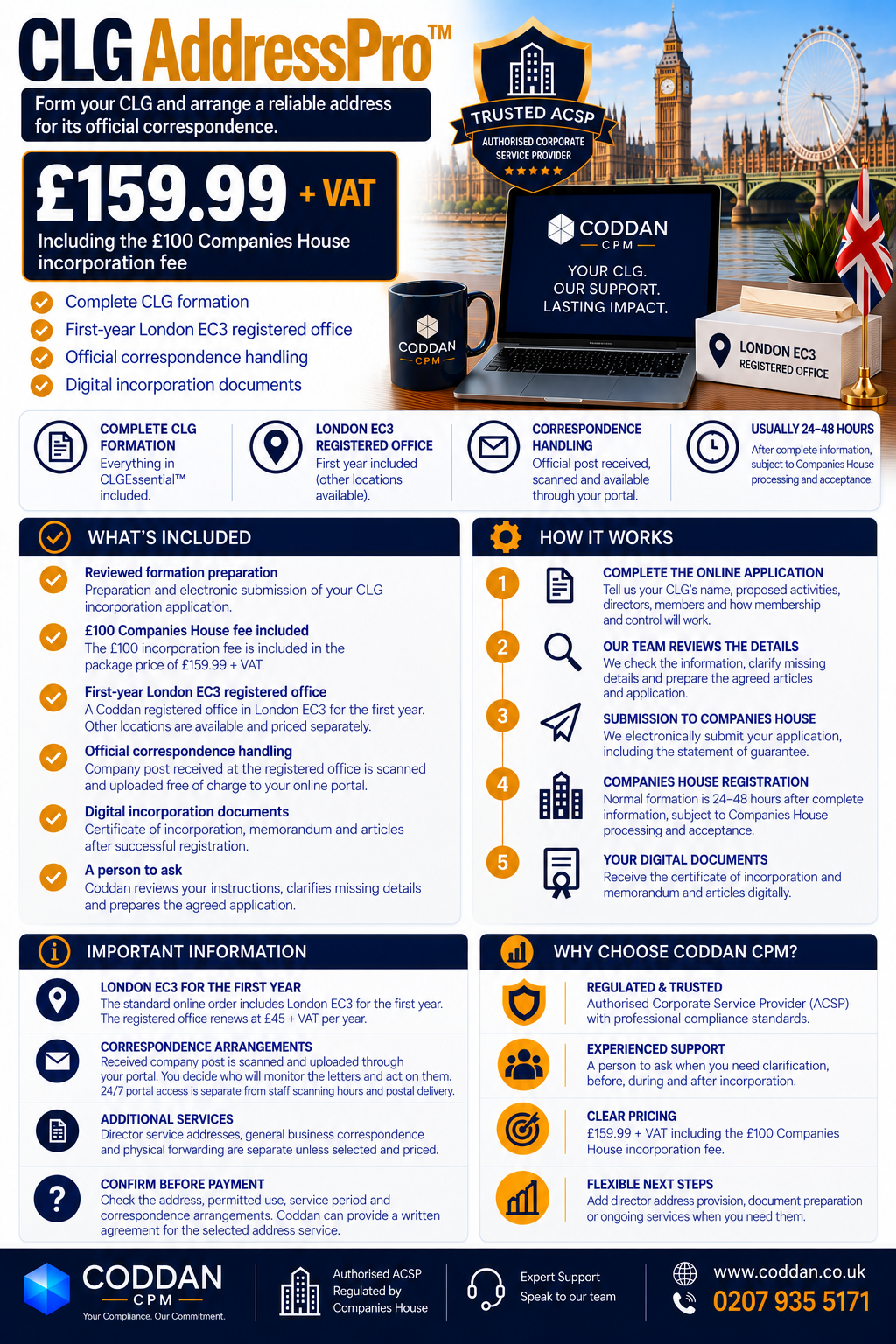
£159.99
+VAT

“CLG AddressPro™”

Recommended for

2
package

Buy Now Let Coddan arrange formation and your registered office together. CLG AddressPro™ suits founders who want a professional address for their company’s official correspondence. It combines the formation service in CLGEssential™ with the first-year London EC3 registered office. Coddan prepares, reviews and submits your approved application, then supplies the digital incorporation documents. Received company post is scanned and uploaded free of charge to your customer portal. Your personal manager helps with the formation order. Choose one provider for formation and official post; read about correspondence handling.

£159.99 + VAT includes the £100 incorporation fee, reviewed electronic formation, digital documents and the first-year London EC3 office. The EC3 address renews at £45 + VAT annually on the incorporation anniversary. Another location must suit your company’s jurisdiction and may have different initial and renewal charges; see available address arrangements. Your organisation monitors the scanned letters and acts on them. Portal access is available 24/7; scanning takes place during service hours. Director addresses, general business correspondence and physical forwarding are separately selected. We agree forwarding charges before instruction. A written address-service agreement is available. Compare CLG ProtectPro™ for a director address and related-service prices for additional work.


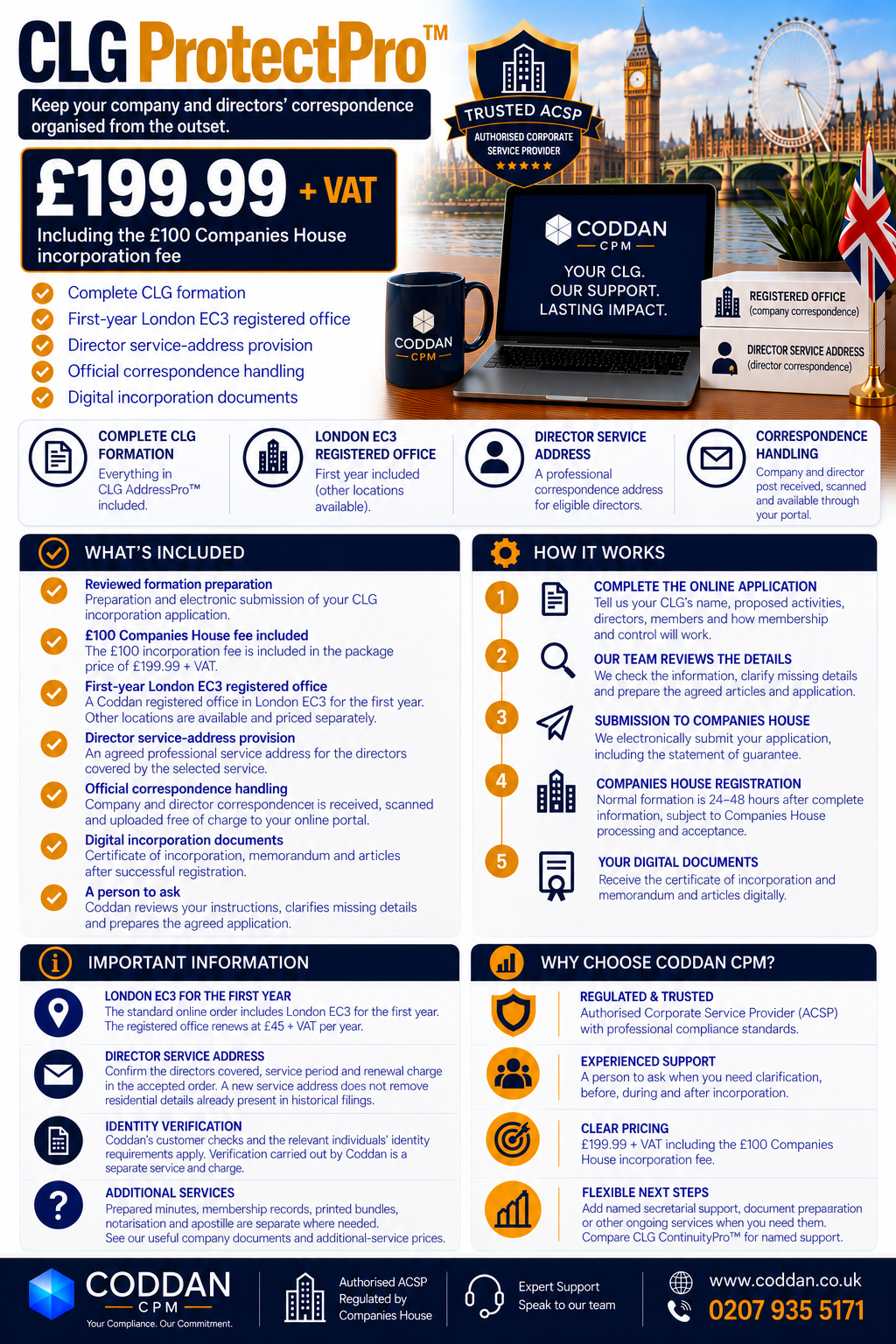
£199.99
+VAT

“CLG ProtectPro™”

Recommended for

3
package

Buy Now Arrange professional correspondence addresses for your company and directors. CLG ProtectPro™ suits founders who want Coddan to handle formation, a registered office and agreed director service-address provision together. It adds the director address to CLG AddressPro™. We check the formation details and address arrangements, prepare your approved application and submit it to Companies House. You receive digital incorporation documents after registration, with free scanning and uploading of the agreed company and director post. Personal-manager assistance is available during formation. Choose company and director addresses together; see how the addresses work.

£199.99 + VAT includes the £100 incorporation fee, electronic formation, digital documents, the first-year London EC3 office and agreed director-address provision. The EC3 office renews at £45 + VAT annually on the incorporation anniversary. Confirm which directors are covered, their address-service period and renewal charge before ordering. An alternative location or wider mail service can change the total. Provide the required residential details; a new service address does not remove home addresses from historic filings. A written address-service agreement is available. Prepared minutes, membership records, printed bundles, notarisation and apostille are separately agreed: see company documents and additional-service prices. Compare CLG ContinuityPro™ for continuing secretarial help.


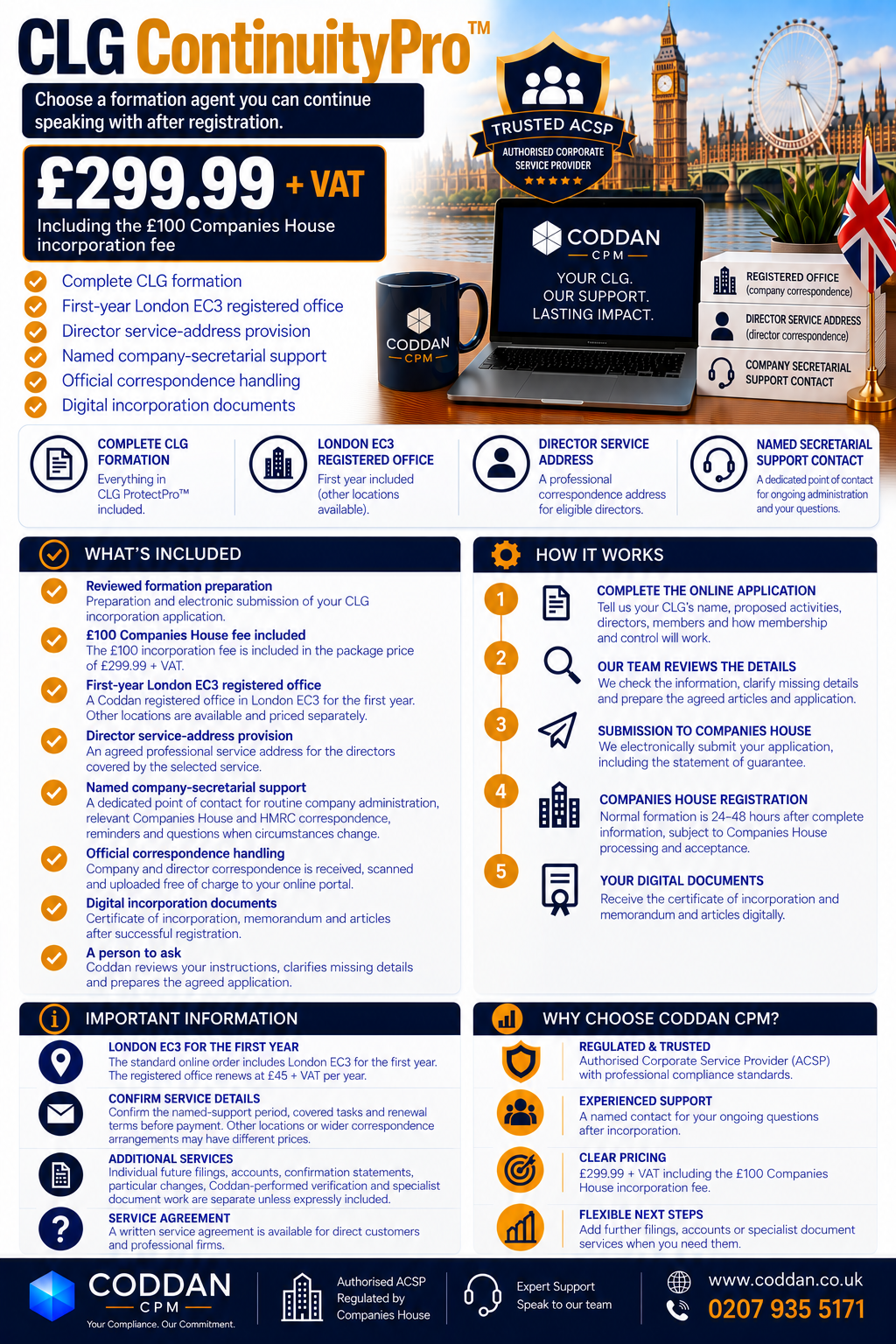
£299.99
+VAT

“CLG ContinuityPro™”

Recommended for

4
package

Buy Now Form your CLG with continuing company-secretarial help. CLG ContinuityPro™ suits directors who want an ongoing contact for company administration after incorporation. It combines CLG ProtectPro™ formation and address services with named secretarial support. Coddan helps with routine administration, relevant Companies House and HMRC correspondence, reminders and questions when circumstances change. Every formation order has personal-manager assistance; this package adds continuing secretarial support. If you appoint Coddan as company secretary, we arrange the appointment with your company’s authority and the required notification. Explore continuing support for help beyond incorporation.

£299.99 + VAT includes the £100 incorporation fee, reviewed formation, digital documents, the first-year London EC3 office, agreed director-address provision and named secretarial support. The EC3 office renews at £45 + VAT annually on the incorporation anniversary. Confirm the continuing-support period, covered tasks, director-address period and renewal charges before ordering. Directors make company decisions and retain their responsibilities. Future filings, returns and applications are separately ordered. Accounts, confirmation statements, changes, Coddan-performed verification and specialist documents have separate charges unless included in your order. See additional-service prices and CLG secretarial services. Professional firms can explore partner support or discuss an ACSP partnership. Partnership work is separately priced; a written service agreement is available.


Quick and Secure Non-Profit Structures Incorporation Explained

Privately Owned Company Limited by Guarantee – Pros and Cons of a Non-For-Profit NPO Business Registration

Compare the practical benefits and commitments of a CLG, then use Coddan’s formation service if it fits your plans. The preparation below helps turn your chosen membership, governance and activities into suitable information and company documents.

Already decided? Compare the formation packages. Still considering the structure or articles? Describe your plans to Coddan before ordering.

Choose your new NPO formation package, or speak with Coddan first

Choose a CLG formation package

Already decided that a CLG suits your organisation? Compare four packages for formation, documents, addresses and continuing support. Select the services you need now.

Discuss your organisation before ordering

Tell us your purpose, participants, intended decisions and any relevant dates or existing documents. We explain suitable preparation and its price. You do not need to diagnose bespoke drafting; an enquiry does not commit you to order.

Private company limited by guarantee formation through Coddan agency

Simple online CLG formation, with professional preparation

Planning a club, community organisation or social enterprise? If a company limited by guarantee suits your plans, Coddan CPM Limited helps make formation straightforward. Describe your purposes, people and intended arrangements; we clarify the information needed, prepare suitable company documents, review the application and handle the agreed electronic submission after the necessary checks and your approval.

You can begin online and receive personal-manager assistance with questions, documents and next steps. Suitable straightforward formations can use established articles; particular requirements and further drafting are discussed and separately agreed. Members participate as guarantors rather than shareholders. If you intend to establish a charity, tell us before ordering so suitable constitutional preparation and any charity-registration work can be considered separately.

These six areas show what you can obtain through Coddan and link to the detail needed to proceed.

Prepare your organisation for formation

Explain what the organisation will do, who will be involved and how decisions should be made. Coddan helps clarify the purpose, members, guarantees, voting, directors and actual control, then prepares the agreed application information.

Choose suitable company articles

Use suitable established Coddan articles, provide your purposes for inclusion, supply prepared articles or discuss particular rules. Choose preparation that reflects the organisation and work already done, with further drafting agreed where needed.

Arrange the checks, addresses and initial company records

Bring relevant identity steps, an appropriate registered office and useful initial records together with your formation. Coddan explains what information is needed, carries out separate AML customer checks and helps arrange the services you select.

Fast incorporation through Coddan

Our expert checks your application and submits it through Companies House-integrated software. In our experience over 20 years, Companies House usually issues the certificate within a few hours after our submission of a ready ordinary electronic incorporation application.

Choose your formation package with clear costs

Compare packages at £119.99, £159.99, £199.99 and £299.99, each plus VAT and including the £100 Companies House incorporation fee. Choose relevant addresses, documents and support; particular drafting and selected additional services follow their stated or agreed prices.

Your company documents, professionally prepared

Receive the certificate, prescribed memorandum and suitable articles included in your formation service. Choose digital, professionally prepared printed or combined materials for their intended use. Ask about company records, initial minutes and guarantor membership certificates for your organisation.

Your personal manager helps with every formation order: contact your manager by phone or email during working hours about information, approvals and next steps. This help is separate from paid priority handling and continuing support.

Compare formation packages and order · Discuss your requirements first

CLG pros, cons and formation: the essentials

A CLG may suit a club, association or membership organisation needing a separate legal identity without shares. Weigh continuity and member governance against annual administration, public filings and costs. Charity registration and tax relief are separate.

People and preparation. A private CLG needs at least one director and one guarantor-member; one person can hold both roles. Particular organisations may need more. Prepare the name, purpose, people, guarantees, voting, addresses and actual-control information.

Work and price. Coddan helps clarify requirements, prepares suitable documents, reviews your information and submits your approved application. England and Wales formation starts at £119.99 + VAT, including the £100 incorporation fee, with your own suitable registered office. Compare inclusions and discuss particular work before ordering.

Time and help. Allow preparation before review and submission: typically 1–2 hours gathering details for suitable established articles, 2–3 hours when supplying prepared documents, or several days for tailored articles. These are preparation estimates, not incorporation deadlines. See the detailed timing explanation for the separate official stage. Your personal manager helps during working hours; online ordering is available 24/7.

Compare structures · What to prepare · Compare packages · Ask Coddan

In this guide

Use the contents below to move directly to the topic that matters most to your organisation.

  1. What a CLG is
  2. How it works
  3. Main advantages
  4. Limited liability
  5. Legal identity and credibility
  6. Membership and governance
  7. Funding and trading
  8. Who may benefit
  9. Main disadvantages
  10. Filing and compliance
  11. Costs and workload
  12. Public information and flexibility
  13. Profits and distributions
  14. CLG and charity status
  15. Compare legal structures
  16. When to choose a CLG
  17. Before registering
  18. Frequently asked questions
  19. Conclusion
  20. Formation through Coddan
  21. The essentials
  22. Articles and preparation choices
  23. Electronic service and portal
  24. Documents and completion
  25. Annual-service support

1. Introduction: Is a Company Limited by Guarantee Right for Your Non-Profit Organisation?

Consider what your organisation needs to do: hold property, employ people, enter contracts, receive funds or continue when its founders leave. A CLG can provide a member-based company structure for those activities. Compare those benefits with the administration your directors and members can sustain.

If you already operate as a club, association or another organisation, tell Coddan about the existing constitution, participants and arrangements. Forming a new company does not itself move activities, assets, funds or contracts into it. Identify any approvals and separate transfer work before setting a changeover date.

Use the detailed comparison below to test the structure against your plans. You can ask Coddan about the formation information, suitable articles and practical services without first knowing every company-law term.

2. What Is a Company Limited by Guarantee?

A Company Limited by Guarantee has guarantor-members instead of shareholders and share capital. Each member promises a stated contribution if the company is wound up in the circumstances covered by the guarantee. £1 is common, but the founders choose the amount and should explain it to prospective members.

Companies House incorporation creates a legal person separate from its members and directors. The company can hold assets, employ staff, operate a bank account, contract and bring or defend proceedings in its own name. A member does not own a divisible share of its assets merely by being a member.

Sports clubs, associations, residents’ organisations, trade bodies and charities use CLGs for different purposes. The articles should reflect the particular organisation. Funding eligibility and charitable or tax status depend on the relevant requirements, not the guarantee-company label.

A private CLG needs at least one member and one director; one person can hold both roles. Members exercise their company-law and constitutional rights, while directors manage the company and fulfil their statutory duties. Particular organisations may need a larger board or membership.

The articles govern admission and departure of members, meetings, voting and director appointments. Suitable established articles can serve a straightforward organisation. Particular membership, charitable, funding or decision-making arrangements may need additional provisions. Discuss the requirements before approving the documents.

Official guidance explains the distinction between companies limited by shares and companies limited by guarantee, including the need to identify guarantors and the amount guaranteed during registration. Read the GOV.UK guide to types of limited company and the guidance on choosing guarantors for a company limited by guarantee.

3. How Does a CLG Work in Practice?

Members, directors and company records make the structure work in practice. The articles allocate powers and procedures; company law and any applicable charity rules also govern how the organisation acts. Agree practical responsibilities before incorporation.

Members and guarantors

Members are individuals or eligible organisations admitted under the articles. Their rights may include voting, electing directors, approving constitutional changes and receiving company information. Any entitlement to income or surplus assets depends on the articles and applicable law. Non-profit provisions should state the intended restrictions clearly.

The guarantee is a winding-up commitment, not normally a joining subscription or a payment on incorporation. It does not make a member personally responsible for every company loan, lease or other debt. Record it separately from membership fees and other funding.

Directors and day-to-day management

Directors oversee operations within the powers assigned to them. Their duties include acting within their powers, exercising independent judgement and reasonable care, managing conflicts and declaring relevant interests. They must oversee finances, records and required filings. These duties apply to unpaid and volunteer directors too.

A private CLG need not appoint a company secretary, although one may be appointed or administrative support engaged. Agree the provider’s work and keep directors informed of decisions and filings; delegating administration does not transfer their legal duties.

The articles and company records

Choose rules suited to actual operations. Annual club elections, corporate membership, regional branches or disciplinary procedures can require different provisions. Resolve practical questions about quorum, voting, resignations and membership termination before they become disputes.

After incorporation, keep the register of members and appropriate accounting records, minutes, decisions and transaction records. The register of members must be available for inspection at the registered office or an appropriate single alternative inspection location (SAIL). Since 18 November 2025, separate local statutory registers of directors, their residential addresses, secretaries and PSCs are no longer required. Relevant officer and PSC information must still be supplied to Companies House and kept current. Charities have additional applicable records and reporting duties.

Agree who keeps records, monitors deadlines, authorises payments and manages conflicts. Clear responsibilities make the company easier to run and help new members and directors understand their roles.

4. The Main Advantages of a Company Limited by Guarantee

A CLG combines a separate company identity with membership-based governance. The main benefits below matter particularly where the organisation has continuing activities, contracts, assets or a changing membership.

Limited liability

Members' liability under the guarantee is normally limited to the amount they have agreed to contribute, rather than being unlimited simply because they are members.

Separate legal identity

The company can own assets, contract, employ staff and continue even when members or directors change.

Member-led governance

The articles can establish voting rights, elections and decision-making procedures appropriate to the organisation's purpose.

Operational continuity

The organisation can continue beyond its founders, with its assets and obligations remaining with the company.

For organisations with staff, leases or grant-funded projects, incorporation makes the contracting party and ownership of assets clearer. Members exercise membership rights; directors manage the company within its governing rules.

A CLG can retain surpluses for its purposes. If you require binding restrictions on distributions or the destination of assets, include suitable provisions in the articles and consider any relevant charity or other regulatory rules.

Banks, landlords, funders and suppliers may be familiar with company documents and public records. Check their evidence and eligibility requirements: they may need accounts, authority to act or details of people controlling the organisation as well as the incorporation certificate.

Weigh these benefits against the administration your organisation can sustain. A small informal group may need less formality, while a body with recurring contracts, staff or substantial assets may find incorporation useful. Discuss the preparation with Coddan before selecting a package if you are uncertain.

5. Advantage: Limited Liability and Financial Protection

Limited liability in a company limited by guarantee means that a member's obligation under the membership guarantee is limited to the agreed contribution in the winding-up circumstances covered by that guarantee and applicable law. The company remains responsible for its own debts. Separate personal guarantees, breaches of duty or other individual obligations can create personal liability beyond the membership guarantee.

Illustration: a community arts CLG rents premises and buys equipment in its own name. If it later closes with unpaid debts, members do not normally fund the full shortfall merely because they are members. Their guarantee contributions, the company’s assets and applicable insolvency rules determine the relevant position.

Keep the company’s finances separate in practice: use appropriate banking, contracts, accounting records and payment approvals. This helps volunteers and members distinguish company commitments from personal ones.

What limited liability does not protect against

A director or member who signs a separate personal guarantee to a landlord, bank or supplier takes on an additional commitment. Check its amount, duration and enforcement conditions before signing; it is not limited by the company membership guarantee.

Directors can face personal consequences for misconduct, breaches of duty and certain insolvency-related actions. Membership limited liability does not protect an individual from liability arising separately from their own conduct.

New companies may be asked for deposits, security or personal guarantees. Consider those requirements when budgeting for premises or finance; incorporation does not establish a credit history.

Choosing the guarantee amount

The guarantee amount is not the company’s value, annual budget or borrowing limit. Choose and record it with an understanding of the winding-up commitment, keeping it distinct from subscriptions and other promised funding.

Explain the agreed guarantee to prospective members. Consider it alongside the articles’ provisions for closing the organisation and applying remaining assets, including any charitable restrictions.

Official guidance on the guarantee and guarantors is available from GOV.UK. Limited liability is a meaningful advantage, but it should be understood as a defined legal protection—not a substitute for prudent financial management, appropriate insurance, accurate records or responsible decision-making.

6. Advantage: Separate Legal Identity, Continuity and Credibility

This is useful for leases, employment, subscriptions, sponsorship and grant agreements that should belong to the organisation rather than an individual founder.

Record equipment and property interests belonging to the company as company assets. Clear ownership supports accounting, continuity and decisions about assets when people leave or the organisation closes.

Continuity beyond the founders

Organisational continuity in a company limited by guarantee means that the same incorporated company can continue when its founders, members or directors change. Assets and contracts belonging to the company remain with it rather than changing ownership merely because someone joins or leaves. Current records, authorised appointments and practical handovers help the company continue operating; incorporation does not guarantee its funding, solvency or indefinite existence.

Maintain an effective board, current records and a handover when responsibilities change. Those arrangements make the legal continuity useful in day-to-day operations.

Credibility and counterparties

A company number, governing documents and filing history help counterparties identify the organisation and who acts for it. These records can support grant, banking and commercial applications.

Counterparties may also ask for accounts, policies, safeguarding arrangements, insurance or references. Prepare the evidence relevant to the proposed relationship; incorporation is one part of that picture.

Keep public details accurate and internal records secure. The public register helps others check the company, while appropriate address arrangements can keep a home address separate from public correspondence details.

Match the structure to expected activities and permanence. The benefits of incorporation are more relevant when the organisation will manage continuing commitments than when it is a temporary informal group.

7. Advantage: Membership, Governance and Collective Control

Membership-based governance in a company limited by guarantee means that company members exercise the rights provided by company law and the articles, rather than participate through share ownership. Those rights can include voting, electing directors and approving constitutional changes. Directors manage the company within their powers and duties. The articles determine the arrangements; equal voting rights and identical rights for every membership category are not automatic.

Explain any proposed membership classes, corporate members, branches or disciplinary rules. Voting and director-appointment rights can affect control, so agree their practical operation before the application is prepared.

Distinguish member decisions from board decisions. Members may elect directors and approve constitutional changes, while directors manage operations. Choose a workable balance between participation, oversight and timely decisions.

Clear meeting, quorum, voting and conflict procedures help everyone understand decisions. Written rules also make it easier for new volunteers to take responsibility without relying on founders’ recollections.

Plan for resignations, inactive members, contested elections and deadlock. Clear rules reduce uncertainty when views differ. Charitable governance must also serve the charity’s purposes and applicable requirements.

Choose membership-based governance because it fits the organisation. If share ownership or an equity return is needed, compare the share-company route in the structure table.

8. Advantage: Grants, Donations, Sponsorship and Trading Income

A CLG can receive subscriptions, donations, grants, sponsorship and trading income in its own name. Generating income is compatible with non-profit objectives; the rules determine how resources are used and whether distributions are permitted.

The company can hold funding agreements and maintain accounts for the money received. Check whether the funder requires incorporation, particular constitutional provisions, financial controls or insurance.

Check the actual grant criteria before choosing the structure. Eligibility may depend on charity status, geography, project outcomes or restrictions on distributions—not incorporation alone.

Donations and charitable tax relief

If charitable donations are planned, consider eligibility for charitable status and HMRC recognition. Gift Aid is available only for qualifying bodies and donations under its conditions; ordinary CLG incorporation does not confer it.

Charity registration and tax recognition are distinct. For example, the tax authority's recognition process is relevant to claiming certain tax reliefs, but it does not replace any charity registration required by the relevant regulator. Official information is available in the GOV.UK overview of charities and tax and the guidance on getting charity recognition from HMRC.

Trading and earned income

The company can sell goods, provide services or run paid events consistent with its purposes and applicable rules. Plan the relevant contracts, insurance, tax and sector requirements alongside the activity.

Assess the income and activity separately for tax. Charitable relief has conditions; a non-charitable company should use the rules relevant to its own circumstances.

Keep different income streams and any restrictions clearly recorded. Apply grants and donations to their permitted purposes, with accounts showing how funds were used.

9. Which Organisations Can Benefit from a CLG?

These examples show where a CLG may be useful. Explain your intended activities and participants to Coddan so the formation preparation reflects the actual organisation.

Clubs and associations

A club collecting subscriptions, hiring facilities or owning equipment may want company contracts, continuity and clear membership rules. Suitable established articles can provide a straightforward starting point.

Professional and membership bodies

A professional or trade body may need membership categories, voting, standards and disciplinary procedures. Describe those arrangements so suitable articles and any further rules can be identified.

Community and social-purpose projects

A community project managing premises, staff or services may benefit from incorporation. If a statutory community-interest framework and asset lock are wanted, compare a CIC, which can be limited by guarantee or shares.

Charitable organisations

A charitable organisation can use a CLG, with suitable charitable articles and relevant registrations. In England and Wales, compare a CIO if an incorporated charitable form is preferred. Scotland has the separate SCIO route.

When a CLG may not be the right fit

Compare a share company where equity investment or shareholder dividends are needed. A small informal group may prefer an association; an eligible charity may prefer a CIO or SCIO. Use the detailed structure comparison before deciding.

Consider likely development: staffing, leases, assets and funding can make incorporation useful earlier. A temporary project may need less formality. Choose preparation proportionate to the plans rather than assuming every particular requirement needs bespoke drafting.

10. The Main Disadvantages of a Company Limited by Guarantee

A CLG needs continuing administration, even with little income or activity. Weigh the following commitments against the benefits and decide who will handle them.

Recurring administration

Accounts, confirmation statements, records and changes must be handled even when the company has limited activity.

Ongoing costs

Accounting, filing support, registered-office services and bespoke drafting may create costs beyond initial incorporation.

Public information

Some company information and documents are available for inspection on the public register.

No equity shares

A conventional share-based investment model and shareholder dividends are not built into the structure.

Settle membership, voting and director arrangements before approval. Later constitutional changes can require formal decisions and filings. The articles choices and preparation guidance explain how Coddan helps at the outset.

A CLG cannot offer share-based investment. Payment for genuine work is a different issue, explained in the income and distributions section. Check funder conditions before treating incorporation as a funding solution.

Lawful registered-office and service-address choices can separate home and public correspondence addresses. They do not remove the information company law requires to be disclosed.

Maintain realistic budgets, appropriate insurance and clear payment authority alongside the company structure. Ask for administrative help with tasks the organisation wants Coddan to handle.

11. Disadvantage: Companies House Filing and Ongoing Compliance

Keep the company’s filing record and relevant deadlines under review. Agree who handles each task and what assistance is needed; use current official guidance when requirements change.

A confirmation statement reviews relevant Companies House information. The first review period normally ends 12 months after incorporation, with filing due within the next 14 days. File even if nothing changed and confirm that intended future activities are lawful. Some changes need separate filings. A private company’s first accounts are generally due 21 months after incorporation; subsequent annual accounts are normally due nine months after the accounting reference date. Keep these dates separate from HMRC tax deadlines.

Keep records explaining subscriptions, donations, grants, trading, spending, payroll, assets and liabilities. Record payment authority and restrictions attached to funds so accounts preparation reflects the actual activity.

Record decisions and report relevant changes involving directors, addresses, membership, control and articles through the appropriate routes. Some changes have their own deadlines and cannot wait for the annual confirmation statement.

People with significant control and identity requirements

Identify and report people with significant control (PSC) using the actual voting, director-appointment and other control arrangements. A CLG can have PSCs despite having no shares. Proposed individual directors must verify their identity and provide their Companies House Personal Codes for incorporation. An individual PSC has a separate code-submission requirement; holding both roles does not merge them. Read the current identity-verification guidance.

A company formation agent helps prepare and submit incorporation applications; Authorised Corporate Service Provider (ACSP) status is a separate Companies House registration for an agent supervised by a UK anti-money-laundering body. A registered ACSP can verify identity for Companies House and submit verification confirmations under the applicable rules. One provider can perform both roles, but electronic formation capability alone does not establish ACSP status or include paid verification in every formation package. AML customer checks are distinct from Companies House identity verification. Companies House issues the Personal Code; required role linkage and company filings remain separate. Accepted existing verification and the free official verification route remain relevant when choosing the assistance needed.

With our service, you complete Credas checks; Coddan reviews the evidence and manually submits confirmation through its ACSP account when satisfied. Companies House issues your Personal Code. Supply identity evidence and confidential codes through the secure process provided.

Late or inaccurate filings can lead to penalties or enforcement and create problems with banking, contracts or funding. Address an overdue filing or Companies House query promptly; Coddan can explain the relevant service.

Professional assistance can reduce administrative effort and help identify missing information, but it does not remove the directors' legal responsibilities. The board should know who is responsible for each deadline, retain access to the company's records and check filings before or after submission as appropriate. Current official guidance is available in the GOV.UK confirmation statement guidance and the guide to being a company director.

Prepare and file your annual confirmation statement

Coddan reviews the relevant company information with you, identifies discrepancies or changes needing separate attention, prepares the statement and obtains your confirmation before agreed submission. Tell us what has changed rather than waiting for the annual review. Choose a one-off instruction or the available continuing service. Explore CLG confirmation-statement support.

Prepare and file your annual accounts

Provide the financial records so Coddan can confirm and prepare the appropriate accounts service, obtain directors’ approval and handle agreed submission. Dormant accounts, active-company accounts preparation and filing accounts already prepared by your accountant are different instructions. HMRC tax work and charity-regulator reporting have separate scope. Discuss accounts preparation and filing.

Annual work is not automatically included with formation. Confirm the accounting period, records, approvals, service price and official fees when instructing the work. Explore continuing CLG support when the company needs it.

12. Disadvantage: Formation Costs, Administration and Governance Workload

Budget for formation and the work of running the organisation: records, accounts, filings, insurance, banking and relevant sector requirements. Directors or volunteers can handle suitable tasks; choose professional support where useful.

Suitable established articles and professional preparation can provide an affordable route for a straightforward organisation. More particular membership, voting or board arrangements may need further drafting. Coddan helps identify the suitable route, explains inclusions and confirms any additional work before you proceed. Compare the four formation packages rather than assuming that a higher-priced package automatically includes bespoke drafting.

Budget separately for the services you select after incorporation, such as accounts, confirmation statements, addresses or company changes. Check the first service period, renewal price and renewal basis before ordering. Continuing support can be useful, but you do not have to buy every possible service at formation.

The time commitment

Allow time for directors to review finances, make decisions and manage risks, and for members to receive notices and voting information. Charity-specific administration can add to this work. Allocate tasks realistically.

Keep shared records, payment approvals and a practical handover so administration does not depend on one person. If a provider helps, agree what it handles and what remains with the organisation.

Ongoing cost versus value

Compare recurring costs with the benefits of company contracts, assets and continuity. A simple association may suit a small group; incorporation can be worthwhile where continuing commitments justify it.

If founders already hold contracts or assets personally, review those arrangements before choosing a formation date. Establishing a company and transferring existing activity are separate pieces of work.

Prepare a first-year budget and identify who will keep the records and manage later dates. This makes the ongoing commitment visible before you order.

13. Disadvantage: Public Information, Accountability and Limited Flexibility

Companies House publishes company information and filed documents. This helps others check the organisation’s identity and history, but means some company and officer information is public.

Directors’ names and service addresses are generally public. Choose an appropriate registered office and service addresses, while supplying the private information Companies House requires. Public-address choices do not remove every disclosure requirement.

Filed accounts create a public financial record, with the detail depending on the reporting category and current rules. Keep sensitive donor, member and commercial information separate from material that must be filed.

Accountability is part of the bargain

Members need understandable information about funds and decisions. Clear articles, records and reporting help directors exercise authority and members use their rights appropriately.

Changes to purposes or governance may require decisions, filings or consent under charity rules, grants, leases or contracts. Tell Coddan what is changing so the appropriate company work can be identified.

Design for practical flexibility

Set practical admission, voting, appointment and amendment rules. Clear provisions should support normal operations without requiring every detail to be renegotiated as membership changes.

An articles amendment is not the same as changing legal form or obtaining charitable status. A restructuring may require new registrations or transfers, with charity or contractual consents where relevant.

Consider the required transparency before incorporation. Discuss lawful address options if privacy matters, and use the structure comparison to assess the wider trade-offs.

14. Can a CLG Make a Profit? Rules on Income, Surpluses and Distributions

Yes. A CLG can generate a surplus from lawful activities and retain reserves for future costs and projects. “Non-profit” does not mean it must break even each year.

Earning a surplus differs from distributing it. The articles, company’s status and applicable law govern distributions to members; no share capital does not itself establish every non-profit restriction.

Paying people for genuine work

The company can pay for genuine work where lawful and authorised. Check the articles, tax treatment and conflicts before approving payments to directors or members. Charities have additional trustee-benefit restrictions.

Record the work, payment terms, approval and relevant conflicts. Retain contracts, invoices and minutes, with independent approval where required.

Reserves, restricted funds and assets

Distinguish unrestricted reserves from grants, donations or contract receipts restricted to particular uses. Financial records should show the conditions and how the money is spent.

Check the destination of remaining assets on closure against the articles, funding conditions and any charity restrictions. The correct arrangement depends on the company’s purposes and status.

Tax is a separate question

Assess Corporation Tax, VAT and payroll responsibilities against actual activity. Charitable relief can apply where its conditions are met; a non-profit objective alone does not establish tax exemption.

Before trading, fundraising or paying people, identify the relevant tax work and obtain appropriate assistance. Keep the constitution and financial arrangements consistent with the organisation’s purposes.

15. CLG vs Registered Charity: Understanding the Difference

A CLG is a company structure; charitable status depends on purposes, public benefit and the relevant legal framework. A CLG can operate on a non-charitable, non-profit basis or serve as a charitable company.

Identify the intended charitable purposes and public benefit, then check the jurisdiction. England and Wales, Scotland and Northern Ireland have different charity regulators and registration arrangements.

An eligible charitable company in England and Wales registers with the Charity Commission as well as Companies House. Scottish charitable companies and SCIOs follow their relevant Scottish routes; Northern Ireland charities follow its separate regime.

Charity status can support particular funding and tax reliefs, alongside duties concerning resources, trustee benefits, records and regulator reporting. Choose it because the organisation is genuinely charitable, not simply to access a grant.

HMRC recognition establishes eligibility for relevant charitable tax reliefs. It does not replace charity-regulator registration; check Gift Aid and other relief conditions against actual activities.

A community or professional purpose need not be charitable. A membership association or CIC may fit where the charity tests do not. Compare who benefits, how funds are used and which regulatory framework is appropriate.

Tell Coddan who benefits, what the organisation will do and whether charitable registration is intended. This helps identify suitable articles and the relevant formation or specialist route.

16. CLG vs Other Legal Structures: Which Is Best for Your Organisation?

Compare legal personality, liability, membership, regulation and likely use. Choose against the organisation’s actual plans, then discuss the preparation needed.

StructureLegal identity and liabilityOwnership or membershipCharity and regulationOften considered for
Company Limited by GuaranteeSeparate legal entity; guarantor-members' liability is generally limited to the guarantee amount, subject to law and circumstances.Members rather than shareholders; no share capital.Companies House obligations; charity registration may also be required if the organisation is charitable.Membership organisations, clubs, associations and some charitable companies.
Company limited by sharesSeparate legal entity; shareholder liability is generally linked to unpaid amounts on shares, subject to law and circumstances.Shareholders own shares and may have rights to dividends and voting according to the share rights.Companies House obligations; usually suited to a commercial ownership model rather than a member-based non-profit model.Businesses expecting share investment, shareholder ownership or dividend distributions.
Charitable Incorporated Organisation (CIO)Separate incorporated charitable form in England and Wales; members' liability depends on the CIO model and constitution.May be a foundation model or association model, with different membership arrangements.Registered and regulated by the Charity Commission in England and Wales; not a Companies House company. Scotland has the separate SCIO model.Organisations that qualify as charities and want an incorporated charitable form.
Community Interest Company (CIC)Separate company form with limited liability; subject to specific community-interest requirements.Can be limited by guarantee or by shares, depending on the model selected.Has a community-interest test and asset-lock regime; it is not itself a registered charity.Social enterprises designed to benefit a community and operate within CIC rules.
Unincorporated associationGenerally not a separate legal person; individuals acting for the group may have personal exposure depending on the circumstances.Members operate under an agreed constitution or rules.No Companies House incorporation; separate charity or tax rules may still apply if the organisation meets relevant tests.Smaller, informal groups with limited assets and activities, where incorporation may not yet be necessary.

How to interpret the comparison

Choose a CLG for a member-based company without shares, or a share company where equity ownership and investment are needed. Eligible charities in England and Wales can consider a CIO; Scottish charities can consider a SCIO.

A CIC offers a community-interest framework and statutory asset lock. An unincorporated association offers simpler organisation without a separate legal person. Consider contracts, employment and assets when weighing those alternatives.

Explain purpose, control, funding and intended asset use before deciding. Coddan can help clarify the formation requirements and suitable services; seek specialist advice where the underlying arrangements require it.

17. When Should You Choose a CLG—and When Should You Avoid It?

Use these questions to decide whether the structure fits your activities and capacity. Membership, financial commitments and the ability to maintain company records matter more than a general non-profit label.

A CLG may be appropriate if…

  • The organisation needs to own assets or enter contracts in its own name.
  • Members should have defined voting or governance rights.
  • The organisation expects to employ staff, manage funds or operate on a continuing basis.
  • The founders want limited liability for members under a guarantee model.
  • There is sufficient capacity to maintain records and complete filings.

Consider another option if…

  • The founders need share-based investment or shareholder dividends.
  • The group is very small, temporary and has little financial or contractual exposure.
  • The organisation needs a charitable form better served by a CIO or SCIO.
  • A CIC's community-interest framework better reflects the intended model.
  • You are unwilling or unable to manage ongoing company obligations.

If members will elect leadership and shape the organisation, a CLG can provide a suitable framework. If shareholders and economic ownership are needed, compare a share company. Charitable plans need their own structural assessment.

Review leases, employment, funding and assets alongside any deposits or personal guarantees. Those commitments help determine the practical value of incorporating and the risk management still needed.

Identify who keeps accounts, monitors filing dates, prepares minutes and maintains the membership register. Agree how someone else takes over if that person leaves.

Choose arrangements that serve present needs and realistic development. Describe particular requirements to Coddan before ordering; suitable established articles remain a valid route for straightforward organisations.

18. Help with setting up your organisation before incorporation

A company formation agent helps founders prepare and submit a company incorporation application. An electronic formation agent uses software capable of submitting applications to Companies House. Coddan CPM Limited appears on the Companies House list of formation agents with this capability. Nonprofit founders may choose an agent for help with CLG information, suitable articles, review and submission of the approved application, rather than preparing a paper application themselves. The agreed service determines the work included; the founders approve the arrangements and Companies House decides whether to incorporate the company.

Describe the organisation you want to establish. Coddan helps clarify its purposes, participants, membership, guarantees, voting, directors and actual control, then prepares suitable information and documents for your approval.

1. Define the organisation's purpose

Describe objectives, activities and who benefits. Tell us about intended charity status or funder conditions before the articles are prepared. Coddan helps turn the supplied purposes into suitable company information and documents.

2. Decide who the members will be

Give the initial members and guarantee amount, then explain admission, departure, membership categories and voting. We help clarify how those arrangements should appear in the formation information and articles.

3. Choose directors and clarify responsibilities

Choose directors and explain appointment rights, responsibilities and conflicts. Agree who oversees finances and records. These arrangements help establish the board and identify any people with significant control.

4. Choose how your company’s articles are prepared

Choose the preparation route that fits the organisation and any work already done. A straightforward club may use suitable established articles; particular rules should reflect the membership and decisions you intend.

  • Suitable established Coddan articles: use an appropriate existing version for the proposed CLG.
  • Your purposes in Coddan’s articles: explain what the company will do for inclusion in our suitable version.
  • Customer-prepared articles: supply your or your adviser’s documents through an order route offering uploads. For the displayed core form, email them to info@coddan.co.uk before ordering so we can confirm the supply route and work.
  • Particular requirements: describe membership classes, voting, director appointments or other rules; further customisation or drafting is separately agreed.

The memorandum uses its prescribed form; purposes and governance provisions belong in the articles. For suitable new CLGs seeking exemption from “Limited”, Coddan uses its special articles. Explore formation without the “Limited” suffix.

5. Arrange addresses, checks and initial records

Choose England and Wales, Scotland or Northern Ireland and maintain an appropriate registered office in that jurisdiction, together with a registered email address reaching someone acting for the company. Use your own suitable address or select Coddan’s address service. Keep directors’ residential details separate from public service addresses. Explain voting and director-appointment rights so we can identify actual control. Coordinate the required identity information and separate AML customer checks with preparation.

Discuss initial decisions, the register of members, record custody and who can act for the company. Coddan can prepare appropriate minutes, records and membership documents for the work you request. See how the documents support your company’s working arrangements.

6. Check funding and tax assumptions

Tell us about intended income and funding conditions, including any required charity status or asset restrictions. Identify relevant tax-registration and accounts work separately from incorporation.

7. Plan your first year and later support

Agree who will keep financial records, authorise spending, maintain membership information and monitor filing dates. Keep formation assistance separate from continuing accounts, address and secretarial services. If requirements change, tell Coddan what you need, including changing or ending an address or support service; we explain the work and arrangements applying to your service.

Pre-registration checklist

  • The organisation's purposes and activities are clearly defined.
  • The members, guarantee amount and voting arrangements have been considered.
  • Directors understand their roles and are willing to take responsibility.
  • The articles match the intended membership and governance model.
  • The need for charity or other regulatory status has been assessed.
  • The registered office and record-keeping arrangements are planned.
  • The organisation has a realistic budget and a plan for recurring compliance.

Official guidance explains the documents required to form a company. Coddan prepares the incorporation application from your information and suitable company documents, obtains approval and handles the agreed submission.

Three preparation routes: how much time to allow

These estimates concern gathering information and preparing documents before incorporation submission. Allow typically 1–2 hours for details and objectives using suitable established articles; 2–3 hours for details and supplying prepared articles; or several days where tailored articles need drafting, discussion and approval. They are not promised review deadlines or Companies House processing times.

With the information ready, a straightforward online order normally takes around 10–15 minutes. Coddan then reviews the information, resolves questions and obtains the necessary approvals before submission.

Quality preparation for your organisation

Formation experience since 2005 helps Coddan turn your purposes, membership and director arrangements into suitable articles and application information. Straightforward formation receives professional care too. Explain what you need; we help clarify the details before you approve them. Choose your articles route.

Quality review, documents and completion

Our team reviews the application, raises relevant questions and obtains approval before submission. We supply the agreed company documents and help explain relevant remaining actions. Choose digital, professionally prepared printed or combined materials according to their intended use. See documents and completion.

Electronic formation with personal assistance

Electronic incorporation, professionally prepared

Provide the proposed company information through Coddan’s single-page order form. Our team prepares and reviews the electronic application using your details and company documents. After the necessary checks and your approval, we submit it through Companies House-integrated software. You do not need to complete a separate paper IN01 for this route.

Electronic documents after incorporation

The displayed core package supplies electronic incorporation documents, including the certificate, memorandum and articles. Retain them for company administration and requests from banks or other recipients. Printed or combined materials can be selected through the relevant document service; certification and international authentication depend on the recipient’s requirements.

Your formation portal, available 24/7

Start your order and provide company information when convenient, including from overseas. Coddan’s single-page form lets you see the requirements and service choices together before submitting. Online availability is distinct from staff working hours and Companies House processing.

Your portal and personal-manager assistance

Your online order brings your company details and selected services together. Where you choose an address service providing scanned-post access, the Dedicated Manager Portal lets you view that correspondence. Your personal manager helps with formation questions, document arrangements and next steps by phone or email during working hours.

Convenient formation, with help when you need it.

Online access lets you begin around your schedule, while experienced people help turn your information into a prepared application and useful company documents. You can ask for help before ordering and contact your manager as the formation progresses.

Preparation, submission and incorporation timing

The fast-incorporation experience in the formation overview concerns the stage after Coddan submits a ready ordinary electronic application. Allow 24–48 hours on the standard route from submitting complete, straightforward information through our portal to incorporation, reflecting review and possible Companies House workload. Drafting, incomplete information, checks and customer approvals may need time before the application is ready.

For urgent incorporation, ask about the same-day service before ordering. The published route requires an order before 11:30 a.m. London time on a working day, with the application information and relevant identity steps ready. Northern Ireland formations can take longer: in our experience, Companies House may check the registered-office details and request confirmation or a third-party no-objection letter.

A new-company “Limited” exemption needs its own preparation and application route, with timing confirmed for that service. The company exists when Companies House registers it and issues its certificate.

Your documents and next steps after incorporation

Keep the certificate confirming the company’s existence, the prescribed memorandum recording the initial members’ agreement and the articles governing how it operates. Appropriate initial minutes, company records and guarantor membership certificates help record the organisation’s actual decisions and membership. Coddan can prepare agreed digital files, professionally prepared printed materials or both, according to your selected service and needs.

Check what has been supplied and ask your manager about any remaining information or approval. Put the register of members and financial records in place, record initial decisions, confirm who can act for the company and note the relevant filing dates. Incorporation does not transfer existing funds, assets or contracts. If another party requests certified, notarised or apostilled documents, explain what is required and where they will be used before selecting the service.

A written service agreement, customer-specific engagement letter and service schedule are available for your selected work, named contact, charges and service period. Ask your manager for the arrangement suited to your instruction, including the first period, renewals and any later service changes.

Send your plans before ordering

Email info@coddan.co.uk with the purpose, participants, intended decision-making, existing rules or prepared articles and relevant dates. For an established organisation, describe its present arrangements and anything that needs to move to the new company. Coddan explains suitable work and confirms the price before you proceed. An enquiry does not commit you to an order.

Use the secure process we provide for identity evidence and confidential codes. You can describe your needs in ordinary language without deciding for yourself whether they require bespoke drafting.

19. Frequently Asked Questions About CLG Pros and Cons

1. Is a Company Limited by Guarantee the same as a charity?

No. A CLG is a company structure; a charity is an organisation that meets the relevant charitable-purpose and public-benefit requirements and follows the registration or recognition process applicable to its jurisdiction. A CLG may be used by a charity, but incorporation alone does not make it charitable or provide automatic tax relief.

2. Can a CLG make a profit?

Yes. A CLG can generate a surplus from lawful activities. The key question is how that surplus may be used. Its constitution and applicable law determine whether distributions to members are restricted or prohibited. A surplus can often be retained to support the organisation's activities, reserves and future costs.

3. Do CLG members have to pay the company's debts?

Members' liability under the guarantee is generally limited to the amount they have agreed to contribute in the relevant winding-up circumstances. It is not normally a general personal guarantee of all company debts. However, separate personal guarantees, misconduct or other legal obligations can create individual liability in particular circumstances.

4. Does a CLG need directors?

Yes. A private company must have at least one director. Directors are responsible for managing the company in accordance with company law and its constitution. They may delegate administrative work, but delegation does not remove their legal responsibilities.

5. Can a CLG receive donations and grants?

Potentially, yes. A CLG can receive income and apply for funding where the relevant donor or funder accepts its legal form and it meets the eligibility conditions. Some grants are restricted to registered charities or particular types of organisation. Gift Aid and charitable tax reliefs have separate eligibility and recognition requirements.

6. Is a CLG exempt from tax because it is not-for-profit?

No. A not-for-profit objective does not automatically exempt a company from Corporation Tax, VAT, payroll taxes or other tax obligations. Tax treatment depends on the organisation's activities, legal status and the relevant rules. Charities may qualify for certain reliefs if the required conditions are met.

7. Is a CLG better than a CIO or CIC?

Not in every case. A CLG may suit a membership-based organisation needing a separate legal identity. A CIO may suit an eligible charity in England and Wales that wants an incorporated charitable form, while a CIC may suit a social enterprise designed to benefit a community under CIC rules. The organisation's purpose, jurisdiction, funding and governance needs should determine the choice.

8. What ongoing filings does a CLG have to make?

A CLG generally needs to file annual accounts and a confirmation statement and report relevant changes to Companies House. The exact requirements and deadlines depend on the company's circumstances and current law. Charitable status can bring additional reporting duties to the relevant charity regulator. Directors should monitor official guidance and maintain a reliable filing calendar.

9. Can a CLG pay directors or members?

A CLG may pay staff or service providers for genuine work where the payment is lawful, authorised and consistent with its constitution. Payment is not the same as a profit distribution to members. If the organisation is a charity, specific restrictions may apply to payments or benefits for trustees and connected persons. Conflicts should be identified and managed, and payments should be properly documented.

10. Can a CLG change its structure later?

Changes to the articles, membership or governance may be possible through the appropriate formal process, but not every change is straightforward. Moving to another legal form may require restructuring, transfers of assets and liabilities, new registrations or regulator consent. Charity law, grant conditions and contracts may restrict changes. It is usually better to assess likely future needs before incorporation.

11. Does a CLG have to use a professional formation agent?

No. The founders can use the official registration process themselves if they understand the requirements and can prepare suitable information and documents. A professional formation agent may help with application preparation, document choices and administrative coordination. The scope and price should be clear, and directors remain responsible for the company's legal obligations after incorporation.

12. Can our existing association continue operating while the CLG is being formed?

Yes. Agree who remains responsible for its activities, money and contracts during the transition. Incorporation creates the new company but does not close the association or replace its agreements. Choose a practical changeover date after checking approvals, banking, insurance and any funder or contractual requirements. Tell Coddan about the existing organisation before ordering so formation preparation can reflect the intended arrangements and any separate transfer work can be identified.

20. Conclusion: Weighing the Pros and Cons Before Forming a CLG

A CLG can give a membership organisation continuity, separate company contracts and defined member rights. Choose it where those benefits justify the records, filings and running costs.

If shares, equity investment or a different charitable structure are needed, use the comparison before deciding. For a suitable CLG, the next step is to prepare the people, purpose and governing arrangements.

Choose suitable articles and the documents, addresses and support your organisation needs. A straightforward formation can use established articles; particular arrangements can be discussed before you decide. The published packages and agreed quotation route make both choices accessible.

If a CLG fits your plans, Coddan can help prepare the organisation’s information and articles, review your application and submit it after approval. Choose a formation package or describe your requirements before ordering. Personal-manager assistance helps you progress the formation, with further services available when the company needs them.