




We use cookies on this website, you can read about cookies and GDPR Privacy Policy here
Coddan CPM Ltd. – Company Registration Agent in the UK

Follow these six steps to prepare your Company Limited by Guarantee formation, complete the required checks and understand what happens after registration.

Step 1
Define Your Organisation
Step 2
Confirm Members and Guarantee
Step 3
Prepare Formation Details
Step 4
Choose Formation Support
Step 5
Complete Checks and Submission
Step 6
Plan Ongoing Compliance
Companies Registry's e-Services Portal Non-For-Profit Companies Incorporate a Non-For-Profit Company Limited by Guarantee in London from just £119.99

Incorporate a Non-For-Profit Company Limited by Guarantee in London from just £119.99

London CLG formation · Choose suitable support

Company Limited by Guarantee – Pros and Cons of Non-For-Profit Business Registration in London

Set up your London club, association, membership body or community organisation as a company limited by guarantee with Coddan. We help clarify your plans, prepare suitable documents, review the application and submit it with your approval. Choose straightforward formation using your own suitable address, add a London registered office, or discuss a UK subsidiary for your overseas non-profit organisation. A personal manager helps you proceed.

Starting a non-profit, charity, or social enterprise shouldn’t mean wading through red tape. With Coddan CPM, you can experience efficient limited by guarantee company formation from just £119.99 + VAT—no stress, just seamless results. Our specialists handle every detail, so you can register CLG efficiently and get back to your cause faster. Prefer things done yesterday? We offer efficient CLG incorporation within 24 hours, thanks to our expert London-based team with a stellar track record in the field. The only choice you’ll need to make is whether to go limited by shares or limited by guarantee—we’ll sort the rest. When it comes to efficient CLG incorporation, our process is as swift as it is simple. Register CLG efficiently, save precious time, and trust Coddan CPM to take care of your efficient limited by guarantee company formation, letting you focus on making a difference, not deciphering paperwork.

Instruct Coddan from London, elsewhere in the UK or overseas. A London registered office means incorporation in England and Wales; your own suitable address remains an option. If you are still choosing a structure, use the comparisons below or ask our team before ordering.

Personal-manager assistance with every formation order. Contact your assigned manager directly by phone or email during working hours about information, documents, approvals and next steps. This help is separate from paid priority handling and continuing support.

01 · Affordable preparation

Suitable articles for your London organisation

Start with preparation that fits your organisation. Suitable established Coddan articles can keep a straightforward formation affordable; you can also provide your purposes or prepared articles. Our team clarifies the work needed and explains any further drafting charge before you choose. You can describe your plans in ordinary language without deciding which documents to commission.

02 · Cost-effective incorporation

Choose the formation and address services you need

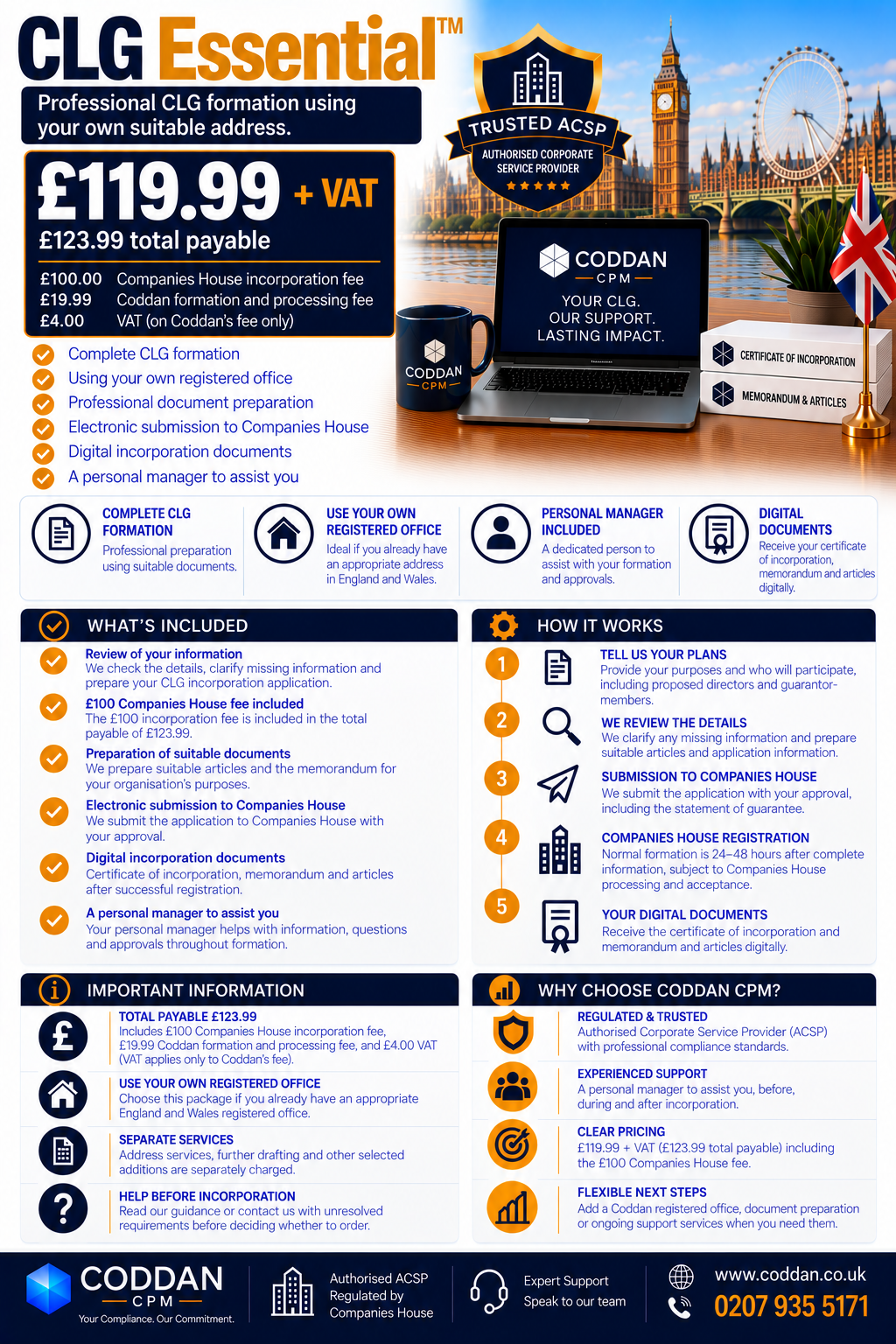
CLGEssential™ is £119.99 + VAT — £123.99 payable: £100 Companies House fee, £19.99 Coddan formation and processing fee and £4.00 VAT on Coddan’s fee only. Use your own suitable England and Wales registered office. CLG AddressPro™ is £159.99 + VAT with London EC3 for the first year. Digital incorporation documents are included; printed or combined materials follow the selected service.

03 · Easy to start

Order online, with someone to ask

Start online 24/7 with requirements and service choices together on Coddan’s single-page form. See what information is needed and ask if anything is unclear. Your personal manager helps with questions, documents and approvals during working hours. Coddan prepares and reviews the application before agreed submission; completing the order starts that work.

04 · Simple to arrange

Your London address and company arrangements

Bring formation and the London address services you need together. Coddan offers four London registered-office options and can explore other locations through provider relationships. The package-included EC3 address and separately priced alternatives have their own terms. Director service addresses and SAIL arrangements serve different purposes; our team helps you choose the relevant services and confirms their charges.

05 · Experienced formation support

Listed and authorised formation-agent support

Coddan CPM Limited has provided formation and business-support services since 2005 and appears on the Companies House formation-agent list. That experience supports the practical work behind your order: clarifying company information, preparing suitable documents, resolving questions and submitting the approved application through Companies House-integrated software. You have an experienced team and an assigned personal manager handling your formation.

06 · Separate provider roles

HMRC-supervised TCSP and registered ACSP

Coddan carries out AML customer checks as an HMRC-supervised trust or company service provider. Our separate Companies House ACSP role supports identity verification when separately instructed: we review evidence and manually submit confirmation, and Companies House issues your Personal Code. Tell us if you have already verified through an accepted route so we can coordinate the relevant information with formation.

Prompt formation, professionally handled. In our experience over 20 years, Companies House usually issues the certificate within a few hours after we submit a ready ordinary electronic incorporation application. Preparation and required checks come before that submission.

Your London formation and related services, through Coddan

Email your purpose, proposed participants, intended decision-making, existing rules or articles and relevant dates to info@coddan.co.uk before ordering. We explain suitable work and confirm its price; an enquiry does not commit you to an order. Describe your needs in ordinary language—you do not have to diagnose bespoke drafting.

Arrange formation alongside addresses, company records and later administration. Explore UK subsidiary formation and continuing support or company documents for use abroad where relevant. A written service agreement identifies your selected work, charges and service period. Use Coddan’s secure process for identity evidence and confidential codes.


Start Your Business Today: Fast Formation Services to Meet All Compliance Standards
£119.99
+VAT

“CLGEssential™”

Recommended for

1
package

Buy Now Professional CLG formation using your own suitable address. Choose CLGEssential™ when your club, association or other organisation needs incorporation and already has an appropriate England and Wales registered office. Tell us your purposes and who will participate. Coddan prepares suitable articles and application information, reviews the details with you and handles the approved submission to Companies House. Your personal manager helps with information, questions and approvals throughout formation. See your articles choices if you have particular purposes or documents already prepared.

Clear formation costs and useful company documents. The £119.99 price before VAT comprises the £100 Companies House fee and Coddan’s £19.99 formation and processing fee. VAT is £4.00 on Coddan’s fee only: £123.99 payable. Receive digital incorporation documents after registration. Choose this package for formation without a purchased address service; address services, further drafting and other selected additions are separately charged. Read about help before incorporation and documents and written service arrangements, or describe unresolved requirements to info@coddan.co.uk before deciding whether to order.


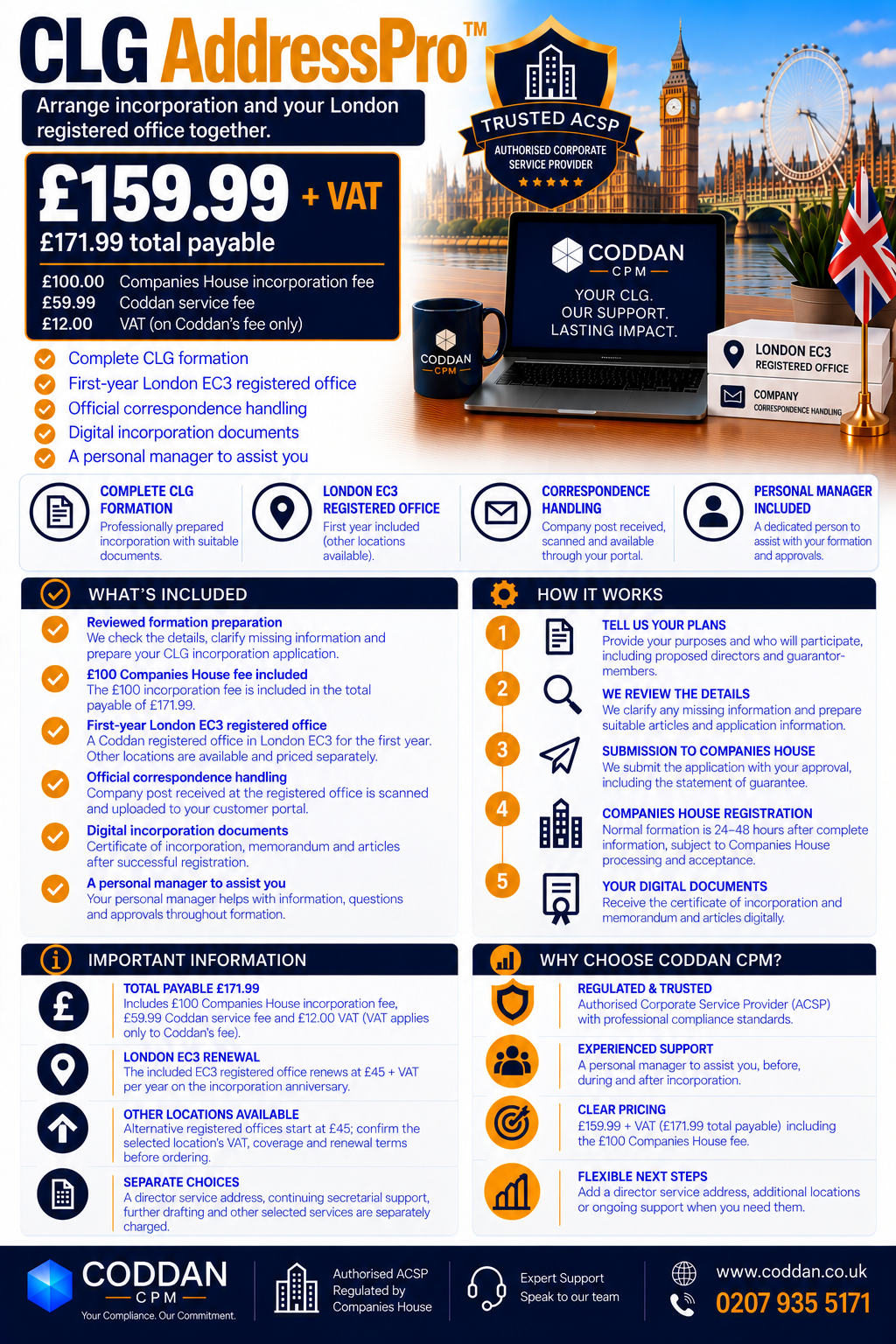
£159.99
+VAT

“CLG AddressPro™”

Recommended for

2
package

Buy Now Arrange incorporation and your London registered office together. CLG AddressPro™ suits organisations that want professional CLG formation with London EC3 as their registered office for the first year. Coddan prepares and reviews your application, resolves questions with you and submits it after approval. The address service receives covered company correspondence, with free scanning and uploading of agreed incoming post to your customer portal. Personal-manager assistance is included throughout formation. Compare London address choices and correspondence arrangements; alternatives are separately selected and priced, not all included in this package.

A first-year address service with clear ongoing costs. The £159.99 price before VAT comprises the £100 Companies House fee and Coddan’s £59.99 fee. VAT is £12.00 on Coddan’s fee only: £171.99 payable. Digital incorporation documents are included. The included EC3 registered office renews at £45 + VAT per year on the incorporation anniversary. Alternative registered-office upgrades start at £45; confirm the selected location’s VAT, coverage and renewal terms before ordering. Choose it for formation and an official London correspondence address. A director service address and continuing secretarial support are separate choices. See documents and service arrangements.


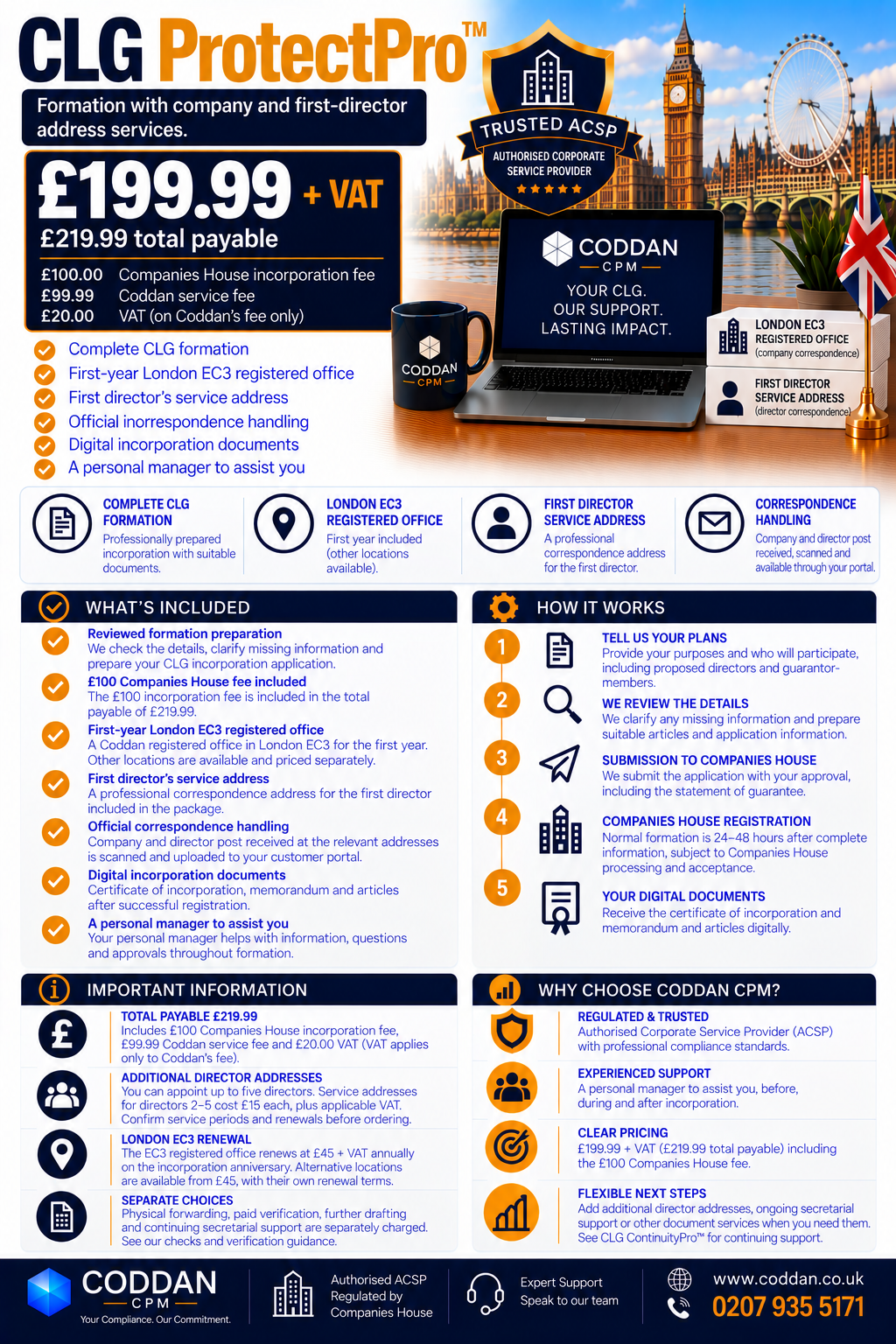
£199.99
+VAT

“CLG ProtectPro™”

Recommended for

3
package

Buy Now Formation with company and first-director address services. Choose CLG ProtectPro™ when you need a London EC3 registered office for the first year and a service address for your first director. Coddan prepares suitable formation documents, reviews the application with you and handles the approved submission. The selected address arrangements cover the relevant company and director correspondence. Your personal manager helps throughout formation. You can appoint up to five directors; the included director address covers one director only. See the different roles of registered-office and director addresses before selecting your services.

Additional address coverage, not a different standard of formation work. The £199.99 price before VAT comprises the £100 Companies House fee and Coddan’s £99.99 fee. VAT is £20.00 on Coddan’s fee only: £219.99 payable. Digital incorporation documents and covered post scanning are included. Service addresses for directors 2–5 cost an additional £15 each; confirm applicable VAT and director-address periods and renewals before ordering. The included EC3 registered office renews at £45 + VAT annually. Choose it for company and first-director address services together. See checks and verification; continuing support is available through CLG ContinuityPro™.


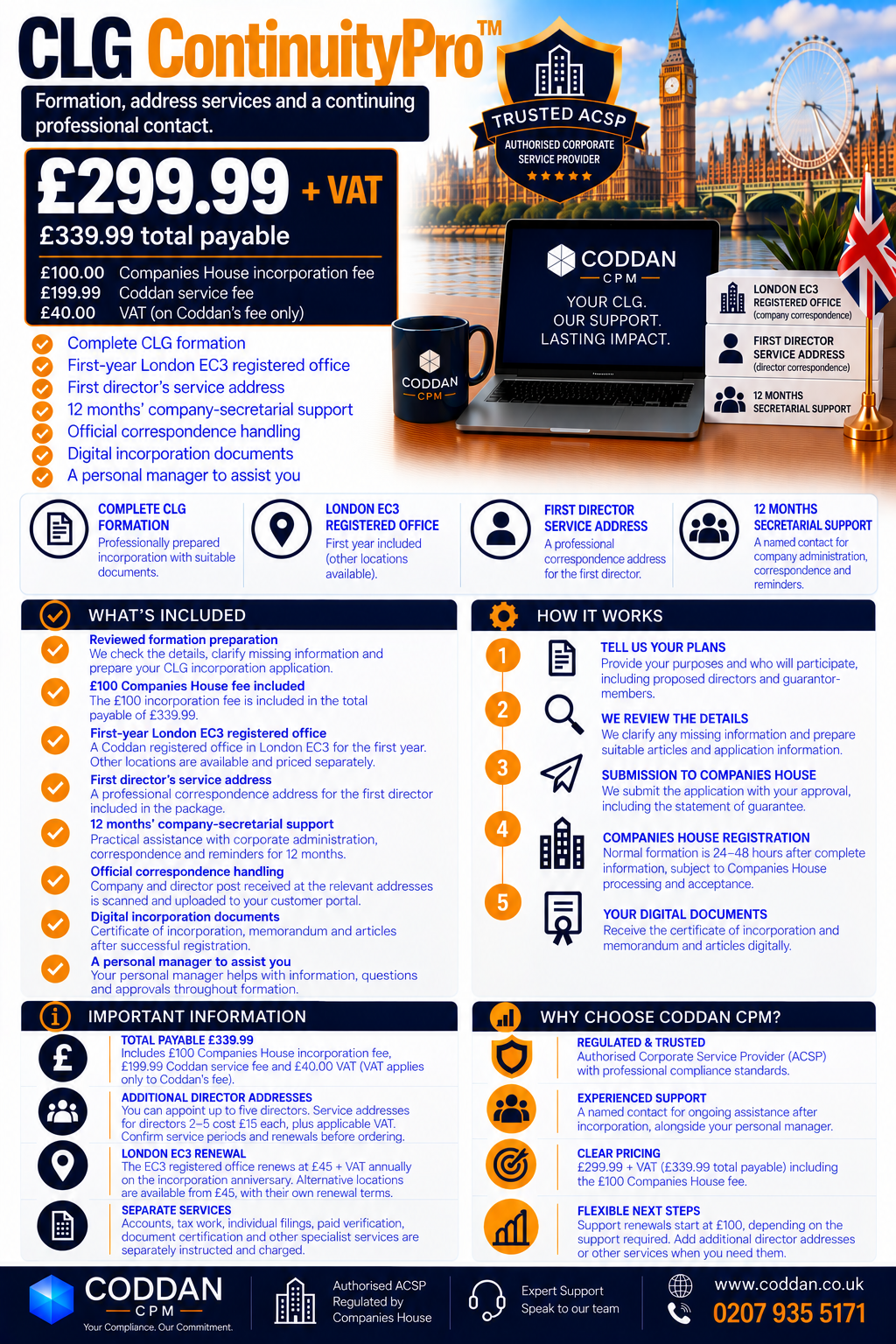
£299.99
+VAT

“CLG ContinuityPro™”

Recommended for

4
package

Buy Now Formation, address services and a continuing professional contact. CLG ContinuityPro™ combines professional CLG formation, first-year London EC3 registered-office service and the first director’s service address with 12 months’ continuing secretarial support. Coddan prepares, reviews and submits your approved formation application, then provides a named contact for agreed corporate-administration assistance, correspondence and reminders. Every formation order receives personal-manager assistance; this package adds support after incorporation. Read about continuing services and annual filings to distinguish practical support from separately ordered filing, accounts or tax work.

Understand the first-year price and later service choices. The £299.99 price before VAT comprises the £100 Companies House fee and Coddan’s £199.99 fee. VAT is £40.00 on Coddan’s fee only: £339.99 payable. Digital incorporation documents and covered post scanning are included. Support renewals start at £100, depending on the support required; confirm scope and VAT. EC3 registered-office renewal is £45 + VAT annually. Additional director addresses cost £15 each; confirm VAT, periods and renewals. Choose it for a continuing point of contact. Discuss overseas-parent arrangements or document certification separately; their additional work is not automatically included.


Non-profit structures explained

Company Limited by Guarantee Formation in the United Kingdom (UK)

Forming a company limited by guarantee can suit clubs, associations, membership organisations, residents’ bodies and other groups that need a separate legal identity without share capital. Coddan helps clarify your proposed purpose, membership, guarantee and governance arrangements, prepares suitable articles and application information, and obtains your approval before submission. You can use your own appropriate registered office in the relevant UK jurisdiction or ask about an available London address service. The guidance below explains the practical benefits, responsibilities and alternatives so you can decide whether a CLG fits your plans.

Choose the next step that suits you: compare the four packages, check a proposed name using the official Companies House service, or begin your application. If your governance arrangements or documents need discussion, contact Coddan before ordering.

The official name checker is a preliminary check, not a guarantee of registration or trade mark clearance. Companies House applies its naming rules when considering an application.

Since 2005: company-formation and business-support services Human review: agreed application checked before submission Identity verification: support from an ACSP where selected

What the Economic Crime and Corporate Transparency Act means for your CLG formation

The ECCTA introduced Companies House identity-verification requirements for relevant individuals, including directors and people with significant control (PSCs). For a new company, each individual director must complete the applicable verification process and provide their Companies House personal code as part of the incorporation filing. PSCs have separate requirements and deadlines, which depend on their circumstances and role.

Coddan is an ACSP and can assist with identity verification where that service is selected. Each individual must personally complete the required verification steps and supply their own evidence through the secure process. A personal code is linked to the individual, not the company; keep it secure and share it only with a trusted person or provider who needs it for an authorised filing.

Companies House identity verification is separate from Coddan’s anti-money-laundering customer due diligence. Using an ACSP does not transfer an individual’s legal responsibilities to Coddan, and it does not guarantee that Companies House will accept an application. Check the current Companies House identity-verification guidance and role-specific deadlines.

Choose a formation package or speak with Coddan first

Choose a CLG formation package

Already decided that a CLG suits your organisation? Compare the available packages for formation, documents, address services and continuing support. Select the services you need now.

Discuss your organisation before ordering

Tell us your purpose, participants, intended decisions and any relevant dates or existing documents. We explain suitable preparation and its price. You do not need to diagnose bespoke drafting; an enquiry does not commit you to order.

Compare Our Company Limited by Guarantee Formation Packages

The packages combine formation with different additional services. Use this summary to shortlist a package, then confirm the selected package’s inclusions, service periods, renewal charges and final amount in the itemised order summary. The figures below reproduce amounts currently stated in the page copy; they have not been independently matched to the live checkout. On wider screens, scroll horizontally using the bar beneath the table to view every package column.

Package comparison based on the information stated in this page
What to compare CLGEssential™ CLG AddressPro™ CLG ProtectPro™ CLG ContinuityPro™
Published base amount £119.99 before VAT £159.99 before VAT £199.99 before VAT £299.99 before VAT
Total currently shown in package description (verify at checkout) £123.99 currently shown; confirm the final amount in the itemised order summary. £171.99 currently shown; confirm the final amount in the itemised order summary. £219.99 currently shown; confirm the final amount in the itemised order summary. £339.99 currently shown; confirm the final amount in the itemised order summary.
Companies House incorporation fee The existing page states that each package includes the £100 Companies House incorporation fee. Confirm the final amount payable and applicable VAT in the itemised order summary before ordering.
Registered-office address The page describes this as intended for a company using its own suitable registered office. London EC3 registered-office service for the first year. London EC3 registered-office service for the first year; confirm the accepted package terms. First-year London EC3 registered-office service; confirm the applicable terms.
First director’s service address Confirm whether included. Confirm whether included. Included, according to the page; confirm the service period and renewal terms. Included, according to the page; confirm the service period and renewal terms.
Continuing company-secretarial support Confirm whether separately available and what it costs. Confirm whether separately available and what it costs. Confirm whether included or separately available, and check the service period. 12 months’ continuing secretarial support; confirm its scope and any renewal after the included period.
How to choose Consider if your organisation will use its own suitable registered office and needs the stated formation service. Consider if you want the stated first-year London EC3 registered-office service. Review the package details if a first director’s service address is important to you. Consider if you want the stated first-year London EC3 address and 12 months’ continuing secretarial support, subject to checking the package terms.
Next step View order options View order options View order options View order options

CLGEssential™

£119.99 before VAT

Total currently shown in package copy: £123.99. Confirm the final amount in the itemised order summary.

Companies House incorporation fee
The page states that the £100 incorporation fee is included. Check the final payable amount and VAT treatment in the itemised order summary.
Registered-office address
Described as intended for a company using its own suitable registered office.
First director’s service address
Confirm whether included in the package details.
Continuing company-secretarial support
Confirm whether separately available and the applicable price.
May suit
An organisation using its own suitable registered office and needing the stated formation service.

View order options

CLG AddressPro™

£159.99 before VAT

Total currently shown in package copy: £171.99. Confirm the final amount in the itemised order summary.

Companies House incorporation fee
The page states that the £100 incorporation fee is included. Check the final payable amount and VAT treatment in the itemised order summary.
Registered-office address
London EC3 registered-office service for the first year; confirm the current package terms.
First director’s service address
Confirm whether included in the package details.
Continuing company-secretarial support
Confirm whether separately available and the applicable price.
May suit
An organisation seeking the stated first-year London EC3 registered-office service.

View order options

CLG ProtectPro™

£199.99 before VAT

Total currently shown in package copy: £219.99. Confirm the final amount in the itemised order summary.

Companies House incorporation fee
The page states that the £100 incorporation fee is included. Check the final payable amount and VAT treatment in the itemised order summary.
Registered-office address
Confirm the registered-office arrangements in the package details.
First director’s service address
Stated as included; confirm the service period and renewal terms.
Continuing company-secretarial support
Confirm whether included or separately available, and check the service period.
May suit
An organisation for which a first director’s service address is important, subject to confirming package terms.

View order options

CLG ContinuityPro™

£299.99 before VAT

Total currently shown in package copy: £339.99. Confirm the final amount in the itemised order summary.

Companies House incorporation fee
The page states that the £100 incorporation fee is included. Check the final payable amount and VAT treatment in the itemised order summary.
Registered-office address
First-year London EC3 registered-office service; confirm the applicable terms.
First director’s service address
Stated as included; confirm the service period and renewal terms.
Continuing company-secretarial support
12 months’ continuing secretarial support; confirm its scope and any renewal after the included period.
May suit
An organisation seeking the stated first-year London EC3 address and 12 months’ continuing secretarial support, subject to checking package terms.

View order options

The “before VAT” figures are the published package base amounts and the page states that they include the £100 Companies House incorporation fee. The package descriptions currently show the totals above and state that VAT applies to Coddan’s service fee rather than the Companies House fee. These figures have not been independently reconciled against the live checkout in this amendment. Before payment, check the selected package, VAT calculation, included services, renewal terms and final amount in the itemised order summary.

Registered Office Renewal and Continuing Service Costs

A registered-office service supplied by Coddan is a continuing service, not a permanent inclusion unless the applicable terms expressly say so. If your selected package includes an address for an initial period and you want to continue using it afterwards, check the renewal date, current fee, renewal process and any applicable service conditions before that period ends.

The page identifies a first-year London EC3 registered-office service in CLG AddressPro. Confirm the current approved renewal price and terms in the package details or order summary. Other address locations are selected and priced separately. Incoming-post scanning and any Royal Mail forwarding may have different conditions or charges, so check what your selected address service covers.

You do not have to purchase Coddan’s address service simply because you form a CLG. The company must, however, maintain an appropriate registered office under the applicable rules. Director service addresses and continuing secretarial support are separate service questions; confirm their inclusions, duration, renewal terms and charges rather than assuming that all services continue automatically.

Review the formation packages and order details · Ask Coddan to confirm package and renewal terms

How the CLG formation process works

The process is straightforward when the organisation’s purpose, participants and governance arrangements are clear. Coddan helps identify the information needed, prepares the agreed formation documents and application, and submits the application after the relevant details have been reviewed and approved.

  1. Explain what your organisation will do and who will be involved.
  2. Choose a formation package and decide whether you need a registered-office address, a director’s service address or continuing support.
  3. Provide the required company, director, member or guarantor information and complete applicable identity and customer checks.
  4. Review the prepared details and approve the application for submission.
  5. Receive the incorporation documents after Companies House registers the company.

The time needed to prepare information and complete checks is separate from Companies House processing. Coddan can help coordinate the selected work, but cannot guarantee acceptance or the timing of the registrar’s decision. Further drafting, address services and continuing administration are included only where stated in the selected package or separately agreed.

Compare the four formation packages · Ask Coddan about your requirements

CLG formation: the essentials

A Company Limited by Guarantee may suit a club, association or membership organisation that needs a separate legal identity without share capital. It is not automatically a registered charity or tax-exempt organisation.

  • A private CLG generally needs at least one director and one guarantor-member; one person may hold both roles.
  • Prepare the proposed name, purpose, people, guarantee, governance arrangements and registered-office details.
  • Decide whether standard articles are suitable or whether your organisation needs separately agreed drafting.
  • Compare package inclusions, the total shown at checkout and any recurring address or support charges before ordering.

Use the package comparison to review the available services, or contact Coddan if your organisation’s arrangements need discussion.

In this guide

Use the contents below to move directly to the topic that matters most to your organisation.

  1. What a CLG is
  2. How it works
  3. Main advantages
  4. Limited liability
  5. Legal identity and credibility
  6. Membership and governance
  7. Funding and trading
  8. Who may benefit
  9. Main disadvantages
  10. Filing and compliance
  11. Costs and workload
  12. Public information and flexibility
  13. Profits and distributions
  14. CLG and charity status
  15. London registration considerations
  16. Compare legal structures
  17. When to choose a CLG
  18. Before registering
  19. Frequently asked questions
  20. Conclusion
  21. Formation through Coddan
  22. The essentials
  23. Articles and preparation choices
  24. Electronic service and portal
  25. Documents and completion
  26. Annual-service support
  27. UK subsidiary for an overseas non-profit
  28. Certified documents for use abroad

1. Introduction: Is a Company Limited by Guarantee Right for Your London Organisation?

Consider the commitments your organisation expects to take on: premises, employees, funding, assets and continuing membership. Those plans help determine whether a CLG’s separate identity and governance are useful, and what preparation and ongoing administration it needs.

If you already operate as a club, association or another organisation, tell Coddan about the existing constitution, participants and arrangements. Forming a new company does not itself move activities, assets, funds or contracts into it. Identify any approvals and separate transfer work before setting a changeover date.

Explain any arrangements that matter before choosing the formation service. Coddan can help with the relevant preparation without expecting you to know every company-law term. The comparison, articles choices and service details below support that decision.

2. What Is a Company Limited by Guarantee?

A Company Limited by Guarantee has guarantor-members instead of shareholders and share capital. Each member promises a stated contribution if the company is wound up in the circumstances covered by the guarantee. £1 is common, but the founders choose the amount and should explain it to prospective members.

Companies House incorporation creates a legal person separate from its members and directors. The company can hold assets, employ staff, operate a bank account, contract and bring or defend proceedings in its own name. A member does not own a divisible share of its assets merely by being a member.

Sports clubs, associations, residents’ organisations, trade bodies and charities use CLGs for different purposes. The articles should reflect the particular organisation. Funding eligibility and charitable or tax status depend on the relevant requirements, not the guarantee-company label.

A private CLG needs at least one member and one director; one person can hold both roles. Members exercise their company-law and constitutional rights, while directors manage the company and fulfil their statutory duties. Particular organisations may need a larger board or membership.

The articles govern admission and departure of members, meetings, voting and director appointments. Suitable established articles can serve a straightforward organisation. Particular membership, charitable, funding or decision-making arrangements may need additional provisions. Discuss the requirements before approving the documents.

Official guidance explains the distinction between companies limited by shares and companies limited by guarantee, including the need to identify guarantors and the amount guaranteed during registration. Read the GOV.UK guide to types of limited company and the guidance on choosing guarantors for a company limited by guarantee.

3. How Does a CLG Work in Practice?

Members, directors and company records make the structure work in practice. The articles allocate powers and procedures; company law and any applicable charity rules also govern how the organisation acts. Agree practical responsibilities before incorporation.

Members and guarantors

Members are individuals or eligible organisations admitted under the articles. Their rights may include voting, electing directors, approving constitutional changes and receiving company information. Any entitlement to income or surplus assets depends on the articles and applicable law. Non-profit provisions should state the intended restrictions clearly.

The guarantee is a winding-up commitment, not normally a joining subscription or a payment on incorporation. It does not make a member personally responsible for every company loan, lease or other debt. Record it separately from membership fees and other funding.

Directors and day-to-day management

Directors oversee operations within the powers assigned to them. Their duties include acting within their powers, exercising independent judgement and reasonable care, managing conflicts and declaring relevant interests. They must oversee finances, records and required filings. These duties apply to unpaid and volunteer directors too.

A private CLG need not appoint a company secretary, although one may be appointed or administrative support engaged. Agree the provider’s work and keep directors informed of decisions and filings; delegating administration does not transfer their legal duties.

The articles and company records

Choose rules suited to actual operations. Annual club elections, corporate membership, regional branches or disciplinary procedures can require different provisions. Resolve practical questions about quorum, voting, resignations and membership termination before they become disputes.

After incorporation, keep the register of members and appropriate accounting records, minutes, decisions and transaction records. The register of members must be available for inspection at tthe registered office or an appropriate single alternative inspection location (SAIL). Since 18 November 2025, separate local statutory registers of directors, their residential addresses, secretaries and PSCs are no longer required. Relevant officer and PSC information must still be supplied to Companies House and kept current. Charities have additional applicable records and reporting duties.

Agree who keeps records, monitors deadlines, authorises payments and manages conflicts. Clear responsibilities make the company easier to run and help new members and directors understand their roles.

4. The Main Advantages of a Company Limited by Guarantee

A CLG combines a separate company identity with membership-based governance. The main benefits below matter particularly where the organisation has continuing activities, contracts, assets or a changing membership.

Limited liability

Members' liability under the guarantee is normally limited to the amount they have agreed to contribute, rather than being unlimited simply because they are members.

Separate legal identity

The company can own assets, contract, employ staff and continue even when members or directors change.

Member-led governance

The articles can establish voting rights, elections and decision-making procedures appropriate to the organisation's purpose.

Operational continuity

The organisation can continue beyond its founders, with its assets and obligations remaining with the company.

For organisations with staff, leases or grant-funded projects, incorporation makes the contracting party and ownership of assets clearer. Members exercise membership rights; directors manage the company within its governing rules.

Discuss how income and remaining assets should be used before approving the articles. The profits and distributions guidance explains the relevant constitutional choices.

Banks, landlords, funders and suppliers may be familiar with company documents and public records. Check their evidence and eligibility requirements: they may need accounts, authority to act or details of people controlling the organisation as well as the incorporation certificate.

Weigh these benefits against the administration your organisation can sustain. A small informal group may need less formality, while a body with recurring contracts, staff or substantial assets may find incorporation useful. Discuss the preparation with Coddan before selecting a package if you are uncertain.

5. Advantage: Limited Liability and Financial Protection

Members’ liability under the guarantee is limited to the stated contribution in the relevant winding-up circumstances. The company remains responsible for its own debts. This can reduce the personal financial exposure associated with participating in an unincorporated organisation.

Illustration: a community arts CLG rents premises and buys equipment in its own name. If it later closes with unpaid debts, members do not normally fund the full shortfall merely because they are members. Their guarantee contributions, the company’s assets and applicable insolvency rules determine the relevant position.

Keep the company’s finances separate in practice: use appropriate banking, contracts, accounting records and payment approvals. This helps volunteers and members distinguish company commitments from personal ones.

What limited liability does not protect against

A director or member who signs a separate personal guarantee to a landlord, bank or supplier takes on an additional commitment. Check its amount, duration and enforcement conditions before signing; it is not limited by the company membership guarantee.

Directors can face personal consequences for misconduct, breaches of duty and certain insolvency-related actions. Membership limited liability does not protect an individual from liability arising separately from their own conduct.

New companies may be asked for deposits, security or personal guarantees. Consider those requirements when budgeting for premises or finance; incorporation does not establish a credit history.

Choosing the guarantee amount

The guarantee amount is not the company’s value, annual budget or borrowing limit. Choose and record it with an understanding of the winding-up commitment, keeping it distinct from subscriptions and other promised funding.

Explain the agreed guarantee to prospective members. Consider it alongside the articles’ provisions for closing the organisation and applying remaining assets, including any charitable restrictions.

Official guidance on the guarantee and guarantors is available from GOV.UK. Limited liability is a meaningful advantage, but it should be understood as a defined legal protection—not a substitute for prudent financial management, appropriate insurance, accurate records or responsible decision-making.

6. Advantage: Separate Legal Identity, Continuity and Credibility

The company can enter contracts in its own name through authorised representatives. This is useful for leases, employment, subscriptions, sponsorship and grant agreements that should belong to the organisation rather than an individual founder.

Record equipment and property interests belonging to the company as company assets. Clear ownership supports accounting, continuity and decisions about assets when people leave or the organisation closes.

Continuity beyond the founders

The company can continue when founders, members or directors change. Its contracts, assets and records remain with it, supporting orderly succession rather than tying the organisation’s affairs to one volunteer.

Maintain an effective board, current records and a handover when responsibilities change. Those arrangements make the legal continuity useful in day-to-day operations.

Credibility and counterparties

A company number, governing documents and filing history help counterparties identify the organisation and who acts for it. These records can support grant, banking and commercial applications.

Counterparties may also ask for accounts, policies, safeguarding arrangements, insurance or references. Prepare the evidence relevant to the proposed relationship; incorporation is one part of that picture.

Keep public details accurate and internal records secure. The public register helps others check the company, while appropriate address arrangements can keep a home address separate from public correspondence details.

If your group needs a company for continuing commitments, describe those plans to Coddan. We can explain the formation work and suitable service before you order.

7. Advantage: Membership, Governance and Collective Control

Membership lets people participate without buying shares. The articles can define eligibility, voting and leadership selection around a shared profession, interest, service or community purpose.

Explain any proposed membership classes, corporate members, branches or disciplinary rules. Voting and director-appointment rights can affect control, so agree their practical operation before the application is prepared.

Distinguish member decisions from board decisions. Members may elect directors and approve constitutional changes, while directors manage operations. Choose a workable balance between participation, oversight and timely decisions.

Clear meeting, quorum, voting and conflict procedures help everyone understand decisions. Written rules also make it easier for new volunteers to take responsibility without relying on founders’ recollections.

Plan for resignations, inactive members, contested elections and deadlock. Clear rules reduce uncertainty when views differ. Charitable governance must also serve the charity’s purposes and applicable requirements.

Choose membership-based governance because it fits the organisation. If share ownership or an equity return is needed, compare the share-company route in the structure table.

8. Advantage: Grants, Donations, Sponsorship and Trading Income

A CLG can receive subscriptions, donations, grants, sponsorship and trading income in its own name. Generating income is compatible with non-profit objectives; the rules determine how resources are used and whether distributions are permitted.

The company can hold funding agreements and maintain accounts for the money received. Check whether the funder requires incorporation, particular constitutional provisions, financial controls or insurance.

Check the actual grant criteria before choosing the structure. Eligibility may depend on charity status, geography, project outcomes or restrictions on distributions—not incorporation alone.

Donations and charitable tax relief

If charitable donations are planned, consider eligibility for charitable status and HMRC recognition. Gift Aid is available only for qualifying bodies and donations under its conditions; ordinary CLG incorporation does not confer it.

Charity registration and tax recognition are distinct. For example, the tax authority's recognition process is relevant to claiming certain tax reliefs, but it does not replace any charity registration required by the relevant regulator. Official information is available in the GOV.UK overview of charities and tax and the guidance on getting charity recognition from HMRC.

Trading and earned income

The company can sell goods, provide services or run paid events consistent with its purposes and applicable rules. Plan the relevant contracts, insurance, tax and sector requirements alongside the activity.

Assess the income and activity separately for tax. Charitable relief has conditions; a non-charitable company should use the rules relevant to its own circumstances.

Keep different income streams and any restrictions clearly recorded. Apply grants and donations to their permitted purposes, with accounts showing how funds were used.

9. Which Organisations Can Benefit from a CLG?

These examples show where a CLG may be useful. Explain your intended activities and participants to Coddan so the formation preparation reflects the actual organisation.

Clubs and associations

A club collecting subscriptions, hiring facilities or owning equipment may want company contracts, continuity and clear membership rules. Suitable established articles can provide a straightforward starting point.

Professional and membership bodies

A professional or trade body may need membership categories, voting, standards and disciplinary procedures. Describe those arrangements so suitable articles and any further rules can be identified.

Community and social-purpose projects

A community project managing premises, staff or services may benefit from incorporation. If a statutory community-interest framework and asset lock are wanted, compare a CIC, which can be limited by guarantee or shares.

Charitable organisations

A charitable organisation can use a CLG, with suitable charitable articles and relevant registrations. In England and Wales, compare a CIO if an incorporated charitable form is preferred. Scotland has the separate SCIO route.

Examples of London organisations that may consider a CLG

London clubs, cultural groups, professional networks and residents’ bodies may need a company to hire premises, employ staff or hold funds. Tell Coddan about the proposed activities and any existing rules or property documents so preparation reflects the organisation you intend to run.

Illustrations: a volunteer association hiring venues may want the company to contract in its own name; a borough-wide membership body may need clear admission and voting rules; a residents’ organisation may need its lease or transfer documents considered before choosing the structure. These are different preparation needs, not automatic reasons to commission bespoke articles.

Check any important funder’s criteria for legal form, governing documents and charity status before choosing the company route. A London address is not a substitute for meeting those requirements.

When a CLG may not be the right fit

Compare a share company where equity investment or shareholder dividends are needed. A small informal group may prefer an association; an eligible charity may prefer a CIO or SCIO. Use the detailed structure comparison before deciding.

Consider likely development: staffing, leases, assets and funding can make incorporation useful earlier. A temporary project may need less formality. Choose preparation proportionate to the plans rather than assuming every particular requirement needs bespoke drafting.

10. The Main Disadvantages of a Company Limited by Guarantee

A CLG needs continuing administration, even with little income or activity. Weigh the following commitments against the benefits and decide who will handle them.

Recurring administration

Accounts, confirmation statements, records and changes must be handled even when the company has limited activity.

Ongoing costs

Accounting, filing support, registered-office services and bespoke drafting may create costs beyond initial incorporation.

Public information

Some company information and documents are available for inspection on the public register.

No equity shares

A conventional share-based investment model and shareholder dividends are not built into the structure.

Settle membership, voting and director arrangements before approval. Later constitutional changes can require formal decisions and filings. The articles choices and preparation guidance explain how Coddan helps at the outset.

A CLG cannot offer share-based investment. Payment for genuine work is a different issue, explained in the income and distributions section. Check funder conditions before treating incorporation as a funding solution.

Lawful registered-office and service-address choices can separate home and public correspondence addresses. They do not remove the information company law requires to be disclosed.

Maintain realistic budgets, appropriate insurance and clear payment authority alongside the company structure. Ask for administrative help with tasks the organisation wants Coddan to handle.

11. Disadvantage: Companies House Filing and Ongoing Compliance

Keep the company’s filing record and relevant deadlines under review. Agree who handles each task and what assistance is needed; use current official guidance when requirements change.

A confirmation statement reviews relevant Companies House information. The first review period normally ends 12 months after incorporation, with filing due within the next 14 days. File even if nothing changed and confirm that intended future activities are lawful. Some changes need separate filings. A private company’s first accounts are generally due 21 months after incorporation; subsequent annual accounts are normally due nine months after the accounting reference date. Keep these dates separate from HMRC tax deadlines.

Keep records explaining subscriptions, donations, grants, trading, spending, payroll, assets and liabilities. Record payment authority and restrictions attached to funds so accounts preparation reflects the actual activity.

Record decisions and report relevant changes involving directors, addresses, membership, control and articles through the appropriate routes. Some changes have their own deadlines and cannot wait for the annual confirmation statement.

People with significant control and identity requirements

Identify and report people with significant control (PSC) from actual voting, director-appointment and other control arrangements. A CLG can have PSCs despite having no shares. Each relevant individual’s identity and code-submission requirements depend on their role. Read the current identity-verification guidance.

Coddan CPM Limited has provided company-formation and business-support services since 2005. We prepare and check the application, clarify outstanding information, obtain your approval and handle the agreed submission. As an HMRC-supervised trust or company service provider, we also carry out anti-money-laundering customer due diligence. These customer checks are separate from Companies House identity verification.

Where selected, Coddan’s ACSP service can assist an individual with Companies House identity verification. The individual must complete the required steps and provide their own evidence through the secure process. Following successful verification, the individual receives a Companies House personal code. Direct verification through the official Companies House service is also available. You do not need to purchase Coddan’s verification service solely to order a formation package if the relevant individuals have already verified through an accepted route.

For a new incorporation, each individual director must meet the applicable identity-verification requirement and provide their personal code in the incorporation filing. Existing directors use the relevant confirmation-statement process. A person with significant control has a separate code-submission requirement and deadline; where one individual is both a director and a PSC, the requirements apply separately to each role. Being a guarantor-member alone does not automatically make someone subject to director or PSC verification requirements.

Requirements and deadlines depend on the person’s role and circumstances. Check the current identity-verification timetable and Personal Code guidance. Coddan can explain the service it is able to provide, but each individual remains responsible for meeting their legal requirements and Companies House decides whether to accept the filing.

Late or inaccurate filings can lead to penalties or enforcement and create problems with banking, contracts or funding. Address an overdue filing or Companies House query promptly; Coddan can explain the relevant service.

Keep access to the company’s records and agree who handles each deadline, approval and submission. Coddan can undertake the work you instruct while the directors retain responsibility for company decisions. Refer to the official confirmation-statement guidance and director responsibilities when planning the annual work.

Prepare and file your annual confirmation statement

Coddan reviews the relevant company information with you, identifies discrepancies or changes needing separate attention, prepares the statement and obtains your confirmation before agreed submission. Tell us what has changed rather than waiting for the annual review. Choose a one-off instruction or the available continuing service. Explore CLG confirmation-statement support.

Prepare and file your annual accounts

Coddan can prepare suitable dormant or active-company accounts, obtain directors’ approval and handle the agreed submission. Provide the relevant financial records so we can confirm the appropriate service. Filing accounts already prepared by your accountant is a separate instruction. HMRC tax work and charity-regulator reporting have their own scope. Discuss accounts preparation and filing.

Annual work is not automatically included with formation. Confirm the accounting period, records, approvals, service price and official fees when instructing the work. Explore continuing CLG support when the company needs it.

12. Disadvantage: Formation Costs, Administration and Governance Workload

Budget for formation and the work of running the organisation: records, accounts, filings, insurance, banking and relevant sector requirements. Directors or volunteers can handle suitable tasks; choose professional support where useful.

Affordable formation gives you suitable preparation, clear inclusions and personal-manager assistance. Established articles can suit straightforward requirements; we explain any further work needed for particular membership, voting or board arrangements. Compare the formation packages and ask Coddan to confirm anything outside the selected service before ordering.

Budget separately for the services you select after incorporation, such as accounts, confirmation statements, addresses or company changes. Check the first service period, renewal price and renewal basis before ordering. Continuing support can be useful, but you do not have to buy every possible service at formation.

The time commitment

Allow time for directors to review finances, make decisions and manage risks, and for members to receive notices and voting information. Charity-specific administration can add to this work. Allocate tasks realistically.

Keep shared records, payment approvals and a practical handover so administration does not depend on one person. If a provider helps, agree what it handles and what remains with the organisation.

Ongoing cost versus value

Compare recurring costs with the benefits of company contracts, assets and continuity. A simple association may suit a small group; incorporation can be worthwhile where continuing commitments justify it.

If founders already hold contracts or assets personally, review those arrangements before choosing a formation date. Establishing a company and transferring existing activity are separate pieces of work.

Prepare a first-year budget and identify who will keep the records and manage later dates. This makes the ongoing commitment visible before you order.

13. Disadvantage: Public Information, Accountability and Limited Flexibility

Companies House publishes company information and filed documents. This helps others check the organisation’s identity and history, but means some company and officer information is public.

Directors’ names and service addresses are generally public. Choose an appropriate registered office and service addresses, while supplying the private information Companies House requires. Public-address choices do not remove every disclosure requirement.

Filed accounts create a public financial record, with the detail depending on the reporting category and current rules. Keep sensitive donor, member and commercial information separate from material that must be filed.

Accountability is part of the bargain

Members need understandable information about funds and decisions. Clear articles, records and reporting help directors exercise authority and members use their rights appropriately.

Changes to purposes or governance may require decisions, filings or consent under charity rules, grants, leases or contracts. Tell Coddan what is changing so the appropriate company work can be identified.

Design for practical flexibility

Set practical admission, voting, appointment and amendment rules. Clear provisions should support normal operations without requiring every detail to be renegotiated as membership changes.

An articles amendment is not the same as changing legal form or obtaining charitable status. A restructuring may require new registrations or transfers, with charity or contractual consents where relevant.

Consider the required transparency before incorporation. Discuss lawful address options if privacy matters, and use the structure comparison to assess the wider trade-offs.

14. Can a CLG Make a Profit? Rules on Income, Surpluses and Distributions

Yes. A CLG can generate a surplus from lawful activities and retain reserves for future costs and projects. “Non-profit” does not mean it must break even each year.

Earning a surplus differs from distributing it. The articles, company’s status and applicable law govern distributions to members; no share capital does not itself establish every non-profit restriction.

Paying people for genuine work

The company can pay for genuine work where lawful and authorised. Check the articles, tax treatment and conflicts before approving payments to directors or members. Charities have additional trustee-benefit restrictions.

Record the work, payment terms, approval and relevant conflicts. Retain contracts, invoices and minutes, with independent approval where required.

Reserves, restricted funds and assets

Distinguish unrestricted reserves from grants, donations or contract receipts restricted to particular uses. Financial records should show the conditions and how the money is spent.

Check the destination of remaining assets on closure against the articles, funding conditions and any charity restrictions. The correct arrangement depends on the company’s purposes and status.

Tax is a separate question

Assess Corporation Tax, VAT and payroll responsibilities against actual activity. Charitable relief can apply where its conditions are met; a non-profit objective alone does not establish tax exemption.

Before trading, fundraising or paying people, identify the relevant tax work and obtain appropriate assistance. Keep the constitution and financial arrangements consistent with the organisation’s purposes.

15. CLG vs Registered Charity: Understanding the Difference

A CLG is a company structure; charitable status depends on purposes, public benefit and the relevant legal framework. A CLG can operate on a non-charitable, non-profit basis or serve as a charitable company.

Identify the intended charitable purposes and public benefit, then check the jurisdiction. England and Wales, Scotland and Northern Ireland have different charity regulators and registration arrangements.

A charitable company in England and Wales must register with the Charity Commission when required, as well as meeting its Companies House obligations. Scottish charitable companies and SCIOs follow their relevant Scottish routes; Northern Ireland charities follow its separate regime.

Charity status can support particular funding and tax reliefs, alongside duties concerning resources, trustee benefits, records and regulator reporting. Choose it because the organisation is genuinely charitable, not simply to access a grant.

HMRC recognition establishes eligibility for relevant charitable tax reliefs. It does not replace charity-regulator registration; check Gift Aid and other relief conditions against actual activities.

A community or professional purpose need not be charitable. A membership association or CIC may fit where the charity tests do not. Compare who benefits, how funds are used and which regulatory framework is appropriate.

Tell Coddan who benefits, what the organisation will do and whether charitable registration is intended. This helps identify suitable articles and the relevant formation or specialist route.

16. CLG vs Other Legal Structures: Which Is Best for Your Organisation?

Compare legal personality, liability, membership, regulation and likely use. Choose against the organisation’s actual plans, then discuss the preparation needed.

StructureLegal identity and liabilityOwnership or membershipCharity and regulationOften considered for
Company Limited by GuaranteeSeparate legal entity; guarantor-members' liability is generally limited to the guarantee amount, subject to law and circumstances.Members rather than shareholders; no share capital.Companies House obligations; charity registration may also be required if the organisation is charitable.Membership organisations, clubs, associations and some charitable companies.
Company limited by sharesSeparate legal entity; shareholder liability is generally linked to unpaid amounts on shares, subject to law and circumstances.Shareholders own shares and may have rights to dividends and voting according to the share rights.Companies House obligations; usually suited to a commercial ownership model rather than a member-based non-profit model.Businesses expecting share investment, shareholder ownership or dividend distributions.
Charitable Incorporated Organisation (CIO)Separate incorporated charitable form in England and Wales; members' liability depends on the CIO model and constitution.May be a foundation model or association model, with different membership arrangements.Registered and regulated by the Charity Commission in England and Wales; not a Companies House company. Scotland has the separate SCIO model.Organisations that qualify as charities and want an incorporated charitable form.
Community Interest Company (CIC)Separate company form with limited liability; subject to specific community-interest requirements.Can be limited by guarantee or by shares, depending on the model selected.Has a community-interest test and asset-lock regime; it is not itself a registered charity.Social enterprises designed to benefit a community and operate within CIC rules.
Unincorporated associationGenerally not a separate legal person; individuals acting for the group may have personal exposure depending on the circumstances.Members operate under an agreed constitution or rules.No Companies House incorporation; separate charity or tax rules may still apply if the organisation meets relevant tests.Smaller, informal groups with limited assets and activities, where incorporation may not yet be necessary.

London registration considerations: address, jurisdiction and public information

London is an address choice within England and Wales, not a separate incorporation jurisdiction. If you choose a London registered office, the company must be registered in England and Wales. The address must be an appropriate physical location where documents reach someone acting for the company and delivery can be acknowledged. Obtain permission to use a third-party address and confirm its correspondence coverage. Your own suitable address remains an option.

Tthe registered office is public; a suitable professional address can keep a home separate from that official correspondence address. A director’s service address receives that individual’s official correspondence; Companies House also requires residential information under separate privacy rules. ProtectPro and ContinuityPro include the first director’s service address; additional directors’ addresses are separately selected. Confirm the director-address service period and renewal terms. A separately arranged SAIL is an inspection location for applicable company records, not a substitute for either correspondence address. Check its suitability for the company’s jurisdiction. Read the official registered-office and email-address requirements.

Coddan currently offers four London registered-office options. Arrange formation and a suitable official correspondence address through one provider, with the exact location, permitted use, first service period, charges and renewal terms confirmed for your choice. If you need another location, Coddan can explore options through its virtual-office provider relationships. Additional locations require individual confirmation; not every address is operated directly by Coddan or includes workspace, meeting facilities or trading-premises rights.

The entry package uses your own appropriate address. CLG AddressPro includes London EC3 for the first year; check the current approved renewal fee, renewal date and process in the applicable package terms. Other locations are separately selected and priced. Covered incoming post is scanned and uploaded free to the client portal under the selected service; weekly Royal Mail forwarding is separately arranged, with destination, charges and coverage confirmed. Explore London registered-office choices and correspondence services, choose a formation package or ask for an alternative-address quotation.

A London charitable company follows the England and Wales charity framework where applicable. Its purposes and public benefit determine the relevant requirements. Check when it must register with the Charity Commission.

If your address or support needs change, ask Coddan about the replacement arrangements, any required filings and changing or ending the selected service. Confirm the applicable service period and renewal arrangements before making the change.

How to interpret the comparison

Choose a CLG for a member-based company without shares, or a share company where equity ownership and investment are needed. Eligible charities in England and Wales can consider a CIO; Scottish charities can consider a SCIO.

A CIC offers a community-interest framework and statutory asset lock. An unincorporated association offers simpler organisation without a separate legal person. Consider contracts, employment and assets when weighing those alternatives.

Explain purpose, control, funding and intended asset use before deciding. Coddan can help clarify the formation requirements and suitable services; seek specialist advice where the underlying arrangements require it.

17. When Should You Choose a CLG—and When Should You Avoid It?

Use these questions to decide whether the structure fits your activities and capacity. Membership, financial commitments and the ability to maintain company records matter more than a general non-profit label.

A CLG may be appropriate if…

  • The organisation needs to own assets or enter contracts in its own name.
  • Members should have defined voting or governance rights.
  • The organisation expects to employ staff, manage funds or operate on a continuing basis.
  • The founders want limited liability for members under a guarantee model.
  • There is sufficient capacity to maintain records and complete filings.

Consider another option if…

  • The founders need share-based investment or shareholder dividends.
  • The group is very small, temporary and has little financial or contractual exposure.
  • The organisation needs a charitable form better served by a CIO or SCIO.
  • A CIC's community-interest framework better reflects the intended model.
  • You are unwilling or unable to manage ongoing company obligations.

If members will elect leadership and shape the organisation, a CLG can provide a suitable framework. If shareholders and economic ownership are needed, compare a share company. Charitable plans need their own structural assessment.

Review leases, employment, funding and assets alongside any deposits or personal guarantees. Those commitments help determine the practical value of incorporating and the risk management still needed.

Identify who keeps accounts, monitors filing dates, prepares minutes and maintains the membership register. Agree how someone else takes over if that person leaves.

Choose arrangements that serve present needs and realistic development. Describe particular requirements to Coddan before ordering; suitable established articles remain a valid route for straightforward organisations.

18. Help with setting up your organisation before incorporation

Tell us the proposed name and purposes, who will take part, the membership and guarantee arrangements, voting and director-appointment rights, relevant control information and addresses. Include existing documents and any dates that matter. Your personal manager helps clarify unresolved points; Coddan prepares suitable information and documents, reviews them with you, resolves questions and obtains your approval before agreed submission. You decide how the organisation should operate; Coddan handles the agreed formation preparation.

1. Define the organisation's purpose

Describe objectives, activities and who benefits. Tell us about intended charity status or funder conditions before the articles are prepared. Coddan helps turn the supplied purposes into suitable company information and documents.

2. Decide who the members will be

Give the initial members and guarantee amount, then explain admission, departure, membership categories and voting. We help clarify how those arrangements should appear in the formation information and articles.

3. Choose directors and clarify responsibilities

Choose directors and explain appointment rights, responsibilities and conflicts. Agree who oversees finances and records. These arrangements help establish the board and identify any people with significant control.

4. Choose how your company’s articles are prepared

Choose preparation that fits the organisation and work already done. Illustration: a new London club may use suitable established articles, while an existing association may bring its constitution and proposed membership rules for discussion. Particular voting, funding or board arrangements should be explained before the application is approved.

  • Suitable established Coddan articles: use an appropriate existing version for the proposed CLG.
  • Your purposes in Coddan’s articles: explain what the company will do for inclusion in our suitable version.
  • Customer-prepared articles: You can email your or your adviser’s articles to info@coddan.co.uk before ordering to discuss their use. We confirm the preparation, review scope, price and document-submission route for your order. For the standard formation order, the current form directs you to email prepared articles to orders@coddan.co.uk after completing it. Confirm any document-handling charge before ordering.
  • Particular requirements: describe membership classes, voting, director appointments or other rules; further customisation or drafting is separately agreed.

For more detail, see efficient CLG formation: preparation and articles choices. Overseas participation alone does not establish a need for bespoke drafting or an additional charge. The memorandum uses its prescribed form; purposes and governance provisions belong in the articles. For suitable new CLGs seeking exemption from “Limited”, Coddan uses its special articles. Explore formation without the “Limited” suffix.

5. Arrange addresses, checks and initial records

Choose your own appropriate England and Wales registered office or ask Coddan to arrange a London service. Provide a registered email address reaching someone acting for the company, and distinguish directors’ residential details from public service addresses. Explain voting and director-appointment rights so we can identify actual control and coordinate the relevant identity information and separate AML customer checks. The London address explanation sets out the location, correspondence and service choices.

Discuss initial decisions, the register of members, record custody and who can act for the company. Coddan can prepare appropriate minutes, records and membership documents for the work you request. See how the documents support your company’s working arrangements.

6. Check funding and tax assumptions

Tell us about intended income and funding conditions, including any required charity status or asset restrictions. Identify relevant tax-registration and accounts work separately from incorporation.

7. Plan your first year and later support

Agree who will keep financial records, authorise spending, maintain membership information and monitor filing dates. Keep formation assistance separate from continuing accounts, address and secretarial services. If requirements change, tell Coddan what you need, including changing or ending an address or support service; we explain the work and arrangements applying to your service.

Pre-registration checklist

  • The organisation's purposes and activities are clearly defined.
  • The members, guarantee amount and voting arrangements have been considered.
  • Directors understand their roles and are willing to take responsibility.
  • The articles match the intended membership and governance model.
  • The need for charity or other regulatory status has been assessed.
  • Tthe registered office and record-keeping arrangements are planned.
  • The organisation has a realistic budget and a plan for recurring compliance.

Official guidance explains the documents required to form a company. Coddan prepares the incorporation application from your information and suitable company documents, obtains approval and handles the agreed submission.

Three preparation routes: how much time to allow

These estimates concern gathering information and preparing documents before incorporation submission. Allow typically 1–2 hours for details and objectives using suitable established articles; 2–3 hours for details and supplying prepared articles; or several days where tailored articles need drafting, discussion and approval. They are not promised review deadlines or Companies House processing times.

With the information ready, a straightforward online order normally takes around 10–15 minutes. Completing it starts the formation work; it does not itself submit the application to Companies House. Preparation, checks, customer approval, agreed submission and official processing are separate stages of the service, not compulsory checkout screens.

Quality preparation for your organisation

Your proposed activities, membership and director arrangements guide preparation of the articles and application. Coddan helps clarify the details and prepares suitable information for approval, whether the formation is straightforward or involves particular rules. Choose the preparation route suited to your organisation.

Quality review, documents and completion

Coddan reviews the application and supporting information, resolves relevant questions and obtains the necessary approval before submission. The agreed documents then help you retain evidence of incorporation and put company records into use. Your manager explains remaining actions and where to obtain help. See your documents and completion arrangements.

Electronic formation with personal assistance

Electronic incorporation, professionally prepared

Provide the proposed company information through Coddan’s single-page order form. Our team prepares and reviews the electronic application using your details and company documents. After the necessary checks and your approval, we submit it through Companies House-integrated software. You do not need to complete a separate paper IN01 for this route.

Electronic documents after incorporation

CLGEssential supplies the electronic certificate, memorandum and articles after incorporation. Keep them accessible for company administration and requests from banks or other recipients. Professionally prepared printed or combined materials can be arranged through the appropriate service. Certification or international authentication depends on the recipient’s requirements.

Your formation portal, available 24/7

Start your order and provide company information when convenient, including from overseas. Coddan’s single-page form lets you see the requirements and service choices together before submitting. Online availability is distinct from staff working hours and Companies House processing.

Your portal and personal-manager assistance

Your online order brings your company details and selected services together. Where you choose an address service providing scanned-post access, the Dedicated Manager Portal lets you view that correspondence. Your personal manager helps with formation questions, document arrangements and next steps by phone or email during working hours.

Convenient formation, with help when you need it.

Start around your schedule and arrange the formation, documents and London address services your organisation needs together. Your personal manager helps settle questions and coordinate the selected work before submission. You can ask for help before ordering and as formation progresses.

Preparation, submission and incorporation timing

In our experience over 20 years, Companies House usually issues the certificate within a few hours after Coddan submits a ready ordinary electronic application. Our standard-route allowance is 24–48 hours from submitting complete, straightforward information through the portal to incorporation, allowing for review and Companies House workload. Preparation, drafting, checks, questions and customer approval must be completed before submission. Use the formation overview to compare the work and services.

For urgent incorporation, ask about the separately charged same-day service before ordering. The published route requires an order before 11:30 a.m. London time on a working day, with the application information and relevant identity steps ready. See efficient online CLG formation and same-day options for eligibility, readiness and the quotation route. Northern Ireland formations can take longer: in our experience, Companies House may check the registered-office details and request confirmation or a third-party no-objection letter.

A new-company “Limited” exemption needs its own preparation and application route, with timing confirmed for that service. The company exists when Companies House registers it and issues its certificate.

Your documents and next steps after incorporation

Keep the included digital certificate confirming the company’s existence, the prescribed memorandum recording the initial members’ agreement and the articles governing how it operates. Initial minutes, company records and guarantor membership certificates can help record decisions and membership where separately selected or expressly included. Coddan can prepare printed or combined materials through the agreed document service; printing and authentication are not automatically included with formation.

Check what has been supplied and ask your manager about any remaining information or approval. Put the register of members and financial records in place, record initial decisions, confirm who can act for the company and note the relevant filing dates. Incorporation does not transfer existing funds, assets or contracts. For overseas recipient requirements, see company-document certification and legalisation.

A written service agreement, customer-specific engagement letter and service schedule are available for your selected work, named contact, charges and service period. Ask your manager for the arrangement suited to your instruction, including first periods, renewals and later service changes.

Send your plans before ordering

Email info@coddan.co.uk with the purpose, participants, intended decision-making, existing rules or prepared articles and relevant dates. For an established organisation, describe its present arrangements and anything that needs to move to the new company. Coddan explains suitable work and confirms its charges before you decide whether to order. An enquiry creates no obligation to order.

Use the secure process we provide for identity evidence and confidential codes. You can describe your needs in ordinary language without deciding for yourself whether they require bespoke drafting.

Form a London subsidiary for your overseas non-profit organisation

Does your overseas non-profit company need a separate UK organisation for its activities? Coddan can help establish an England and Wales company limited by guarantee with a suitable London registered office, and arrange professional company-secretarial support after incorporation. Your overseas company can participate as a corporate guarantor-member where eligible. A CLG has no shares: a subsidiary relationship depends on the actual voting, director-appointment or other qualifying control arrangements, rather than the parent’s name alone.

Send us the parent’s registration details and governing documents, its intended UK activities, proposed directors and how it should control or participate in the new company. We clarify membership, guarantees, appointment rights, relevant control information and authority to act, prepare suitable articles and application information, and submit the approved application after the required checks. We confirm the formation work, London address choice and charges before you decide whether to order.

Once the company is registered, Coddan can provide separately agreed continuing support with its register of members, minutes and resolutions, company changes, confirmation statements and other corporate administration. We prepare the agreed work, obtain the relevant customer or director approval and handle instructed submissions. Formation assistance comes with every order; continuing work follows the selected support service, period and renewal arrangements.

Incorporation creates a separate UK company. It does not transfer the parent’s activities, assets or contracts, or extend foreign charitable or tax status to the new company. Tell us about any intended UK charitable status and relevant parent approvals before preparation.

Explore continuing CLG company-secretarial services or discuss your overseas organisation’s UK subsidiary. An enquiry creates no obligation to order.

Company documents for use abroad: certification, notarisation and legalisation

Need to show your London CLG’s documents to its overseas parent, a bank, regulator or another recipient? Coddan can help obtain the appropriate company documents and arrange the certification or legalisation required for their intended use. The service can cover official certified Companies House documents, notarial certification, an apostille from the Foreign, Commonwealth and Development Office (FCDO), foreign embassy or consular legalisation, and certified translation where needed.

Provide the documents you have, the destination country, recipient, purpose, written requirements and any relevant date. You do not need to choose the legalisation process yourself. Coddan checks the requested document and form, identifies the appropriate service and confirms the work, charges and delivery arrangements before you instruct it. We coordinate the agreed stages with the responsible notary, authority, embassy, consulate or translator.

Notarisation, an apostille and consular legalisation are different acts; they are not automatically required together or in a fixed sequence. The notary performs the notarial act, the FCDO issues the UK apostille, and the embassy or consulate controls its own legalisation stage. The recipient determines what it will accept. These services are separately agreed and are not automatically included in a formation package.

Explore company-document certification, apostille and legalisation services or send your document requirements to Coddan.

19. Frequently Asked Questions About CLG Pros and Cons

1. Is a Company Limited by Guarantee the same as a charity?

No. A CLG is a company structure; a charity is an organisation that meets the relevant charitable-purpose and public-benefit requirements and follows the registration or recognition process applicable to its jurisdiction. A CLG may be used by a charity, but incorporation alone does not make it charitable or provide automatic tax relief.

2. Can a CLG make a profit?

Yes. A CLG can generate a surplus from lawful activities. The key question is how that surplus may be used. Its constitution and applicable law determine whether distributions to members are restricted or prohibited. A surplus can often be retained to support the organisation's activities, reserves and future costs.

3. Do CLG members have to pay the company's debts?

Members' liability under the guarantee is generally limited to the amount they have agreed to contribute in the relevant winding-up circumstances. It is not normally a general personal guarantee of all company debts. However, separate personal guarantees, misconduct or other legal obligations can create individual liability in particular circumstances.

4. Does a CLG need directors?

Yes. A private company must have at least one director. Directors are responsible for managing the company in accordance with company law and its constitution. They may delegate administrative work, but delegation does not remove their legal responsibilities.

5. Can a CLG receive donations and grants?

Potentially, yes. A CLG can receive income and apply for funding where the relevant donor or funder accepts its legal form and it meets the eligibility conditions. Some grants are restricted to registered charities or particular types of organisation. Gift Aid and charitable tax reliefs have separate eligibility and recognition requirements.

6. Is a CLG exempt from tax because it is not-for-profit?

No. A not-for-profit objective does not automatically exempt a company from Corporation Tax, VAT, payroll taxes or other tax obligations. Tax treatment depends on the organisation's activities, legal status and the relevant rules. Charities may qualify for certain reliefs if the required conditions are met.

7. Is a CLG better than a CIO or CIC?

Not in every case. A CLG may suit a membership-based organisation needing a separate legal identity. A CIO may suit an eligible charity in England and Wales that wants an incorporated charitable form, while a CIC may suit a social enterprise designed to benefit a community under CIC rules. The organisation's purpose, jurisdiction, funding and governance needs should determine the choice.

8. What ongoing filings does a CLG have to make?

A CLG generally needs to file annual accounts and a confirmation statement and report relevant changes to Companies House. The exact requirements and deadlines depend on the company's circumstances and current law. Charitable status can bring additional reporting duties to the relevant charity regulator. Directors should monitor official guidance and maintain a reliable filing calendar.

9. Can a CLG pay directors or members?

A CLG may pay staff or service providers for genuine work where the payment is lawful, authorised and consistent with its constitution. Payment is not the same as a profit distribution to members. If the organisation is a charity, specific restrictions may apply to payments or benefits for trustees and connected persons. Conflicts should be identified and managed, and payments should be properly documented.

10. Can a CLG change its structure later?

Changes to the articles, membership or governance may be possible through the appropriate formal process, but not every change is straightforward. Moving to another legal form may require restructuring, transfers of assets and liabilities, new registrations or regulator consent. Charity law, grant conditions and contracts may restrict changes. It is usually better to assess likely future needs before incorporation.

11. Does a CLG have to use a professional formation agent?

No. The founders can use the official registration process themselves if they understand the requirements and can prepare suitable information and documents. A professional formation agent may help with application preparation, document choices and administrative coordination. The scope and price should be clear, and directors remain responsible for the company's legal obligations after incorporation.

12. Does registering a CLG in London give it charitable status?

No. Registering a company with a London registered office does not make it a charity or automatically qualify it for tax relief. Charitable status depends on the organisation’s purposes and the applicable legal requirements. A charity based in England and Wales may need to register with the Charity Commission, and separate recognition by HM Revenue and Customs may be needed for relevant tax reliefs. Check the current rules before describing the organisation as a charity or claiming charitable tax benefits.

20. Conclusion: Weighing the Benefits and Responsibilities Before Forming a CLG

A CLG can provide a practical company structure for an organisation with continuing membership, contracts or assets. The comparisons above help you weigh those benefits against the governance and administration involved.

Ready to form a CLG? Coddan helps turn your purposes, participants and governing arrangements into suitable documents and a reviewed application. If the structure remains unsettled, describe your plans before ordering.

Choose suitable articles and the documents, addresses and support your organisation will use. Start with an appropriate package for straightforward formation, or discuss particular requirements before deciding.

Compare CLG formation packages or send your plans to Coddan before ordering. Your personal manager helps progress the formation, and you can return for separately instructed assistance as the company’s needs develop.