We use cookies on this website, you can read about cookies and GDPR Privacy Policy here
Coddan CPM Ltd. – Company Registration Agent in the UK

Learn about our efficient 6-step process for director appointments and resignations, tailored to enhance your corporate governance and ensure compliance.

Step 1
Instruction Received.
Step 2
Compliance Review.
Step 3
Documentation Prepared.
Step 4
Approval & Sign-Off.
Step 5
Companies House e-Filing.
Step 6
Confirmation & Records Updated.

Fast, compliant director appointment, replacement & resignation service in London


Streamline your corporate governance in London with expert director appointment and resignation services; fast, compliant, and affordable packages available.

In London’s competitive corporate landscape, many startups, SMEs, and established businesses rely on specialist corporate service providers to manage director appointments and resignations efficiently and compliantly. These professional director services in London are commonly offered as a combined appointment and resignation package, with typical fees ranging from £25.00 to £75.00 plus VAT, depending on urgency and service scope.
Most London-based company formation agents and ACSP-regulated providers deliver a fully managed service that includes the electronic filing of Companies House Form AP01 for appointing a new director and Form TM01 for resigning or removing an existing director. These filings are submitted online to Companies House, ensuring that director changes are processed quickly and reflected accurately on the public register.
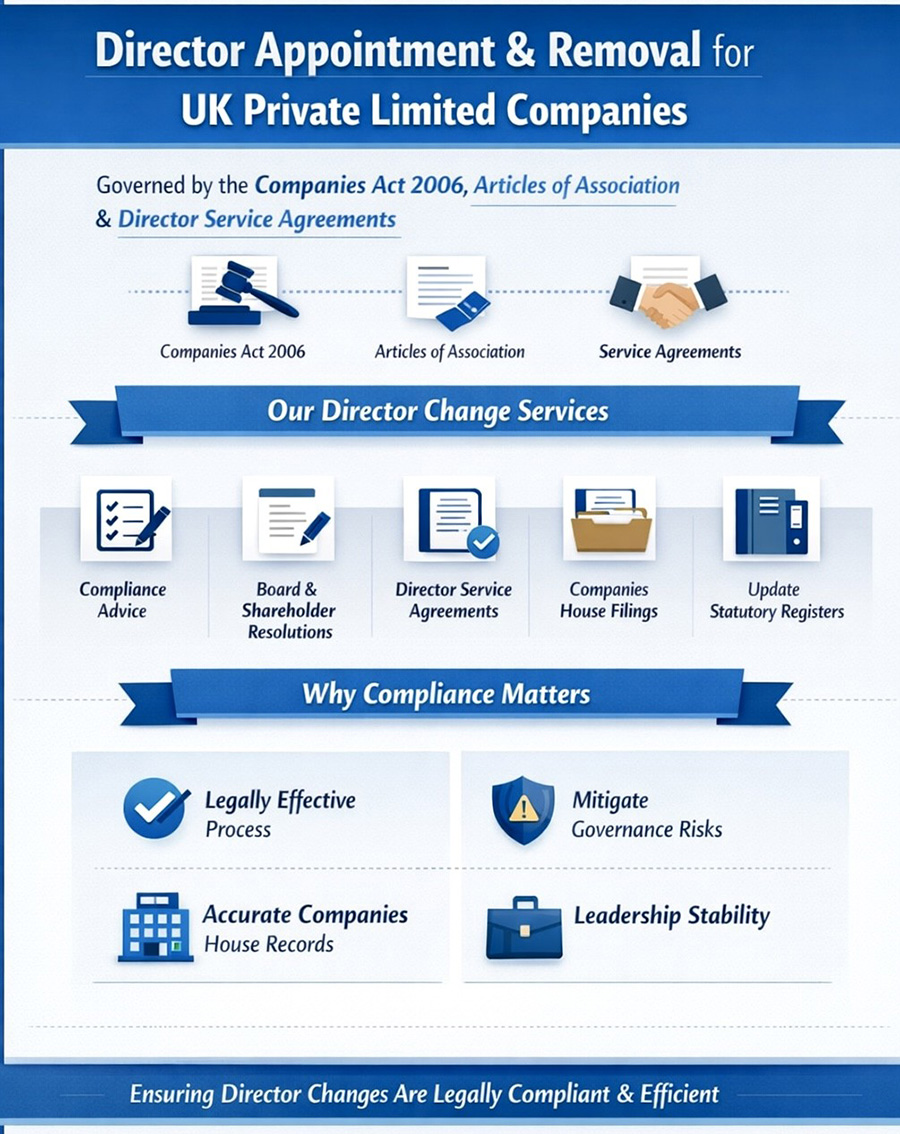
In addition to Companies House filings, reputable providers also update the company’s statutory registers, including the register of directors and register of directors’ service addresses. This step is critical for maintaining ongoing compliance with the Companies Act 2006, particularly for London-registered private limited companies and unlimited companies (UL Ltd).
One well-established provider in this sector is Coddan CPM, a trusted London corporate services firm known for its efficient handling of director appointment and resignation services. Coddan CPM prepares and submits AP01 and TM01 forms electronically, reducing administrative delays and ensuring filings are completed within statutory deadlines.
By using an experienced London-based corporate service provider such as Coddan CPM, companies benefit from reduced compliance risk, faster processing, and expert oversight. This allows directors and shareholders to focus on strategic decision-making and business growth, while remaining confident that all governance changes are handled professionally, accurately, and in full compliance with UK law.

Replace a director effortlessly with our Appointment & Resignation Bundle; enjoy fast, secure, and compliant service for UK limited companies.

Replace a Director in One Simple Step. Need to appoint a new director and remove an existing one at the same time? Our Director Appointment & Resignation Bundle offers a fast, secure, and fully compliant solution for UK limited companies. We manage the entire process in one seamless service, saving you time and reducing risk. We handle the Companies House AP01 director appointment, TM01 director resignation, secure identity verification, and statutory register updates, then provide official Companies House confirmation once filings are completed.
Why Choose the Director Appointment & Resignation Bundle? When replacing a company director, handling both changes together is the most efficient approach. Our combined service ensures accurate filings, faster processing, and full compliance with the Companies Act 2006, all completed in a single instruction. From ID checks for new directors to electronic Companies House WebFiling, everything is managed by an authorised ACSP provider, minimising delays and eliminating administrative errors.
For added protection, Coddan CPM can also provide London director service addresses, helping directors keep their home address off the public register while maintaining full legal compliance. This all-in-one solution is ideal for startups, SMEs, and growing businesses seeking a simple, professional way to replace a director in the UK—without disruption to company operations.

Simplify director changes with our all-in-one bundle; we manage appointments, resignations, and compliance, providing peace of mind for UK limited companies.

Simple, Transparent Pricing
Director Appointment & Resignation Bundle
25.00 + VAT
One clear price. No hidden fees. Includes:
1. Director appointment (AP01 filing).
2. Director resignation or removal (TM01 filing).
3. Secure ID verification for new director.
4. Statutory register updates.
5. Electronic Companies House submission.
6. Official filing confirmation
Why Pay More Elsewhere? Replacing a director separately can increase costs and delay filings. Our all-in-one director replacement service ensures everything is completed accurately, quickly, and compliantly in a single step. Handled by Coddan CPM – Authorised ACSP Provider, trusted by UK startups, SMEs, and professional firms. Utilize our Director Appointment and Resignation service to appoint new directors and remove existing ones, with e-Filing available for only £25 + VAT.

Fast selling packages. FREE delivery Monday, February 2nd 2026. 121 orders are in the queue. The last order was sent 59h 40m ago.

Coddan CPM takes the stress out of director appointments and terminations; trust our London-based experts to handle your private limited by shares company needs.

Simplify your company's leadership changes with Coddan CPM. Our expert team in London handles all director appointments and terminations seamlessly.
£25.00

“SwiftDirector Solutions”

Recommended for

1
package

Buy Now Changing your company's leadership shouldn't feel like navigating a legal labyrinth. Coddan CPM takes the headache out of a private limited by shares company director appointment and termination processes with our seamless, expert-led services. Based in the heart of London, our ACSP-qualified team manages all the paperwork, filings, and compliance requirements so you don't have to. Whether you're bringing fresh talent aboard through a private limited by shares company director appointment or handling a private limited by shares company director termination, we ensure every detail is properly executed. No more sleepless nights wondering if you've missed a crucial step. When you need a private limited by shares company director changes in London, our professionals handle the entire process from start to finish, giving you more time to focus on what truly matters—running your business.

Coddan, as your ACSP provider, ensures all documentation meets Companies House requirements. We manage the entire process from initial paperwork to final submission, helping you avoid costly mistakes and delays. Whether you're bringing on new leadership or processing a private limited by shares company director termination, our efficient service keeps your business compliant with UK regulations. Save valuable time and eliminate stress by trusting Coddan with your director appointment and resignation requirements. Fast-track online service in London for director resignation (TM01) and appointment (AP01) offer quick electronic filing processing with Companies House.


£75.00

“ClearPath Solution”

Recommended for

2
package

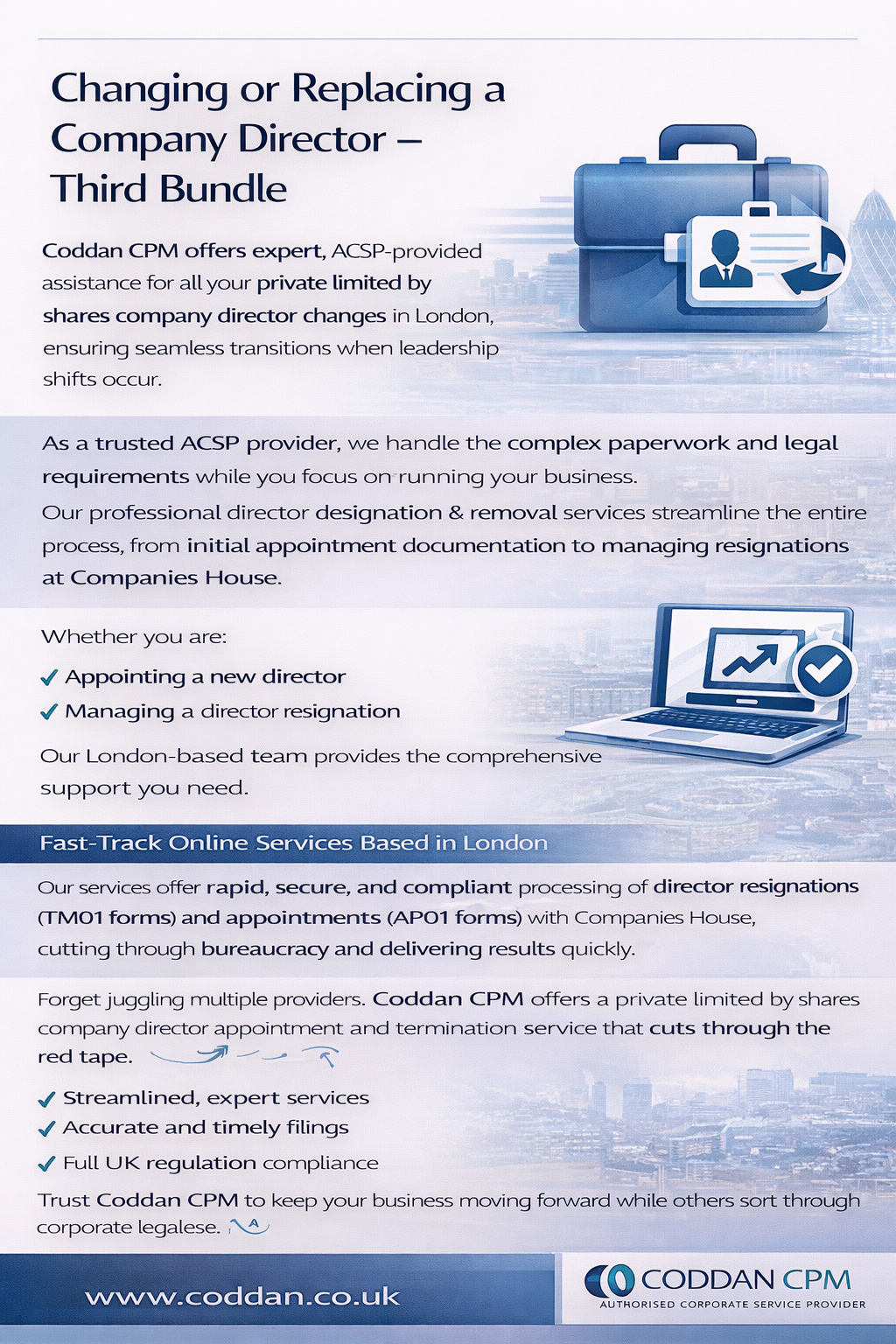
Buy Now Navigating a private limited by shares company director appointment or termination doesn't have to be a bureaucratic headache. Coddan CPM offers expert assistance with all your private limited by shares company director changes in London, ensuring seamless transitions when leadership shifts occur. As a trusted ACSP provider, we handle the complex paperwork and legal requirements while you focus on running your business. Our professional director designation & removal services streamline the entire process, from initial appointment documentation to managing resignations with Companies House. Whether you're bringing on new talent or managing a private limited by shares company director termination, our London-based team provides the comprehensive support you need.

Coddan CPM takes the headache out of a private limited by shares company director appointment and termination processes with our seamless, expert-led services. Based in the heart of London, our ACSP-qualified team manages all the paperwork, filings, and compliance requirements so you don't have to. Whether you're bringing fresh talent aboard through a private limited by shares company director appointment or handling a private limited by shares company director termination, we ensure every detail is properly executed. No more sleepless nights wondering if you've missed a crucial step. When you need a private limited by shares company director changes in London, our professionals handle the entire process from start to finish, giving you more time to focus on what truly matters—running your business.


£75.00

“AppointWise Solution”

Recommended for

3
package

Buy Now Coddan CPM offers expert assistance with all your private limited by shares company director changes in London, ensuring seamless transitions when leadership shifts occur. As a trusted ACSP provider, we handle the complex paperwork and legal requirements while you focus on running your business. Our professional director designation & removal services streamline the entire process, from initial appointment documentation to managing resignations with Companies House. Whether you're bringing on new talent or managing a private limited by shares company director termination, our London-based team provides the comprehensive support you need. Fast-track online services based in London offer rapid, secure, and compliant processing of director resignations (TM01) and appointments (AP01) with Companies House.

Coddan CPM offers a private limited by shares company director appointment and termination service that cuts through the red tape. Forget juggling multiple providers or decoding corporate legalese—our comprehensive solution handles a private limited by shares company director changes in London with remarkable efficiency. When leadership transitions loom, our professional director designation & removal services ensure a seamless handover without the procedural headaches. We've distilled complex requirements into one straightforward package, whether you're seeking a private limited by shares company director appointment or overseeing a necessary termination. Our London-based team specialises in professional director designation & removal services that keep your business moving forward while corporate musical chairs takes place.


£100.00

“Compliance Direct”

Recommended for

4
package

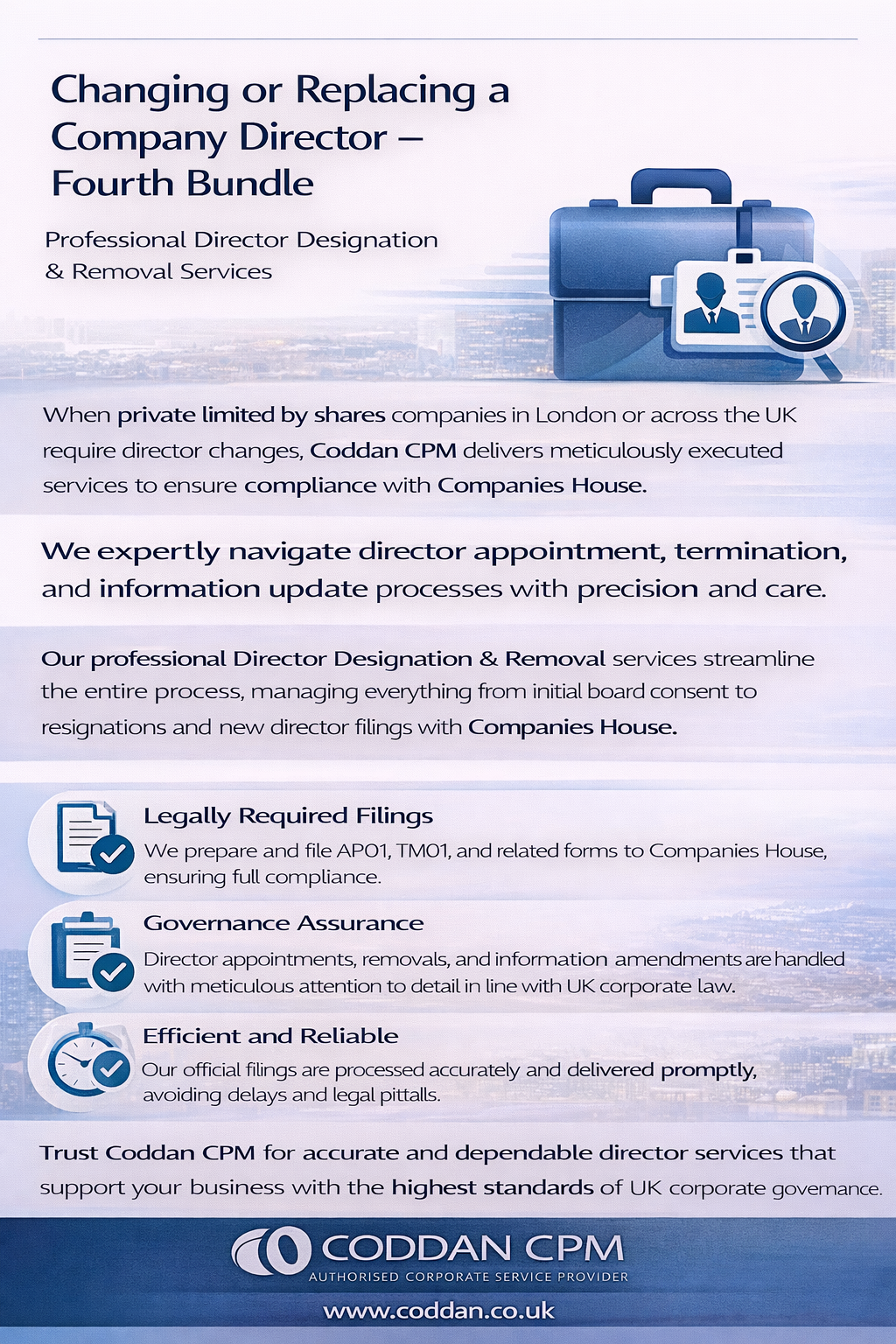
Buy Now Coddan CPM delivers professional director designation & removal services with precision and expertise. When your business needs a private limited by shares company director changes in London or anywhere in the UK, our comprehensive solution handles all the paperwork. We meticulously prepare and file every legally required document for director appointments, resignations, and information amendments, ensuring full compliance with Companies House requirements. Our specialists manage a private limited by shares company director termination with the same attention to detail as a new appointment, giving you confidence that all corporate governance matters are properly addressed. Save time and avoid potential legal pitfalls with a professional director designation & removal services from a team that understands the intricacies of UK company law.

Coddan CPM offers a private limited by shares company director appointment and termination service that cuts through the red tape. Forget juggling multiple providers or decoding corporate legalese—our comprehensive solution handles a private limited by shares company director changes in London with remarkable efficiency. When leadership transitions loom, our professional director designation & removal services ensure a seamless handover without the procedural headaches. We've distilled complex requirements into one straightforward package, whether you're seeking a private limited by shares company director appointment or overseeing a necessary termination. Our London-based team specialises in professional director designation & removal services that keep your business moving forward while corporate musical chairs takes place.


Compliance expert services for director appointments and resignations of a director

Change, or remove a director with the help of our experts in London.

Image depicting the formal process of appointing and removing a company director, with relevant documents. UK director appointment and resignation services by Coddan.

Appointing or removing a director in a UK private limited company can be done quickly online through professional services or Companies House WebFiling.
Specialist corporate service providers manage the compliance process, including the preparation and submission of Form AP01 (appointment) and Form TM01 (resignation/removal).
A professional director resignation service also updates statutory registers, verifies director details, and ensures compliance with the Companies Act 2006, minimizing errors and disputes.
Utilizing expert services for director changes provides CEOs with peace of mind, protects corporate records, and allows them to focus on business operations while professionals handle legal and administrative tasks.


Appointing or removing a director from a UK private limited company can be completed quickly and securely online using a professional director appointment and resignation service, or directly via Companies House WebFiling.

Specialist corporate service providers in the UK handle the full compliance process, including preparing and submitting Form AP01 (appointing a director) and Form TM01 (resigning or removing a director). This ensures accuracy, legal validity, and on-time submission.

A professional director resignation service UK goes beyond filing forms. It also updates statutory registers, verifies director details, and ensures compliance with the Companies Act 2006, reducing the risk of errors or future disputes.

UK law requires all director changes to be filed with Companies House within 14 days. Failure to meet this deadline can result in penalties, rejected filings, or governance and banking complications.

Using an expert director removal service or director appointment service gives CEOs peace of mind, protects corporate records, and allows you to focus on running your business while professionals manage the legal and administrative detail.

Designating or removing a UK private limited company director can be completed securely and compliantly within 14 days using Companies House–approved electronic WebFiling or a professional ACSP director appointment and resignation service such as Coddan CPM.

For appointing a director, the company must file Form AP01, confirming the director’s name, date of birth, service address, and appointment date. For director resignation or removal, Form TM01 must be submitted, stating the director’s name and effective resignation or termination date.

Using an online director resignation service ensures the public Companies House register is updated accurately and efficiently. Electronic filings are typically processed within 2–3 working days, significantly faster and more reliable than paper submissions, which are more prone to rejection.

UK law requires every private limited company to have at least one natural person director, aged 16 or over. While directors must provide a residential address, this can be kept off the public record by using a registered service address, protecting personal privacy.

All director changes must comply with the company’s Articles of Association, which may set additional rules for appointments or removals. Professional director removal services manage these checks, handle filings, update statutory registers, and ensure compliance with the Companies Act 2006.

For CEOs and business owners, using an official electronic WebFiling service or a trusted director appointment service UK reduces risk, avoids delays, and provides confidence that governance changes are completed correctly the first time.

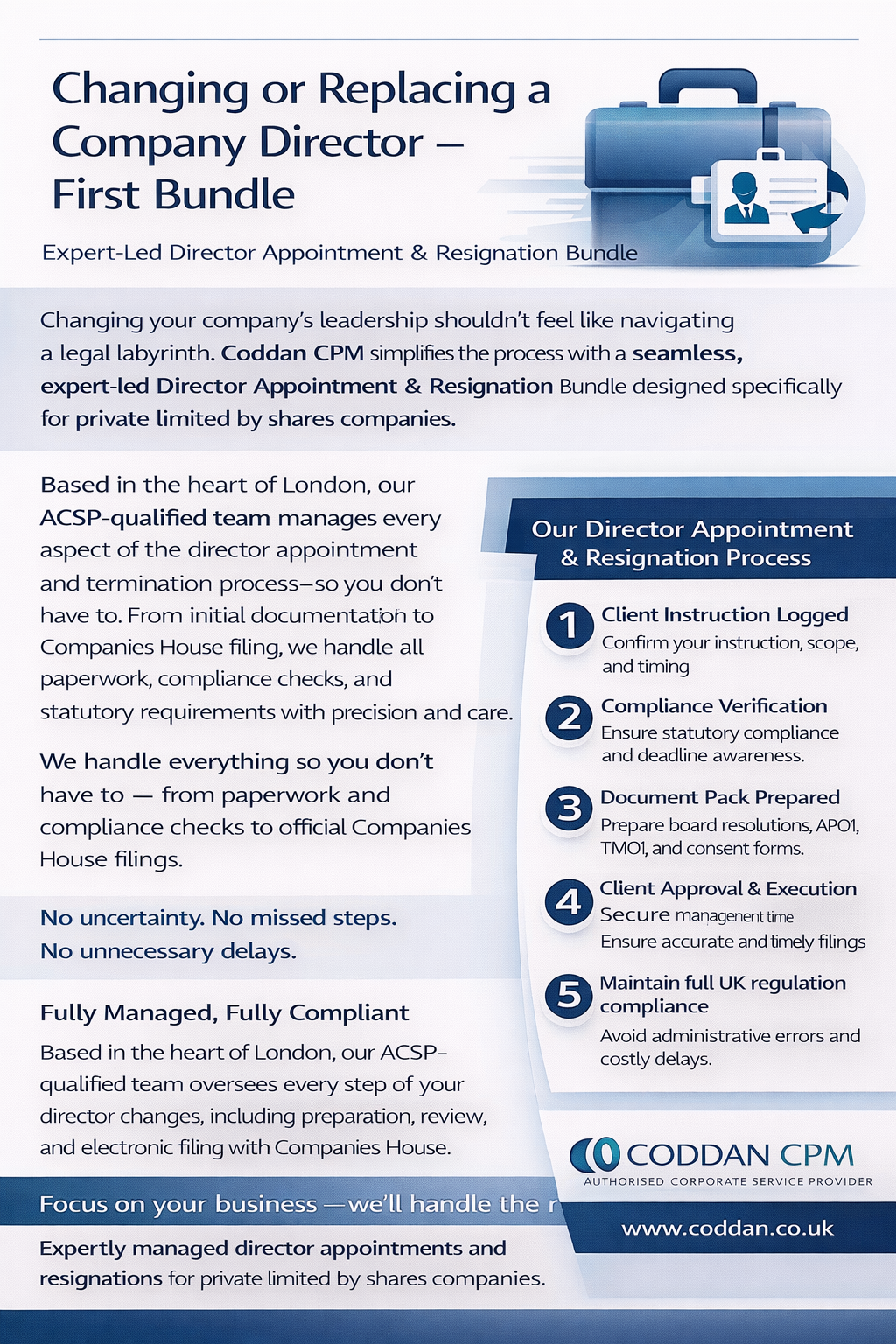
Our 6-Step Director Appointment & Resignation Process.

  1. Client Instruction Logged
    Client instructions have been received and logged, with including the required company details. You instruct the director on appointment or resignation and confirm the transaction scope and timing.
  2. Compliance Verification
    We assess statutory compliance, governance impact, and any transaction-related constraints. We verify statutory requirements and filing deadlines.
  3. Document Pack Prepared
    All resolutions, consents, and Companies House forms are generated.
  4. Client Approval Obtained
    All board resolutions, consents, and statutory documentation are prepared accurately. Corporate documents are issued for approval and execution.
  5. Filing & Tracking
    Legal documents and forms are circulated for swift review and sign-off by relevant parties. All required submissions are filed and tracked through Companies House acceptance.
  6. Completion & Record Maintenance
    Client is notified, and statutory records are updated and maintained. You receive confirmation, and post-completion records are updated for audit readiness.

Compliance expert services for director designation and removal in London

Add, or remove a director with the help of our experts in London.

Image depicting the formal process of appointing and removing a company director, with relevant documents. UK director appointment and resignation services by Coddan.

Simplify your corporate governance with our dedicated service for director appointments and resignations; we take care of all paperwork and Companies House filings.
We offer an expert service for clients who wish to appoint or remove directors, including the filing of the Companies House forms and all other paperwork necessary to keep your corporate records up-to-date and compliant..
We provide a comprehensive professional service for clients seeking to appoint or resign directors, which includes the completion and filing of Companies House forms and all requisite paperwork to ensure your company records remain current and compliantand disputes.
We provide a professional service for clients looking to appoint or resign directors, handling all Companies House forms and necessary documentation.


Fast-track online director resignation and appointment services in London provide a quick, compliant alternative to traditional postal filings. By submitting TM01 director resignation and AP01 director appointment forms electronically, changes can typically be processed by Companies House within 24 hours to 3 working days.
In contrast, paper filings often take 7–10 days or longer, creating unnecessary delays and increasing the risk of rejected documents. Using an online Companies House filing service ensures faster processing, greater accuracy, and immediate confirmation once filings are accepted.
Authorised ACSP agents in London, such as Coddan CPM, commonly offer a director replacement bundle, allowing companies to remove and appoint a director simultaneously. This combined service includes preparing and filing TM01 and AP01 forms, updating statutory registers, and ensuring full compliance with UK company law.
Pricing for a director appointment and resignation service in London typically ranges from £25 to £75 + VAT, depending on verification requirements and additional services such as director service addresses or ID checks. For startups and SMEs, this bundled approach is the most cost-efficient way to keep company records accurate and compliant.


Are you a startup or entrepreneur looking to incorporate a business in London? Coddan CPM, an authorised ACSP service provider, delivers expert company formation and legal support tailored to ambitious founders.

Choosing the right UK business structure—whether a private company limited by shares, company limited by guarantee, co-operative, or unlimited company—has long-term legal and tax implications. We guide you to the structure that best supports your growth strategy.

Our electronic company incorporation service streamlines registration with Companies House, reducing paperwork, errors, and delays. Most incorporations are completed quickly and compliantly using approved digital filings.

Beyond formation, Coddan CPM provides ongoing compliance and governance support, helping your company meet UK legal obligations as it scales and adapts to regulatory change.

Partner with Coddan CPM and incorporate with confidence. We handle the legal complexity, so you can focus on building, scaling, and leading your business from day one.

Simplifying Company Formation with Coddan CPM Electronic Incorporation Bundles.

Starting a limited company should not slow down your momentum. Coddan CPM’s electronic incorporation bundles are designed for startups, entrepreneurs, and growing businesses that want a fast, compliant, and hassle-free way to form a UK company.

As an authorised ACSP provider, Coddan CPM enables you to incorporate a limited company entirely online, removing the delays and complexity of paper-based filings. Our guided electronic application ensures accuracy, compliance, and speed—so you can focus on building your business, not managing forms.

Each incorporation bundle allows you to appoint up to five directors, shareholders, company secretaries, and Persons of Significant Control (PSCs) within a single streamlined process. This flexibility makes it easy to structure your company correctly from day one, whether you are launching solo or with multiple stakeholders.

Choosing the right people for these roles is critical to governance, control, and long-term growth. Coddan CPM’s intuitive system supports informed decision-making, allowing founders to adapt appointments as their business strategy evolves—without compromising legal compliance.

Beyond registration, Coddan CPM provides expert guidance on director duties, shareholder responsibilities, and UK company law, giving first-time founders confidence and experienced entrepreneurs efficiency. Our incorporation bundles are built to support both compliance and commercial clarity.

By automating the formation process, Coddan CPM helps businesses save time, reduce errors, and launch faster. This efficiency allows founders to redirect energy toward product development, market entry, and growth—where it matters most. In a competitive, digital-first economy, speed and certainty are essential. Coddan CPM’s electronic incorporation bundles remove barriers to entry, making UK company formation accessible, professional, and future-ready.

Form your company with confidence. Launch faster. Stay compliant.
Coddan CPM turns business ideas into legally sound companies—simply, securely, and efficiently.

Coddan provides comprehensive payroll management and ongoing compliance support specifically designed for non-resident directors and overseas entrepreneurs operating UK companies. Our services are built to address the unique administrative and regulatory challenges faced by directors based outside the UK.

As a specialist provider for non-UK resident directors, Coddan offers tailored non-resident director packages covering UK payroll processing, bookkeeping, and multi-currency operations. We ensure that salary payments, reporting obligations, and record-keeping remain fully compliant with UK tax and employment regulations, regardless of where directors are based globally.

Our team supports businesses with post-formation compliance, managing PAYE registration, director payroll setup, and ongoing tax obligations for foreign directors. This includes ensuring accurate submissions to HMRC, correct treatment of cross-border income, and adherence to UK statutory requirements.

By working with Coddan, international founders and non-resident directors gain access to expert UK payroll and compliance support, reducing risk, avoiding penalties, and allowing them to manage their UK company with confidence while operating from abroad.


Navigating New Company Formation: Key Considerations for Startups and Founders.

Launching a new company is an exciting milestone, but early decisions made during company formation can have long-term legal and operational consequences. One of the most critical—and often underestimated—steps is the appointment of company officers and directors before incorporation.

Appointing Key Officers Before Incorporation.

When forming a company, founders typically appoint senior officers such as the Chief Executive Officer (CEO), Chief Financial Officer (CFO), and Chief Operating Officer (COO). These roles shape strategic direction, governance, and day-to-day operations. Selecting the right individuals at this stage is essential to the company’s stability and future growth.

Why Pre-Incorporation Flexibility Matters.

Before formal incorporation, founders retain full flexibility to amend, replace, or remove proposed officers without regulatory filings or delays. Once the company is incorporated, any changes to directors or officers must be formally reported to Companies House, often involving statutory forms, deadlines, and compliance obligations.

This makes the pre-incorporation phase the safest and most efficient time to finalise leadership decisions.

Due Diligence on Officers and Directors.

Founders should take time to assess candidates carefully. This includes reviewing experience, leadership capability, cultural fit, and alignment with the company’s mission. Conducting interviews, reference checks, and strategic discussions at this stage helps avoid costly changes after incorporation.

Collaborative Decision-Making for Strong Governance.

Involving co-founders, shareholders, or advisors in officer appointments strengthens governance from day one. Transparent discussions around responsibilities, authority, and expectations reduce the risk of future disputes and ensure everyone enters the business with clarity.

Accuracy Is Critical at Incorporation.

When the company is ready to incorporate, all officer and director details must be submitted accurately. Errors or omissions in names, roles, or addresses can cause delays, rejections, or compliance issues. Ensuring precision at this stage protects the company’s legal standing from the outset.

Building a Strong Foundation for Growth.

Company formation is not just an administrative task—it is the foundation of your business. By taking advantage of pre-incorporation flexibility and appointing the right officers before filing, startups position themselves for smoother operations, stronger governance, and long-term success.

Careful planning today reduces complexity tomorrow.
Approach company formation with foresight, and your startup will be better equipped to thrive in a competitive UK business environment.


Appointing Limited Company Officers with Coddan CPM.

When forming a UK limited company, appointing directors and company officers is a critical legal step. Coddan CPM provides professional, ACSP-authorised support to ensure officer appointments are completed accurately, compliantly, and without delay.

Our service removes the complexity from company formation and officer appointments, allowing founders to focus on building their business while we manage the regulatory detail.

Expert Support for Directors and Company Secretaries.

Coddan CPM assists with the appointment of company directors, company secretaries, shareholders, and Persons of Significant Control (PSCs) as part of your limited company formation or post-incorporation changes.

We ensure all appointments comply with the Companies Act 2006, your Articles of Association, and Companies House requirements. Whether you are appointing a sole director or structuring a multi-director board, our team ensures accuracy from the outset.

Seamless Electronic Filing with Companies House.

As an authorised provider, Coddan CPM uses secure electronic Companies House WebFiling, enabling faster processing and reducing the risk of rejected submissions. Officer appointments and updates are typically processed within 1–2 working days.

We handle:

  • Director appointments (AP01).
  • Director resignations or removals (TM01).
  • Statutory register updates.
  • Public record accuracy and compliance.

Supporting Growing and Founder-Led Businesses.

Startups and growing companies often evolve quickly. Coddan CPM provides the flexibility to structure officer appointments correctly at formation and supports future changes as your business scales.

We work with:

  • Private companies limited by shares.
  • Companies limited by guarantee.
  • Cooperatives.
  • Unlimited companies.

Our guidance helps founders avoid common governance errors that can create issues with banks, investors, or regulators later.

Risk Awareness and Director Protection.

Coddan CPM supports informed decision-making by highlighting director responsibilities, liabilities, and risk considerations. Where appropriate, we can signpost protective measures such as directors’ insurance or personal guarantee awareness, helping directors understand their exposure without providing legal advice.

A Reliable Partner from Day One.

Choosing Coddan CPM means working with an experienced UK provider trusted by entrepreneurs, startups, and established businesses. Our business formation and directors appointment services are designed to be clear, compliant, and efficient, giving you confidence that your company’s foundations are correctly in place.

Whether you are forming a new company or appointing officers post-incorporation, Coddan CPM ensures the process is handled professionally, accurately, and in line with UK company law.


Appointing or Removing a Director in a UK Private Limited Company.

Appointing or removing a UK private limited company director is a critical governance action that must be handled accurately, lawfully, and within strict statutory deadlines. Whether you are restructuring your board, managing a director resignation, or appointing new leadership, Coddan CPM delivers a professional director appointment and resignation service UK designed for founders, CEOs, and growing businesses.

Under the Companies Act 2006, every private limited company must maintain at least one natural person director at all times. Failure to comply can expose the company to regulatory risk and potential enforcement action. Coddan CPM ensures every director change is completed correctly, protecting both the business and its officers.

When You May Need to Appoint or Remove a Director.
Director changes typically arise when:

  • Incorporating a new limited company.
  • Appointing additional directors to support growth or investment.
  • Managing a director resignation or exit.
  • Removing a director due to performance, conflict, or shareholder decision.
  • Implementing board restructuring or governance changes.

Each scenario requires compliance with the company’s articles of association, internal resolutions, and formal notification to Companies House within 14 days.

How Director Appointments Work.

When appointing a director, Coddan CPM manages the entire process using Companies House electronic WebFiling, including:

  • Filing Form AP01 (Director Appointment).
  • Verifying director eligibility (age, legal status).
  • Managing service address vs residential address privacy.
  • Updating statutory registers accurately.

Electronic filing ensures faster processing (typically 1–2 working days) and reduces the risk of rejected submissions compared to paper filings. If you are a sole director, you must appoint a replacement before resigning to avoid the company being struck off.

Director Resignation and Removal Services.

Our director resignation service UK supports both voluntary resignations and formal removals, including those carried out under Section 168 of the Companies Act 2006. We handle:

  • Filing Form TM01 (Director Resignation or Removal).
  • Recording the correct effective date.
  • Updating statutory registers.
  • Ensuring the public Companies House record reflects the change.

This is essential to prevent future disputes, personal liability risks, or continued association with company decisions after exit.

Why CEOs and Business Owners Choose Coddan CPM.

Coddan CPM is an authorised ACSP provider, trusted by UK companies for director appointment and removal services that are accurate, compliant, and commercially efficient.

Our service is ideal for:

  • Startup founders.
  • Owner-managed businesses.
  • UK and international directors.
  • High-growth private companies.

We remove administrative friction, allowing leadership teams to focus on strategy, growth, and operations.

Key Benefits of Using Coddan CPM:

  • Director appointment service UK.
  • Director resignation and removal service.
  • Secure Companies House WebFiling.
  • Statutory compliance handled end-to-end.
  • Fast turnaround and fixed-fee clarity.
  • Reduced governance and liability risk.

Coddan CPM ensures your director changes are handled professionally, lawfully, and without disruption—so your business remains compliant and leadership-ready at all times. Even after resignation, the director’s details remain on the public record, but they will be marked as inactive


Professional Director Service by Coddan CPM: Strengthen Your Startup’s Credibility in London.

Launching a business in London is exciting—but it also requires strict compliance and strong governance from day one. For startups, early-stage companies, and new ventures, the responsibilities of directorship can be overwhelming. That’s why Coddan CPM offers a Professional Director Service in London, designed to support founders who need a credible, compliant, and reliable directorship solution.

As an authorised ACSP provider, Coddan CPM provides professional directors and registered office addresses across prime London locations. This service helps startups maintain strong governance, protect personal privacy, and build trust with clients, investors, and partners.

Why Use a Professional Director?

A professional director is not just a formality—it’s a strategic asset. Many startups lack the internal experience and corporate governance knowledge required to manage legal obligations efficiently. A professional director brings:

  • Expert corporate governance support
  • Compliance with Companies House requirements.
  • Experienced decision-making guidance.
  • Reduced risk of regulatory penalties.
  • Enhanced credibility for investors and stakeholders.

Key Benefits of Coddan CPM’s Professional Director Service.
Prestigious London Registered Office Address

Coddan CPM offers registered office addresses across London, helping startups present a professional image and improve business credibility. A high-quality address can positively influence:

  • Investor confidence.
  • Client perception.
  • Supplier trust.
  • Market positioning.

Complete Compliance Support.

Our professional directors understand the latest regulatory requirements and ensure your company remains compliant with Companies House. This includes:

  • Accurate statutory records.
  • Timely filings.
  • Corporate governance oversight.
  • Risk reduction and legal protection.

Strategic Business Guidance.

Coddan CPM provides experienced guidance on governance best practices and operational structure. This support helps startups develop stronger leadership and decision-making processes.

Privacy and Confidentiality.
Startups often need to protect their personal information. Coddan CPM’s service helps ensure:

  • Your personal address is not on the public record.
  • Sensitive data remains protected.
  • Compliance is maintained without sacrificing privacy.

Focus on Growth.
By outsourcing directorship responsibilities to Coddan CPM, founders can concentrate on:

  • Product development.
  • Sales and marketing.
  • Scaling operations.
  • Raising investment.

Conclusion.
For London startups and early-stage businesses, Coddan CPM’s Professional Director Service offers an essential solution for credible governance and compliance. Our service is designed to help you launch and grow with confidence, ensuring your company meets legal requirements while strengthening investor and market trust.

Partner with Coddan CPM to build a strong foundation for your business and focus on growth while we manage the governance and compliance.


Appointing or Removing a Company Director (UK).

Appointing or removing a company director involves strict legal requirements and must be handled correctly to avoid compliance issues. Companies House must be notified within 14 days, and the process includes detailed paperwork and statutory register updates. Coddan CPM simplifies this by managing the entire director appointment or resignation process for you, ensuring accuracy and timely filing so you can focus on running your business.

What Is a Director Appointment?

A director appointment is the formal process of naming an individual as a company director. Once appointed, the director takes on legal responsibilities for managing the company’s operations and compliance. Their details are recorded on the public Companies House register and must be kept up to date.

What Is a Director Resignation?

A director resignation formally removes an individual from their role. While their past details remain on the Companies House record, the register will show that the director is no longer active. Resignation must be handled carefully to ensure the company remains compliant and that the correct filings are submitted within the required timeframe.

How Many Directors Does a Company Need?

Every UK limited company must have at least one director, who must be a natural person (not a corporate entity). For public limited companies (PLCs), a minimum of two directors is required.

Who Can Appoint Directors?

Directors are typically appointed by shareholders through a shareholder resolution at the Annual General Meeting (AGM) or an Extraordinary General Meeting (EGM). Appointments can also occur:

  • At company incorporation.
  • When ownership changes during a sale.
  • To add expertise during business growth.

Temporary Director Appointments.

If a director position becomes unexpectedly vacant, remaining directors may temporarily appoint a replacement. This appointment must be ratified by shareholders at the earliest opportunity. This is common in cases such as:

  • Director death.
  • Sudden resignation.
  • Unexpected departure of key leadership.

Delegating the Power to Appoint.

Shareholders may delegate the authority to appoint directors to existing directors or a shareholder committee. While this can speed up the process, it reduces shareholder control. For major decisions, shareholder involvement is strongly recommended to protect governance balance.

Director Appointment Process (Step-by-Step).

The process is generally outlined in the company’s Articles of Association, which may limit the number of directors or require a vacancy before a new appointment.

Required actions include:

  • Confirm authority to appoint (Articles or shareholder resolution).
  • Complete and file Form AP01 (or AP02) with Companies House.
  • Update the statutory register of directors.
  • Submit the filing within 14 days.
  • Typical processing time: 1–2 working days for electronic filing.

Information Required for Appointment.
To appoint a director, you must provide:

  • Company name and CRN.
  • Date of appointment.
  • Full name (including any former names).
  • Date of birth.
  • Residential address.
  • Service address.
  • Occupation.
  • Nationality.

Who Cannot Be Appointed as a Director?
An individual cannot be appointed if they are:

  • Disqualified by a court.
  • An undischarged bankrupt (unless permitted).
  • Under 16 years old.

The appointment must also comply with the company’s Articles of Association.

Appointing a Corporate Director.
A corporate director (another company) can be appointed, but at least one natural person director must still be appointed. The same filing rules apply, and the company must ensure compliance with the Articles and statutory requirements.

Need Expert Help With Director Appointments or Resignations?

Coddan CPM provides professional director appointment and resignation services, helping you manage the process quickly and correctly. We handle Companies House filings, update statutory registers, and ensure your company remains fully compliant.

Contact Coddan CPM today to streamline your director changes and protect your business governance.

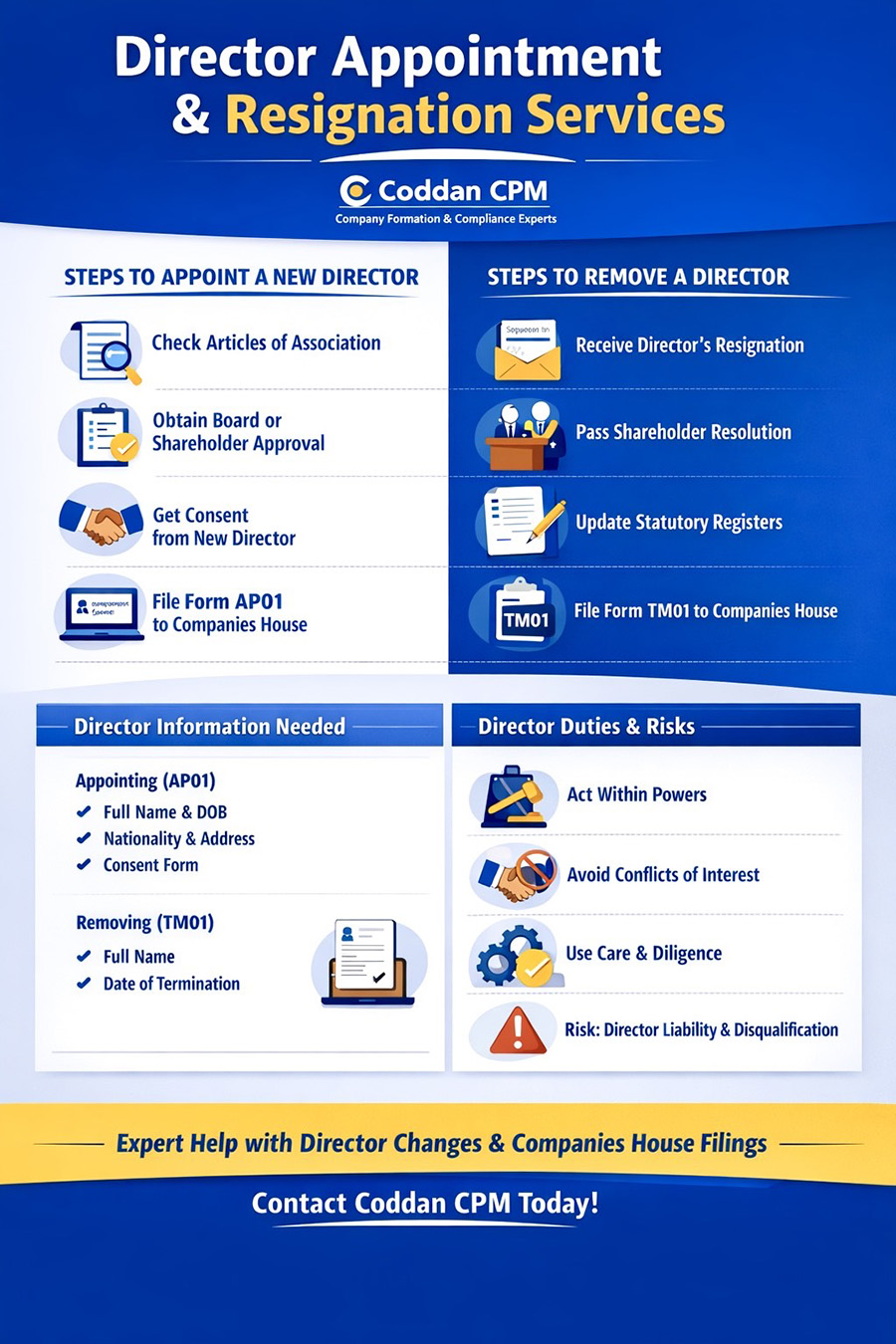
Steps to Appoint a New Director (UK Private Limited Company)..

  1. Check the Articles of Association
    Before appointing a director, confirm the company’s Articles of Association do not impose special rules or restrictions. The Model Articles (private company limited by shares) generally allow director appointments, but you must follow any specific procedural requirements.
  2. Obtain Board or Shareholder Approval
    Director appointments are usually made by:
    • Board resolution, or
    • Shareholder resolution, if required by the Articles.
  3. Get Consent from the New Director
    The new director must formally consent to act, typically through a signed consent form or letter.
  4. Notify Companies House (Form AP01)
    File Form AP01 online to register the new director. Deadline: within 14 days of appointment.

Steps to Remove a Director (UK Private Limited Company).

  1. Voluntary Resignation
    A director can resign by submitting a written resignation, which must be formally recorded by the board or shareholders.
  2. Removal by Shareholders
    Shareholders may remove a director by passing an ordinary resolution at a general meeting (with proper notice).
  3. Update the Company Register
    Update the company’s statutory registers to reflect the change.
  4. Notify Companies House (Form TM01)
    File Form TM01 online to record the director’s resignation or removal. Deadline: within 14 days of the change.

Director Information Requirements (Companies House).
For Appointing a Director (AP01) Companies House requires:

  • Full name (including any former names used in the last 20 years).
  • Date of birth (month and year only).
  • Nationality.
  • Occupation (if any).
  • Country/state of residence.
  • Service address (public record).

For Removing a Director (TM01).
Required details include:

  • Full name (as registered).
  • Date of termination (effective date of resignation or removal).

Appointing a director is not a formality. Under the Companies Act 2006, directors must comply with seven core statutory duties:

  • Act within powers.
  • Promote the success of the company.
  • Exercise independent judgment.
  • Use reasonable care, skill and diligence.
  • Avoid conflicts of interest.
  • Not accept benefits from third parties.
  • Declare interests in transactions.

Risks of Non-Compliance.

Failure to comply may result in:

  • Personal liability for company losses.
  • Director disqualification.
  • Civil or criminal penalties.
  • Damage to reputation.

Want a Seamless Director Appointment or Removal?

Coddan CPM offers a professional director appointment service and director resignation support across the UK. We handle the paperwork, statutory register updates, and Companies House filings, ensuring your company remains fully compliant. Coddan provides professional services for director appointments, resignations, and changes, ensuring legal compliance and seamless transitions.

Contact Coddan CPM today to streamline your director changes.


Limited Company Director: Termination vs Resignation – What Every Startup CEO Must Know.

In the fast-moving world of startups and early-stage companies, corporate governance and board stability are critical for growth and investor confidence. One of the most sensitive governance issues is how a director exits the company—either through resignation or termination. Each route has distinct legal implications, reputational risks, and operational consequences.

Understanding Director Resignation (Voluntary Exit).
Resignation occurs when a director voluntarily steps down from their role. This may happen for personal reasons, career change, strategic differences, or a shift in business direction.

Key Features of Resignation:

Voluntary decision made by the director
Requires formal notice, typically aligned with the Articles of Association or shareholder agreement.

Usually the most professional exit option, preserving goodwill.

Can help maintain positive stakeholder relationships, which is vital for startups.

Risks and Implications
While resignation is often viewed as a clean exit, it still carries risks, such as:

  • Potential liability for past decisions.
  • Questions from investors or stakeholders if resignation occurs during financial stress.
  • Possible reputational impact if resignation appears sudden or strategic.
  • Understanding Director Termination (Involuntary Removal).

Termination refers to the involuntary removal of a director. This occurs when a director is removed due to misconduct, breach of duty, underperformance, or detrimental actions.

Key Features of Termination:

  • Company-initiated removal.
  • Typically requires a shareholder resolution or compliance with Articles of Association.
  • Can be necessary to protect company interests and governance standards.

Risks and Implications.
Termination is a more serious and high-risk process, often involving:

  • Reputational damage to the director and company.
  • Potential legal disputes, especially if termination is contested.
  • Operational disruption and team morale issues.
  • Higher likelihood of regulatory scrutiny and compliance challenges.
  • CEO-Level Considerations for Startups.

For startups, the decision between resignation and termination should be handled with care, transparency, and legal precision. Key considerations include:

  1. Governance and Legal Compliance.
    Ensure all processes align with:
    • Companies Act 2006.
    • Company Articles of Association.
    • Shareholder agreements and corporate governance policies.
  2. Communication Strategy.
    Clear communication is essential to protect:
    • Investor confidence.
    • Team morale.
    • Market reputation.
  3. Risk Management.
    Consider the impact on:
    • Operational continuity.
    • Financial stability.
    • Future fundraising prospects.

Conclusion.
Whether a director resigns or is terminated, the impact on a startup can be profound. CEOs should treat director exits as a strategic governance event, not just an administrative task.

By implementing clear policies, following legal procedures, and prioritizing transparency, startups can manage director transitions smoothly while protecting the company’s reputation and long-term growth trajectory.

Coddan ACSP provider allows for the simultaneous appointment and resignation of directors, making it ideal for replacements. The service ensures that all changes are filed within the legal 14-day limit, preventing potential issues with the regulatory body.These services often include preparing minutes or resolutions, and they handle the required ID verification for new directors.


How to Legally Appoint an Pvt Ltd Company Director.

How to Simplify Your Director Appointment in London

Keep your public records at Companies House error-free; our expert services ensure timely updates, helping you avoid fines for improper filings.

Ensure your Companies House records are accurate and up-to-date; our services help prevent errors and avoid costly fines for late filings!

Trust our services to maintain accurate Companies House records; we help you avoid fines and ensure timely updates for your business filings.

Streamline the process of appointing or removing a company director; learn how to navigate Companies House requirements and complete necessary paperwork efficiently.

Appointing or removing a company director doesn’t have to be overwhelming; discover essential steps to meet Companies House deadlines and simplify the paperwork

Simplify the appointment or removal of a company director; get expert tips on handling Companies House notifications and essential paperwork with ease.

Navigate the complexities of appointing or removing a company director; our resources ensure you meet Companies House requirements and complete paperwork on time.
Appointing or removing a company director is hassle-free with Coddan ACSP Formations; we take care of all the details and inform Companies House for you

Trust Coddan ACSP Formations to simplify your company director changes; we manage the paperwork and liaise with Companies House, making it effortless for you.

Simplify the process of appointing or removing a company director with Coddan ACSP Formations; we handle the paperwork and notify Companies House for you.

Learn why UK company directors and LLP partners must register their address with Companies House; stay informed about legal document delivery.

Find out why registering your address with Companies House is crucial for UK directors and LLP partners; get insights on legal document handling.

Key Takeaway

For UK startups and early-stage limited companies, understanding the director appointment and removal process is essential for maintaining effective corporate governance and Companies House compliance. Changes to company officers are common during growth, restructuring, or investment rounds, and failing to follow the correct legal procedure can expose the business to regulatory risk.
The appointment of a company director in the UK is usually a fast and straightforward process. Once the board of directors or shareholders approve the appointment in line with the company’s Articles of Association, the company must ensure the proposed director meets all legal eligibility requirements, including not being disqualified and being at least 16 years old. The appointment must then be reported to Companies House using Form AP01, which must be filed within 14 dayswithin 2–3 working days. When filed electronically, appointments are often processed within 1–3 working days, allowing the director to act almost immediately.
In contrast, the removal of a company director can take longer, particularly if the decision is contentious. Under the Companies Act 2006, shareholders have the statutory right to remove a director by ordinary resolution, even if the Articles state otherwise. This process may require special notice, a formal general meeting, and allowing the director the opportunity to make representations. Once the removal or resignation takes effect, the company must file Form TM01 with Companies House within 14 days to update the public register.
Although the administrative filings for both appointment and removal can be completed quickly, delays may occur if there are shareholder disputes, poorly drafted Articles, or disagreements with the outgoing director. For startup companies, these issues can disrupt operations, delay funding, and undermine investor confidence if not handled properly.
To minimise risk and ensure accuracy, many businesses use professional director appointment and company secretarial services. These services help manage Companies House filings, statutory registers, and compliance deadlines, reducing the likelihood of rejected submissions or legal exposure. For founders and CEOs, outsourcing these tasks allows greater focus on scaling the business, securing investment, and maintaining operational momentum.
In summary, while appointing a director in a UK limited company can often be completed within days, removing a director may take one to two weeks depending on governance requirements. Clear procedures, proper documentation, and expert support are key to ensuring director changes are handled efficiently, legally, and in the best interests of the company.
When starting a new business in the UK, one of the most important early decisions is determining the number of directors required for company formation. Whether you are setting up a company limited by shares or a company limited by guarantee, understanding the legal requirements and best practices for directors is essential for compliance, governance, and long-term growth.
For a UK private limited company by shares, the minimum number of directors is one, as required under the Companies Act 2006. This director can be an individual or a corporate director (subject to current restrictions). While a single-director structure is common for startups and owner-managed businesses, many companies choose to appoint additional directors as the business scales. Having two or three directors can strengthen corporate governance, improve strategic decision-making, and bring complementary skills such as finance, operations, or industry expertise to the board.
A company limited by guarantee, often used for non-profit organisations, charities, clubs, and associations, also requires at least one director. However, in practice, these organisations typically appoint a larger board. From a governance and compliance perspective, appointing three or more directors is widely regarded as best practice. A broader board supports transparency, shared accountability, and balanced decision-making, particularly where members or trustees are involved.
Choosing the right number of directors is not just about meeting the legal minimum. Startups and newly incorporated companies should consider their business objectives, regulatory obligations, and governance needs when deciding how many directors to appoint. By structuring the board appropriately from the outset, businesses can ensure compliance with UK company law, support sustainable growth, and create a strong foundation for future director appointments or changes.
In today’s digital business environment, managing company administration has become significantly more efficient—particularly for startups and growing enterprises. A common question among company owners is whether it is possible to appoint or resign a director of a UK private limited company or unlimited company (UL Ltd) online. The short answer is yes, and the process is well established under UK company law.
Most regulated online company formation and corporate service providers offer secure digital services for both director appointments and director resignations. These platforms are designed to minimise paperwork and remove the need for in-person meetings. In most cases, the process involves completing the relevant Companies House filing—Form AP01 for appointing a director or Form TM01 for resigning a director—which is submitted electronically on your behalf.
When appointing a new director, the company must ensure the individual meets all legal eligibility requirements, including minimum age, non-disqualification status, and formal consent to act. Reputable providers also guide businesses through identity verification requirements, ensuring compliance with Companies Act 2006 obligations and Companies House filing standards.
Director resignation is equally straightforward. The outgoing director provides written notice of resignation, which is then formally recorded and filed online. This ensures the public register remains accurate and that the company’s statutory records are fully up to date.
Overall, using an online director appointment or resignation service is a practical, compliant, and time-efficient solution for startups and early-stage companies. By outsourcing these administrative tasks to experienced providers, business owners can maintain good governance, reduce risk, and focus on growing their business with confidence.
In the world of UK business, flexibility and adaptability are essential—particularly for startups and owner-managed limited companies. However, situations can arise where a business needs to remove a director, even when the company has only one director in office. This raises important legal and governance questions that must be handled carefully to remain compliant with UK company law.
Under the Companies Act 2006, every UK limited company must have at least one director at all times. In a single-director limited company, this requirement creates a legal constraint: the sole director cannot be removed unless another director is appointed first or an alternative lawful route is followed. This is especially relevant where the director is also the founder, shareholder, or key decision-maker, as removal without planning can leave the company in breach of statutory requirements.
Ordinarily, the removal of a director requires a resolution passed at a general meeting of shareholders, in accordance with section 168 of the Companies Act 2006. However, in a one-director company, the process is governed heavily by the company’s Articles of Association. The articles may set out specific rules for director resignation, appointment, or shareholder powers, and these must be reviewed before taking any action.
In practice, if you are the sole director and a change in leadership is required, there are typically two lawful options. The first is to appoint a new director and then submit a resignation or removal filing for the existing director. The second option—used less frequently—is to close the company through voluntary dissolution and incorporate a new company with a different director. This route requires all debts, taxes, and statutory obligations to be settled before dissolution, and may not be suitable for trading businesses.
Because removing a sole director involves both legal risk and compliance obligations, it is strongly recommended to seek guidance from a regulated corporate service provider, company secretary, or legal professional. Proper advice ensures the correct use of Companies House forms, compliance with statutory deadlines, and continuity of governance. Taking the right steps protects the company, its shareholders, and its future operations while ensuring leadership changes are handled lawfully and efficiently.
When starting a new business in the UK, understanding who can legally be appointed as a company director is a critical early step. UK company law is relatively flexible, but there are clear statutory requirements and restrictions that every entrepreneur should understand before making an appointment.
Under the Companies Act 2006, a company director must be at least 16 years old. There is no upper age limit, allowing companies to appoint experienced professionals or younger founders alike. Importantly, a director does not need to be a UK citizen or UK resident. Both UK and non-UK residents can legally act as directors of a UK company, giving businesses access to international expertise and leadership talent.
However, eligibility is not universal. Individuals who are disqualified under the Company Directors Disqualification Act 1986 cannot be appointed. Disqualification typically arises from serious misconduct, insolvency-related offences, or breaches of company law. Appointing a disqualified person can expose the company and its officers to penalties, making due diligence essential.
While UK companies may appoint corporate directors in limited circumstances, the law increasingly restricts this practice. In most cases, companies appoint natural persons (individuals) as directors, even where they are representing another business or investment entity. Identity verification is also now mandatory, further reinforcing transparency and accountability in company leadership.
For startups and growing businesses, this flexible framework allows founders to build boards that reflect their commercial needs—whether that means appointing overseas directors, industry specialists, or trusted advisers. At the same time, compliance with director eligibility rules is vital to maintaining good governance and avoiding regulatory issues.
In summary, while most individuals can legally become directors of a UK company, appointments must be made carefully and in full compliance with UK law. Taking the time to verify eligibility, document consent to act, and complete the correct Companies House filings lays a strong foundation for effective governance and long-term business success.
When starting a private company limited by shares, one important decision for business owners is whether to issue shares to directors. In the UK, there is no legal requirement to offer shares to directors, but granting director equity can be a strategic tool for growth, governance, and long-term success.
Many startups and early-stage companies choose to offer shares to directors to attract experienced leadership. Issuing director shares can help secure directors who bring valuable expertise, networks, and industry insight. By aligning directors’ interests with the company’s success, equity incentives can motivate stronger performance and long-term commitment.
However, issuing shares to directors can result in share dilution, which reduces the ownership percentage of existing shareholders. This is a key consideration for founders and investors, particularly during early fundraising rounds. Companies must carefully balance the benefits of director equity against the potential impact on control, voting rights, and shareholder value.
Even though directors are not required to hold shares, providing director equity can support better corporate governance and stronger accountability. It is important to document any share allocation correctly, including updating the share register, issuing share certificates, and recording the transaction in the company’s statutory records.
In summary, while directors do not need to be offered shares in a private company limited by shares, issuing shares to directors can be a powerful strategy for attracting leadership and aligning incentives. Business owners should evaluate the long-term implications of director share allocations and seek professional guidance to ensure compliance with UK company law and shareholder agreements.

How to Ensure Compliance Resign a Director.

Impact Beyond Just Filing the Resignation TM01 Form

The details of all directors submitted to Companies House upon their appointment will be publicly accessible, excluding home addresses and the day of their birth date.

Learn the formal process for appointing or resigning a director in a London private limited company; ensure compliance with Companies House within 14 days.

Discover the steps to appoint or resign a director for your London private limited company; stay compliant by updating Companies House records within 14 days.

When the sole director resigns, timely appointment of a new director is crucial; explore our guide to ensure your company remains compliant.

Learn why appointing a new director simultaneously with a resignation is vital for compliance; safeguard your company’s legal status today!

Navigate the complexities of a departing director who is a shareholder; explore share transfer and buyback solutions to maintain business stability.

Ensure a smooth exit for departing directors who are shareholders; learn about share transfers and buybacks to safeguard your company’s future.

Simplify your director appointments and resignations with our efficient AP01 and TM01 form services, including secure ID verification and record updates.

Trust us to manage your AP01 and TM01 forms, conduct secure ID checks, and keep your statutory records up to date with ease and professionalism.

Ensure compliance and efficiency with our AP01 and TM01 form services, secure ID checks, and timely updates to your statutory records.

We specialize in AP01 and TM01 form processing, secure ID checks for new directors, and updating your statutory records seamlessly and securely.

Coddan ACSP specializes in director appointment and resignation services in the UK; rely on our expertise for smooth transitions and full compliance.

Coddan ACSP offers professional director appointment and resignation services in the UK; experience seamless transitions and compliance with our expert support.

Discover the Details

For startups and early-stage companies, maintaining the right board structure is essential. Director appointments and removals must follow UK company law and your Articles of Association, and must be correctly filed with Companies House to remain compliant.
Director appointments typically require nomination, approval via board or shareholder resolution, and filing Form AP01 (or AP02 for corporate directors). Director removals generally require a shareholder resolution, formal notice, and filing Form TM01.
Coddan CPM simplifies these processes by providing regulated ACSP-backed director appointment and removal services, including board resolutions, statutory register updates, Companies House filings, and secure identity verification where required. Our team handles the paperwork so you can focus on growing your business—ensuring fast, accurate, and compliant director changes every time.
When starting a business, one of the most important decisions is how to structure your organisation, particularly when it comes to appointing directors. A company director plays a key role in setting the strategic direction, ensuring compliance with UK company law, and overseeing the day-to-day governance of the business.
A director is typically an individual chosen by the company’s founders or shareholders to manage and guide the company’s affairs. The appointment is usually formalised through board resolutions and documented in the company’s Articles of Association or bylaws. Directors have legal responsibilities to act in the best interests of the company and its stakeholders, and they must operate within the framework of the company’s governing documents.
For startups and early-stage companies, choosing the right directors can directly influence business performance and long-term success. Directors provide strategic oversight, make high-level decisions, and ensure effective corporate governance. They also play a critical role in safeguarding compliance, financial integrity, and risk management.
While the legal requirements for director appointments vary by jurisdiction, common factors include age, eligibility, and legal status. Startups should also consider board diversity and expertise, as a varied mix of skills can enhance innovation and decision-making—particularly in competitive markets.
In summary, appointing directors is a foundational step in building a strong governance structure for any new venture. The right board can support sustainable growth, strengthen compliance, and help guide the business through its early stages and beyond.
In startups and early-stage businesses, directors play a critical role in guiding strategy and ensuring governance. However, leadership changes are sometimes necessary, and understanding the differences between director resignation, termination, and removal is essential for compliance and continuity.
Director Resignation. A director resignation occurs when a director voluntarily steps down from their role. This may be due to personal reasons, a new opportunity, or a change in the company’s direction. To ensure a smooth transition, startups should have a clear resignation process documented in their corporate governance policies. Following resignation, the company can appoint a new director to maintain leadership continuity and ensure ongoing compliance.
Director Termination. Director termination typically refers to a company ending a director’s appointment due to performance issues, breach of fiduciary duty, or failure to meet legal obligations. The process depends on the company’s Articles of Association and applicable laws. Termination generally involves formal notice and an opportunity for the director to respond before a final decision is made.
Director Removal. Director removal is often the most formal and serious action and may involve a shareholder vote, particularly in larger or publicly held companies. Removal procedures should be clearly defined in the company’s governance documents to avoid disputes and ensure fairness. It is usually used in cases of misconduct, conflicts of interest, or severe governance failures.
Why Clear Policies Matter. Resignation, termination, and removal each carry legal and governance implications. Startups should ensure their board governance policies and Articles of Association clearly define the process for each scenario. This helps avoid disputes, protects the company from regulatory issues, and ensures leadership transitions are handled professionally and legally.
Director Resignation and Termination: What Startups Need to Know. Leadership changes are a natural part of any business lifecycle. Whether a director steps down voluntarily or is terminated due to performance or governance issues, understanding the process is essential for startups and early-stage companies. These transitions can impact team dynamics, corporate governance, and operational continuity.
Director Resignation. A director resignation typically begins with internal discussions between the director and other board members. Once the decision is made, the director should submit a formal resignation letter. This letter usually includes the reason for stepping down and the effective date of resignation, helping the company plan for succession and maintain clear records.
After the resignation is confirmed, the company should update its statutory records, including the register of directors, and file the appropriate notification with Companies House (for UK companies). Maintaining accurate records ensures compliance and protects the company from potential legal issues.
Director Termination. Director termination is a more formal process and is usually governed by the company’s Articles of Association and corporate governance policies. The process typically starts with a board meeting to review the reasons for termination, which may include performance issues, breach of fiduciary duties, or failure to comply with legal obligations.
Once a decision is reached, the director should receive formal written notification outlining the reasons for termination. It’s important that the process is handled fairly and transparently to minimise disruption and reduce the risk of disputes.
Post-Termination Steps. After a director leaves, companies should assess the impact on governance and leadership. This may involve appointing an interim director, initiating a director appointment process, or reviewing board composition. Keeping the process professional and respectful helps preserve morale and supports a smooth transition.
Resigning as a director is a major decision for startup founders and early-stage company leaders, and it requires a clear understanding of the process to ensure a smooth transition. A director resignation can impact company governance, stakeholder relationships, and ongoing operations. To protect both yourself and the company, it’s essential to follow the correct steps and document the resignation properly.
The first step in the director resignation process is to draft a formal director resignation letter. This letter should clearly state your intention to resign, include your name and role, the company name, and the effective resignation date. While a reason for resigning is optional, including a brief explanation can help maintain transparency and professionalism.
Before submitting the resignation letter, it is important to review the company’s Articles of Association and any shareholder agreements. These documents may outline specific requirements for resigning directors, such as notice periods or approval procedures. Following the company’s governance rules ensures that the resignation is valid and compliant with company law.
Communication is also key during a director resignation. Inform your co-directors and shareholders in advance to maintain transparency and prevent disruptions to business operations. In many cases, a board meeting may be held to discuss the resignation and plan for a smooth handover of duties.
After the resignation is confirmed, the company must update its statutory records and internal company records. For UK companies, this includes notifying Companies House and updating the register of directors. Ensuring accurate records helps maintain compliance and protects the company from potential regulatory issues.
Finally, consider the timing and handover process. A planned transition period allows for a structured handover of responsibilities to a successor, especially in startups where roles are critical. Leaving on good terms and maintaining professional relationships can help preserve goodwill and protect your reputation for future business opportunities.
The idea of a director walking away from a company may sound simple, but in practice it’s rarely that straightforward. Directors hold significant legal responsibilities and are expected to act in the best interests of the company and its shareholders. Stepping away without following the correct process can expose a director to serious legal and financial consequences.
Directors are bound by fiduciary duties, meaning they must act honestly, responsibly, and in good faith. Abandoning responsibilities without formal resignation can be viewed as a breach of these duties. In extreme cases, this could lead to legal action or claims of misconduct, especially if the director leaves the company in a vulnerable or unstable position.
One of the biggest risks of walking away is personal liability. If a company has debts, obligations, or outstanding liabilities, creditors may seek to hold directors accountable—particularly if the director leaves without proper notice or fails to ensure the company is compliant and properly managed during the exit process. This risk is heightened in smaller companies or startups where directors often carry more direct operational responsibility.
In most jurisdictions, a director must formally resign in writing, and the resignation must be recorded in the company’s official records. This process protects both the director and the company by clearly documenting the departure and ensuring that responsibilities are properly transferred. Without this documentation, the director may remain legally listed as responsible for company decisions and compliance.
Ultimately, while directors may wish to exit quickly, they should do so with care. A properly managed resignation helps protect the company’s stability and the director’s personal reputation. If you’re considering stepping down, it’s advisable to seek professional advice to ensure you comply with legal requirements and safeguard your interests.
In UK company law, director appointments and director removals are formal actions that must be recorded accurately and promptly. Many startups and early-stage companies ask whether a director appointment can be backdated or whether a director removal can be made retrospective. While a director appointment may sometimes be backdated if allowed by the company’s Articles of Association, director removal is rarely eligible for retrospective effect due to the need for proper process and legal transparency.
A director appointment typically takes effect once it has been approved by the board or shareholders and the appropriate filing has been made. In certain situations, companies may wish to backdate a director appointment to align with a key business decision or board resolution. However, any retrospective appointment must be supported by clear governance documentation and be compliant with the company’s Articles of Association and the Companies Act.
In contrast, director removal generally takes effect from the date of the formal resolution or official notification. Retrospective director removal is uncommon because it can undermine corporate governance and may appear to avoid accountability for decisions made during the director’s tenure. Attempting to backdate a director removal could also create legal and regulatory complications, especially if the company fails to follow the required director removal process.
For startups, maintaining accurate corporate records is essential for compliance and investor confidence. Clear documentation of director resignations, appointments, and removals ensures the company remains compliant with Companies House requirements and supports effective corporate governance. It is strongly recommended that companies consult a corporate governance expert or legal professional before considering any retrospective director action.

Director Appointment and Removal in a UK Limited Company – Complete Guide for Startups.

For UK startups, early-stage businesses, and private limited companies, understanding the director appointment and removal process is critical to maintaining corporate governance, legal compliance, and investor confidence. Whether you are forming a new company, restructuring management, or responding to shareholder decisions, changes to directors must be handled correctly and reported to Companies House within strict statutory deadlines.

Failure to comply with the Companies Act 2006 can result in penalties, rejected filings, or reputational risk—issues that can seriously impact growing businesses.

How Long Does It Take to Appoint a Director in the UK?

The appointment of a company director in a UK private limited company is usually a fast and efficient process when handled correctly. Once the board of directors or shareholders approve the appointment in accordance with the company’s Articles of Association, the company must ensure the individual meets all legal eligibility requirements, including:

  • Being at least 16 years old.
  • Not being disqualified from acting as a director.
  • Providing valid director identification and service address.

After approval, the company must notify Companies House by submitting Form AP01 within 14 days of appointment. When filed online using the Companies House WebFiling system, updates are often processed within 24–72 hours, meaning the director can legally act almost immediately.

How to Remove a Director from a UK Limited Company.

The removal of a company director can be more complex, particularly where disputes or shareholder disagreements exist. Under Section 168 of the Companies Act 2006, shareholders have the statutory right to remove a director by passing an ordinary resolution, regardless of what the Articles of Association state.

The removal process may involve:

  • Giving special notice to the director.
  • Holding a general meeting of shareholders.
  • Allowing the director to make formal representations.

Once the resignation or removal takes effect, the company must file Form TM01 with Companies House within 14 days to update the public register and statutory records.

Common Delays in Director Changes for Startups.

While Companies House filings can be completed quickly, delays often arise due to:

  • Shareholder disputes.
  • Poorly drafted Articles of Association.
  • Disagreements with the outgoing director.
  • Failure to maintain statutory registers.

For startup companies and high-growth businesses, delays in director changes can affect banking arrangements, fundraising rounds, and commercial contracts, making accuracy and timing essential.

Why Use Professional Director Appointment Services?

Many UK businesses choose to use professional company formation and director appointment services to ensure full compliance and avoid costly errors. These services manage:

  • Director appointments and resignations.
  • Companies House AP01 and TM01 filings.
  • Statutory register updates.
  • Company secretarial compliance.

For founders and CEOs, outsourcing these administrative responsibilities allows greater focus on business growth, strategy, and investor relations, while ensuring all director changes are legally compliant and recorded correctly.

Summary: Director Appointment and Removal Timeline in the UK.
In most cases:

  • Appointing a director. can be completed within 2–5 working days.
  • Removing a director. typically takes 7–14 days, depending on notice and shareholder approval.

Having clear internal procedures, well-drafted Articles, and professional support ensures that director changes are handled efficiently, transparently, and in the best interests of the company.

Appointing or Resigning a Director Online in London (UK Limited & UL Ltd Companies).

In London’s fast-paced business environment, startups, scale-ups, and established companies need efficient and compliant company administration. A common question for company owners and directors across Greater London and the UK is whether it is possible to appoint or resign a director of a UK private limited company or unlimited company (UL Ltd) online.

The answer is yes. Under UK company law, director appointments and resignations can be completed entirely online, either through Companies House WebFiling or via London-based regulated corporate service providers.

Online Director Appointment Services in London.

Many London company formation agents and Authorised Corporate Service Providers (ACSPs) offer secure, end-to-end solutions for appointing a company director online. These services are widely used by:

  • London startups.
  • Overseas founders setting up UK companies.
  • Property SPVs and holding companies.
  • Professional service firms and contractors.

The process involves submitting Companies House Form AP01 (Appointment of Director) electronically. When filed online, director appointments are typically processed within 24–72 hours, making it one of the fastest governance updates available for UK limited companies registered in London.

Before appointment, the company must ensure the director:

  • Is at least 16 years old.
  • Is not disqualified under UK law.
  • Has formally consented to act as a director.
  • Meets identity verification requirements introduced by Companies House.

London-based providers also offer service address solutions, allowing directors to use a central London address rather than a home address on the public register.

Director Resignation Services in London (Form TM01).

The online director resignation process in London is equally efficient. A director may resign by giving written notice, which the company must record internally and file with Companies House.

This is done using Form TM01 (Termination of Director), submitted electronically. Filing online ensures:

  • Immediate updating of the Companies House public register.
  • Continued compliance with Companies Act 2006 obligations.
  • Accurate statutory records for London-registered companies.

Most London corporate service providers can complete this process same day, minimising disruption to the business.

Why London Businesses Use Online Director Services.

For London-based companies and UK startups, using an online director appointment or resignation service delivers clear benefits:

  • Fast Companies House processing.
  • Expert compliance support.
  • Reduced administrative risk.
  • Privacy protection using London service addresses.
  • Support for UK-resident and non-UK resident directors.

Director Eligibility in the UK: How Coddan CPM Supports Compliance and Governance.

When starting a UK company, choosing the right directors is a key governance decision. UK company law is flexible, but it also sets clear requirements and restrictions. That’s why many founders rely on experienced corporate service providers like Coddan CPM, a certified ACSP (Authorised Corporate Service Provider), to ensure director appointments are compliant, properly documented, and legally valid.

Under the Companies Act 2006, a director must be at least 16 years old and can be of any nationality or residency status. This means UK companies can appoint both UK-based and non-UK resident directors, giving businesses access to wider expertise and international leadership talent.

However, not everyone is eligible. Individuals who are disqualified under the Company Directors Disqualification Act 1986 cannot serve as directors. Coddan CPM helps businesses avoid costly mistakes by conducting thorough compliance checks and ensuring that director candidates meet all legal requirements before appointment.

While corporate entities can sometimes be involved in governance, UK law generally requires directors to be natural persons. Coddan CPM assists companies with the correct structuring and appointment process, including ensuring that the director’s consent to act is properly documented.

As a regulated ACSP provider, Coddan CPM also supports mandatory identity verification requirements. We guide directors through the secure GOV.UK One Login identity check and ensure that all documentation is accurate and compliant before filing with Companies House. This reduces the risk of rejection, delays, or regulatory issues.

In short, while UK director eligibility rules are straightforward, ensuring compliance in practice requires experience and careful governance. With Coddan CPM’s ACSP expertise, you can confidently appoint directors knowing that the process is legally compliant, professionally managed, and fully documented.

This is particularly valuable for international entrepreneurs, FinTech startups, property companies, and SMEs operating in Central London, Canary Wharf, and Greater London.

Summary: Online Director Changes for London & UK Companies.
Appointing or resigning a director online in London and across the UK is:

  • Fully compliant with UK company law.
  • Quick and cost-effective.
  • Ideal for private limited companies and UL Ltd companies.
  • Best managed through regulated London corporate service providers.

For modern businesses operating in London’s competitive market, digital director services are now the standard, compliant solution for maintaining strong corporate governance while focusing on growth.

For startups and emerging businesses, the appointment and resignation of directors can be daunting but is essential for establishing a solid organizational structure. As you embark on your entrepreneurial journey, understanding the nuances of these processes will not only lay the groundwork for effective governance but also ensure compliance with legal obligations.

The procedure for appointing and resigning directors typically begins with internal discussions. Founders or shareholders should engage in clear conversations about the skills, experience, and values they wish to bring to the board. This collaborative approach is vital for nurturing a dynamic and focused team.

Once a decision has been reached, it’s time to formally implement the appointment. Although the process culminates with filing changes with Companies House, it is important to remember that this foundation is built well before this stage. The Companies House WebFiling service allows businesses to appoint a director online, and this service is generally free. However, the electronic submission is just the final step in a more comprehensive process.

The internal appointment involves drafting a resolution, which typically requires majority agreement among shareholders to authorize the appointment. This ensures stakeholder alignment and involvement in the decision-making process. Once the resolution is in place, the new director should be officially notified and can then assume their responsibilities, which typically include contributing to strategic decision-making, overseeing company operations, and adhering to fiduciary duties.

After the appointment has been confirmed, it is essential to communicate the changes to Companies House within the stipulated timeframe. As a director, understanding your role and responsibilities, including legal requirements for registration and compliance, is crucial. Neglecting these duties can lead to significant issues, including potential fines or complications with corporate governance.

Conversely, there may come a time when a director needs to resign. The resignation process often requires a formal letter to the board. Internally, this should be managed carefully to preserve the company’s reputation and maintain morale among remaining team members. Conducting an exit interview can also be beneficial to understand the reasons for leaving and gather insights that may benefit the organization.

Once the resignation letter has been submitted, it is vital to file the resignation with Companies House. This formalizes the change and updates the public register. Just like appointments, resignations must be communicated promptly to ensure compliance with legal requirements.

For startups and emerging businesses, effectively managing director appointments and resignations can set the tone for organizational culture and governance. By approaching these processes strategically, founders can ensure they have the right leaders in place while fostering a transparent and accountable environment.

In conclusion, while the administrative aspects of director appointments and resignations—such as filing with Companies House—are critical, the real work lies in the preparations and considerations preceding these steps. For entrepreneurs navigating the complexities of building a new venture, understanding these processes can be an invaluable tool in establishing a strong and credible presence in the marketplace. Embrace the opportunity to build a talented board of directors that reflects the values and vision of your startup.