We use cookies on this website, you can read about cookies and GDPR Privacy Policy here
Coddan CPM Ltd. – Company Registration Agent in the UK

Ensure compliance when appointing or removing a director with Coddan's expert support from £130 (ex VAT); we handle all necessary ID verification checks.

Step 1
Review Company Documents.
Step 2
Formal Written Notice.
Step 3
Director Consent.
Step 4
Board Resolution.
Step 5
Update Statutory Registers.
Step 6
Notify Companies House.

Expert Director Resignation Service and New Appointments in the UK


Ensure compliance with UK corporate law with our director resignation and appointment service. We handle all necessary filings to keep your company records accurate.

A director resignation and appointment service is a specialized professional service designed to manage the legal documentation and filings required by Companies House when there is a change in the directorship of a UK company. This service is essential for ensuring compliance with the Companies Act 2006, which governs corporate operations in the UK.
When a director resigns, the service prepares the necessary forms, such as the TM01, which must be submitted to Companies House to officially record the resignation. Similarly, when a new director is appointed, the service facilitates completion of the relevant forms to ensure the appointment is recorded correctly. These documents help maintain the accuracy of the company’s statutory records and inform stakeholders of leadership changes.
In addition to handling these critical filings, director resignation and appointment services are valuable in streamlining the overall process. They often provide guidance throughout the legal requirements, ensuring that companies adhere to deadlines and avoid potential penalties for non-compliance. Many of these services offer free or low-cost options, making them accessible for businesses of all sizes, particularly small and medium enterprises that may not have dedicated legal teams.
By utilizing a director resignation and appointment service, companies can prevent legal complications and potential disputes that may arise from improper documentation. Overall, these services play a crucial role in reinforcing corporate governance and maintaining transparency in the management of companies.

Learn how to appoint a director and understand their legal responsibilities under the Companies Act 2006, including compliance and governance essentials.

Effectively managing the appointment or resignation of a director is an essential administrative responsibility for any company operating in the UK. At Coddan CPM, we specialise in providing a comprehensive service to ensure compliance with all Companies House requirements when appointing or resigning directors. This support is crucial to maintaining your company’s compliance with UK company law.
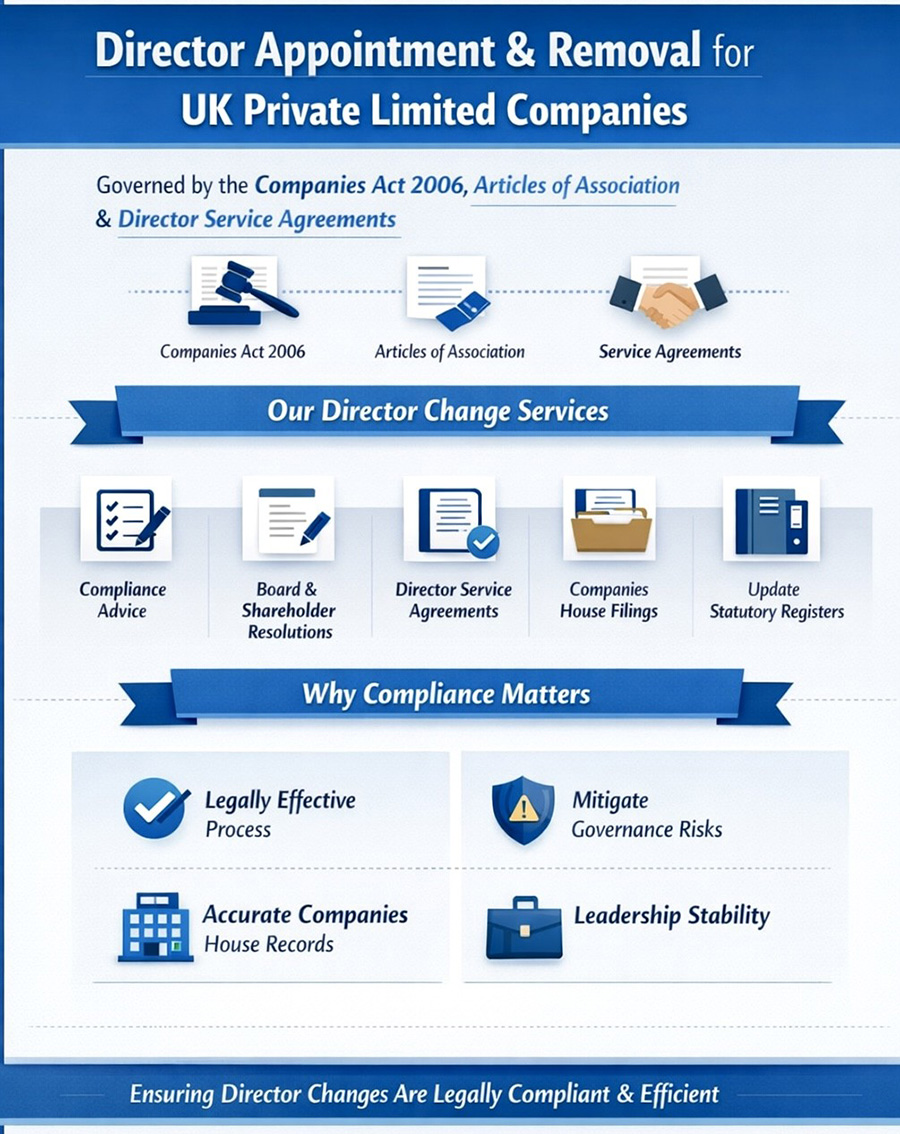
The procedure for appointing a director, as well as defining their roles and responsibilities, is primarily governed by the Companies Act 2006. Additionally, the company’s articles of association, which outline its internal governance regulations, play a significant role in this process. If the appointed director has a service contract, the terms agreed upon in this contract will also dictate their specific duties and expectations within the company.
It is important to highlight that many formation service providers often fail to address the extensive legal responsibilities and potential personal liabilities that come with a director’s role. Directors are not only responsible for guiding the company’s strategic direction but are also accountable for ensuring compliance with various legal and regulatory obligations. This may include filing annual returns, adhering to health and safety regulations, and maintaining accurate financial records.
Furthermore, the internal governance requirements are complex and require careful attention. Directors must understand their fiduciary duties, which include acting in the best interests of the company, avoiding conflicts of interest, and ensuring transparency in decision-making. Failing to meet these obligations can lead to significant consequences, including financial penalties or even disqualification from serving as a director in the future.
In summary, while the administrative task of appointing or resigning directors may seem straightforward, it encompasses a multitude of legal and governance considerations that are vital for the smooth functioning and compliance of your company. At Coddan CPM, we are here to navigate these complexities, ensuring you receive the support and expertise you need to manage these critical changes effectively.

Fast selling packages. FREE delivery Friday, December 19th 2025. 52 orders are in the queue. The last order was sent 11h 17m ago.

Appoint or resign directors smoothly with our efficient service; expert services for directors appointments, directors resignations, and changes.

Professional solutions for clients who need to fast and easy appoint or resign a business directors within 24 hours.
£25.00
+VAT

“SwiftDirector Solutions”

Recommended for

1
package

Buy Now Efficient Director Resignation Appointment Services in the UK with Coddan CPM. Seamless Director Appointment (AP01 Form): we expertly prepare and submit the AP01 form, ensuring the smooth addition of your new director to the Companies House records. Effortless Director Resignation (TM01 Form): we handle the completion and filing of the TM01 form, officially and elegantly removing the departing director from your company records. Secure and Swift ID Verification for New Director: your incoming director will effortlessly complete a quick and secure online ID check, fulfilling all compliance requirements with ease. Confidential Delivery of the Official Companies House Code: the personal Companies House code for your new director will be sent securely via email, ensuring a smooth transition into their new role.

Update of Statutory Records: we’ve expertly updated your company’s statutory records to accurately reflect both the new appointment and the resignation, ensuring everything is in order. A Smooth and Hassle-Free Process: experience the ease of saving time and eliminating errors. With our swift and compliant service, everything is seamlessly managed for your convenience.


£75.00
+VAT

“ClearPath Resignations”

Recommended for

2
package

Buy Now Coddan is a full-service provider offers an easy resignation process for existing company directors, ensuring compliance with all legal requirements and providing all required documentation. When a director departs from a company, it is crucial to comply with UK legal requirements throughout the process; compliance with relevant laws ensures that the transition is handled appropriately. It is important to follow established protocols and guidelines to maintain the integrity of the company’s operations and uphold its legal obligations. Proper documentation and communication during this process are essential to ensure clarity and transparency for all stakeholders involved.

Coddan handles director resignations from £75, including Companies House filing, board documentation, register updates, and expert compliance checks. Drafting and passing a board resolution to formally approve the resignation, and filing an official form to terminate a director’s appointment (Form TM01). Updating the register of directors in a company’s statutory records is a crucial administrative task that ensures compliance with legal requirements.


£75.00
+VAT

“AppointWise Solution”

Recommended for

3
package

Buy Now Coddan is the complete service provider that facilitates the legal appointment of a director for an existing company, ensuring compliance with all legal regulations and documentation requirements. Ensure a smooth director appointment with Coddan; for only £75, we manage all Companies House filings and legal documentation professionally. We will prepare the necessary board minutes or resolutions approving the appointment, ensuring compliance with your company’s articles of association. Streamline your director appointment with our precise filing of form AP01; trust us to manage all necessary paperwork for a hassle-free experience.

We manage all statutory deadlines and ensure adherence to the UK Companies Act 2006, preventing late filing penalties or legal issues. Experience hassle-free Companies House filings with our expert team; we manage resolutions and documentation quickly and in full compliance.


£100.00
+VAT

“Compliance Direct”

Recommended for

4
package

Buy Now Use Coddan Web Incorporation Service (WIS) and an all-in-one service provider to handle the director appointments and resignations quickly and efficiently. All-in-one service provider is designed to simplify the complexities associated with corporate governance, making it easier for businesses to maintain compliance and focus on their core operations. Ensure your business stays compliant with our expert services from £100; we handle filings, resolutions, and checks, all aligned with UK law. Get fast and accurate compliance services from £100; our experts handle all filings, resolutions, and updates, ensuring full alignment with UK law.

Directorship changes require accuracy and speed; trust our expertise to manage appointments and resignations with the utmost legal precision and care. Experience smooth directorship transitions; we specialise in managing appointments and resignations with precision, speed, and complete legal accuracy.


How to Legally Appoint a Limited Company Director.

How to Simplify Your Business Director Appointment in the UK

Streamline your business formation with our services; we gather necessary details for Companies House while highlighting key director obligations for compliance.

New directors must verify their identity with Companies House via GOV.UK One Login or an ACSP before appointment. Ensure compliance and avoid delays!

All new directors must confirm their identity with Companies House via GOV.UK One Login or an ACSP; avoid delays and ensure compliance with the new system.

Discover how directors receive a unique UID after IDV, essential for verifying roles in company filings. Ensure compliance with our detailed guide.

Learn about the unique UID system for directors post-IDV; this code is crucial for accurate company role verification in all official filings.

Don’t overlook compliance! Our guide covers the essential steps for directors, including filing confirmation statements and understanding IDV requirements.

Ensure your business stays compliant! Learn about the importance of timely confirmation statements and annual accounts for directors in our comprehensive guide
Confirm your eligibility with basic checks on age, bankruptcy, and court orders; explore our formation service for a smooth application process!

Ensure your executive directors have formal service contracts outlining employment terms, remuneration, and notice periods. Essential for legal compliance.

Normal service contracts for executive directors are crucial; learn how to outline employment terms and ensure compliance with essential legal documents.

Many free formation services provided by financial apps allow only a basic setup: one shareholder, one director, and minimal customization options.

With Coddan, you pay a modest fee but gain full control over your business’s structure; you can appoint multiple directors and shareholders.

Key Takeaway

When registering a limited company in the UK, every company director must provide two addresses: a residential address and a service address. The residential address is kept on a private record, while the service address is published in the public register maintained by Companies House. The service address serves as the official contact address for the director, where all official correspondence from Companies House, HMRC, and other statutory bodies will be sent. Directors can choose a service address that is different from their home address. Many opt for a separate business or registered office address to maintain privacy and professionalism.
To successfully appoint a director, it is crucial to secure their explicit written consent beforehand. This consent serves as a formal agreement that indicates the individual’s willingness to take on the responsibilities associated with the role. If this consent is not obtained or is deemed invalid for any reason, your application for registration will be rejected, which can lead to delays in your organization’s establishment and operational plans. Therefore, ensure that you maintain proper documentation of this consent to facilitate a smooth registration process and avoid any complications that may arise.
Appointing a director involves checking eligibility, getting board and shareholder approval (often via resolution), obtaining the appointee’s written consent, and then formally notifying the relevant registrar (like Companies House in the UK) by filing specific forms (e.g., AP01) to make the appointment official and public. The process is largely governed by the company’s Articles of Association, so reviewing these documents first is crucial.
Ensure that the candidate satisfies all legal requirements for appointment as a director. This includes being at least 16 years old and not being currently bankrupt or disqualified from serving as a director. It is essential to carefully review the company’s Articles of Association, as they outline specific regulations regarding the number of directors permitted on the board, as well as the processes for nomination and appointment. Typically, the responsibility for proposing a new director falls to the existing board members. This proposal process should be thorough and documented. Once a candidate is identified, it is important to formalize the decision through board meeting minutes. In most cases, the appointment will require a resolution that can be adopted either during a board meeting or through a written procedure, depending on the company’s bylaws. This ensures transparency and provides a clear record of the board’s decision-making process.
Depending on the Articles of Association, shareholders may need to approve the appointment of a director through an ordinary resolution at a general meeting (either an Annual General Meeting or an Extraordinary General Meeting) or via a written resolution. The candidate must provide written consent to serve as a director, confirming that they meet all legal requirements. Additionally, it is necessary to file the appropriate forms, such as Form AP01 for an individual director in the UK, with the relevant official registrar, such as Companies House.
Yes — a director can still be liable after resignation, depending on the circumstances. Resigning does not automatically erase responsibility for actions taken while they were still in office. A former director can be held liable for breaches of duty that occurred while they were still a director, including:
  • Breach of fiduciary duties.
  • Acting in their own interest instead of the company’s.
  • Misuse of company assets.
  • Failing to exercise reasonable care, skill, and diligence.
  • Wrongful or fraudulent trading.
If the company later goes insolvent, a former director may still be liable if they allowed the company to continue trading while insolvent. Any wrongful acts performed before resignation remain actionable. A director may remain personally liable after resignation if they:
  • Personally guaranteed company loans or contracts.
  • Are responsible under statutory regimes (e.g., tax liabilities).
  • Are involved in regulatory breaches (e.g., health & safety, environmental, corporate reporting).
If a director resigns after things start going wrong, the resignation does not protect them from liability for actions already taken.

How to Ensure Compliance Resign a Director.

Impact Beyond Just Filing the Resignation TM01 Form

Get informed about the significant implications of director resignations; delve into the legal and financial consequences that extend beyond the TM01 filing.

Understand how resignation doesn’t shield directors from liability for actions taken during their tenure, especially in cases of wrongful trading and insolvency.

Learn about the ongoing responsibilities of directors post-resignation, including potential liabilities for wrongful trading during their time in office.

Ensure your resignation process as an executive director aligns with employment law to prevent unfair dismissal claims. Learn more about the necessary steps.

Executive directors must align their resignation with employment law to avoid unfair dismissal; explore essential guidelines beyond standard Companies House procedures.

Learn why a carefully drafted resignation letter, often including a waiver of claims, is essential for safeguarding your interests when leaving a company.

Explore the importance of a resignation letter with a waiver of claims, a vital step for a secure and legally robust transition from your current job.

Directors must understand their ongoing legal liability for company decisions, even if falsely excluded from operations. Learn how to protect your interests.

Directors remain liable for company decisions despite false claims of departure; explore how to address these issues and safeguard your legal standing.

Don’t overlook the importance of checking your company’s articles of association and shareholder agreements for specific resignation clauses like notice periods.

Ensure a smooth transition by reviewing your company’s articles of association and shareholder agreements for unique resignation clauses and share transfer rules.

Ensure compliance with legal requirements for board meetings and resolutions; learn how to properly accept resignations before filing with Companies House.

Don’t overlook the legal steps for accepting resignations. Learn how to conduct board meetings and resolutions correctly before filing with Companies House.

Discover the Details

While several services provide template minutes for board meetings, they frequently fail to highlight the critical legal requirement of conducting formal meetings and passing resolutions to officially acknowledge a resignation. This step is essential before submitting any filings to Companies House, ensuring compliance with regulatory standards and protecting the integrity of the company’s governance process.
There is a considerable risk that bank accounts may be frozen if the resigning director is the sole signatory on the bank mandate, and a new signatory has not been appointed at the same time. This situation can arise because banks require at least one authorized signatory to conduct transactions on behalf of the company. If the only person with the authority to manage the account steps down without a replacement being appointed, it can lead to interruptions in access to funds. To avoid this potential issue, it is essential to ensure that a replacement is designated in advance and the necessary changes to the bank mandate are made promptly. This proactive approach will help maintain smooth financial operations and prevent any unforeseen disruptions.
It is essential to thoroughly assess and outline the terms related to any outstanding loans between the director and the company. This includes determining repayment schedules, interest rates, and any potential implications for the company's financial health. Additionally, attention must be given to final remuneration packages, which encompass base salary, bonuses, and any share options the director may be entitled to. Each case should be evaluated on its own merits to ensure that all financial arrangements are clearly defined and compliant with company policies and regulations.
A well-defined handover plan is essential for ensuring business continuity, especially in situations where the director holds vital knowledge or authorizations. Such a plan provides a structured approach for transferring responsibilities and information, minimizing disruptions to operations. It should outline key tasks, designate appropriate personnel for each responsibility, and include a timeline for the transition. Additionally, incorporating a knowledge transfer process that captures critical insights and decision-making criteria will help to sustain the organization’s effectiveness during leadership changes. By addressing these elements, businesses can safeguard against potential gaps in leadership and maintain smooth operations even in the director’s absence.
Formation service providers are responsible for the efficient submission of the TM01 form to Companies House, which is essential for formally notifying any changes regarding a company’s appointment of directors or secretaries. However, these service providers typically do not offer the specialized, in-depth legal and commercial advice that professional solicitors or accountants can provide. This type of expert guidance is critical for ensuring a smooth and secure separation, as it helps businesses navigate the complexities of the process, assess potential risks, and understand their legal obligations. Without this professional advice, companies may face pitfalls that could jeopardize their operations or lead to compliance issues in the future. Therefore, seeking comprehensive support from qualified professionals is vital for a successful transition.
Yes — a director can still be liable after resignation, depending on the circumstances. Resigning from a director position does not automatically eliminate responsibility for actions taken while still in office. A former director can be held liable for breaches of duty that occurred during their tenure, which may include:
  • Breach of fiduciary duties.
  • Acting in their own interest rather than the company’s.
  • Misusing company assets.
  • Failing to exercise reasonable care, skill, and diligence.
  • Engaging in wrongful or fraudulent trading.
If the company later becomes insolvent, a former director may still be held liable if they allowed the company to continue trading while it was insolvent. Any wrongful actions taken before resignation can still lead to legal repercussions.

Coddan CPM, Authorized Corporate Service Providers (ACSPs), offers essential services for director appointments and resignations. Our primary focus is verifying identities and ensuring all necessary documents are prepared and filed with Companies House.

Key Services for Director Changes:

  • Identity Verification:
    ACSPs conduct thorough identity checks for new and existing directors. Verified individuals receive a unique personal code for future filings.
  • Document Preparation:
    We draft critical internal documents such as board minutes, resolutions, and appointment/resignation letters to maintain accurate records.
  • Filing with Companies House:
    We ensure timely submission of required forms, such as Form AP01 for appointments and Form TM01 for resignations, within the mandatory 14-day timeframe.
  • Compliance & Guidance:
    We advise on compliance with the Companies Act 2006 and your company’s Articles of Association to avoid legal issues and ensure proper director representation.
  • Data Accuracy & Privacy:
    We handle data submissions efficiently to protect personal information and prevent the public listing of home addresses.
  • Ensuring Compliance and Documentation:
    ACSPs ensure the entire process adheres to the relevant Companies Act and other regulations, including obtaining the new director's consent to act and drafting supporting documentation like board resolutions or resignation letters/minutes.

By facilitating these processes, we help businesses reduce administrative burdens and avoid rejected filings or regulatory penalties.

Compliance expert services for director appointments, director resignations, and changes

Appoint, change, add, or resign a director with the help of our experts in London.

To quickly resign from a director position and appoint a new director in London, you can use online ACSP formation agents, such as Coddan CPM, or the GOV.UK services. You will need to file the TM01 Form for resignation and the AP01 Form for appointment with Companies House. These forms are often processed together in one service for efficiency. This process also includes managing internal paperwork, such as board minutes and director consent, and you can expect to receive confirmation within a few hours to ensure compliance.
The agent files electronically, and Companies House updates records within hours to days, with confirmation emails sent to you.
Ensure you have a Director’s Letter of Resignation, Board Minutes, and the new Director’s Consent to Act.
You’ll need the new director’s details (name, DOB, addresses) and must ensure they meet age (16+) and legal requirements, receiving confirmation once the public register is updated.
London director appointment services are designed to ensure the appointment process is compliant with the Companies Act 2006 and the requirements of Companies House, the UK’s registrar of companies.


Appointing or Removing a Company Director: Comprehensive Services in the UK with Coddan CPM.
When it comes to appointing or resigning a company director, the preparation of the correct company documents is vital. Unfortunately, this often gets overlooked, putting companies at risk of non-compliance with legal obligations. Our service ensures that we handle all the necessary documentation required by Companies House, safeguarding your company’s compliance and keeping your records in order.

Managing the appointment or resignation of a director is not just a routine administrative task; it is a critical component of corporate governance for any UK company. At Coddan CPM, we specialize in providing a streamlined service designed to meet all the statutory requirements set forth by Companies House. By ensuring you remain compliant with UK company law, we help mitigate potential legal risks and maintain the integrity of your business.

Understanding the Director Appointment and Resignation Process.
In the UK, when an individual is appointed as a new director or when a current director decides to resign, it's imperative that the company promptly notifies Companies House. This notification process involves the completion and submission of specific forms, as well as adhering to all legal stipulations outlined in the Companies Act 2006. Coddan CPM is committed to ensuring that this process is completed efficiently, without unnecessary delays or complications.

Our service is available at a cost of £25.00 + VAT for each appointment or resignation processed. Our Director Appointment and Resignation Service Includes:

  1. Comprehensive Document Preparation:
    We meticulously handle all the necessary paperwork required for the appointment or resignation of directors. This includes preparing the appropriate forms and ensuring their timely submission to Companies House, which is essential for maintaining accurate company records.
  2. Ensuring Compliance with the Companies Act 2006:
    We prioritize compliance by verifying that all changes regarding your company’s directors adhere to the regulations stipulated in UK law, particularly those set forth in the Companies Act 2006. This commitment helps prevent any future legal issues related to director management.
  3. Prompt and Efficient Processing:
    We understand that time is of the essence in business. Therefore, we aim to process all requests for director appointments or resignations as swiftly as possible, minimizing any disruptions to your operations.

Step-by-Step Process: How It Works

  • Select a Package/Bundle from the top of this page on our website.
  • Complete the Application Form: enter all required details pertaining to the director’s appointment or resignation. This information is crucial for accurate processing.
  • Pay and Checkout: finalize your order through our secure payment system.

Once we receive your request, we will electronically file the relevant form with Companies House. Within 1-2 working days, you will receive an email notification confirming that your appointment or resignation has been authorized by Companies House. This correspondence will also include a VAT invoice and a copy of your digital documents for your records.

By choosing our services, you can focus on running your business while we take care of the legal requirements associated with director appointments and resignations. Trust Coddan CPM for a hassle-free experience in managing your company’s directorship.

The crucial aspects of director appointment and resignation services frequently overlooked by formation service providers involve not just the administrative tasks of filing required paperwork with Companies House, but also the extensive legal responsibilities, potential personal liabilities, and internal governance requirements that accompany these processes. Understanding these components is essential for ensuring both compliance and effective corporate governance.

  1. Board Resolutions/Meetings:
    Before any appointment or resignation of a director can take effect, it is imperative that the company’s board holds a formal meeting to discuss and vote on these decisions. This process should be meticulously documented in official board minutes, as failure to do so could lead to disputes over the legitimacy of the appointment or resignation. Proper record-keeping not only upholds corporate governance standards but also protects board members from potential legal challenges.
  2. Updating Internal Registers:
    Once a new director is appointed or an existing director resigns, the company must update its statutory register of directors. This responsibility lies with the company itself and is often neglected by formation service providers. Failure to maintain accurate and up-to-date internal records can result in penalties and may hinder the company’s compliance with regulatory requirements.
  3. Articles of Association:
    Formation service providers may not review the company’s articles of association, which could impose specific limitations or requirements regarding the maximum number of directors and the procedures for their appointment or removal. It is crucial for companies to ensure that any changes made comply with these internal regulations. If amendments are necessary, a separate process must be followed, potentially incurring additional time and costs.
  4. Service Contracts:
    For new directors who are also employees, it is essential to either draft a new director’s service contract or update an existing one. This contract should clearly outline critical terms such as remuneration, notice periods, and any compensation or benefits associated with the director’s role. Neglecting to formalize these details can lead to misunderstandings and disputes over compensation and responsibilities.
  5. Impact on Company Operations (e.g., Quorum):
    When a director resigns, there can be significant implications for the company’s operations, particularly if the resignation results in the company falling below the minimum number of directors needed to meet quorum requirements as specified in its articles of association. This situation could disrupt essential decision-making processes and operations, necessitating the urgent appointment of an additional director to ensure continuity and compliance.
  6. Ongoing Filing Obligations:
    While formation service providers typically facilitate the immediate filing of necessary forms with Companies House, they often do not stress the importance of ongoing regulatory compliance. Companies must remain vigilant about deadlines for any subsequent filings and understand the potential penalties for late submissions. Maintaining good standing requires proactive management of these aspects.
  7. Identity Verification Requirements:
    Recent and upcoming regulatory changes will mandate that all directors complete an identity verification process with Companies House. This requirement ensures that all corporate directors are thoroughly vetted. Directors may need to handle this process directly, utilizing their unique personal verification codes, which separates this obligation from the initial formation service.

In summary, while formation service providers can assist with the filing of essential forms regarding director appointments and resignations, it is crucial for companies to fully understand their internal governance obligations, legal responsibilities, and the potential ramifications of non-compliance. By proactively addressing these aspects, companies can better safeguard their operations, uphold corporate governance standards, and mitigate personal liabilities for their directors.

Smooth, quick, and fully compliant director appointment & resignation bundle

Professional services for the appointment and resignation of directors.

To quickly and professionally resign and appoint a director for a UK limited company, use an online formation agent (like Coddan CPM) who handles all the paperwork, files forms AP01/TM01 with Companies House (Gov.uk), and confirms changes, usually within 1-3 days, ensuring legal compliance for the new director (must be 16+, not bankrupt/disqualified). 
Give necessary info for the resigning director (name, date of resignation) and the new director (name, DOB, address, personal details for identity verification).
The agent prepares and electronically files the required forms (AP01 for appointment, TM01 for resignation) with Companies House.


Directors play a pivotal role in the governance and operational framework of any company. They are responsible for making strategic decisions, managing everyday operations, ensuring compliance with legal standards, and representing the organization in various capacities—be it legal, financial, or operational. Due to the critical nature of their roles, any shift in the directorship—be it an appointment or resignation—must be approached with meticulous attention to detail, unwavering speed, and total legal adherence.

Changing a director is far more than an administrative task; it necessitates careful consideration of various factors, including:

  1. Companies House Filings:
    This includes submitting the necessary forms to officially record changes in directorship.
  2. Internal Record-Keeping Updates:
    Changes must be reflected in the company’s internal databases to maintain accurate and up-to-date records.
  3. Board Resolutions:
    Formal resolutions must be passed to document the decisions made regarding director changes.
  4. Statutory Register Updates:
    Legal registers must be updated to reflect changes in directorship.
  5. Legal Obligations and Governance:
    Compliance with corporate governance standards is essential to ensure lawful operations.
  6. Potential Financial Implications:
    Changes may affect tax statuses, payroll responsibilities, and banking arrangements.
  7. Notifications to Stakeholders:
    Relevant parties—such as stakeholders, banks, clients, and partners—must be informed of any changes to ensure smooth operational continuity.

Errors in this process can result in severe repercussions, including:

  • Penalties from Companies House:
    Fines or restrictions can be imposed for late or inaccurate filings.
  • Non-compliance with the Companies Act 2006:
    Failure to adhere to legal requirements can lead to legal repercussions.
  • Shareholder Disputes:
    Poorly managed transitions can spark conflicts among shareholders.
  • Invalid Appointments:
    Incomplete or incorrect paperwork may lead to appointments that lack legal validity.
  • Legal Exposure:
    The company may face lawsuits or penalties due to non-compliance.
  • Rejected Filings:
    Mistakes can result in filings being rejected, causing further delays.
  • Audit Complications:
    Inaccurate records can create issues during audits or when seeking funding.

At Coddan CPM, a certified ACSP provider, we deliver a comprehensive, end-to-end service that covers every aspect of appointing new directors, removing existing ones, managing voluntary resignations, and ensuring compliance with all corporate governance requirements. Our methodology is straightforward, professional, and closely aligned with UK corporate law.

The Significance of Proper Director Appointments and Resignations.
Many business owners underestimate the importance of effectively managing directorships. A director not only oversees compliance and statutory filings but also plays a crucial role in decision-making, financial management, and representing the company to external stakeholders. As such, every change in directorship must be documented accurately and submitted in accordance with legal protocols.

The ramifications of a director’s appointment or resignation include:

  • Impacts on Company Governance:
    Clear delineation of who is responsible for decision-making within the organization.
  • Shareholder Expectations:
    Directors have a fiduciary duty to act in the best interests of the company rather than individual stakeholders.
  • Banking and Financial Access:
    Accurate records are necessary for banks and financial institutions to verify who has the authority to act on behalf of the company.
  • Legal Compliance:
    Companies House requires notifications of changes within 14 days to avoid penalties.
  • Updates to HMRC Records:
    Payroll and tax records may need to be amended to reflect changes in directorship.
  • Investor Confidence:
    Investors expect clarity in governance and stability during transitional periods.
  • Audits and Due Diligence:
    Clear documentation is vital for any future investments or company sales.
  • Operational Continuity:
    Effective management of day-to-day operations must be ensured during transitions.

Director appointments and removals are thus not merely administrative events; they are strategic, legal occurrences that significantly shape a company’s trajectory.

Why Choose Coddan CPM for Director Appointments and Resignations?

  1. Complete Companies House Filing:
    We ensure that all necessary forms are filled out correctly, with accurate details that are submitted error-free.
  2. Full Documentation Preparation:
    Our service encompasses comprehensive documentation, including:
    • AP01 (Appointment Form):
      Required for a new director’s appointment.
    • TM01 (Termination Form):
      Necessary for recording a director’s resignation.
    • Board Resolutions:
      Formal documentation to validate decisions made by the board.
    • Meeting Minutes:
      Official records of meetings which discuss directorship changes.
    • Resignation Acceptance Letters:
      Documents acknowledging the director’s resignation.
    • Updated Statutory Registers:
      Ensuring compliance with legal requirements.
  3. Corporate Governance Expertise:
    ur professionals ensure that every change aligns with:
    • The Companies Act 2006:
      Adhering to the specific legal requirements set forth in UK law.
    • The Articles of Association:
      Ensuring internal governance standards are met.
    • Shareholder Agreement Rules:
      Taking necessary clauses into consideration.
    • Internal Governance Standards:
      Upholding the company’s internal regulations.
  4. Fast Turnaround:
    We provide options for both standard and urgent services to meet your time constraints.
  5. Clear Guidance:
    Our team explains every step of the process in straightforward language, ensuring you understand all aspects.
  6. Risk-Free Compliance:
    We promise no rejected filings, missed deadlines, or governance gaps.
  7. Register Updates Included:
    We ensure all relevant registries are updated, including:
    • Register of Directors.
    • Register of Directors’ Residential Addresses.
    • Persons with Significant Control.
    • Internal Corporate Records.
  8. Director Background Verification:
    We ensure compliance with:
    • Disqualification Restrictions:
      Verifying that new directors are eligible to serve.
    • Identity Verification:
      Confirming the identity of all directors.
    • Residency and Age Rules:
      Ensuring all legal criteria are met.
  9. Support for All Types of Director Changes:
    We assst with:
    • Executive Directors.
    • Non-Executive Directors.
    • Company Secretaries.
    • Nominee Directors.
    • Resignations.
    • Removals under Section 168.
    • Replacement directors.

Confidential and Professional Service.
Particularly critical for sensitive director exits where discretion is paramount. What’s included in our director appointments and resignations service:

  1. Initial Consultation & Compliance Check:
    We begin with a thorough understanding of:
    • The reasons behind the appointment or resignation.
    • Internal governance rules and procedures.
    • The Articles of Association.
    • Relevant clauses in shareholder agreements.
    • Any internal approval requirements necessary for the changes. This preliminary step ensures that the process is legally sound from the outset.
  2. Review of Articles of Association & Shareholder Agreements:
    We meticulously verify:
    • The rules for director appointments and removals.
    • Required approvals for such actions.
    • Statutory notice periods.
    • Any restrictions or special rights applicable.
    • The existing board structure to ensure compliance and prevent disputes.
  3. Preparation of Internal Documentation:
    We create all necessary documentation, including:
    • Director consent to act.
    • Completion of the AP01 form.
    • Board resolution approving the appointment.
    • Meeting minutes capturing the discussions.
    • Director appointment letters outlining the terms.
    • Welcome and onboarding documentation.
    • The resignation letter from the departing director.
    • Completion of the TM01 form.
    • Board resolution formally accepting the resignation.
    • Exit acknowledgments.
    • Official director removal notices.
  4. Updating Statutory Registers:
    As required by law, we ensure timely updates to:
    • The Register of Directors.
    • The Register of Directors’ Residential Addresses.
    • The Register of Secretaries, if applicable..
    • The Persons with Significant Control (PSC) register. Keeping the registers current is crucial for compliance and risk management..
  5. Companies House Filing:
    We manage the filing of:
    • The AP01 (for appointments).
    • The TM01 (for terminations).
    • CH01 (for changes of details), if necessary. Our commitment is to ensure that all filings are accurate, timely, and fully compliant with legal standards.

By choosing Coddan CPM for your director appointment and resignation needs, you can trust that the transitions will be conducted smoothly and in full compliance with all legal requirements, thereby safeguarding your company’s reputation and operational integrity.

A director’s resignation has significant implications for an organization’s internal governance and external compliance. Internally, the departure can disrupt decision-making processes, affect team dynamics, and necessitate adjustments in leadership roles. This change may also lead to a reevaluation of strategic priorities and operational effectiveness. Externally, the resignation can impact stakeholder confidence, regulatory relationships, and compliance with legal obligations. Organizations must address these challenges promptly to maintain stability and uphold their governance standards. Overall, the resignation of a director is a critical event that requires careful management to mitigate potential risks and ensure continued organizational integrity.

Updating the register of directors in a company’s statutory records is a crucial administrative task that ensures compliance with legal requirements. It is essential for maintaining accurate and up-to-date information regarding the individuals who hold directorship positions within the company. This process typically involves recording any changes in directorship, such as appointments, resignations, or changes in personal details of the directors.

Timely updates to the register are important not only for legal compliance but also for transparency and accountability within the organization. Failure to maintain an accurate register can lead to legal repercussions and may affect the company’s reputation. Therefore, companies should establish a systematic approach to regularly review and update their statutory records, ensuring that all changes are documented promptly and accurately. This practice supports good governance and fosters trust among stakeholders.

The process of managing a director’s resignation involves two key steps: drafting and passing a board resolution to formally approve the resignation, and filing the official form to terminate the director’s appointment, specifically Form TM01. The board resolution serves as a formal acknowledgment of the director’s decision to resign, ensuring that the action is documented and recognized by the board. Following this, the completion and submission of Form TM01 to the relevant authorities is essential to officially record the termination of the director’s appointment. This procedure is crucial for maintaining accurate corporate governance and compliance with regulatory requirements.

It is essential for organizations to ensure that their director appointments adhere to UK company law, as compliance is critical for legal integrity and operational effectiveness. Accuracy in managing legal and financial responsibilities is paramount, as it not only safeguards the organization against potential legal repercussions but also fosters trust among stakeholders. Understanding and implementing these legal frameworks can significantly enhance the governance and accountability of a company, ultimately contributing to its long-term success.


Directors: Detailed Responsibilities and Potential Liabilities.
Directors represent the leadership of a company and are accountable for its overall management and strategic direction. As the principal decision-makers, they bear significant responsibility for the company’s performance and conduct. In many cases, directors may also be shareholders, intertwining their interests with those of the company.

Key Responsibilities of Directors.
Directors have a range of critical responsibilities, articulated below:

  1. Primary Responsibility to the Company:
    The foremost duty of any director is to act in the best interest of the company. This means prioritizing the company’s long-term success over personal gains or external pressures.
  2. Compliance with Legal Authority:
    Directors must ensure that their actions are consistent with the powers granted to them by relevant company laws and the company’s constitution. This includes understanding both statutory obligations and internal governance documents.
  3. Promotion of Corporate Success:
    Directors are tasked with promoting the success of the company, which involves strategic planning, risk management, and fostering a positive workplace culture that enhances productivity and growth.
  4. Exercising Independent Judgment:
    A director must exercise independent judgment and make decisions based on the best information available, free from undue influence or bias. This independence is crucial in ensuring that decisions are made equitably and ethically.
  5. Diligence and Care:
    Directors are required to act with a certain level of skill, care, and diligence. This implies that they must stay informed about the company’s operations and the industry environment, undertaking necessary actions to mitigate risks and seize opportunities.
  6. Avoiding Conflicts of Interest:
    Directors must maintain a clear boundary between their personal interests and those of the company. They are ethically and legally bound to avoid situations that may lead to conflicts of interest and must not use their position for personal advantage.
  7. Debt Obligation Assurance:
    Directors are responsible for ensuring that the company meets its financial obligations and can pay its debts as they become due. Failing to do so could lead to personal liability, especially in cases of insolvency or wrongful trading.
  8. Filing and Disclosure Requirements:
    It is imperative for directors to ensure that the company fulfills its filing obligations with Companies House. This includes submitting annual statutory accounts, confirmation statements, and any notices regarding changes in directors or secretaries.
  9. Prohibition on Personal Benefits:
    As a general rule, directors should not accept personal benefits from third parties that could compromise their impartiality or the company’s interests.
  10. Mandatory Declaration of Interests:
    Directors must disclose any personal interests in proposed transactions or arrangements that may affect the company, ensuring transparency in all dealings.

Broader Duties of Directors.
Beyond the legal obligations, directors also have fiduciary duties to various stakeholders, including employees, shareholders, trading partners, and regulatory bodies. They must manage the company with a sense of accountability and towards achieving sustainable growth that benefits all stakeholders.

Directors require extensive powers to effectively promote the company’s interests. However, abuse of these powers or failure to uphold responsibilities can lead to significant repercussions. Directors bear personal responsibility for compliance with company law and, if duties are delegated (to a company secretary or trusted employees), they must still oversee these responsibilities to ensure adherence.

Statutory Filing and Record-Keeping.
Directors must be diligent in filing statutory returns with the registrar of companies consistently. This encompasses the annual report and accounts, confirmation statements, and notifications of any changes in directorship. Non-compliance can result in severe penalties, including fines for which directors may be personally liable and potential criminal charges.

All companies are required to submit accounts to Companies House, and while small and medium-sized enterprises may submit abbreviated accounts to simplify reporting, it is essential that they maintain accurate financial records. Generally, small companies with a turnover below £6.5 million and total assets below £3.26 million may not require an audit, reducing their compliance burden.

Directors are additionally required to sign declarations affirming that they have disclosed any material information related to the company. Concealing such information can lead to fines or imprisonment.

General Meetings and Proper Notification.
While most private companies are no longer obligated to hold Annual General Meetings (AGMs), they must still provide adequate notice for any general meetings requested by directors or shareholders holding 5% of the company’s shares.

For private companies with publicly traded shares, AGMs remain a requirement. If a general meeting occurs, it is crucial to provide appropriate notice—usually a minimum of 14 days—and maintain meticulous minutes of the meeting to document decisions made. This practice serves as a protective measure should legal challenges arise later.

Companies are no longer required to circulate annual accounts for member approval at general meetings. Instead, members should simply receive these accounts prior to their submission to the Registrar of Companies.

Once the board collectively approves the financial statements, any director can sign the balance sheet and the directors’ report, affirming that due diligence has been exercised in preparing these documents.

Further, all company stationery must include the company name, registration number, country of registration, and registered address. These details must also be present on the company’s website, emails, and official forms to ensure recognition and accountability.

Understanding Potential Penalties.
Directors must navigate their responsibilities with care; the consequences of failing to fulfill these duties can be substantial. In a limited liability company, there are still scenarios where directors may be held personally liable for losses stemming from non-compliance with legal/statutory obligations.

Liabilities can arise from both legal violations and from exercising their powers with insufficient skill and diligence. Directors may also face liability for contributing to company debts resulting from wrongful or fraudulent trading practices. If directors act together in violation of their responsibilities, they may find themselves jointly and severally liable for any resulting damages.

Liability can potentially be unlimited, posing a risk of personal bankruptcy due to the decisions of other directors. If a director dissents from a decision being made, they should ensure that their objections are duly recorded in the minutes, accompanied by reasons for their dissent.

Directors may face disqualification for various misconducts, including:

  • Continuing to trade when the company is insolvent.
  • Failing to maintain accurate accounting records.
  • Neglecting tax obligations.
  • Not cooperating with official receivers.

Disqualification periods can range from 2 to 15 years, depending on the severity of the conduct. Certain actions may also expose directors to criminal charges, particularly for failing to keep proper accounting records. Consequently, maintaining diligence and ethical standards in all director actions is paramount to both personal and corporate integrity.

Appoint new directors and remove existing with secure ID checks in Scotland or Northern Ireland

Appoint or resign a director a Scottish or Northern Irish company with the help of our ACSP experts.

To quickly and professionally resign and appoint a director online in Scotland or Northern Ireland with ID verification, use a formation agent or ACSP (Authorised Corporate Service Provider) to handle the mandatory Companies House process, where the new director uses their GOV.UK One Login or an agent to verify their identity with a passport/driving license, then the agent files forms like AP01 (appointment) and TM01 (resignation) digitally, ensuring compliance and speed. 
The new director must verify their identity via GOV.UK One Login (using a biometric passport, UK driving license, etc.) or through the ACSP, receiving a personal code.
The agent uses the new director’s personal code to submit the appointment forms (like AP01) to Companies House. To appoint or remove a Scottish or Northern Irish limited company director, follow the procedures outlined in the company’s articles of association.


Can a Non-UK Resident Be a Director of a UK Limited Company?
Yes, a non-UK resident can indeed assume the role of a director in a UK limited company. There are no residency restrictions, which means individuals from anywhere in the world are eligible. This openness extends to nationality and employment status as well. Furthermore, non-UK residents can participate not only as directors but also as shareholders and company secretaries, creating a welcoming environment for international entrepreneurs looking to engage in UK business operations.

A company director holds a crucial position, tasked with steering the company towards its objectives, ensuring compliance with legal obligations, and making strategic decisions that benefit the business. To qualify as a company director, an individual must meet specific criteria:

  • Age Requirement:
    The individual must be at least 16 years old.
  • Disqualification Status:
    They should not be disqualified from serving as a director due to prior court orders or stipulations in the company’s memorandum and articles.
  • Bankruptcy Status:
    They must not be an undischarged bankrupt.

Importantly, factors such as the individual’s place of residence, nationality, employment status, and occupation do not play a role in eligibility. This means that anyone from any corner of the globe can step into the role of a director in a UK limited company.

How to Appoint a Director While Forming a Company.
To establish a private company limited by shares—one of the most popular forms of company structure—at least one director is required. During the company formation process, the appointment of a director is a vital step. Without a designated director, forming the company is simply not feasible.

Entrepreneurs can apply for company formation directly through Companies House, the UK’s official register of companies, or enlist the services of a company formation agent for guidance and support throughout the process.

How to Appoint a Company Director in an Existing Company.
If you are looking to appoint a new director to an already established company, you have several options. You can utilize the AP01 Appointment of Director paper form for a traditional approach, or you can streamline the process using Companies House WebFiling to complete the appointment online. If you don’t yet have a WebFiling account, you can easily create one by selecting the Register option.

Alternatively, you can use our free online company manager to appoint a director. Companies formed through our services automatically receive an account, but you are also welcome to use our platform if your company was set up elsewhere. To create an account:

  1. Visit the designated online company manager page and select Click here to create an account.
  2. Input your account holder and primary address information, agree to the terms and conditions, and click on Submit Registration.

Once your account is active, you can import an existing company by:

  1. Selecting Import a Company from your company dashboard.
  2. Entering the company number and company authentication code to search for your company name.
  3. Following the prompts to import your company, which will then appear in the My Companies section of your dashboard.

Director Service Address (Correspondence Address).
The director service address acts as the official point of contact for the director, where all government correspondence specific to them is sent. Unlike the company’s registered office, this address need not be located within the UK. While a residential address may be used, it is generally not advisable due to privacy concerns, as it becomes part of the public register, potentially attracting unsolicited visitors and mail. Instead, consider using an alternative address, with permission, to maintain privacy (many of our company formation packages include the option to use our address as the service address).

Director Home Address (Usual Residential Address).
The director home address is the actual residential address of the appointed director and can be situated anywhere in the world. This address is not disclosed on the public register unless it is also utilized as the registered office or service address, allowing directors to maintain a level of privacy.

What Other Information Is Needed to Appoint a Company Director?
In addition to the addresses mentioned, the following information is required for the appointment of a company director:

  • Title and Full Name: This will formally identify the director.
  • Date of Birth: This helps verify the individual’s age.
  • Nationality: Important for understanding the director’s background.
  • Occupation: Providing insights into the director’s professional background.

This information will be recorded on the public register as soon as the appointment is confirmed, contributing to the transparency of the company’s operations.

In the UK, the town of birth is not a standard requirement for appointing a company director. The necessary information includes the director’s name, address (both service and residential), date of birth, nationality (if applicable), and confirmation that they are not disqualified from being a director. This information must be reported to Companies House using Form AP01. While town of birth is not a mandatory requirement in general, specific company articles may impose additional residency rules. However, it is important to note that directors do not need to reside in the UK; they only need the company to have a registered office in the UK.

There are no legal barriers regarding the residency of directors in a UK limited company. In fact, many businesses thrive with non-UK residents in director roles. The designation of a UK company is determined by the location of its registered office, rather than the residential status of its directors. This flexibility allows for a diverse range of directors and shareholders from abroad.

While there are no legal restrictions on appointing directors from outside the UK, there are important considerations to keep in mind:

  • Banking Access: Opening a UK bank account may pose challenges, especially if banks are unable to perform credit checks on company directors promptly. You might have to consult with a local bank regarding options for business bank accounts.
  • Visa Considerations: Holding the position of a company director does not automatically grant you a visa to enter or work in the UK. We recommend reaching out to UK Visa and Immigration Services for any inquiries regarding visa eligibility and requirements.

By taking these relevant factors into account, non-UK residents can successfully navigate the UK business landscape as directors, contributing their expertise and vision to fostering growth within the company.

How Do Different Companies Handle Director Appointments and Resignation?

Does Company Type Affect Director Resignation and Appointments Processes?

The process for appointing or resigning directors can differ significantly among companies. While core legal requirements, such as notifying Companies House, are generally the same for UK limited companies, the specific steps and restrictions are largely determined by the company’s Articles of Association. These articles can vary considerably, especially between private and public companies, and may include unique provisions. Key differences often involve board and shareholder approval, service agreements, and clauses that may prevent a sole director from resigning without appointing a replacement.
A private limited company needs at least one director; if the sole director resigns, a replacement must be in place, or shareholders must act quickly, or the company risks being struck off.
Consider the Companies Act as the foundational law, while the Articles of Association serve as the company’s specific rulebook, tailoring the appointment and resignation processes uniquely for each business. At Coddan CPM, we offer expert assistance to clients looking to seamlessly add or remove directors for private companies limited by shares and companies limited by guarantee. Our dedicated team ensures a smooth transition, providing you with peace of mind as you navigate these important changes. Let us help you enhance your company’s governance with professionalism and care!