We use cookies on this website, you can read about cookies and GDPR Privacy Policy here
Coddan CPM Ltd. – Company Registration Agent in the UK

Get efficient director removal services in the UK; we handle TM01 submissions online for £18.99 to £75 + VAT, ensuring confirmation in 1-2 working days.

Step 1
Initial Assessment.
Step 2
Risk & Compliance Check.
Step 3
Resolution & Documentation.
Step 4
Companies House Filings.
Step 5
Governance &; Records Update.
Step 6
Completion & Confirmation.

How to Terminate a Limited Company Director Effectively (via Form TM01)


Navigate the sensitive process of director removal in the UK; explore the Companies Act 2006 for faster, strategic solutions to secure resignations effectively.

Removing a company director in the UK is usually governed by the Companies Act 2006 and the company’s Articles of Association. A director may be removed automatically, by board resolution, or forced to resign using bad leaver clauses or a power of attorney—often without a shareholder vote. Ensure a smooth transition when changing directors with our guide on essential company secretarial procedures and necessary filings to Companies House
Removing or forcing the resignation of a company director is a sensitive and often contentious process, particularly during periods of significant structural change or rapid business growth. Many companies, professional advisers, and even directors themselves mismanage the process by defaulting to slow, confrontational procedures. In reality, UK company law—specifically the Companies Act 2006 (CA 2006)—and well-drafted corporate documents often provide faster, cleaner, and more strategic ways to remove a director or secure a resignation.
For companies scaling quickly or seeking to fill specific skill gaps at the board level, the first and most frequently overlooked step is a thorough review of the Articles of Association. Most standard Articles, including the Model Articles, contain provisions under which a director automatically ceases to hold office. Common triggers include bankruptcy or arrangements with creditors, prolonged absence from board meetings (often six months) without permission, or physical or mental incapacity. Many businesses assume a formal vote is required to remove a director, when in fact the director may have already vacated office by operation of the Articles, making any removal process unnecessary. An existing director can resign by giving written legal notice to the company, typically by an official resignation letter or email

Discover why removing a director doesn't eliminate their shareholding. Learn how strategic leverage in Shareholders’ Agreements can influence company dynamics.

Where a director is also a shareholder, it is critical to understand that removing a director does not remove their shareholding. This distinction is particularly crucial in growth-stage companies or restructuring scenarios. Strategic leverage is often found not in company law, but in the Shareholders’ Agreement. A properly drafted agreement will include bad leaver provisions, which may be triggered by gross misconduct, breach of fiduciary duty, or serious underperformance. These clauses frequently require the compulsory transfer of shares at a discounted or nominal value, creating strong commercial pressure for the director to resign voluntarily.
Employment documentation is another area where companies frequently fail to use existing protections. A robust Service Agreement for a director should include a Power of Attorney clause, allowing the company or another director to sign a resignation letter on behalf of the departing director following termination of employment. This mechanism is especially valuable where a director refuses to cooperate, delays filings, or attempts to obstruct governance changes during a period of corporate transition or investment activity.
Finally, companies undergoing rapid growth should not assume that director removal must always be shareholder-led. Depending on the drafting of the Articles of Association, it may be possible for the board of directors to remove a director by board resolution, particularly in cases of misconduct or failure to perform. This approach is significantly faster and less public than a statutory removal under section 168 of the Companies Act 2006, which requires special notice, shareholder meetings, and formal representations from the director concerned.
In fast-moving organisations, director misalignment is a governance risk rather than a personal dispute. Businesses that scale successfully are those that understand how to remove a company director efficiently, lawfully, and with minimal disruption—often by using mechanisms that already exist within their constitutional documents rather than resorting to contentious shareholder votes.
Breaking up with your director doesn’t have to be complicated. Our fast and easy company director resignation service handles all the paperwork so you can move on without the headache. Whether you need to resign a company director with a full set of legally required documents or remove a company director easily and stay compliant, we’ve got you covered. We’ll notify Companies House about the termination of a director’s appointment and file form TM01 with Companies House on your behalf. Understanding the difference matters—resignation is voluntary, removal typically requires shareholder action, and termination affects only the service contract. Don’t risk compliance issues when directors change; our fast and easy company director resignation service ensures everything’s properly documented. Remove a company director easily and stay compliant with regulations while we handle the complex administrative requirements, saving you time and potential legal complications.


Fast selling packages. FREE delivery Monday, April 27th 2026. 40 orders are in the queue. The last order was sent 00h 03m ago.

Streamline your company leadership changes with our professional director resignation and removal services, ensuring compliance with the Companies Act 2006.

Trust our professional services for director appointments and removals, guiding you through the legal requirements to maintain compliance and avoid future disputes.
£75.00
+VAT

“DirectEase Solutions”

Recommended for

1
package

Buy Now If a director has resigned or needs to be removed, immediate and accurate action is essential to remain compliant. Coddan delivers a fast, event-driven compliance service for UK director resignations and removals, ensuring your statutory obligations are met without delay. Director changes must comply with the Companies Act 2006, your company’s Articles of Association, and the 14-day notification requirement to Companies House. Filing alone is not sufficient—the resignation or removal must first be legally valid. We ensure that board or shareholder resolutions are properly prepared, internal procedures are followed, and statutory registers are updated before submission. As a certified Authorised Corporate Service Provider (ACSP) based in Central London, Coddan combines legal, accounting, and company secretarial expertise under one roof.

Our structured process reduces the risk of rejected filings, governance disputes, or ongoing director liability. Whether the event involves a voluntary resignation, contested removal, or urgent board restructuring, we manage the entire process efficiently and professionally. You receive a complete corporate document pack and confirmation of filing, ensuring your company records remain accurate and compliant. Act promptly. Secure compliant director removal or resignation with Coddan’s expert support—delivered with precision, efficiency, and legal certainty. Coddan streamlines the director removal process, minimizing risks and ensuring compliance, act now for expert support and a complete document pack!


£75.00
+VAT

“SwiftExit Solutions”

Recommended for

2
package

Buy Now When you need to remove a limited company director, prompt and accurate action is essential. Coddan provides a compliant, fully managed solution—preparing board resolutions, updating statutory registers, and filing the required notifications with Companies House within the 14-day statutory deadline. As an experienced UK Authorised Corporate Service Provider (ACSP), we deliver efficient, best-value results for director resignations, removals, and appointments. While directors remain legally responsible for ensuring that filings are accurate and submitted on time, our structured compliance process significantly reduces the risk of errors, rejected submissions, or penalties. There is no need to download or complete multiple forms yourself. Remove a limited company director with ease, Coddan offers a compliant, fully managed solution for timely filings and accurate resolutions.

We prepare and submit e-Form TM01 for resignations or removals and provide a comprehensive corporate document pack, including board minutes and supporting legal documentation where required. Current Companies House regulations require director identity verification. As a UK certified ACSP, Coddan can conduct this verification on your behalf, streamlining compliance and saving valuable time. Director filings must include a residential address and a service address. For enhanced privacy, you may use Coddan’s compliant director service address for public records.


£75.00
+VAT

“ClearPath Services”

Recommended for

3
package

Buy Now If you are looking for a cost-efficient and professionally managed solution to change, amend, or remove a company director, Coddan provides a fast and compliant service tailored to UK companies. Director resignations or removals for private companies limited by shares can often be completed within 24 hours, subject to statutory requirements and Companies House processing times. Director changes must comply with the Companies Act 2006, your company’s Articles of Association, and the 14-day notification requirement to Companies House. Filing a form alone is not sufficient—the underlying resignation or removal must be legally valid. We prepare the necessary board or shareholder resolutions, manage director service terminations where required, and ensure statutory registers are properly updated before submission.

Our bespoke service covers amendments to director details, resignations, and removals for all types of UK-registered companies. You receive a complete set of legally required supporting documentation alongside accurate and timely filing. While anyone can submit statutory forms, only an experienced corporate service provider can ensure that the legal and procedural framework behind the change is correct. We offer professional, compliance-focused assistance at competitive rates—delivering accuracy, efficiency, and peace of mind. Apply today and ensure your director changes are handled quickly, correctly, and in full accordance with UK company law.


£75.00
+VAT

“StatutorySync”

Recommended for

4
package

Buy Now If you operate a company limited by shares, a company limited by guarantee, or a UK-incorporated co-operative and need to amend director records, Coddan delivers a fully managed and compliant solution. We prepare all legal documentation relating to director resignation or termination and ensure that statutory filings are submitted correctly to Companies House within the required timeframe. Director removal involves more than filing a form. The process must comply with the Companies Act 2006, your Articles of Association, and any applicable shareholder or board approval requirements. Our team ensures all internal procedures are properly completed before submission, reducing the risk of invalid resolutions, rejected filings, or governance disputes.

Where a director termination also involves a transfer of shares, we can manage the associated corporate and legal formalities, including preparation of transfer documentation and updates to statutory registers—typically within 24 to 48 hours, subject to approvals and statutory processing. As a London-based certified Authorised Corporate Service Provider (ACSP), Coddan has the legal authority to file director changes directly with Companies House. Our structured, compliance-focused approach delivers accuracy, efficiency, and legal certainty. Choose Coddan to manage the procedural and regulatory complexities of director removal professionally and promptly—so your company remains fully compliant and operational without disruption.


Fast selling packages. FREE delivery Monday, April 27th 2026. 20 orders are in the queue. The last order was sent 00h 03m ago.

Easily remove a company director  and stay compliant; we file the TM01 form with Companies House and provide official confirmation of the resignation.

Streamline the process of removing a company director; we file the TM01 form with Companies House and offer official confirmation of the resignation.
£18.99
+VAT

“ExecuChange Solutions”

Recommended for

1
package

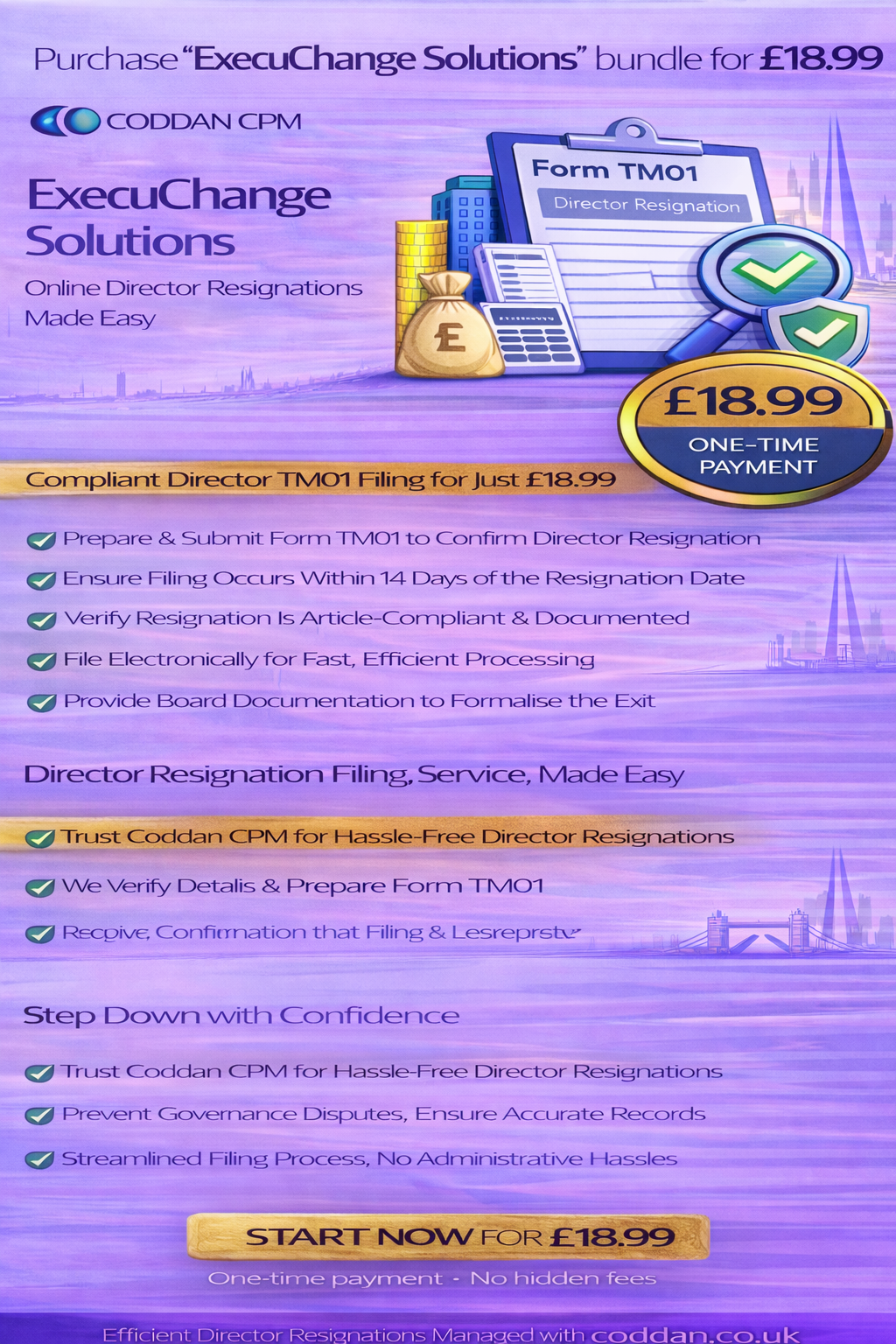
Buy Now When a director decides to resign or step down, the process must be handled correctly to ensure compliance with UK company law. Filing Form TM01 is the statutory requirement to notify UK Companies House of a director’s resignation, and it must be submitted within 14 days of the effective date. Coddan CPM offers a digital TM01 bundle designed to manage director resignations quickly, accurately, and in full compliance. Whether you are voluntarily stepping down, relinquishing your directorship, or formally vacating office, our streamlined electronic filing service ensures the notification is prepared and submitted without delay. It is important to understand that filing TM01 is a notification—not the act of resignation itself. The resignation must first comply with the company’s Articles of Association and any applicable director service agreement.

Our service ensures the removal is properly documented before submission, reducing the risk of governance disputes or ongoing liability. Our secure online system removes unnecessary paperwork and administrative complexity. We prepare the TM01 form, verify key details, and file electronically to ensure timely processing. Where required, we can also provide supporting board documentation to formalise the resignation internally. With Coddan CPM, stepping down as a director becomes a clear, compliant, and professionally managed process—allowing you to focus on your next venture with confidence, knowing your resignation has been handled correctly and efficiently. Step down as a director with confidence. Coddan CPM handles your resignation documentation, ensuring compliance and timely processing without the hassle.


£18.99
+VAT

“ExecuChange Solutions”

Recommended for

2
package

Buy Now Resigning as a director must be handled correctly to ensure full compliance with UK company law. When stepping down, vacating office, or making a voluntary departure, Form TM01 must be filed with Companies House within 14 days of the effective resignation date. Coddan CPM provides a streamlined electronic TM01 filing service designed to make director resignations clear, compliant, and professionally managed. Whether you are relinquishing your directorship voluntarily, demitting office due to restructuring, or formally standing down from board duties, we prepare and submit the required notification swiftly and accurately. It is important to note that TM01 is a statutory notification—not the act of resignation itself. The resignation must first comply with the company’s Articles of Association and any relevant service agreement.

Our service ensures that the termination is properly documented before electronic filing, helping to prevent governance disputes or ongoing liability. We manage the full process from preparation to submission, providing official confirmation once the filing has been accepted. The service supports both individual and corporate director resignations and eliminates unnecessary paperwork or administrative confusion. With Coddan CPM, director resignation becomes a straightforward and compliant transition. We handle the regulatory details with precision, allowing you to move forward confidently while ensuring your company records remain accurate and up to date. Trust Coddan CPM for hassle-free director resignations; we manage documentation and filing, preventing disputes and ensuring your records are always up to date.


£18.99
+VAT

“ExecuChange Solutions”

Recommended for

3
package

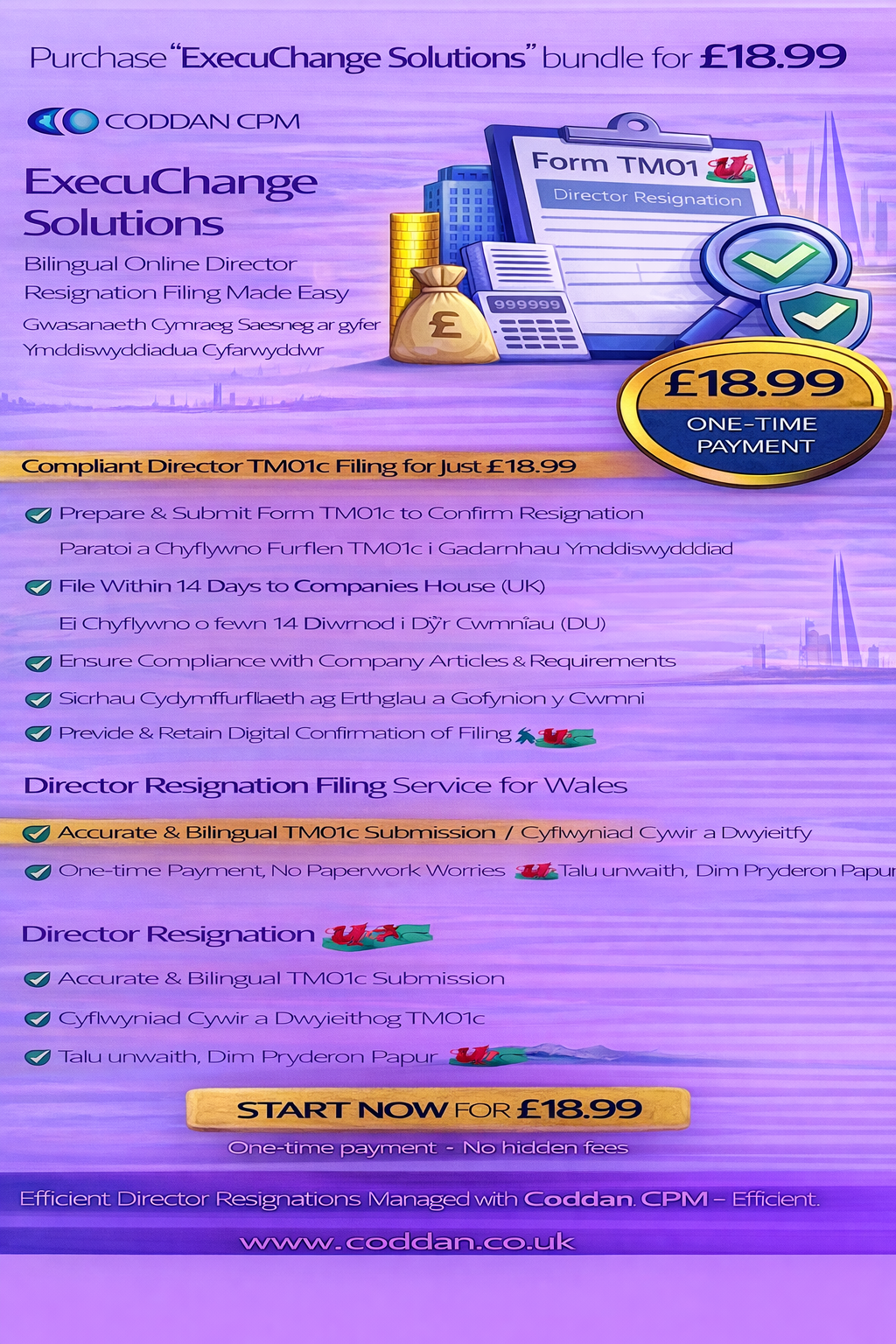
Buy Now When a director resigns or steps down from a Welsh-registered company, the change must be formally notified using Form TM01c and filed with UK Companies House within 14 days. Whether the departure is voluntary, part of a board reshuffle, or due to removal or disqualification, accurate and timely filing is essential to maintain compliance. Coddan CPM offers a streamlined electronic TM01c filing service tailored for companies registered in Wales. Our bilingual English and Welsh support ensures clarity throughout the process, helping directors and companies manage resignations, standing down, or vacating office without administrative confusion. It is important to note that filing TM01c is a statutory notification—it does not itself create the resignation. The resignation or removal must first comply with the company’s Articles of Association and any relevant service agreements.

We ensure that the underlying legal steps are properly documented before submitting the form electronically. Our secure digital process prepares and files the TM01c accurately, confirms submission, and helps maintain correct statutory records. Whether managing a voluntary departure, demitting office, or a more complex exit scenario, we ensure every detail is handled professionally. With Coddan CPM, director resignations in Wales are managed efficiently, bilingually, and in full accordance with UK company law—delivering clarity, compliance, and peace of mind at every stage. Ensure your director resignations are handled with precision. Coddan CPM offers secure, bilingual TM01c filing, ensuring compliance with UK company law.


£18.99
+VAT

Buy “Amendify Pro”

Recommended for

4
package

Buy Now Updating a director’s details should be straightforward—but it must be done correctly to remain compliant. Form CH01 is the statutory form used to notify Companies House of changes to a director’s personal particulars, such as a name change, service address update, or residential address amendment. It is not used to remove a director (Form TM01 applies in that case). Coddan CPM offers a fast and compliant online CH01 filing service, allowing you to amend existing director details efficiently and accurately. Our electronic submission process significantly reduces processing time—often delivering updates within 24 hours, subject to Companies House turnaround—compared with postal filings, which may take 6–7 working days. Accuracy is essential, as director information forms part of the public register.

Errors can result in rejected filings or discrepancies between statutory records and internal registers. Our structured process ensures that all required information is reviewed and submitted correctly, helping your company remain fully compliant. Whether you need to update one director or amend details across your entire board, we provide a streamlined, paperless solution that removes administrative burden. You remain in control of your company’s records, while we ensure every update is handled promptly and professionally. Keep your director records current, compliant, and accurate—with clarity and confidence. Keep your statutory records accurate and compliant with our structured process; we manage updates seamlessly, allowing you to focus on your business with confidence.


Key Takeaways: Use e-Filing Business Portal

Leverage Our Director Removal Service for Expert Support

Expert Corporate Secretarial & Compliance director resignation services involve the professional management of the entire resignation process for a company director, ensuring that all legal, regulatory, and administrative obligations are met to prevent compliance breaches.
Our services provide a secure, accurate, and efficient transition, particularly in managing the legal liabilities of the departing director and the company's statutory records.

Streamline your legal documentation process with our professional filing services for statutory forms, ensuring timely submissions to Companies House and other authorities.

Legal Documentation & Filings: Preparation and filing of required statutory forms (e.g., Form TM01 in the UK) with relevant authorities, such as Companies House, within strict legal timeframes.

Stay compliant with the new UK identity verification process for directors. Discover essential guidance and resources to navigate mandatory requirements effectively.

Compliance & Guidance: Ensuring compliance with mandatory requirements, such as the new identity verification (IDV) process for directors that became mandatory in the UK as of November 2025.

Simplify your board's administrative tasks. Our services include drafting resignation resolutions and updating meeting minutes for clear and formal records.

Board Proceedings: Assisting in drafting board resolutions to accept the resignation and formally updating board meeting minutes.

Keep your statutory registers compliant by updating records of directors, secretaries, and members promptly after any resignations occur.

Statutory Register Management: Updating the company's registers of directors, secretaries, and members to reflect the resignation.

Expert guidance on governance best practices during transitions. We help boards ensure resignations comply with articles of association and contracts.

Advisory & Risk Mitigation: Advising the board on governance best practices during the transition, ensuring the resignation complies with the company's articles of association and employment contracts

Master liability management by learning how to manage resignations effectively, safeguarding against fiduciary duty claims in times of board turmoil.

Liability Management: Ensuring that the resignation is handled correctly to minimize the risk of breach of fiduciary duty claims, especially if the resignation is due to disagreements with the board or company troubles.

Key Takeaways: fast-track e-Filing service

Quick Service To Keep Your Business Corporation Compliant

In essence, our professional services ensure that the "exit" of a director is handled with the same level of legal care and formality as their "entry," protecting both the company and the individual from legal, reputational, or financial repercussions.

Stay compliant and avoid penalties by ensuring your regulatory notifications are filed on time. Learn how to meet deadlines effectively in the UK.

Compliance with Deadlines: Ensuring that regulatory notifications are filed on time (e.g., within 14 days in the UK) to avoid penalties.

Master the art of handling contentious resignations. Discover strategies for managing conflicts and ensuring compliance with regulatory requirements.

Handling Sensitive Departures: Managing potential conflicts or contentious resignations, including documenting disagreements and notifying regulatory bodies if necessary.

Ensure your official records reflect accurate departure dates. Our service guarantees precision for liability and legal purposes. Trust us for compliance.

Assurance of Accuracy: Guaranteeing that the official records accurately reflect the date of departure, which is crucial for liability and legal purposes.

Stay ahead of regulatory changes in board composition. Our expert guidance simplifies the complexities, ensuring compliance in your industry.

Support for Regulatory Changes: Managing the complexities of changes in board composition, especially in regulated industries.

Maximize your productivity! Explore how outsourcing enables CEOs and business owners to focus on essential operations and streamline their workflow.

Unlock time savings with outsourcing! Learn how CEOs can concentrate on core operations while delegating tasks for greater efficiency and growth.

Safeguard your organization with our risk mitigation strategies. Ensure legal compliance and reduce risks from board disputes and documentation issues.

Risk Mitigation: Ensures adherence to legal duties and mitigates risks related to board disputes or improper documentation.

Trust us to prepare and file all required documents for director appointments and resignations, ensuring your compliance is always up to date and hassle-free.

We specialize in preparing and filing essential documents for director changes, guaranteeing full compliance with legal requirements. Let us handle the details for you.


If you are comparing a Director Resignation Service and a Director Termination Service in the UK, you are really comparing two very different legal events under the Companies Act 2006 — even though both end with the same filing at Companies House (Form TM01).

For CEOs, founders, and board-level decision makers, the difference is not administrative — it is about control, risk exposure, governance stability, and legal liability.

Below is a clear, commercially focused breakdown using the key UK company law principles that matter in practice.

Feature Resignation Service Termination (Removal) Service
Nature Voluntary (Director wants to leave) Involuntary (Company wants them out)
Primary Document Resignation Letter Shareholders' Resolution
Notice Period Determined by Contract Statutory 28-day Special Notice
Companies House Form TM01 TM01
Director's Rights None (they chose to leave) Right to protest & speak at the meeting
Risk Level Low High (Risk of "Unfair Dismissal" or "Wrongful Dismissal" claims)

Director Resignation Service (Voluntary Exit)

A Director Resignation is a voluntary departure initiated by the director.

What It Is
A director chooses to step down by submitting a written resignation notice to the company (usually to the registered office). Under standard Model Articles:

  • The director can resign at any time;
  • No shareholder vote is required;
  • No statutory notice period is required (unless stated in a service contract) .

This is the simplest form of director removal in the UK because it is self-initiated.

Who Controls the Process?
The director controls the timing, subject to:

  • Any contractual notice period
  • The requirement that the company must retain at least one natural person director

For CEOs and boards, this usually means the departure can be managed strategically and communicated cleanly.

Legal Complexity Level: LOW
The process typically requires:

  • Written resignation letter
  • Board minute noting the resignation
  • Update of statutory registers
  • Filing Form TM01 within 14 days

There is no requirement for:

  • Special notice
  • Shareholder meeting
  • Statutory right to representations

This makes resignation a low-risk corporate governance process.

Typical Commercial Reasons

  • Retirement
  • Planned succession
  • Strategic exit
  • Health or personal matters
  • Role restructuring

Professional Services Usually Include

  • Drafting compliant resignation letter
  • Preparing board minutes
  • Updating statutory registers
  • Filing TM01 with Companies House
  • Ensuring PSC review (if applicable)

For most private limited companies, this is a straightforward compliance exercise.

Director Termination Service (Shareholder Removal)

A Director Termination (also called Director Removal under Section 168 Companies Act 2006) is an involuntary process. This is where the legal risk increases significantly.

What It Is
Under Section 168 Companies Act 2006, shareholders have a statutory right to remove a director by:

  • Ordinary Resolution (more than 50%)
  • At a properly convened General Meeting

This right cannot be removed by the company’s Articles.

Who Controls the Process?
The shareholders control the outcome, not the director. This often arises in:

  • Shareholder disputes
  • Founder conflicts
  • Performance concerns
  • Breach of fiduciary duty
  • Board breakdown scenarios

For CEOs, this is a high-sensitivity governance event.

Legal Complexity Level: HIGH
This is not a simple filing exercise. The law requires strict procedural compliance:

  1. 28 Clear Days’ Special Notice
    Shareholders must formally notify the company of their intention to remove the director.
  2. Director Must Be Notified
    The company must send the notice to the director.
  3. Right to Make Representations
    The director has a statutory right to:
    • Submit written representations
    • Speak at the general meeting
  4. General Meeting Required
    Removal cannot be done by written resolution.
  5. Post-Removal Filing
    Form TM01 must be filed within 14 days.

Failure to comply with any of these steps can make the removal legally challengeable.

Typical Commercial Reasons

  • Underperformance
  • Governance breaches
  • Misconduct
  • Strategic restructuring
  • Irretrievable breakdown in trust

Professional Termination Services Typically Cover

  • Managing the 28-day statutory timeline
  • Drafting special notice documentation
  • Preparing shareholder resolutions
  • Advising on representation rights
  • Managing reputational and dispute risk
  • Filing TM01
  • Coordinating employment law advice

This is fundamentally a corporate governance and risk management exercise.

Critical CEO Risk: The Executive Director Problem
The single biggest legal pitfall in UK director removal is when the individual is both:

  • A Director, and
  • An Employee under a service contract

Removing someone as a director does NOT automatically terminate employment.

This is where many businesses make costly mistakes. If handled incorrectly, the company may face:

  • Unfair Dismissal claims
  • Wrongful Dismissal claims
  • Contractual damages
  • Tribunal proceedings
  • Reputational damage

In Great Britain, employment claims fall under the Employment Rights Act 1996. In Northern Ireland, they fall under the Employment Rights (Northern Ireland) Order 1996.

A properly structured Director Termination Service must coordinate both:

  • Company law compliance
  • Employment law compliance

Ignoring one while focusing on the other is a major liability risk.

Is the Law Different in England, Wales, Scotland or Northern Ireland?

From a company law perspective: No.

The Companies Act 2006 applies across the entire UK. The procedure for:

  • Director resignation
  • Director removal under Section 168
  • Filing Form TM01

is identical nationwide.

Differences only arise in:

  • Court systems
  • Employment tribunals
  • Insolvency administration

The core UK director removal process is unified.

Executive-Level Summary

Factor Director Resignation Director Termination
Voluntary? Yes No
Who controls timing? Director Shareholder
Shareholder vote required? No Yes
28-day special notice? No Yes
Right to make representations? No Yes
Legal risk level Low High
Employment law exposure Moderate Significant

Final Takeaway for CEOs and Founders
A Director Resignation Service is a compliance-driven administrative process.

A Director Termination Service is a statutory, procedural, and potentially litigious event that requires careful governance management. Although both end with filing Form TM01 at Companies House, the underlying legal mechanics — and risk exposure — are entirely different.

If you are considering removing a director in the UK, the decision should be approached not just as a filing exercise, but as a strategic legal and reputational risk assessment.


Director Resignation or Removal – Our Service.
Coddan CPM makes director resignation and removal straightforward, compliant, and stress-free. Whether a director is stepping down voluntarily or being replaced as part of a wider board change, our regulated team manages the entire process accurately and efficiently.

What Our Director Resignation Service Includes.
Our director resignation service is designed to meet all legal and Companies House requirements under the Companies Act 2006. We handle every administrative step on your behalf, including:

  1. Director resignation letter.
    A formal letter from the outgoing director confirming their decision to resign. While an acceptance letter is not legally required, we recommend retaining a copy if issued for internal records.
  2. Director resignation board minutes.
    Professionally drafted minutes for the board meeting at which the resignation is noted and accepted, prepared in line with statutory requirements.
  3. Director resignation resolution.
    A compliant written resolution documenting the change in directorship.
  4. Companies House filing (TM01).
    Completion and electronic submission of Form TM01 to notify Companies House of the resignation or removal.
  5. Confirmation of filing.
    Email notification once Companies House has accepted the submission.
  6. Digital documentation delivery.
    All completed documents are delivered securely by email within 1–2 working days.
  7. Combined Service.
    Appoint a New Director and Resign an Existing One.

If you are replacing a director, our combined appointment and resignation service allows you to complete both actions in one seamless process.

We will:

  • Prepare and file Form AP01 (appointment) and Form TM01 (resignation).
  • Update statutory registers.
  • Carry out secure identity verification for the incoming director.
  • Ensure Companies House records are fully aligned and up to date.

This is the fastest and most reliable way to manage board changes while maintaining full compliance.

Why Use Coddan CPM?
As an ACSP-regulated corporate service provider, Coddan CPM processes director changes daily for UK companies of all types. Every step is completed in accordance with Companies House rules, giving you confidence that your company remains legally compliant.

By letting us handle the paperwork and filings, you:

  1. Save time.
  2. Avoid costly errors or rejected submissions.
  3. Gain peace of mind that the process has been completed correctly.

Our Director Resignation and Removal service is efficient, reliable, and built to let you stay focused on running your business—while we take care of governance and compliance.


How to Legally Remove a Limited Company Director.

How to Simplify Your Business Director Resignation in the UK

The legal process permits the removal or termination of any director through an ordinary resolution passed by the shareholders during general meetings.

Explore the intricacies of terminating directors’ appointments, including resignation, vacation of office, and legal implications; stay informed and compliant!

Learn about the termination of directors’ appointments, including resignation and legal vacating; navigate the complexities with our comprehensive resources.

To resign a limited company director in the UK affordably, use an online Companies House agent service for a fast, digital process with prices around £75 + VAT.

Resign as a limited company director in the UK easily and affordably; use our online Companies House agent service for a quick process at just £75 + VAT.

Use this service and purchase our simple online Webform" to remove a director from a limited company electronically; use our basic digital webform starting from £75.

Easily remove a director from your limited company with our simple online webform, starting at just £75—quick, efficient, and hassle-free service.

Learn the legal steps to resign or remove UK company directors, from fast preparation of resolutions and e-filings to compliance tips that protect your business.

Learn how to legally resign or remove UK company directors with our comprehensive guide—from resolutions to compliance tips, protect your business effectively.
Streamline the resignation and removal process for directors with our easy-to-use electronic Webforms, complete with all necessary legal documents.

The fastest way to resign and remove a listed director is by utilizing the online Companies House-approved WebFiling ACSP services, allowing you to complete the process 100% remotely and stress-free.

Resign and remove a listed director quickly and easily with our Companies House-approved WebFilings ACSP services; complete the process 100% online and stress-free.

Key Takeaway

Understanding the Legal Steps for a Director to Resign in the UK.
A director resignation in the UK is generally straightforward, but it must follow specific legal and procedural steps to remain compliant with the Companies Act 2006. Failing to follow the correct process can result in inaccurate Companies House records, ongoing statutory duties, or disputes over authority. Directors should therefore ensure their resignation is properly documented and formally recorded.
Before resigning as a company director, it is essential to review the Articles of Association and any director service agreement in place. These documents often set out the required resignation procedure, including notice periods, formalities, or post-termination obligations. Complying with these contractual terms helps avoid breach of contract claims and governance issues.
A director should then notify the company of their resignation, ideally by submitting a written resignation letter to the board. The letter should clearly confirm the intention to resign and state the effective date of resignation. While providing reasons is optional, the resignation notice should be unambiguous, as it serves as formal evidence that the directorship has ended.
Once a director resigns, the company must update its statutory records and notify Companies House by filing a TM01 form within 14 days of the resignation date. Although this filing is the company’s responsibility, resigning directors are advised to verify that the TM01 has been submitted to ensure public records accurately reflect their status and ongoing director duties are brought to an end.
Finally, directors should consider the wider legal and financial implications of resigning, particularly where there are outstanding projects, client relationships, or continuing obligations under shareholder or service agreements. Managing a structured handover and seeking professional advice where necessary can help protect both the director and the company during the transition.
Navigating Director Resignation Made Easy with Coddan Online Services.
Director resignations are a routine but sensitive part of corporate life, particularly for CEOs and senior leaders managing change, succession, or strategic realignment. When a company director resigns in the UK, the process must comply with the Companies Act 2006, the company’s Articles of Association, and Companies House filing requirements. Coddan Online Services provides a streamlined and compliant solution designed to remove complexity from the director resignation process.
Resigning as a director can involve multiple steps, including preparing formal resignation documentation, notifying the board, and ensuring that the correct filings—such as the TM01 form—are submitted to Companies House within 14 days. Coddan simplifies this process through an intuitive online platform that guides directors and companies through each legal requirement, reducing the risk of errors, delays, or compliance breaches.
One of the key benefits of using Coddan for a director resignation is their practical understanding of UK company law and corporate governance procedures. Their service ensures that all required documents are correctly prepared and submitted, helping companies maintain accurate statutory records while enabling directors to step down professionally and efficiently. This is particularly valuable where timing, reputation, or transactional certainty matters.
Coddan’s online director resignation service allows resignations to be managed remotely, saving time and administrative burden. Directors can access the necessary forms, complete the process online, and ensure that Companies House records are properly updated without the need for lengthy correspondence or manual filings. This approach supports a smooth transition while allowing leadership teams to remain focused on business continuity.
In a fast-moving commercial environment, working with a specialist provider that understands director resignation procedures in the UK is essential. Coddan Online Services not only simplifies the administrative process but also supports best-practice governance, ensuring that a director’s departure is handled with professionalism and legal certainty.
For directors or companies facing an imminent resignation, Coddan Online Services offers a reliable, efficient, and compliant solution—providing peace of mind and helping ensure that the company remains on track during periods of change.
How to Notify Companies House of a Director Departure Using Coddan Legal Firm.
Notifying Companies House of a director departure is a legal requirement for UK companies and must be completed accurately and on time to remain compliant with the Companies Act 2006. When a director resigns or is removed, companies must ensure their statutory records are updated promptly. Coddan Legal Firm provides expert support to simplify this process and reduce the risk of errors or delays.
Before notifying Companies House, companies must gather the required information about the departing director. This typically includes the director’s full legal name, the effective date of resignation or removal, and confirmation of how the departure was approved. Coddan’s corporate services team assists clients in identifying and verifying the correct information, ensuring all filings meet Companies House standards.
Coddan Legal Firm specialises in handling the formal documentation required for a director resignation or removal. This includes preparing board resolutions where necessary and completing the TM01 form, which is used to notify Companies House that a director has ceased to act. The TM01 must be filed within 14 days of the director’s departure, making accuracy and timing critical.
Once the documentation is prepared, Coddan can submit the TM01 and related filings to Companies House on the company’s behalf. This allows directors and business owners to focus on day-to-day operations while ensuring that their compliance obligations are met efficiently and correctly. Coddan’s experience helps prevent common filing errors that can lead to rejected submissions or inaccurate public records.
Maintaining accurate Companies House records is essential for corporate transparency, governance, and investor confidence. By using Coddan Legal Firm to notify Companies House of a director departure, companies benefit from a streamlined, professional service that ensures changes in directorship are handled smoothly and in full compliance with UK company law.
How to Choose a Reliable Service for Director Resignation Changes.
When managing director resignation changes, choosing a reputable professional service is essential to protect your company’s integrity and ensure compliance with UK company law. Errors in handling director resignations can lead to inaccurate Companies House records, regulatory risk, and governance issues. Working with an established provider such as Coddan CPM can significantly reduce complexity and stress during the process.
The first step in selecting a reliable director resignation service is thorough research. Look for providers that specialise in company formation and company secretarial services, as these firms typically have extensive experience handling director appointments, resignations, and statutory filings. A credible provider should have a strong online presence, clear service descriptions, and positive reviews or testimonials demonstrating consistent client satisfaction.
Experience and technical expertise are critical when dealing with director-related changes. A trusted provider should have a proven track record in managing resignations, preparing statutory documents, and filing updates with Companies House, including the TM01 form. Reviewing case studies or client examples can help assess how effectively the provider has handled similar director resignation scenarios in the past.
Direct communication is another key indicator of reliability. A reputable service will be transparent about its process, timelines, and fees for handling director resignations. Engaging with the provider before instructing them allows you to evaluate their responsiveness, professionalism, and willingness to explain compliance requirements clearly—an important factor when dealing with time-sensitive filings.
Finally, consider professional standards and affiliations. Providers aligned with recognised professional bodies or operating under established regulatory frameworks demonstrate a commitment to best practice, confidentiality, and compliance. This reassurance is particularly important when sharing sensitive company and director information.
By following these guidelines and choosing an experienced provider such as Coddan CPM, companies can manage director resignations efficiently, maintain accurate statutory records, and ensure a smooth and compliant transition in leadership.
How Long Does It Take Coddan CPM to Process a Director Removal or Resignation?
Managing a director removal or director resignation in the UK requires accuracy, speed, and compliance with Companies House requirements. Businesses using Coddan CPM often want clarity on how long the process takes, particularly where leadership changes are time-sensitive. While timelines can vary, Coddan CPM is structured to deliver efficient and reliable turnaround times.
In most cases, once Coddan CPM receives complete and accurate documentation, the director removal or resignation filing can be processed within 1 to 2 business days. This includes preparing the necessary paperwork, completing the TM01 form, and submitting the update to Companies House. Processing times may be shorter where instructions are clear and no additional approvals or corrections are required.
Delays typically arise when paperwork is incomplete, information is inconsistent with Companies House records, or clarification is required regarding the method of removal or resignation. Ensuring that director details, resignation dates, and approvals are correct at the outset helps Coddan CPM process filings quickly and without interruption.
Effective communication also plays a key role in expediting director changes. Coddan CPM’s corporate services team is available to answer questions, resolve issues, and confirm requirements throughout the process. Prompt responses to any queries help avoid unnecessary delays and ensure filings are completed within the expected timeframe.
In summary, Coddan CPM can usually process a director resignation or removal within a few working days, provided all information is accurate and complete. For companies seeking a fast, compliant, and professionally managed solution, Coddan CPM offers a dependable service that supports smooth leadership transitions.
Understanding the Legal Procedure for Removal and Resignation of a Director.
Understanding the legal procedure for the removal and resignation of a company director in the UK is essential for CEOs, board members, and company secretaries. Each process is governed by the Companies Act 2006, the company’s Articles of Association, and internal governance documents. Following the correct procedure helps ensure compliance, reduce dispute risk, and maintain corporate integrity.
Legal Procedure for Removal of a Director.
The removal of a director is often a sensitive and legally structured process. In most UK companies, directors are removed by shareholders under section 168 of the Companies Act 2006, which requires an ordinary resolution supported by a simple majority. Special notice must be given, and the director has the right to make representations. However, companies should first review their Articles of Association, as some permit removal by the board or provide for automatic cessation of office in defined circumstances.
Before initiating removal, companies should carefully document the reasons for the decision and ensure procedural fairness. Board and shareholder meetings must be properly convened, notices correctly issued, and decisions accurately recorded in the meeting minutes. Once a director is removed, the company must notify the individual formally and file a TM01 form with Companies House within 14 days to update the public register.
Legal Procedure for Resignation of a Director.
A director resignation is a voluntary process and usually takes effect when the director provides written notice to the company, unless the Articles specify otherwise. The resignation letter should clearly confirm the intention to resign and state the effective date. While board approval is not always legally required, it is best practice to acknowledge the resignation formally and record it in the board minutes.
Following a director’s resignation, the company must update its statutory registers and file the TM01 form at Companies House within the required timeframe. Until this filing is completed, the director may continue to appear on the public register and could be perceived as retaining statutory responsibilities.
Importance of Compliance and Documentation.
Whether a director is removed or resigns, maintaining accurate documentation and procedural compliance is critical. Companies must ensure that statutory records are updated, governance processes are followed, and any implications under service agreements, shareholder agreements, or share transfers are addressed. Poorly managed director exits frequently lead to disputes, regulatory exposure, or transaction delays.
For this reason, many companies choose to involve legal or company secretarial professionals to manage director removals and resignations correctly. Understanding and following the correct legal steps is not only a compliance requirement—it is a key component of strong corporate governance and reputation management.

How to Ensure Compliance Resign a Director.

Impact Beyond Just Filing the Resignation TM01 Form

Understand the important impacts of director resignations by exploring the legal and financial repercussions that go far beyond just the TM01 filing.

Discover top-rated London agents like Coddan for seamless online services to remove directors from private limited companies—experience hassle-free solutions today!

Several top-rated London agents, like Coddan, provide quick and user-friendly online services for removing directors to private limited by shares companies, based on recent experiences in the UK company formation market (2025–2026).

Coddan CPM agents expertly manage Form TM01 filings with Companies House, ensuring all necessary documentation, including board minutes, is provided seamlessly.

Coddan CPM agents handle the necessary Form TM01 filing with Companies House and typically provide supporting documentation  such as board minutes.

Coddan provides first-time directors with a seamless online removal process and exceptional UK customer support; experience hassle-free service now!

Coddan offers an invaluable service for first-time directors, with a straightforward online directors removal process and excellent customer support based in the UK.

Coddan CPM streamlines the complexities of director appointments and resignations with a quick, easy online process—discover efficient solutions now!

Coddan CPM offers a very user-friendly, fast online process, often praised for helping with the complexities of appointing new directors and resigning listed directors.

Choose our experienced ACSP filing agent for quick electronic submissions; remove key managerial personnel efficiently and stay compliant with Companies House.

Use an experienced ACSP filing agent that files electronically (API) directly to Companies House, which is much faster than a paper form for removing a key managerial personel.

Coddan CPM provides a quick and affordable director removal service for £75+ VAT—complete the process online in just 1-2 working days.

Coddan CPM offering a dedicated director removal and resignation service for around £75+ VAT, usually completed within 1–2 working days, entirely online.

Discover the Details

Resigning as a company director in the UK does not need to be complex, but it does require careful handling to ensure legal compliance and a smooth transition. Whether a director is stepping down for personal reasons, career progression, or strategic realignment, understanding the correct resignation process helps protect both the individual and the company.
Before resigning, a director should review the company’s Articles of Association and any shareholder or service agreements. These documents often specify the formal procedure for resignation, including notice requirements or additional obligations. In most cases, a director resignation must be made in writing. A director resignation letter should clearly state the intention to resign, confirm the effective date, and be submitted to the company in accordance with the Articles. Maintaining a professional and courteous tone supports ongoing goodwill and reputation.
Directors should also be aware that resignation does not remove responsibility for actions taken while in office. Statutory and fiduciary duties continue to apply in relation to past decisions, and any unresolved matters should be addressed before departure. Preparing a structured handover or transition plan—outlining responsibilities, key projects, and recommended successors—helps ensure continuity and demonstrates responsible governance.
Once a director resigns, the company must update its internal records and notify Companies House by filing a TM01 form within 14 days of the resignation date. Although this filing is the company’s responsibility, resigning directors are advised to confirm that the update has been made to avoid remaining listed on the public register.
Clear communication is also an important part of the resignation process. Informing fellow directors, senior management, and key stakeholders in a timely and transparent manner helps prevent uncertainty and maintains confidence in the company’s leadership.
In summary, resigning as a director involves more than submitting a resignation letter. By following the correct legal steps, complying with governance documents, and supporting a smooth transition, directors can step down professionally while safeguarding their reputation and the company’s stability.
Understanding the Legal Procedure for Resignation of a Director.
Resigning from a company directorship in the UK is a formal legal process that must be handled correctly to ensure compliance with the Companies Act 2006 and to maintain effective corporate governance. While the process is generally straightforward, failure to follow the correct steps can result in ongoing statutory obligations or inaccurate Companies House records.
Before resigning, a director should review the company’s Articles of Association and any applicable shareholder or service agreements. These documents often set out specific procedures for director resignation, including notice requirements, resignation formalities, or post-resignation obligations. Adhering to these provisions is essential to avoid contractual breaches and governance disputes.
A written resignation letter is a key legal requirement. The letter should clearly state the director’s intention to resign and specify the effective date of resignation. While providing reasons for resigning is optional, the notice must be unambiguous to ensure there is no uncertainty about when the directorship ends. A clear and professional resignation letter helps prevent misunderstandings and protects both the director and the company.
Once prepared, the resignation letter should be submitted to the board of directors in accordance with the Articles. As a matter of best practice, directors often discuss their intention to resign with the chair, managing director, or CEO in advance. This supports transparency and allows the board to consider succession planning and continuity.
Following the resignation, the company must update its statutory records and notify Companies House by filing a TM01 form within 14 days of the resignation date. This step is critical to ensure the public register accurately reflects the company’s current directors and that the resigning director’s statutory duties formally come to an end.
In summary, resigning as a director involves more than submitting a resignation letter. By following the correct legal procedure, complying with governance documents, and ensuring timely Companies House filings, directors can resign confidently while safeguarding their legal position and the company’s integrity.
Can a Director Remove Themselves from a Limited Company?
Yes, a director can remove themselves from a limited company by resigning from office, provided the correct legal procedure is followed. In the UK, director resignation is governed by the Companies Act 2006 and the company’s Articles of Association. While the process is generally straightforward, it must be handled properly to ensure compliance and avoid ongoing legal obligations.
A director resigns by giving written notice to the company, unless the Articles specify an alternative method. The resignation letter should clearly state the intention to resign and confirm the effective date. This written notice forms part of the company’s official records and is essential for evidencing when the directorship ends. Once the resignation takes effect, the remaining directors or company secretary should update the company’s internal registers.
Following a director’s resignation, the company must notify Companies House by filing a TM01 form within 14 days. This updates the public register and ensures the resigning director is no longer shown as an active officer of the company. Although filing the TM01 is the company’s responsibility, directors are advised to confirm that the filing has been completed to avoid remaining listed publicly.
It is important to note that resigning as a director does not remove liability for actions taken while in office. Directors may still be held accountable for breaches of duty, wrongful trading, or decisions made during their tenure. For this reason, seeking legal or professional advice before resigning is often advisable, particularly where the company is experiencing financial or legal difficulties.
In summary, a director can remove themselves from a limited company by resigning, but the resignation must comply with the Articles, be properly documented, and be recorded at Companies House. Following the correct process protects both the director and the company and supports a smooth and legally compliant transition.
Can a Director Walk Away from a Private Limited by Shares Company?
A director of a private limited by shares company can resign from their role, but they cannot simply “walk away” without following the correct legal and governance procedures. In the UK, director resignation is governed by the Companies Act 2006, the company’s Articles of Association, and any applicable shareholder or service agreements. Failing to follow the proper process can result in ongoing legal obligations or disputes.
Before resigning, a director should review the company’s Articles of Association, which typically set out the formal procedure for resignation, including notice requirements and documentation. In most cases, a director must provide written notice of resignation to the company, clearly stating the intention to resign and the effective date. This ensures the resignation is valid and properly recorded.
Although a director is entitled to resign at any time, they should consider their ongoing duties and responsibilities. Directors remain accountable for decisions made while in office and may still face liability for breaches of duty, wrongful trading, or misconduct that occurred before resignation. Communicating the decision to fellow directors and shareholders helps support continuity and avoids governance gaps.
Following a director’s resignation, the company must update its internal statutory registers and notify Companies House by filing a TM01 form within 14 days. This step is essential to ensure public records accurately reflect the company’s current directors. Until this filing is completed, the resigning director may continue to appear on the public register.
Directors should also consider the practical impact of their departure. Assisting with succession planning, handover of responsibilities, or training a replacement can help minimise disruption, particularly where the director plays a key strategic or operational role. Additionally, directors should review any post-termination obligations, such as confidentiality or non-compete clauses, contained in service or shareholder agreements.
In summary, while a director of a private limited by shares company can resign, doing so requires formal notice, proper documentation, and compliance with Companies House filing requirements. Exiting in a structured and professional manner protects both the director and the company and supports a smooth transition in leadership.
Can I Use an Online Platform to Resign as a Director Electronically?
Yes, directors can resign electronically using a reputable online platform. Online director resignation services are increasingly popular for their speed, convenience, and compliance support. In the UK, director resignation must comply with the Companies Act 2006 and the company’s Articles of Association, but the process can be managed efficiently online through specialist providers such as Coddan CPM.
Using an online platform to resign as a director allows you to submit the necessary documents digitally, including a formal director resignation letter and any supporting information required by the company. These services guide directors through the process step-by-step, ensuring all legal requirements are met, documentation is correctly completed, and statutory records are updated.
Online resignation platforms offer several key benefits for directors and companies. They provide convenience, allowing the process to be completed remotely without the need for in-person meetings or manual paperwork. They also support faster processing times, helping to ensure that the resignation is recorded promptly. Most importantly, they help maintain compliance with Companies House filing requirements, including submitting the TM01 form within 14 days of resignation.
When choosing an online director resignation service, it is essential to select a reputable provider that understands corporate governance and UK company law. A trusted platform should provide clear guidance, maintain data security, and ensure accurate filings. Providers such as Coddan CPM are known for their user-friendly interfaces and professional support, helping directors manage their exit efficiently and confidently.
Rules for Removing Directors in a Private Company.
Removing a director in a private company is a serious governance decision that must be handled carefully to ensure compliance with company law and the company’s constitutional documents. In the UK, director removal is governed by the Companies Act 2006 and the company’s Articles of Association. Private companies typically remove directors through a shareholder vote, but the exact process can vary depending on the company’s articles and any service agreements.
The first step in the director removal process is to review the company’s Articles of Association. These articles often set out the procedure and grounds for removing a director, including whether removal requires an ordinary resolution or a specific process. In most private companies, directors can be removed by an ordinary resolution of shareholders, meaning more than 50% of the shareholders present and voting must approve the removal.
It is also important to consider any contractual terms that apply to the director, particularly if they were appointed for a fixed term or under a service agreement. The articles and employment contract may contain provisions about early termination, notice periods, and compensation. Directors should be treated fairly, and the company should document the reasons for removal to reduce the risk of legal challenges, especially where misconduct or breach of duty is alleged.
In most jurisdictions, including the UK, a director being removed must be given the opportunity to make representations at the meeting where the removal is proposed. This is a key procedural safeguard and helps protect the company against claims of unfair treatment or procedural irregularity.
Once a director is removed, the company must update its statutory registers and notify Companies House by filing a TM01 form within 14 days. This ensures that the public register reflects the current board and helps maintain corporate transparency and compliance.
In summary, director removal in a private company requires careful planning, adherence to the Articles of Association, and accurate statutory filings. For companies seeking to manage director removal efficiently and compliantly, professional company secretarial support can provide guidance and ensure the process is handled correctly.
What is the Simple Online Coddan Director Removal Webform Service?
The Coddan director removal webform service is a simple online solution designed to streamline the process of removing a director from a UK company. For many business leaders, director removal can involve complex paperwork, legal requirements, and Companies House filings. Coddan’s webform service simplifies this by allowing directors to complete the process quickly and accurately through an intuitive online platform.
This service is ideal for directors who want a fast, compliant way to resign or remove themselves from a company without navigating complex corporate governance procedures. Users simply complete a straightforward online form with their details, and Coddan’s team handles the preparation and submission of the necessary documentation. This includes ensuring that the resignation or removal is processed in accordance with the company’s Articles of Association and the Companies Act 2006.
One of the key benefits of the Coddan director removal webform service is its user-friendly design. The platform guides users step-by-step, reducing the risk of errors or delays that can occur with manual filings. This makes it a practical option for busy CEOs and company directors who need an efficient way to manage corporate changes.
In addition, Coddan’s service ensures compliance with the latest regulatory requirements, including the correct filing of the TM01 form with Companies House. By using a professional online service, directors can avoid common mistakes that may lead to rejected filings or compliance issues. This provides peace of mind and helps maintain accurate statutory records.
In summary, the simple online Coddan director removal webform service offers a fast, reliable, and compliant way to handle director removal or resignation. It is an effective solution for businesses seeking to manage leadership changes efficiently while maintaining corporate governance standards. If you are considering stepping down or updating your company’s directorship, this service provides a convenient and professional option.

Director Resignation & Removal Services | Coddan CPM Online Platform.

When a director decides to resign or a company needs to remove a director, the process can be complex and time-consuming. From drafting formal documentation to filing with Companies House, compliance requirements can easily overwhelm business leaders. That’s where Coddan CPM comes in.

Coddan CPM provides a professional, streamlined online service for director resignation and removal, designed for private limited companies. Whether you are a director stepping down or a CEO managing corporate changes, our service simplifies the entire process, ensuring accuracy, compliance, and peace of mind.

Why Choose Coddan CPM for Director Resignation & Removal?

Choosing a reputable company secretarial provider is essential to protect your company’s integrity and ensure compliance with legal obligations. Coddan CPM specialises in company formation, company secretarial services, and director changes, with a strong track record of successful filings and satisfied clients.

When you work with Coddan CPM, you benefit from:

  • Expert guidance on company law and governance.
  • Accurate completion of all required documentation.
  • Efficient filing with Companies House.
  • Fast processing times (typically 1–2 business days).
  • Clear communication and support throughout the process.

Our platform is designed for busy directors and CEOs who need a fast, compliant solution without the hassle of manual paperwork.

Understanding Director Resignation vs Director Removal. Director Resignation (Voluntary):

A director may resign for personal reasons, career changes, or other commitments. Resignation is a voluntary action and typically requires:
  • A written resignation letter.
  • Submission to the board of directors.
  • Formal acceptance documented in board minutes.
  • Filing the relevant forms with Companies House (usually TM01).

While resignation is straightforward, it is important to follow company procedures outlined in the Articles of Association and any shareholder agreements.

Director Removal (Shareholder Decision).

Director removal is often more complex and may involve:
  • Review of the company’s Articles of Association.
  • A shareholder vote (ordinary resolution), usually requiring a majority.
  • Opportunity for the director to be heard (where applicable).
  • Formal documentation and meeting minutes.
  • Filing with Companies House.

In some cases, removal may be necessary due to misconduct, breach of duty, or a conflict of interest. Proper documentation is crucial to avoid disputes or legal challenges.

Can a Director Resign Electronically?

Yes. Directors can use online platforms to submit their resignation and complete the required filings. Coddan CPM’s online director removal webform service enables directors to resign electronically with ease.

Using our service, you can:

  • Complete the process remotely from home or office.
  • Submit required documents online.
  • Receive confirmations and updates.
  • Ensure compliance with Companies House requirements.

Our webform service is designed to be user-friendly and efficient, saving you time and reducing the risk of filing errors.

The Coddan CPM Director Removal Webform Service.

The Coddan director removal webform service is a simple and reliable solution for directors seeking to resign or be removed from a private limited company. The service is designed to reduce administrative burden and streamline the process from start to finish.

How it works:

  • Complete the online webform with director details and effective date.
  • Coddan prepares the necessary documentation, including the TM01 form.
  • We file the forms with Companies House on your behalf.
  • You receive confirmation once the change is updated in the public register.

Our service ensures compliance with the latest regulations and helps prevent common filing mistakes. It is an ideal solution for directors who need a fast, professional way to step down.

How Long Does the Process Take?

Coddan CPM typically completes the filing process within 1–2 business days, provided all documentation is accurate and submitted correctly. Delays can occur if information is missing or requires correction, which is why our team provides full support to ensure a smooth process.

Key Considerations When Resigning or Removing a Director.

Legal Obligations and Responsibilities.
Even after resignation, directors may still be accountable for decisions made during their tenure.

It is important to ensure:

  • All pending matters are settled.
  • Ongoing responsibilities are transitioned.
  • Stakeholders are informed.
  • Proper documentation is maintained.
  • Company Records and Compliance.

After any director change, the company must update:

  • Director register.
  • Companies House records.
  • Company minutes and board resolutions.

Failing to update records can lead to compliance issues or legal complications.

How to Choose a Trustworthy Service Provider.

When selecting a company secretarial service, consider the following:

  • Experience and expertise in director changes.
  • Positive reviews and client testimonials.
  • Clear communication and transparent pricing.
  • Professional affiliations or certifications.
  • Strong compliance record.

Coddan CPM meets all these criteria, offering a trusted and reliable service for director resignation and removal.

Ready to Resign or Remove a Director?
If you need to resign as a director or manage a director removal, Coddan CPM provides a fast, compliant, and professional solution. Our online platform makes the process simple, allowing you to focus on running your business.

Contact Coddan CPM today to begin your director resignation or removal process with confidence.

Compliance expert services for director removal, and resigning a director

Resign, or remove a director with the help of our experts in London.

Removing a company director in the UK requires adherence to the Companies Act 2006 to prevent unfair dismissal claims.
The process can be expedited by reviewing the Articles of Association and following the statutory procedure.
Engaging a legal professional to draft a resignation letter and agreement can ensure compliance and clarity in the resignation terms.
The fastest way to resign and remove a listed director is by utilizing the online Companies House-approved WebFiling ACSP services, allowing you to complete the process 100% remotely and stress-free.


How to Legally Remove a Limited Company Director.

How to Simplify Your Business Director Resignations in the UK

Streamline your director resignation process with Coddan CPM’s expert service; we handle all legal documents, saving you time and ensuring compliance.

Coddan CPM is the law firm and Authorised Corporate Service Provider (ACSP) that offers a variety of legal services in Great Britain GB:
  • A director removal service for your limited company in just 24 hours.
    • Filing necessary forms like the TM01.
    • Preparation of the director’s resignation letters.
    • Preparation of the board resolutions.
    • Preparation of the director service agreement.
    • Advising on statutory procedures (s168/s169 Companies Act).
    • Updating your vital corporate registers.
    • Updating public records for a stress-free process.
    • Employment Law & Service Contract review.
  • Manage the administrative and legal requirements.
    • Ensuring all board minutes, resolutions are correctly prepared and filed.
    • Ensuring the Form TM01 (to notify Companies House within 14 days) is correctly prepared and filed.

How to Ensure Compliance Remove a Director.

Impact Beyond Just Filing the Appointment TM01 Form

Ensure a smooth director removal process with expert corporate law advice. Discover essential procedures and legal insights tailored for removal company directors.
Make sure to handle all the necessary admin and legal steps for new directors under UK company law, from removing directors to updating records.

  • Confirm Authority.
    Review the company’s articles of association and any director service agreement to confirm the correct removal process.
  • Approve the Removal.
    Obtain approval via board resolution (if permitted) and/or shareholder resolution (as required by the articles and Companies Act 2006).
  • Provide Notice.
    Serve a notice of proposed removal and allow the director the opportunity to respond where applicable.
  • Issue a Formal Removal Letter.
    Confirm the removal in writing, including the effective date and any contractual terms.

Is Removing a Director a Hassle?

Removing a company director is generally considered a high-stakes, complex, and potentially time-consuming process, but Coddan can handle all required paperwork on your behalf.


Why Removing a Company Director Is Often More Complicated Than Expected.

Removing a company director is rarely straightforward. While many business owners assume it is a quick shareholder vote, the reality is that director removal is a high-risk legal process governed by strict rules under the Companies Act 2006. If the process is mishandled, the removal can be invalidated, and the company may face legal claims, financial exposure, and operational disruption.

Shareholders do have the legal power to remove a director by ordinary resolution (a simple majority). However, that power comes with procedural obligations that must be followed precisely. Missing a step, using the wrong notice period, or ignoring the director’s rights can turn what should be a governance exercise into a costly dispute.

The Special Notice Requirement: A Common Pitfall.

One of the most frequently overlooked requirements is special notice. Under the Companies Act 2006, shareholders must give the company at least 28 clear days’ notice of their intention to remove a director. This is not optional. If the notice period is incorrect or improperly served, the removal can be legally void, even if shareholders unanimously vote in favour.

This is where many companies encounter problems. Informal agreements, rushed meetings, or poorly drafted resolutions often fail to meet statutory standards, leaving the company exposed to challenge.

Directors Have Legal Rights — Even During Removal.

A director facing removal has legally protected rights. They must receive formal notice of the proposed removal and are entitled to submit written representations to shareholders. They also have the right to speak at the meeting where the resolution is considered.

Ignoring or limiting these rights can significantly increase the risk of legal action. Courts take procedural fairness seriously, particularly where removal affects a director’s reputation, livelihood, or shareholding position.

Employment Law Risks Often Overlooked.

A critical but often misunderstood point is that removing a director does not automatically terminate their employment. If the director also has a service contract, employment law applies. Failure to follow a fair dismissal process can result in unfair dismissal or wrongful dismissal claims, with compensation, legal costs, and management distraction following closely behind.

This separation between office (director) and employment is one of the biggest sources of unexpected liability for companies.

Shareholder Deadlock Can Make Removal Impossible.

In private companies with equal (50/50) shareholdings, removing a director can be practically impossible without their consent. An ordinary resolution requires more than 50% approval. Without a casting vote or contractual mechanism, shareholder deadlock can prevent any formal removal, forcing companies to explore negotiated exits or alternative legal remedies.

Administrative and Reputational Risks.

Once a director is removed, the company must notify Companies House using Form TM01 within 14 days. Failure to do so can lead to penalties and inaccurate public records. Beyond compliance, contested director removals often cause reputational damage, disrupt daily operations, and undermine trust with staff, investors, and commercial partners.

How to Reduce Risk and Simplify Director Removal.

The most effective way to reduce friction is to start with the company’s Articles of Association. Some articles allow directors to be removed by board resolution or automatically cease office in defined circumstances.

Shareholders’ agreements may also contain good leaver and bad leaver provisions, which can provide powerful leverage and clarity.

In many cases, negotiating a voluntary director resignation is faster, cheaper, and far less disruptive than a forced removal. Where removal is unavoidable, professional legal and company secretarial support is strongly recommended to ensure compliance, manage risk, and protect the company’s position.


Essential Steps for Director Removal and Resignation.

Key Steps for Director Removal; and Resignation in the UK

Master the legal complexities of removing and resigning directors to ensure your company’s compliance with regulations, starting from £25 and delivered within 24 hours.

Part 1: How to Resign as a Company Director. Step 1: Review the Articles of Association and Agreements.
  • Review the Articles of Association, shareholders’ agreement, and service agreement before resigning.
  • Understand that contractual terms can influence the timing and consequences of resignation.
  • Resignation is not always automatic; compliance with contractual obligations is essential.
Step 2: Prepare a Written Director Resignation Letter. A director must resign in writing. The resignation letter should:
  • Clearly state the intention to resign as a director.
  • Specify the effective date of resignation.
  • Be addressed to the company (usually the board).
  • Reasons are optional but clarity is essential for legal certainty.
Step 3: Submit the Resignation to the Company. Deliver the resignation letter to the board or company secretary.
  • Formal Submission: Resignation letters should be submitted to the board of directors or the company secretary.
  • Effective Date: The resignation becomes effective immediately or on a specified date, as per the company’s Articles of Association.
  • No Shareholder Vote: A voluntary resignation does not require a vote from shareholders.
Step 4: Update Statutory Records and File TM01. The company must:
  • Accurate Statutory Records: Maintaining precise statutory records is crucial for compliance and transparency within the company.
  • Update Register of Directors:The register must reflect current board members, including the addition of new directors and removal of those who have resigned or been removed.
  • Timely Filing of Form TM01: The company is required to submit Form TM01 to Companies House within 14 days of any changes to the board, ensuring public records are accurate.
  • Director Engagement: Directors should actively participate in maintaining these records to prevent delays and ensure compliance, thereby protecting the company’s reputation.

How to Ensure Compliance Removing a Director.

Impact Beyond Just Filing the Termination TM01 Form

Learn the challenges of removing a company director; we explain the risks and issues that could arise, helping you make informed decisions.

Step 5: Address Ongoing Duties and Liabilities. Resignation does not remove liability for actions taken while in office. Directors should:
  • Resignation does not absolve directors of liability for actions taken while in office.
  • Provide comprehensive documentation on ongoing projects and financial obligations.
  • Ensure compliance with data protection regulations to avoid legal issues.
  • Consult legal and financial experts to manage responsibilities and liabilities effectively.
Part 2: How to Remove a Company Director. Step 1: Check the Articles of Association First:
  • Some articles allow Board-level removal.
  • Automatic cessation (e.g. bankruptcy, prolonged absence, incapacity).
Step 2: Determine Whether Shareholder Approval Is Required.
  • If the Articles do not provide an alternative mechanism, removal usually requires an ordinary resolution of shareholders under the Companies Act 2006 (simple majority).
  • In companies with 50/50 shareholdings, removal may be impossible without consent, creating shareholder deadlock.
Step 3: Serve 28 Days’ Special Notice.
  • Board minutes.
  • Shareholders proposing removal must give the company 28 clear days’ special notice. This is a strict statutory requirement.
  • Failure to serve valid special notice can render the entire removal legally void, even if shareholders vote in favour.
Step 4: Notify the Director and Allow a Defence. The director must:
  • Receive formal notice of the proposed removal.
  • Be allowed to submit written representations.
  • Be given the opportunity to speak at the meeting.
Step 6: File TM01 and Update Company Records. Once removed, the company must:
  • Update statutory registers.
  • File TM01 with Companies House within 14 days.
  • Failure to file can result in penalties and inaccurate public records.

Coddan CPM Company Director Resignation Service.

At Coddan CPM, we see one mistake repeatedly: directors are told that resigning is “just filing a TM01”. In reality, resigning as a company director is a legal event with lasting personal consequences if it is not handled correctly. Our Company Director Resignation Service is designed to ensure your resignation is not only processed quickly, but done properly, compliantly, and with full awareness of the risks that remain after you step down.

What Coddan CPM Actually Does for You.

Our service goes beyond basic form filing. We manage the entire director resignation process, ensuring accuracy, compliance, and clarity at every stage. This includes:

  • Preparing a legally effective director resignation letter.
  • Filing Form TM01 with Companies House.
  • Ensuring the resignation date is recorded correctly.
  • Updating the company’s statutory registers and board records.
  • Confirming the company will still meet the minimum director requirement.
  • Guiding you on post-resignation duties and exposure.

Most resignations are completed within 24–48 hours, with transparent pricing and no hidden steps.

Why Coddan CPM is Different From Standard Filing Services.

Many online providers focus solely on submitting TM01. From our experience, this leaves directors dangerously exposed. At Coddan CPM, we make sure you understand what resignation does and does not protect you from.

Resigning does not cancel personal guarantees for company borrowing. It does not remove liability for past breaches of duty, wrongful trading, or misconduct. If a company later becomes insolvent, your actions as a former director can still be reviewed for up to three years prior to insolvency.

Our service is built to flag these risks early—before you assume you are out.

Insolvency and High-Risk Resignations.

We regularly assist directors who are resigning from companies under financial pressure. This is where mistakes are most costly. Resigning in the face of insolvency does not shield you from scrutiny and can, in some cases, increase it.

Coddan CPM ensures resignations are handled in a way that aligns with director duties, insolvency risk management, and best practice—so you do not inadvertently worsen your position.

Sole Director Resignations: A Critical Compliance Check.

A UK private company must have at least one director at all times. If you are a sole director, your resignation cannot take effect unless a replacement is appointed. We verify this before filing, preventing companies from falling into technical breach or strike-off risk.

This is an area where low-cost, automated services frequently fail.

Contracts, Shares, and Restrictions After Resignation.

Coddan CPM also helps directors understand the contractual consequences of resigning. Service agreements often include post-termination restrictions that remain enforceable. If you are also a shareholder, resignation may trigger good leaver or bad leaver clauses, potentially forcing a share sale.

Once you resign, you lose access to company records and control—even if guarantees or historic liabilities remain. We make sure you resign with your eyes open, not after the fact.

Why Use Coddan CPM for Your Director Resignation.

Our director resignation service is designed for directors who want certainty, not just speed. We ensure your resignation is:

  • Legally effective.
  • Properly recorded at Companies House.
  • Fully compliant with UK company law.
  • Considered in the context of your personal risk.

If your situation involves disputes, insolvency risk, or complex agreements, we strongly recommend addressing these before resignation. Coddan CPM provides the structure and expertise to help you exit correctly and confidently.


Legal Requirements to Resign as a Company Director (UK).

Resigning as a company director in the UK is legally straightforward in principle, but mistakes in process, timing, or documentation can leave former directors exposed to ongoing liability. Based on the Companies Act 2006 and established governance practice, the following legal requirements must be met to ensure a valid and effective resignation.

1. You Must Give Valid Notice to the Company.

Under the Companies Act 2006 and standard Model Articles, a director resigns by giving notice to the company. There is no prescribed statutory format, but best practice—and often a contractual requirement—is to resign in writing.

The resignation takes effect either:

  • On the date stated in the notice, or
  • On the date the company receives the notice if no date is specified.

The key legal point is simple but critical: the company must receive notice. Until that happens, you remain a director in law.

Resignations cannot be backdated. Any attempt to retrospectively resign is legally invalid and will not protect you from liability.

2. The Company Must File Form TM01 With Companies House.

Once you resign, the company has a statutory duty to notify Companies House by filing Form TM01 within 14 days. This removes your name from the public register.

Importantly:

  • The legal obligation sits with the company, not the resigning director.
  • Until TM01 is filed, you may continue to appear publicly as a director.

If the company refuses or fails to file TM01, you can submit evidence of your resignation directly to Companies House to protect yourself from ongoing exposure.

3. Minimum Director Requirements Must Still Be Met.

UK company law requires:

  • Private limited companies to have at least one director.
  • Public limited companies (PLCs) to have at least two directors.

If your resignation would leave the company without the required minimum number of directors, a replacement must be appointed before your resignation takes effect. This is especially critical for sole directors, where an unmanaged resignation can immediately place the company in breach of the Companies Act 2006.

4. The Articles of Association Must Be Followed.

A company’s Articles of Association are legally binding and may regulate how a director resigns. While Articles cannot force a director to remain in office, they may impose procedural requirements such as:

  • Written notice provisions.
  • Delivery methods.
  • Timing rules.

Failing to follow the Articles can delay or complicate an otherwise valid resignation.

5. Statutory Registers Must Be Updated.

In addition to Companies House filings, the company must update its internal records, including:

  • The Register of Directors.
  • The Register of Directors’ Residential Addresses.

If the resigning director was also a Person with Significant Control (PSC), the PSC register must be updated within 14 days, followed by a further filing at Companies House.

6. Resignation Does Not Remove Past Duties or Liabilities.

This is the most misunderstood area of director resignations. Resigning does not remove liability for:

  • Breaches of director duties committed while in office.
  • Negligence, fraud, or wrongful trading.
  • Decisions made during your tenure.

In insolvency scenarios, a former director’s conduct can be reviewed by liquidators for up to three years prior to insolvency. Resigning during financial distress does not provide automatic protection.

7. Certain Fiduciary Duties Continue After Resignation.

While most statutory duties end on resignation, some fiduciary obligations continue, particularly:

The duty to avoid conflicts of interest relating to information, property, or opportunities identified while you were a director. This ongoing duty is frequently overlooked and can create exposure long after resignation.

8. Personal Guarantees Remain in Force.

Any personal guarantees you signed for company loans, leases, or credit facilities remain legally binding after resignation unless formally released by the lender. Resignation alone has no effect on these obligations.

9. Director, Employee, and Shareholder Roles Must Be Treated Separately.

Many directors hold multiple legal roles simultaneously:

  • Director (company officer).
  • Employee (under a service or employment contract).
  • Shareholder (company owner).

Resigning as a director does not:

  • Terminate employment.
  • Cancel a service agreement.
  • Trigger or resolve share transfers.

Each role must be addressed independently to avoid contractual or financial consequences.

10. Practical and Procedural Issues Commonly Missed.

In practice, directors should also consider:

  • Removal from bank mandates to avoid operational disruption.
  • Access to company systems and data.
  • Recording the resignation in board minutes (best practice).
  • Returning company property.

These are not always statutory requirements but are critical to a clean and defensible exit.

Identity Verification (From Late 2025).

From 18 November 2025, Companies House is introducing mandatory identity verification for directors as part of the safer business environment reforms. While this primarily affects new appointments, any replacement director appointed to facilitate your resignation must be compliant.

Why Specialist Support Matters.

Most general guidance focuses narrowly on procedural steps like filing TM01, while overlooking ongoing liabilities, insolvency risk, and intertwined legal roles. In reality, resigning as a director is often less about the act of resignation and more about managing what follows.

Directors should document everything, comply strictly with statutory and constitutional requirements, and seek specialist advice where risk, disputes, or financial distress are involved.

Company Director Resignation Service – Coddan CPM.

At Coddan CPM, we manage company director resignations properly, not just administratively. While resigning as a director may appear straightforward, errors in notice, timing, filings, or compliance regularly leave former directors exposed to ongoing legal and financial risk. Our director resignation service is designed to ensure your resignation is legally effective, correctly recorded, and defensible.

We act as an experienced company secretarial partner, handling both the statutory requirements and the practical risks that generic resignation services routinely overlook.

What Coddan CPM Does for You.

When you instruct Coddan CPM to manage a director resignation, we take responsibility for the entire compliance process, including:

  • Preparing or reviewing the formal resignation notice to ensure it is legally valid.
  • Confirming the effective resignation date under the Companies Act 2006.
  • Filing Form TM01 with Companies House within the statutory 14-day deadline.
  • Updating the company’s statutory registers (directors and residential addresses).
  • Ensuring the resignation is properly recorded for audit and governance purposes.

Our role is to make sure your resignation is not just submitted, but correctly executed.

Ensuring Compliance With Director Resignation Law.

UK law requires that a director resigns by giving notice to the company. There is no prescribed format, but the notice must be received by the company to take effect. Resignations cannot be backdated, and errors here can invalidate the process entirely.

Coddan CPM ensures:

  • The resignation complies with the Companies Act 2006.
  • The company’s Articles of Association are followed.
  • The resignation date is legally defensible if challenged later.

This is particularly important in disputes, shareholder conflicts, or insolvency scenarios.

TM01 Filing and Public Record Protection.

Although the legal duty to file TM01 sits with the company, failure to do so leaves former directors publicly listed and potentially exposed. Coddan CPM ensures the filing is completed accurately and on time, removing your name from the public register and protecting you from continued association with company actions after resignation.

Where there is concern the company may not cooperate, we advise on escalation options to protect your position.

Sole Director and Minimum Director Requirements.

A private company must have at least one director at all times. If you are a sole director, resigning without a replacement puts the company in breach of the Companies Act 2006 and creates immediate risk.

Coddan CPM:

  • Identifies minimum director issues before resignation.
  • Coordinates the appointment of a replacement director where required.
  • Ensures your resignation only takes effect once the company remains compliant.

This is a common failure point with low-cost resignation services.

What Most Resignation Services Don’t Tell You (But We Do).

Resigning as a director does not remove liability for past conduct. At Coddan CPM, we flag the risks that are routinely missed, including:

  • Ongoing liability for breaches of duty committed while you were a director.
  • Insolvency scrutiny, including wrongful trading exposure for up to three years.
  • Personal guarantees that remain legally binding after resignation.
  • Continuing fiduciary duties, such as conflicts of interest.

We do not provide legal advice, but we ensure you understand where risk remains and when specialist advice is essential.

Director, Employee, and Shareholder Roles Treated Separately.

Many resigning directors are also employees or shareholders. Resigning as a director does not automatically:

  • Terminate employment.
  • Cancel service agreements.
  • Resolve shareholding obligations.

Coddan CPM highlights these distinctions so your resignation does not trigger unintended contractual or financial consequences.

Why Use Coddan CPM?

Unlike generic online providers that simply file TM01, Coddan CPM delivers a compliance-led resignation service designed to withstand scrutiny. Our focus is accuracy, governance, and risk management—not just speed.

Our clients use us because:

  • Mistakes in director resignations are expensive.
  • Liability often survives resignation.
  • Compliance failures surface later, when they are hardest to fix.

We ensure the resignation is done once, correctly, and with clarity.


Crucial Legal and Financial Implications of Resigning as a Company Director.

What Coddan CPM Ensures You Understand Before You Step Down.

At Coddan CPM, we regularly see directors assume that resignation brings an immediate and complete end to responsibility. In practice, resigning as a company director ends future involvement, not past accountability. Understanding the legal and financial implications before you resign is essential to protecting yourself.

Our resignation service is designed to address these risks upfront—before mistakes become expensive.

You Remain Liable for Past Actions After Resignation.

Resigning as a director does not wipe the slate clean. You can still be held personally liable for decisions, omissions, and breaches of duty that occurred during your tenure. This includes breaches of the Companies Act 2006, failure to challenge improper conduct, misrepresentation, negligence, or fraud.

Claims against former directors often arise years after resignation, particularly where a company later enters insolvency. Coddan CPM ensures resigning directors understand this exposure and document their exit properly to avoid unnecessary future risk.

Wrongful Trading Risk Does Not End When You Leave.

If the company was insolvent—or close to insolvency—at the time of your resignation, stepping down does not automatically protect you. Courts and insolvency practitioners assess whether directors took reasonable steps to minimise losses to creditors.

Resigning instead of acting responsibly can be viewed negatively. At Coddan CPM, we regularly flag insolvency-related risk before resignation, as this is one of the most misunderstood and dangerous areas for outgoing directors.

Personal Guarantees Survive Director Resignation.

One of the most serious financial risks we see overlooked is personal guarantees. Any guarantees you signed for bank lending, leases, or supplier credit remain fully enforceable after resignation.

Resignation has no legal effect on these obligations. You remain personally liable until the debt is repaid or the lender issues a formal release, which is uncommon. Coddan CPM highlights this risk clearly so resigning directors are not left exposed without understanding their true financial position.

HMRC and Regulatory Exposure Can Continue.

Former directors can remain personally exposed to HMRC enforcement where misconduct occurred during their time in office. This includes PAYE or VAT fraud, deliberate tax evasion, and certain compliance failures.

Resignation does not shield you from investigation if the underlying conduct occurred while you were a director. This is why accurate resignation timing, documentation, and compliance records matter.

Director Disqualification Risk Persists.

Under the Company Directors Disqualification Act 1986, directors can be disqualified for up to 15 years based on conduct prior to resignation. Resigning does not prevent investigation, and most disqualification proceedings arise after insolvency, not before.

Coddan CPM ensures resignations are handled cleanly and defensibly, reducing avoidable scrutiny where possible.

Companies House Records Must Be Accurate to Protect You.

Until your resignation is properly filed at Companies House using Form TM01, you may still appear as an active director. Third parties rely on this public record, and errors here can wrongly associate you with decisions made after you leave.

Coddan CPM ensures filings are completed correctly and on time, and we advise on protective steps if the company fails to act.

Ongoing Confidentiality and Fiduciary Duties.

Certain duties survive resignation, including confidentiality obligations and the proper use of company information or opportunities you became aware of while in office. Contractual restrictions—such as non-compete or non-solicitation clauses—may also continue to apply.

Breaching these obligations can result in civil claims long after resignation. Our role is to ensure directors do not resign blindly.

Employment, Shareholding, and Income Are Separate Legal Roles.

Many directors are also employees or shareholders. Resigning as a director does not automatically terminate employment, force a share sale, or end dividend rights. Each role carries separate legal and financial consequences.

Coddan CPM highlights these distinctions clearly, as confusion here is a common cause of post-resignation disputes.

The Coddan CPM Approach: Compliance First, Not Just Filing.

Most resignation services focus narrowly on filing TM01. At Coddan CPM, we treat director resignation as a risk-managed compliance event, not a box-ticking exercise.

We ensure:

  • Your resignation is legally valid.
  • The public record is accurate.
  • Minimum director requirements are met.
  • You understand what liabilities end—and which do not.

Resigning ends future responsibility, not past accountability. Our role is to make sure you step down with clarity, compliance, and protection.

Sole Company Directorships in 2026: Legal Design, Risks, and How to Get It Right.

Designing or operating a sole director company in 2026 offers simplicity, speed, and total control—but it also introduces significant legal, operational, and personal risk if not structured correctly. At Coddan CPM, we regularly see problems arise not from the concept of sole directorship itself, but from poor constitutional design and overlooked compliance issues.

Below are the key risks every sole director must address—and how they should be mitigated.

1. Legal Validity of Decisions: The Quorum Problem.

The most serious risk facing sole director companies is whether decisions are legally valid.

Under the default Model Articles of Association, the minimum quorum for a board meeting is two directors. This creates a well-known legal trap. While some court decisions have permitted sole directors to act, others have invalidated decisions where the articles implied the need for more than one director.

If your articles are silent or ambiguous, contracts, loans, and strategic decisions may later be challenged—particularly in insolvency scenarios.

Best-practice solution:
Your articles of association must explicitly state that a sole director may form a quorum and exercise all board powers alone. Coddan CPM routinely amends or replaces default articles to remove this risk entirely.

2. Business Continuity and Succession Risk.

A sole director structure creates a single point of failure. If the director dies or becomes incapacitated, the company may be unable to:

  • Access bank accounts.
  • Pay staff or suppliers.
  • Enter contracts.
  • Appoint a replacement director.

Where the sole director is also the sole shareholder, their shares pass to a personal representative who may lack authority to appoint a new director without court involvement.

Best-practice solution:
The articles should allow personal representatives to appoint a director immediately on death. In addition, a business-specific Lasting Power of Attorney (LPA) should be considered to protect continuity during incapacity.

3. Lack of Oversight and Increased Scrutiny.

Sole directors operate without internal checks and balances. While lawful, this structure attracts greater scrutiny when things go wrong.

Conflicts of interest are harder to manage because there are no other directors to authorise them. Decision-making is also more vulnerable to challenge if it appears informal or poorly documented.

Best-practice solution:
Sole directors should maintain robust written records of all key decisions, demonstrating that statutory duties were considered—particularly creditor, employee, and long-term company interests. This documentation is critical in defending later claims.

4. External Credibility with Banks and Third Parties.

Banks, lenders, landlords, and institutional partners often view sole director companies as higher risk. It is increasingly common for lenders to require:

  • Confirmation that the sole director has valid authority.
  • Certified articles of association.
  • Legal opinions before granting finance or registering charges.

Best-practice solution:
Ensure your constitutional documents clearly support sole-director authority and be prepared to provide certified copies. Coddan CPM regularly supports directors in satisfying lender and investor due diligence requirements.

5. Heightened Personal Liability Exposure.

While limited companies remain separate legal entities, sole directors face greater personal exposure, particularly where governance is weak.

Ratifying breaches of duty as both sole director and sole shareholder is legally complex, and courts may refuse to recognise self-approval of misconduct. Insolvency practitioners and regulators scrutinise sole-director conduct closely.

Best-practice solution:
Comprehensive Directors’ & Officers’ (D&O) insurance is essential. It should be reviewed regularly to ensure adequate cover for legal defence costs, regulatory investigations, and claims brought by creditors or liquidators.

Getting a Sole Director Structure Right in 2026.

A sole directorship is not inherently risky—but a poorly designed one is. Most problems arise from:

  • Default Model Articles.
  • Lack of succession planning.
  • Inadequate documentation.
  • Misunderstanding of personal exposure.

Coddan CPM helps directors implement legally robust sole-director structures that stand up to scrutiny from lenders, regulators, and insolvency practitioners.


Contractual Obligations with Personal Consequences When a Director Resigns.

Resigning as a company director is often assumed to be a clean break. In reality, many of the most serious personal risks arise from contracts, not company law. At Coddan CPM, we regularly advise directors who have resigned correctly—only to discover that personal liabilities continue long after their name is removed from Companies House.

Understanding these obligations before you resign is critical.

1. Personal Guarantees Do Not End When You Resign.

Personal guarantees are the single biggest financial risk for resigning directors. If you personally guaranteed company obligations—common in SMEs—you remain liable for:

  • Bank loans and overdrafts.
  • Asset finance and hire purchase agreements.
  • Commercial property leases.
  • Supplier and trade credit facilities.

Key point:
Resigning as a director does not cancel a personal guarantee. Liability continues until:

  • The debt is fully repaid, or
  • The lender formally releases you in writing (which is rare).

This means you can remain personally exposed without any control over the business. Coddan CPM routinely flags this risk and advises on mitigation before resignation.

2. Director Service Agreements Can Bind You After You Leave.

If you signed a Director’s Service Agreement, it will almost always contain obligations that survive resignation, including:

  • Notice periods.
  • Bonus or incentive clawbacks.
  • Confidentiality obligations.
  • Post-termination restrictions.

Failing to comply can result in personal breach of contract claims, even if your resignation itself was valid.

3. Restrictive Covenants Can Limit Your Next Move.

Restrictive covenants are commonly found in:

  • Director service agreements.
  • Shareholders’ agreements.

These may include:

  • Non-compete clauses.
  • Non-solicitation of clients or staff.
  • Non-dealing provisions.

Courts will enforce these if they are reasonable in scope, geography, and duration, and designed to protect legitimate business interests. Breach can lead to injunctions and damages.

4. Confidentiality Obligations Almost Always Continue.

Confidentiality clauses:

  • Nearly always survive resignation.
  • Often apply indefinitely to trade secrets.

Using or disclosing confidential information after resigning can result in:

  • Court injunctions.
  • Damages claims.
  • An account of profits.

This applies even if the information was learned years earlier while you were a director.

5. Shareholder Agreements Can Trigger Forced Share Sales.

If you are also a shareholder, resignation may activate provisions such as:

  • Compulsory share transfers.
  • Discounted valuation mechanisms.
  • Good leaver / bad leaver clauses.

In some cases, directors are forced to sell shares below market value, creating significant personal financial loss. This is frequently overlooked by directors who focus only on the TM01 filing.

6. Indemnities and Warranties Can Crystallise Later.

You may have given:

  • Personal warranties (for example, accuracy of financial information).
  • Indemnities to the company or third parties.

These obligations:

  • Survive resignation.
  • May only crystallise years later, particularly on a sale, dispute, or insolvency.

Resignation does not extinguish these risks.

7. Settlement and Exit Agreements Are Legally Binding.

Where resignation forms part of a negotiated exit:

  • All settlement terms remain enforceable.
  • Breach can trigger repayment obligations or litigation.

This includes repayment of severance, deferred consideration, or share-related payments.

8. Bank Mandates and Authority Must Be Revoked.

Failing to formally remove yourself from:

  • Bank mandates.
  • Payment approval systems.
  • Authorised signatory roles.

Can expose you to:

  • Allegations of involvement after resignation.
  • Regulatory or reputational risk.

Coddan CPM ensures resignation processes include practical authority clean-up, not just Companies House filings.

9. Insurance Protection Has Conditions.

Directors’ & Officers’ (D&O) insurance:

  • Covers acts committed while you were a director.
  • Often requires prompt notification of claims or circumstances.

Failure to comply with policy conditions can invalidate personal protection, even for historic decisions.

The Critical Takeaway for Resigning Directors.

Only contracts you signed personally can follow you after resignation—but those obligations can be financially devastating if misunderstood.

Before resigning, you should:

  • Identify every document bearing your personal signature.
  • Check for survival and post-termination clauses.
  • Understand personal guarantee exposure.
  • Ensure Companies House records are updated correctly.
  • Take advice where insolvency, disputes, or shareholdings are involved.

How Coddan CPM Protects You When You Resign.

Coddan CPM’s resignation service goes beyond filing Form TM01. We help directors:

  • Resign correctly and evidentially.
  • Avoid ongoing public liability exposure.
  • Identify overlooked contractual risks.
  • Ensure compliance with Companies House and governance requirements.

Resigning ends future responsibility, not past or contractual accountability. Getting it wrong is expensive. Getting it right starts with understanding the risks before you step down.

Resigning as a Sole UK Company Director in 2026: Critical Legal Risks You Must Address.

Resigning as the sole director of a UK limited company in 2026 is legally possible—but it is not risk-free. While no individual can be forced to remain a director indefinitely, stepping down without proper planning can expose you to statutory breaches, personal financial liability, and long-term legal risk.

At Coddan CPM, we regularly assist sole directors who underestimate how complex and exposed this position can be. Below are the key legal issues you must understand before resigning.

1. Statutory Compliance Risks for Sole Directors.

Minimum Director Requirement (Companies Act 2006):

  • Under sections 154 and 155 of the Companies Act 2006, every private limited company must have at least one active director at all times.
  • If you resign as the sole director without appointing a replacement, the company immediately falls into statutory breach.

Companies House Enforcement. Where a company is left without a director:

  • Companies House may issue a formal notice requiring a new appointment.
  • Failure to comply can result in strike-off proceedings.
  • Bona Vacantia (Loss of Company Assets).

If the company is struck off:

  • All remaining assets automatically pass to the Crown under Bona Vacantia.
  • Bank balances, property, and intellectual property may be lost permanently.

Coddan CPM ensures sole-director resignations are structured to avoid invalid resignations and catastrophic asset loss.

2. Ongoing Personal Liability After Resignation.

Personal Guarantees Do Not End

Resigning as a director does not cancel personal guarantees you may have signed for:

  • Bank loans and overdrafts.
  • Commercial leases.
  • Asset finance or supplier credit.

If the company defaults after your resignation, you can still be pursued personally, even though you no longer control the business.

Investigations into Past Conduct.
Former directors can be investigated for years after resignation. This includes:

  • Wrongful trading.
  • Fraudulent trading.
  • Misfeasance or breach of duty.

Liquidators and the Insolvency Service focus on what happened while you were in office, not whether you resigned later.

De Facto or Shadow Director Risk.

If you continue to influence company decisions after resigning—informally or “to help out”—you may still be treated as a de facto or shadow director, with full legal liability restored. Coddan CPM advises on clean, defensible exits that genuinely end your role.

3. Contractual and Fiduciary Duties That Continue.

Notice Periods and Articles of Association.

Before resigning, you must review:

  • The Articles of Association.
  • Any director service or employment contract.
  • Some Articles restrict how or when a sole director may resign, particularly if no successor is in place.

Continuing Fiduciary Duties.

Certain fiduciary duties survive resignation, including:

  • The duty to avoid conflicts of interest.
  • Restrictions on exploiting business opportunities you became aware of as a director.
  • Restrictive Covenants.

Post-termination restrictions—such as non-compete or non-solicitation clauses—are commonly enforceable and can limit your next business move.

4. Mandatory Administrative Steps.

A sole-director resignation must be executed correctly to be legally effective:

  • Form TM01 must be filed with Companies House within 14 days.
  • The Register of Directors must be updated immediately.

If you were also a PSC, the PSC register may require updates. Your name should be removed from bank mandates and financial authorities to avoid ongoing exposure. Failure to complete these steps properly can leave you publicly listed as a director, even after you believe you have resigned.

How Coddan CPM Protects Sole Directors When Resigning.

Coddan CPM’s director resignation service is specifically designed to handle high-risk sole-director resignations, not just administrative filings. We help you:

  • Resign in a way that is legally valid and defensible.
  • Avoid leaving the company in statutory breach.
  • Reduce exposure to personal liability and investigations.
  • Ensure Companies House records are accurate and timely.
  • Address overlooked risks such as guarantees, contracts, and authority removal.

Key Takeaway:
Resigning as a sole director ends future involvement, not past accountability. Done incorrectly, it can trigger company strike-off, asset forfeiture, and personal financial exposure. If you are the sole director and considering resignation, professional handling is not optional—it is essential.


Resigning as a UK Company Director: Legal Duties, Ongoing Liabilities, and Compliance Risks (2026 Guide).

Resigning as a UK company director is a formal legal act — but it is not a clean break from responsibility. While resignation ends your authority to manage the company going forward, it does not eliminate personal liability for past conduct, contractual obligations, or financial guarantees.

This guide provides a clear, practical, and legally accurate explanation of what resignation actually means in 2026, the risks directors frequently underestimate, and how to resign properly and defensibly under UK law.

This guidance reflects current UK company law, insolvency practice, and Companies House procedures and is written from the perspective of real-world director resignations, disputes, and post-exit investigations.

Who This Guide Is For. This page is essential reading if you are:

  • A sole director or one of a small number of directors.
  • A director considering resignation due to risk, dispute, insolvency, or exit.
  • A director who has personal guarantees in place.
  • A shareholder-director subject to leaver provisions.

An adviser supporting directors through resignation. This is YMYL (Your Money or Your Life) content. Errors or assumptions at this stage can result in personal financial loss, disqualification, or litigation years after resignation.

1. What Director Resignation Legally Does — and Does Not — Do.

What resignation does.

  • Ends your authority to act as a director from the effective date.
  • Removes you from future decision-making.
  • Ends future statutory duties.

What resignation does not do.

  • It does not cancel personal guarantees.
  • It does not protect you from insolvency investigations.
  • It does not extinguish contractual obligations.
  • It does not remove liability for past misconduct.
  • It does not prevent director disqualification.

Key principle:
Resignation ends future power — not past responsibility.

2. Statutory Compliance Risks When a Director Resigns Minimum director requirement (Companies Act 2006).

Every UK private limited company must have at least one director at all times. If you resign as a sole director without appointing a replacement:

  • The company immediately breaches sections 154 and 155.
  • Companies House may issue a compliance notice.
  • Continued breach can result in strike-off.

Strike-off and Bona Vacantia. If a company is struck off:

  • Bank accounts are frozen.
  • Contracts terminate.
  • Remaining assets pass to the Crown under Bona Vacantia.
  • Former directors may face investigation into how this occurred.

Resignation that leaves a company unmanaged is not neutral — it actively increases regulatory risk.

3. Ongoing Personal Liability After Resignation.

Liability for past breaches of directors’ duties. You remain personally liable for breaches committed while in office, including:

  • Failure to act in the company’s best interests.
  • Conflicts of interest.
  • Lack of reasonable care, skill, and diligence.
  • Misuse of company assets.
  • Approval of misleading accounts or statements.

Claims may be brought years later, particularly after insolvency.

4. Insolvency “Look-Back” Risk (One of the Most Serious Exposures).

If the company becomes insolvent after your resignation, an insolvency practitioner will examine your conduct before you left. Potential claims include:

  • Wrongful trading — allowing the company to trade when insolvency was unavoidable.
  • Misfeasance — misuse of company funds or breach of duty.
  • Preferences or transactions at undervalue.

Resigning shortly before insolvency does not protect you and may worsen scrutiny if no corrective action was taken.

5. Personal Guarantees: The Most Common Financial Trap.

If you signed personal guarantees for:

  • Bank loans or overdrafts.
  • Asset finance or HP agreements.
  • Commercial property leases.
  • Trade credit facilities.

You remain personally liable after resignation.

Important points:

  1. Resignation does not cancel a guarantee.
  2. Liability continues until:
    • The debt is repaid, or
    • The creditor issues a formal written release.
  3. You may still be pursued even if you no longer control the company.

This is one of the leading causes of personal bankruptcy among former directors.

6. Contractual Obligations That Survive Resignation.

Director service agreements. These commonly include:

  • Notice periods.
  • Garden leave provisions.
  • Bonus clawbacks.
  • Confidentiality obligations.
  • Post-termination restrictions.

Failure to comply can result in personal breach of contract claims.

Restrictive covenants. Enforceable if reasonable in scope and duration:

  • Non-compete clauses.
  • Non-solicitation of clients or staff.
  • Non-dealing provisions.

Courts regularly enforce these against former directors.

7. Shareholder Implications (Leaver Provisions).

If you are also a shareholder, resignation may trigger:

  • Forced share transfers.
  • Discounted valuations.
  • Good leaver / bad leaver classifications.
  • Loss of unvested shares or options.

These provisions can have significant financial consequences and should be reviewed before resigning.

8. Continuing Fiduciary Duties After Resignation.

Certain duties continue even after you step down, including:

  • Confidentiality (often perpetual).
  • Not exploiting opportunities learned while in office.
  • Not misusing company information.
  • Not accepting benefits connected to past actions.

Former directors are increasingly challenged for post-resignation misuse of knowledge.

9. HMRC, Regulatory, and Disqualification Risk.

HMRC enforcement. HMRC can pursue former directors for:

  • PAYE or VAT fraud.
  • Deliberate tax evasion.
  • Penalties linked to misconduct.

Resignation does not block enforcement. Director disqualification Under the Company Directors Disqualification Act 1986:

  • Former directors can be investigated.
  • Disqualification can last 2 to 15 years.
  • Conduct before resignation is decisive.

10. Administrative Errors That Create Ongoing Risk.

  • Companies House filing (Form TM01).
  • Must be filed within 14 days.
  • If not filed, you may still appear as an active director.
  • Third parties may rely on public records.
  • Internal records and mandates.

Before resigning, ensure:

  • Statutory registers are updated.
  • Bank mandates are revoked.
  • Signing authority is formally removed.

Failure to do this can expose you to reputational and legal risk.

How to Reduce Risk Before You Resign.

Before stepping down, prudent directors should:

  • Document concerns and dissent.
  • Ensure accounts and records are accurate.
  • Assess insolvency risk early.
  • Identify all personal guarantees.
  • Confirm Companies House filing.
  • Retain written evidence of resignation.
  • Obtain professional advice where risk exists.

Final Takeaway
Resigning as a company director is not merely an administrative step. It is a legal transition point that can either limit or magnify personal exposure, depending on how it is handled.

  • Handled correctly, resignation can protect you.
  • Handled casually, it can leave you exposed for years.

About This Guidance
This page is written by UK company secretarial and director compliance specialists and reflects practical experience with director resignations, insolvency investigations, and post-resignation disputes. It is intended as general guidance and does not replace advice tailored to your specific circumstances.


Many directors assume that resigning ends their financial exposure. It does not. If you have signed a personal guarantee, resignation alone offers no protection whatsoever.

A personal guarantee is a separate legal contract you signed as an individual. It survives your resignation and remains enforceable until the debt is repaid or the lender formally releases you in writing.

Why Personal Guarantees Are So Dangerous for Resigning Directors.

If the company later defaults, creditors can pursue you personally, even if you no longer have any control over the business. This can include:

  • Immediate repayment demands.
  • Court action or bankruptcy proceedings.
  • Claims against your personal assets.
  • Enforcement years after you resigned.

If the company becomes insolvent, lenders often skip the company entirely and enforce the guarantee directly against former directors.

Resignation Does Not Reduce Guarantee Risk.

Your resignation date is usually irrelevant. Creditors only care about:

  • Whether the guarantee exists.
  • Whether the company has defaulted.
  • Whether you were formally released.

If the guarantee is joint and several, you can be pursued for 100% of the debt, even if other directors also signed.

Can You Be Released From a Personal Guarantee?

Only with the creditor’s written consent. Possible (but not guaranteed) routes include:

  • Refinancing without your guarantee.
  • Replacement guarantees from other directors.
  • Settlement or repayment of the debt.

Verbal assurances are meaningless. No written release = ongoing liability.

The Key Takeaway
For most resigning directors, personal guarantees are the single biggest personal financial risk. Resigning without addressing them can expose you to serious long-term consequences.

How We Help. Our director resignation service goes beyond filing forms. We help you:

  • Identify all personal guarantees you’ve signed.
  • Understand your ongoing exposure.
  • Coordinate a compliant resignation process.
  • Reduce the risk of future personal liability.

If you are planning to resign as a director, do not do it blindly. Get expert support before you step down. Speak to our team today for clear, practical guidance and peace of mind.


Resigning as a director can be straightforward—but only if you understand the post-termination restrictions UK that may continue to apply after you leave. At Coddan CPM, our specialist director resignation service helps you resign safely while protecting your future career and limiting legal risk.

What Are Post-Termination Restrictions UK?

Post-termination restrictions are contractual clauses that restrict what you can do after you resign as a director. They are common in:

  • Director service agreements.
  • Employment contracts.
  • Shareholder agreements.
  • Exit or settlement agreements.

These restrictions only apply if they are written into a contract and are reasonable, enforceable, and necessary to protect the company.

Common Post-Termination Restrictions UK (What We Review).

When you use Coddan CPM’s director resignation service, we check all contracts for these common restrictions:

  1. Non-Compete Clauses.
    Prevent you from joining or starting a competing business for a set period.
  2. Non-Solicitation Clauses.
    Prevent you from contacting or approaching former clients, customers, or suppliers.
  3. Non-Dealing Clauses.
    Stop you from doing business with former clients even if they contact you.
  4. Non-Poaching Clauses.
    Restrict you from recruiting former employees or encouraging staff to leave.
  5. Confidentiality Clauses.
    Usually apply indefinitely and are strictly enforceable.

Are Post-Termination Restrictions UK Enforceable?

In the UK, post-termination restrictions are treated as a restraint of trade and are enforceable only if they meet a strict legal test:

  • They protect a legitimate business interest.
  • They are reasonable in duration and scope.
  • They are clearly drafted and specific.

Coddan CPM assesses enforceability and helps you negotiate practical solutions where possible.

Why You Need a Director Resignation Service.

Breaching post-termination restrictions can result in:

  • Court injunctions.
  • Financial damages.
  • Legal costs.
  • Loss of exit benefits or shareholdings.

Our director resignation service ensures your resignation is legally compliant and reduces the risk of future disputes.

How Coddan CPM Supports You.

Coddan CPM’s director resignation service includes:

  • Review of all director and shareholder agreements.
  • Identification of post-termination restrictions UK.
  • Practical advice on enforceability.
  • Negotiation support to reduce or remove restrictions.
  • Full guidance on resignation steps and Companies House filing.
  • Written confirmation of actions taken.

Key Takeaway
Post-termination restrictions UK can limit your next career move after resignation. Coddan CPM’s director resignation service helps you manage these risks proactively, ensuring a clean and compliant exit. Contact Coddan CPM today to arrange your resignation review.


Resigning as a director does not automatically force you to sell your shares. Directorship and shareholding are separate legal roles, and UK company law does not, by itself, compel a shareholder to dispose of shares upon ceasing to be a director. What happens to your shares depends entirely on the company’s Articles of Association, any Shareholders’ Agreement, and related contractual arrangements.

At Coddan CPM, our director resignation service helps you understand and manage shareholding implications before you resign, so you avoid unintended loss or financial disadvantage.

1. Director Role vs Share Ownership — A Fundamental Distinction

Under UK company law, a director’s appointment and share ownership are legally distinct. Resigning as a director does not, in itself, cancel your ownership of shares or extinguish your rights as a shareholder. Unless the company’s constitutional documents or agreements expressly require it, you keep your shares and retain:

  • Dividend rights.
  • Voting rights.
  • Capital value on sale or liquidation.

This distinction means many departing directors remain shareholders indefinitely if no disposal mechanism is triggered.

2. Shareholder Agreements — The Most Common Driver of Disposal

In private companies, the Shareholders’ Agreement is the primary document that governs share transfers and exits. It commonly includes leaver provisions that specify what happens when a shareholder (often also a director) leaves the business.

Compulsory Transfer Provisions.
A typical Shareholders’ Agreement may require a departing shareholder to sell their shares back to the company or to remaining shareholders if certain events occur, such as resignation as director. These provisions often aim to keep the shareholding structure stable and aligned with ongoing management.

3. Good Leaver / Bad Leaver Clauses

Most Shareholders’ Agreements distinguish between good leaver and “bad leaver” outcomes:

Good Leaver: Leaves for reasons accepted by the agreement (e.g., retirement, health), often entitled to fair market value for their shares.

Bad Leaver: Leaves under less favourable circumstances (e.g., voluntary resignation without notice, breach of contract, misconduct), and may be required to sell at discounted or nominal value.

These clauses are contractual and only enforceable if properly incorporated into the governing documents. Without them, there is no automatic obligation to sell on resignation.

4. Articles of Association and Compulsory Transfers

The Articles of Association are a company’s internal rulebook. They can contain provisions that:

  • Restrict transfers to outsiders.
  • Require board approval.

Set mechanisms for compulsory transfer on specified events, including resignation or cessation of office.

If the Articles include such a mechanism, it is legally binding on shareholders just as much as a shareholder agreement — even if the shareholder forgot it existed.

5. Share Valuation Methods

If a share disposal is required, the governing documents normally specify how shares are valued. Common approaches include:

  • Fair Market Value: Based on independent valuation or valuation formula.
  • Formula Valuation: Uses predetermined metrics (e.g., earnings multiples).
  • Discounted Value: Often applies to bad leavers.

The valuation method and process can be a major financial determinant and a frequent source of dispute.

6. Timing and Terms of Payment

Even where disposal is required, it does not guarantee immediate cash in hand. Agreements frequently allow:

  • Deferred payment schedules.
  • Instalment terms.
  • Payment linked to company cash flow.

These terms create credit risk for the resigning director and should be carefully reviewed prior to exit.

7. Tax Considerations (Overview)

Share disposal can trigger Capital Gains Tax (CGT) liabilities. In the UK, qualifying for Business Asset Disposal Relief (BADR) — which currently offers a preferential rate — typically requires you to remain a shareholder and often an employee or director up to the point of sale. Timing your resignation and share disposal can therefore have significant tax consequences.

Tax rules are complex and change periodically, so professional tax advice is advisable.

8. Shares as Security and Transfer Restrictions

In some cases, shares are:

  • Charged as security for personal or corporate borrowings.
  • Subject to investment agreements or pre-emption rights.

These conditions can limit your ability to transfer or dispose of shares until obligations are fully discharged or other contractual conditions are met.

9. What If the Company Refuses to Buy?

If contractual mechanisms require share disposal but:

  • No willing buyer exists, or
  • There is a valuation dispute.

This can lead to:

  • Shareholder deadlock.
  • Court involvement under unfair prejudice provisions (Companies Act 2006, s.994).
  • Forced negotiations or alternative remedies.
  • Courts have upheld compulsory transfer provisions when properly drafted and applied.
  • Common Misconceptions (Dangerous to Act On).

It is frequently assumed that:

  • “I resigned, so my shares are cancelled”.
  • “They can take my shares without paying for them”.
  • “Director shares are treated differently from other shares”.

All of these are incorrect without specific contractual authority to do so.

Key Takeaways for Directors
Resigning as a director does not itself affect your share ownership.

Whether you must sell shares depends on contractual provisions in the Articles or Shareholders’ Agreement. Good leaver / bad leaver clauses can substantially affect value and terms. Valuation, payment timing, tax, and security interests all matter and should be reviewed before resignation.

How Coddan CPM’s Director Resignation Service Helps

Coddan CPM’s director resignation service provides:

  • Detailed review of Articles and Shareholders’ Agreements.
  • Identification of share disposal triggers and valuation methods.
  • Practical guidance on negotiation and timing.
  • Integration of resignation process with shareholding transition.
  • Support on tax and financial planning considerations.

A poorly managed resignation can lead to loss of value or legal dispute. Our service ensures your exit is compliant, strategic, and financially sound.


Resigning as a director is a common step in a company lifecycle, but if you are the sole director of a UK company, the process requires careful planning and compliance. Under the Companies Act 2006, every UK company must always have at least one active director. A sole director cannot simply resign and walk away without consequences — whether legal, administrative, or financial.

This guide explains how UK law treats sole directors who resign, what can go wrong, and what steps should be taken to protect both the company and the departing director.

Key Legal Principle: You Cannot Leave a Company Without Meeting Director Minimums.

Statutory Director Requirements.
Under the Companies Act 2006, private companies must have at least one natural person as a director at all times. A public limited company must have at least two directors. Leaving a company with no valid director is a breach of statutory requirements.

If you are the sole director and resign without first ensuring the company will continue to have at least one director, the company becomes non-compliant and effectively incapable of lawful management.

Why this matters: Without a valid director, critical activities — from filing accounts to handling banking matters — cannot be carried out legitimately.

What Happens If a Sole Director Resigns Anyway?

Resignation May Not Be Effective in Practice.
Legally you can provide written notice of resignation, but if no replacement director has been appointed:

  • The company may still show as active but without any directors listed at Companies House.
  • Banks and regulators may treat the company as director-less and non-compliant.
  • You may continue to appear on the public record without authority to act.

Potential Consequences.
A company with no director can trigger:

  • Ongoing regulatory scrutiny.
  • Administrative difficulties (e.g., frozen bank accounts).
  • Compliance actions from Companies House.
  • Challenges in proving you have truly ceased acting as a director.

In practice, this creates both legal ambiguity and operational gridlock.

The Proper Legal Route for a Sole Director.

Before you resign, one of the following should happen:

  1. Appoint a New Director. This is the cleanest and safest solution:
    • Appoint at least one replacement director before resignation.
    • File the appointment with Companies House using Form AP01.
    • Then file your resignation with Form TM01.
    • This ensures continuous lawful governance.
  2. Place the Company Into a Formal Close. If the company has reached the end of its life:
    • Voluntary strike-off (if eligible).
    • Members’ voluntary liquidation (MVL) if solvent.
    • Creditors’ voluntary liquidation (CVL) if insolvent.

In these cases, timing of resignation and statutory compliance must be handled carefully and usually with professional advice.

Why the Articles of Association Matter for Sole Directors.

A company’s Articles of Association can govern how a director resigns and how replacements are appointed. For sole directors, Articles commonly:

  • Allow the sole director to exercise all board powers.
  • Set rules on appointing successors.
  • Require a replacement to be in place before resignation.

Articles cannot force a director to remain forever, but they can regulate how and when a resignation takes effect.

Personal Liability Risks Unique to Sole Directors.

Because you have been the only decision-maker, courts and regulators often scrutinise your conduct more closely:

  • Wrongful trading and misfeasance claims are more likely when a sole director leaves during financially stressful periods.
  • Delaying resignation until insolvency is obvious can heighten personal risk.
  • Being the sole controlling mind removes the defence of shared decision-making.

Coddan CPM’s resignation services help directors plan exits that mitigate these risks.

Companies House and Public Record Issues.

If a resignation is mishandled:

  • Your name may still appear on the public register.
  • Banks and creditors may continue to treat you as responsible.
  • Actions taken by the company after your resignation may wrongly be attributed to you.

Proof and timing matter more for sole directors because there is no alternative officer to clarify leadership continuity.

Shares and Sole Director Resignation.
If you are also the sole shareholder or a majority shareholder:

  • Resigning as director does not affect share ownership.
  • But it leaves the company with no management, triggering internal mechanisms.
  • Articles or shareholder agreements often require events (including resignation) to trigger share transfer or appointment processes.

Coddan CPM’s service reviews these documents to clarify shareholding implications before you resign.

What You Should NEVER Do as a Sole Director.

  • Resign without appointing a replacement.
  • Assume resignation automatically dissolves the company.
  • Leave the company dormant but active with no directors.
  • Ignore insolvency risks or compliance obligations.

These actions can lead to personal liability, enforcement action, or disqualification.

Regulatory Consequences if No Director Is Appointed.

Companies House Intervention

If a company is left with no directors:

  • Companies House can issue a notice requiring appointment.
  • Directors must be appointed within a set time (commonly 1–3 months).
  • Failure can result in compulsory strike-off and dissolution.

Bona Vacantia.
If the company is struck off and dissolved, remaining assets (bank accounts, property, intellectual property) may pass to the Crown through Bona Vacantia.

Personal Risks for Sole Directors Who Walk Away.

Even if you resign:

  • HMRC and the Insolvency Service may scrutinise your conduct.
  • You may be treated as a de facto or shadow director if you continue to influence decisions.
  • Personal liability for mismanagement, wrongful trading, or compliance failures may still be pursued.
  • Director disqualification proceedings can still be brought afterward.

This is why a planned transition is essential.

What You Should Do Before Resigning.

Before you submit a notice of resignation:

  • Review the Articles of Association for governance requirements.
  • Decide whether to appoint a replacement director or close the company properly.
  • File appointments and resignations in the correct order.
  • Seek professional advice if insolvency or compliance issues are present.

Key Takeaway.
A sole director cannot safely resign unless the company’s future management or closure is dealt with first. Resigning without planning exposes both the company and the departing director to significant legal and operational risk.

Coddan CPM’s director resignation service ensures that your exit is fully compliant, professionally managed, and aligned with statutory requirements.

About This Guidance.
This page is written by corporate governance and company secretarial specialists with extensive experience in director resignation and UK company law practice. It is intended to provide high-level guidance only and is not a substitute for personalised legal advice.


Resigning as a UK company director involves far more than filing Form TM01. A poorly handled director exit can leave you exposed to ongoing liability, disputes over authority, insolvency scrutiny, and personal financial risk long after you believe you have stepped away.

Our Director Resignation Service UK is designed to manage the entire exit process — not just the statutory filing — so your resignation is legally effective, evidentially robust, and defensible if challenged later.

Filing Form TM01 at Companies House formally ends a director’s public appointment, but it does not, on its own, protect a resigning director from future disputes, claims, or investigations. In practice, many director disputes arise months or years after resignation, often because internal processes were poorly documented or authority was not fully unwound.

Coddan CPM’s resignation service focuses on procedural robustness, ensuring that a director’s exit is defensible, evidenced, and aligned with UK corporate governance best practice.

Create a Clear, Verifiable Evidence Trail.

Why this matters

Many directors assume that once Companies House is updated, their responsibility ends. In reality, claims against directors frequently arise months or years after resignation, often during insolvency or shareholder disputes.

Common risks we address include:

  • Allegations that you continued acting as a de facto director.
  • Disputes over the effective resignation date.
  • Ongoing exposure through bank mandates, guarantees, or system access.
  • Poor records leading to Insolvency Service scrutiny.
  • Failure to evidence responsible handover or dissent.

A professional director exit is about creating a clear evidence trail, not just submitting a form.

What Our Director Resignation Service Covers.
We manage the procedural and governance steps that protect you personally:

  1. Resignation documentation
    Clear, dated resignation letters with proof of delivery and effective dates.
  2. Board acknowledgement & minutes
    Written confirmation and board minutes recording resignation, timing, and handover.
  3. Governance clean-up
    Updates to internal statutory registers and governance records beyond Companies House.
  4. Authority removal
    Removal from bank mandates, signing authorities, accounting systems, and digital access — confirmed in writing.
  5. Formal handover support
    Documented transfer of key responsibilities, risks, and compliance obligations.
  6. Liability protection steps
    Review of personal guarantees, post-termination restrictions, and D&O insurance run-off cover.
  7. Post-exit verification
    Monitoring the public register to ensure your resignation is accurately recorded.

Designed for High-Risk Director Exits.
This service is particularly relevant if you are:

A sole director.
Exiting during financial distress or insolvency risk.

Both a director and shareholder.
Subject to post-termination restrictions.

Concerned about future claims, investigations, or disqualification risk.
Director Exit, Done Properly.

A compliant filing ends your public role.
A professionally managed director resignation protects you personally.

If you need a director resignation service in the UK that goes beyond the basics and focuses on risk reduction, evidence, and long-term protection, this service is designed for you.

When disputes arise, the question is rarely: Did you resign? but When did it take effect, and can you prove it?

Best practice
A resigning director should:

  • Issue a signed resignation letter stating a clear effective date.
  • Deliver it to the registered office.

Send copies by email to:.

  • Another director, and/or
  • The company secretary.
  • Retain proof of delivery (email confirmation, recorded post receipt).

This evidence trail is critical if the company later disputes timing, authority, or responsibility.

Coddan CPM approach: We prepare resignation documentation designed to withstand scrutiny by insolvency practitioners, regulators, and courts.

Board Acknowledgement and Formal Minutes.

Although not always legally required, board-level documentation is powerful evidential support. Best practice includes:

  • Written acknowledgement of the resignation.

Board minutes recording:

  • The resignation.
  • The effective date.
  • Any agreed handover or transitional arrangements.

Minutes should be dated, approved, and retained with statutory records.

Why this matters: Board minutes often carry more weight than informal correspondence in later disputes.

Update Internal Statutory Registers (Not Just Companies House).

Beyond public filings, UK companies must maintain accurate internal registers, including:

  • Register of Directors.
  • Register of Directors’ Residential Addresses.
  • Register of Secretaries (if applicable).
  • PSC Register (if control changes).

Failure to update these records can create contradictory evidence and ongoing compliance risk.

Coddan CPM ensures all internal registers align precisely with public filings and resignation dates.

Formal Handover of Responsibilities.

A resigning director should prepare a concise handover note, covering:

  • Key contracts and deadlines.
  • Banking and finance arrangements.
  • Regulatory or filing obligations.
  • Known disputes, risks, or contingent liabilities.

Why this matters.
A documented handover demonstrates that you acted reasonably and responsibly, which can materially reduce exposure to misfeasance or negligence allegations.

Resign From All Authority Roles and Access Rights.

Resignation as a director does not automatically remove authority. Best practice requires written confirmation that you have been removed from:

  • Bank mandates and online banking access.
  • Payment approval systems.
  • Contract signing authority.
  • Accounting platforms (e.g. Xero, Sage).
  • Internal approval workflows.

Key risk: Retained access can imply ongoing control — even after resignation.

Document Concerns or Dissent (Where Relevant).

If there are:

  • Financial concerns.
  • Insolvency indicators.
  • Governance disagreements.

Best practice is to:

  • Record concerns in writing before resignation.
  • Clearly document dissent from decisions.
  • Retain copies for your personal records.

Why this matters: In insolvency scenarios, written dissent is often decisive evidence.

Review and Secure Your Contractual Position.

Before resigning, a director should identify and review:

  • Personal guarantees.
  • Post-termination restrictions.
  • Shareholder agreements and leaver provisions.
  • Indemnities and insurance protections.

These obligations do not end automatically on resignation.

Coddan CPM integrates resignation with contractual review, reducing the risk of post-exit surprises.

Confirm Directors’ & Officers’ (D&O) Insurance Position.

Key points to confirm:

  • That former directors remain covered.
  • That run-off cover applies for the period served.
  • That any potential claims are notified in time.

Failure to notify insurers can invalidate cover entirely.

Separate Director Exit From Employment or Consultancy Exit.

Many directors hold multiple roles. If you were also:

  • An employee.
  • A consultant.

Ensure that:

  • Employment termination is documented separately.
  • Final pay, benefits, and tax treatment are confirmed

Legal principle: Directorship and employment are distinct relationships.

Secure and Retain Personal Records.

A resigning director should retain copies of:

  • Board packs and minutes.
  • Financial statements.
  • Key correspondence.
  • Signed contracts and guarantees.

These records are often critical in later investigations or claims.

Communications With Stakeholders.

Where appropriate, the company should:

  • Notify banks, insurers, and advisers.
  • Inform key clients or suppliers.
  • Clearly state that you no longer act for the company.

Avoid any ongoing involvement that could imply continued control or influence.

Monitor the Companies House Record After Filing.

Even after submission:

  • Check the public register.
  • Confirm the resignation date is accurate.
  • Act quickly if corrections are needed.

Errors left unchallenged can become assumed facts in future disputes.

Key Takeaway.
Companies House filing ends your public appointment.
Good procedure protects you personally.

Coddan CPM’s director resignation service goes beyond basic filings, providing a defensible, well-documented exit aligned with UK governance standards and real-world risk scenarios.

Director Removal vs Director Resignation: How Coddan CPM Helps You Handle Both Correctly.

Understanding whether a director should be removed or allowed to resign is a critical governance decision, and one we help businesses navigate every day at Coddan CPM. While both outcomes result in a director leaving office, the legal process, risk profile, and compliance obligations are very different.

Director Removal: A Formal, Regulated Process.

Director removal is initiated by the company, not the individual. In the UK, this is usually carried out by shareholders passing an ordinary resolution, in line with the Companies Act 2006 and the company’s Articles of Association. The director must be given proper notice and has the legal right to make representations and, in many cases, to be heard before a decision is taken.

This is where companies often seek our support. Coddan CPM manages the process carefully—reviewing the Articles, preparing the required notices and resolutions, guiding clients through statutory rights, and filing the correct forms with Companies House. Removal can carry contractual, reputational, and procedural risks, and getting it wrong can lead to disputes or invalid filings. Our role is to ensure the process is lawful, documented, and defensible.

Director Resignation: Simpler, but Still Regulated.

Director resignation is a voluntary step taken by the director themselves. It is typically completed by submitting a written resignation letter, with no vote required. While the process is simpler, it still carries compliance obligations. The resignation must be correctly recorded in the company’s statutory registers and reported to Companies House within the required timeframe.

Coddan CPM assists by reviewing resignation letters, confirming effective dates, updating internal records, and submitting the necessary filings. Even straightforward resignations can create issues if documentation is unclear or deadlines are missed—something we help clients avoid.

Why the Distinction Matters.

Removal can affect board dynamics, shareholder confidence, and public perception, particularly where disputes or performance concerns are involved. Resignation is often less contentious, but sudden or poorly managed exits can still raise governance questions. In both cases, accuracy, timing, and transparency are essential.

How Coddan CPM Supports You.

We provide clear, regulated support for both director removals and resignations, handling the paperwork, compliance checks, and Companies House filings end to end. Our experience spans private companies limited by shares, companies limited by guarantee, cooperatives, and other UK entities. Clients work with us because we explain the process in plain English, flag risks early, and ensure everything is completed correctly the first time.

Whether you are managing a sensitive removal or processing a straightforward resignation, Coddan CPM helps you navigate the change calmly, compliantly, and without unnecessary disruption.

Director Removal & Resignation: Step-by-Step Legal Checklist.

(UK Companies – Coddan CPM Compliance Guide)

Step 1: Confirm the Correct Route (Removal vs Resignation).

Determine whether the director is resigning voluntarily or being removed by the company.

Check the company’s Articles of Association and any shareholders’ agreement for specific provisions.

Identify whether statutory removal under Companies Act 2006, s.168 applies (most common for removals).

Coddan CPM always begins with an Articles and governance review to avoid invalid or challengeable actions.

Step 2: Review Contracts and Legal Exposure.

Check the director’s service agreement or employment contract.

Identify notice periods, termination clauses, and compensation risks.

Assess whether removal triggers wrongful dismissal or unfair prejudice concerns.

Removal from office does not automatically terminate employment—this is a common compliance pitfall.

Step 3A: Director Removal – Formal Procedure.

If removing a director:

  • Issue special notice to shareholders (minimum 28 clear days).
  • Notify the director and confirm their right to make representations.
  • Arrange a general meeting (unless written resolution is permitted).
  • Pass an ordinary resolution (simple majority).
  • Record full meeting minutes and outcomes.

Coddan CPM prepares compliant notices, resolutions, and board/shareholder documentation to statutory standards.

Step 3B: Director Resignation – Voluntary Exit.

If the director is resigning:

  • Obtain a written resignation letter (dated and signed).
  • Confirm the effective date of resignation.
  • Check that minimum director requirements remain satisfied.
  • Record the resignation in board minutes and statutory registers.

Even simple resignations can fail compliance if dates or filings are incorrect.

Step 4: Update Statutory Registers.

For both removal and resignation:

  • Update the Register of Directors.
  • Update the Register of Directors’ Residential Addresses.
  • Retain copies of resolutions, notices, and resignation letters.

Step 5 File with Companies House.

  1. Submit Form TM01 (termination of a director).
  2. Ensure filing is completed within 14 days of the change.
  3. Confirm accuracy of dates, names, and positions.

Coddan CPM handles Companies House filings digitally and verifies acceptance to prevent rejections.

Step 6: Identity Verification Compliance (Post-2026 Rules).

  1. Confirm the director’s identity verification status under the new regime.
  2. Ensure compliance with ACSP and Companies House requirements.
  3. Retain evidence where required for audit or inspection.

Step 7: Issue Confirmation Documentation.

  1. Provide internal confirmation of the change.
  2. Where required, issue a digital or printed certificate confirming removal or resignation.
  3. Notify banks, accountants, and regulators if applicable.

Coddan CPM supplies formal confirmation documents to support governance records and third-party checks.

Step 8: Post-Change Governance Review.

  1. Confirm the board remains quorate.
  2. Assess whether a replacement director is required.
  3. Update internal authorities, mandates, and decision-making frameworks.

Why Businesses Use Coddan CPM.

As an ACSP-regulated corporate service provider, Coddan CPM manages director removals and resignations daily. We combine legal accuracy, regulatory awareness, and hands-on experience to ensure leadership changes are completed correctly, defensibly, and without unnecessary disruption.

How to Remove a Director from a UK Company

When it comes to managing a private company limited by shares, the role of a company director is central to the operation and governance of the business. However, circumstances may arise where shareholders decide that it is necessary to remove a director from the company.

Before taking any action, the first place to review is your company’s Articles of Association. This document sets out the internal rules governing your company, including the procedures that must be followed when removing a director.

Understanding the legal framework and following the correct process is essential to ensure compliance with the UK Companies Act 2006 and avoid potential disputes.


Understanding the Articles of Association

The Articles of Association act as the constitutional rulebook of a company. They define the powers and responsibilities of directors, the rights of shareholders, and the procedures for company decision-making.

Before initiating the removal process, shareholders should carefully review the Articles to understand:

  • The permitted grounds for removing a director
  • The voting requirements needed for removal
  • The formal procedures that must be followed
  • Any specific conditions or protections given to directors

In many companies using the Model Articles, directors may be removed by shareholders through an ordinary resolution. However, some companies adopt customised Articles that include additional requirements or procedures.

Learn more about UK Company Formation and Articles of Association.


Legal Basis for Removing a Director

Under Section 168 of the Companies Act 2006, shareholders have the legal right to remove a director by passing an ordinary resolution, even if the director was appointed under a service contract.

However, the law requires that special notice of the resolution must be given, and the director must be given the opportunity to make representations before the vote takes place.

Because of these legal requirements, companies must follow the process carefully to avoid procedural errors.


Steps to Remove a Company Director

Once you have reviewed the Articles of Association and confirmed the appropriate procedure, the following steps are typically required.

1. Consult with Shareholders

The first step is to discuss the proposed removal with other shareholders. Depending on the company’s structure, a simple majority vote (over 50%) may be required to approve the removal.

Clear communication between shareholders helps reduce disputes and ensures that the proposed action has sufficient support.


2. Give Special Notice of the Resolution

Under UK company law, shareholders proposing the removal must give special notice of the resolution to the company. This usually means providing at least 28 days’ notice before the vote takes place.

The company must then inform the director concerned about the proposed resolution.


3. Notify the Director

The director who is subject to removal must be formally notified. They have the legal right to:

  • Submit written representations
  • Address the shareholders at the meeting where the vote will occur

Providing the director with an opportunity to respond is a statutory requirement under the Companies Act.


4. Hold a General Meeting

The company will normally convene a General Meeting of Shareholders where the proposed resolution is presented and voted upon.

The meeting must be conducted in accordance with the Articles of Association and the Companies Act 2006.

If the required majority of shareholders votes in favour of the resolution, the director will be removed from office.


5. Notify Companies House

After the director has been removed, the company must notify Companies House of the change.

This is done by submitting Form TM01 – Termination of Appointment of Director, usually within 14 days of the removal.

You can also manage this process through our Companies House Filing Services.


6. Update Company Records

Following the removal, the company must update its internal statutory registers, including:

  • Register of directors
  • Register of directors’ service addresses
  • Company meeting minutes and resolutions

Maintaining accurate company records is an important part of UK corporate compliance.


Why Professional Guidance May Be Important

Removing a director can be legally sensitive, particularly where shareholder disputes, employment contracts, or minority rights are involved. Professional assistance can help ensure:

  • Compliance with UK company law
  • Proper preparation of shareholder resolutions
  • Correct filing with Companies House
  • Protection against potential legal disputes

Our specialists can assist with the entire process, ensuring that the removal of a director is handled efficiently and in full compliance with regulatory requirements.

Speak with our experts about Director Appointment and Removal Services.


Need Help Removing a Company Director?

If you need assistance with removing a director from a UK company, preparing shareholder resolutions, or updating company records, our experienced corporate specialists can help. We provide professional support with:

  • Director removal and appointment
  • Companies House filings
  • Corporate governance advice
  • UK company compliance services

Contact our team today for expert assistance.


How to Remove a Director from a UK Company (Complete Guide)

Removing a director from a UK limited company can be necessary when shareholders lose confidence in the director’s management, governance issues arise, or strategic changes require a new leadership structure.

Under the Companies Act 2006, shareholders have the legal right to remove a director by passing an ordinary resolution, even if the director objects to the decision.

However, the process must follow strict legal procedures, including special notice requirements, shareholder voting, and Companies House filings.

Failure to follow the correct process could make the removal invalid or expose the company to legal disputes.

If you need assistance, explore our UK Director Appointment & Removal Services.


Quick Answer: How to Remove a Director in the UK

To remove a director from a UK company, shareholders must:

  1. Give special notice (28 days) of the proposed removal Resolution
  2. Notify the director and allow them to respond
  3. Hold a general meeting of shareholders
  4. Pass an ordinary resolution (more than 50% of votes)
  5. File Form TM01 with Companies House within 14 days
  6. Update the company’s statutory registers

This process is governed by Section 168 of the Companies Act 2006.


Check the Articles of Association First

Before starting the removal process, shareholders should review the company’s Articles of Association. The Articles act as the company’s internal rulebook and may contain provisions relating to:

  • Director removal procedures
  • Shareholder voting thresholds
  • Notice requirements for meetings
  • Director rights and protections

Many UK companies use Model Articles, but customised Articles may contain additional governance provisions.

Learn more about UK Company Formation and Articles of Association Services.


Legal Authority: Companies Act 2006

The legal basis for removing a director is set out in Section 168 of the Companies Act 2006, which allows shareholders to remove a director by ordinary resolution. Important legal points include:

  • The director cannot block the removal
  • Shareholders must give special notice
  • The director has the right to make written representations

Even if the director has a service contract, removal from office is still possible (although compensation may apply).


Step-by-Step Process for Removing a Director

1. Give Special Notice of the Resolution

Shareholders proposing the removal must give special notice of at least 28 days before the vote takes place. The company must then inform the director concerned.


2. Notify the Director

The director must receive formal notice of the proposed resolution and has the legal right to:

  • Submit written statements to shareholders
  • Speak at the meeting where the vote occurs

This protects directors from being removed without due process.


3. Hold a Shareholder Meeting

A General Meeting must be convened where shareholders vote on the proposed resolution. Most companies require:

  • Ordinary resolution
  • More than 50% of shareholder votes

The meeting must follow the procedures outlined in the Articles of Association.


4. Pass the Resolution

If the majority of shareholders vote in favour of the resolution, the director is removed from office. The company must record the outcome in:

  • Meeting minutes
  • Shareholder resolutions
  • Statutory company registers


5. File Form TM01 with Companies House

After the director has been removed, the company must notify Companies House. This is done by filing Form TM01 – Termination of Appointment of Director.

The filing deadline is usually 14 days after removal.

Our team can handle this process through Companies House Filing Services.


Update Company Records

Once the removal is complete, the company must update its internal records, including:

  • Register of directors
  • Register of directors’ service addresses
  • Board meeting minutes
  • Shareholder resolutions

Maintaining accurate records is essential for UK corporate compliance.


Common Reasons Directors Are Removed

Directors may be removed for various governance or operational reasons, including:

  • Poor management performance
  • Conflict with shareholders
  • Breach of fiduciary duties
  • Corporate restructuring
  • Strategic leadership changes

In some cases, director removal may occur alongside new director appointments.

See our Director Appointment Services.


Why Professional Support Matters

Removing a director can involve legal, governance, and compliance risks, especially when:

  • shareholder disputes exist
  • directors hold significant shares
  • service contracts are involved
  • minority shareholder protections apply

Professional corporate service providers can ensure:

  • ✔ legally compliant removal
  • ✔ proper shareholder resolutions
  • ✔ accurate Companies House filings
  • ✔ reduced risk of disputes

Coddan provides expert assistance with director appointments, removals, and corporate governance support.


Remove a Director from Your Company Today

If you need help removing a director or updating your company records, our specialists can manage the entire process. Our services include:

  • Director removal procedures
  • Shareholder resolution preparation
  • Companies House filings (TM01)
  • Corporate governance advice
  • UK company compliance support

Contact Coddan today to arrange a Director Removal Service.


Can a Company Director Be Removed Without Their Consent in the UK?

Yes. Under Section 168 of the Companies Act 2006, shareholders have the legal right to remove a company director without their consent by passing an ordinary resolution at a general meeting.

However, the law requires a strict statutory procedure to ensure that the director is treated fairly and has the opportunity to respond before the vote takes place. Failure to follow the correct process can make the removal legally invalid.


Quick Answer

A company director can be removed without consent in the UK if shareholders:

  1. Give special notice of at least 28 days
  2. Notify the director of the proposed resolution
  3. Allow the director to make written or oral representations
  4. Hold a general meeting
  5. Pass an ordinary resolution (more than 50% of votes)
  6. File Form TM01 with Companies House within 14 days

This procedure is governed by Section 168 of the Companies Act 2006.


1. The Statutory Removal Process (Section 168)

The removal of a director without consent is sometimes described as the “nuclear option” in company law because it overrides many contractual protections. For that reason, the law imposes a precise procedural timeline.

Special Notice Requirement
Shareholders proposing removal must give “special notice” to the company. Typically this means:

  • Shareholders holding at least 5% of voting rights (or as specified in the Articles)
  • Notice must be given at least 28 clear days before the meeting


Inform the Director

Once the company receives the special notice, it must immediately send a copy to the director concerned.

This ensures that the director is aware of the proposed resolution and has sufficient time to respond.


The Director’s Right to Respond

The director has statutory rights designed to ensure fairness. They may:

  • Submit written representations explaining their position
  • Request the company to circulate the statement to shareholders
  • Attend the meeting and speak in their defence

These rights protect directors from being removed without due process.

The Shareholder Vote

The final decision is made by shareholders through an ordinary resolution. This requires:

✔ More than 50% of votes cast at the meeting.

If the resolution passes, the director is removed from office immediately.


Companies House Filing Requirement

After the director is removed, the company must notify Companies House.

The company must submit Form TM01 – Termination of Appointment of Director within 14 days.

Many companies choose professional support for Companies House filing services to ensure compliance.


Automatic Removal Under the Articles of Association

In addition to shareholder removal under Section 168, a director may also cease to hold office automatically under the Articles of Association.

The Model Articles (Article 18) include several automatic removal triggers.

Bankruptcy
If the director becomes bankrupt or enters into an arrangement with creditors.


Medical Incapacity

If a registered medical practitioner certifies that the director is physically or mentally incapable of acting for more than three months.


Court Disqualification

If the director is disqualified under the Company Directors Disqualification Act 1986.


Resignation

A director’s formal resignation notice normally triggers automatic termination under the Articles.


The “Two Hats” Legal Risk

One of the most important legal risks when removing a director is the “two hats” problem.

In UK companies, a director may simultaneously hold two roles:

Officer of the Company

As a director, they are an officer responsible for governance and fiduciary duties.

Shareholders can remove them through Section 168.


Employee of the Company

If the director also has an employment contract (for example, as CEO or managing director), removing them as a director does not automatically terminate their employment. This means the company may still face claims such as:

  • Unfair dismissal
  • Wrongful dismissal
  • breach of employment contract

Professional advice is often recommended to manage these risks.


Can the Articles Prevent Director Removal?

In most cases, no.

Section 168 is considered a mandatory statutory power, meaning shareholders retain the right to remove a director regardless of provisions in the Articles.

However, some companies include Bushell v Faith clauses.

These clauses give the director weighted voting rights when a removal resolution is proposed. For example:

  • A director holding 10% of shares might receive 75% voting power on a removal resolution.

This makes it practically impossible for other shareholders to reach the 50% majority needed for removal.

The legality of this mechanism was confirmed in the case of Bushell v Faith.


When Professional Assistance Is Recommended

Removing a director can become legally complex when:

  • shareholder disputes exist
  • directors hold significant shares
  • employment contracts are involved
  • minority shareholder protections apply

Professional corporate service providers can help ensure:

  • ✔ legally compliant removal procedures
  • ✔ correct shareholder resolutions
  • ✔ proper Companies House filings
  • ✔ reduced litigation risk

Our specialists assist with director removal services, Companies House filings, and corporate governance support.


Need Help Removing a Director?

If you need assistance with removing a director from a UK company, our corporate specialists can manage the entire process for you. We assist with:

  • Director removal procedures
  • Shareholder resolutions
  • TM01 filings with Companies House
  • Corporate governance compliance
  • Director appointment and restructuring


1. Director Resignation vs Removal in the UK. Director Resignation vs Removal: What’s the Difference?

In a UK limited company, a director may leave their position either through resignation or by being removed by shareholders. While both result in a change to the company’s board, the legal procedures and implications differ significantly.

Understanding the difference between resignation and removal is important for ensuring compliance with the Companies Act 2006 and avoiding potential disputes.


Director Resignation

A director resignation occurs when a director voluntarily steps down from their role. Common reasons for resignation

  • Personal reasons
  • Career changes
  • Conflicts of interest
  • Retirement
  • Strategic restructuring

Steps for director resignation

  1. Submit a written resignation letter to the company.
  2. Record the resignation in the board meeting minutes.
  3. Update the company’s statutory registers.
  4. File Form TM01 with Companies House.

The company must usually notify Companies House within 14 days.


Director Removal

Director removal occurs when shareholders vote to remove a director from the board.

This process is governed by Section 168 of the Companies Act 2006. Key requirements

  • Special notice (28 days)
  • Shareholder vote by ordinary resolution
  • Director’s right to defend themselves
  • Filing Form TM01

When Professional Assistance Helps
Companies often seek assistance when handling director resignations and removals to ensure:

  • compliance with UK company law
  • correct Companies House filings
  • accurate corporate records


2. How to File TM01 with Companies House. What is Form TM01?

Form TM01 is the official document used to notify Companies House that a director has left office or been removed from a company.

Filing TM01 ensures that the public company register accurately reflects the company’s current board of directors.


When Must TM01 Be Filed?

Companies must file TM01 within 14 days of the director leaving office. This applies to:

  • director resignation
  • shareholder removal
  • automatic removal under the Articles

Failure to notify Companies House may lead to penalties or compliance issues.


Information Required for TM01
The form requires the following details:

  • Company name
  • Company registration number
  • Director’s full name
  • Director’s date of birth (partial)
  • Date the appointment ended


How to Submit TM01

Online Filing
The fastest method is filing through the Companies House online service. Advantages include:

  • instant submission
  • confirmation receipt
  • faster public record updates

Postal Filing
You may also submit a paper TM01 form by post to Companies House. However, this process may take several days to process.

Updating Company Records
After filing TM01, the company must update its internal records, including:

  • Register of directors
  • Register of directors’ service addresses
  • Company meeting minutes

Maintaining accurate records is a legal obligation under the Companies Act 2006.


Need Help Filing TM01?

Many businesses choose professional support to ensure filings are completed correctly.

Our Companies House Filing Services help ensure accurate submissions and full compliance.


3. Shareholder Rights to Remove Directors. Can Shareholders Remove a Director?

Yes. Under the Companies Act 2006, shareholders have the power to remove a company director through a formal vote.

This right is provided under Section 168, which allows shareholders to remove directors even if the director does not agree.


Voting Requirements

Director removal requires an ordinary resolution, meaning:

✔ more than 50% of shareholder votes must support the resolution.


Special Notice Requirement

Before the vote takes place, shareholders must give special notice of at least 28 days.

The company must then notify the director concerned.


Director’s Right to Respond

The director may:

  • submit written representations
  • request the company circulate their statement
  • speak at the shareholder meeting

These protections ensure the removal process is fair.


Articles of Association

While the Articles of Association may set procedural rules, they generally cannot override the statutory right of shareholders to remove directors.

However, some companies include weighted voting provisions such as the Bushell v Faith clause.


Governance Considerations

Director removal should always be handled carefully, especially where:

  • shareholder disputes exist
  • directors hold significant shares
  • employment contracts apply

Professional guidance helps avoid legal complications.


4. Changing Company Directors Step-by-Step. How to Change Directors in a UK Company

Changing company directors is a common corporate action when businesses restructure, expand, or replace leadership.

Companies must notify Companies House whenever directors are appointed or removed.


Step 1: Board or Shareholder Decision

The company must first decide whether the change involves:

  • appointing a new director
  • removing an existing director
  • replacing a director

This decision is typically recorded through a board resolution or shareholder resolution.


Step 2: Obtain Director Consent

For new appointments, the individual must provide formal consent to act as a director.

They must also confirm they are not disqualified under the Company Directors Disqualification Act 1986.


Step 3: File the Appropriate Companies House Forms

Companies must file the correct forms depending on the change:

  • AP01 – Appointment of director
  • TM01 – Termination of director appointment


Step 4: Update Company Registers

The company must update its statutory registers, including:

  • Register of directors
  • Register of directors’ service addresses
  • PSC register (if applicable)


Step 5: Update External Records

The company may also need to notify:

  • banks
  • investors
  • regulators
  • key business partners


Professional Director Change Services

Handling director changes correctly ensures compliance with UK corporate regulations.

Our team provides Director Appointment, Removal, and Companies House Filing Services to manage the entire process.