We use cookies on this website, you can read about cookies and GDPR Privacy Policy here
Coddan CPM Ltd. – Company Registration Agent in the UK

Create your verification file instantly without the hassle of clunky government software. Experience a seamless process today!

Step 1
Submit Your Director Profile & Details
Step 2
Upload Your Proof of Identification
Step 3
Expert IDVT Forensic Review (Human-Over-Machine)
Step 4
ACSP Authorised Submission to Companies House
Step 5
Generate Your 11-Character Personal Code
Step 6
Seamless Role Linking & Portfolio Management
Companies Registry's e-Services Portal Business Packages ID Verification Solutions Center The Companies House Director ID Verification Service quickly and securely

The Companies House Director ID Verification Service quickly and securely


Uncover the importance of identity verification in UK company law. Ensure responsible management and transparency with our comprehensive guide for directors.

Director Identity Verification: Building Trust in Modern UK Company Management
Identity verification has become one of the most significant developments in UK company law for many years. Introduced as part of the UK's wider programme to strengthen corporate transparency, it represents far more than a new administrative requirement. It marks a fundamental shift in how company directors establish their identity, demonstrate accountability and participate in the ongoing governance of UK companies.
Whether you are forming a new company, accepting your first board appointment, managing an established business or serving as an overseas director, understanding the identity verification process is now an essential part of responsible company management. Knowing who must verify, when verification is required, how the process works and which verification pathway is appropriate helps directors prepare with confidence while avoiding unnecessary delays and uncertainty.
This Resource Centre has been created to explain every stage of director identity verification in clear, practical language. Rather than focusing solely on legal requirements, it explores how identity verification fits within the wider lifecycle of a UK company—from incorporation and director appointments to ongoing compliance, corporate governance and future business growth.
Drawing upon more than two decades of experience supporting entrepreneurs, SMEs, overseas investors and established organisations, Coddan CPM explains the verification process from the perspective of a professional Authorised Corporate Service Provider (ACSP). Our objective is to help directors understand not only what must be done, but why identity verification has become an important part of building trusted, well-governed businesses.
Below, you will find guidance covering the questions directors ask most frequently, including who needs to verify, when verification should be completed, how overseas directors verify their identity, what happens if verification is delayed and how the Companies House verification framework operates in practice. Once you understand the process and identify the verification pathway that matches your circumstances, you can decide whether completing the process independently or obtaining professional ACSP assistance is the most appropriate option for your business.


Start Your Business Today: Fast Formation Services to Meet All Compliance Standards

Ensure compliance with Companies House through rapid, secure ID verification for Directors and PSCs. Complete the process online with an authorized ACSP

treamline your compliance with Companies House using our fast, secure ID verification for Directors and PSCs, all completed online by an authorized ACSP
£40.00
+VAT

IdentityGuard Pro™

Recommended for

1
package

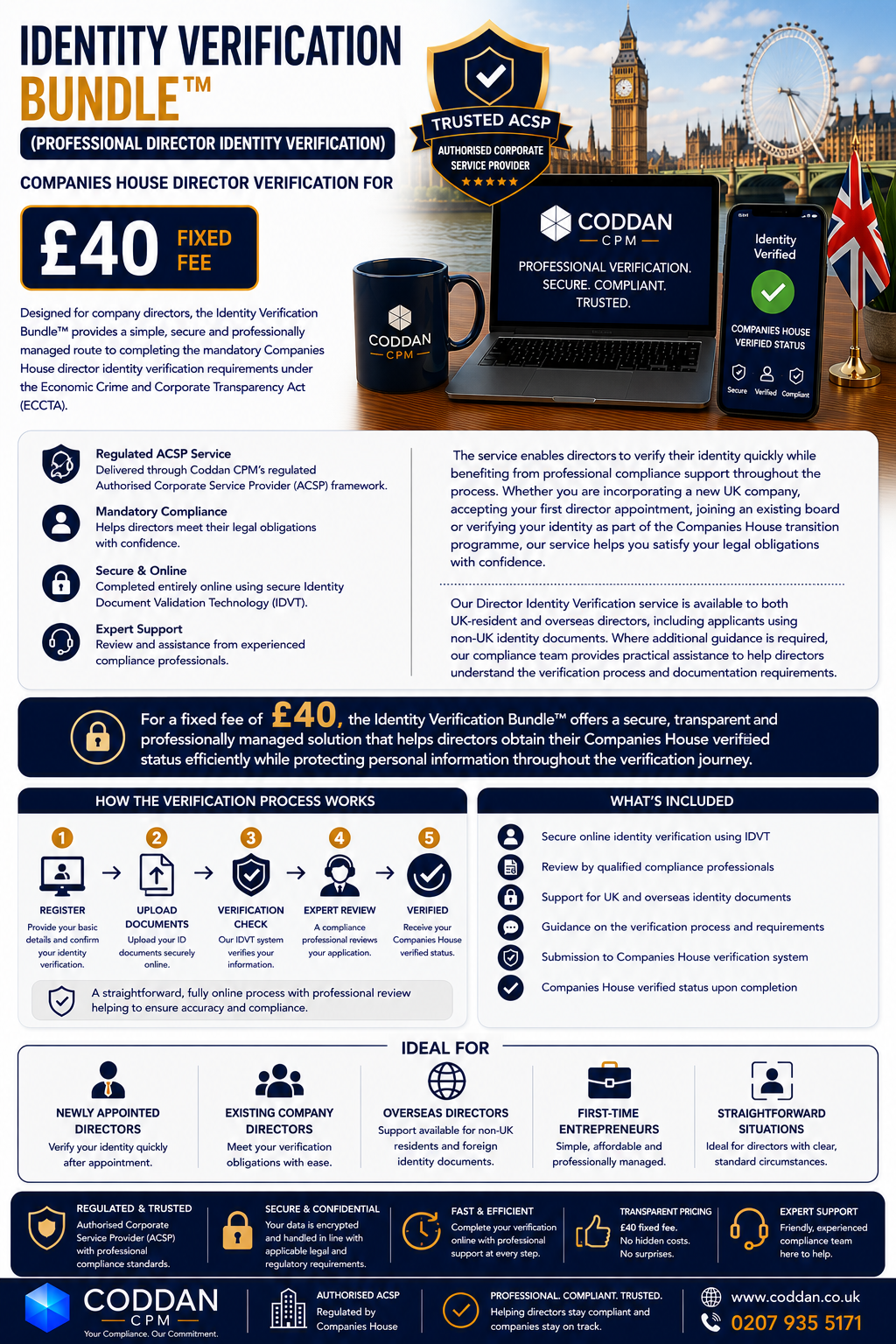
Buy Now Identity Verification Bundle™ (Professional Director Identity Verification) – Companies House Director Verification for £40.
Designed for company directors, the Identity Verification Bundle™ provides a simple, secure and professionally managed route to completing the mandatory Companies House director identity verification requirements under the Economic Crime and Corporate Transparency Act (ECCTA). Delivered through Coddan CPM's regulated Authorised Corporate Service Provider (ACSP) framework, the service enables directors to verify their identity quickly while benefiting from professional compliance support throughout the process. Whether you are incorporating a new UK company, accepting your first director appointment, joining an existing board or verifying your identity as part of the Companies House transition programme, our service helps you satisfy your legal obligations with confidence. The verification process is completed entirely online using secure Identity Document Validation Technology (IDVT), supported by experienced compliance professionals who review each application to help ensure accuracy and regulatory compliance.

Our Director Identity Verification service is available to both UK-resident and overseas directors, including applicants using non-UK identity documents. Where additional guidance is required, our compliance team provides practical assistance to help directors understand the verification process and documentation requirements. For a fixed fee of £40, the Identity Verification Bundle™ offers a secure, transparent and professionally managed solution that helps directors obtain their Companies House verified status efficiently while protecting personal information throughout the verification journey. Ideal for: Newly appointed directors, existing company directors, overseas directors, first-time entrepreneurs and individuals requiring straightforward Companies House director identity verification. Streamline your director identity verification with our £40 bundle. Get expert guidance and secure your Companies House status efficiently today!


£65.00
+VAT

RapidVerify Pro™

Recommended for

2
package

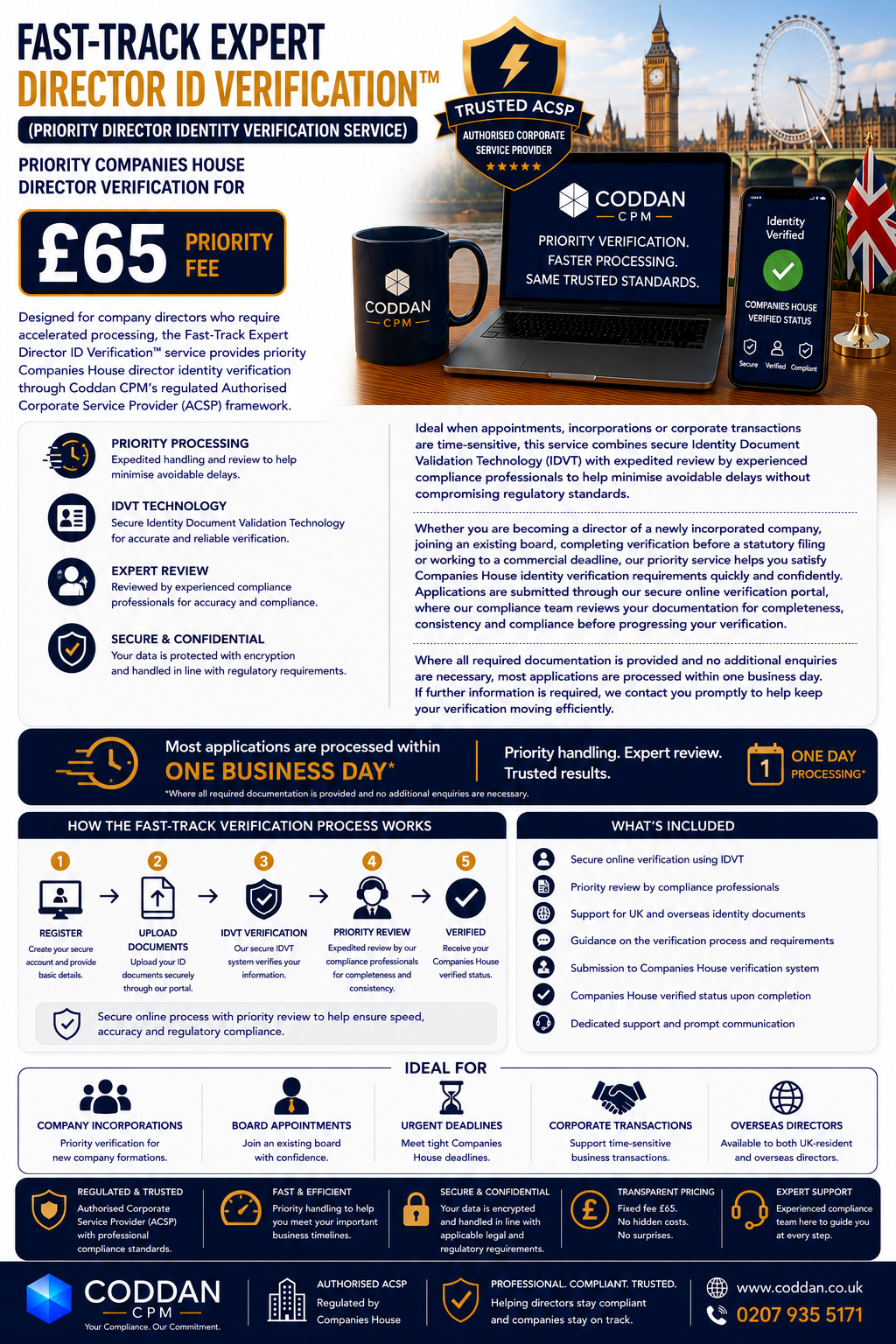
Buy Now Fast-Track Expert Director ID Verification™ (Priority Director Identity Verification Service) – Priority Companies House Director Verification for £65.
Designed for company directors who require accelerated processing, the Fast-Track Expert Director ID Verification™ service provides priority Companies House director identity verification through Coddan CPM's regulated Authorised Corporate Service Provider (ACSP) framework. Ideal when appointments, incorporations or corporate transactions are time-sensitive, this service combines secure Identity Document Validation Technology (IDVT) with expedited review by experienced compliance professionals to help minimise avoidable delays without compromising regulatory standards. Whether you are becoming a director of a newly incorporated company, joining an existing board, completing verification before a statutory filing or working to a commercial deadline, our priority service helps you satisfy Companies House identity verification requirements quickly and confidently. Applications are submitted through our secure online verification portal, where our compliance team reviews your documentation for completeness, consistency and compliance before progressing your verification.

Where all required documentation is provided and no additional enquiries are necessary, most applications are processed within one business day. If further information is required, we contact you promptly to help keep your verification moving efficiently. Available to both UK-resident and overseas directors, Fast-Track Expert Director ID Verification™ delivers responsive professional support, priority handling and the reassurance of working with an experienced ACSP throughout the verification process. Ideal for: Directors requiring priority verification for company incorporations, board appointments, urgent Companies House deadlines, corporate transactions or other time-sensitive business requirements. Experience swift processing with our Fast-Track Expert Director ID Verification™. Get priority support for urgent business needs, ensuring efficiency and peace of mind.


£125.00
+VAT

VerifyFlex Solutions™

Recommended for

3
package

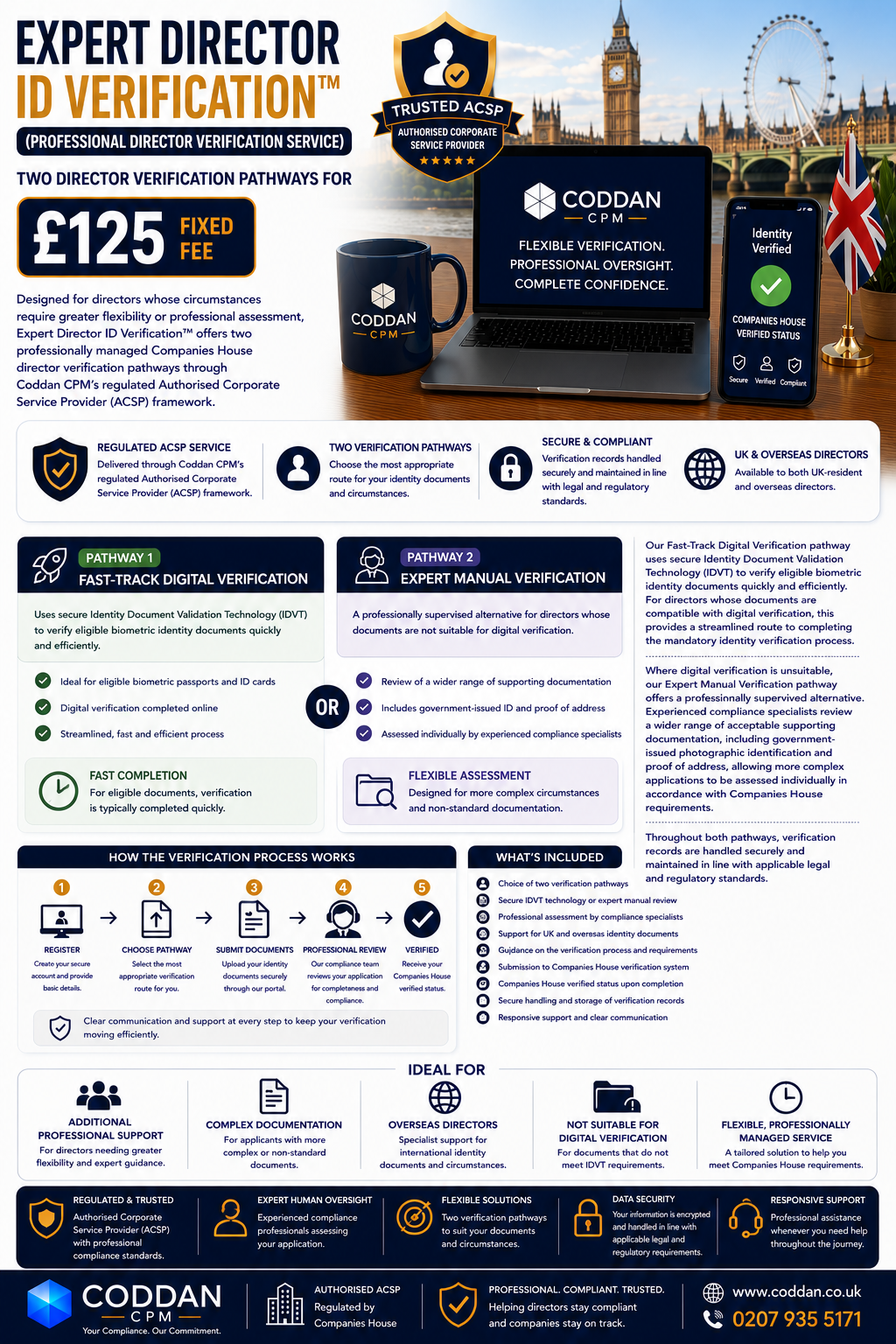
Buy Now Expert Director ID Verification™ (Professional Director Verification Service) – Two Director Verification Pathways for £125. Designed for directors whose circumstances require greater flexibility or professional assessment, Expert Director ID Verification™ offers two professionally managed Companies House director verification pathways through Coddan CPM's regulated Authorised Corporate Service Provider (ACSP) framework. The service enables directors to select the verification route most appropriate for their identity documents and individual circumstances while ensuring full compliance with Companies House requirements. Our Fast-Track Digital Verification pathway uses secure Identity Document Validation Technology (IDVT) to verify eligible biometric identity documents quickly and efficiently. For directors whose documents are compatible with digital verification, this provides a streamlined route to completing the mandatory identity verification process. Where digital verification is unsuitable, our Expert Manual Verification pathway offers a professionally supervised alternative. Experienced compliance specialists review a wider range of acceptable supporting documentation, including government-issued photographic identification and proof of address, allowing more complex applications to be assessed individually in accordance with Companies House requirements.

Throughout both pathways, verification records are handled securely and maintained in line with applicable legal and regulatory standards. Available to both UK-resident and overseas directors, Expert Director ID Verification™ combines advanced technology with experienced human oversight, providing greater flexibility, regulatory expertise and confidence when straightforward digital verification is not the most appropriate solution. Ideal for: Directors requiring additional professional support, applicants with more complex documentation, overseas directors, individuals whose identity documents are not suitable for standard digital verification, or anyone seeking a flexible, professionally managed Companies House director identity verification service.


£220.00
+VAT

FlexiVerify Option™

Recommended for

4
package

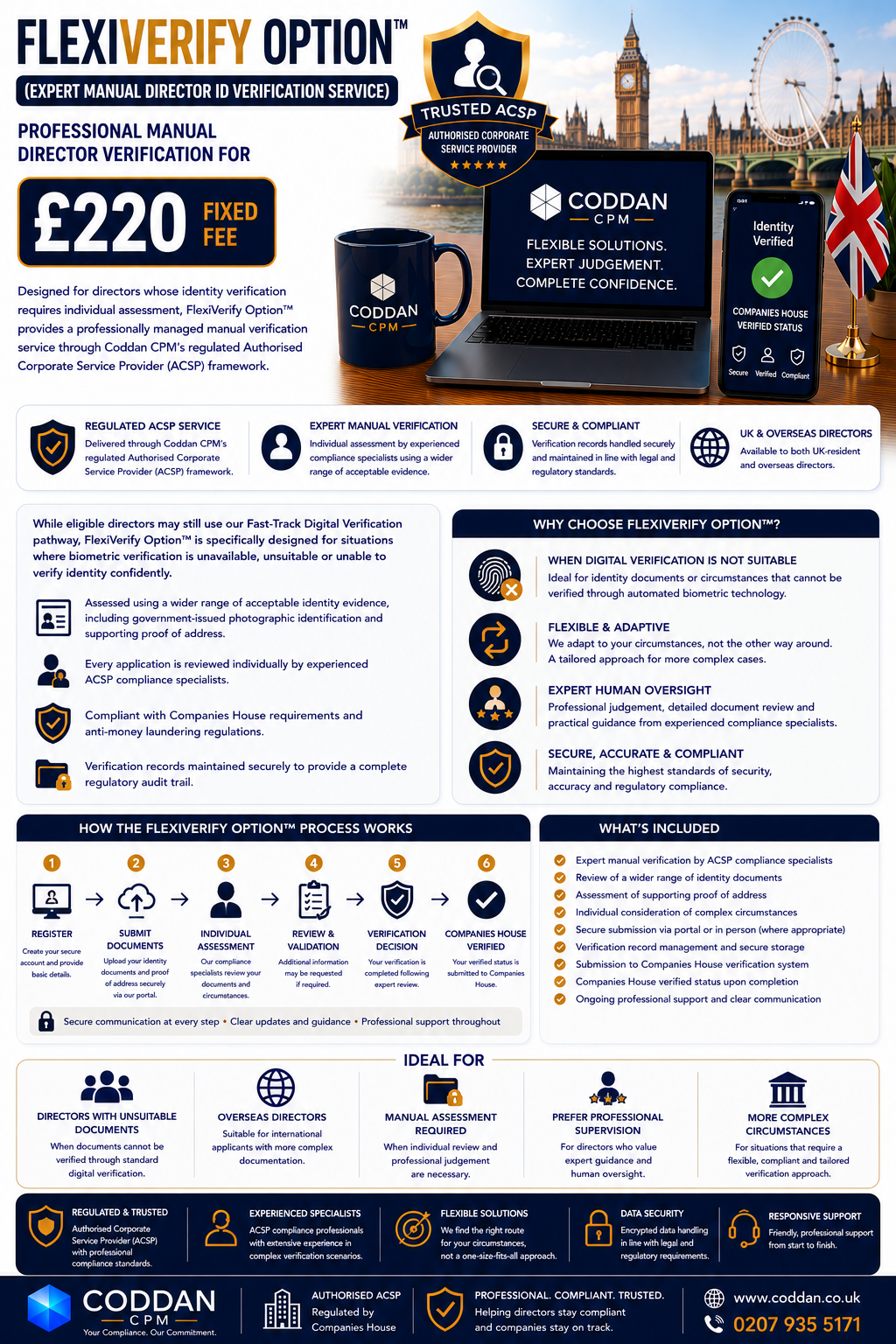
Buy Now FlexiVerify Option™ (Expert Manual Director ID Verification Service) – Professional Manual Director Verification for £220.
Designed for directors whose identity verification requires individual assessment, FlexiVerify Option™ provides a professionally managed manual verification service through Coddan CPM's regulated Authorised Corporate Service Provider (ACSP) framework. This service is intended for applicants whose circumstances extend beyond straightforward digital verification, offering a flexible and compliant route to satisfying Companies House director identity verification requirements. While eligible directors may still use our Fast-Track Digital Verification pathway, FlexiVerify Option™ is specifically designed for situations where biometric verification is unavailable, unsuitable or unable to verify identity confidently. Instead of relying solely on automated technology, experienced compliance professionals assess each application individually using a wider range of acceptable identity evidence, including government-issued photographic identification and supporting proof of address, in accordance with applicable Companies House and anti-money laundering requirements.

Applications may be submitted securely through our online verification portal or, where appropriate, presented in person. Every verification receives individual review, with comprehensive verification records maintained securely to provide a complete regulatory audit trail and demonstrate compliance with applicable legal obligations. Available to both UK-resident and overseas directors, FlexiVerify Option™ combines professional judgement, regulatory expertise and human oversight to resolve more complex verification scenarios while maintaining the highest standards of security, accuracy and compliance. Ideal for: Directors whose identity documents are unsuitable for standard digital verification, applicants requiring manual assessment, overseas directors with more complex documentation, or individuals who prefer a professionally supervised verification process supported by experienced ACSP compliance specialists.


Get clarity on director identity verification. Explore tailored solutions based on your circumstances to ensure a successful verification journey.

Understanding Director Identity Verification Before You Begin
Choosing the right identity verification pathway starts with understanding your own circumstances. Although every company director ultimately shares the same objective—a successfully verified identity—the journey can vary depending on whether you are forming a new company, joining the board of an existing business, serving as an overseas director or managing multiple corporate appointments..
For that reason, we believe it is important to explain the process before recommending a solution. An informed decision is almost always a better decision than selecting a service without understanding why it may—or may not—be appropriate for your particular situation.
The articles below have been written to answer the questions directors ask most frequently. They explain why identity verification has become mandatory under the UK's corporate transparency reforms, when verification should be completed, how the process differs for newly appointed and existing directors, what overseas directors need to know, and how professional verification through an Authorised Corporate Service Provider (ACSP) fits within the wider Companies House framework.
Rather than focusing solely on compliance, these guides explore identity verification as part of the complete lifecycle of a company director. They demonstrate how verification supports effective corporate governance, accurate company records, responsible board appointments and long-term business administration.
Whether you have already selected one of our verification packages or are still deciding which approach best meets your needs, we encourage you to spend a few minutes exploring the guidance below. It has been designed to help entrepreneurs, company directors, professional advisers and overseas business owners understand both the legal framework and the practical realities of director identity verification.
Below, you will find guidance covering the questions directors ask most frequently, including who needs to verify, when Once you have identified the verification pathway that reflects your individual circumstances, you will be in a stronger position to choose the most appropriate solution—whether that involves completing the process independently where suitable or obtaining professional support through Coddan's Authorised Corporate Service Provider service. Our aim is not simply to verify identities, but to help directors make informed decisions that contribute to stronger corporate governance, greater compliance confidence and well-managed UK companies.


Who Must Verify Their Identity as a Director? A Practical Guide to Modern Corporate Compliance

The role of a company director has always carried legal responsibilities, but the expectations placed upon directors have changed significantly in recent years. Identity verification is now an integral part of the UK's corporate transparency framework, reflecting a broader shift towards stronger governance, greater accountability and enhanced protection against corporate fraud.

For entrepreneurs, investors and business owners, identity verification should not be viewed as an administrative hurdle. It is one of the first building blocks of responsible company management and forms part of a wider commitment to maintaining accurate corporate records throughout the life of a business.

Understanding who must verify their identity, when verification is required and how the process fits within ongoing corporate compliance is essential for anyone planning to act as a director of a UK company.

Why Director Identity Verification Matters

Every company relies on trust. Customers, suppliers, financial institutions, investors and regulators all expect the individuals responsible for managing a company to be properly identified.

Identity verification helps strengthen confidence in the integrity of the corporate register by confirming that the people accepting statutory responsibilities are who they claim to be. It also supports wider efforts to reduce identity fraud, misuse of corporate structures and the creation of companies using false or misleading information.

For directors, successful identity verification creates a trusted link between their personal identity and their corporate appointments, supporting a more transparent business environment.

Who Must Verify Their Identity?

Identity verification generally applies to individuals who are appointed as directors of UK companies, regardless of whether the company is newly incorporated or already established.

This includes many different types of directors, such as:

  • First-time directors establishing a new company.
  • Existing directors continuing to manage incorporated businesses.
  • Sole directors of private limited companies.
  • Directors appointed to multiple companies.
  • Overseas individuals serving as directors of UK companies.
  • Directors appointed by corporate groups or investment structures.
  • Individuals joining an existing board following a change in ownership or business expansion.

In many cases, identity verification forms part of the wider process of maintaining accurate corporate information throughout the company's lifecycle.


Identity Verification Is Not Just About New Companies

One common misconception is that identity verification only affects newly formed businesses.

In reality, many established companies also need to consider identity verification when appointing new directors, updating corporate records or meeting evolving compliance requirements. Businesses undergoing restructuring, investment, succession planning or international expansion may all encounter situations where identity verification becomes an important part of the overall governance process.

Viewing verification as an ongoing compliance obligation rather than a one-off incorporation task allows businesses to manage future changes more efficiently.

Directors Living Outside the United Kingdom

International entrepreneurship continues to grow, and thousands of UK companies are managed by directors living overseas.

While the legal responsibilities of a director remain the same regardless of where they live, international applicants may have different identity documents, different forms of supporting evidence or additional practical considerations when completing identity verification.

Professional guidance can often simplify the process by helping overseas directors understand which verification pathway best suits their circumstances and what documentation is likely to be required before an application begins.

Identity Verification Supports Better Corporate Governance

Good corporate governance starts with accurate information.

Identity verification is closely connected to many other governance responsibilities, including maintaining statutory registers, recording appointments correctly, keeping company information up to date and ensuring that significant corporate changes are accurately documented.

Businesses that integrate identity verification into their wider compliance procedures are generally better prepared for future corporate events, including director appointments, shareholder changes, funding rounds, acquisitions and international expansion.

Rather than treating verification as an isolated administrative exercise, successful organisations incorporate it into their broader governance framework from the outset.


Choosing the Right Verification Pathway

No single verification solution is appropriate for every applicant.

Some directors can complete a straightforward digital verification using compatible identity documents, while others may require additional professional support because of their individual circumstances, overseas residency or the nature of their identity evidence.

Selecting the appropriate verification pathway before beginning the process can reduce delays, improve efficiency and provide greater confidence that the necessary information has been prepared correctly.

This is particularly valuable for businesses appointing multiple directors, international management teams or individuals with more complex verification requirements.

Professional Guidance Makes a Difference

Identity verification is becoming increasingly integrated into the wider management of UK companies. As compliance requirements continue to evolve, many businesses choose to work with experienced corporate service providers who understand not only identity verification but also the broader legal and administrative responsibilities that accompany directorship.

Since 2005, Coddan CPM has supported entrepreneurs, investors and established businesses with company formations, corporate governance and ongoing compliance services. As an Authorised Corporate Service Provider (ACSP) and a regulated Registered Corporate Service Provider (RCSP), we combine professional identity verification with practical knowledge gained from assisting thousands of UK and international businesses over two decades.

Our approach extends beyond completing an identity check. We help directors understand how identity verification fits within the wider corporate lifecycle, from company formation and board appointments to statutory filings, governance support and long-term compliance management.

Building a Strong Foundation for Responsible Directorship

Every successful director begins with a verified identity, but effective governance does not end there.

Identity verification represents the beginning of a broader commitment to transparency, accountability and responsible business management. By approaching verification as part of a comprehensive compliance strategy rather than a standalone requirement, directors place themselves—and their companies—in a stronger position for future growth.

Whether you are becoming a director for the first time, joining an established company, managing several businesses or expanding into the UK from overseas, understanding your identity verification responsibilities is one of the most important steps in building a resilient and well-governed organisation.

When Must Directors Verify Their Identity? Understanding the Timing of Director Identity Verification

For anyone becoming a director of a UK company, one of the most important compliance questions is not simply whether identity verification is required, but when it must be completed.

The timing of identity verification has become a key element of modern corporate governance. Rather than treating verification as an isolated administrative step, businesses are increasingly integrating it into their wider company formation, board appointment and compliance procedures. Understanding when verification should take place helps directors avoid unnecessary delays, supports accurate corporate records and provides greater confidence when accepting statutory responsibilities.

Whether you are establishing a new company, appointing an additional director, joining an existing board or managing several companies, knowing when identity verification forms part of the process is an essential aspect of responsible business management.

Identity Verification Should Be Planned, Not Left Until the Last Minute

One of the most common mistakes businesses make is viewing identity verification as something that can be completed after corporate decisions have already been made.

In practice, identity verification is most effective when it forms part of the planning stage rather than becoming a last-minute compliance exercise. Directors who prepare their identity documentation early are generally better positioned to complete appointments efficiently, respond to business opportunities without unnecessary interruption and maintain accurate corporate records throughout the life of the company.

Forward planning is particularly valuable where several individuals are being appointed simultaneously or where overseas directors are involved.

When Establishing a New Company

For many entrepreneurs, identity verification becomes relevant before or during the incorporation process.

Preparing verification early allows the formation process to progress more smoothly and reduces the likelihood of delays caused by missing information or incomplete documentation.

This is especially important for businesses with:

  • Multiple founding directors.
  • Overseas shareholders and directors.
  • Investor-backed companies.
  • Group company structures.
  • International management teams.

Building identity verification into the incorporation timetable creates a stronger compliance foundation from the outset.

When Joining an Existing COmpany

Identity verification is equally important when an individual is appointed to the board of an existing company.

Director appointments often occur because a business is expanding, attracting investment, restructuring its management team or replacing retiring directors. Completing identity verification as part of the appointment process helps ensure that governance records remain accurate and that new appointments are supported by verified identity information.

Businesses should therefore consider identity verification as an integral component of director onboarding rather than a separate administrative task.


When Existing Directors Are Required to Verify

Identity verification is not limited to newly appointed directors.

As the UK's corporate transparency framework continues to develop, existing directors may also need to complete identity verification in accordance with the applicable implementation timetable and regulatory requirements.

For established businesses, this provides an opportunity to review wider governance arrangements, confirm the accuracy of statutory records and ensure that company information remains up to date.

Many organisations use this period to conduct a broader compliance review covering director appointments, Persons with Significant Control (PSCs), statutory registers and company records.

Before Significant Corporate Changes
Businesses often focus on identity verification only when appointing directors, but there are many other situations where preparing verification in advance is beneficial.

Examples include:

  • Business acquisitions.
  • Company restructures.
  • Shareholder reorganisations.
  • Investment transactions.
  • Management buy-outs.
  • Succession planning.
  • International expansion.
  • Corporate refinancing.

These events frequently involve changes to company officers or governance structures, making advance preparation an important part of effective corporate administration.

Overseas Directors Should Allow Additional Preparation Time

International directors frequently manage UK companies successfully, but overseas applications may involve different identity documents, supporting evidence or verification pathways.

Rather than waiting until a director appointment is imminent, overseas applicants often benefit from preparing documentation well in advance. Early preparation helps identify any additional evidence that may be required and allows sufficient time for professional review where appropriate.

Businesses appointing international directors should therefore include identity verification within the overall project timetable instead of treating it as a final administrative step.

Identity Verification Is Part of Ongoing Corporate Governance

Many business owners assume that identity verification is completed once and then forgotten.

In reality, verification should be viewed as one element of an ongoing governance framework that includes maintaining accurate company records, documenting board decisions, recording changes to company officers and supporting long-term statutory compliance.

Companies that adopt a structured governance approach are generally better prepared to respond to future changes, including additional director appointments, business growth, investment opportunities and corporate reorganisations.

Identity verification works best when integrated into wider governance procedures rather than managed in isolation.

Why Timing Matters

Completing identity verification at the appropriate stage provides several practical advantages.

It helps businesses:

  • Reduce delays during director appointments.
  • Prepare documentation before significant corporate events.
  • Maintain accurate governance records.
  • Improve administrative efficiency.
  • Support compliance planning.
  • Build confidence among investors, lenders and business partners.
  • Minimise disruption when organisational changes occur.

For growing businesses, early preparation is often far simpler than attempting to resolve compliance issues after corporate decisions have already been implemented.

Professional Planning Creates Better Outcomes

Businesses with straightforward director appointments may complete verification with minimal difficulty. Others—particularly those involving overseas directors, multiple appointments or complex ownership structures—often benefit from a more structured approach supported by experienced corporate professionals.

Since 2005, Coddan CPM has worked with entrepreneurs, international investors, SMEs and corporate groups to establish and administer UK companies. As an Authorised Corporate Service Provider (ACSP) and regulated Registered Corporate Service Provider (RCSP), we understand that successful identity verification is not simply about confirming identity—it is about integrating verification into the wider lifecycle of company management.

Our experience has shown that organisations achieving the smoothest outcomes are those that plan verification as part of their overall governance strategy rather than treating it as a standalone requirement.

Preparing Today for Tomorrow's Corporate Responsibilities
The timing of identity verification reflects a broader principle of good corporate governance: preparation creates confidence.

Whether you are forming your first company, appointing additional directors, welcoming overseas board members or preparing your business for future investment, planning identity verification early helps create a stronger foundation for compliant and well-managed corporate administration.

By understanding when directors should verify their identity—and by integrating that process into wider governance planning—businesses place themselves in a stronger position to manage future growth while maintaining the high standards of transparency and accountability expected in today's corporate environment.


What Happens if a Director Doesn't Verify Their Identity? Understanding the Consequences of Delayed Verification

Identity verification has become an important element of the UK's corporate transparency framework. For company directors, verification is no longer simply an administrative exercise—it forms part of demonstrating accountability, maintaining accurate corporate records and supporting confidence in the individuals responsible for managing UK companies.

While most directors intend to comply with their obligations, some postpone identity verification because they believe it can wait until a more convenient time or assume it only applies to newly incorporated businesses. Others are uncertain about the requirements, are waiting for additional documentation or simply do not appreciate how verification fits within the wider corporate governance process.

Understanding what may happen if a director does not complete identity verification helps businesses plan ahead, reduce unnecessary disruption and maintain good corporate governance throughout the life of the company.

Identity Verification Is Part of Good Corporate Governance

Every company relies upon accurate and reliable information.

Identity verification helps ensure that the individuals managing a company can be properly linked to their corporate appointments, strengthening transparency and supporting confidence among customers, investors, lenders, suppliers and professional advisers.

When identity verification is delayed or overlooked, it may create unnecessary administrative complications and increase the likelihood of compliance issues arising later.

Forward-thinking businesses therefore treat verification as an integral part of their governance procedures rather than as a separate compliance task.

Delays Can Affect Corporate Administration

Many routine company activities depend upon accurate and up-to-date corporate information.

If identity verification has not been completed where required, businesses may encounter delays when carrying out activities connected with director appointments, corporate updates or other statutory procedures that rely upon verified identity information.

Rather than waiting until a transaction is underway, experienced businesses increasingly incorporate identity verification into their normal governance planning so that directors are prepared before significant corporate changes take place.

Corporate Transactions May Take Longer

Businesses evolve continuously.

They appoint new directors, attract investors, acquire other companies, reorganise ownership structures and expand into new markets.

Where identity verification forms part of these wider corporate processes, failing to prepare in advance can create avoidable delays while verification requirements are addressed.

Although every business situation is different, preparing directors before major corporate events generally supports a smoother and more efficient administration process.


International Businesses Face Additional Challenges

Many UK companies are owned or managed by individuals living outside the United Kingdom.

International directors often require additional planning because they may hold different identity documents, reside in different jurisdictions or require alternative verification pathways depending on their individual circumstances.

Leaving verification until the final stages of a transaction may introduce unnecessary complexity into projects that already involve multiple legal, commercial and administrative considerations.

Businesses with international management teams therefore benefit from treating identity verification as an early planning priority.

Delayed Verification Can Increase Administrative Work

One of the less obvious consequences of postponing identity verification is the additional administrative effort it can create.

When verification is completed at the appropriate stage, supporting documentation is usually prepared alongside other company records.

Where verification is left until later, businesses may need to revisit documentation, obtain updated information, coordinate multiple individuals and resolve issues under tighter timescales.

This often creates additional work that could have been avoided through earlier preparation.

Identity Verification Supports Business Confidence
Corporate transparency is not solely about meeting statutory requirements.

Verified directors provide reassurance to:

  • Investors considering funding opportunities.
  • Banks assessing business relationships.
  • Professional advisers supporting corporate transactions.
  • Commercial partners entering long-term agreements.
  • Customers seeking confidence in the businesses with which they trade.

Maintaining accurate and verified corporate information contributes to a stronger reputation and demonstrates a commitment to responsible business management.

Identity Verification Is Part of the Director Lifecycle
Many people still think of identity verification as something that happens only once.

In reality, it forms part of a broader director lifecycle that includes:

  • Accepting a board appointment.
  • Maintaining accurate corporate records.
  • Recording governance changes.
  • Supporting statutory filings.
  • Managing ongoing compliance responsibilities.
  • Participating in future corporate transactions.

Viewing identity verification within this wider context enables businesses to develop more effective governance procedures and reduces the likelihood of compliance issues arising unexpectedly.

A Proactive Approach Reduces Risk
Businesses that plan identity verification early are generally better positioned to respond when opportunities arise.

Whether appointing additional directors, restructuring a group of companies or preparing for investment, verified identity information allows organisations to move forward with greater confidence and fewer avoidable administrative interruptions.

Proactive planning also enables directors to understand their wider responsibilities from the outset instead of addressing compliance matters only when deadlines become urgent.

Professional Guidance Can Simplify the Process

Every director's circumstances are different.

Some individuals complete a straightforward digital verification using compatible identity documents. Others require additional support because they live overseas, hold different forms of identity evidence or are involved in more complex corporate structures.

Working with an experienced corporate service provider allows businesses to prepare verification in an organised and structured manner while integrating it into their broader governance procedures.

Since 2005, Coddan CPM has assisted entrepreneurs, SMEs, international investors and established organisations with company formation, corporate governance and ongoing compliance support. As an Authorised Corporate Service Provider (ACSP) and regulated Registered Corporate Service Provider (RCSP), we understand that identity verification is only one part of responsible company administration.

Our role is not simply to help directors complete a verification process, but to support businesses in developing practical compliance systems that remain effective throughout the entire corporate lifecycle.


Building Strong Companies Begins with Prepared Directors

Successful businesses rarely leave important compliance matters until the final moment.

Preparing directors for identity verification at the appropriate stage helps reduce uncertainty, supports efficient corporate administration and reinforces the standards of transparency expected in today's business environment.

Whether you are appointing your first director, managing an established company, expanding internationally or preparing for future investment, taking a proactive approach to identity verification strengthens the foundations of good corporate governance and helps your business remain ready for whatever opportunities lie ahead.

Ultimately, the question is not simply what happens if a director does not verify their identity. The more important question is whether your business has built a governance framework that enables directors to meet their responsibilities confidently, efficiently and at the right time. That is the approach adopted by well-managed companies and the standard Coddan CPM has helped businesses achieve since 2005.

How Do Newly Appointed Directors Verify Their Identity? A Practical Guide for First-Time and Newly Appointed Company Directors

Accepting an appointment as a director of a UK company is an important milestone. Whether you are launching your first business, joining an established organisation, becoming a non-executive director or representing an overseas parent company, your appointment brings legal responsibilities as well as new compliance obligations.

One of the first steps in today's corporate environment is ensuring that your identity is verified through the appropriate verification route. Identity verification is no longer viewed simply as an administrative procedure—it forms part of a wider framework designed to promote corporate transparency, strengthen confidence in company records and support responsible business governance.

For newly appointed directors, understanding how the verification process works before accepting or taking up the role helps create a smoother transition into company management while reducing the risk of unnecessary delays later.

Identity Verification Begins Before Your First Board Meeting
Many people assume that identity verification takes place after they have officially become a director.

In practice, successful businesses increasingly plan verification before or alongside the appointment process. By preparing identity verification early, organisations can ensure that new directors are ready to assume their responsibilities with confidence while maintaining accurate corporate records from the outset.

This forward-planning approach is particularly valuable for businesses that are expanding quickly, appointing several directors simultaneously or restructuring their management team.

Understanding the Verification Journey
Although every appointment is different, the identity verification journey generally follows a structured process.

It begins by identifying the most appropriate verification pathway for the individual director, taking into account factors such as:

  • Country of residence.
  • Type of identity documents available.
  • Whether digital verification is suitable.
  • Whether additional professional assessment may be appropriate.
  • The complexity of the company's ownership or management structure.

Preparing these details before beginning the process helps minimise delays and allows the appointment to progress more efficiently.

Choosing the Appropriate Verification Pathway
Not every newly appointed director has the same circumstances.

Some individuals hold compatible identity documents that allow a straightforward digital verification process, while others may require additional support because they:

  • Live outside the United Kingdom.
  • Hold overseas identity documents.
  • Are joining several companies simultaneously.
  • Have more complex personal or corporate circumstances.
  • Prefer professional guidance throughout the verification process.

Selecting the most appropriate verification pathway before beginning helps avoid unnecessary complications later.

Preparing Your Documentation

One of the simplest ways to support a successful verification process is to prepare documentation in advance.

Depending on the verification method and individual circumstances, directors should ensure that their identity documents are current, accurate and readily available before beginning the application.

Professional preparation also allows any inconsistencies or additional evidence requirements to be identified early, reducing the likelihood of delays once the verification process has started.

Verification Is Part of Director Onboarding
Forward-thinking businesses increasingly treat identity verification as part of director onboarding rather than as an isolated compliance exercise.

Alongside identity verification, many organisations also introduce new directors to:

  • Their statutory responsibilities.
  • Corporate governance policies.
  • Board procedures.
  • Company record-keeping requirements.
  • Internal compliance processes.
  • Decision-making responsibilities.

Integrating identity verification into a broader onboarding programme helps directors understand both their legal responsibilities and the standards expected within the organisation.

Overseas Directors Require Early Planning

International appointments have become increasingly common as UK businesses attract overseas investors and expand into global markets.

While overseas directors fulfil the same corporate responsibilities as UK-based directors, their identity verification journey may require additional planning because of differences in identity documents, supporting evidence or verification pathways.

Preparing documentation well before the appointment date allows international directors to begin their role without unnecessary administrative interruptions.

Verification Supports Long-Term Corporate Governance

Identity verification is not simply about confirming who a director is today.

It creates a trusted foundation that supports many future corporate activities, including:

  • Additional board appointments.
  • Company restructures.
  • Investment transactions.
  • Changes to company ownership.
  • International expansion.
  • Corporate governance reviews.
  • Ongoing statutory compliance.

Businesses that integrate verification into their wider governance framework are generally better prepared to manage future organisational changes efficiently.


Common Questions Asked by Newly Appointed Directors

First-time directors often ask similar questions before beginning identity verification.

These typically include:

  • Which verification pathway is most suitable?
  • Can verification be completed remotely?
  • What documentation should be prepared?
  • How does verification fit into the appointment process?
  • What happens after verification has been completed?
  • How does identity verification support future compliance?

Receiving clear guidance before beginning the process often makes the overall experience more straightforward and reduces uncertainty for directors who are unfamiliar with UK corporate administration.

Why Professional Guidance Benefits Newly Appointed Directors

For many entrepreneurs, becoming a director is an entirely new experience.

While some appointments are straightforward, others involve overseas ownership, group companies, investor participation or multiple simultaneous appointments. In these situations, professional guidance provides reassurance that identity verification is being managed within the wider context of company administration rather than as a standalone exercise.

Since 2005, Coddan CPM has helped entrepreneurs, established businesses and international investors establish and manage UK companies with confidence. As an Authorised Corporate Service Provider (ACSP) and regulated Registered Corporate Service Provider (RCSP), we assist directors through professionally managed identity verification while also supporting company formation, board appointments, company secretarial services and long-term corporate governance.

Our experience enables us to understand the practical challenges faced by newly appointed directors and to provide structured guidance that supports both immediate compliance and future business growth.

Building Confidence from the First Day of Directorship

The appointment of a new director marks the beginning of an important professional responsibility. Identity verification is one of the first practical steps in that journey, helping establish confidence, transparency and accountability from the outset.

By preparing early, selecting the appropriate verification pathway and integrating verification into a broader governance strategy, newly appointed directors place themselves in a stronger position to fulfil their responsibilities while supporting the long-term success of the organisations they serve.

For businesses, effective director onboarding begins with preparation. For directors, it begins with a verified identity and a clear understanding of the responsibilities that accompany the role. That philosophy has guided Coddan CPM's approach to corporate services since 2005, helping businesses build strong governance foundations from the moment a director joins the board.

How Do Existing Company Directors Verify Their Identity? A Guide for Directors Already Listed on the UK Company Register

Many business owners assume that identity verification only affects newly appointed directors or people forming a company for the first time. In reality, identity verification also applies to many individuals who are already serving as directors of existing UK companies.

For directors whose appointments are already recorded on the public company register, identity verification represents an important stage in the continuing evolution of corporate governance and business transparency. Rather than creating a new legal responsibility, it strengthens the connection between an individual's verified identity and their existing corporate appointments.

For established businesses, identity verification should be viewed as an opportunity to review governance arrangements, confirm the accuracy of company records and ensure that directors remain prepared for future compliance requirements.


Existing Directors Should Prepare Before Verification Is Required

One of the biggest advantages available to existing directors is time.

Unlike newly appointed directors, many existing company officers have the opportunity to prepare their identity documentation before verification becomes necessary within their own compliance timetable.

Forward-thinking businesses are already reviewing their corporate records, identifying which directors require verification and ensuring that appropriate documentation is readily available.

Preparing early reduces pressure, avoids unnecessary disruption and enables directors to complete verification as part of an organised governance review rather than responding at the last moment.

Identity Verification Is Part of Maintaining Accurate Corporate Records

Good governance depends upon accurate information.

Businesses regularly review:

  • Director appointments.
  • Persons with Significant Control (PSCs).
  • Registered office details.
  • Statutory registers.
  • Company officers.
  • Shareholding structures.
  • Corporate resolutions.

Identity verification naturally complements these activities by helping ensure that the identity linked to each director remains properly established within the wider corporate framework.

Rather than being treated as a separate administrative exercise, verification fits within the ongoing maintenance of accurate company records.

Reviewing Existing Board Appointments

Many established businesses have directors who have served for many years.

During identity verification planning, organisations often use the opportunity to review their board structure and confirm that:

  • All listed directors remain correctly recorded.
  • Company records accurately reflect current appointments.
  • Historic changes have been properly documented.
  • Governance procedures remain up to date.
  • Internal compliance policies continue to reflect current best practice.

This broader governance review frequently delivers benefits well beyond the identity verification process itself.

Directors Serving Multiple Companies
Many experienced business people serve as directors of several companies simultaneously.

This may include:

  • Group companies.
  • Holding companies.
  • Property businesses.
  • Investment vehicles.
  • Family-owned companies.
  • Trading subsidiaries.
  • Joint venture businesses.

For these individuals, careful planning becomes particularly important because one verified identity may relate to several corporate appointments.

Maintaining accurate information across multiple businesses helps simplify administration and supports more effective long-term governance.

Existing Overseas Directors

Thousands of UK companies are managed by directors who permanently live outside the United Kingdom.

For these directors, identity verification should form part of wider international corporate administration rather than being treated as an isolated compliance requirement.

Professional preparation allows overseas directors to:

  • Review identity documentation.
  • Confirm supporting information.
  • Select an appropriate verification pathway.
  • Coordinate verification alongside other corporate responsibilities.
  • Reduce the likelihood of delays affecting future company activities.

Businesses with international management teams benefit significantly from early planning and structured administration.

Identity Verification Supports Future Corporate Activity
Verification is not only about today's company records.

It also supports future business events, including:

  • Additional director appointments.
  • Business acquisitions.
  • Investment transactions.
  • Corporate restructuring.
  • Group reorganisations.
  • Changes to ownership.
  • International expansion.
  • Governance reviews.

Businesses that prepare existing directors well in advance are generally able to respond more efficiently when these opportunities arise.


Common Questions Existing Directors Ask

Directors who have been managing companies for many years often ask practical questions such as:

  • Do I need to verify if I have been a director for many years?
  • Can I complete verification before making future company changes?
  • What documents should I prepare?
  • How does verification relate to my existing appointments?
  • Does living overseas change the verification process?
  • How should businesses with several directors organise verification?

Providing clear answers to these questions enables businesses to plan verification within their wider compliance programme rather than treating it as a separate project.

Why Existing Companies Benefit from a Structured Approach
Established companies often have more complex governance arrangements than newly incorporated businesses.

They may have:

  • Several directors.
  • Multiple shareholders.
  • Overseas management teams.
  • Historic corporate changes.
  • Complex ownership structures.
  • Group company relationships.

In these situations, identity verification is most effective when incorporated into a structured governance review rather than completed independently.

Many businesses choose to coordinate verification alongside company secretarial services, statutory register reviews and broader corporate compliance planning to ensure consistency across all company records.

Professional Support for Existing Directors

For businesses that have traded successfully for many years, identity verification should enhance existing governance standards rather than interrupt day-to-day operations.

Since 2005, Coddan CPM has assisted established businesses, entrepreneurs, professional investors and international organisations with company administration, corporate governance and regulatory compliance. As an Authorised Corporate Service Provider (ACSP) and regulated Registered Corporate Service Provider (RCSP), we support existing directors through professionally managed identity verification while helping companies integrate the process into their wider governance framework.

Our experience demonstrates that the most successful organisations do not treat identity verification as a standalone obligation. Instead, they use it as an opportunity to strengthen corporate administration, improve governance procedures and prepare for future business growth.

Preparing Existing Directors for the Future
Identity verification marks another important stage in the continuing development of UK corporate governance.

For directors already listed on the company register, it represents far more than confirming personal identity. It provides an opportunity to review governance arrangements, strengthen company administration and ensure that businesses remain prepared for future regulatory and commercial developments.

Whether you have served as a director for six months or twenty years, planning identity verification early helps maintain confidence in your company's records while supporting efficient corporate management.

For well-managed businesses, verification is not simply about meeting a compliance requirement—it is about demonstrating professionalism, protecting the integrity of corporate information and ensuring that directors remain ready for the next stage of their company's development. That long-term perspective has been central to Coddan CPM's corporate services since 2005 and continues to shape the way we help businesses build stronger governance foundations for the future.

How Do Overseas Directors Verify Their Identity? A Practical Guide for International Business Owners and Non-UK Directors

The United Kingdom continues to attract entrepreneurs, investors and multinational businesses from around the world. Thousands of UK companies are owned or managed by directors who permanently live outside the UK, making international directorship a normal part of modern business.

As corporate transparency standards continue to evolve, overseas directors are increasingly asking one important question:

How do I verify my identity if I do not live in the United Kingdom?

The answer depends on the individual's circumstances, the identity documents available and the most appropriate verification pathway. For many international applicants, identity verification is straightforward when it is properly planned and supported by experienced corporate professionals.

Rather than viewing verification as an obstacle to doing business in the UK, overseas directors should regard it as one of the first steps in establishing a trusted and compliant presence within one of the world's leading business environments.

Overseas Directors Have the Same Corporate Responsibilities
A common misconception is that directors living outside the United Kingdom are subject to different corporate responsibilities.

While practical arrangements may differ, overseas directors generally accept the same statutory duties and governance responsibilities as directors who live within the UK.

This includes responsibilities relating to:

  • Company management.
  • Corporate decision-making.
  • Maintaining accurate company records.
  • Ongoing compliance.
  • Good corporate governance.
  • Acting in the best interests of the company.

Identity verification forms part of this wider framework by helping establish a trusted link between the individual director and their corporate appointments.

Living Overseas Does Not Prevent You Becoming a UK Director
Many successful UK companies are managed by directors based in Europe, North America, the Middle East, Asia, Africa and Australia.

International entrepreneurs frequently establish UK companies in order to:

  • Enter the UK market.
  • Expand global operations.
  • Build relationships with British customers.
  • Create a European business presence.
  • Hold intellectual property.
  • Operate international trading businesses.
  • Support investment activities.

For these businesses, identity verification becomes another stage in establishing a well-governed corporate structure.

Preparing Before You Begin

Successful overseas verification starts long before documents are submitted.

International applicants benefit from reviewing their circumstances in advance, including:

  • Country of residence.
  • Identity documentation.
  • Supporting evidence.
  • Company structure.
  • Number of directorships.
  • Future business plans.

Preparing this information early allows the most suitable verification pathway to be identified before the process begins.

This proactive approach often saves time and reduces unnecessary administrative delays.


Choosing the Appropriate Verification Pathway

Not every overseas director has identical circumstances.

Some applicants possess identity documents that are compatible with a straightforward digital verification process, while others may benefit from additional professional assessment depending on their documentation or individual situation.

Factors that may influence the most appropriate verification pathway include:

  • Type of passport or national identity document.
  • Country of issue.
  • Supporting identity evidence.
  • Individual business circumstances.
  • Complexity of the corporate structure.
  • Number of appointments requiring verification.

Selecting the appropriate pathway before beginning the application helps create a more efficient verification experience.

Managing International Corporate Structures
Many overseas directors are involved in businesses that extend beyond a single company.

Examples include:

  • International holding companies.
  • Group structures.
  • Overseas parent companies.
  • Investment portfolios.
  • Family offices.
  • Cross-border trading organisations.
  • Multi-jurisdictional business groups.

In these situations, identity verification often forms part of a much broader programme of corporate governance and compliance planning.

Rather than verifying each appointment independently, businesses frequently benefit from taking a coordinated approach across the wider corporate group.

Remote Verification and Professional Guidance

Modern verification solutions have made it possible for many overseas directors to complete identity verification without travelling to the United Kingdom.

Depending on the chosen verification pathway and the applicant's circumstances, much of the process can often be managed remotely through secure digital systems and professionally supervised document assessment.

This has significantly improved accessibility for international entrepreneurs who may be operating businesses across several countries simultaneously.

Professional guidance also helps applicants understand documentation requirements before the process begins, reducing uncertainty and helping avoid unnecessary delays.

Common Challenges Faced by Overseas Directors

Although many international applications progress smoothly, overseas directors frequently ask similar questions before beginning identity verification.

These include:

  • Which identity documents are suitable?
  • Can verification be completed remotely?
  • Which verification pathway should I choose?
  • Will living overseas affect my appointment as a director?
  • How does verification fit within wider company administration?
  • What should be prepared before beginning the process?

Receiving professional guidance at an early stage allows these questions to be addressed before they become obstacles.

Identity Verification Is Part of International Business Planning

Experienced international entrepreneurs rarely treat identity verification as an isolated compliance task.

Instead, it forms part of a broader business strategy that may include:

  • Company formation.
  • Director appointments.
  • Registered office services.
  • Company secretarial support.
  • Corporate governance.
  • Statutory record maintenance.
  • International business expansion.
  • Long-term compliance management.

Integrating identity verification into these wider corporate services creates a more efficient and better organised administrative framework.

Why International Businesses Choose Professional Support

Overseas directors often operate across multiple legal systems, time zones and regulatory environments.

Managing these responsibilities efficiently requires more than simply completing an identity verification process.

Since 2005, Coddan CPM has assisted international entrepreneurs, overseas investors, multinational organisations and non-UK residents establishing and managing UK companies. As an Authorised Corporate Service Provider (ACSP) and regulated Registered Corporate Service Provider (RCSP), we provide professionally managed identity verification together with comprehensive corporate services that support businesses throughout their entire lifecycle.

Our experience extends beyond verifying identities. We help overseas directors understand how verification connects with company formation, corporate governance, board appointments, company secretarial administration and ongoing compliance obligations.

This integrated approach enables international businesses to establish strong governance foundations from the very beginning.

Building a Trusted UK Presence from Anywhere in the World
Geography is no longer a barrier to establishing or managing a successful UK company.

With appropriate preparation, suitable verification pathways and professional guidance, overseas directors can complete identity verification confidently while maintaining full focus on growing their businesses internationally.

Identity verification represents more than confirming who you are. It demonstrates a commitment to transparency, responsible corporate governance and well-managed business administration.

Whether you are launching your first UK company from overseas, joining the board of an existing business, managing multiple international companies or expanding into new markets, preparing your identity verification early helps create a stronger platform for long-term success.

At Coddan CPM, we have been supporting international businesses since 2005. Our experience as both an ACSP and regulated RCSP enables us to provide practical, professional guidance that extends well beyond identity verification, helping overseas directors build compliant, resilient and confidently managed UK companies for the future.


Can Coddan Verify Directors Through Its Authorised Corporate Service Provider (ACSP) Service?

As identity verification becomes an integral part of the UK's corporate transparency framework, many entrepreneurs, company directors and overseas business owners are asking an important practical question:

Can Coddan verify directors through its Authorised Corporate Service Provider (ACSP) service?

The answer is yes. As an Authorised Corporate Service Provider (ACSP), Coddan CPM is authorised to provide identity verification services through the Companies House authorised verification framework, subject to the applicable legal requirements and the successful completion of the verification process.

However, our role extends far beyond simply verifying identity. Since 2005, we have helped entrepreneurs, established businesses and international organisations establish, manage and develop UK companies. Identity verification is now another important part of that broader corporate governance journey.

Rather than viewing verification as a standalone transaction, we integrate it into the wider process of company administration, helping businesses build strong governance foundations from the very beginning.

What Is an Authorised Corporate Service Provider?
An Authorised Corporate Service Provider is a business that has been authorised to carry out identity verification and submit certain filings on behalf of clients within the Companies House framework.

Authorisation is available only to businesses that meet the required registration and regulatory standards. As an ACSP, Coddan operates within this regulated environment, enabling us to assist directors, Persons with Significant Control (PSCs) and other individuals who require professional identity verification support.

For many businesses, working with an ACSP provides reassurance that identity verification is being handled by an organisation experienced in UK corporate administration.

Who Can We Help?

Our ACSP verification service is suitable for a wide range of individuals involved in UK companies.

This includes:

  • Newly appointed company directors.
  • Existing directors already recorded at Companies House.
  • Overseas directors.
  • Entrepreneurs forming a new UK company.
  • Individuals becoming a Person with Significant Control (PSC).
  • Directors serving multiple companies.
  • Investors joining UK businesses.
  • Corporate groups managing several appointments.

Whether you are establishing your first company or managing a complex international group structure, professional verification can form part of a broader governance strategy.

Our Approach Is About More Than Identity Verification
Many verification providers focus solely on completing the verification process.

At Coddan, we take a wider perspective.

Identity verification often forms part of a much larger business journey that may include:

  • Company formation.
  • Director appointments.
  • Registered office services.
  • Director service addresses.
  • Company secretarial support.
  • Corporate governance advice.
  • Ongoing Companies House compliance.
  • Future statutory filings.

By understanding the wider context of each business, we can help clients integrate identity verification into their overall corporate administration rather than treating it as an isolated compliance requirement.

Digital and Professionally Managed Verification Pathways
Every director's circumstances are different.

Some individuals are able to complete a straightforward digital verification process, while others require additional support because of overseas documentation, more complex circumstances or multiple company appointments.

As an ACSP, we help clients identify the verification pathway that best reflects their individual circumstances.

Where appropriate, we can guide applicants through professionally managed verification procedures designed to support accurate, efficient and compliant outcomes.

Supporting Overseas Directors
International entrepreneurs have been at the heart of Coddan's business for more than two decades.

We regularly assist directors based outside the United Kingdom who are establishing UK companies, joining existing boards or managing international corporate structures.

Overseas directors often require additional planning because they may:

  • Hold non-UK identity documents.
  • Operate across several jurisdictions.
  • Manage multiple businesses.
  • Require coordinated company formation and governance support.

Our experience with international clients enables us to provide practical guidance throughout the verification journey while helping businesses understand how identity verification fits within their wider UK corporate obligations.


Why Businesses Choose an ACSP Instead of Managing Everything Alone

Many directors are capable of managing parts of the identity verification process independently.

However, businesses frequently choose an ACSP because they value:

  • Professional guidance.
  • Structured compliance support.
  • Experience with UK company administration.
  • Assistance for overseas directors.
  • Help with more complex corporate structures.
  • Integration with wider company services.
  • Ongoing governance support beyond verification.

For growing businesses, professional support often provides greater confidence that identity verification has been incorporated into a broader compliance framework.

Identity Verification Is Only the Beginning
One of the biggest misconceptions surrounding identity verification is that it represents the end of the compliance process.

In reality, verification is often the beginning of an ongoing relationship with good corporate governance.

Following verification, businesses may need support with:

  • Changes to directors.
  • PSC updates.
  • Confirmation Statements.
  • Registered office services.
  • Company secretarial administration.
  • Statutory registers.
  • Shareholder changes.
  • Corporate restructuring.
  • Ongoing Companies House filings.

Viewing identity verification as the starting point rather than the final destination enables businesses to build stronger governance systems over the long term.

Why Businesses Have Trusted Coddan Since 2005
For more than twenty years, Coddan CPM has supported entrepreneurs, SMEs, overseas investors and established organisations with every stage of the company lifecycle.

Our experience extends across:

  • UK company formation.
  • Corporate governance.
  • Company secretarial services.
  • Director appointments.
  • Registered office services.
  • Compliance administration.
  • International business support.
  • Identity verification through our ACSP authorisation.

This combination of practical experience and regulatory knowledge enables us to support businesses from incorporation through to ongoing corporate management.

Rather than providing a single compliance service, we aim to become a long-term governance partner for businesses operating in the UK.

Professional Verification Backed by Corporate Experience
So, can Coddan verify directors through its ACSP service?

Yes. As an Authorised Corporate Service Provider (ACSP), we are authorised to verify the identities of eligible individuals in accordance with the Companies House framework, subject to the applicable verification requirements and the successful completion of the process.

More importantly, we understand that identity verification is only one part of building a well-managed company.

By combining identity verification with company formation, governance support, company secretarial services and ongoing compliance assistance, we help businesses create stronger corporate foundations that support sustainable growth long after verification has been completed.

Whether you are a first-time entrepreneur, an experienced company director or an overseas investor establishing a UK presence, Coddan's ACSP verification service is designed to provide more than a compliance checkpoint. It forms part of a professional, governance-led approach that has helped businesses succeed since 2005 and continues to support directors throughout every stage of the corporate lifecycle.


Why Director Identity Verification Is Now Mandatory

For many years, forming and managing a UK company relied largely on the information submitted to Companies House by businesses and their advisers. While this system enabled millions of companies to be incorporated efficiently, the UK Government recognised the need to strengthen the accuracy of the public register, improve corporate transparency and reduce the risk of company information being misused.

These objectives led to one of the most significant reforms of UK company law in decades—the Economic Crime and Corporate Transparency Act (ECCTA).

The Act introduces a wide-ranging programme of corporate reforms, with mandatory identity verification for company directors forming one of its most important changes. The purpose is straightforward: to ensure that every individual acting as a company director can be linked to a verified identity, helping to improve confidence in the integrity of the Companies House register.

For businesses, identity verification is no longer simply an administrative recommendation. It has become an integral part of modern corporate governance and an important component of maintaining an accurate and trusted public register.

What Is the Economic Crime and Corporate Transparency Act?
The Economic Crime and Corporate Transparency Act (ECCTA) modernises the way Companies House operates and significantly expands its role within the UK's corporate regulatory framework.

Historically, Companies House acted primarily as a registrar, recording information submitted by companies. Under ECCTA, Companies House has been given broader powers to improve the quality of information on the register, support the prevention of economic crime and enhance public confidence in UK companies.

The reforms introduced by the Act include measures designed to:

  • Improve the accuracy of company information.
  • Strengthen corporate transparency.
  • Reduce the misuse of UK corporate entities.
  • Enhance confidence in the Companies House register.
  • Support the prevention of fraud and identity misuse.
  • Increase accountability for company officers.
  • Modernise corporate administration through secure identity verification.

Mandatory director identity verification forms a central part of these wider reforms.

Why Has Director Identity Verification Become Mandatory?
The introduction of mandatory identity verification reflects a simple principle: individuals who manage UK companies should be able to demonstrate their identity through an approved verification process.

Verification helps establish a trusted connection between the individual director and their official company appointment. This strengthens confidence in the information held by Companies House while supporting better corporate governance across the UK business community.

For directors, verification should not be viewed merely as another regulatory requirement. It demonstrates a commitment to transparency, accountability and responsible company management.

For businesses, it helps create stronger governance foundations that support future growth, investment and long-term compliance.

Who Must Verify Their Identity?
The mandatory identity verification requirements apply to company directors regardless of whether they are based in the United Kingdom or overseas.

The implementation timetable means that different categories of directors verify at different stages.

Newly Appointed Directors
Individuals becoming directors of a UK company are required to complete identity verification before their appointment can be formally recognised in accordance with the applicable Companies House requirements.

Preparing verification before the appointment process begins helps businesses avoid unnecessary delays and allows new directors to assume their responsibilities with confidence.

Many organisations now include identity verification as part of their standard director onboarding procedures, ensuring that governance requirements are addressed from the outset.

Existing Directors Already Listed at Companies House
Directors whose appointments are already recorded on the Companies House register are also required to complete identity verification during the implementation of the new regime.

Existing directors must complete identity verification before their company's next annual Confirmation Statement is filed once the requirement applies to their company.

For established businesses, this provides an excellent opportunity to review wider corporate governance arrangements, confirm the accuracy of company records and prepare for future compliance requirements.

Rather than waiting until filing deadlines approach, many companies are choosing to organise director verification well in advance as part of their annual compliance planning.


Identity Verification Applies to UK and Overseas Directors

One of the strengths of the ECCTA reforms is that they apply consistently to directors regardless of where they live.

Whether a director is based in:

  • England
  • Scotland
  • Wales
  • Northern Ireland
  • Europe
  • North America
  • Asia
  • Africa
  • Australia
  • The Middle East

identity verification forms part of the same corporate transparency framework.

For overseas directors, the verification pathway may differ depending on individual circumstances and available identity documentation, but the underlying objective remains the same—to establish a trusted and verified corporate identity.

Identity Verification Is More Than a Compliance Exercise
Although ECCTA makes verification mandatory, the benefits extend beyond regulatory compliance.

Verified directors contribute to:

  • More accurate company records.
  • Greater confidence among investors.
  • Improved trust with banks and financial institutions.
  • Stronger relationships with customers and suppliers.
  • Better corporate governance.
  • More efficient company administration.
  • Greater confidence in future corporate transactions.

Businesses that integrate identity verification into their governance procedures often find that it complements other important compliance activities, including maintaining statutory registers, reviewing director appointments and preparing annual filings.

Planning Ahead Makes Compliance Easier
One of the key lessons emerging from the ECCTA reforms is that preparation is far more effective than reacting to approaching deadlines.

Companies that begin reviewing director records early can:

  • Identify which directors require verification.
  • Confirm documentation is available.
  • Choose the appropriate verification pathway.
  • Coordinate verification across multiple directors.
  • Integrate verification into wider governance reviews.
  • Reduce pressure during annual filing periods.

For larger organisations, corporate groups and businesses with overseas directors, early planning significantly reduces administrative complexity.

Why Businesses Choose Professional Verification Support
Although some directors may complete identity verification independently where appropriate, many businesses prefer professional assistance, particularly where there are multiple directors, international ownership structures or more complex governance arrangements.

Since 2005, Coddan CPM has supported entrepreneurs, SMEs, overseas investors and established companies with company formation, corporate governance and ongoing compliance. As an Authorised Corporate Service Provider (ACSP) and regulated Registered Corporate Service Provider (RCSP), we are authorised to verify the identities of eligible individuals in accordance with the Companies House framework.

Our role extends beyond completing verification. We help businesses understand how identity verification fits within the wider lifecycle of company management, enabling directors to integrate compliance into their long-term governance strategy rather than treating it as a one-off administrative requirement.

Building Stronger Companies Through Verified Leadership

Mandatory director identity verification represents one of the most significant developments in UK corporate law for many years. Introduced through the Economic Crime and Corporate Transparency Act, it reflects a broader commitment to creating a more transparent, accurate and trusted company register.

For newly appointed directors, verification forms part of the appointment process. For existing directors, it becomes an essential element of ongoing compliance before the company's next annual Confirmation Statement is submitted when the requirement applies.

Businesses that prepare early, understand the new framework and integrate identity verification into their governance procedures will be well placed to meet their statutory responsibilities while demonstrating the professionalism and transparency expected of modern UK companies.

At Coddan CPM, we believe identity verification is not simply about complying with new legislation. It is about strengthening corporate governance, protecting the integrity of company information and helping businesses build a secure foundation for long-term success.

Step-by-Step Process: How Directors Complete Identity Verification with Coddan

Identity verification should be straightforward, secure and professionally managed. Whether you are forming a new company, joining the board of an existing business or verifying as an overseas director, understanding each stage of the process helps remove uncertainty and ensures you know exactly what to expect.

At Coddan CPM, we have designed our Authorised Corporate Service Provider (ACSP) verification service to make the process as efficient as possible while maintaining the high compliance standards required by the Companies House identity verification framework.

From your initial application through to the issue of your Companies House Personal Code, our team provides structured guidance at every stage.

Step 1 — Complete Your Secure Online Application
Your verification journey begins by completing our secure online application form.

The application allows us to collect the information necessary to begin your identity verification while ensuring that your details are handled securely and confidentially.

During this stage, you will normally provide information such as:

  • Your full legal name.
  • Date of birth.
  • Contact details.
  • Residential address.
  • The capacity in which verification is required (for example, company director or Person with Significant Control).
  • Basic information relating to your UK company, if applicable.

Completing the application carefully at the outset helps reduce delays later in the process and enables our compliance team to begin reviewing your submission promptly.

Step 2 — Upload Your Identity Documents
Once your application has been submitted, you will be asked to upload the required identification documents through our secure document portal.

In most cases this will include:

  • A valid government-issued photographic identity document, such as:
    • Passport.
    • UK or eligible driving licence.
  • Proof of your residential address, where required.

Providing clear, high-quality copies of your documentation helps our compliance specialists complete the review more efficiently and reduces the likelihood of additional information being requested.

If your circumstances require alternative documentation or additional supporting evidence, our team will explain exactly what is needed before your verification proceeds.

Step 3 — Professional Review Using Identity Document Validation Technology (IDVT)
After your documents have been received, they are assessed through our professionally managed verification process using secure Identity Document Validation Technology (IDVT) together with compliance oversight by our experienced team.

This stage helps confirm that:

  • Your identity documents appear genuine.
  • The information provided is consistent.
  • Images are suitable for verification.
  • Any supporting documentation satisfies the applicable verification requirements.
  • Any issues requiring clarification are identified before submission.

Unlike fully automated systems that simply accept or reject documents, our verification process includes professional review, allowing potential issues to be identified and addressed wherever possible before the verification is finalised.

This structured approach helps provide a smoother experience, particularly for overseas directors, individuals with more complex circumstances and businesses verifying multiple company officers.

Step 4 — Verification Through Our Authorised Corporate Service Provider (ACSP)
Once the verification process has been successfully completed, Coddan, acting in its capacity as an Authorised Corporate Service Provider (ACSP), prepares the verified identity information for submission in accordance with the Companies House identity verification framework.

As an authorised provider, we submit the verified information using the appropriate Companies House systems, helping ensure that the verification process is completed professionally and in line with the applicable regulatory requirements.

For many businesses, this removes the uncertainty of managing the process independently while providing reassurance that verification has been completed through an authorised corporate service provider.

Step 5 — Receive Your Companies House Personal Code
After Companies House has processed the successful verification, it issues your unique 11-character Personal Code.

This Personal Code is sent directly by Companies House to the email address associated with your verification.

Your Personal Code is unique to you and is intended to remain with you throughout your involvement with UK companies. As you take on new appointments or manage existing company roles, the same code is used to connect your verified identity with your Companies House records.

Because the code forms an important part of your future interactions with Companies House, it should be stored securely and retained for future reference.

What Happens If Additional Information Is Required?
Occasionally, additional clarification or supporting documentation may be needed before verification can be completed.

If this happens, our compliance team will contact you promptly, explain what information is required and guide you through the next steps.

Most issues can be resolved quickly when addressed early, which is why careful preparation at the beginning of the process is so important.

Supporting Directors Throughout the Verification Journey
Identity verification is only one stage in the lifecycle of a company director.

Many of our clients continue to work with Coddan after verification for services including:

  • Company formation.
  • Director appointments.
  • Company secretarial services.
  • Registered office facilities.
  • Director service addresses.
  • Persons with Significant Control (PSC) administration.
  • Confirmation Statement filings.
  • Ongoing Companies House compliance.
  • Corporate governance support.

By integrating identity verification with wider company administration, businesses benefit from a coordinated approach that supports long-term compliance rather than simply completing a single regulatory requirement.

A Simple Process Backed by Professional Expertise
Our goal is to make director identity verification as clear and straightforward as possible.

The process can be summarised in five simple steps:

  1. Complete your secure online application.
  2. Upload your identity documents.
  3. Professional IDVT review by our compliance specialists.
  4. Verification submitted through Coddan's Authorised Corporate Service Provider (ACSP) service.
  5. Receive your unique 11-character Companies House Personal Code directly from Companies House.

Since 2005, Coddan CPM has helped entrepreneurs, overseas investors, SMEs and established organisations navigate UK company administration with confidence. As an Authorised Corporate Service Provider (ACSP) and regulated Registered Corporate Service Provider (RCSP), we combine secure identity verification with practical corporate expertise, helping directors complete the verification process efficiently while laying the foundations for effective long-term corporate governance.