We use cookies on this website, you can read about cookies and GDPR Privacy Policy here
Coddan CPM Ltd. – Company Registration Agent in the UK

File Form SH01 to register share allotments within a month; discover the simple steps to update your company details through Companies House WebFiling.

Step 1
1️⃣ Gather Necessary Information
Step 2
2️⃣ Access Companies House WebFiling
Step 3
3️⃣ Complete the Form
Step 4
4️⃣ Review and Submit
Step 5
5️⃣ Online filing is recommended
Step 6
6️⃣ A paper form can be downloaded and posted
Companies Registry's e-Services Portal Post Incorporation Support Service Form SH01 Explained: Allotment of Shares Made Easy


Need to register new share allotments? Use Form SH01 and Companies House WebFiling for a hassle-free process. Get started today!

Form SH01 – Allotment of Shares Filing Service
Issuing new shares is a significant corporate action that must be handled correctly and within strict statutory timeframes. With Coddan ACSP, your Form SH01 (Return of Allotment of Shares) is prepared and filed accurately, ensuring full compliance with Companies House requirements. Under the Companies Act 2006, companies must notify Companies House of any allotment of shares within one month of the allotment date. This includes details of the number and class of shares issued, nominal value, amount paid or unpaid, and updated statement of capital. Errors or late filings can result in penalties and inconsistencies in the public register.
Our fully managed SH01 filing service includes:
• Review of board and shareholder approvals
• Preparation of allotment resolutions (where required)
• Accurate completion and electronic submission of Form SH01
• Updated statement of capital
• Guidance on updating statutory registers
Whether you are issuing shares to attract investment, admit new shareholders, or implement an employee equity arrangement, we ensure the allotment is legally valid before submission. Electronic filing reduces delays and minimises the risk of rejection. With professional oversight, your share issue is recorded correctly and your company remains compliant. Add new shareholders with confidence. Choose a structured, compliant SH01 service that protects your company’s records while supporting your growth strategy.

Filing Form SH01? Get step-by-step guidance to ensure accurate share allotment submissions to Companies House and maintain your company's compliance.

How to Complete and File Form SH01 – Return of Allotment of Shares
Issuing new shares? You must file Form SH01 (Return of Allotment of Shares) with Companies House within one month of the allotment date. Missing this statutory deadline can lead to penalties and discrepancies in your company’s public record. The SH01 form requires precise information, including:
• Date of allotment
• Share class
• Number of shares issued
• Nominal value
• Amount paid or unpaid
• Updated statement of capital
You can submit your Companies House SH01 form through WebFiling by signing in, updating company details, and entering the required allotment data accurately. However, errors in the statement of capital or share structure are common and may result in rejected filings.
With guidance from Coddan CPM, completing and filing Form SH01 becomes straightforward. We help ensure the allotment is properly authorised, the details are accurate, and the submission meets all statutory requirements under the Companies Act 2006. Whether you are admitting new shareholders, raising investment, or restructuring equity, filing SH01 correctly is essential for compliance. Stay ahead of deadlines. File your Return of Allotment of Shares electronically accurately, confidently, and without unnecessary stress.

Simplify your share allotment process with Form SH01 from Coddan CPM. Learn to file quickly and keep your company compliant with ease.

Form SH01 – Compliant Return of Allotment of Shares Filing
When issuing new shares, your company must file Form SH01 (Return of Allotment of Shares) with Companies House within one month of the allotment date. This is a statutory obligation under the Companies Act 2006. Late or inaccurate filings can result in penalties and discrepancies in your company’s public record. Completing the Companies House SH01 form requires precise information, including the allotment date, share class, number of shares issued, nominal value, amount paid or unpaid, and an updated statement of capital. Errors—particularly in the statement of capital—are a common cause of rejected submissions.
With support from Coddan CPM, your SH01 filing is prepared and reviewed for accuracy before secure electronic submission. We help ensure the allotment is properly authorised, your capital structure is correctly recorded, and statutory deadlines are met. Whether you are raising investment, issuing shares to new shareholders, or restructuring equity, our managed SH01 service provides clarity, compliance, and peace of mind. File your Return of Allotment of Shares correctly, on time, and without unnecessary risk.

How to Submit Your SH01 Form via WebFiling

How Does the SH01 Form Affect New Shareholders?

Companies House SH01 form must be submitted via WebFiling within one month of share allotment.
Accurate completion of the form is crucial to avoid common errors, particularly in the statement of capital, which can lead to rejected filings.
Coddan CPM provides guidance to simplify the filing process, ensuring compliance with the Companies Act 2006.
Late or inaccurate submissions can result in penalties and affect the company’s public record.
Coddan CPM offers a managed service to prepare and review SH01 filings for accuracy, ensuring proper authorization and compliance with statutory deadlines.
Filing SH01 correctly is essential for admitting new shareholders, raising investment, or restructuring equity, providing clarity and peace of mind.

  Form SH01 (Return of allotment of shares)

No more share allotment headaches—learn how to complete and file an SH01 form with Coddan CPM’s step-by-step guidance. If you need to file a form SH01 (Return of allotment of shares), it’s never been easier. Sign in to Companies House WebFiling, update your company’s details, specify the allotment date, and enter all the must-have info: share class, number, nominal value, payment, and statement of capital. You must file a Return of Allotment of Shares within one month, so don’t let deadlines sneak up on you. This guide covers everything about how to complete the SH01 form and ensures your Companies House form SH01 is handled with confidence. Whether you’re new to the process or just need a refresher on how to complete and file an SH01 form, Coddan CPM keeps things simple, clear, and entirely stress-free—leaving you more time to focus on what matters most in your business.

Price: £18.99

SH01 “ShareGuard Solutions”

Recommended for


How to File Form SH01 for Share Allotment Compliance

Filing Form SH01: A Complete How-To for Companies.

Informative flyer for the SH01 file form available online, detailing submission steps and providing a website link. Visual flyer for the online SH01 file form, including guidelines for completion and a link to the submission portal.

Companies must report new share issuances to Companies House by filing Form SH01 – Return of Allotment of Shares.
The form is primarily used by company directors, secretaries, or officers seeking to protect their personal privacy while ensuring compliance with UK regulations.
Form SH01 must be submitted within one month of the share allotment, as mandated by the Companies Act 2006.
Key information required on Form SH01 includes allotment date, share class, number of shares issued, nominal value, consideration received, and updated statement of capital.
Timely and accurate filing is crucial to avoid rejected submissions and discrepancies in statutory records.
Coddan CPM offers support for the efficient and correct preparation and electronic filing of Form SH01.


Form SH01 Explained: Allotment of Shares Made Easy

Issuing new shares is a key mechanism for raising capital, onboarding investors, or restructuring ownership in a company. In the UK, any allotment of shares must be reported to Companies House using Form SH01.

Coddan provides a fast and compliant e-filing service to help you complete and submit Form SH01 accurately, ensuring your company’s share structure is updated without delays or errors.


What Is Form SH01?

Form SH01 is used to notify Companies House of the allotment (issuance) of new shares in a company. This includes:

  • Issuing shares to new investors
  • Allocating shares to existing shareholders
  • Increasing company capital
  • Implementing ownership restructuring

The form captures essential details such as:

  • Number and class of shares issued
  • Nominal value and premium (if applicable)
  • Details of shareholders receiving shares

This filing must typically be submitted within one month of the allotment.

If your share issuance is part of a broader ownership transition, it’s important to understand the wider framework of
Change of Control and Corporate Restructuring, where share allotments often play a central role.


When Do You Need to File Form SH01?

You must file SH01 when:

  • Raising capital through new share issuance
  • Bringing in new investors
  • Converting loans into equity
  • Expanding ownership among shareholders
  • Restructuring company ownership

Accurate reporting ensures your company remains compliant and your share capital is properly recorded.


Step-by-Step: How to File Form SH01

  1. Approve the Allotment
    Ensure the allotment is authorised by shareholders or directors in line with your company’s articles.
  2. Determine Share Details
    Confirm the number, class, and value of shares being issued.
  3. Complete Form SH01
    Provide all required information accurately to avoid rejection.
  4. Submit to Companies House
    Electronic filing is the fastest and most efficient option.
  5. Update Statutory Registers
    Record the changes in your register of members and share capital.


Share Allotment and Related Filings

Share allotment is often part of a wider set of corporate actions. Depending on your situation, you may also need:

Changes to Share Capital Structure
If you are altering the structure of your share capital beyond simple allotment:
Form SH02 – Change of Share Capital Expert Filing Service

Transferring Shares Between Shareholders
If ownership is changing through transfer rather than issuance:
Form J30 the Stock Transfer: Fast and Simple Submission J30 Form
Form J10 the Stock Transfer: Quick and Easy Submission J10 Form

Share Buybacks and Cancellation
If the company is purchasing and cancelling its own shares:
e-Filing the Form SH03 (Return of Purchase of Own Shares)
Fast and Easy e-Filing Form SH06 (Notice of Cancellation of Shares)

Handling these filings together ensures your company’s share structure remains accurate and compliant.


Impact on PSC (People with Significant Control)

Issuing new shares can directly affect who controls your company. If ownership thresholds change, you must update your PSC register accordingly. Learn how to stay compliant:

How to Amend Your Company’s PSC Information Effectively

Failure to update PSC details can lead to regulatory issues and penalties.


Common Mistakes to Avoid

Businesses often encounter issues when:

  • Incorrect share values or classes are reported
  • Allotments are not properly authorised
  • Filing deadlines are missed
  • PSC updates are overlooked

Coddan ensures your filing is accurate and fully compliant, reducing risk and saving time.


Why Choose Coddan for SH01 e-Filing?

  • ✔ Fast Electronic Submission
    We file your SH01 directly with Companies House for quicker processing.
  • ✔ Accuracy and Compliance
    Our experts ensure all share details are correctly reported.
  • ✔ End-to-End Support
    We assist with related filings and company updates.
  • ✔ Scalable for Growth
    Whether you’re issuing a few shares or restructuring ownership, we support businesses at every stage.


Issue Shares with Confidence

Streamline your share allotment process with Coddan’s professional e-filing service.

  • ✔ Fast processing
  • ✔ Accurate filings
  • ✔ Full compliance support

Start your SH01 filing today and keep your company’s share structure up to date.

Form SH01 – Return of Allotment of Shares
When a company issues new shares to shareholders, the transaction must be reported to Companies House by filing Form SH01 – Return of Allotment of Shares. This statutory filing records the creation and allocation of new shares, ensuring the company’s statement of capital and shareholder structure remain accurate on the public register.

Form SH01 must be submitted within one month of the share allotment in accordance with the Companies Act 2006. The form captures essential information including the allotment date, share class, number of shares issued, nominal value, consideration received, and the updated statement of capital following the issuance.

Because the allotment of shares directly affects the company’s issued share capital and ownership structure, accuracy and timely filing are essential. Incorrect details or missed deadlines can lead to rejected filings and inconsistencies in statutory records.

With support from Coddan CPM, the preparation and electronic filing of Form SH01 can be handled efficiently and correctly. Our service ensures the form is completed with the required information and submitted securely, helping businesses remain compliant with Companies House requirements.

Filing SH01 – Return of Allotment of Shares promptly ensures your company’s share capital records are accurate, transparent, and fully compliant, providing clarity for shareholders, regulators, and future investors.


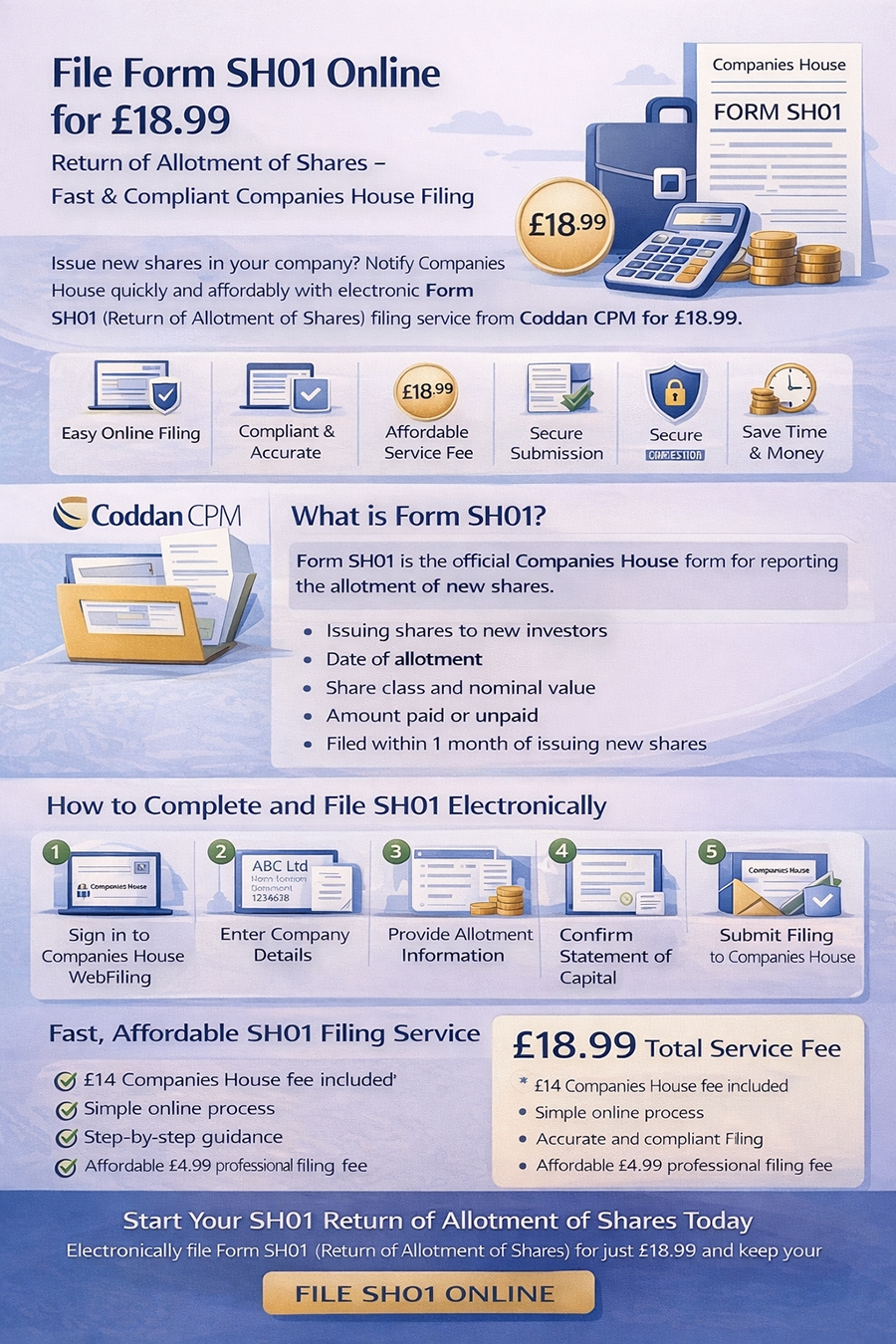
File Form SH01 Online – Return of Allotment of Shares. Fast, Secure Electronic Filing from £18.99

If your company has issued new shares, UK law requires you to notify the corporate registry by filing Form SH01 – Return of Allotment of Shares. This filing ensures that your company’s share capital and shareholder records remain accurate with Companies House.

With the electronic SH01 filing service from Coddan CPM, submitting your allotment return is quick, simple, and affordable. Our streamlined platform allows startup founders, accountants, and international business owners to complete the process online for just £18.99.

No complex paperwork. No confusion. Just a compliant filing handled efficiently.


What Is Form SH01?

Form SH01 is the statutory return used to report the allotment of new shares in a UK company.

An allotment occurs when a company issues new shares to investors, founders, or employees. This commonly happens when:

  • bringing in a new investor
  • issuing shares to co-founders
  • converting convertible notes or SAFEs
  • exercising employee share options
  • restructuring share capital

Once shares are allotted, companies must report the transaction to Companies House within one month.


File Your SH01 Online for £18.99

Our electronic filing service allows you to complete the process quickly without dealing with complicated forms.

Simple Online Process
Enter the required share allotment information through our secure online interface.

Fast Electronic Filing
Your Form SH01 is prepared and submitted electronically to Companies House.

Compliance Assurance
We ensure your return includes the required details and statutory statement of capital.

Affordable Pricing
File your SH01 for only £18.99, making compliance straightforward and cost-effective.


Information Required to Complete Form SH01

To submit your allotment return, you will need the following details:

  • company name and company number
  • date the shares were allotted
  • class of shares (for example ordinary or preference shares)
  • number of shares issued
  • nominal value of each share
  • amount paid or unpaid on each share
  • updated statement of capital

Providing accurate information helps ensure the filing is accepted without delays.


Why Timely Filing Matters

Under the Companies Act 2006, the SH01 must be filed within one month of the allotment date. Missing the deadline can cause compliance problems and may raise concerns during:

  • investment rounds
  • due diligence reviews
  • company sales or acquisitions

Submitting the form promptly keeps your corporate records accurate and up to date.


Designed for Startup Founders and Overseas Entrepreneurs

Our SH01 filing service is ideal for:

  • startup founders issuing new equity
  • international investors managing UK companies remotely
  • accountants handling client company filings
  • growing businesses adjusting their share structure

The platform is built to remove the administrative burden so you can focus on building your business. At Coddan, we make life simpler, more affordable, worry-free, and compliant, and we back it with experience for all our clients.


Why Use Coddan CPM?

Thousands of companies rely on Coddan CPM for corporate filings and compliance services. With years of experience assisting UK and international clients, our team provides:

  • reliable electronic filing systems
  • professional support when you need it
  • transparent pricing with no hidden surprises
  • strict confidentiality for your company data

We make corporate compliance simple.


Start Your SH01 Filing Today

If you need to file Form SH01 – Return of Allotment of Shares, our electronic service allows you to complete the process quickly and confidently. Avoid missed deadlines and administrative headaches. Submit your SH01 online today for £18.99 and keep your company records fully compliant.

File Form SH01 Fast – Return of Allotment of Shares (UK 2026 Guide)
If your company has issued new shares, you are legally required to file Form SH01 – Return of Allotment of Shares with Companies House.

For startups, scale-ups and investor-backed companies, filing SH01 correctly and on time is critical. Failure to comply can delay funding rounds, create legal uncertainty in your cap table, and expose directors to compliance risk.

This guide explains how to prepare and file Form SH01 quickly, accurately and without unnecessary complications.

What Is Form SH01?
Form SH01 is the statutory filing used to notify Companies House that your company has:

  • Issued new shares
  • Allotted shares to existing or new shareholders
  • Completed a funding round
  • Converted loan notes into equity
  • Issued shares under an option scheme
  • You must file SH01 within one month of the allotment date.

When Do You Need to File SH01?
You must submit SH01 if your company:

  • ✔ Issues new ordinary shares
  • ✔ Issues preference shares
  • ✔ Allots shares to founders
  • ✔ Allots shares to investors
  • ✔ Converts debt into equity
  • ✔ Issues shares under EMI or option schemes

You do not file SH01 for a simple share transfer between shareholders — that requires stock transfer documentation, not an allotment return.

Why Accurate SH01 Filing Matters
Proper SH01 filing ensures:

  • Legal confirmation of share allotment
  • Updated public record of issued share capital
  • Transparent ownership structure
  • Investor due diligence readiness
  • Compliance with the Companies Act 2006
  • Incorrect or late filings can result in:
  • Financial penalties
  • Delays in investment completion
  • Cap table inconsistencies
  • Reputational damage

Step-by-Step: How to Prepare Form SH01
1️⃣ Gather the Required Information
You will need:

  • Company name
  • Company registration number
  • Allotment date
  • Class of shares issued
  • Number of shares allotted
  • Nominal value per share
  • Amount paid or unpaid
  • Statement of capital (post-allotment position)

Accuracy is essential — this updates your company’s official share capital structure.

2️⃣ Complete the Statement of Capital
You must provide:

  • Total number of shares in issue after allotment
  • Aggregate nominal value
  • Rights attached to each share class

This section must align with your Articles of Association and any shareholder agreements.

3️⃣ Board Approval & Supporting Documents
Before filing SH01, you should have:

  • ✔ Board resolution approving the allotment
  • ✔ Shareholder approval (if required under pre-emption rights)
  • ✔ Updated statutory Register of Members
  • ✔ Share certificates issued

SH01 is the public notification — not the legal authorisation itself.

4️⃣ Submit SH01 to Companies House
You can file:

  • Online (recommended – faster processing)
  • By post

Online submission provides faster confirmation and reduces rejection risk. Deadline: Within one month of allotment date

Common SH01 Mistakes Startups Make

  • Filing late
  • Incorrect statement of capital
  • Failure to update internal registers
  • Ignoring pre-emption rights
  • Confusing share transfer with share allotment
  • Misstating paid vs unpaid capital

Errors here can complicate future funding rounds or exits.

SH01 & Investment Rounds
If you are raising capital, SH01 must reflect:

  • Correct post-money share capital
  • Correct investor share class
  • Proper rights (voting, dividends, liquidation preference)

Investors will verify SH01 filings during due diligence.

How to Prepare SH01 Quickly & Correctly
While SH01 can be filed independently, many startups prefer professional support to:

  • ✔ Ensure capital structure accuracy
  • ✔ Draft compliant board resolutions
  • ✔ Update statutory registers properly
  • ✔ Avoid Companies House rejection
  • ✔ Maintain clean cap table records

This is particularly important if:

  • You are issuing multiple share classes
  • You are completing a funding round
  • You are restructuring equity
  • You are preparing for investment or sale

SH01 Filing Checklist (2026)
Before submitting:

  • ✔ Confirm board approval
  • ✔ Check Articles of Association
  • ✔ Verify pre-emption compliance
  • ✔ Update Register of Members
  • ✔ Prepare share certificates
  • ✔ Confirm correct statement of capital
  • ✔ File within 1 month

File Form SH01 Fast – Professional Support for Startups
If you are searching for:

  • file SH01 online UK
  • Return of Allotment of Shares filing service
  • Companies House SH01 support
  • issue new shares UK startup
  • update share capital Companies House

We can prepare and file your SH01 quickly, accurately and fully compliant with UK company law.

Ready to File SH01?
Share allotments are a critical corporate event — especially during fundraising or equity restructuring. Get your Form SH01 prepared and filed correctly the first time, so you can focus on scaling your business with confidence.

Form SH01, known as the Return of Allotments of Shares, is utilized by limited companies to report share capital changes, such as the issuance or consolidation of shares. However, it cannot be used to remove a shareholder, which involves different legal protocols. The shareholder (stockholder) removal process typically requires reviewing the company’s articles of association, adhering to any relevant shareholder agreements, passing a formal resolution, and possibly redeeming or transferring shares. Understanding these distinctions helps prevent confusion and ensures compliance with UK corporate laws.
The SH01 form, or Return of Allotment of Shares, is an essential document that UK companies must file with Companies House when they issue new shares. This typically occurs during funding rounds or when new founders are added to the mix. The SH01 form keeps the public register informed about changes in the company’s share capital, including details like the number, class, and value of the new shares. Just a heads up: it needs to be submitted within a month of the allotment.


Case Study 1: Startup Funding Round – SH01 Filing for New Investors

Client: UK Technology Startup
Service: Return of Allotment of Shares Filing
Jurisdiction: UK

A London-based startup had successfully closed its seed funding round, issuing new shares to several investors. However, the founders were unaware that a Form SH01 must be filed with Companies House within one month of issuing new shares.

The company contacted Coddan CPM after discovering that the filing deadline was approaching.

Challenge

The founders needed to ensure the Return of Allotment of Shares (Form SH01) accurately reflected:

  • The number of new shares issued
  • The share class and nominal value
  • The updated statement of capital
  • The correct allotment date

Any errors could have created incorrect public records or investor disputes.

Solution

Coddan’s corporate compliance specialists:

  • Reviewed the investment documentation
  • Calculated the correct share capital structure
  • Prepared and submitted the SH01 filing electronically
  • Updated the company’s Register of Members

Outcome

The filing was successfully processed by Companies House before the statutory deadline.

The company:

  • Maintained full Companies House compliance
  • Ensured accurate shareholder records
  • Successfully completed its investment round


Case Study 2: Founder Equity Allocation – Correcting Share Structure

Client: UK SaaS Startup
Service: Expert SH01 Filing and Share Capital Update

A software startup needed to issue new shares to co-founders and early employees as part of its equity structure.

The founders initially attempted to prepare the Return of Allotment of Shares themselves but realised that calculating the statement of capital and share premium was more complex than expected.

Challenge

The company needed to ensure:

  • The nominal value and share premium were reported correctly
  • The statement of capital reflected the total issued share capital
  • The SH01 filing complied with UK company law

Incorrect filings could have caused problems during future investment rounds.

Solution

Coddan CPM:

  • Reviewed the company’s Articles of Association
  • Verified the directors’ authority to allot shares
  • Prepared the Form SH01 filing
  • Ensured the share capital structure matched the cap table

Outcome

The startup successfully updated its share structure and maintained accurate Companies House records, ensuring the company was investment-ready for future funding rounds.


Case Study 3: International Investor Share Issue

Client: Overseas Investor Backed UK Company
Service: SH01 Filing and Share Allotment Compliance

A UK company with international investors issued shares to an overseas shareholder.

The directors needed assistance ensuring the Return of Allotment of Shares filing met Companies House requirements.

Challenge

The company had to ensure the SH01 included:

  • Correct currency details
  • Share class information
  • The aggregate share capital after allotment

Additionally, the company needed to confirm the new shareholder’s position within the company’s ownership structure.

Solution

Coddan CPM provided:

  • Professional preparation of Form SH01
  • Verification of the updated statement of capital
  • Compliance review of the share allotment process
  • Secure electronic submission to Companies House

Outcome

The company successfully recorded the share allotment and maintained transparent shareholder records, supporting the company’s international investment structure.


Case Study 4: Late SH01 Filing Recovery

Client: UK E-commerce Company
Service: Companies House Compliance Recovery

An e-commerce company discovered that new shares issued six weeks earlier had not been reported to Companies House.

Because the one-month statutory deadline had passed, the directors needed urgent help to rectify the situation.

Challenge

The company faced potential compliance issues including:

  • Late filing risk
  • Incorrect Companies House records
  • Inaccurate share capital reporting

Solution

Coddan CPM’s compliance team:

  • Reconstructed the share allotment transaction
  • Verified the correct allotment date
  • Prepared and submitted the SH01 filing immediately
  • Updated the company’s internal shareholder register

Outcome

The company’s records were corrected and brought back into full Companies House compliance, avoiding further governance complications.


Case Study 5: Startup Employee Equity Allocation

Client: Fintech Startup
Service: Return of Allotment of Shares Advisory

A growing fintech startup issued shares to key employees as part of an incentive programme.

The company needed to ensure the share allotment complied with UK corporate governance requirements.

Challenge

The directors needed to ensure the share allotment was correctly documented and reported, including:

  • Share class structure
  • Nominal value calculations
  • Updated statement of capital

Solution

Coddan CPM provided:

  • Guidance on the share allotment process
  • Preparation of Form SH01
  • Compliance review of the share capital structure
  • Filing of the return with Companies House

Outcome

The employee share allocation was successfully completed and formally recorded, ensuring the company maintained transparent corporate records and investor confidence.


Form SH01 Filing Service UK (2026)
High-Risk Share Allotment Compliance for Startups & Growth Companies
Most providers treat Form SH01 (Return of Allotment of Shares) as a routine update to your share count. In 2026, that approach is dangerously outdated.

Under the Economic Crime and Corporate Transparency Act 2023, share allotments now trigger deeper compliance checks involving PSC verification, identity validation, capital reporting accuracy, and director authority. Filing SH01 incorrectly can compromise your cap table, invalidate tax relief, or trigger Companies House enforcement flags. If you are searching for:

  • Form SH01 filing service UK
  • Return of Allotment of Shares 2026 compliance
  • file SH01 Companies House correctly
  • issue new shares UK startup
  • SEIS EIS share allotment filing support

This page explains what most automated providers miss — and how to protect your company properly.

Why SH01 Is Now a High-Risk Filing
In 2026, SH01 is not just about numbers. It interacts with:

  • Person with Significant Control (PSC) verification
  • Identity verification requirements
  • Share class rights disclosure
  • Director authority under Companies Act 2006
  • SEIS/EIS tax relief timing
  • Statement of Capital accuracy

Failure in any of these areas can:

  • Trigger Companies House flags
  • Delay future filings
  • Jeopardise funding rounds
  • Invalidate investor tax relief
  • Create defective shares
  • Expose directors to liability

The 5 Critical Compliance Traps Most Providers Miss
1. The 2026 PSC Identity Verification Trap
If your new share allotment causes a shareholder to hold 25% or more, they become a Person with Significant Control (PSC) .

What most bots ignore:
That individual must complete mandatory identity verification with Companies House or via an Authorised Corporate Service Provider (ACSP) .

The risk:
Filing SH01 that creates an unverified PSC can result in:

  • Immediate Companies House compliance flag
  • Blocked future filings
  • Financial penalties
  • Reputational damage

Proper sequencing of PSC verification is now essential.

2. The Prescribed Particulars Rejection Issue
Section 4 of SH01 requires detailed disclosure of the rights attached to the shares. Companies House now rejects vague wording like: Rights as set out in the Articles. You must explicitly state:

  • Voting rights (e.g., one vote per share)
  • Dividend rights (pari passu or preferential)
  • Capital distribution rights (including winding up)
  • Redemption rights (redeemable or not)

The risk:
If the wording does not match your Articles of Association precisely:

  • Shares may be considered defective
  • Funding rounds may stall
  • Due diligence may uncover inconsistencies
  • Buyers may require indemnities

This is a frequent issue in investor-backed startups.

3. The SEIS / EIS Timing Conflict
For startups raising capital under SEIS or EIS, the SH01 filing date is critical.

The hidden issue:
SEIS shares must be issued at least 24 hours before any EIS shares in the same round. Many automated platforms:

  • Batch all shares
  • Use one allotment date
  • File a single SH01

The risk:
This can accidentally disqualify investors from SEIS relief — collapsing the funding round. Correct sequencing of:

  • Board resolutions
  • Allotment dates
  • SH01 filings

is essential for tax compliance.

4. Statement of Capital – The Aggregate Total Error
Section 4 requires a complete post-allotment Statement of Capital. You are not reporting just the new shares. You are reporting:

  • Total number of shares in issue (after allotment)
  • Total aggregate nominal value
  • Full share capital structure

Common error:
Only listing the newly issued shares.

The consequence:
This can mistakenly signal that prior shares were cancelled — distorting your official capital structure. This is one of the most frequent Companies House correction issues in 2026.

5. Director Authority to Allot (Sections 550 vs 551)
Most providers do not verify whether directors actually have the power to issue the shares. Under the Companies Act 2006:

  • If your company has only one share class, directors may rely on Section 550 authority.
  • If you have multiple share classes, directors usually require a shareholder resolution granting authority to allot under Section 551.

The risk:
Issuing shares without proper authority makes the allotment technically ultra vires (beyond director power). This can lead to:

  • Shareholder disputes
  • Legal challenge
  • Transaction delays
  • Valuation complications

Why Automated SH01 Filing Is Risky in 2026
Automated portals typically:

  • Do not check PSC thresholds
  • Do not verify identity sequencing
  • Do not review Articles of Association
  • Do not assess SEIS/EIS timing
  • Do not confirm director authority
  • Do not reconcile your capital table

SH01 is no longer a data-entry task — it is a corporate governance event.

Our Form SH01 Filing Service UK
Our service provides full 2026-compliant Return of Allotment of Shares support, including:

  • ✔ Review of director authority to allot
  • ✔ Drafting board and shareholder resolutions
  • ✔ PSC impact assessment
  • ✔ Identity verification sequencing guidance
  • ✔ Share class rights drafting
  • ✔ Accurate Statement of Capital preparation
  • ✔ SEIS/EIS timing coordination
  • ✔ Companies House submission
  • ✔ Statutory Register updates
  • ✔ Cap table reconciliation

We support:

  • Startups issuing founder shares
  • Investor-backed growth companies
  • SEIS/EIS funding rounds
  • Venture capital transactions
  • Equity restructures
  • EMI option exercises

Who Needs Professional SH01 Support?
You should not file SH01 alone if:

  • You are issuing preference shares
  • You are raising SEIS or EIS investment
  • The allotment changes control percentages
  • You have multiple share classes
  • You are preparing for acquisition or due diligence
  • Your Articles are bespoke
  • You are restructuring ownership

Protect Your Cap Table in 2026
Inaccurate share allotments can create long-term legal and financial problems. A defective SH01 filing may not cause immediate rejection — but it will surface during:

  • Investor due diligence
  • Bank compliance checks
  • Acquisition negotiations
  • Legal audits

Fixing historic errors is far more expensive than filing correctly the first time.

File Form SH01 Correctly – First Time
If you are searching for:

  • Form SH01 filing service UK
  • Companies House share allotment filing 2026
  • SEIS EIS share issue compliance
  • Return of Allotment of Shares expert support
  • Issue new shares UK limited company

We provide structured, compliance-first support to ensure your allotment is legally robust and audit-ready.

Ready to File SH01?
Share issuance is a defining corporate event. Treat it with the legal precision it now requires. Get your Form SH01 prepared, verified and filed properly — protecting your investors, your directors, and your company’s future.


Allot Shares to New Investors in the UK (2026 Compliance Guide)

Allotting shares to new investors is not just a funding milestone — it is a legally significant corporate event. In 2026, under the Economic Crime and Corporate Transparency Act 2023, every share allotment triggers strict compliance obligations with Companies House, PSC identity verification, and internal statutory record updates. If you are searching for:

  • allot shares to investors UK
  • issue new shares limited company
  • Form SH01 filing service UK
  • SEIS EIS share allotment compliance
  • digital share issuance service UK

this guide explains exactly what you need to do — and where founders often make costly mistakes.

What Does It Mean to Allot Shares?
A share allotment is the formal process of issuing new shares in your company in exchange for investment capital. Once shares are allotted:

  • The investor becomes a legal shareholder
  • Your ownership percentages change
  • Your control structure may shift
  • A mandatory Form SH01 filing is triggered

Shares are not just financial instruments — they carry voting rights, dividend rights, capital distribution rights, and control implications. That is why the process must be handled precisely.

Step 1: Decide the Number and Class of Shares
Before issuing shares, you must determine:

  • How many shares to issue
  • What share class (Ordinary, Preference, Alphabet, Growth shares)
  • Whether pre-emption rights apply
  • How dilution affects existing shareholders

Under the Companies Act 2006, directors must also confirm they have Authority to Allot shares (Section 550 or Section 551). If this authority is missing, the share issue can be legally challenged. This is one of the most overlooked risks in UK startup funding rounds.

Step 2: Valuation and Share Pricing
Your company valuation determines:

  • The price per share
  • The percentage ownership investors receive
  • The post-money structure of the business

For startups raising under SEIS or EIS, valuation and timing must align with HMRC rules. Even small sequencing errors can invalidate investor tax relief. Professional oversight at this stage protects both the company and the investors.

Step 3: Prepare the Required Legal Documents
A compliant share allotment typically requires:

  • Board Resolution approving the allotment
  • Shareholder Resolution (if required)
  • Subscription Agreement
  • Updated Articles of Association (if new share classes are created)
  • Updated Shareholder Agreement

The documentation must match exactly what is reported on Form SH01 – Return of Allotment of Shares. Inconsistencies between legal documents and Companies House filings are a common red flag during due diligence.

Step 4: Receive Funds and Issue Shares
Correct sequencing matters:

  1. Investor funds received
  2. Board formally approves allotment
  3. Shares are legally issued
  4. Register of Members is updated immediately
  5. Form SH01 is filed within one month

In 2026, missing the filing deadline can trigger penalties and compliance flags.

Mandatory 2026 Compliance Checks
PSC Identity Verification
If the new share allotment causes a shareholder to exceed 25% ownership, they become a Person with Significant Control (PSC) . Under 2026 rules:

  • The PSC must complete mandatory identity verification
  • Filing SH01 without verified PSC status can trigger enforcement review

This is one of the most significant new compliance layers.

Register of Members – The True Legal Ownership Record
Many founders assume filing SH01 makes someone a shareholder. It does not. The Register of Members is the definitive legal proof of ownership. Since January 2026, companies must maintain this register internally — it cannot be held at Companies House. If you fail to update the Register of Members:

  • The investor may appear publicly listed
  • But legally may have no enforceable shareholder rights

This becomes critical during:

  • Investor audits
  • M&A transactions
  • Dividend declarations
  • Shareholder disputes

SEIS / EIS 24-Hour Rule
If raising under SEIS and EIS:

  • SEIS shares must be allotted at least 24 hours before EIS shares

Automated filing platforms often batch everything into one SH01 — which can invalidate tax relief. Proper sequencing protects investor eligibility.

Filing Form SH01 Correctly
You must notify Companies House within one month of allotment. The SH01 requires:

  • Accurate Statement of Capital (entire post-allotment structure)
  • Detailed Prescribed Particulars of share rights
  • Correct share class breakdown
  • Correct allotment dates

Common mistakes include:

  • Reporting only new shares (instead of total share capital)
  • Using generic wording for share rights
  • Filing before verifying PSC status
  • Missing authority-to-allot checks

These errors may not always cause immediate rejection — but they surface during future funding rounds.

Why Professional Share Allotment Support Matters in 2026
In today’s regulatory environment, a share issue is a governance event, not just a funding task. Professional oversight ensures:

  • Proper Authority to Allot
  • Accurate Statement of Capital
  • PSC threshold monitoring
  • Identity verification sequencing
  • Register of Members update
  • Investor tax compliance protection
  • Audit-ready documentation

This protects your:

  • Cap table integrity
  • Investor relationships
  • Funding eligibility
  • Long-term exit value

Digital Share Allotment & SH01 Filing Support
For founders searching for:

  • allot shares to new investors UK
  • Form SH01 filing service
  • issue new shares startup compliance
  • SEIS EIS share issue support
  • update share capital Companies House

A structured, compliance-first approach is essential. Digital share allotment services now allow:

  • Secure electronic issuance of shares
  • Real-time cap table management
  • Digital share certificates
  • Faster Companies House filing
  • Audit-ready statutory record updates

This reduces error risk and increases transparency with investors.

The Bottom Line
Allotting shares is one of the most important decisions a startup makes. It affects:

  • Ownership
  • Control
  • Governance
  • Tax relief eligibility
  • Investor confidence
  • Future funding potential

In 2026, precision is no longer optional — it is protective. If you are preparing to issue new shares, structure it correctly from the start. A compliant, carefully sequenced share allotment process ensures your company remains legally robust, investor-ready, and positioned for long-term growth.

What Is Form SH01? (Return of Allotment of Shares – 2026 UK Guide)
Form SH01 is the statutory document that must be filed with Companies House every time a UK limited company issues new shares. If your startup has:

  • Raised investment
  • Issued founder shares
  • Completed a funding round
  • Allotted SEIS or EIS shares
  • Converted debt into equity
  • Issued shares under an option scheme

you are legally required to file Form SH01 – Return of Allotment of Shares within one month of the allotment date. Failure to file does not automatically invalidate the share issue — but it is a criminal offence for company officers if the filing deadline is missed. In 2026, SH01 has become a high-scrutiny compliance filing under the Economic Crime and Corporate Transparency Act.

When Do You Need to File SH01?
You must complete and file an SH01:

  • ✔ Every time your company issues new shares
  • ✔ After a funding round
  • ✔ When allotting shares to new investors
  • ✔ When issuing preference or alphabet shares
  • ✔ When allotting shares under SEIS or EIS

You do not file SH01 for a simple share transfer between shareholders — that requires a stock transfer form.

How Do You File Form SH01?
You can file:

  • Electronically (recommended)
  • By submitting a hard copy

To file online, you must register with Companies House and obtain an authentication code sent to your registered office address. In 2026, filings must also meet identity verification requirements, particularly where the allotment creates a new Person with Significant Control (PSC) .

How to Complete Form SH01 – Section-by-Section Guide
Below is a practical breakdown of each section and what you must include.

Section 1: Company Details
Confirm:

  • Full company name
  • Company registration number

Always use the exact name as shown on Companies House.

Section 2: Allotment Dates
If all shares were issued on one date, complete the first From Date line only. If shares were issued across different dates (for example, split SEIS and EIS allotments) , you must list the full date range correctly.

Important for SEIS:
SEIS shares must be allotted at least 24 hours before EIS shares in the same round. Incorrect sequencing can invalidate investor tax relief.

Section 3: Shares Allotted
This section requires detailed capital information:

  • Currency (usually GBP)
  • Share class (Ordinary, A Ordinary, Preference, etc.)
  • Number of shares issued
  • Nominal value per share
  • Total amount paid per share (nominal value + premium)
  • Amount unpaid (usually nil)

If shares were issued for non-cash consideration (e.g. intellectual property or services), you must disclose this.

Common mistake:
Confusing nominal value with share price. They are not the same.

Example:
If shares have a nominal value of £1 and were issued for £10.49:

  • Nominal value = £1
  • Share premium = £9.49
  • Total paid per share = £10.49

Section 4: Statement of Capital
This is one of the most critical sections. You must report:

  • The entire issued share capital after allotment
  • Not just the newly issued shares

This includes:

  • Total shares in issue per class
  • Currency
  • Total unpaid amounts

Failure to include aggregated totals at the bottom is a common cause of delay or rejection. In 2026, Companies House reviews Statement of Capital disclosures more strictly.

Section 5: Prescribed Particulars (Share Rights)
You must describe the rights attached to each share class regarding:

  • Voting
  • Dividends
  • Capital distribution (including winding up)
  • Redemption rights (if applicable)

Avoid vague wording like:
Rights as set out in the Articles.
Use clear, structured descriptions.

Example for standard ordinary shares:
The shares carry full voting rights, full dividend rights, and full rights to participate in capital distributions (including on winding up). The shares are not redeemable. Incorrect or incomplete prescribed particulars are a leading cause of SH01 rejection in 2026.

Section 6: Signature / Authorisation
If filing by paper:

  • Signed by a director, company secretary, or authorised officer.

If filing electronically:

  • Authorisation is confirmed digitally.

Always double-check all figures before submission.

2026 Compliance Considerations Most Founders Miss
PSC Identity Verification
If your allotment causes a shareholder to exceed 25% ownership, they become a Person with Significant Control (PSC) .

That individual must complete identity verification. Failure to manage this can result in:

  • Filing flags
  • Blocked future filings
  • Potential director penalties

Register of Members (Legal Ownership)
Filing SH01 does not create shareholder rights. The Register of Members is the definitive legal record of ownership. As of January 2026:

  • This register must be maintained internally.
  • It cannot be kept at Companies House.

If not updated immediately:

  • The shareholder may have no enforceable voting or dividend rights.

Authority to Allot
Directors must have legal authority to issue shares under the Companies Act 2006. If authority is missing:

  • The allotment may be voidable.
  • Other shareholders could challenge it.

Why Professional Support Matters in 2026
Form SH01 now intersects with:

  • PSC rules
  • Identity verification law
  • SEIS/EIS compliance
  • Director authority requirements
  • Capital structuring integrity

A simple mistake may not show up immediately — but it will surface during:

  • Investor due diligence
  • Bank reviews
  • M&A transactions
  • Legal audits

How Coddan CPM Supports Founders
At Coddan CPM, we help founders make their UK startups investor-ready and fully compliant. We provide:

  • Form SH01 filing service UK
  • ✔ SEIS and EIS advance assurance support
  • ✔ Funding round legal documentation
  • ✔ Cap table management
  • ✔ Data room preparation
  • ✔ Register of Members maintenance
  • ✔ EMI and unapproved share option scheme setup
  • ✔ Corporate secretarial compliance

Our approach ensures:

  • Correct sequencing
  • Clean statutory records
  • Investor tax protection
  • Audit-ready documentation
  • Long-term structural integrity

Ready to Issue Shares?
If you are:

  • Closing a funding round
  • Preparing SEIS or EIS allotments
  • Issuing new shares to investors
  • Restructuring your cap table

Make sure your Form SH01 is prepared and filed correctly the first time. Book a call with a compliance expert to ensure your startup remains legally robust, investor-ready, and positioned for growth.

Ordinary Resolution to Allot Shares (UK 2026 Guide for Startups)
For business startups and early-stage companies, understanding how to pass an ordinary resolution to allot shares is not just corporate theory — it is a practical, high-impact funding mechanism. If you are searching for:

  • ordinary resolution to allot shares UK
  • authority to allot shares Companies Act 2006
  • shareholder resolution for new shares
  • issue new shares limited company
  • Section 551 Companies Act allotment authority

this guide explains exactly how it works, when it is required, and why it matters in 2026.

What Is an Ordinary Resolution?
An ordinary resolution is a formal shareholder decision that requires a simple majority (more than 50%) of votes to pass. Under the Companies Act 2006, companies often need an ordinary resolution to grant directors the legal authority to allot shares. Without this authority, directors may not have the power to issue new shares — even if investors are ready to fund the business.

Why Authority to Allot Shares Matters
Allotting shares is one of the most important actions a startup can take. It allows a company to:

  • Raise new capital from investors
  • Bring in co-founders
  • Issue shares under SEIS or EIS
  • Create EMI or growth share schemes
  • Restructure ownership
  • Incentivise key employees

However, directors cannot always issue shares automatically. Section 550 vs Section 551 (Key Distinction) Under the Companies Act 2006:

  • Section 550: Directors of private companies with only one class of shares may have automatic authority to allot.
  • Section 551: If there is more than one class of shares, directors typically require shareholder approval via an ordinary resolution.

Most funded startups with preference shares, alphabet shares, or growth shares fall under Section 551 — meaning authority must be formally granted. Failure to obtain proper authority makes the share issue voidable and open to legal challenge.

Why This Is Critical in 2026
Under the Economic Crime and Corporate Transparency Act, share allotments now interact with:

  • PSC identity verification
  • Enhanced Companies House scrutiny
  • Strict Statement of Capital requirements
  • Mandatory internal Register of Members maintenance

An incorrectly authorised allotment can cause:

  • Funding delays
  • Due diligence failures
  • Shareholder disputes
  • Director liability exposure

Authority to allot is not paperwork — it is structural governance.

Step-by-Step: Passing an Ordinary Resolution to Allot Shares
1. Draft the Resolution
The board prepares a proposed ordinary resolution specifying:

  • The maximum number of shares directors may allot
  • The time period of the authority (usually up to 5 years)
  • The nominal value limit
  • Any restrictions

The resolution must clearly state the statutory basis (typically Section 551).

2. Circulate to Shareholders
The resolution can be:

  • Passed at a general meeting
  • Passed as a written resolution (common for startups)

Shareholders must receive sufficient notice and documentation. Transparency here reduces later disputes.

3. Voting
An ordinary resolution requires:

  • More than 50% approval (by voting rights)

If approved, directors gain legal authority to issue shares within the defined limits. All voting records must be documented properly.

4. Record and Implement
After approval:

  • Update company minute books
  • Retain signed resolutions
  • Proceed with share allotment
  • File Form SH01 within one month

You must also update your Register of Members immediately upon allotment. Filing with Companies House does not replace internal record updates.

Common Mistakes Startups Make

  • Assuming directors automatically have authority
  • Forgetting to check Articles of Association
  • Issuing shares before shareholder approval
  • Failing to disapply pre-emption rights (if required)
  • Not sequencing SEIS/EIS properly
  • Filing SH01 without confirming authority

These errors may not cause immediate rejection — but they will surface during funding rounds or acquisitions.

When Is an Ordinary Resolution Required?
You likely need one if:

  • You have multiple share classes
  • You are raising venture capital
  • You are issuing preference shares
  • You are restructuring your cap table
  • You are increasing authorised share capital
  • You are preparing an SEIS or EIS round

If in doubt, review your Articles and existing shareholder agreements.

Strategic Importance for Startups
Passing an ordinary resolution to allot shares enables you to:

  • ✔ Raise investment efficiently
  • ✔ Move quickly during funding rounds
  • ✔ Issue shares without repeated shareholder approval (if authority is broad)
  • ✔ Protect directors from ultra vires claims
  • ✔ Maintain corporate governance credibility

Investors routinely check that authority was properly granted.

Legal & Compliance Considerations (2026 Focus)
In addition to authority to allot, you must also consider:

  • PSC thresholds (25%+)
  • Identity verification requirements
  • Statement of Capital accuracy
  • Prescribed Particulars of share rights
  • Register of Members compliance
  • SEIS/EIS sequencing

Each element must align precisely. Corporate governance is now closely monitored — especially for high-growth startups.

Why Professional Support Is Advisable
While an ordinary resolution may seem simple, the legal and structural implications are not. Professional corporate secretarial support ensures:

  • Correct statutory wording
  • Alignment with Articles of Association
  • Authority limits correctly drafted
  • Pre-emption rights handled properly
  • Cap table impact assessed
  • SH01 filed correctly
  • Statutory registers updated

This protects your funding round from being undermined by technical defects.

Final Thought
An ordinary resolution to allot shares is not just a compliance step — it is the legal foundation that enables your company to grow. In 2026, with enhanced regulatory oversight and identity verification rules, getting this right is essential. If you are preparing to issue new shares, raise capital, or restructure ownership, ensure your authority to allot shares is properly granted, documented, and implemented. That precision protects your directors, your investors, and your company’s future.

Can You File Form SH01 Without Professional Help? (2026 UK Guide)
Yes — it is technically possible to file Form SH01 (Return of Allotment of Shares) yourself using the Companies House WebFiling system. However, in 2026, filing SH01 without experience carries real legal and structural risks. While the online system is accessible, it assumes you fully understand:

  • Your share capital structure
  • Your authority to allot
  • Your Statement of Capital
  • PSC thresholds and identity verification
  • SEIS/EIS compliance timing
  • Internal statutory register requirements

Mistakes may not always cause immediate rejection — but they can create inaccurate public records, invalidate tax relief, or cause serious due diligence issues later.

When You Should Strongly Consider Professional Assistance
You are at higher risk if any of the following apply:

1. Non-Cash Consideration
If shares are issued in exchange for:

  • Intellectual property
  • Services
  • Assets
  • Debt conversion

You must disclose this correctly in SH01. Errors here can:

  • Misstate capital structure
  • Create tax complications
  • Cause valuation disputes
  • Trigger regulatory scrutiny

Non-cash allotments require careful drafting.

2. Complex Capital Structure
If your company has:

  • Multiple share classes (A Ordinary, B Ordinary, Preference shares)
  • Different voting or dividend rights
  • Alphabet shares
  • Growth shares
  • Redeemable shares

You must correctly draft the Prescribed Particulars and update the Statement of Capital. Generic wording like:
Rights as per Articles
is now a leading cause of rejection.

Incorrectly describing rights can create defective share classes, which becomes a serious issue during funding or exit.

3. SEIS or EIS Investment
If the allotment forms part of:

  • SEIS (Seed Enterprise Investment Scheme)
  • EIS (Enterprise Investment Scheme)

Timing and sequencing are critical.

The 24-Hour Rule
SEIS shares must be allotted at least 24 hours before EIS shares in the same round. Common DIY mistake:
Batching all shares under one allotment date.
This can disqualify investors from valuable tax relief — potentially collapsing the funding round.

Key Risks and Common Pitfalls
Incorrect Statement of Capital
SH01 requires you to report the entire issued share capital after the allotment, not just the new shares. Common errors include:

  • Reporting only newly issued shares
  • Forgetting to aggregate totals
  • Miscalculating total nominal value

This can distort your official share structure on the public record.

Confusing Nominal Value with Share Price
Every share has:

  • Nominal value (e.g. £1)
  • Share premium (e.g. £99 if issued at £100)

Many founders mistakenly enter:

  • The full share price as the nominal value
  • Or omit the premium entirely

This creates accounting and capital errors that may require corrective filings.

Missing the One-Month Deadline
You must file SH01 within one month of the allotment date. Failure to do so is:

  • A statutory breach
  • An offence committed by every company officer

Late filings can trigger penalties and compliance review.

Failing to Update Internal Registers
Filing SH01 does not complete the process. You must also update:

  • Register of Members
  • Register of Allotments

As of 2026, the Register of Members must be maintained internally — it cannot be held at Companies House. If you fail to update it:

  • The shareholder may appear publicly listed
  • But legally may not have enforceable voting or dividend rights

This is a major hidden risk.

Additional 2026 Compliance Considerations
Following the Economic Crime and Corporate Transparency Act:

  • Identity verification may be required for new PSCs
  • Filing inconsistencies can trigger automated flags
  • Capital changes are more closely monitored

Even small technical errors can cause:

  • Future filing delays
  • Investor due diligence issues
  • Banking compliance queries
  • Valuation complications

When DIY May Be Acceptable
You may reasonably file SH01 yourself if:

  • You have a single class of ordinary shares
  • The shares are issued for cash
  • There is no SEIS/EIS involvement
  • No new PSC is created
  • You fully understand your capital structure

Even then, careful review is essential.

The Bottom Line
Filing Form SH01 without legal or corporate secretarial experience is possible — but in 2026 it is no longer low-risk. SH01 is not just a form. It affects:

  • Ownership
  • Control
  • Investor rights
  • Tax relief eligibility
  • Corporate governance compliance

If your share allotment is part of a funding round, involves multiple share classes, or impacts control thresholds, professional oversight is strongly advisable. Getting it right at the point of issue is far easier — and far cheaper — than fixing a defective capital structure later.

Remove a Shareholder UK | England, Wales, Scotland & Northern Ireland | Share Transfer & Buyback Specialists
Need to remove a shareholder from a UK limited company? Expert support across England, Wales, Scotland and Northern Ireland. Compliant share transfers, buybacks and Companies House filings handled professionally.

If you need to remove a shareholder from a limited company in England, Wales, Scotland or Northern Ireland, acting quickly and correctly is critical. Shareholder disputes and ownership restructures carry legal, financial and operational risk. Many directors mistakenly attempt to file Form SH01 to remove a shareholder, only to discover that it does not apply. Form SH01, filed with Companies House, records the allotment of new shares. It does not remove or transfer existing shareholders. Using the wrong procedure can invalidate transactions and expose directors to compliance breaches under the Companies Act 2006.

A shareholder is removed only when their shares are lawfully transferred, bought back or otherwise extinguished under the company’s constitutional documents. This requires precision. Articles of Association must be reviewed. Shareholders’ Agreements must be examined. Pre-emption rights must be considered. Stamp Duty implications must be assessed. Registers must be updated immediately. Errors at any stage can create uncertainty over legal ownership, which may surface months or years later during investment, sale or dispute proceedings.

For companies registered in England and Wales, the statutory framework is identical, but the practical execution of a shareholder removal requires careful documentation and procedural discipline. Whether you are restructuring in London, Birmingham, Manchester, Cardiff or Swansea, the core legal principle remains the same: shares must change ownership properly before a shareholder ceases to be a member. Confirmation Statements must reflect the new position. The Register of Members must be accurate. Directors must demonstrate that their duties have been fulfilled.

Scottish Ltd Companies operate under the same Companies Act regime, but dispute enforcement may fall under Scots law. Many shareholder exits in Scotland arise in family businesses, professional practices and SMEs undergoing succession planning. In cities such as Glasgow, Edinburgh, Aberdeen and Dundee, it is common for ownership restructuring to follow retirement, internal disagreement or minority buyouts. Proper drafting and execution ensure that the transaction withstands scrutiny and prevents later challenge.

In Northern Ireland, companies also file through Companies House and follow the same statutory structure. However, regional advisory considerations often arise during disputes or compulsory transfer scenarios. Businesses in Belfast, Derry/Londonderry and across Northern Ireland frequently require structured guidance to ensure that shareholder exits are compliant and defensible. Failure to follow statutory buyback rules or compulsory transfer provisions correctly can result in void transactions.

Across all UK jurisdictions, the lawful routes for removing a shareholder are consistent. A voluntary share transfer is typically the most efficient method where agreement exists. A company share buyback is more technical and demands strict adherence to statutory procedure. Compulsory transfer provisions may apply where validly drafted Articles or Shareholders’ Agreements permit removal under defined circumstances. Form SH01 is relevant only if new shares are being issued as part of a wider restructuring and does not itself remove a shareholder.

What distinguishes a compliant shareholder removal from a risky one is documentation and sequencing. Board minutes must authorise the transaction. Stock Transfer Forms must be properly executed. Statutory registers must be updated without delay. PSC changes must be recorded. Where required, buyback forms must be filed within strict deadlines. Each step must align with both the Companies Act and the company’s internal governance framework.

We provide structured shareholder removal services across England, Wales, Scotland and Northern Ireland for founders, directors and investors who require certainty. Our role is to ensure that ownership changes are legally robust, commercially practical and properly recorded. We assess the safest route, draft and review documentation, manage Companies House compliance and reduce the risk of future disputes. Our approach is methodical, confidential and outcome-focused.

If you are dealing with a founder exit, minority shareholder buyout, internal dispute, equity restructuring or incorrect Companies House filing, early intervention reduces cost and complexity. Delays increase risk. Unresolved ownership issues can derail investment rounds, financing arrangements or business sales.

Speak to a specialist today to receive a structured assessment of your company’s position and a clear action plan. We will identify the correct legal route, outline required documentation and guide you through each compliance stage. Whether your company is registered in England, Wales, Scotland or Northern Ireland, you will receive clear, practical advice grounded in UK company law.

Compliance and Risk Management
Directors ensure filings, records, and legal obligations are properly handled.

This may include appointing qualified directors when needed. For example: