We use cookies on this website, you can read about cookies and GDPR Privacy Policy here
Coddan CPM Ltd. – Company Registration Agent in the UK

Simplify your share transfer process with our expert guide on stock transfer forms; ensure legal compliance and faster HMRC processing with the right documents.

Step 1
1️⃣ Obtain the Form
Step 2
2️⃣ Fill in Details
Step 3
3️⃣ Consideration Money
Step 4
4️⃣ Transferor Details
Step 5
5️⃣ Transferee Details
Step 6
6️⃣ Submit the Form
Companies Registry's e-Services Portal Post Incorporation Support Service Form J30 the Stock Transfer: Fast and Simple Submission J30 Form


Let our expert team handle your Stock Transfer Form J30 preparation and submission. Enjoy a hassle-free experience and ensure compliance with legal requirements.

Stock Transfer Form J30 – Professional Preparation & Submission
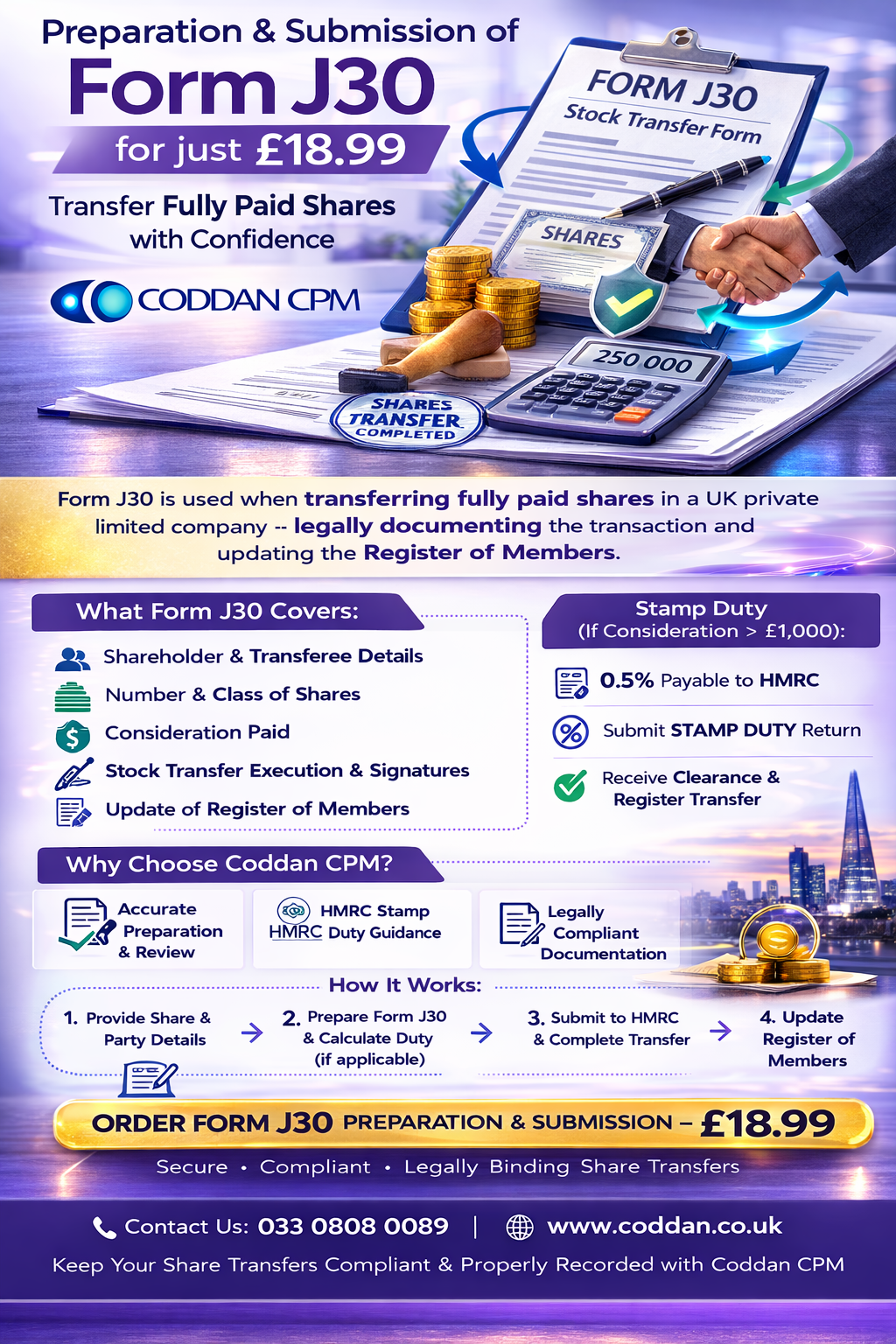
Transferring shares requires precision and strict compliance with UK regulations. Our professional Stock Transfer Form J30 preparation service ensures your share transfer is documented correctly and processed efficiently. The J30 form is used to transfer fully paid shares in a UK company. Where consideration exceeds £1,000, the form must be submitted to HM Revenue & Customs for stamping and payment of 0.5% Stamp Duty before the transfer can be fully registered. Accuracy in valuation, consideration, and share details is essential to avoid delays or rejection.
Our experienced team manages the entire process, including:
• Preparation of the Stock Transfer Form J30
• Review of share details and consideration
• Coordination of HMRC stamping where required • Guidance on updating the Register of Members
• Ensuring alignment with Companies House records
While share transfers are not filed directly with Companies House, they must be reflected in the company’s statutory registers and reported in the next Confirmation Statement. With our structured, compliance-focused service, you benefit from accurate documentation, timely processing, and reduced administrative risk. Whether transferring shares as part of a sale, gift, restructuring, or exit, we ensure your transaction is handled professionally and in accordance with UK law. Streamline your share transfer with confidence—leave

Ensure a smooth share transfer with Form J30. Learn how to complete this essential document for fully paid shares and meet HMRC requirements accurately.

Form J30 – Transfer Fully Paid Shares Correctly
When transferring shares in a UK private limited company, Form J30 (Stock Transfer Form) is essential. It is the prescribed document used when transferring fully paid shares, ensuring the change of ownership is legally valid and properly recorded. You must complete a stock transfer form to transfer shares from one shareholder to another. The form sets out the transferor and transferee details, number and class of shares, and the consideration paid. Accuracy matters—errors can delay registration and create inconsistencies in your statutory records.
If the consideration exceeds £1,000, the signed Form J30 must be submitted to HM Revenue & Customs for assessment and payment of 0.5% Stamp Duty before the company can register the transfer. Failure to comply can invalidate the registration of the shares. Once stamped (where required), the company must update its Register of Members and reflect the change in the next Confirmation Statement filed with Companies House. Completing Form J30 correctly is not just administration—it is the foundation of a compliant, enforceable share transfer. Handle it precisely, meet HMRC requirements, and keep your company records accurate and up to date. the paperwork to experienced specialists while you focus on your business.

Simplify your private limited company share transfers with Form J30. Ensure legal clarity and compliance while keeping your records pristine.

Form J30 – Transfer Fully Paid Shares with Confidence
When transferring ownership in a UK private limited company, you must complete a Stock Transfer Form J30. Form J30 is used when transferring fully paid shares, ensuring the transaction is legally documented and your company’s records remain accurate. Completing Form J30 correctly is essential for establishing clear legal ownership between transferor and transferee. The form must state the shareholder details, number and class of shares, and the consideration paid. Once executed, the company can update its Register of Members, making the transfer legally effective.
If the consideration exceeds £1,000, the form must be submitted to HM Revenue & Customs for payment of 0.5% Stamp Duty before registration. Failure to address stamp duty requirements can delay or invalidate the transfer. While share transfers are not filed directly with Companies House, the change must be reflected in the company’s statutory registers and disclosed in the next Confirmation Statement. Form J30 is more than paperwork—it safeguards transparency, protects both parties, and ensures your share transfer is compliant, enforceable, and properly recorded. Handle it correctly to keep your business structured, secure, and fully aligned with UK company law.

How to Ensure Compliance with Form J30 in the UK

How Does Form J30 Ensure Legal Ownership of Shares?

Form J30 (Stock Transfer Form) is essential for transferring fully paid shares in a UK private limited company, ensuring legal validity and proper record-keeping.
If the consideration exceeds £1,000, the signed Form J30 must be submitted to HM Revenue & Customs for a 0.5% Stamp Duty payment before the transfer can be registered.
Proper completion of Form J30 is vital for establishing clear legal ownership, safeguarding transparency, and ensuring compliance with UK company law.
Utilizing experienced specialists for paperwork can help maintain focus on business operations while ensuring compliance and accuracy in share transfers.
The Stock Transfer Form J30 is the standard document used in the UK for transferring fully paid shares in a private limited company.
Although the J30 form is not typically filed with Companies House, it is essential for compliance and must be accurately completed and retained in the company’s statutory records.


  Transfer of Company Shares Service (J30)

When it’s time to move shares from one name to another, Form J30 is your must-have paperwork. If you’re handling share transactions in a UK private limited company, you must complete a stock transfer form to ensure everything’s above board—because Form J30 is used when transferring fully paid shares. Completing the form to legally transfer shares means company records stay current and everyone’s in the clear. Completing Form J30 correctly is essential for updating legal ownership and, if the consideration tops £1, it’s your ticket to notifying HMRC for Stamp Duty as required. Form J30 is used when transferring fully paid shares, so don’t skip the details: you must complete a stock transfer form as part of doing things right. Completing Form J30 correctly isn’t just admin—it’s the cornerstone of a smooth, stamp-duty-compliant share transfer process that keeps your business moving forward.

Price: £18.99

J30 “GovernPro Filing”

Recommended for


How to Complete Form J30 for Share Transfers in the UK

Completing Form J30: A Guide for Private and Public Companies.

Flyer for Form J30, featuring details and instructions for completion and submission. Informative flyer for Form J30, outlining necessary steps and requirements for applicants.

Ownership changes of fully paid shares in UK companies require documentation via Form J30 – Stock Transfer Form.
Form J30 is essential for both private limited companies (Ltd) and public limited companies (PLC) to maintain accurate statutory records and shareholder registers.
The form includes critical details such as the names of the transferor and transferee, share class, number of shares, and the consideration paid.
Transfers exceeding £1,000 must be submitted to HM Revenue & Customs for Stamp Duty assessment, typically at a rate of 0.5% of the transaction value.
After Stamp Duty confirmation or payment, companies can update their member registers and issue new share certificates.
Coddan CPM offers professional assistance in preparing and completing Form J30, ensuring accuracy and compliance to prevent errors and delays.


Form J30 the Stock Transfer: Fast and Simple Submission J30 Form

Transferring shares is one of the most common ways to change ownership in a UK company. Whether you are selling shares, bringing in new investors, or restructuring your business, the transfer must be properly documented using a stock transfer form.

For fully paid shares, this is done using Form J30. Coddan offers a fast, accurate, and compliant service to help you complete and process your J30 form efficiently, ensuring your ownership changes are legally recognised.


What Is Form J30?

Form J30 is the standard stock transfer form used for transferring fully paid shares from one shareholder to another. It records key details including:

  • Name of the seller (transferor)
  • Name of the buyer (transferee)
  • Number and class of shares
  • Consideration (price paid for the shares)

Once completed, the form serves as legal evidence of the transfer and must be retained in company records.

If your share transfer is part of a broader ownership transition, you should also review
Change of Control and Corporate Restructuring, where share transfers play a central role in shifting control of a company.


When Do You Need to Use Form J30

You should use Form J30 when:

  • Selling or gifting fully paid shares
  • Transferring shares between existing shareholders
  • Bringing in new investors
  • Reorganising ownership structures
  • Completing part of a business sale

Correct documentation ensures the transfer is valid and enforceable.


Step-by-Step: How to Complete a J30 Form

  1. Enter Transfer Details
    Provide accurate information about the seller, buyer, and shares being transferred.
  2. Specify Consideration
    State the amount paid for the shares (if applicable).
  3. Sign the Form
    The transferor must sign the document to validate the transfer.
  4. Pay Stamp Duty (if required)
    Stamp Duty may apply depending on the value of the transaction.
  5. Update Company Registers
    Record the transfer in the register of members and issue new share certificates.


  6. J30 and Related Share Transactions

    Share transfers often occur alongside other corporate actions. Depending on your situation, you may also need:

    Issuing New Shares Instead of Transferring
    If ownership is changing through new share issuance:
    Form SH01 Explained: Allotment of Shares Made Easy

    Restructuring Share Capital
    If you are adjusting your company’s share structure:
    Form SH02 – Change of Share Capital Expert Filing Service

    Transferring Partly Paid Shares
    If the shares are not fully paid, a different form is required:
    Form J10 the Stock Transfer: Quick and Easy Submission J10 Form

    Share Buybacks and Cancellation
    If the company is purchasing its own shares:
    e-Filing the Form SH03 (Return of Purchase of Own Shares)
    Fast and Easy e-Filing Form SH06 (Notice of Cancellation of Shares)

    Handling these processes together ensures your company records remain accurate and compliant.


    Impact on PSC (People with Significant Control)

    A share transfer can significantly affect who controls the company. If ownership thresholds change (e.g. exceeding or dropping below 25%), you must update your PSC register.

    Learn how to stay compliant:
    How to Amend Your Company’s PSC Information Effectively

    Failure to update PSC information can result in regulatory issues.


    Common Mistakes to Avoid

    Businesses often encounter issues when:

    • Incorrect shareholder details are entered
    • The wrong form (J30 vs J10) is used
    • Stamp Duty requirements are overlooked
    • Company registers are not updated

    Coddan ensures your transfer is handled correctly, avoiding delays and compliance risks.


    Why Choose Coddan for J30 Submission?

    • ✔ Fast and Simple Process
      We guide you through completing your J30 form quickly and correctly.
    • ✔ Accuracy and Compliance
      Our experts ensure all details are properly recorded.
    • ✔ End-to-End Support
      We assist with related filings and ownership updates.
    • ✔ Suitable for All Business Sizes
      Whether a small transfer or full ownership change, we support your needs.


    Transfer Shares with Confidence

    Simplify your share transfer process with Coddan’s expert support.

    • ✔ Accurate documentation
    • ✔ Fast processing
    • ✔ Full compliance

    Start your J30 submission today and ensure your ownership changes are properly recorded.

    Form J30 – Stock Transfer of Fully Paid Shares
    When ownership of fully paid shares in a UK company changes, the transaction must be properly documented using Form J30 – Stock Transfer Form. This document formally records the transfer of shares between shareholders, ensuring the company’s statutory records and shareholder register remain accurate and legally compliant.

    Form J30 is used by both private limited companies (Ltd) and public limited companies (PLC) when fully paid shares are transferred to another individual or corporate entity. The form captures key information including the name of the transferor and transferee, share class, number of shares transferred, and the consideration (price) paid for the shares.

    Where the value of the transfer exceeds £1,000, the completed form must normally be submitted to HM Revenue & Customs for Stamp Duty assessment, typically calculated at 0.5% of the transaction value. Once the duty is confirmed or paid, the company can update its register of members and issue new share certificates reflecting the change of ownership.

    With support from Coddan CPM, the preparation and completion of Form J30 can be handled professionally. Our service ensures all required details are correctly recorded, helping to avoid errors, delays, or compliance issues during the share transfer process.

    Accurate preparation of Form J30 – Stock Transfer Form ensures that share ownership changes are legally documented, tax compliant, and properly recorded, allowing your company’s shareholder records to remain clear and up to date.


    Stock Transfer Form J30 (Fully Paid Shares)
    How to Prepare and Process a Share Transfer in a UK Limited Company

    For startups, growth companies and overseas entrepreneurs entering the UK market, understanding how to transfer shares correctly is essential. A share transfer changes legal ownership of part of your company. If handled incorrectly, it can create disputes, invalidate transactions or cause serious problems during due diligence.

    The Stock Transfer Form J30 is the standard instrument used in the UK to transfer fully paid shares in a private limited company. It is a legal document that evidences the transfer of title from one shareholder to another. While it is not filed directly with Companies House in most cases, it is a critical compliance document that must be properly completed and retained within the company’s statutory records.

    If you are searching for How to transfer shares in a UK limited company, Form J30 explained, or Stock Transfer Form fully paid shares UK, this guide provides clarity on the correct process.

    What Is Form J30?
    Form J30 is used when fully paid shares are being transferred from one shareholder (the transferor) to another (the transferee). It records the number and class of shares being transferred, the consideration paid and the parties involved.

    It does not itself update Companies House. The legal transfer occurs when the company updates its Register of Members following approval in accordance with its Articles of Association. The Confirmation Statement (CS01) later reflects the new ownership structure on the public register.

    This distinction is important. Filing documents with Companies House alone does not complete a transfer. Proper internal documentation is what creates legal ownership.

    Who Must Use Form J30?
    Form J30 is required whenever fully paid shares in an England and Wales company are transferred. This applies to founder exits, investor buy-ins, internal restructures, family business succession and foreign entrepreneurs acquiring shares in a UK company.

    For partly paid shares, a different form (J10) is used.

    Before completing J30, the company’s Articles of Association must be reviewed to confirm whether director approval is required and whether pre-emption rights apply. Many startups overlook these provisions, which can invalidate a transfer if ignored.

    What Information Is Required on Form J30?
    The form must accurately state the full name and address of the transferor and transferee. It must include the company name and registration number, the number and class of shares being transferred, and the consideration paid.

    If consideration exceeds £1,000, Stamp Duty at 0.5 percent may be payable to HMRC before the transfer can be registered. Failure to address stamp duty correctly can delay the process.

    The transferor must sign the form. The transferee’s signature is not legally required but is often included for clarity.

    Accuracy matters. Errors in share class, number of shares or consideration can cause administrative and legal complications later.

    The Correct Process for Completing a Share Transfer
    A compliant share transfer involves more than filling in Form J30. The correct sequence typically includes preparing the Stock Transfer Form, assessing Stamp Duty liability, obtaining board approval (if required under the Articles), updating the Register of Members, issuing a new share certificate and cancelling the old certificate.

    The shareholder ceases to be a member when their name is removed from the Register of Members — not when the J30 is signed and not when the Confirmation Statement is filed.

    This is one of the most misunderstood aspects of UK company law.

    Do You Submit Form J30 to Companies House?
    In most private company transfers, Form J30 is not submitted to Companies House. It is retained with the company’s statutory records.

    The ownership change is reflected in the next Confirmation Statement. Only in limited circumstances — such as certain public company scenarios — would additional filings apply.

    Many online sources incorrectly suggest uploading J30 directly to Companies House. That is not standard procedure for private limited companies.

    Common Mistakes Startups Make
    Early-stage companies frequently fail to check pre-emption rights, neglect stamp duty requirements, forget to update the Register of Members or misclassify share classes. These errors may not become apparent until external investment or sale negotiations occur.

    Improperly documented share transfers can derail funding rounds and undermine investor confidence.

    Professional Support for UK Share Transfers
    If you are restructuring ownership, onboarding investors or managing a founder exit, professional handling of the share transfer process reduces risk and ensures compliance. At Coddan, we make life simpler, more affordable, worry-free, and compliant, and we back it with experience for all our clients.

    We assist startups and overseas founders with preparing Stock Transfer Forms, reviewing Articles of Association, managing board approvals, updating statutory registers and ensuring Companies House records are consistent with internal documentation.

    Whether you are transferring a small minority stake or executing a full ownership transition, precision is essential.

    Protect Your Company’s Legal Ownership Structure
    A share transfer is not merely an administrative task. It alters the legal and economic ownership of your company. Done correctly, it strengthens governance and investor confidence. Done incorrectly, it creates avoidable disputes.

    If you need assistance preparing Form J30, transferring shares in a UK limited company, or ensuring compliance with Companies Act requirements, seek guidance before executing the transaction.

    Early advice prevents corrective action later.

    What Information Is Required on Form J30?
    The form must accurately state the full name and address of the transferor and transferee. It must include the company name and registration number, the number and class of shares being transferred, and the consideration paid. If consideration exceeds £1,000, Stamp Duty at 0.5 percent may be payable to HMRC before the transfer can be registered. Failure to address stamp duty correctly can delay the process. The transferor must sign the form. The transferee’s signature is not legally required but is often included for clarity.

    Accuracy matters. Errors in share class, number of shares or consideration can cause administrative and legal complications later.

    The Correct Process for Completing a Share Transfer
    A compliant share transfer involves more than filling in Form J30. The correct sequence typically includes preparing the Stock Transfer Form, assessing Stamp Duty liability, obtaining board approval (if required under the Articles), updating the Register of Members, issuing a new share certificate and cancelling the old certificate. The shareholder ceases to be a member when their name is removed from the Register of Members — not when the J30 is signed and not when the Confirmation Statement is filed. This is one of the most misunderstood aspects of UK company law.


    Transfer Shares in a UK Limited Company — Done Properly the First Time
    Corporate Secretarial & Compliance Support for Form J30 Transactions

    A share transfer is not paperwork. It is a legal change of ownership.

    If you are transferring shares in a UK limited company — whether onboarding an investor, restructuring founder equity or managing an overseas acquisition — precision is critical. Errors in Stock Transfer Form J30, statutory registers or board approvals can invalidate the transfer and surface later during due diligence, funding rounds or business sales.

    We provide structured corporate secretarial and compliance services to ensure your share transfer is legally effective, fully documented and aligned with Companies Act requirements.

    If you need clarity, certainty and speed, speak to a compliance specialist today.

    Why Professional Oversight Is Essential
    Many founders believe signing Form J30 completes the transfer. It does not.

    In UK private companies, ownership changes only when the Register of Members is updated following proper approval under the Articles of Association. Public filings with Companies House reflect the change later through the Confirmation Statement. The internal documentation creates the legal effect.

    If the sequence is wrong — if pre-emption rights are ignored, stamp duty is overlooked or board authority is missing — the transfer may be defective.

    That risk increases when startups operate without in-house governance expertise or when foreign investors are unfamiliar with UK corporate procedures.

    We eliminate that exposure.

    Who We Support
    Our services are designed for:

    • Startup founders issuing or transferring equity
    • Foreign investors acquiring shares in UK companies
    • Minority shareholder buy-ins or exits
    • Family succession transfers
    • Growth companies preparing for fundraising
    • Businesses correcting historic share transfer errors

    If you searched for How to transfer shares in a UK limited company correctly or Form J30 compliance service UK, this is precisely what we handle.

    What Our Corporate Secretarial Service Covers
    We begin with a detailed review of your Articles of Association to identify transfer restrictions, director discretion clauses and pre-emption rights. We then prepare the Stock Transfer Form J30 accurately, ensuring correct share class descriptions, quantities and consideration.

    Where consideration exceeds £1,000, we assess stamp duty requirements and manage HMRC stamping before registration.

    Once approval is confirmed, we update the Register of Members, issue new share certificates, cancel previous certificates and ensure your Confirmation Statement reflects the revised ownership.

    Every step is sequenced properly. Every document is defensible.

    Risk Reduction for Founders and Investors
    Improper share transfers frequently remain undiscovered until investors conduct legal due diligence. At that stage, corrections can delay transactions and damage credibility.

    Professional corporate secretarial oversight protects you by:

    • Ensuring statutory registers are accurate
    • Preventing procedural invalidity
    • Reducing director liability risk
    • Strengthening investor confidence
    • Maintaining audit-ready documentation

    Equity structure errors are avoidable. Early compliance prevents later remediation.

    Built for Foreign Entrepreneurs Entering the UK Market
    If you are investing in or acquiring shares in a UK company from overseas, you may be accustomed to systems where filings alone effect ownership change. UK law operates differently.

    We explain the legal mechanics clearly so you understand when ownership transfers, how voting rights attach and how corporate records must be maintained.

    This clarity protects your investment.

    Addressing Common Concerns
    If you are unsure whether directors can refuse a transfer, we review the Articles to confirm their discretion.

    If you are concerned about stamp duty liability, we calculate the threshold and advise before registration.

    If you suspect previous transfers were handled incorrectly, we conduct a compliance review and implement corrective steps before issues escalate.

    No assumptions. No shortcuts. No avoidable exposure.

    Why Clients Choose Us
    We focus on UK corporate governance and share capital compliance. Our approach is methodical, legally grounded and commercially pragmatic.

    Clients rely on us because we deliver:

    • Technical accuracy aligned with the Companies Act 2006
    • Clear guidance without unnecessary complexity
    • Fast turnaround for time-sensitive transactions
    • Confidential handling of sensitive ownership changes
    • Investor-ready documentation

    Your company’s equity is its foundation. It deserves professional management.

    Take the Next Step Now
    If you are transferring shares, onboarding investors or restructuring ownership, do not rely on templates or informal guidance.

    Contact us today for a confidential consultation. We will review your company structure, identify the correct procedural route and provide a clear, fixed-scope solution to complete your share transfer compliantly.

    Protect your ownership structure before problems arise.

    Why Startups Choose Coddan for Stock Transfer Form J30 Assistance
    Licensed ACSP Support for UK Share Transfers

    Transferring shares in a UK limited company is a legal event — not an administrative formality. When ownership changes, voting rights, dividend entitlements and control structures change with it. For startups, scaling companies and overseas entrepreneurs entering the UK market, mistakes in the Stock Transfer Form J30 process can create costly governance issues later.

    Coddan, a licensed Alternative Company Secretary Provider (ACSP), provides structured, compliant and efficient support for stock transfers across England, Wales, Scotland and Northern Ireland.

    If you are searching for Form J30 help UK, transfer shares UK limited company support or corporate secretarial services for share transfer, you need more than a template. You need procedural certainty.

    Specialist Expertise in UK Share Transfers
    Many founders underestimate the legal mechanics behind a share transfer. Signing Form J30 alone does not complete the process. The transfer becomes legally effective only when the company updates its Register of Members in accordance with its Articles of Association and the Companies Act 2006.

    Coddan’s team understands this distinction.

    Our professionals review the company’s constitutional documents, identify transfer restrictions and pre-emption rights, confirm whether director approval is required and ensure that all procedural steps are followed in the correct sequence. This eliminates ambiguity and protects the validity of the transaction.

    For foreign investors unfamiliar with UK corporate mechanics, this clarity is particularly valuable.

    Fast, Structured and Digitally Managed
    Startups operate under pressure. Funding deadlines, investor negotiations and internal restructures require speed without sacrificing compliance.

    Coddan’s streamlined digital systems allow share transfer documentation to be prepared efficiently and accurately. Clients benefit from rapid processing while maintaining full compliance standards. Administrative friction is reduced, enabling founders to focus on business growth rather than procedural complexity.

    Efficiency does not replace diligence. It enhances it.

    Tailored Support for Founders and Overseas Investors
    No two share transfers are identical. A founder exit requires a different approach from a minority investor buy-in. A family business succession differs from a venture capital transaction.

    Coddan adapts its support based on the commercial context. Whether you are restructuring ownership, onboarding investors or correcting historic share transfer errors, the solution is structured around your company’s specific governance framework.

    Foreign entrepreneurs entering the UK market receive clear explanations of how ownership legally transfers — including the distinction between internal statutory registers and filings with Companies House.

    This transparency protects both investment and reputation.

    Proactive Compliance and Risk Reduction
    Share transfer errors frequently surface during due diligence. At that stage, rectifying defective documentation can delay investment rounds or acquisition deals.

    Coddan mitigates this risk by ensuring:

    • Accurate completion of Form J30
    • Proper sequencing of board approvals
    • Stamp Duty assessment where consideration exceeds thresholds
    • Immediate update of the Register of Members
    • Issuance and cancellation of share certificates
    • Alignment with Confirmation Statement disclosures

    By embedding compliance into the process, Coddan protects directors from procedural breach and strengthens investor confidence.

    More Than Just Form J30
    Stock transfer support is often part of a wider corporate lifecycle. Coddan provides integrated company formation, registered office, corporate secretarial and compliance services under one structure.

    This continuity means your share structure, statutory records and Companies House filings remain consistent and professionally managed over time.

    For startups operating with lean internal teams, this integrated support model is both efficient and cost-effective.

    Addressing Common Founder Concerns

    • If you are unsure whether stamp duty applies, Coddan will assess and advise before registration.
    • If your Articles give directors discretion to refuse a transfer, Coddan reviews and clarifies the scope of that discretion.
    • If previous transfers were handled informally, Coddan can conduct a compliance review and correct irregularities before they create future liability.

    No assumptions. No shortcuts. No compliance gaps.

    A Long-Term Governance Partner
    Choosing Coddan is not a one-off administrative decision. It is the start of a long-term corporate governance partnership.

    As a licensed ACSP provider, Coddan operates with professionalism, reliability and procedural discipline. Their focus is not simply on completing a form — it is on safeguarding the legal integrity of your company’s ownership structure.

    For startups building toward investment, expansion or exit, that integrity matters.

    Take Control of Your Share Transfer Today
    If you are transferring shares, restructuring equity or onboarding investors, do not rely on informal documentation.

    Contact Coddan today for structured, compliant and confidential Stock Transfer Form J30 assistance. Secure your ownership structure before issues arise.

    Your equity defines your company. Manage it professionally.

    Form J30 vs Form J10 Explained
    Share Transfer Rules Every UK Startup Must Understand

    If you are transferring shares in a UK limited company, using the correct stock transfer form is critical. The difference between Form J30 and Form J10 is simple in principle — but serious mistakes happen when founders misunderstand when each applies.

    For startups, growth companies and foreign investors entering the UK market, choosing the wrong form can delay transactions, invalidate transfers or create compliance exposure.

    This guide explains the difference clearly — and when professional corporate secretarial oversight is essential.

    First: J30 and J10 Are for Transfers — Not Share Issuance
    A common misconception is that J30 and J10 are filed when shares are issued. That is incorrect.

    When a company issues new shares, different Companies House forms apply.

    Form J30 and Form J10 are used when existing shares are being transferred from one shareholder to another.

    Understanding this distinction protects your company from procedural errors.

    What Is Form J30?
    Form J30 is used to transfer fully paid shares in a UK company.

    Fully paid shares mean the shareholder has already paid the full nominal value of the shares. There is no outstanding liability to the company. J30 records:

    • The name of the transferor (seller)
    • The name of the transferee (buyer)
    • The number and class of shares
    • The consideration paid
    • The execution by the transferor

    Once approved (where required by the Articles of Association), the company updates its Register of Members. That update — not the form itself — legally completes the transfer.

    For most startup equity restructures, investor onboarding transactions and founder exits, J30 is the correct instrument.

    What Is Form J10?
    Form J10 is used to transfer partly paid (unpaid) shares.

    Partly paid shares carry an outstanding liability. The shareholder remains legally responsible for unpaid amounts if called upon by the company.

    Because of this continuing obligation, J10 includes additional protections and formalities compared to J30.

    Partly paid shares are less common in modern startups but may arise in:

    • Early-stage founder arrangements
    • Family-owned companies
    • Structured capital agreements
    • Historic share structures

    If partly paid shares are transferred incorrectly, liability disputes can arise later.

    Why the Difference Matters for Startups
    Using the wrong transfer form creates legal ambiguity.

    If fully paid shares are transferred using incorrect documentation, investor confidence may be undermined during due diligence.

    If partly paid shares are transferred without properly addressing outstanding liability, both parties may face unexpected financial exposure.

    For foreign entrepreneurs, the UK system can be confusing because ownership does not transfer through a public filing at Companies House. The transfer becomes effective when the company updates its internal Register of Members in compliance with the Companies Act 2006 and its Articles. Precision is not optional.

    Common Founder Mistakes
    Many early-stage companies:

    • Fail to check whether shares are fully or partly paid
    • Confuse share issuance with share transfer
    • Ignore pre-emption rights in the Articles
    • Overlook stamp duty where consideration exceeds £1,000
    • Fail to update the Register of Members immediately

    These issues often surface during investment rounds or exit negotiations — when timing is critical.

    Which Form Do You Need?
    If the shares are fully paid, Form J30 is generally required.

    If the shares are partly paid, Form J10 is required.

    If you are issuing new shares, neither J30 nor J10 applies.

    If you are unsure which category your shares fall into, professional review is strongly recommended before executing the transfer.

    Professional Corporate Secretarial Support
    Share transfers are governance events. They alter ownership, control and voting power. Professional oversight ensures:

    • Correct form selection (J30 or J10)
    • Review of Articles of Association
    • Director approval procedures
    • Stamp Duty assessment
    • Immediate Register of Members update
    • Proper share certificate issuance
    • Alignment with Confirmation Statement disclosures

    This structured approach protects founders, investors and directors from compliance risk.

    Built for UK Startups and Overseas Investors
    If you are raising investment, restructuring equity or acquiring shares in a UK company, clarity around share status is essential. We support:

    • Startup founders onboarding investors
    • Foreign investors acquiring UK equity
    • Minority shareholder buy-ins or exits
    • Companies correcting historic transfer errors
    • Growth businesses preparing for funding

    Early advice prevents later remediation.

    Take the Right Step Now
    If you are transferring shares and are unsure whether Form J30 or J10 applies, do not proceed based on assumption.

    Contact a corporate compliance specialist for a structured review of your share capital position and Articles of Association. A short consultation now can prevent significant complications later. Your ownership structure defines your company’s future. Handle it correctly.

    Can I Use Coddan CPM to Submit Stock Transfer Form J30?

    What UK Startups and Foreign Investors Need to Know
    If you are transferring shares in a UK limited company, you may be asking whether you can use Coddan CPM to submit the Stock Transfer Form J30.

    The short answer is: you can use Coddan CPM to prepare, review and process your J30 correctly — but Form J30 is not submitted directly to Companies House in most private company transfers.

    This distinction matters. Understanding it protects your company from compliance mistakes.

    First: Is Form J30 Filed with Companies House?

    No — not in standard private company share transfers.

    Form J30 is a stock transfer instrument, not a Companies House filing form. It records the transfer of fully paid shares from one shareholder to another. The transfer becomes legally effective when:

    1. The company approves the transfer (if required under the Articles of Association)
    2. The Register of Members is updated
    3. A new share certificate is issued

    The ownership change is then reflected publicly in the next Confirmation Statement (CS01).

    Many founders mistakenly believe uploading J30 to Companies House completes the transfer. It does not.

    So How Does Coddan CPM Help?

    Coddan CPM supports startups and foreign entrepreneurs by managing the entire share transfer process correctly from start to finish. Instead of simply offering a template, Coddan ensures:

    • The correct form is used (J30 for fully paid shares, J10 for partly paid shares)
    • Your Articles of Association are reviewed for transfer restrictions
    • Pre-emption rights are considered
    • Director approval procedures are followed
    • Stamp Duty is assessed where consideration exceeds £1,000
    • The Register of Members is updated correctly
    • New share certificates are issued
    • Your Confirmation Statement reflects the updated ownership

    In other words, Coddan does not just “submit a form.” They manage the legal mechanics of the transfer.

    Why This Matters for Startups

    Startups frequently restructure equity during:

    • Founder exits
    • Investor onboarding
    • Equity incentives
    • Joint ventures
    • Foreign acquisitions

    If the share transfer process is handled incorrectly, problems often surface during investor due diligence or funding rounds. Rectifying defective transfers can delay transactions and damage credibility. Professional oversight prevents those risks.

    Built for Foreign Businesses Entering the UK

    If you are an overseas entrepreneur acquiring shares in a UK company, the internal nature of UK share transfers can be confusing. Ownership changes through internal statutory records — not through a Companies House submission alone. Coddan provides clarity on:

    • When legal ownership changes
    • ow voting rights attach
    • How shareholder registers must be maintained
    • What documentation investors expect to see

    This protects your investment and ensures compliance with UK company law.

    Common Questions

    If you are unsure whether Stamp Duty applies, Coddan will assess the transaction before registration.

    If your Articles allow directors to refuse a transfer, Coddan will clarify the scope of discretion.

    If previous transfers were handled informally, Coddan can review and correct historic errors before they create complications.

    Why Startups Choose Coddan CPM

    Clients rely on Coddan because they provide:

    • Accurate, Companies Act–compliant documentation
    • Structured corporate secretarial support
    • Fast turnaround for time-sensitive transactions
    • Clear guidance without unnecessary legal jargon
    • Confidential handling of ownership changes

    Your share structure defines control, profit distribution and exit value. It should not be left to guesswork.

    Ready to Transfer Shares the Right Way?

    If you need help preparing or processing a Stock Transfer Form J30, do not rely on assumptions about submission procedures.

    Contact Coddan CPM today for structured, compliant and efficient share transfer assistance. Protect your company’s ownership structure before issues arise.

    Stock Transfer Form J30: Do You Need to Submit It to Companies House or HMRC?

    If you are transferring shares in a UK limited company, one of the most common questions is whether the Stock Transfer Form J30 must be submitted to Companies House or HMRC.

    For startups, early-stage companies and overseas entrepreneurs entering the UK market, misunderstanding this process can lead to compliance mistakes. The rules are straightforward — but they must be followed precisely.

    This guide explains exactly what you must file, what you must retain internally, and when HMRC becomes involved.

    What Is Stock Transfer Form J30?

    Stock Transfer Form J30 is the standard instrument used to transfer fully paid shares in a UK company from one shareholder to another. It records:

    • The transferor (seller)
    • The transferee (buyer)
    • The number and class of shares
    • The consideration paid
    • The execution of the transfer

    Importantly, J30 applies to share transfers, not the issue of new shares. If your company is issuing new shares, different Companies House forms apply.

    Do You Submit Form J30 to Companies House?

    In most private limited company transfers, no. The form itself is not filed with Companies House. Instead, the legal transfer takes effect when:

    1. The company approves the transfer (if required by the Articles of Association).
    2. The company updates its Register of Members.
    3. A new share certificate is issued.

    The updated ownership is later reflected publicly in the company’s next Confirmation Statement (CS01).

    This is a critical point. Companies House does not process or approve J30 forms in standard private company transfers. The responsibility sits with the company’s internal statutory records.

    Do You Need to Submit Form J30 to HMRC?

    In certain cases — yes.

    If the consideration for the share transfer exceeds £1,000, Stamp Duty at 0.5% may be payable. In that case, the J30 must be sent to HMRC for stamping before the company registers the transfer. If the transfer is:

    • For £1,000 or less
    • A gift with no consideration
    • Exempt under specific relief

    Stamp Duty may not apply.

    This is the area where many startups make mistakes. Failure to address Stamp Duty correctly can delay registration of the transfer and create compliance exposure. HMRC is not concerned with ownership structure generally — it is concerned with tax liability.

    What About Employee Share Schemes?

    If shares are transferred under an employee share scheme or as part of remuneration, additional tax reporting obligations may apply. These are separate from the J30 process and may involve PAYE or employment-related securities reporting.

    In these situations, professional tax advice is strongly recommended.

    Why Accurate Record-Keeping Is Critical

    Although you may not file J30 with Companies House, you must retain it with your statutory records.

    Your Register of Members is the definitive legal record of ownership. A person only ceases to be a shareholder when their name is removed from that register.

    Improperly recorded transfers frequently cause issues during:

    • Investment due diligence
    • Business sales
    • Shareholder disputes
    • Corporate audits

    For startups planning growth or fundraising, clean ownership records are non-negotiable.

    Common Founder Misunderstandings

    Early-stage businesses often:

    • Assume uploading documents to Companies House completes the transfer
    • Fail to update the Register of Members immediately
    • Ignore pre-emption rights in the Articles
    • Overlook Stamp Duty obligations
    • Confuse share transfers with new share allotments

    These errors typically surface at the worst possible time — during funding or exit negotiations.

    When Should You Seek Professional Support?

    You should consider structured corporate secretarial or compliance support if:

    • The transfer involves significant consideration
    • The Articles contain transfer restrictions
    • Directors have discretion to refuse transfers
    • The company is preparing for fundraising
    • Previous transfers may not have been properly recorded

    Early review prevents later remediation.

    Final Summary

    You do not normally submit Stock Transfer Form J30 to Companies House.

    You may need to submit it to HMRC for Stamp Duty if consideration exceeds £1,000.

    You must update your Register of Members for the transfer to become legally effective.

    For startups and foreign investors, understanding this sequence protects ownership integrity and prevents compliance issues later.

    If you are unsure whether your transfer requires Stamp Duty stamping or internal approval procedures, professional guidance can ensure your transaction is legally valid and properly recorded.

    Stock Transfer Form J30 – Professional Guidance for Share Transfers

    Transferring shares in a UK company requires careful attention to legal and regulatory requirements. For startups, new ventures, and overseas businesses entering the UK market, the process can appear complex—particularly when completing the >Stock Transfer Form J30, the official document used to transfer fully paid shares between shareholders.

    Form J30 records the details of the transfer, including the parties involved, the number and class of shares, and the consideration paid. Accuracy is essential. Errors or incomplete information can delay the transfer or create inconsistencies in the company’s statutory records. Where the value of the shares exceeds £1,000, the form must also be submitted to HM Revenue & Customs for assessment and payment of Stamp Duty before the transfer can be registered.

    At Coddan, we provide professional support for businesses that prefer personal, offline assistance rather than navigating complex legal forms alone. Our London-based specialists guide clients through every stage of the share transfer process—from understanding the legal implications and confirming share valuation to ensuring the J30 form is completed accurately and compliant with UK company law.

    Our service goes beyond preparing a document. We help ensure the transfer aligns with the company’s Articles of Association, that the Register of Members is updated correctly, and that any required disclosures toCompanies House are properly reflected in future filings.

    For entrepreneurs, founders, and international investors, having experienced support can prevent costly errors and administrative delays. With professional guidance, your share transfer can be handled confidently, accurately, and in full compliance with UK regulations—allowing you to focus on growing your business rather than navigating complex paperwork.

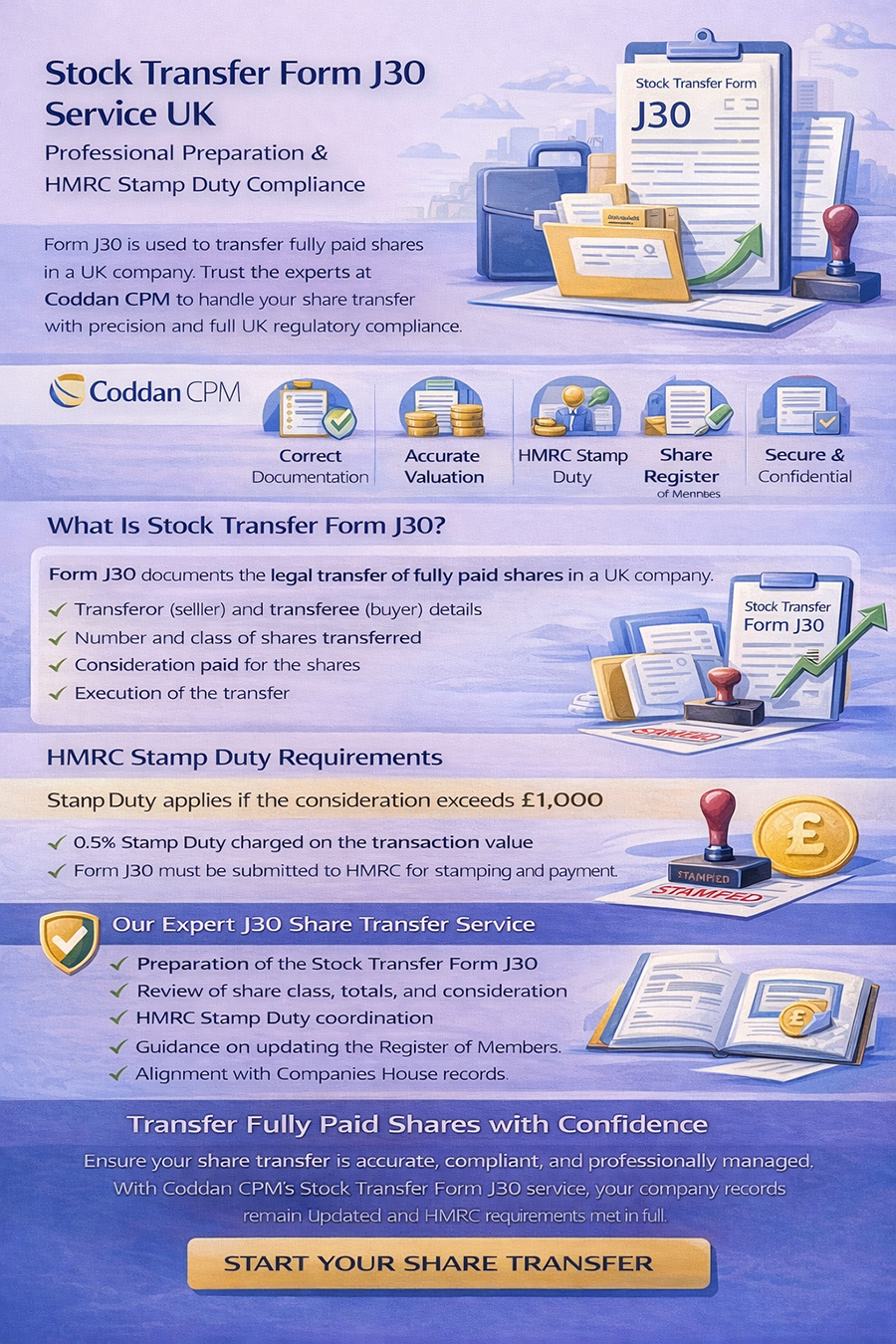
    Stock Transfer Form J30 Service UK. Professional Preparation & HMRC Stamp Duty Compliance

    Transferring shares in a UK company requires accurate documentation and strict compliance with company law and tax regulations. The Stock Transfer Form J30 is the official document used to transfer fully paid shares between shareholders in a private limited company.

    With Coddan CPM, your Form J30 share transfer is prepared and processed professionally, ensuring your transaction is accurately documented, compliant with UK law, and properly recorded in your company’s statutory registers.

    Our structured service helps companies complete share transfers efficiently while reducing administrative risk and ensuring alignment with HM Revenue & Customs and Companies House requirements.


    HMRC Stamp Duty Requirements

    If the consideration for the share transfer exceeds £1,000, the signed Form J30 must be submitted to HMRC for stamping. Under UK tax rules:

    • Stamp Duty is charged at 0.5% of the transaction value
    • HMRC must assess and stamp the document before the company registers the transfer

    Failure to address the stamp duty requirement may delay or invalidate the share transfer.


    Transfer Fully Paid Shares with Confidence

    Completing Stock Transfer Form J30 correctly is essential for ensuring that share ownership changes are legally valid and properly recorded.

    With Coddan CPM’s professional J30 preparation service, you benefit from accurate documentation, compliant processing, and reduced administrative burden.

    Streamline your share transfer today and keep your company’s records clear, compliant, and fully aligned with UK corporate law.

    Coddan Case Studies: Transfer of Fully Paid Shares (Form J30). Case Study 1: Founder Exit Through Share Transfer

    Client: UK Technology Startup
    Service: Share Transfer & J30 Preparation

    A technology startup experienced a founder departure after its initial growth phase. The departing founder agreed to transfer fully paid shares to the remaining shareholders, ensuring the company’s ownership structure remained stable.

    Because the transfer involved consideration exceeding £1,000, the company needed to comply with the stamp duty requirements administered by HM Revenue & Customs.

    Challenge

    The company needed to ensure:

    • Accurate completion of Stock Transfer Form J30
    • Proper share valuation and consideration recording
    • Compliance with stamp duty requirements
    • Correct updates to the Register of Members

    Solution

    Coddan CPM managed the process by:

    • Preparing the Stock Transfer Form J30
    • Reviewing share class and consideration values
    • Coordinating the HMRC stamp duty submission
    • Advising on updating the company’s statutory registers

    Outcome

    The share transfer was completed successfully, ensuring the company’s ownership records remained accurate and legally enforceable.


    Case Study 2: Investor Share Purchase

    Client: UK Fintech Company
    Service: Share Transfer Documentation

    A fintech company secured a private investor who acquired shares from an existing shareholder rather than through a new share allotment.

    Because the shares were already issued and fully paid, the transaction required a Stock Transfer Form J30 rather than an SH01 allotment filing.

    Challenge

    The company needed to ensure:

    • The transferor and transferee details were correctly recorded
    • The consideration value was accurately declared
    • The company’s Register of Members reflected the new shareholder

    Solution

    Coddan CPM prepared the J30 transfer documentation, confirmed the share details, and guided the company through updating internal records and ensuring compliance with **Companies House disclosure requirements.

    Outcome

    The investor’s share purchase was completed smoothly, ensuring the company’s statutory records remained compliant and transparent.


    Case Study 3: Family Business Share Transfer

    Client: UK Family-Owned Business
    Service: Share Transfer & Register Updates

    A family-owned business needed to transfer shares from a retiring shareholder to the next generation as part of succession planning.

    Challenge

    The business required assistance with:

    • Preparing the Stock Transfer Form J30
    • Ensuring the transfer complied with company law
    • Updating the company’s Register of Members

    Because the transaction involved a nominal transfer value, stamp duty requirements also needed to be reviewed.

    Solution

    Coddan CPM:

    • Prepared the J30 share transfer documentation
    • Reviewed the consideration value and duty implications
    • Guided the company through register updates and compliance procedures

    Outcome

    The company successfully completed the generational transfer, ensuring its ownership structure was properly documented and compliant.


    Case Study 4: Share Transfer During Corporate Restructuring

    Client: UK Holding Company
    Service: Share Ownership Reorganisation

    A corporate group reorganised ownership between its holding company and subsidiary entities.

    This restructuring required multiple share transfers between group companies, all documented using Stock Transfer Form J30.

    Challenge

    The group needed to ensure:

    • All transfers were accurately documented
    • Share consideration values were properly recorded
    • The company’s statutory registers reflected the restructuring

    Solution

    Coddan CPM handled the process by:

    • Preparing multiple J30 share transfer forms
    • Coordinating HMRC stamping requirements
    • Ensuring each company updated its Register of Members

    Outcome

    The corporate restructuring was completed successfully, providing clear ownership documentation across the group structure.


    Case Study 5: Shareholder Exit During Business Sale

    Client: UK Manufacturing Company
    Service: Share Transfer Compliance

    During the sale of a manufacturing business, a minority shareholder agreed to sell their shares to the acquiring company.

    Challenge

    The transaction required:

    • Proper documentation of the share transfer agreement
    • Accurate completion of Stock Transfer Form J30
    • Compliance with stamp duty requirements

    Solution

    Coddan CPM prepared the required documentation and ensured the transfer complied with UK regulatory requirements. The service included:

    • Preparation of Form J30
    • Review of share consideration values
    • Guidance on updating the Register of Members

    Outcome

    The share transfer was completed without delay, allowing the acquisition to proceed with clean and accurate shareholder records.

    Compliance and Risk Management
    Directors ensure filings, records, and legal obligations are properly handled.

    This may include appointing qualified directors when needed. For example: