We use cookies on this website, you can read about cookies and GDPR Privacy Policy here
Coddan CPM Ltd. – Company Registration Agent in the UK

Learn how to properly resign or terminate a company director, including the required public filings and the distinctions between voluntary and involuntary actions.

Step 1
1️⃣ Review Articles of Association and Contracts
Step 2
2️⃣ Formal Resignation (Voluntary Departure)
Step 3
3️⃣ Completing form TM01 for directors
Step 4
4️⃣ File with Companies House (Mandatory)
Step 5
5️⃣ Update Internal Records
Step 6
6️⃣ Finalize and Notify
Companies Registry's e-Services Portal Post Incorporation Support Service How to Simplify Director Removal (form TM01) for Your Business


Streamline director changes with our expert resignation and termination service; we ensure compliance with the Companies Act 2006 and handle all legal paperwork.

Ensure director resignations and removals are handled correctly, promptly, and in full compliance with UK company law. Coddan CPM offers a professionally managed service for the resignation, termination, or removal of company directors—delivered efficiently and, in many cases, within 24 hours, subject to statutory requirements. Director changes must comply with the Companies Act 2006, your company’s Articles of Association, and the 14-day notification requirement to Companies House. Filing the statutory form (TM01) is a legal notification, not the act of resignation itself. Proper board or shareholder procedures must be completed before submission to ensure the change is legally valid.
Our specialist team manages the entire process—from preparing resolutions and updating statutory registers to securely filing the required forms electronically. This structured approach reduces the risk of rejected filings, governance disputes, or compliance breaches. Whether you require urgent action or are managing a planned leadership transition, we provide clear guidance and precise execution at every stage. You can focus on protecting and progressing your business while we handle the regulatory and procedural requirements.
Contact us today to ensure your director changes are completed quickly, correctly, and with full legal certainty.

Ensure legal compliance with director resignations and removals; Coddan CPM offers a fast TM01 service to simplify the process and keep your records updated.

When a director resigns or is removed, the process must be handled correctly to ensure full legal compliance. Coddan CPM offers a fast and professionally managed TM01 service, simplifying director resignations and removals while ensuring your statutory obligations are met. Under the Companies Act 2006, a director may resign at any time by giving written notice to the company, subject to the company’s Articles of Association or service agreement. The company must then notify Companies House within 14 days by filing Form TM01. It is important to note that TM01 is a legal notification of a change that has already taken effect—it is not the resignation itself.
Our structured service ensures that written notice is properly documented, board or shareholder procedures (where required) are followed, and statutory registers are updated before submission. We prepare and file the TM01 electronically to minimise delays and reduce the risk of rejected filings. Where necessary, we also assist with related updates, including internal registers and corporate records. Whether the resignation is voluntary or part of a wider board restructuring, we manage the compliance process efficiently and accurately. With Coddan CPM, director removals and resignations are handled clearly, quickly, and in strict accordance with UK company law—so your governance remains sound and your records fully up to date.

Ensure compliance with Coddan CPM's TM01 filing service for director resignations; we handle all steps efficiently, keeping your records up to date and risk-free.

Changing your board should not become a compliance risk. Coddan CPM offers a fast and professionally managed TM01 filing service to ensure director resignations and removals are handled correctly and without delay. Under the Companies Act 2006, a director may resign at any time by giving written notice to the company, subject to the company’s Articles of Association or any service agreement. The company must then notify Companies House within 14 days by filing Form TM01. It is important to understand that TM01 is a statutory notification—it does not itself create the resignation.
Our structured process ensures that written notice is properly documented, internal approvals (where required) are completed, and statutory registers are updated before submission. We prepare and file the TM01 electronically to minimise delays and reduce the risk of rejected filings. Where applicable, we also assist with updating bank mandates and corporate records to ensure a clean transition. Whether the departure is voluntary or part of a board restructuring, we manage the legal and administrative steps efficiently and accurately. With Coddan CPM, director resignations and removals are completed within the required timeframe—keeping your company compliant, your records up to date, and your governance fully intact.

Best Practices for Director Transitions: Leveraging Expert Services for Appointments and Resignations

From Start to Finish: The Expert’s Guide to Streamlining Director Appointments and Resignations.

Under Section 168 of the Companies Act 2006, shareholders can remove a company director by passing an ordinary resolution, which requires a majority vote (over 50%). This process necessitates a 28-day notice period, allowing the director to make representations before the vote takes place. The removal can occur without the director's consent, but it must adhere to proper procedures, including special notice and the director's right to be heard.
The primary responsibility of a director is to manage the company effectively, maximizing shareholder benefits while ensuring compliance with relevant laws and regulations. In many businesses, particularly smaller ones, directors often serve as both owners and managers, leading to the term "owner-managed businesses."
The authority to remove a director may also be outlined in a company's articles of association, which can grant this power to the board of directors or a majority of shareholders. In cases where such powers are not specified, the statutory procedure under the Companies Act 2006 allows shareholders to remove a director by passing an ordinary resolution at a general meeting. This ensures that the process remains structured and legally compliant.


  Easy & Compliant Director Removal Service

When it’s time for change in your company, Coddan CPM’s Remove an Existent Director Fast and Easy (TM01) service takes the hassle out of the process. Whether a director may resign his or her office at any time or is being removed, our streamlined approach ensures that giving written notice to the company and filing a TM01 form—a legal document—are handled quickly. Resigning as a company director is a straightforward process with us: we’ll help you update statutory registers, make sure directors can resign or be removed at any point after incorporation, and tidy up the register of directors and bank mandates. Voluntary resignation or not, stay compliant by giving written notice to the company and remembering that a TM01 form is a legal document. With Coddan CPM, directors can resign or be removed at any point after incorporation and updating statutory registers is never a chore.

Price: £18.99

“ExecuChange Solutions”

Recommended for


Key Takeaways: Use e-Filing Business Portal

Leverage Our Director Removal Service for Expert Support

In 2026, the landscape of UK company law has shifted from a "paperwork exercise" to a high-stakes regulatory environment.
Using a professional service for director changes is no longer just about convenience; it is about shielding the company and the individual from severe legal and financial repercussions.

Learn about the transformative impact of the 2026 "Gatekeeper" powers on Companies House, enhancing regulatory measures under the ECCTA.

Navigating the 2026 "Gatekeeper" Powers: Following the Economic Crime and Corporate Transparency Act (ECCTA), Companies House has transformed into a proactive regulator.

Ensure compliance with the Registrar’s scrutiny of filings. Our experts align director exit dates with company records to prevent inconsistencies.

Scrutiny of Filings: The Registrar now has the power to query any filing, demand evidence, and reject information that appears inconsistent. A professional ensures that the dates and reasons for a director’s exit align perfectly with the company’s historical records.

Ensure smooth appointments with our Identity Verification service. Avoid filing errors and investigations by managing your Personal Verification Codes effectively.

Identity Verification (IDV) Links: Every new appointment and even some removals now require a Personal Verification Code. If a professional isn’t managing this, a simple filing error can trigger an investigation or a "Notice of Inconsistency."
Preventing "Invalid" Removals: Removing a director against their will (Section 168) is the most legally dangerous maneuver a board can make.

Protect your business from the "Reinstatement" risk. Learn how professional guidance can prevent a removed director from freezing your operations and funds.

The "Reinstatement" Risk: Without professional guidance, a removed director can apply to the court for reinstatement, potentially freezing your company’s bank accounts and operations while the dispute is settled.

Understand the nuances of Employment vs. Directorship in the UK. Learn how to resign correctly to avoid Unfair Dismissal claims with expert guidance.

Employment vs. Directorship: In the UK, a director is often also an employee. A professional ensures that resigning as a director also triggers the correct clauses in their Service Agreement to prevent a separate claim for Unfair Dismissal.

Key Takeaways: fast-track e-Filing service

Quick Service To Keep Your Business Corporation Compliant

Companies House can now share data directly with HMRC and the National Crime Agency.
An error in a director removal isn’t just an administrative "whoops" anymore—it can be flagged as a potential signal of corporate "cleansing" or fraud

Discover how "Bad Leaver" clauses can protect your business from hostile minority shareholders when a director exits. Ensure a smooth transition today.

Shareholder "Bad Leaver" Clauses: If the director is also a shareholder, professional services check if their exit triggers a mandatory sale of their shares. Without this, you could remove a director but be stuck with a hostile minority shareholder forever.

Ensure your name is officially moved to the "Resigned" section of Statutory Registers, providing essential legal proof of your exit. Learn more today!.

Statutory Registers: We ensure your name is moved from the "Active" to the "Resigned" section of the internal Statutory Registers, which is the primary legal proof of your exit.

Ensure your removal process adheres to the Companies Act 2006 and your articles of association to avoid invalid removals. Stay compliant and informed.

Legal Compliance: Ensure that the removal process complies with the Companies Act 2006 and the company’s articles of association. Failure to follow the correct legal procedures can lead to invalid removal.

Discover how to verify the authority for director removal. Learn about shareholder resolutions and ensure your process is legally sound and effective.

Authority to Remove: Verify that the individual or group seeking to remove the director has the legal authority to do so, typically requiring a resolution passed by shareholders.

Ensure legal compliance by properly notifying directors of their proposed removal. Learn the importance of adequate notice to avoid potential legal issues?

Proper Notification: Directors must be informed of their proposed removal, as required by law. Not providing adequate notice can lead to legal challenges.

Ensure timely and accurate document filing with Form TM01 for director cessation. Avoid complications by submitting to Companies House correctly.

Document Filing: Ensure all required documents, such as Form TM01 (for cessation of a director’s appointment), are correctly filled out and submitted to Companies House on time. Delays or errors can complicate the process.
Consult Legal Advice: It’s often advisable to seek legal counsel familiar with corporate law to navigate the process and mitigate any risks involved.

When your business undergoes restructuring or changes in ownership, keeping accurate documents is vital for your credibility. We offer company certificates, such as the Certificate of Good Standing and the Certificate of Incumbency, to help you meet compliance requirements. The Certificate of Good Standing shows your current status with Companies House. It proves that you are compliant and active, which builds trust with partners and stakeholders.
The Certificate of Incumbency confirms who has the legal authority to act on behalf of your company. This is especially important when opening bank accounts or preparing for ownership changes. Companies in the UK, particularly those with directors overseas, often rely on this certificate to provide proof of authority. Together, the Certificate of Good Standing and the Certificate of Incumbency strengthen your company’s reputation and prepare you for the future.

Steps to Ensure a Smooth Director Resignation Process

Essential Steps for Managing Director Departures.

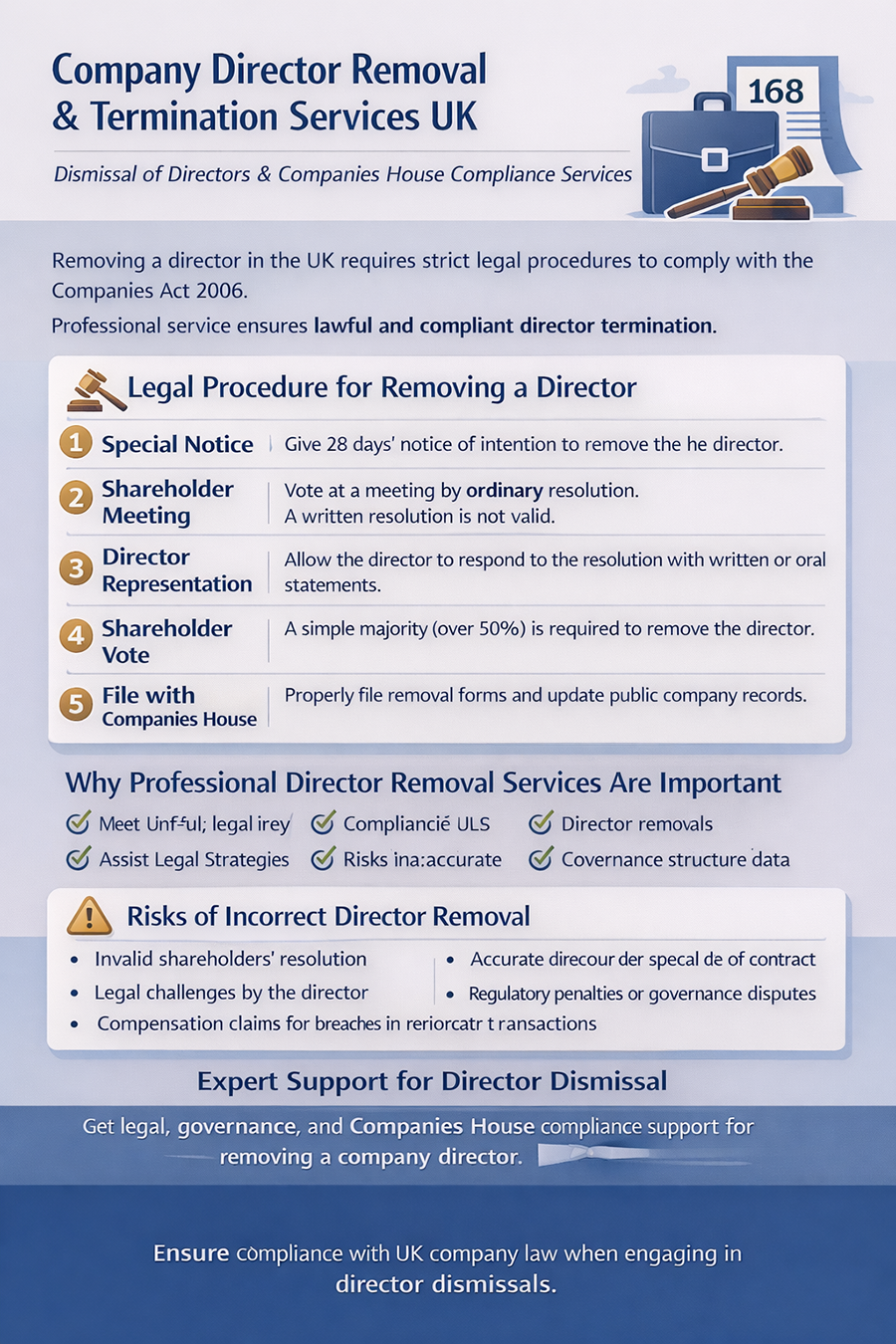
Legal process illustration for company director removal and termination services, highlighting key steps and procedures. Visual representation of the legal process for terminating a company director, outlining necessary actions and requirements.

Deed of Indemnity: A contract ensuring the company will cover the former director’s legal costs if they are sued for decisions made while they were in office
Resignation Letter Drafting: A professionally drafted letter that includes a "Section 168" statement confirming they have no claims against the company for loss of office.
ACSP Verification Sync: Ensuring the departing director’s 11-character Personal Code is properly deactivated from the company’s internal filing authority.
Authentication Code Reset: Changing the company's Companies House "PROUD" or authentication code to prevent the former director from making unauthorized changes to the public record.
PSC Register Realignment: If the director was also a Person with Significant Control (PSC), their removal triggers a mandatory update to the PSC register within 14 days.
Stock Transfer Management (J30): Handling the transfer of the director's shares to remaining shareholders.


How to Simplify Director Removal (Form TM01) for Your Business

Removing a company director is a significant corporate action that must be handled carefully to ensure legal compliance and accurate company records. In the UK, this process requires submitting Form TM01 to Companies House to formally notify the termination of a director’s appointment.

At Coddan, we provide a fast and reliable e-filing service to simplify director removal, ensuring your submission is accurate, compliant, and processed without delay.


What Is Form TM01?

Form TM01 is the official Companies House form used to notify that a director has resigned, been removed, or otherwise ceased to act in their role.

The form includes key details such as:

  • Director’s full name
  • Date of termination
  • Company information

This filing must typically be submitted within 14 days of the director leaving the position to remain compliant with UK regulations.

If your director removal is part of a broader restructuring or ownership transition, you should also consider the wider context of
Change of Control and Corporate Restructuring, where leadership changes often occur alongside share transfers or governance updates.


When Do You Need to Remove a Director?

You may need to file Form TM01 in situations such as:

  • Director resignation
  • Board restructuring or leadership changes
  • Removal by shareholders
  • Replacement due to business strategy shifts
  • Company sale or ownership transition

Properly handling this process ensures your company remains compliant and avoids discrepancies in public records.


Step-by-Step: How to File Form TM01

  1. Confirm the Director’s Departure
    Ensure the resignation or removal has been formally agreed and documented according to your company’s articles of association.
  2. Record the Termination Date
    Accurately determine the date the director ceased to act.
  3. Complete Form TM01
    Enter all required details correctly. Errors can lead to rejection or delays.
  4. Submit to Companies House
    Electronic filing is the fastest and most efficient method.
  5. Update Internal Registers
    Update your statutory registers and company records accordingly.


Director Changes Often Involve Additional Filings

Director removal is rarely an isolated action. In many cases, it is part of a broader update to your company structure.

Appointing a Replacement Director
If you are replacing a director, you will need to file a new appointment:
Why Choose Coddan for Electronically Filing Form AP01?

Appointing a Corporate Director
If your business structure requires a corporate entity to act as a director:
Steps to Appoint a Corporate Director in the UK Using Form AP02

Protecting Director Privacy
After a director leaves, they may wish to remove personal address details from public records:
How to File Form SR01 to Remove Your Residential Address

Managing these related filings together ensures a smooth and compliant transition.


Common Mistakes to Avoid

Businesses often encounter issues when:

  • Incorrect termination dates are submitted
  • The wrong director is identified
  • Filings are delayed beyond statutory deadlines
  • Internal records are not updated

Coddan helps you avoid these pitfalls with expert handling and precise filing.


Why Choose Coddan for TM01 e-Filing?

  • ✔ Fast Electronic Submission
    We submit your TM01 form directly to Companies House for quicker processing.
  • ✔ Accuracy and Compliance
    Our team ensures all details are correct and meet legal requirements.
  • ✔ Expert Guidance
    We support you through every stage of the director removal process.
  • ✔ Integrated Company Services
    We assist with related filings, making corporate changes seamless and efficient.


Start Your Director Removal Today

Remove a director quickly and confidently with Coddan’s professional e-filing service.

  • ✔ No paperwork confusion
  • ✔ Fast turnaround
  • ✔ Full compliance support

Get started today and keep your company records accurate and up to date.

Director Resignation & Removal Services in 2026. Why Filing Form TM01 Alone Is No Longer Enough

In 2026, simply filing Form TM01 (Termination of Appointment of Director) with Companies House has become a basic administrative task. Many providers offer it as a low-cost “commodity” service.

However, the resignation or removal of a director is rarely just a paperwork exercise. It can trigger complex compliance issues involving corporate governance, shareholder rights, identity verification requirements and potential legal liabilities.

Following the introduction of the Economic Crime and Corporate Transparency Act 2023, leading corporate service providers now offer high-compliance or concierge director exit services designed to manage these risks proactively.

These services focus on anticipatory compliance—solving governance, security and legal issues before they become problems.

Personalised Director Exit Advisory

Every director resignation or removal occurs within a unique context. Directors may be founders, shareholders, employees or investors, each with different legal and financial implications. A high-compliance service begins with a tailored advisory process that evaluates:

  • the director’s contractual and fiduciary obligations
  • potential shareholder disputes
  • board governance implications
  • communication with stakeholders and employees

Professional advisers may also assist with drafting resignation letters, structuring the timing of announcements and managing internal communications to minimise disruption. At Coddan, we make life simpler, more affordable, worry-free, and compliant, and we back it with experience for all our clients.

Comprehensive Compliance & Documentation Review

Removing a director involves more than submitting Form TM01 under the Companies Act 2006.

A comprehensive compliance review often includes:

  • reviewing the company’s Articles of Association
  • analysing any shareholders’ agreements
  • verifying board resolutions or shareholder approvals
  • ensuring statutory registers are updated correctly

This documentation review ensures the departure is legally valid and reduces the risk of future disputes.

ACSP Digital Security and Filing Control

Under modern transparency rules, individuals interacting with the Companies House register may need identity verification.

Some corporate service providers, such as Coddan CPM, act as Authorised Corporate Service Providers (ACSPs) to manage this transition securely. Enhanced director exit services may include:

  • revoking the departing director’s filing authority
  • updating Companies House authentication credentials
  • ensuring that only authorised persons can submit future filings

This prevents unauthorised or accidental changes to the company record after the director leaves.

Shareholder “Good Leaver / Bad Leaver” Analysis

In many SMEs, directors are also shareholders. Their departure can therefore affect the company’s cap table and shareholder rights.

Specialist advisers often review shareholder agreements and articles of association to determine:

  • whether the director qualifies as a good leaver or bad leaver
  • the valuation method for their shares
  • any share buyback or transfer requirements

Where a share buyback is required, advisers may prepare the associated filings such as SH03 alongside board resolutions to ensure the director’s board exit and shareholder exit are handled in a coordinated manner.

Director Liability and Run-Off Protection

Even after leaving office, directors may remain liable for decisions made during their tenure.

Advanced exit services may include advice on Directors and Officers (D&O) run-off insurance, which can provide protection against future claims relating to past decisions.

Some providers also assist with drafting deeds of release or settlement agreements that clarify the terms of the director’s departure and reduce the likelihood of future disputes.

Settlement and Transition Support

Where a director’s departure involves disagreements or disputes, professional advisers may assist with structured exit negotiations. This may include drafting settlement agreements covering matters such as:

  • confidentiality obligations
  • non-disparagement provisions
  • non-compete restrictions
  • return of company property and access credentials

Structured transition support helps protect both the departing director and the company.

Ensuring Board Continuity

UK companies must maintain at least one natural person director at all times.

If the departure of a director risks leaving the company without a compliant board, professional advisers will typically coordinate the appointment of a replacement director using the appropriate filing procedures.

Managing the removal and appointment together helps avoid compliance gaps and ensures the company remains fully operational.

Why High-Compliance Director Exit Services Matter

Director departures often occur during sensitive moments such as:

  • shareholder disputes
  • business restructuring
  • acquisitions or exits
  • leadership transitions

Handling the process carefully protects the company’s governance structure and preserves investor confidence.

Providers that combine regulatory compliance, governance advisory and secure filing management offer far greater value than those simply submitting a TM01 form.

Director Changes 2026: Regulatory-Grade Support for Law Firms & Corporate Service Providers

UK Director Appointment, Resignation & Corporate Director Compliance Services
In 2026, UK director changes are no longer administrative filings. They are regulated compliance events subject to scrutiny, rejection risk and potential enforcement action.

For law firms, trust companies, fiduciary providers, accountants and corporate service providers, the margin for error has narrowed significantly. The introduction of enhanced transparency rules and mandatory identity verification under the Economic Crime and Corporate Transparency Act 2023 means that every director appointment, resignation or corporate director filing must be structured, verified and audit-ready.

All director changes must be notified to Companies House within 14 days. Non-compliance can result in rejected filings, financial penalties and reputational exposure for both the company and its advisers. We provide regulatory-grade support designed specifically for professional intermediaries managing complex client portfolios.

Why Director Changes Are High-Risk in 2026
Companies House now operates as an active gatekeeper rather than a passive registry. Enhanced powers include:

  • Immediate rejection of inaccurate filings
  • Querying and annotation of public records
  • Cross-referencing identity data
  • Financial penalties for false or misleading information
  • Information sharing with enforcement bodies

For advisers, inaccurate filings can undermine credibility, delay transactions and expose clients to unnecessary regulatory scrutiny.

Our Specialist Director Change Services (Wide UK)
We provide structured support for:

  • Director Appointment Service UK (AP01 filing)
  • Corporate Director Appointment Compliance 2026 (AP02 filing)
  • Director Resignation Filing Companies House (TM01)
  • Corporate governance documentation support
  • Identity verification management (ACSP standard)
  • Group structure and multi-entity board changes

Our services are aligned with high-intent search and transactional requirements, including:

  • appoint director Companies House UK
  • Form TM01 filing service UK
  • director resignation filing Companies House
  • corporate director compliance 2026
  • UK director changes service by law firms

Structured Compliance for UK and for Overseas Customers

1. Pre-Filing Eligibility & Risk Review
We conduct a compliance assessment before submission, including:

  • All-natural board rule validation for corporate directors
  • Identity verification status confirmation
  • Statutory deadline assessment
  • Conflict and disqualification checks

This prevents rejected filings and Companies House flags.

2. Mandatory Identity Verification Management
Director identity verification is no longer optional. We support:

  • Manual ACSP-standard identity verification
  • Overseas director verification handling
  • Verification statement preparation
  • Audit-ready record retention

This is particularly valuable where automated GOV.UK systems fail for international clients.

3. Precision Drafting & Statutory Disclosure
Form AP02 requires technical disclosure of:

  • Legal form
  • Governing law
  • Official registry name
  • Registration number

For international structures, incorrect terminology can result in annotated or queried records. We ensure filings meet the current Companies House technical standard.

4. Board & Governance Documentation
Beyond filing, we prepare:

  • Board resolutions
  • Shareholder resolutions (if required)
  • Minutes of meetings
  • Consent to act documentation
  • Updated statutory registers

This ensures full audit-readiness for:

  • Due diligence
  • Banking reviews
  • M&A transactions
  • Regulatory inspection

Our service framework is built around Experience, Expertise, Authoritativeness and Trustworthiness.

  1. ✔ Experience
    Extensive handling of UK director appointment and resignation filings across private companies, group structures and cross-border entities.
  2. ✔ Expertise
    Deep understanding of Companies Act 2006, Economic Crime and Corporate Transparency Act reforms, and Companies House 2026 enforcement framework.
  3. ✔ Authoritativeness
    Specialist focus on corporate secretarial compliance and director governance events. Structured internal processes aligned with regulatory expectations.
  4. ✔ Trustworthiness
    • ACSP-standard identity verification protocols
    • GDPR-compliant data handling
    • Secure document exchange
    • Audit-ready documentation
    • Transparent fee structure

Director changes now sit at the intersection of compliance risk and reputational exposure. Using structured professional support ensures:

  • Reduced rejection risk
  • Protection against inaccurate disclosure
  • Accurate statutory registers
  • Timely Companies House filing
  • Defence-ready documentation

For advisers, this protects both client interests and professional standing.

UK-Wide Director Change & Corporate Director Filing Service
We support director changes across:

  • England
  • Wales
  • Scotland
  • Northern Ireland

Whether handling:

  • Single-entity changes
  • Multi-entity restructurings
  • Group-level corporate director appointments
  • Overseas corporate director compliance
  • High-value transaction deadlines

Our process is structured, defensible and regulator-aligned.

Secure & Compliant Director Change Support
In 2026, director changes must be treated as compliance-sensitive governance events. For law firms and corporate service providers, precision is not optional — it is essential. If you require structured support for:

  • Director appointment service UK
  • Director resignation filing Companies House
  • Form TM01 filing service UK
  • Corporate director appointment compliance 2026

We provide specialist, compliance-first support designed for professional intermediaries. Contact us to discuss confidential engagement options.


Coddan Case Studies: Director Removal & TM01 Compliance. Case Study 1: Shareholder Dispute – Director Removal via TM01 Filing

Client: UK Retail Company
Service: Director Removal & TM01 Filing
Jurisdiction: UK

A London retail company faced an internal governance issue when one of its directors was no longer aligned with the company’s strategy. The shareholders voted to remove the director using their statutory rights under the **Companies Act 2006.

However, the company was unsure how to properly notify Companies House and complete the TM01 director removal filing.

Challenge

The company needed to ensure:

  • The removal resolution was properly documented
  • The director removal process complied with company law
  • The TM01 form was correctly filed within the required timeframe

Incorrect filings could result in invalid corporate records.

Solution

Coddan CPM assisted by:

  • Preparing the director removal documentation
  • Drafting the board meeting minutes
  • Completing the TM01 filing
  • Submitting the filing electronically to Companies House

Outcome

The director was formally removed and the Companies House register was updated correctly, ensuring the company maintained full corporate governance compliance.


Case Study 2: Voluntary Director Resignation – TM01 Filing

Client: UK Consultancy Firm
Service: Director Resignation Filing

A director of a consultancy firm decided to step down due to retirement.

Although the resignation was straightforward, the company needed help ensuring the director resignation was correctly recorded with Companies House.

Challenge

The business required support to:

  • Document the director’s resignation
  • Update the statutory register of directors
  • Submit the TM01 notice of termination

Solution

Coddan CPM:

  • Prepared the director resignation documentation
  • Updated internal company records
  • Filed the TM01 director resignation form

Outcome

The resignation was successfully recorded, ensuring that the company’s Companies House records reflected the current board structure.


Case Study 3: Corporate Governance Restructuring

Client: UK Technology Company
Service: Director Removal & Governance Advisory

During a strategic restructuring, a technology company needed to remove and replace several directors to align the board with the company’s future growth strategy.

Challenge

The company required:

  • Accurate preparation of director removal documentation
  • Filing multiple TM01 forms
  • Ensuring the new board structure complied with UK governance requirements

Solution

Coddan CPM supported the restructuring by:

  • Preparing the director termination filings
  • Coordinating the TM01 submissions
  • Updating statutory records
  • Advising on board governance compliance

Outcome

The company successfully completed its restructuring and maintained accurate Companies House records, strengthening investor confidence in its governance framework.


Case Study 4: Incorrect Director Record Correction

Client: UK Construction Company
Service: Companies House Filing Correction

A construction company discovered that a former director who had resigned months earlier was still listed as an active director on the Companies House register.

Challenge

The incorrect public record created potential issues with:

  • corporate liability
  • bank compliance checks
  • due diligence for contracts

Solution

Coddan CPM conducted a compliance review and:

  • Prepared the missing TM01 director termination filing
  • Submitted the correction to Companies House
  • Updated the company’s statutory registers

Outcome

The company’s public record was corrected, ensuring the former director was properly removed from the register.


Case Study 5: Director Exit During Business Sale

Client: UK Manufacturing Company
Service: Director Removal Compliance

During a business acquisition, the buyer required that one of the company’s directors resign before the transaction completed.

Challenge

The seller needed to ensure the director’s removal was properly documented and recorded before the transaction closing date.

Solution

Coddan CPM:

  • Drafted the director resignation documentation
  • Updated the company’s internal registers
  • Filed the TM01 form with Companies House

Outcome

The director’s resignation was successfully processed before completion of the acquisition, ensuring clean corporate records for the new owners.


Company Director Removal & Termination Services UK. Expert Advisory for Dismissal of Directors and Companies House Compliance

Removing or terminating a company director is one of the most sensitive governance actions a business can take. Whether due to restructuring, shareholder disputes, performance issues, or strategic changes, the dismissal of a director must follow strict legal procedures under UK company law.

Our company director removal or termination services UK help businesses manage director dismissals correctly, ensuring full compliance with the Companies Act 2006 and proper filing with Companies House.

By combining legal procedure, corporate governance guidance, and professional filing support, we ensure that director removals are handled lawfully, efficiently, and without exposing the company to unnecessary legal risk.

Professional Director Removal Services in the UK

Our dismissal of a director advisory UK services provide comprehensive support for companies that need to remove or terminate a director. These services include:

  • Strategic director removal advisory
  • Guidance on shareholder and board procedures
  • Preparation of special notice and shareholder resolutions
  • Drafting board minutes and corporate documentation
  • Filing Companies House director removal forms
  • Updating statutory registers and governance records

This structured approach ensures the director removal process is legally valid and properly documented.

Legal Framework for Director Removal

Under Section 168 of the Companies Act 2006, shareholders have the statutory right to remove a director before the expiration of their term of office. This right allows a company to remove a director:

  • Even if the director has a service agreement
  • Regardless of provisions within internal contracts

However, while the director can be removed from the board, the individual may still retain contractual rights under their employment agreement, including the right to claim compensation or damages if contractual obligations are breached.

Our director termination advisory services help companies manage these complexities while protecting the company’s legal position.

Key Steps in the Director Removal Process

Removing a director requires strict compliance with statutory procedures. Failure to follow the correct process may result in the removal being invalid or legally challenged.

1. Special Notice of Removal

The removal process begins when shareholders give special notice of their intention to remove the director.

This notice must be given to the company at least 28 clear days before the meeting where the resolution will be considered.

The special notice requirement ensures that both the company and the director are informed of the proposed removal.

2. Shareholder Meeting to Vote on Removal

Unlike many corporate decisions, a director a cannot be removed using a written resolution.

Instead, the removal must be approved by a ordinary resolution at a general meeting of shareholders.

An ordinary resolution requires a more than 50% of shareholder vote.

This ensures transparency and allows shareholders to debate the proposed removal.

3. Director’s Right to Representation

The Companies Act includes protections for directors facing removal. The director has the right to:

  • Receive notice of the proposed resolution
  • Submit a written representations
  • Address shareholders at the meeting

These procedural protections ensure fairness and transparency in the removal process.

4. Shareholder Vote

Once the meeting takes place, shareholders vote on the removal resolution. If the ordinary resolution passes, the director is officially removed from office. However, the company must still ensure that:

  • The board maintains the minimum number of directors
  • At least one director remains a natural person

5. Filing the Director Removal with Companies House

After the resolution passes, the company must update its public record with Companies House.

This typically involves filing the relevant director termination notification and updating statutory records. Our Companies House compliance services ensure that these filings are completed correctly and without delay.

Director Removal vs Termination of Employment

A common source of confusion is the difference between:

  • Removing a director from the board
  • Terminating their employment contract

These are separate legal matters. A director may:

  • Remain an employee after board removal, or
  • Remain a director after employment termination

To avoid governance complications, many companies include provisions in director service agreements requiring the individual to resign as director if their employment ends. Our advisory services help companies manage both aspects simultaneously.

Risks of Incorrect Director Removal

If the correct statutory procedures are not followed, the removal resolution may be invalid. Common mistakes include:

  • Attempting to remove a director using a written resolution
  • Failing to give the required 28-day special notice
  • Denying the director their right to representation
  • Incorrectly filing the removal with Companies House

These mistakes can lead to:

  • Legal disputes
  • Governance challenges
  • Compensation claims from the director

Professional director removal advisory services help companies avoid these risks.

Our Companies House Compliance Services

Our Companies House compliance services support companies with all aspects of corporate governance and regulatory filings. Services include:

  • Director removal and resignation filings
  • Director appointment filings
  • Updating statutory registers
  • PSC notifications and compliance updates
  • Corporate governance advisory
  • Ongoing company secretarial support

By maintaining accurate records and filings, businesses can ensure compliance with UK corporate regulations.

When Businesses Need Director Removal Services

Companies often seek dismissal of a director advisory UK services in situations such as:

  • Shareholder disputes
  • Corporate restructuring
  • Governance changes
  • Breach of director duties
  • Strategic leadership changes

Professional support ensures that these sensitive transitions are handled correctly.

Expert Support for Director Removal in the UK

If your company needs professional help with company director removal or termination services UK, our compliance specialists can guide you through every step of the process.

From special notice procedures and shareholder resolutions to Companies House filings, we ensure the director removal process is carried out lawfully, transparently, and in full compliance with UK company law.

Our expertise allows businesses to resolve governance changes efficiently while protecting their legal and corporate interests.


Director Removal in 2026: Why Form TM01 Is the Final Step — Not the First. Legal Risk Briefing for Law Firms & Corporate Service Providers In 2026, filing Form TM01 with Companies House

It is no longer a routine administrative update. It is the final act of a structured legal process governed by the Companies Act 2006, employment law, shareholder agreements and (increasingly) Companies House enforcement powers.

Treating TM01 as a delete button is now one of the leading causes of:

  • Employment Tribunal claims
  • Wrongful dismissal disputes
  • Invalidated board decisions
  • Shareholder litigation
  • Regulatory exposure for false or misleading filings

For msny firms, business formation agents and corporate service providers, the real risk lies in what happens before the TM01 is submitted. Below are the critical gaps most automated providers miss.

The Waiver of Claims Gap (Employment Risk)
A director is an office holder — but very often also an employee under a service contract.

Removing someone as a director does not automatically terminate their employment.

The Risk If you file TM01 without:

  • A properly structured settlement agreement
  • A clean break letter
  • A waiver of claims
  • Lawful termination of employment

The individual may bring claims for:

  • Unfair dismissal
  • Wrongful dismissal
  • Breach of contract
  • Unlawful deduction of wages

The removal itself frequently becomes the trigger event for litigation. Professional-grade removal support ensures:

  • Director role and employment status are treated separately
  • Settlement agreements are legally compliant
  • Independent legal advice requirements are met
  • Risk exposure is quantified before filing

TM01 should follow settlement — not replace it.

Section 168 – The Special Notice Requirement
If a director refuses to resign, shareholders must rely on Section 168 of the Companies Act 2006. This requires:

  • 28 clear days’ Special Notice
  • Formal circulation of the notice
  • A properly convened general meeting
  • An ordinary resolution passed by shareholders

The Risk If you skip the 28-day window and simply file TM01:

  • The removal may be legally void
  • The director can apply to court
  • Board decisions made after the defective removal may be challengeable

Many online filing services do not verify whether the statutory process was followed before submission. For professional advisers, that gap creates liability exposure.

Section 169 – The Director’s Right to Protest
Under Section 169, a director has the statutory right to be heard.

This includes:

  • Receiving the removal notice
  • Submitting written representations
  • Having those representations circulated to shareholders
  • Speaking at the meeting

The Risk If the company denies this right:

  • The removal process becomes procedurally defective
  • The director may challenge the resolution
  • Litigation risk increases

Automated filing systems never ask whether the director was granted their statutory right. Compliance-grade services document the process end-to-end.

2026 Statutory Register Changes – The Shareholder Trap
Since November 2025, Companies House operates as the verified public source for directors. Internal Registers of Directors are no longer strictly mandatory. However:

The Register of Members (Shareholders) remains legally required.

The Critical Risk If the departing director is also a shareholder:

  • Filing TM01 removes them as director
  • But does not remove them as shareholder

Unless:

  • A share transfer is executed
  • The Register of Members is updated
  • Any PSC implications are reviewed

Failure to complete the share side of the transaction means the individual may remain a legal owner — even after removal. This is one of the most common structural errors in SME disputes.

Bad Leaver Clauses & Shareholder Agreements
Many shareholder agreements contain Good Leaver / Bad Leaver provisions. If a director is removed for misconduct:

  • They may be forced to transfer shares
  • Often at nominal value
  • Subject to strict notice requirements

The Timing Risk If you file TM01 before:

  • Triggering the Bad Leaver mechanism
  • Serving contractual notice
  • Initiating compulsory transfer procedures

You may lose leverage. The individual may remain a shareholder at full value. Professional removal strategy aligns:

  • Companies Act procedure
  • Employment law process
  • Shareholder agreement mechanics
  • Timing of TM01 filing

The 2026 Enforcement Risk – False or Misleading Filings
Companies House now has expanded powers to:

  • Query filings
  • Impose financial penalties
  • Flag misleading information
  • Share intelligence with enforcement bodies

If a company files TM01 stating a director resigned when in reality:

  • They were removed without following statutory procedure
  • They were dismissed without settlement
  • There is an ongoing dispute

That filing creates a documentary record that may be used in tribunal or litigation. Accuracy now has regulatory consequences.

Why Professional Removal Management Is Essential
For law firms and corporate service providers, TM01 is not a filing — it is the conclusion of a risk-managed legal process. Professional-grade director removal support includes:

  • ✔ Section 168 compliance review
  • ✔ Section 169 procedural safeguards
  • ✔ Employment status analysis
  • ✔ Settlement and waiver documentation
  • ✔ Shareholder agreement review
  • ✔ Register of Members update
  • ✔ PSC impact review
  • ✔ Board and shareholder minutes
  • ✔ Defensible filing narrative

Only after these are satisfied should TM01 be filed.

Director Removal Service UK – Compliance-First Approach
Our director removal support for professional intermediaries includes:

  • Statutory removal procedure management
  • Employment risk coordination (with employment counsel where required)
  • Share transfer structuring
  • Bad Leaver mechanism alignment
  • Governance documentation
  • TM01 filing with audit-ready backing

Designed specifically for:

  • Law firms
  • Corporate service providers
  • Fiduciaries
  • Accountancy practices
  • Transactional advisers

Final Position: TM01 Is Evidence
In 2026, Form TM01 is not just an update to the register. It is:

  • Evidence of governance
  • Evidence of process
  • Evidence of accuracy

If challenged in court or tribunal, the timeline behind that filing will be examined in detail.

For professional advisers managing director removals, the safest position is structured, documented, procedurally compliant execution — with TM01 as the final step, not the first.

If required, this can be converted into a compliance-focused service page targeting director removal service UK and TM01 filing compliance 2026.

Simply filing the official forms with Companies House to appoint or resign a company director is not always sufficient due to several reasons:

  1. Compliance with Legal Requirements:
    • Notice Period: Often, legal requirements mandate a notice period for the director being appointed or resigning. For example, a company must notify the director in advance of a meeting where their removal will be discussed.
    • Validity of Resolution: The appointment or resignation may require a formal resolution passed by the board or shareholders, depending on the company’s articles of association.
  2. Internal Company Procedures:
    • Articles of Association: Companies may have specific rules outlined in their articles of association regarding appointment or resignation that must be followed. Non-compliance could lead to disputes or challenge the validity of the appointment.
    • Board Meetings: In some cases, the appointment or resignation may need to be recorded in the minutes of a board meeting, establishing the decision as part of the company’s internal record-keeping.
  3. Employment Contract Considerations:
    • If the director is also an employee, termination of their directorship may need to align with employment contract terms, including notice periods and grounds for dismissal.
  4. Legal Implications:
    • The appointment or resignation must comply with relevant laws, such as the Companies Act, which outlines the legal framework for corporate governance. Failing to adhere to these can lead to legal challenges or penalties.
  5. Protection of Stakeholder Interests:
    • Proper procedures ensure that stakeholders (shareholders, employees, clients) are informed and can voice any concerns before a director leaves or joins, maintaining good governance practices.
  6. Record Keeping:
    • Maintaining accurate records of appointments and resignations helps ensure clarity in the company's governance structure, which can be essential for audits, accounting, and legal transparency.

In summary, while filing forms with Companies House is an essential step, it must be accompanied by compliance with internal and legal requirements to ensure that the process is valid and recognized.

Many people misunderstand the role of Companies House concerning the appointment or resignation of company directors and shareholders. Here are some key points that people often miss or misinterpret:

  1. Filing vs. Authority:
    • Companies House does not appoint or resign directors or shareholders; it serves as a registry that records these actions. The authority to make these decisions rests with the company’s board of directors or its shareholders, not with Companies House.
  2. Notification Requirement:
    • Individuals often assume that submitting the relevant forms to Companies House is the only requirement. However, valid appointments or resignations must also adhere to internal company procedures, such as holding board meetings and passing resolutions.
  3. Legal Validity:
    • Many believe that simply filing a form makes the appointment or removal legally binding. In reality, if the process outlined in the company’s articles of association or the Companies Act is not followed, the changes may be deemed invalid.
  4. Internal Governance:
    • There is often a lack of understanding that changes in directors and shareholders must align with the company’s governance documents. Failing to do so can lead to disputes among stakeholders and questions about authority.
  5. Notification Timing:
    • Some may think there is no obligation to notify Companies House promptly. However, companies are required to file changes within specific timeframes (usually 14 days), and failing to do so can result in penalties.
  6. Oversight of Responsibilities:
    • People may overlook that the directors themselves have a duty to ensure proper procedures are followed. Failure to comply with these responsibilities can open them up to personal liability.
  7. Consequences of Inactivity:
    • There’s a misconception that not acting on changes (like a resignation) can be ignored. Delays or inaction can create issues for the company’s governance and operations, including legal ramifications.
  8. Public Record Considerations:
    • Many underestimate the importance of accurate public records. Inaccuracies in director or shareholder information can mislead stakeholders and damage the company’s reputation.

Conclusion:
Understanding that Companies House operates as a regulatory body for documentation—not a decision-making authority—is crucial. Proper procedures must be followed to ensure valid and effective governance within the company, reinforcing the importance of compliance with internal and statutory regulations.

Engaging a professional corporate secretarial and compliance service for the removal, termination, and resignation of company directors in the UK offers several significant benefits:

  1. Expertise in Compliance:
    These professionals are well-versed in UK corporate law, including the Companies Act 2006. They ensure that all procedures are followed correctly, reducing the risk of legal challenges or non-compliance.
  2. Streamlined Process:
    They provide a structured approach to managing the removal or resignation process. This includes ensuring that all necessary documentation is prepared, submitted, and filed promptly with Companies House.
  3. Reduction of Legal Risks:
    By handling the complexities of director removals and resignations, corporate secretarial services help mitigate the risks of wrongful dismissal claims or breaches of contract.
  4. Objective Perspective:
    External professionals can offer an objective viewpoint, which can be valuable when dealing with sensitive situations involving conflicts or disputes among directors and shareholders.
  5. Time Efficiency:
    Outsourcing these tasks allows company executives to focus on their core responsibilities, rather than getting bogged down in administrative and legal procedures related to director changes.
  6. Maintaining Corporate Governance:
    These services help ensure that changes in directors are conducted in line with the company’s articles of association and corporate governance standards, promoting transparency and accountability.
  7. Handling Shareholder Communication:
    They can assist in drafting communications to shareholders and the board regarding director changes, helping to manage relations and expectations professionally.
  8. Record Keeping:
    Professional secretarial services maintain accurate records of all changes, ensuring that the company’s statutory registers are up-to-date, which is critical for ongoing compliance.
  9. Navigating Sensitive Situations:
    In cases of contentious removals or resignations, having a professional handle the situation can reduce friction and help preserve relationships among the remaining directors and stakeholders.
  10. Continuity of Services:
    If there’s a sudden departure of a director, a corporate secretarial service can step in to provide continuity, ensuring that the company continues to operate smoothly without disruption.

Overall, enlisting a professional corporate secretarial and compliance service can greatly enhance the efficiency, legality, and professionalism of managing director removals and resignations in the UK.


How to Legally Remove a Company Director.

How to Simplify Your Business Expert Corporate Secretarial & Compliance

To remove a non-resident director in the UK online, file Form TM01 via the Companies House online service within 14 days of the resignation or removal.
The process requires the director’s resignation or a shareholder resolution, updating company registers, and submitting details electronically for faster processing.

Ensure a smooth transition by obtaining a written resignation from your director or passing a resolution at your next general meeting. Learn how today!

Obtain Resignation: Secure a written resignation from the director or pass an ordinary director leaving resolution at a general meeting.
File Form TM01: Submit Form TM01 online for faster director termination processing, which is generally quicker than paper filing.

. Discover crucial information about directorships, including company number, director’s name, and the exact date of cessation. Access it now!

Required Details: You will need the company number, director’s name, and the exact date the directorship ceased.

Understand the process of shareholder action when directors refuse to resign. Learn how ordinary resolutions can empower shareholders with controlling interests.

Shareholder Action: If the director is not resigning voluntarily, an ordinary resolution passed by shareholders is typically required, provided they hold more 50% of voting shares (having a controlling interest in a company).

Ensure compliance with the PROOF scheme by utilizing our online filing service. Streamline your submissions and stay on track with your requirements.

Proof Scheme: If your private limited by shares company is in the PROOF scheme, you must use the online filing service.

Discover how non-resident directors can suppress their residential address from public view. Learn the process and limitations for address removal today.

Address Removal: If a non-resident director wants to remove their residential address from public view, you can apply to suppress it, though non-UK residents cannot hide their country of residence.

Key Takeaway

In fast-moving businesses—especially startups, scale-ups, and overseas founders operating in the UK—director changes must be handled quickly and correctly. A director’s resignation is not just an administrative task; it is a statutory event that must comply with the Companies Act 2006 and be properly notified to Companies House within 14 days.
Coddan provides a streamlined online solution designed specifically for companies that need certainty, speed, and full compliance. We manage the entire process—from documenting the written resignation notice in line with your Articles of Association to preparing and electronically filing Form TM01. It is important to note that TM01 is a legal notification of a resignation that has already taken effect, not the resignation itself. Our structured approach ensures the underlying corporate steps are properly completed before submission.
Our service is particularly valuable for foreign-owned and early-stage UK companies unfamiliar with local regulatory requirements. We reduce the risk of rejected filings, governance gaps, or ongoing director liability by ensuring statutory registers are updated and internal records align with the public register.
With competitive pricing and fully digital processing, resignations can often be completed within 24 hours, subject to statutory requirements. Post-filing, we continue to support clients with related compliance updates where needed.
Director resignations should be clear, compliant, and professionally managed. With Coddan, you gain expert oversight and administrative certainty—so you can focus on building and growing your business with confidence.
Resigning as a director is a formal legal step that must be handled correctly to avoid ongoing liability or compliance risks. Under the Companies Act 2006, a director may resign by giving written notice to the company, and the company must then notify Companies House within 14 days using Form TM01. Filing the form is a statutory notification of a resignation that has already taken effect—it is not the resignation itself.
Coddan offers a secure digital service that simplifies this process for startups, early-stage businesses, and overseas founders operating in the UK. Our structured approach ensures the resignation complies with your company’s Articles of Association and any relevant service agreement before submission.
The process is straightforward. You provide the required director and company details, including the effective resignation date. We prepare the TM01 form, verify accuracy, and submit it electronically to Companies House within the statutory timeframe. Electronic filing reduces delays and minimises the risk of rejected submissions compared with paper forms.
We also ensure that statutory registers are updated and that your internal records align with the public register. Confirmation of filing is provided for your records, giving you clear evidence that the resignation has been properly notified.
Director resignation is a significant corporate event. With Coddan’s professionally managed digital service, you can complete the process efficiently, compliantly, and with full legal certainty—allowing you to move forward with confidence in your next venture.
A director’s resignation is a statutory event that must be handled promptly and correctly. Under the Companies Act 2006, once a director resigns by giving written notice to the company, the company must notify Companies House within 14 days using Form TM01. Failure to meet this deadline may result in inaccurate public records and potential compliance risks.
Coddan, a certified Authorised Corporate Service Provider (ACSP), delivers a structured, event-driven compliance solution for director resignations. We ensure that the resignation complies with the company’s Articles of Association and any applicable service agreement before filing the statutory notification.
Our service includes preparation and electronic submission of Form TM01, confirmation of the effective resignation date, and updates to statutory registers to ensure alignment between internal records and the public register. Electronic filing reduces delays and minimises the risk of rejected submissions.
For startups, scale-ups, and overseas-owned UK companies, we provide regulatory clarity and administrative certainty—removing the risk of governance gaps or ongoing director liability.
Act within the 14-day deadline.
Secure compliant director resignation filing with Coddan and ensure your company records remain accurate, up to date, and fully aligned with UK company law.
For startups, scale-ups, and overseas businesses operating in the UK, director resignations must be handled with precision and within statutory deadlines. Under the Companies Act 2006, once a director resigns by giving written notice to the company, the company must notify Companies House within 14 days using Form TM01. Failure to comply may result in inaccurate public records and potential governance risks.
Coddan provides a structured, compliance-focused service to manage director resignations efficiently and correctly. We ensure the resignation aligns with your company’s Articles of Association and any relevant service agreement before submitting the statutory notification.
Our service includes preparation and electronic filing of Form TM01, confirmation of the effective resignation date, and updates to statutory registers to ensure internal records match the public register. Electronic submission reduces delays and minimises the risk of rejected filings.
For foreign-owned or early-stage companies unfamiliar with UK regulatory requirements, we provide clear guidance and full administrative management—reducing compliance exposure and ensuring continuity of governance.
Director resignation is a formal corporate event. Act within the 14-day deadline and ensure your company remains fully compliant. Partner with Coddan for accurate filing, legal certainty, and a professionally managed leadership transition.
A digital company secretarial service can professionally manage TM01 submissions on your behalf—provided the resignation has been validly effected first.
Form TM01 is the statutory notice used to inform Companies House that a director’s appointment has ended. The company must file the form within 14 days of the effective resignation or removal date. Failure to meet this deadline can result in inaccurate public records and potential compliance consequences.
Coddan, a certified Authorised Corporate Service Provider (ACSP), delivers a structured digital solution for director resignation filings. It is important to note that TM01 is a notification—not the resignation itself. The resignation must first comply with the Companies Act 2006, your Articles of Association, and any relevant service agreement. Our service includes:
- Verification of the effective resignation date
- Preparation and electronic filing of Form TM01
- Updating statutory registers
- Confirmation of submission
Electronic filing ensures faster processing and reduces the risk of rejected submissions compared with paper forms. For startups, early-stage companies, and overseas-owned UK businesses, this provides regulatory clarity and administrative certainty without the need for in-house compliance teams.
Director resignation is a formal corporate event. Ensure it is filed correctly and within the statutory timeframe. Partner with Coddan to manage your TM01 submission efficiently, accurately, and in full compliance with UK company law.
When a director resigns or is replaced, the process must be handled correctly to avoid compliance risks. Under the Companies Act 2006, once written notice of resignation is given to the company, the company must notify Companies House within 14 days using Form TM01. Failure to file on time may result in inaccurate public records and potential regulatory consequences.
Coddan provides an affordable, professionally managed director resignation service tailored to startups, early-stage companies, and overseas-owned UK businesses. We ensure the resignation complies with your company’s Articles of Association and any relevant service agreement before submitting the statutory notification.
Our structured service includes preparation and electronic filing of Form TM01, confirmation of the effective resignation date, and updates to statutory registers to ensure internal records align with the public register. Electronic submission reduces delays and minimises the risk of rejected filings.
Director resignation is more than an administrative step—it is a formal corporate event with legal implications. Our compliance-focused approach protects your business from governance gaps or ongoing director liability while keeping costs transparent and competitive.
Manage director changes efficiently and within the statutory deadline. Partner with Coddan for accurate filing, regulatory certainty, and a smooth leadership transition—so you can focus on growing your business with confidence.

How to Ensure Compliance Add a Director.

Impact Beyond Filing the TM01 Form

While the statutory procedures for removing or resigning as a director under the Companies Act 2006 (such as filing form TM01 at Companies House within 14 days) are largely the same regardless of residency, there are significant differences for non-resident directors (NRDs) concerning tax obligations, social security, and practical logistics, particularly if they perform duties in the UK.

Understand the legal requirements for removing directors as per the Companies Act 2006. Explore how residency impacts contractual obligations and articles.

Legal Requirements: The legal framework for removing directors is the same for both non-resident and UK-resident directors under the Companies Act 2006. However, there may be specific contractual obligations or provisions in the articles of association that could differ based on the director’s residency.
Notification and Communication: Non-resident directors may require different methods of communication for notifying them of their removal or resignation, particularly if they are in a different country. It’s important to ensure that notifications are sent in a manner that complies with any applicable laws regarding communication.

Explore the tax obligations of non-resident directors in the UK. Learn how their remuneration and withholding tax can complicate termination procedures.

Tax Implications: Non-resident directors may have different tax obligations compared to UK-resident directors, particularly regarding their remuneration and any potential withholding tax. This can complicate the termination process, as additional considerations need to be taken into account.

Stay compliant with statutory register regulations! Explore how to manage updates for non-resident directors through postal and electronic communication.

Statutory Registers and Records: Regardless of residency, companies must maintain accurate statutory registers. However, the process of updating these registers may differ, especially if the non-resident director requires postal or electronic communication.

Understand the importance of legal representation for non-resident directors in disputes. Get insights on managing claims and removal complexities with ease.

Discover the Details

For startups and early-stage UK companies, understanding the legal distinction between a director resignation and a director removal is essential for maintaining proper corporate governance and compliance with the Companies Act 2006.
Director Resignation (Voluntary)
A director may resign voluntarily by giving written notice to the company, subject to the company’s Articles of Association and any applicable service agreement. The resignation takes effect in accordance with that notice. The company must then notify Companies House within 14 days by filing Form TM01. Importantly, TM01 is a statutory notification of a resignation that has already occurred—it is not the resignation itself.
Resignations are generally straightforward but must still be properly documented, recorded in board minutes where appropriate, and reflected in statutory registers.
Director Removal (Involuntary)
Director removal is a formal corporate action initiated by the company, usually under section 168 of the Companies Act 2006. In most cases, removal requires an ordinary resolution of shareholders (simple majority), even if the Articles provide otherwise. The director must be given special notice and has the right to make representations. Failure to follow the correct statutory procedure can invalidate the removal and expose the company to legal claims.
Once validly removed, the company must file Form TM01 with Companies House within 14 days and update its statutory registers.
Key Compliance Differences
Voluntary vs Involuntary: Resignation is initiated by the director; removal is initiated by shareholders.
Procedure: Resignation requires written notice; removal requires formal shareholder process and statutory notice.
Risk Exposure: Improper removal can lead to disputes or unfair dismissal claims.
For professionally managed, compliant director changes, Coddan provides structured support to ensure resignations and removals are executed correctly and filed within statutory deadlines—protecting your company’s governance and public record.
For startups, scale-ups, and overseas founders operating in England, director resignation is a formal legal event that must be handled correctly to avoid compliance risks.
Legal Framework
Director resignations are governed by the Companies Act 2006 and the company’s Articles of Association. A director may resign by giving written notice to the company. The effective date will depend on the wording of that notice and any applicable service agreement. If no notice period is specified contractually, resignation can usually take effect immediately.
Statutory Notification Requirement
Once the resignation has taken effect, the company must notify Companies House within 14 days by filing Form TM01. Importantly, TM01 is a statutory notification of a resignation that has already occurred—it is not the act of resignation itself. Failure to file within the 14-day deadline may result in inaccurate public records and potential compliance exposure.
Corporate Governance Steps
To ensure proper governance, companies should:
Obtain and retain written resignation notice
Record the resignation in board minutes (best practice)
Update statutory registers
File Form TM01 within the statutory timeframe
Professional Support
For startups and foreign-owned UK companies unfamiliar with local requirements, Coddan provides structured support to manage director resignations efficiently and in full compliance.Handling director changes correctly protects your company’s public record, governance structure, and regulatory standing—ensuring a smooth and legally sound leadership transition.
or startups, scale-ups, and overseas founders operating in the UK, director resignations must be handled carefully to avoid governance risks and statutory breaches. Once a director resigns by giving written notice to the company, the company is legally required to notify Companies House within 14 days using Form TM01.
Failure to file within this timeframe can result in inaccurate public records and potential compliance exposure. Importantly, TM01 is a statutory notification of a resignation that has already taken effect—it is not the act of resignation itself. The underlying corporate steps must first comply with the Companies Act 2006 and the company’s Articles of Association.
Coddan offers a secure, digital service designed to simplify this process. Our structured approach ensures that resignation notices are properly documented, statutory registers are updated, and Form TM01 is prepared and filed electronically within the required deadline.
Electronic submission provides greater speed, reliability, and confirmation compared to paper filing. For early-stage companies without in-house compliance teams, this reduces administrative burden while ensuring regulatory accuracy. Director resignation is a formal corporate event with legal implications. Using a professionally managed digital service ensures your records remain accurate, compliant, and aligned with UK law—allowing you to focus on building and growing your business with confidence.
A well-defined handover plan is essential for ensuring business continuity, especially in situations where the director holds vital knowledge or authorizations. Such a plan provides a structured approach for transferring responsibilities and information, minimizing disruptions to operations. It should outline key tasks, designate appropriate personnel for each responsibility, and include a timeline for the transition. Additionally, incorporating a knowledge transfer process that captures critical insights and decision-making criteria will help to sustain the organization’s effectiveness during leadership changes. By addressing these elements, businesses can safeguard against potential gaps in leadership and maintain smooth operations even in the director’s absence.
Formation service providers are responsible for the efficient submission of the TM01 form to Companies House, which is essential for formally notifying any changes regarding a company’s appointment of directors or secretaries. However, these service providers typically do not offer the specialized, in-depth legal and commercial advice that professional solicitors or accountants can provide. This type of expert guidance is critical for ensuring a smooth and secure separation, as it helps businesses navigate the complexities of the process, assess potential risks, and understand their legal obligations. Without this professional advice, companies may face pitfalls that could jeopardize their operations or lead to compliance issues in the future. Therefore, seeking comprehensive support from qualified professionals is vital for a successful transition.
Yes — a director can still be liable after resignation, depending on the circumstances. Resigning from a director position does not automatically eliminate responsibility for actions taken while still in office. A former director can be held liable for breaches of duty that occurred during their tenure, which may include:
  • Breach of fiduciary duties.
  • Acting in their own interest rather than the company’s.
  • Misusing company assets.
  • Failing to exercise reasonable care, skill, and diligence.
  • Engaging in wrongful or fraudulent trading.
If the company later becomes insolvent, a former director may still be held liable if they allowed the company to continue trading while it was insolvent. Any wrongful actions taken before resignation can still lead to legal repercussions.
When it comes to corporate governance, the appointment or termination of a director is a critical decision that demands careful consideration. One significant question that often arises in this context is whether these changes can take effect retrospectively.
In general, appointments or terminations of directors can be structured to be effective from a specific date. However, the legality of retrospective effect predominantly depends on the governing laws of the jurisdiction and the articles of association of the company.
Most jurisdictions prefer transparency and the clear delineation of responsibility, which tends to discourage retrospective changes in director appointments or terminations. For example, in the UK, companies must maintain accurate records of directors for statutory compliance, aligning with the principle that such appointments should take effect from the date of a formal resolution.
Yet, circumstances may arise—such as resolving prior legal disputes or addressing internal governance issues—where retroactive decisions may be justified. It is crucial for companies to seek legal counsel before implementing any retrospective changes to ensure compliance with corporate governance standards.
In conclusion, while it is possible for the appointment or termination of a director to take effect retrospectively, it is essential to navigate the legal implications carefully to maintain corporate integrity and accountability.

Director Resignation Filing in the UK – Fast, Compliant & Fully Managed

If you are a startup founder, small business owner, or overseas entrepreneur operating in the UK, understanding director resignation in the UK is essential. When a director steps down, the process is not just administrative—it is a statutory compliance event governed by the Companies Act 2006. Handling it incorrectly can expose your company to regulatory risks, inaccurate public records, or potential liability.

Under UK law, a director may resign by giving written notice to the company. Once the resignation takes effect, the company must notify Companies House within 14 days by filing Form TM01. It is important to understand that Form TM01 is a legal notification, not the resignation itself. The resignation must already be valid under your company’s Articles of Association and any relevant director service agreement before the form is submitted.

For many early-stage businesses, especially foreign-owned UK companies, navigating TM01 filing requirements, director resignation procedures, and statutory register updates can feel overwhelming. That is where Coddan provides structured, compliance-driven support.

Our fully managed director resignation service includes:

  • Verification of the effective resignation date
  • Preparation and secure electronic filing of Form TM01
  • Updating the statutory register of directors
  • Ensuring alignment between internal records and the Companies House public register
  • Confirmation of successful submission

Using online TM01 filing significantly reduces delays compared to paper submissions and minimises the risk of rejected filings. For companies enrolled in digital filing systems, electronic processing ensures speed, security, and compliance accuracy.

Director resignation is a formal governance milestone. Acting within the statutory 14-day deadline protects your company’s public record and reduces exposure to compliance issues.

If you need professional TM01 filing support, UK director resignation assistance, or a compliant, fast-track solution for updating Companies House, partnering with an experienced Authorised Corporate Service Provider ensures your resignation is handled correctly, efficiently, and in full alignment with UK company law.

Director Resignation, Removal and Termination in the UK (2026 Guide for Founders & Corporate Advisers)
If you are searching for how to remove a director in the UK, director resignation process Companies House, or director termination procedure under the Companies Act 2006, it is important to understand one key point:

The legal framework is unified across England, Wales, Scotland and Northern Ireland — but the practical risks vary depending on employment status, shareholder rights, and governance structure.

In 2026, a director change is no longer a routine filing. It is a compliance-sensitive corporate event with legal, financial and reputational implications.

A

ll director changes must be notified to Companies House within 14 days. However, the Companies House filing (AP01, TM01, or AP02) is only the final administrative step — not the legal process itself.

Below is a detailed breakdown designed for startups, private limited companies, group structures and international businesses operating in the UK.

Director Resignation in the UK – The Correct Process
What is a Director Resignation?
A director resignation occurs when the director voluntarily steps down from office. Under the Companies Act 2006, a director may resign at any time by giving written notice to the company.

There is no statutory requirement to give a reason. However, resignation must comply with:

  • The company’s Articles of Association
  • Any service agreement or employment contract
  • Any shareholders’ agreement
  • Any notice period obligations

Step-by-Step Director Resignation Procedure

  1. Written resignation notice submitted
  2. Board acknowledgment (recommended best practice)
  3. Update internal statutory records
  4. File Form TM01 within 14 days
  5. Review employment and shareholding position

Critical 2026 Risk
If the director is also an employee, resignation as a director does not automatically terminate employment. Failure to address the employment contract can lead to:

  • Constructive dismissal claims
  • Unfair dismissal tribunal cases
  • Breach of contract disputes

In Northern Ireland, employment law operates under separate legislation, although the company law process remains the same.

How to Remove a Director in the UK (Section 168 Companies Act 2006)
Removing a director who does not resign voluntarily is more complex.

Under Section 168 of the Companies Act 2006, shareholders can remove a director by:

  • Passing an ordinary resolution (more than 50%)
  • Giving 28 clear days’ Special Notice
  • Holding a general meeting
  • Allowing the director to exercise their statutory rights

Mandatory Legal Requirements (UK-Wide)

  • ✔ 28-day Special Notice
  • ✔ Properly convened general meeting
  • ✔ Director’s right to be heard (Section 169)
  • ✔ Circulation of written representations
  • ✔ Ordinary resolution vote

These rules apply identically across:

  • England
  • Wales
  • Scotland
  • Northern Ireland

The Right to Protest – A Frequently Missed Step
Under Section 169, the director has a statutory right to:

  • Receive notice of removal
  • Submit written representations
  • Have those representations circulated to shareholders
  • Speak at the meeting

If this right is denied, the removal may be legally defective. This is one of the most common procedural failures in SME disputes.

Director Termination For Cause – Misconduct & Breach of Duty
A director may be terminated for:

  • Breach of fiduciary duty
  • Gross misconduct
  • Wrongful trading
  • Regulatory violations
  • Breach of shareholder agreement

However, termination for cause is not a separate statutory process. It still relies on:

  • Articles of Association
  • Shareholders’ agreements
  • Employment contracts
  • Section 168 (if forced removal is required)

Critical Risk Area in 2026
If a director is:

  • Removed as a director
  • Dismissed as an employee
  • Forced to transfer shares

Each step must be legally coordinated. Improper sequencing can lead to:

  • Invalid removal
  • Loss of Bad Leaver rights
  • Tribunal litigation
  • Shareholding disputes

Differences Across England, Scotland, Wales & Northern Ireland
What Is the Same?

  • ✔ Companies Act 2006 removal process
  • ✔ Special Notice requirement
  • ✔ Director’s statutory rights
  • ✔ Companies House filing deadline
  • ✔ Requirement for at least one natural person director

Company law is a reserved matter, meaning it is uniform across the UK.

What Can Differ?
The differences arise in:

  • Employment law enforcement
  • Court jurisdiction
  • Litigation venue
  • Procedural court rules

If challenged:

  • England & Wales: High Court
  • Scotland: Court of Session or Sheriff Court
  • Northern Ireland: High Court (NI)

The law is the same — the forum differs.

Companies House Filing in 2026 – Increased Enforcement Risk
Companies House now has enhanced powers to:

  • Reject inaccurate filings
  • Penalise misleading information
  • Annotate public records
  • Share intelligence with enforcement authorities

If you file TM01 stating a director resigned when they were in fact removed without following statutory process, you create a public compliance record that may be used in litigation.

Shareholder & PSC Considerations
If the departing director is also:

  • A shareholder
  • A Person with Significant Control (PSC)
  • Bound by a shareholders’ agreement

You must also:

  • Update the Register of Members
  • File PSC updates if applicable
  • Trigger Good Leaver / Bad Leaver clauses correctly

Failing to manage the shareholding side of the transaction means the individual may remain an owner — even if no longer a director.

Director Change Compliance Checklist (2026 Best Practice)
Before filing any director change:

  • ✔ Review Articles of Association
  • ✔ Confirm employment status
  • ✔ Assess shareholder agreement provisions
  • ✔ Serve valid Special Notice (if applicable)
  • ✔ Document board and shareholder resolutions
  • ✔ Update internal statutory registers
  • ✔ Confirm share transfer mechanics
  • ✔ File Companies House notice within 14 days

Final Thought: Director Changes Are Governance Events, Not Admin Tasks
Whether you are:

  • A startup founder
  • A private limited company director
  • A corporate adviser
  • An international investor

Director resignation, removal and termination must be handled with structured legal discipline.

The statutory framework is consistent across the UK. The risk exposure depends on how carefully you execute the process. If needed, I can now convert this into:

  • A conversion-focused service page
  • A law firm–targeted advisory briefing
  • A founder-friendly compliance checklist
  • Or an SEO-optimised landing page targeting remove director UK and director resignation Companies House process 2026.

If you are searching for remove director UK or need clarity on the director resignation Companies House process 2026, you are right to pause before filing anything.

In 2026, removing or accepting the resignation of a company director is not a simple form submission. It is a legally regulated process under the Companies Act 2006, with strict procedural requirements and increased scrutiny from Companies House. Filing the wrong form — or filing it at the wrong time — can lead to:

  • Invalid removal
  • Employment Tribunal claims
  • Shareholder disputes
  • Regulatory penalties
  • Reputational damage

This page explains the correct UK director removal process, the lawful director resignation procedure, and what has changed in 2026.

How to Remove a Director in the UK (2026 Legal Process)
Removing a director depends on whether they resign voluntarily or must be removed by shareholders.

Director Resignation – The Proper Companies House Process (2026)
A director may resign at any time by providing written notice to the company.

Step-by-Step Director Resignation UK:

  1. Written resignation notice submitted
  2. Board records the resignation
  3. Update internal statutory records
  4. File Form TM01 with Companies House within 14 days

Important 2026 Compliance Points:

  • Resignation must comply with the Articles of Association
  • If the director is also an employee, employment must be terminated separately
  • If the director is a shareholder, share transfers must be handled
  • The company must retain at least one natural person director

The Companies House filing is the final step — not the legal process itself.

How to Remove a Director UK – Section 168 Procedure
If a director refuses to resign, shareholders must follow the statutory removal process under Section 168 of the Companies Act 2006.

Mandatory Removal Procedure:

  • ✔ 28 clear days’ Special Notice
  • ✔ General meeting of shareholders
  • ✔ Ordinary resolution (over 50%)
  • ✔ Director’s right to be heard (Section 169)
  • ✔ Circulation of written representations

This process applies across:

  • England
  • Wales
  • Scotland
  • Northern Ireland

Critical Warning (2026)
If you skip the 28-day Special Notice and simply file TM01:

  • The removal may be legally void
  • The director can challenge the decision in court
  • Board decisions made afterward may be disputed

Director Termination For Cause – Misconduct or Breach of Duty
If removing a director for:

  • Breach of fiduciary duty
  • Misconduct
  • Gross negligence
  • Wrongful trading

You must coordinate:

  • Company law procedure
  • Employment law compliance
  • Shareholder agreement provisions
  • Bad Leaver clauses

Improper sequencing can result in:

  • Employment Tribunal claims
  • Loss of share buy-back rights
  • Shareholder litigation
  • Financial exposure

2026 Companies House Enforcement – What Changed?
Companies House now has enhanced powers to:

  • Reject inaccurate filings
  • Penalise false or misleading information
  • Flag company records
  • Share information with enforcement authorities

If you file TM01 stating a director resigned when they were actually removed without due process, that filing becomes evidence in future litigation. Accuracy matters more than ever.

Additional 2026 Risks Most Businesses Miss

  1. Employment Law Exposure
    Removing someone as director does not terminate their employment.
  2. Shareholder Status
    If the departing director owns shares, they remain a shareholder unless shares are transferred and the Register of Members is updated.
  3. PSC Implications
    If the director was also a Person with Significant Control (PSC) , PSC filings may be required.
  4. Sole Director Risk
    A private limited company must always retain at least one natural person director.

Remove Director UK – Compliance Checklist (2026)
Before filing TM01:

  • ✔ Confirm whether resignation or removal applies
  • ✔ Review Articles of Association
  • ✔ Check employment contracts
  • ✔ Serve 28-day Special Notice (if required)
  • ✔ Provide right to protest
  • ✔ Hold valid general meeting
  • ✔ Update statutory registers
  • ✔ Review shareholder agreements
  • ✔ Confirm share transfer mechanics
  • ✔ File within 14 days

Why Professional Support Matters in 2026
Director removal is now a compliance-sensitive event. Businesses searching for:

  • remove director UK service
  • director resignation Companies House filing
  • TM01 filing compliance 2026
  • director removal legal advice UK

should understand that improper filings can create significant legal exposure. Professional support ensures:

  • ✔ Correct statutory procedure
  • ✔ Proper documentation
  • ✔ Employment risk mitigation
  • ✔ Shareholder alignment
  • ✔ Accurate Companies House filing
  • ✔ Audit-ready governance records

UK-Wide Director Removal & Resignation Support
We assist companies across:

  • England
  • Wales
  • Scotland
  • Northern Ireland

Whether you are:

  • A startup founder
  • A growing private limited company
  • A group restructuring leadership
  • An international business operating in the UK

We ensure your director resignation Companies House process 2026 or remove director UK procedure is handled correctly, lawfully and defensibly.

Need to Remove or Accept a Director Resignation?
Do not treat TM01 as a simple form. Director changes in 2026 require:

  • Legal precision
  • Procedural discipline
  • Compliance awareness
  • Structured documentation

Contact us for expert support with your remove director UK process or your director resignation Companies House filing 2026.


Director Resignation UK 2026: The Hidden Legal Risks Beyond Form TM01
If you are planning to resign as a company director in the UK, do not assume that filing Form TM01 with Companies House is the end of the process.

In 2026, director resignation is far more than an administrative filing. Under the Companies Act 2006 and the Economic Crime and Corporate Transparency reforms, resigning incorrectly can expose you to personal liability, financial claims, shareholder disputes, and even criminal risk.

Below are the critical invisible traps every resigning director must consider.

Post-Resignation Duties Still Apply (Section 170(2) Companies Act 2006)
One of the most dangerous myths in UK company law is that fiduciary duties end the moment you resign. They do not.

Under Section 170(2) of the Companies Act 2006, two duties continue indefinitely:

  1. Duty to Avoid Conflicts of Interest
    You must not exploit:
    • Corporate opportunities
    • Confidential information
    • Business relationships
    • Intellectual property
    • Strategic insights gained during your tenure
    • Even after resignation.
  2. Duty Not to Accept Benefits from Third Parties
    You cannot receive:
    • Kickbacks
    • Commission
    • Rewards
    • Incentives

For actions (or omissions) connected to your time as a director. Failure to comply can result in personal claims long after you leave the board.

Personal Guarantees – The Biggest Financial Trap
Resigning as a director does not cancel personal guarantees. If you signed guarantees for:

  • Business loans
  • Commercial leases
  • Company overdrafts
  • Credit facilities
  • Asset finance

You remain personally liable unless formally released.

The Risk
If the company collapses two years after you resign, lenders can still pursue:

  • Your savings
  • Your property
  • Your personal assets

The Solution
You must request a formal written release from the lender. In most cases, the lender will require a replacement guarantee from another director.

Ignoring this step is one of the most costly mistakes former directors make.

2026 Identity Verification Compliance
Under the Economic Crime and Corporate Transparency reforms, every UK director must now complete mandatory identity verification. Your directorship is linked to a unique 11-character Personal Verification Code.

Critical 2026 Compliance Issues

  • Acting as an unverified director is a criminal offence
  • Even during your final days, you must be properly verified
  • Your Personal Code must be retained securely for future roles

Why This Matters
If you resign during the transition period (2025–2026) and were not verified, you may face:

  • Regulatory scrutiny
  • Record annotations
  • Enforcement action

This is no longer optional administrative housekeeping — it is statutory compliance.

Director vs Employee – Two Separate Legal Roles
In most private limited companies, directors are also employees. These are legally distinct positions.

Resigning as a Director
Removes your office-holding status only.

Resigning as an Employee
Terminates your employment contract. They must be handled separately.

The Risk
If you resign as a director but fail to comply with your employment contract:

  • You may breach your service agreement
  • You may owe notice pay
  • You could face a damages claim

Director notice periods are commonly 3 to 6 months. Always review:

  • Service agreement
  • Notice clauses
  • Restrictive covenants
  • Garden leave provisions

Shareholder Leaver Clauses – The Equity Risk
If you own shares, resignation can trigger Good Leaver / Bad Leaver provisions under the Shareholders’ Agreement.

  1. Good Leaver
    Typically applies where resignation is:
    • Ill health
    • Mutual agreement
    • Redundancy
    • Non-fault departure. You may retain shares or sell at fair market value.
  2. Bad Leaver
    Triggered by:
    • Breach of contract
    • Misconduct
    • Resignation in breach of notice
    • Dismissal for cause. You may be forced to sell shares at nominal value (e.g., £1 total) .

Critical 2026 Risk
If the resignation is not documented properly, or if notice terms are breached, you could unintentionally classify yourself as a Bad Leaver. This can dramatically affect your financial outcome.

Companies House Filing Is the Final Step — Not the Legal Process
After internal matters are addressed, you must file Form TM01 within 14 days. However:

  • Filing does not protect you from guarantee liability
  • Filing does not terminate employment
  • Filing does not cancel shareholding
  • Filing does not remove fiduciary duties
  • It simply updates the public register at Companies House.

Director Resignation UK 2026 – Protection Checklist
Before filing TM01:

  • ✔ Confirm employment termination terms
  • ✔ Review service agreement notice periods
  • ✔ Secure lender release from personal guarantees
  • ✔ Review shareholder agreement leaver clauses
  • ✔ Ensure identity verification compliance
  • ✔ Retain your Personal Verification Code
  • ✔ Confirm final board minutes
  • ✔ Update internal statutory records

Why Proper Resignation Planning Matters in 2026
Increased Companies House enforcement powers mean that director records are now:

  • More scrutinised
  • Digitally cross-referenced
  • Linked to personal identity verification
  • Used in litigation and due diligence

Resigning carelessly can create exposure that lasts years.

Planning to Resign as a Director in the UK?
If you are considering:

  • how to resign as a director UK
  • director resignation Companies House process 2026
  • director liability after resignation
  • remove director liability UK

Understand that resignation is a structured legal exit — not just a filing exercise. Handled properly, you exit cleanly. Handled incorrectly, you carry risk forward indefinitely.

Removing a company director is a significant governance decision that must be handled carefully to ensure compliance with UK company law. Under the Companies Act 2006, shareholders have the statutory right to remove and replace directors by passing an ordinary resolution. This right is powerful and applies even if the company’s Articles of Association or service agreements suggest otherwise.

Our company director removal or termination services UK provide expert guidance to businesses navigating the dismissal of directors, ensuring the process is conducted correctly and reported to Companies House. With professional advisory support, companies can avoid legal pitfalls and ensure that governance changes are fully compliant with the law.

Shareholder Rights to Remove Directors

The Companies Act 2006 allows shareholders to remove a director for any reason, or even without giving a reason, provided the statutory procedure is followed. This mechanism ensures that the owners of the company ultimately determine who manages it.

Although a company’s Articles of Association may include provisions that make removing directors easier or faster, the statutory right under the Companies Act cannot be excluded. This means that the legal procedure for removing a director is always available to shareholders.

Importantly, the statutory procedure applies only to directors formally registered at Companies House. Individuals who act as directors but are not formally registered may require removal through contractual or employment arrangements instead.

The Statutory Process for Removing a Director

The legal procedure for director removal involves several steps designed to ensure fairness and transparency.

1. Special Notice of Removal

The process begins when shareholder(s) give the company special notice if their intention to remove a director. This requires:

  • At least 28 clear days’ notice before the shareholder meeting at which the resolution will be proposed.

Although this notice period may appear lengthy, it ensures that the company and the director concerned have adequate time to prepare.

2. Notice to the Director

Once the special notice is received, the company must:

  • Forward a copy of the proposed resolution to the director who is facing removal.

This step ensures that the director is aware of the proposed action and has the opportunity to respond.

3. Notice of Shareholders’ Meeting

The company must then notify shareholders of the meeting. This notice must be given at least 14 days before the meeting, allowing shareholders to prepare for the vote on the removal resolution.

4. Director’s Right to Representation

Directors facing removal have statutory rights under the Companies Act. They are entitled to:

  • Submit written representations to the company
  • Address shareholders at the meeting
  • Present arguments against the proposed removal

These protections ensure that the process remains fair and transparent.

5. Shareholder Vote

At the shareholder meeting, the resolution to remove the director is voted on. Voting may occur by:

  • Show of hands, or
  • Poll vote (commonly used in corporate settings)

The resolution succeeds if more than 50% of the shareholders voting support the removal.

What Happens if Directors Refuse to Call a Meeting?

Occasionally, the board of directors may refuse or fail to call a meeting to consider the removal of a director. Under Section 303 of the Companies Act 2006, shareholders have the power to bypass the board.

If shareholders holding at least 5% of the company’s voting rights request a meeting, they can force the company to hold a shareholder meeting to consider the resolution. This provision ensures that shareholders retain control over the company’s governance even if the board attempts to block action.

When the Director is Also a Shareholder

It is very common for directors to also hold shares in the company. When a director is removed, their shares do not automatically transfer or disappear. What happens to the shares depends on:

  • The Articles of Association
  • Any shareholder agreement
  • The director’s service agreement

Many companies include provisions that require a departing director to sell their shares back to the company or other shareholders. If no such provisions exist, the situation may require negotiation between the parties. Our dismissal of a director advisory UK services help companies review these agreements and determine the most appropriate course of action.

Director Deadlock: 50/50 Shareholder Situations

Many small businesses are structured with two directors holding equal shares (50:50) . While this arrangement may initially appear fair, it can create serious problems if disagreements arise. In such cases:

  • Neither party may have enough votes to remove the other.
  • The company may become deadlocked, preventing decisions from being made.

Without a shareholder agreement or bespoke Articles of Association, resolving such disputes can be extremely difficult. Professional advisory support is often required to explore solutions such as:

  • Negotiated buyouts
  • Share transfers
  • Corporate restructuring

Majority Shareholder Control and Minority Protection

Under UK company law, the majority shareholders ultimately control the company. This means that shareholders holding more than 50% of voting rights can determine who sits on the board.

However, the law also protects minority shareholders through mechanisms such as unfair prejudice petitions.

If minority shareholders believe that the company’s affairs are being conducted unfairly, they may apply to the court for relief, which may include:

  • An order requiring the majority shareholders to purchase their shares at fair value.

Our Companies House compliance services and corporate governance advisory help companies manage these situations while minimising legal risk.

Our Director Removal and Companies House Compliance Services

Our company director removal or termination services UK provide comprehensive support for businesses dealing with director dismissals. Services include:

  • Director removal advisory and governance guidance
  • Preparation of special notice and shareholder resolutions
  • Board and shareholder meeting documentation
  • Filing director removal updates with Companies House
  • Updating statutory registers
  • Corporate restructuring and dispute guidance

With expert compliance support, companies can ensure that director removals are handled lawfully, efficiently, and with minimal disruption to operations.

Expert Advisory for Director Dismissal in the UK

If your business requires professional support with dismissal of a director advisory UK, our specialists can guide you through every stage of the process.

From special notice procedures and shareholder voting to Companies House filings and statutory register updates, we ensure that director removal is carried out in full compliance with UK company law and best corporate governance practices.

How to Remove a Director in the UK: Understanding Form TM01

Removing or terminating a company director is a significant corporate action that affects a company’s governance and management. In the UK, once a director ceases to hold office, the company must notify the corporate registry by filing Form TM01 – Termination of Appointment of Director.

This filing ensures that the public company record maintained by Companies House accurately reflects the current board of directors.

Form TM01 applies to all UK company types, including private companies limited by shares (Ltd) and companies limited by guarantee (LBG) .

What Is Form TM01?

Form TM01 is the official document used to inform Companies House that a director has ceased to hold office. The form records:

  • the company name and registration number
  • the name of the director who has left the board
  • the date on which the directorship ended

Importantly, TM01 does not itself remove the director. The director must already have ceased to hold office according to the company’s internal governance rules.

When Form TM01 Is Used

Form TM01 must be filed whenever a director stops acting as a director, including when the director:

  • resigns voluntarily
  • is removed by shareholders
  • reaches the end of their appointment term (if applicable)
  • becomes disqualified or ineligible
  • passes away

Once the cessation occurs, the company must notify Companies House.

Step-by-Step Process to Remove a Director

1. Follow the Company’s Articles of Association

The first step is to review the company’s Articles of Association, which define how directors may be appointed and removed.

Different companies may have specific procedures, including requirements for shareholder approval.

2. Obtain the Necessary Approval

The removal process usually involves one of the following:

Director resignation
The director submits a resignation letter to the company.

Shareholder removal
Under the Companies Act 2006, shareholders can remove a director by passing an ordinary resolution with special notice. The company should record the decision in board minutes or a written resolution..

3. Complete Form TM01

Once the director has ceased to hold office, Form TM01 must be completed. The form requires:

  • company name
  • company number
  • director’s full name
  • date the director stopped acting

Unlike some Companies House forms, TM01 does not normally require the departing director’s signature.

4. Submit the Form to Companies House

Form TM01 must be submitted within 14 days of the director leaving the board. Submission options include:

  • online filing through the Companies House WebFiling service
  • sending the paper form by post

Filing within the statutory deadline ensures the company remains compliant.

5. Update the Company’s Statutory Registers

After removing the director, the company must update its internal records, including:

  • the Register of Directors
  • the Register of Directors’ Residential Addresses

These registers form part of the company’s statutory books.

Differences Between Companies Limited by Shares and by Guarantee

The TM01 filing process itself is identical for both company types. However, governance differences may affect how the removal decision is made.

Companies Limited by Shares

These companies are owned by shareholders. Director removal decisions are typically driven by shareholder interests and may involve shareholder resolutions.

Companies Limited by Guarantee

Companies limited by guarantee are often non-profit organisations, charities or associations. Instead of shareholders, they have members who guarantee a nominal amount if the company is wound up.

In these organisations, the removal of directors may require approval from members rather than shareholders.

Why Filing TM01 Is Important

Keeping the Companies House register accurate is a legal obligation. Failure to update the register when a director leaves can:

  • create misleading public records
  • expose the company to compliance issues
  • cause problems during investment or due diligence processes

Maintaining accurate director records ensures transparency and proper corporate governance.

Final Thoughts

Form TM01 plays an essential role in keeping the official record of company directors accurate. Although the form itself is simple, it represents the final step in a director’s removal or resignation process.

By following the correct procedures, updating internal records and submitting the form within the required timeframe, companies can ensure compliance with UK company law and maintain transparent corporate governance.

Companies House Privacy Protection Guide (2026). How Directors and PSCs Can Protect Their Home Address on the Public Register

For many company directors and Persons with Significant Control (PSCs), protecting personal privacy has become increasingly important. The UK corporate register maintained by Companies House is publicly accessible, meaning certain personal details—such as names and service addresses—are visible to anyone searching the register.

Fortunately, UK company law provides several mechanisms that allow individuals to remove or limit the visibility of their residential address while remaining fully compliant with the Companies Act 2006 and corporate transparency rules. This guide explains the main privacy protection tools available in 2026:

  • Form SR01 – Remove a residential address from the public register
  • Form SR02 / SR03 – Protect an address from disclosure to credit reference agencies
  • Using a service address
  • Director address suppression strategies

Understanding these options helps directors maintain privacy without breaching legal disclosure requirements.

Why Your Home Address Appears on Companies House

Residential addresses can appear on the public register for several reasons:

  • used as a service address for a director
  • used as the registered office address at incorporation
  • included on historical filings (such as director appointment forms)
  • listed in earlier Annual Returns or other documents

While Companies House does not normally display a director’s residential address publicly, historical filings can still reveal it unless suppression procedures are used.

Form SR01 – Removing a Residential Address from the Public Register

Form SR01 allows an individual to request the removal of their home address from publicly available Companies House documents. This is the most common privacy protection method used by directors and PSCs.

What SR01 Does
SR01 removes the residential address from:

  • director appointment forms
  • PSC filings
  • historical company filings where the address appears

The address is suppressed from public view but is still retained internally by Companies House for official purposes.

Key Requirements
To apply successfully:

  • the address must no longer be used as the current service address or registered office
  • a replacement service address must be provided
  • the applicant must identify the documents containing the address

Companies House charges a statutory fee per document listed in the application.

Form SR02 and SR03 – Protection from Credit Reference Disclosure

Forms SR02 and SR03 offer stronger protection than SR01. These applications are used when an individual faces a serious risk of violence or intimidation.

R02 – Directors
SR02 applies to individuals acting as company directors.

SR03 – PSCs
SR03 applies to persons with significant control.

What These Forms Do
If approved, the residential address is withheld not only from the public register but also from credit reference agencies.

Because this level of protection affects regulatory data sharing, applicants must normally provide supporting evidence of risk, such as police reports or legal documentation.

Using a Service Address to Protect Your Home Address

The simplest long-term privacy strategy is to use a service address instead of a residential address for company roles. A service address is the public contact address displayed on the Companies House register for:

  • company directors
  • company secretaries
  • PSCs

Many directors use professional service addresses such as:

  • registered office providers
  • corporate service firms
  • legal or accounting offices

This approach ensures that the home address remains private while maintaining compliance with Companies House requirements.

Compliance and Risk Management
Directors ensure filings, records, and legal obligations are properly handled.

This may include appointing qualified directors when needed. For example:


Changing Your Service Address

If you previously used your home address as a service address, you can update it by filing the appropriate change form with Companies House.

Once the service address is updated, you may then apply for SR01 suppression to remove historical references to your residential address.

Additional Privacy Considerations for Directors

Directors concerned about privacy should also review:

Registered Office Address
If the company’s registered office is a home address, it is visible on the public register. Filing a change of address form allows the company to move the registered office to a commercial location.

Historical Filings
Older filings may still contain personal data even if the current record is updated. SR01 can be used to address these historical references.

Identity Verification
Recent transparency reforms have introduced identity verification requirements for individuals interacting with the corporate register. These processes help ensure that suppression requests are legitimate.

What Cannot Be Removed from the Register

Companies House maintains certain information permanently to preserve corporate transparency. Even after suppression:

  • the director’s name remains public
  • company ownership records remain visible
  • some historical corporate filings may remain accessible

Privacy protections therefore focus on removing residential addresses, not eliminating all personal information.

Final Thoughts
Protecting personal privacy while maintaining corporate transparency is a growing concern for directors and business owners. Fortunately, UK company law provides clear mechanisms to remove residential addresses from the public register where appropriate.

By understanding how SR01, SR02, SR03 and service addresses work, directors can ensure their personal information remains protected while their companies remain fully compliant with Companies House requirements.

If you are a company director or Person with Significant Control (PSC), your personal details may appear on the public register maintained by Companies House. This means that anyone—including competitors, marketers, and unknown third parties—can potentially see where you live.

For startup founders and overseas investors who value discretion, this can be uncomfortable and unnecessary.

Using Form SR01, eligible individuals can apply to remove their residential address from publicly accessible company filings while remaining fully compliant with the Companies Act 2006.

Our professional SR01 filing service helps you complete this process correctly, quickly, and without the risk of rejection.

Why Directors Choose to Remove Their Home Address

Many founders initially use their home address when starting a company. Later, as the business grows or attracts investment, privacy becomes more important. Removing your residential address can help:

  • protect personal privacy
  • separate your home life from your business activities
  • reduce exposure to unwanted contact or identity misuse
  • present a more professional corporate profile

For foreign investors managing UK companies remotely, keeping personal information off the public register is often a priority.

What Form SR01 Actually Does

Form SR01 allows you to request the suppression of your residential address from public Companies House documents. Once accepted:

  • your home address will no longer be visible on the public register
  • the address will still be retained privately by Companies House for official purposes
  • a replacement service address will remain visible for correspondence

This ensures transparency while protecting your private residential details.

Our SR01 Privacy Filing Service

We provide a fully managed application designed for busy founders and international company owners.

Compliance Review
We assess your company filings to confirm that your address is eligible for suppression and identify the documents that contain the information.

Document Preparation
Our team prepares the SR01 application correctly to reduce the risk of rejection.

Secure Submission
We submit the application to Companies House and guide you through the statutory fee process.

Professional Support
If your address appears in multiple filings, we help you determine the most efficient suppression strategy.

Important: When SR01 Cannot Be Used

To avoid unnecessary delays, it’s important to understand when SR01 is not the correct solution.

If Your Home Address Is the Current Registered Office
Companies must always maintain a valid registered office address. If your home address is currently being used as the company’s registered office, it must first be changed using Form AD01 before SR01 suppression can be requested.

If You Are Applying on Behalf of Someone Else
SR01 is an individual application. Each director or PSC must submit their own request to remove their residential address.

If No Replacement Service Address Is Provided
Directors and PSCs must maintain a public correspondence address. If a replacement service address is not provided, Companies House will reject the application.

If the Address Belongs to a Corporate Entity
SR01 is designed only for individuals. Companies and other corporate bodies must follow different procedures.

Why Accuracy Matters

Many SR01 applications are rejected because:

  • the address is still listed as the registered office
  • incorrect documents are listed in the application
  • the replacement service address is missing

A rejected application can delay the process and increase costs because Companies House charges a statutory fee for each document listed.

Our role is to ensure your submission is structured correctly before it is filed.

Who This Service Is Designed For

Our SR01 filing service is particularly useful for:

  • startup founders who used their home address at incorporation
  • foreign entrepreneurs operating UK companies remotely
  • investors who prefer greater privacy on the public register
  • directors concerned about personal data exposure

Start Protecting Your Privacy Today

If your residential address appears on the Companies House register, you may be able to remove it through a compliant SR01 application. Our team will guide you through the process and ensure the filing is prepared correctly.

Submit your details today to begin your SR01 application and take control of your personal privacy.