We use cookies on this website, you can read about cookies and GDPR Privacy Policy here
Coddan CPM Ltd. – Company Registration Agent in the UK

Experience hassle-free stock transfers with our quick Form J10 submission service for partly paid or nil paid shares, backed by a reliable UK ACSP provider.

Step 1
1️⃣ Preparation of the J10 Form
Step 2
2️⃣ Identify the recipient of the shares
Step 3
3️⃣ Stamp Duty Assessment
Step 4
4️⃣ Supporting Documents
Step 5
5️⃣ Submit to the Company
Step 6
6️⃣ Post-Submission Actions
Companies Registry's e-Services Portal Post Incorporation Support Service Form J10 the Stock Transfer: Quick and Easy Submission J10 Form


Trust our professional team for your Form J10 stock transfer needs. Enjoy a seamless experience with prompt submissions and expert guidance.

Form J10 – Fast-Track Stock Transfer Service for Partly Paid Shares
Transferring partly paid or nil paid shares requires the correct documentation and strict compliance with UK company law. Form J10 (Stock Transfer Form) is specifically used for these types of share transfers and must be completed accurately to ensure the transaction is legally valid. Our Professional Fast-Track J10 preparation and submission service ensures the process is handled efficiently and correctly. At Coddan CPM, our experienced team manages every stage—from preparing the Form J10 to verifying share details and ensuring the transfer complies with statutory requirements.
Where applicable, the form may also require submission to HM Revenue & Customs for Stamp Duty assessment before the company can register the transfer. Accuracy is critical, as errors in share consideration, class details, or shareholder information can delay registration and create discrepancies in company records. Our structured secretarial service includes preparation of the J10 form, review of transfer details, and guidance on updating the company’s Register of Members. While share transfers are not filed directly with Companies House, they must be reflected in statutory registers and future filings. With our fast-track service, you benefit from expert handling, compliant documentation, and prompt processing—ensuring your share transfer is completed smoothly, accurately, and without unnecessary delays.

Ensure a smooth transfer of unpaid shares with Form J10 from Coddan CPM. Get clear guidance to avoid legal pitfalls and complete your paperwork confidently.

Form J10 – Transfer Partly Paid or Nil Paid Shares Correctly
When partly paid or nil paid shares are transferred in a UK company, the correct document is Form J10 (Stock Transfer Form). Unlike Form J30, which is used for fully paid shares, Form J10 records the transfer of shares that still carry outstanding payment obligations. Completing Form J10 correctly is essential because the liability for unpaid share capital transfers from the seller to the new shareholder. The form must clearly identify the transferor, transferee, number and class of shares, and the amount unpaid on those shares. Both parties must sign the document to confirm the transfer and acceptance of the future liability.
Where applicable, the transaction may also need to be assessed by HM Revenue & Customs for Stamp Duty based on the consideration involved. Once executed, the company must update its Register of Members and ensure the change is reflected in statutory records maintained in line with Companies House requirements. With guidance from Coddan CPM, you can prepare Form J10 correctly, avoid common legal or HMRC pitfalls, and complete the stock transfer process with confidence. Ensure your share transfer is accurate, compliant, and properly documented—protecting both parties and keeping your company records fully up to date.

Simplify the transfer of unpaid shares with Form J10. Ensure accuracy and avoid legal pitfalls while recording share transactions with confidence.

Form J10 – Transfer Partly Paid or Nil Paid Shares
When transferring partly paid or nil-paid shares in a UK company, the correct document is Form J10 (Stock Transfer Form). This form is specifically designed to record the transfer of unpaid or partly paid shares, where the new shareholder assumes the remaining payment liability attached to those shares. Unlike Form J30, which applies to fully paid shares, Form J10 requires both the seller and the buyer to sign, confirming that the transferee accepts responsibility for any outstanding share capital. The form must clearly identify the transferor, transferee, number and class of shares, and the amount unpaid on those shares.
Accuracy is essential when completing a stock transfer form. Incorrect details or missing signatures can delay the registration of the transfer and create inconsistencies in the company’s statutory records. Where consideration is involved, the transfer may also need to be reviewed by HM Revenue & Customs for Stamp Duty purposes. Once executed, the company must update its Register of Members and maintain accurate corporate records in line with requirements of Companies House. With support from Coddan CPM, you can prepare Form J10 correctly, avoid common legal or HMRC pitfalls, and complete your share transfer with confidence. Proper documentation ensures your company’s share register remains accurate, compliant, and fully up to date.

How to Complete Form J10 for Unpaid Shares

How Can I Ensure My Form J10 is Submitted Correctly?

Comprehensive service for preparation and submission of Form J10, focused on unpaid or partly paid shares.
Experienced team ensures meticulous attention to detail, adhering to the latest regulatory standards.
Guidance includes accurate completion of Form J10, covering shareholding information and transaction details.
Full oversight of the submission process, including communication with relevant authorities for efficient processing.
Commitment to professionalism, ensuring care, expertise, and efficiency in handling share transfers.
Clients can focus on their business while the service manages the execution of share transfers.


  Preparing and submitting Form J10 electronically

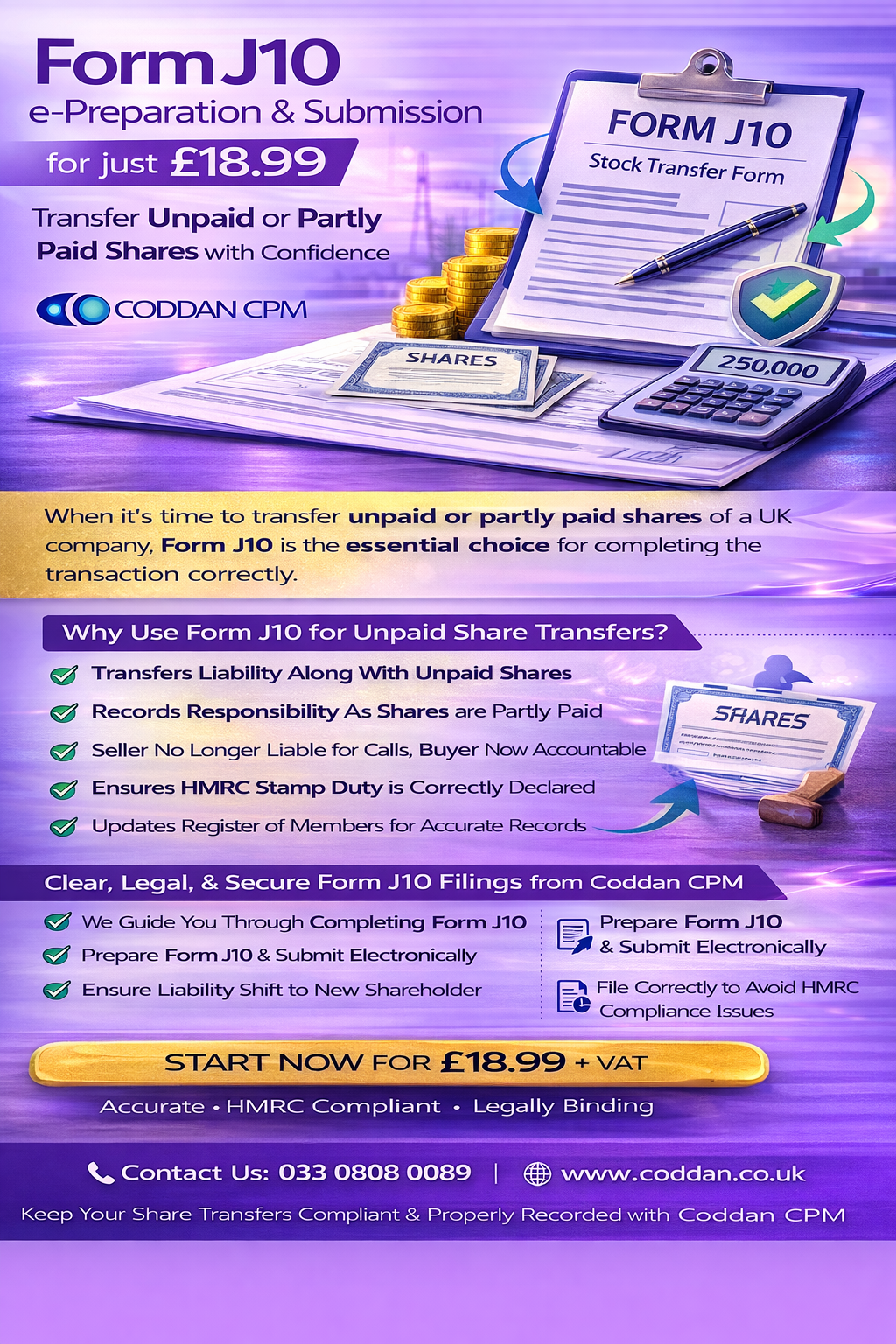
When it's time to transfer unpaid or partly paid shares, Form J10 from Coddan CPM is an essential tool. This form is specifically designed for situations where partly paid or nil-paid shares are being transferred, ensuring that you prepare the paperwork correctly and identify the recipient of the shares accurately. Understanding how to fill out Form J10 for transferring unpaid shares—rather than just completing Form J30 correctly—is crucial to avoid common legal and HMRC issues. Since the form documents the transfer of unpaid or partly paid shares, both the buyer and seller must sign it, as the liability for the shares shifts to the new owner. With clear guidance on completing Form J10, you can confidently fill out your stock transfer form without any uncertainty. By preparing your form correctly, you can complete a stock transfer confidently and steer clear of legal or HMRC complications every time.

Price: £18.99

J10 “TransferWise Pro”

Recommended for


How to Complete Form J10 for Share Transfers

How to Ensure Compliance with Form J10 for Shares.

Poster displaying various types of documents with descriptions and examples for each category. Informative poster outlining different document types, including definitions and visual examples for clarity.

Transfers of partly paid or nil-paid shares require documentation using Form J10 – Stock Transfer Form for Partly Paid or Nil-Paid Shares.
Form J10 ensures accurate and compliant shareholder records by documenting the legal transfer of shares with outstanding payment obligations.
Depending on the transaction value, HM Revenue & Customs may need to review the form for Stamp Duty assessment before formal recording.
After completing the documentation, the company can update its register of members and issue revised share certificates if necessary.
Coddan CPM offers professional support for the preparation and submission of Form J10, ensuring accuracy and smooth processing.
Proper preparation of Form J10 is essential for legal documentation of share transfers, clear assignment of liabilities, and compliance with company records.


Form J10 the Stock Transfer: Quick and Easy Submission J10 Form

Transferring shares is a key part of managing ownership changes in a UK company. When shares are partly paid or unpaid, the transfer must be completed using Form J10, rather than the standard J30 form.

Coddan offers a fast and reliable service to help you complete and process your J10 form correctly, ensuring your share transfer is legally valid and fully compliant.


What Is Form J10?

Form J10 is the official stock transfer form used for transferring partly paid shares. Unlike fully paid shares, these shares still carry outstanding financial obligations, making accurate documentation especially important. The form includes:

  • Details of the transferor (seller)
  • Details of the transferee (buyer)
  • Share class and number of shares
  • Consideration (if applicable)

Proper completion ensures the transfer is recognised and enforceable.

If your transfer forms part of a wider ownership change, you should also review
Change of Control and Corporate Restructuring, where share transfers and control shifts are closely connected.


When Do You Need to Use Form J10?

You should use Form J10 when:

  • Transferring partly paid or unpaid shares
  • Bringing in new investors under staged payment terms
  • Reorganising ownership with outstanding share obligations
  • Completing transactions involving uncalled capital

Using the correct form is essential—incorrect filings can invalidate the transfer or cause compliance issues.


Step-by-Step: How to Complete a J10 Form

  1. Enter Share Transfer Details
    Provide accurate information about both parties and the shares being transferred.
  2. Include Payment Terms
    Clearly state any consideration and outstanding amounts.
  3. Execute the Transfer
    Ensure the transferor signs the form to validate the transaction.
  4. Review Stamp Duty Requirements
    Determine whether Stamp Duty applies based on the transaction value.
  5. Update Company Records
    Amend the register of members and issue updated share certificates.


  6. J10 and Related Share Transactions

    Partly paid share transfers often occur alongside other corporate actions. Depending on your situation, you may also need:

    Issuing New Shares
    If ownership is changing through new share allotment:
    Form SH01 Explained: Allotment of Shares Made Easy

    Changing Share Capital Structure
    If your company is restructuring its share capital:
    Form SH02 – Change of Share Capital Expert Filing Service

    Transferring Fully Paid Shares
    If the shares are fully paid, use the appropriate form instead:
    Form J30 the Stock Transfer: Fast and Simple Submission J30 Form

    Share Buybacks and Cancellation
    If the company is reducing capital through share repurchase:
    e-Filing the Form SH03 (Return of Purchase of Own Shares)
    Fast and Easy e-Filing Form SH06 (Notice of Cancellation of Shares)

    Handling these filings together ensures your company records remain accurate and compliant.


    Impact on PSC (People with Significant Control)

    Transferring shares—especially those tied to future payments—can affect control of the company. If ownership thresholds change, you must update your PSC register accordingly.

    Learn more here:
    How to Amend Your Company’s PSC Information Effectively

    Keeping PSC records up to date is essential for legal compliance and transparency.


    Common Mistakes to Avoid

    Businesses often encounter issues when:

    • The wrong form (J10 vs J30) is used
    • Outstanding share obligations are not clearly documented
    • Incorrect shareholder details are submitted
    • Company registers are not updated

    Coddan helps you avoid these pitfalls by ensuring your transfer is handled accurately and efficiently.


    Why Choose Coddan for J10 Submission?

    • ✔ Fast and Efficient Process
      We simplify the completion and submission of your J10 form.
    • ✔ Accuracy and Compliance
      Our experts ensure all details are correct and compliant.
    • ✔ Expert Guidance
      We support you through complex share transfer scenarios.
    • ✔ Integrated Company Services
      We assist with related filings and ownership changes.


    Transfer Partly Paid Shares with Confidence

    Complete your share transfer quickly and correctly with Coddan’s expert support.

    • ✔ Accurate documentation
    • ✔ Fast turnaround
    • ✔ Full compliance

    Start your J10 submission today and ensure your ownership changes are properly recorded.

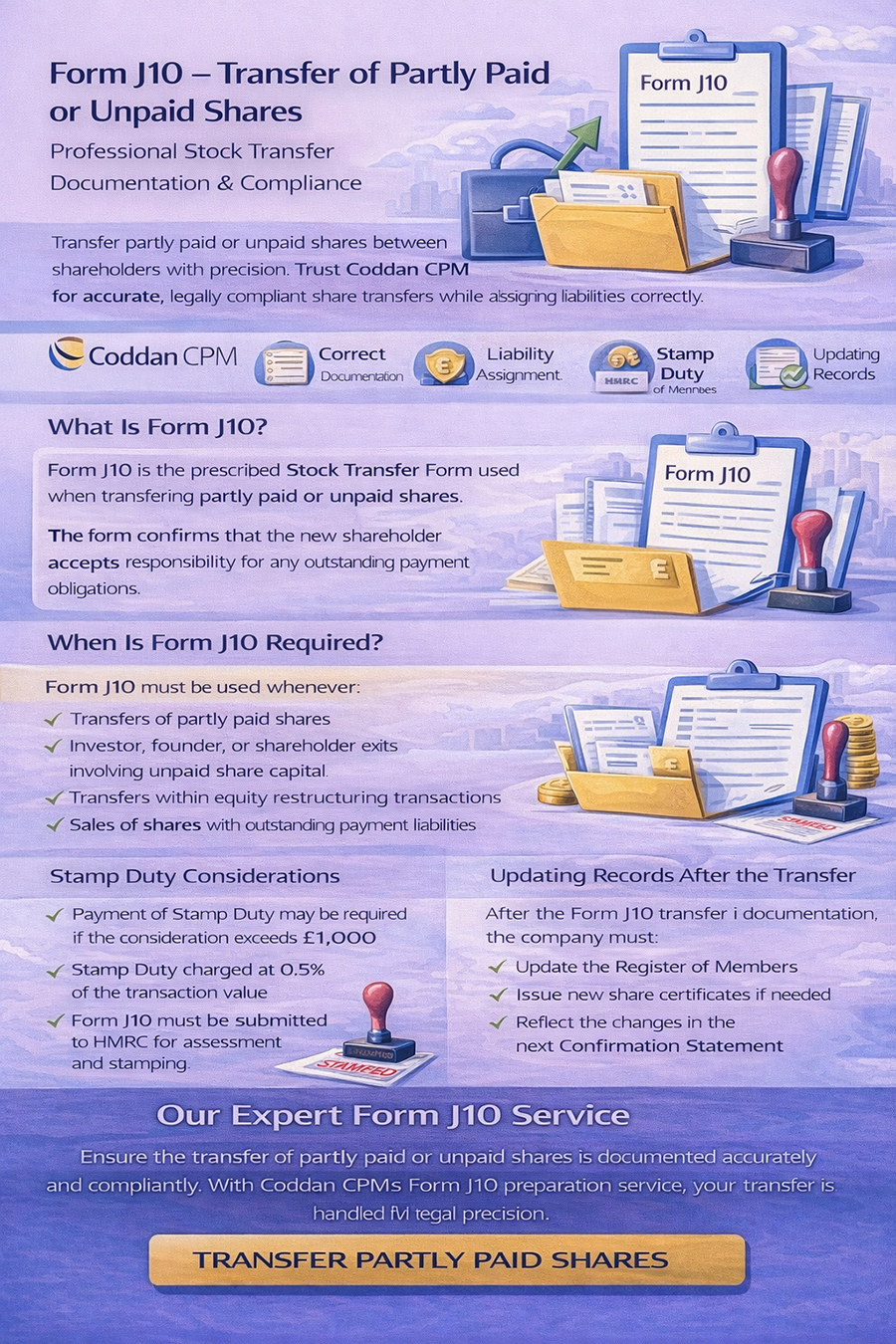
    Form J10 – Transfer of Partly Paid or Unpaid Shares
    When shares that are not fully paid are transferred between shareholders, the transaction must be documented using Form J10 – Stock Transfer Form for Partly Paid or Nil-Paid Shares. This form records the legal transfer of shares that still carry outstanding payment obligations, ensuring the company’s shareholder records remain accurate and compliant.

    Unlike transfers of fully paid shares, Form J10 confirms that the new shareholder accepts liability for any unpaid portion of the shares. The form captures key details such as the company name, share class, number of shares transferred, consideration (if any), and the identities of both the transferor and transferee. Because future financial liability is involved, the form must normally be signed by both parties.

    Depending on the value of the transaction, the completed form may also require review by HM Revenue & Customs for Stamp Duty assessment before the transfer is formally recorded. Once the documentation is complete, the company can update its register of members and issue revised share certificates where applicable.

    With support from Coddan CPM, the preparation and submission of Form J10 can be handled professionally. Our service ensures the transfer documentation is completed correctly, all relevant details are verified, and the process proceeds smoothly without unnecessary delays.

    Properly preparing Form J10 – Stock Transfer Form helps ensure that transfers of partly paid or unpaid shares are legally documented, liabilities are clearly assigned, and company records remain fully compliant.


    Form J10 (Stock Transfer for Partly Paid Shares): How Electronic Processing Works in 2026

    For startups, growth companies and foreign investors operating in the UK, transferring shares requires careful attention to corporate governance and tax compliance. One form that often causes confusion is Form J10, which applies when transferring partly paid or unpaid shares.

    Unlike many corporate filings, Form J10 is not submitted directly to the public register. Instead, it operates as a private legal instrument and tax document within the UK share transfer framework.

    Understanding the correct workflow ensures the transfer is legally valid and compliant with UK company law.

    What Is Form J10?

    Form J10 is the stock transfer form used to transfer partly paid or unpaid shares in a UK company.

    Partly paid shares mean the shareholder has not yet paid the full nominal value of the shares. Because the buyer inherits the financial liability for any unpaid amount, additional formalities apply compared with transfers of fully paid shares.

    The J10 therefore functions as:

    • a legal contract between transferor and transferee
    • a record of the share transfer
    • a document used to assess Stamp Duty obligations

    The transfer only becomes legally effective once the company records the change internally.

    Step 1: Electronic Preparation of the J10 Form

    Before completing the document, it is essential to confirm that J10 is the correct form.

    If the shares are fully paid, the correct form is J30.

    If the shares are partly paid or unpaid, the correct form is J10.

    Because the buyer assumes the liability for unpaid capital, the J10 requires both parties to sign:

    • the transferor (seller)
    • the transferee (buyer)

    In modern practice, most companies execute these documents electronically using e-signature platforms such as DocuSign or Adobe Sign. This allows founders and investors in different jurisdictions to complete transfers quickly.

    Step 2: Electronic Stamp Duty Submission to HMRC

    If the consideration paid for the shares exceeds £1,000, Stamp Duty becomes payable.

    The current rate is 0.5% of the consideration.

    In these cases, the signed J10 must be submitted to HM Revenue & Customs for stamping before the company can register the transfer.

    The standard digital workflow is:

    1. Pay the Stamp Duty via bank transfer.
    2. Email a clear scanned copy of the signed J10 form to HMRC’s Stamp Duty mailbox.
    3. Include payment reference and transaction details in the email.

    HMRC typically processes digital submissions within approximately 15 working days and issues confirmation electronically once the duty is satisfied.

    If the transfer is:

    • for £1,000 or less, or
    • a gift with no consideration, Stamp Duty may not apply.

    Step 3: Corporate Record Update (Where the Transfer Becomes Legal)

    Once Stamp Duty is satisfied — or confirmed as exempt — the final stage occurs within the company.

    The transfer becomes legally effective when the company updates its Register of Members. This internal register is the definitive legal record of ownership under UK company law.

    At this stage:

    • the Register of Members is updated
    • the previous share certificate is cancelled
    • a new share certificate is issued to the transferee

    The change is later reflected publicly in the company’s filing with Companies House through the next Confirmation Statement (CS01).

    Why J10 Transfers Require Extra Care

    Partly paid shares carry a financial obligation. If transferred incorrectly, disputes can arise over who is responsible for unpaid capital.

    Because of this, directors often require additional approvals before registering the transfer. Articles of Association may also give directors discretion to refuse certain transfers.

    For startups preparing for investment or restructuring equity, clean documentation is essential.

    Common Mistakes Founders Make

    Early-stage companies frequently:

    • use J30 when shares are actually partly paid
    • fail to obtain the transferee’s signature
    • ignore Stamp Duty requirements
    • register the transfer before HMRC stamping
    • neglect to update the Register of Members

    These mistakes often surface during investment due diligence or company sales.

    Final Summary

    Form J10 is not filed with the public register. Instead, the process involves three stages:

    1. Correct preparation and signing of the J10 transfer document
    2. Stamp Duty submission to HMRC where required
    3. Internal corporate record updates and issuance of new share certificates

    Only after these steps does the ownership transfer become legally effective.

    For startups and foreign investors, understanding this workflow helps avoid compliance issues and protects the integrity of the company’s share structure. At Coddan, we make life simpler, more affordable, worry-free, and compliant, and we back it with experience for all our clients.


    Coddan Case Studies: Transfer of Partly Paid or Unpaid Shares (Form J10). Case Study 1: Startup Founder Share Transfer with Outstanding Capital s

    Client: UK Technology Startup
    Service: Transfer of Partly Paid Shares – Form J10

    A startup founder decided to exit the business shortly after incorporation. The founder’s shares had been issued as partly paid shares, meaning that a portion of the nominal value remained unpaid.

    The transfer, therefore, required the use of Form J10 – Stock Transfer Form for partly paid shares.

    Challenge

    The company needed to ensure:

    • The new shareholder accepted liability for the unpaid share capital
    • The transfer was accurately documented
    • The company’s statutory records were updated correctly
    • The transfer complied with requirements under the Companies Act 2006

    Solution

    Coddan CPM managed the transaction by:

    • Preparing the Stock Transfer Form J10
    • Confirming the outstanding liability attached to the shares
    • Verifying the transferor and transferee details
    • Advising the company on updating its Register of Members

    Outcome

    The founder’s shares were successfully transferred, ensuring the liability for unpaid capital was legally assigned to the new shareholder and the company’s records remained compliant.


    Case Study 2: Investor Purchase of Partly Paid Shares s

    Client: UK Fintech Startup
    Service: Share Transfer Documentation – Form J10

    A fintech company issued shares to early founders on a partly paid basis, with capital contributions scheduled over time.

    When one founder sold their shares to a private investor, the transfer required Form J10 rather than Form J30.

    Challenge

    The company needed to ensure:

    • The investor formally accepted the remaining payment obligations
    • The share transfer was properly documented
    • Any applicable stamp duty requirements were considered with HM Revenue & Customs

    Solution

    Coddan CPM prepared the J10 stock transfer documentation, verified the share class and outstanding liability, and ensured the company updated its internal registers correctly.

    Outcome

    The investor successfully acquired the shares and assumed the future financial obligations attached to the unpaid capital, ensuring full compliance with UK corporate governance rules.


    Case Study 3: Group Company Share Restructuring s

    Client: UK Corporate Group
    Service: Internal Share Transfer – Unpaid Shares

    A corporate group reorganised ownership between its parent and subsidiary entities. Several shares issued within the group were partly paid shares, meaning that a standard J30 transfer form could not be used.

    Challenge

    The restructuring required:

    • Proper documentation using Form J10
    • Clear allocation of outstanding share capital liability
    • Accurate updates to the company’s statutory records

    Solution

    Coddan CPM handled the restructuring by:

    • Preparing the J10 transfer documentation
    • Verifying the unpaid share capital obligations
    • Guiding the company through updating its Register of Members

    Outcome

    The restructuring was completed successfully, providing clear ownership documentation and legally assigned financial obligations across the corporate group.


    Case Study 4: Shareholder Exit with Unpaid Share Capital s

    Client: UK Professional Services Firm
    Service: Shareholder Exit & J10 Documentation

    A professional services company needed to remove a shareholder who held partly paid shares issued during company formation.

    Challenge

    Because the shares had outstanding capital obligations, the transfer required:

    • Proper preparation of Form J10
    • Confirmation that the incoming shareholder accepted liability
    • Accurate updates to the company’s statutory registers

    Solution

    Coddan CPM provided a compliance-focused share transfer service, including:

    • Preparation of the J10 stock transfer form
    • Verification of shareholder details
    • Guidance on updating the Register of Members

    Outcome

    The shareholder exit was completed smoothly, ensuring the liability for unpaid capital was transferred legally and transparently.


    Case Study 5: Early Startup Equity Transfer Between Founders

    Client: UK SaaS Startup
    Service: Transfer of Nil-Paid Shares

    A SaaS startup issued nil-paid shares to founding team members during the early stages of the company.

    When one founder stepped down, their shares needed to be transferred to another team member.

    Challenge

    The company needed to ensure:

    • The new shareholder formally accepted liability for the unpaid shares
    • The share transfer was properly documented using Form J10
    • The company’s statutory records remained compliant with Companies House requirements

    Solution

    Coddan CPM prepared the J10 stock transfer form, verified the share details, and guided the company through the correct process for updating internal shareholder records.

    Outcome

    The founder’s shares were successfully transferred, and the company’s shareholder register accurately reflected the new ownership structure .


    In 2026, many providers still treat Form J10 as just another version of the standard J30 stock transfer form. This is a significant mistake. Because the J10 is used for unpaid or partly-paid shares, it carries legal liabilities that a standard share transfer does not.

    Here is the critical information most UK providers miss when assisting with a J10:

    1. The "Transferee Liability" Trap

    Most providers only ask for the seller's signature.

    • The Missed Info>: On a J10, the Transferee (Buyer) must sign. By signing, the buyer is not just accepting the shares; they are legally accepting the obligation to pay the remaining balance to the company whenever a call is made.
    • The Risk: If a provider uses a J30 or a J10 without the buyer’s signature, the transfer is legally "defective." The seller remains liable for the unpaid money, and the buyer may not be legally recognized as a shareholder.

    2. Mandatory Call on Shares" Audit

    Professional firms check the company's Articles of Association for Call provisions before filing.

    • The Missed Info: Many Articles state that shares cannot be transferred if there is an outstanding "call" (a demand for payment) that hasn't been met.
    • The Risk: If the directors approve a J10 transfer while a payment is overdue, they may be in breach of their fiduciary duties. Most online-only bots don't audit your Articles to see if the transfer is even permitted.

    3. The 2026 Tax Adviser Requirement

    As of May 2026, new HMRC rules (from the Finance Bill 2025–26) require anyone interacting with HMRC on behalf of clients for Stamp Duty purposes to beregistered as a tax adviser>.

    • The Missed Info: Simple administrative providers can no longer handle the Stamp Duty submission for you unless they meet these new professional standards.
    • The Risk: Using an unregistered filing agent to submit your J10 to the HMRC stamp office could lead to your application being rejected or the agent being fined £5,000+, delaying your transfer indefinitely.

    4. Statement of Deemed Consideration

    When transferring partly-paid shares, calculating Stamp Duty is not always straightforward.

    • The Missed Info: If shares are transferred for £1 but have a £10,000 unpaid liability, HMRC may calculate Stamp Duty on the "Deemed Consideration" (the value of the debt being taken over) rather than just the cash paid.
    • The Ris: Most providers only look at the Consideration box. If you underpay Stamp Duty because you ignored the unpaid liability value, HMRC can impose penalties of up to 100% of the duty owed.

    5. Interaction with the PSC Register (11-Character Code)

    In 2026, the J10 is a trigger forIdentity Verification.

    • The Missed Info: If the J10 transfer results in the buyer holding 25% or more of the company's shares/voting rights, they are a new Person with Significant Control (PSC).
    • The Requirement: You cannot simply record the transfer; the buyer must be verified as an ACSP and provide their 11-character verification code to the company. Automated providers often forget to link the stock transfer to the mandatory PSC verification.

    Understanding the Difference Between Form J10 and Form J30 for Share Transfers in the UK

    For startups, founders and foreign investors entering the UK market, understanding how shares are transferred in a company is essential. Share transfers change ownership, voting rights and dividend entitlement, so they must be handled correctly.

    In the UK, two standard instruments are commonly used for transferring shares: Form J30 and Form J10. While both are stock transfer forms, they apply to different types of shares and carry different legal implications.

    Knowing which form to use helps ensure that your share transfer is legally valid and compliant with UK company law.

    What Is Form J30?

    Form J30 is the standard stock transfer form used to transfer fully paid shares in a UK company.

    Fully paid shares are shares where the shareholder has already paid the entire nominal value of the shares. Because no further payment obligation exists, the transfer process is relatively straightforward. The J30 form typically records:

    • the name of the transferor (seller)
    • the name of the transferee (buyer)
    • the number and class of shares being transferred
    • the consideration paid for the shares

    Where the consideration exceeds £1,000, Stamp Duty at 0.5% may apply, and the form must be submitted to HM Revenue & Customs for stamping before the company registers the transfer.

    Once the company approves the transfer and updates its Register of Members, the new shareholder becomes the legal owner of the shares.

    J30 is therefore the most common transfer instrument used by startups, private companies and investors when fully paid shares are transferred.

    What Is Form J10?

    Form J10 is used when partly paid or unpaid shares are transferred.

    Partly paid shares carry an outstanding liability. This means the shareholder may still be required to pay additional amounts to the company if the directors make a call on shares.

    Because the buyer is taking on this financial obligation, the J10 form includes additional safeguards. Key characteristics of J10 include:

    • Both parties must sign the form.
      The transferee’s signature confirms that they accept the liability for any unpaid share capital.
    • The transfer may require additional checks.
      Many company Articles of Association restrict transfers where unpaid amounts are outstanding.
    • Stamp Duty considerations may differ.
      If the transferee assumes unpaid share capital, HMRC may treat that liability as part of the effective consideration when calculating Stamp Duty.

    Partly paid shares are less common in modern startups but still appear in founder arrangements, legacy share structures and certain investment agreements.

    Key Differences Between Form J10 and Form J30

    The primary distinction between the two forms relates to the payment status of the shares.

    Form J30 is used when shares are fully paid, meaning no further payment obligation exists.

    Form J10 is used when shares are partly paid or unpaid, meaning the transferee assumes responsibility for any remaining capital owed to the company.

    Because of this additional liability, the J10 process typically requires more careful review of the company’s Articles of Association and share capital structure.

    Do These Forms Need to Be Filed with Companies House?

    Neither Form J10 nor Form J30 is normally submitted to the public register at Companies House.

    Instead, the transfer becomes legally effective when the company updates its Register of Members and issues a new share certificate.

    The change in ownership is later reflected in the company’s next Confirmation Statement (CS01).

    This internal registration step is what legally transfers the shares.

    Why Startups Must Handle Share Transfers Carefully

    For early-stage companies, share transfers frequently occur during:

    • founder restructuring
    • investor onboarding
    • employee equity arrangements
    • mergers or acquisitions

    Incorrectly documented transfers can create serious problems during investment due diligence or company sales. Maintaining accurate statutory records and using the correct transfer form protects both shareholders and directors.

    Final Thoughts

    Although Form J10 and Form J30 are both stock transfer forms used in the UK, they serve different purposes depending on whether the shares being transferred are fully paid or partly paid.

    Understanding this distinction helps startups and investors manage ownership changes correctly and avoid compliance issues.

    When share capital structures become complex, seeking professional corporate secretarial or legal guidance can ensure that transfers are executed properly and recorded in accordance with UK company law.


    Why Corporate Secretarial and Compliance Firms Are Important for Form J10 Transfers in 2026

    In 2026, Form J10—the stock transfer form used for partly paid or unpaid shares—is one of the most sensitive documents in UK corporate administration. Unlike the standard J30 transfer for fully paid shares, a J10 transaction transfers not only ownership but also financial liability for unpaid share capital.

    For startups, founders and investors, this means the transfer must be handled carefully to avoid legal defects, tax exposure or governance failures. Professional corporate secretarial oversight is increasingly important to ensure the transfer is valid, compliant and properly recorded.

    Below are the key reasons experienced firms are often involved in J10 transactions.

    1. Verification of Transferee Liability

    The defining feature of a J10 transfer is that the buyer accepts responsibility for the unpaid portion of the shares.

    When the company makes a call on shares, the shareholder must pay the remaining amount. Because of this continuing liability, the transferee must explicitly acknowledge and accept this obligation.

    Professional advisers therefore ensure:

    • the transferee signs the J10 form
    • the buyer understands the liability being assumed
    • the transfer complies with the company’s Articles of Association

    If the transferee does not sign the document or the process is handled incorrectly, the transfer may be defective and the original shareholder could remain liable for unpaid capital.

    2. Identity Verification and Corporate Transparency Requirements

    Recent reforms to UK company law have strengthened identity verification requirements connected with the register of companies maintained by Companies House.

    Authorised Corporate Service Providers (ACSPs) can perform identity verification checks for individuals interacting with the register. These checks may become relevant when a share transfer results in a new Person with Significant Control (PSC).

    Professional compliance providers can therefore help ensure that:

    • new PSCs are identified correctly
    • required identity verification procedures are completed
    • PSC records are updated accurately

    Failure to update PSC information can expose the company and its officers to regulatory penalties.

    3. Managing Stamp Duty and HMRC Interaction

    Where consideration exceeds £1,000, share transfers may require Stamp Duty assessment by HM Revenue & Customs.

    Partly paid shares introduce an additional complexity: the buyer may assume liability for unpaid share capital. HMRC may treat this liability as part of the effective consideration when calculating Stamp Duty.

    Professional advisers help ensure that:

    • the correct duty is calculated
    • deemed consideration is assessed where applicable
    • documentation submitted to HMRC is complete and accurate

    Incorrect calculations can result in underpayment of duty and possible penalties.

    4. Updating the Register of Members

    Many founders believe the public record at Companies House is the definitive proof of share ownership. In fact, under UK company law the Register of Members maintained by the company is the legal record of shareholders.

    When a J10 transfer is completed:

    • the company must update its Register of Members
    • the old share certificate must be cancelled
    • a new share certificate must be issued

    Only after this internal update does the transferee become the legal shareholder. The change is then reflected publicly in the next Confirmation Statement filing.

    5. Preparing for Investor Due Diligence

    Share transfers involving partly paid shares often attract scrutiny during legal due diligence.

    If documentation is incomplete—such as a missing transferee signature, incorrect stamp duty calculation or inconsistencies in the Register of Members—lawyers reviewing the company’s share capital may treat the transfer as atitle defect.

    Professional corporate secretarial support helps ensure that:

    • the company’s share register is accurate
    • transfer instruments are properly executed
    • stamp duty compliance is documented

    This protects the company’s cap table and avoids complications during investment rounds or company sales.

    Identity Verification Documents Typically Required

    When identity verification is required (for example through an Authorised Corporate Service Provider), the individual being verified will normally need to provide identification documents.

    Commonly accepted primary identification documents include:

    • passport
    • UK photocard driving licence
    • biometric residence permit or residence card
    • biometric national identity card from certain jurisdictions

    In addition, proof of residential address is typically required, such as:

    • a utility bill
    • bank statement
    • council tax bill
    • HMRC correspondence

    Where a company is acquiring the shares, verification normally focuses on an authorised individual acting on behalf of that company.

    Modern verification systems may also use identity document validation technology (IDVT), which can include biometric checks or a short video confirmation (“liveness check”).

    Final Thoughts

    Form J10 transfers involve more than a simple change of ownership. Because partly paid shares carry continuing financial obligations, the transaction requires careful attention to documentation, tax treatment and corporate governance.

    For startups and investors, professional corporate secretarial support can help ensure that the transfer is properly executed, recorded and compliant with UK regulatory requirements.

    File and Process Form J10 Quickly with the Coddan CPM LegalTech Platform

    For startups, entrepreneurs and foreign investors entering the UK market, managing company ownership changes can be complex. Share transfers must follow strict legal procedures, and even small documentation mistakes can create problems during investment rounds or corporate audits.

    To simplify this process, Coddan CPM offers an electronic LegalTech platform designed to help businesses prepare and process stock transfer documentation efficiently. Through this platform, companies can manage Form J10 share transfers for partly paid shares in a structured and compliant way.

    Instead of struggling with technical paperwork, founders can focus on growing their businesses while ensuring that their share ownership records remain accurate and legally valid.

    Form J10 is the stock transfer form used when partly paid or unpaid shares are transferred between shareholders in a UK company.

    Unlike transfers of fully paid shares (which typically use Form J30), a J10 transaction involves the buyer accepting liability for the remaining unpaid share capital. Because of this continuing financial obligation, the document carries additional legal significance.

    The form records:

    • the transferor (seller)
    • the transferee (buyer)
    • the number and class of shares
    • the consideration paid
    • the acceptance of liability for unpaid capital

    Once properly executed, the company updates its Register of Members, which is the legal record of share ownership under UK company law.

    Why Startups Use the Coddan CPM Platform

    Early-stage companies often restructure ownership when onboarding investors, reallocating founder equity or correcting historical share records. Handling these transfers manually can be time-consuming and error-prone.

    The Coddan CPM LegalTech platform simplifies the process by guiding users through the correct documentation steps.

    Intuitive Digital Interface

    The platform provides a clear workflow that helps founders identify whether they should use Form J10 or Form J30, ensuring the correct transfer instrument is prepared from the start.

    Faster Document Preparation

    Instead of relying on manual templates, businesses can complete the required information digitally. This reduces preparation time and helps prevent common documentation mistakes.

    Electronic Execution

    Modern share transfers often involve parties located in different jurisdictions. Coddan’s platform supports electronic document preparation and execution, allowing founders and investors to complete transactions efficiently.

    Professional Compliance Support

    The Coddan team can assist with reviewing documentation, assessing Stamp Duty implications and ensuring that share transfers are executed correctly before the company updates its statutory registers.

    Ongoing Corporate Compliance

    Beyond share transfers, Coddan provides company formation, registered office services and corporate secretarial support to help businesses remain compliant with UK regulations.

    Important: Form J10 Is Not Filed with Companies House

    One of the most common misconceptions among founders is that Form J10 must be filed directly with Companies House.

    In reality, stock transfer forms are normally retained within the company’s statutory records.

    The transfer becomes legally effective when:

    1. the company approves the transfer (if required under the Articles of Association)
    2. the Register of Members is updated
    3. a new share certificate is issued

    The change is later reflected publicly through the company’s Confirmation Statement (CS01).

    Stamp Duty Considerations

    If the consideration for the share transfer exceeds £1,000, the transaction may require Stamp Duty assessment by HM Revenue & Customs.

    Because partly paid shares involve outstanding liability, the duty calculation can sometimes include the assumed unpaid capital.

    Professional guidance ensures the correct duty is assessed and avoids delays in registering the transfer.

    A Faster Way to Manage Share Transfers

    For founders managing a growing company, administrative efficiency matters. Using the Coddan CPM LegalTech platform allows businesses to prepare share transfer documentation quickly while maintaining compliance with UK corporate law.

    Instead of navigating the process alone, startups can rely on structured digital tools and expert guidance to ensure their ownership records remain accurate and investor-ready.

    Transfer Unpaid or Partly Paid Shares in a UK Company. File a J10 Stock Transfer Form with Expert Support

    If you need to transfer unpaid or partly paid shares in a UK company, the correct legal document is the J10 Stock Transfer Form. This form records the transfer of ownership where the shares have not been fully paid for, ensuring the new shareholder accepts the remaining financial obligation attached to those shares.

    For startup founders, investors, and international entrepreneurs managing UK companies, completing a J10 correctly is essential to maintain compliant shareholder records with Companies House.

    Our professional share transfer service ensures the process is handled accurately, securely, and without unnecessary delays.


    What Is Form J10?

    The J10 Stock Transfer Form is used when transferring shares that are unpaid or partly paid.

    In many UK companies, shares are issued fully paid. In those cases, the J30 Stock Transfer Form is used. However, when shares still carry an unpaid balance owed to the company, a J10 must be used instead.

    This situation commonly occurs when:

    • founders issue shares with deferred payment terms
    • early investors receive partly-paid shares
    • shareholder restructuring transfers liability to a new owner

    The J10 ensures the new shareholder legally accepts responsibility for any outstanding payments related to those shares.


    Why the J10 Requires Two Signatures

    Unlike standard share transfer forms, the J10 must be signed by both parties involved in the transaction.

    • Transferor – the existing shareholder transferring the shares
    • Transferee – the person receiving the shares

    The transferee’s signature confirms they accept the liability for the unpaid amount attached to the shares.

    Failing to complete the form correctly can lead to disputes about ownership or liability.


    Important: J10 Does Not Remove a Shareholder

    Many founders mistakenly believe the J10 can be used to remove a shareholder from a company.

    This is not correct.

    A J10 only records a transfer of ownership between two parties. If you want to remove a shareholder entirely, different procedures apply.

    Removing a Shareholder via Share Buyback
    If the company buys back a shareholder’s shares and cancels them, this process involves:

    • a buyback agreement
    • Form SH03 – Return of Purchase of Own Shares
    • sometimes Form SH06 – Notice of Cancellation of Shares

    Terminating Shares for Non-Payment
    If a shareholder fails to pay for their shares, the company may follow a forfeiture process defined in its Articles of Association. This may also lead to share cancellation using SH06.

    Understanding the correct legal route avoids costly compliance problems.


    The Reality of Share Transfer Filings

    Another common misconception is that J10 forms are submitted directly to Companies House.

    In practice, the process works differently.

    Step 1: Stamp Duty Assessment
    If the share transfer value exceeds £1,000, the document normally needs to be sent to HM Revenue & Customs for stamp duty assessment.

    The standard rate is 0.5% of the transaction value.

    Step 2: Update the Register of Members
    Once the transfer is completed, the company updates its Register of Members.

    This is the moment the new shareholder legally becomes the owner of the shares.

    Step 3: Notify Companies House
    Shareholder changes are usually reported through the company’s Confirmation Statement (CS01) rather than a specific transfer form.


    PSC Reporting Requirements

    If the transfer results in a shareholder holding more than 25% of the company, they become a Person with Significant Control (PSC) .

    In this case the company must notify Companies House by filing the appropriate PSC notification within 14 days of the change.

    Failing to update PSC information can create compliance issues during investor due diligence or company sales.


    Why Founders and Investors Use Our Share Transfer Service

    Handling share transfers incorrectly can create problems during funding rounds, acquisitions, or legal reviews.

    Our service helps avoid those risks by ensuring:

    Accurate Documentation
    Your J10 form is prepared correctly to reflect the transfer and associated liabilities.

    Compliance with UK Company Law
    All steps follow the requirements of the Companies Act 2006 .

    Support for International Clients
    Overseas founders and investors receive clear guidance on UK corporate procedures.

    Confidential and Professional Handling
    Your company data is processed securely and discreetly.


    Who This Service Is Designed For

    Our J10 share transfer support is ideal for:

    • startup founders restructuring ownership
    • early-stage investors transferring shares
    • international entrepreneurs managing UK companies
    • companies issuing or transferring partly-paid shares

    If your company’s share structure is evolving, getting the documentation right from the start protects your business.


    Start Your Share Transfer Today

    If you need to transfer unpaid or partly-paid shares, completing the J10 correctly is essential for maintaining compliant shareholder records.

    Our experienced team will guide you through the process and ensure the documentation is prepared accurately.

    Contact us today to begin your share transfer and keep your company records fully compliant.

    Form J10 – Transfer of Partly Paid or Unpaid Shares
    For private companies limited by shares in the UK, maintaining accurate shareholder records is a key part of regulatory compliance. When partly paid or nil-paid shares are transferred between shareholders, the transaction must be documented using Form J10 – Stock Transfer Form for Unpaid or Partly Paid Shares. Proper completion of this form ensures the company’s ownership records remain correct and that any future payment liability attached to the shares is clearly transferred to the new shareholder.

    Form J10 is specifically used when shares have not been fully paid up. Unlike transfers of fully paid shares (which use Form J30), the J10 form confirms that the new shareholder accepts responsibility for any unpaid portion of the share value. The document records essential details including the company name, share class, number of shares transferred, consideration paid (if applicable), and the identities of both the transferor and transferee.

    Where the value of the transfer exceeds the relevant threshold, the document may also need to be processed by HM Revenue & Customs for Stamp Duty assessment before the transfer can be formally registered. Once the documentation is properly completed, the company updates its register of members and issues revised share certificates reflecting the new ownership.

    For businesses operating in the UK or overseas but registered with Companies House, ensuring that share transfer documentation is completed correctly is essential to maintaining good corporate governance.

    With support from Coddan CPM, the preparation of Form J10 and related share transfer documentation can be handled efficiently and professionally. Our corporate secretarial specialists help ensure the form is completed accurately, the transfer is properly documented, and all statutory records are updated—allowing your business to remain fully compliant while focusing on growth.

    Compliance and Risk Management
    Directors ensure filings, records, and legal obligations are properly handled.

    This may include appointing qualified directors when needed. For example: