We use cookies on this website, you can read about cookies and GDPR Privacy Policy here
Coddan CPM Ltd. – Company Registration Agent in the UK

Simplify your company registration in the UK with Form AP01; capture vital director details and ensure compliance with the Companies Act today!

Step 1
1️⃣ Get Board Approval
Step 2
2️⃣ Consent to Act
Step 3
3️⃣ Director Identity Verification (NEW)
Step 4
4️⃣ Provide Company Details
Step 5
5️⃣ Provide Appointment Date
Step 6
6️⃣ Provide Director’s Details
Companies Registry's e-Services Portal Post Incorporation Support Service Why Choose Coddan for Electronically Filing Form AP01?

Why Choose Coddan for Electronically Filing Form AP01?


Keep your company records up to date with our hassle-free service for updating director details. Enjoy swift processing and low costs. Contact us today!

Introducing our efficient and cost-effective service designed for private limited companies seeking to update their director details. With our professional assistance, you can easily change or amend existing director information and seamlessly appoint a new director using our electronic Form AP01.
Our streamlined process ensures that your updates are handled swiftly and correctly, so you can focus on what matters most: your business. Trust us for a hassle-free experience at a low cost, allowing you to maintain compliance and keep your company’s records up to date without any unnecessary delays.
Take the next step today and simplify your company administration with our professional service. Contact us to get started!

Refresh your leadership effortlessly! Use our online form to appoint a new company director quickly and ensure compliance with Companies House Form AP01!

Need to refresh your company’s leadership? Appoint a new company director quickly and stay compliant with our streamlined solution. Use our online (electronic) form to appoint an individual as a company director—just enter the essential details like full name, date of birth, nationality, and addresses, and you’re ready to go. You may use this form to appoint an individual as a director, ticking every compliance box without the mountain of paperwork. Appoint the new director using Companies House Form AP01, giving you peace of mind that your update is filed securely and accurately.
Why waste time with manual forms or guesswork? Appoint a new company director quickly and stay compliant every step of the way. Use our online (electronic) form to appoint an individual as a company director, and appoint the new director using Companies House Form AP01—making directorship changes as smooth as possible. You may use this form to appoint an individual as a director today.

Appoint a new company director in minutes with Coddan CPM! Use our easy online form to ensure compliance and steer your business forward—no paperwork needed.

Appointing a new director just got a whole lot easier. With Coddan CPM, you may use this form to appoint an individual as a director in a matter of minutes—no paper, no fuss. Use our online (electronic) form to appoint an individual as a company director and steer your company in a fresh direction, all while keeping compliance front and centre. Simply gather your new director’s details and appoint the new director using Companies House Form AP01. It’s the swift, secure, and hassle-free way to appoint a new company director quickly and stay compliant.
Why get bogged down in paperwork? You may use this form to appoint an individual as a director and ensure you appoint the new director using Companies House Form AP01 without delay. Get your leadership sorted and your company set for the next chapter—easily and compliantly.

  Fast & Compliant Director Appointment Service

Appoint a new company director quickly and remain fully compliant with UK company law. Coddan CPM offers a streamlined electronic solution for e-filing Form AP01, ensuring your company meets its statutory obligation to notify Companies House within the required 14-day deadline.
Our secure online form allows you to appoint an individual as a director by entering the essential statutory details, including full legal name, date of birth, nationality, occupation, and residential and service addresses. We review and validate the information before submission to reduce the risk of rejected filings or compliance errors.
It is important to note that Form AP01 is a notification of an appointment that must already be validly approved in accordance with the Companies Act 2006 and your company’s Articles of Association. Our structured process ensures that the appointment is properly authorised before electronic filing.
Avoid delays, manual paperwork, or uncertainty. Our digital filing service provides speed, accuracy, and secure submission, giving you peace of mind that your director appointment has been handled correctly.
Appoint a new director efficiently and confidently—professionally managed, fully compliant, and processed without unnecessary complexity.

Price: £18.99

Buy “GovernSure Pack”

Recommended for


Why Choose Coddan for Electronically Filing Form AP01?

Appointing a new company director is a key step in managing or restructuring your business. In the UK, this process must be completed by submitting Form AP01 to Companies House, ensuring that the appointment is legally recorded and publicly registered.

At Coddan, we simplify this process through a fast, accurate, and fully compliant electronic filing service, helping you appoint directors without delays or administrative complexity.


What Is Form AP01 and Why Is It Important?

Form AP01 is the official Companies House form used to appoint an individual as a company director. It includes essential details such as:

  • Full name and service address
  • Date of birth
  • Nationality and occupation
  • Consent to act as a director

Submitting this form correctly is critical. Errors or omissions can lead to rejection, delays, or compliance issues.

If your appointment is part of a broader ownership or management transition, you may also benefit from understanding the wider process of
Change of Control and Corporate Restructuring – where director appointments often coincide with share transfers or governance updates.


Why Choose Coddan for AP01 e-Filing?

✔ Fast and Efficient Submission
We electronically submit your Form AP01 directly to Companies House, significantly reducing processing time compared to paper filing.

✔ Error-Free Documentation
Our specialists review your information before submission, ensuring accuracy and minimising the risk of rejection.

✔ Full Compliance Assurance
We ensure your filing meets all statutory requirements under the Companies Act 2006.

✔ Expert Support
Whether you are appointing a single director or restructuring your board, our team provides clear guidance at every step.


When Do You Need to File Form AP01?

You must file Form AP01 when:

  • Appointing a new individual director
  • Replacing or expanding your board
  • Bringing in investors or new management
  • Restructuring company leadership

If your situation involves appointing a corporate entity as a director, you will need a different process. Learn more here:
Steps to Appoint a Corporate Director in the UK Using Form AP02.


Director Changes Often Involve More Than One Filing

In many cases, appointing a director is only one part of a broader set of changes. Businesses frequently need to manage additional filings such as:

Director Removal
If you are replacing an existing director, you must also notify Companies House:
How to Simplify Director Removal (Form TM01) for Your Business .

Director Privacy Protection
Directors may wish to remove their residential address from public records:
How to File Form SR01 to Remove Your Residential Address.

These related filings are often part of the same compliance workflow, particularly during restructuring or ownership changes.


Avoid Common AP01 Filing Mistakes

Many businesses encounter delays due to:

  • Incorrect personal details
  • Missing consent to act
  • Using outdated forms
  • Filing outside the required timeframe

Coddan eliminates these risks by handling the process on your behalf with precision and care.


A Complete Solution for Company Changes

Our AP01 service is designed to integrate seamlessly with other company updates. Whether you are:

  • Expanding your leadership team
  • Replacing directors
  • Preparing for investment
  • Undergoing corporate restructuring

We provide a streamlined, end-to-end solution that keeps your company compliant and up to date.


Start Your AP01 Filing Today

Appoint your new director quickly and confidently with Coddan’s professional e-filing service.

  • ✔ No paperwork confusion
  • ✔ Fast processing
  • ✔ Expert support

Get started today and ensure your company records are updated without delay.

Streamlining Company Formation: Coddan’s Expert Preparation and Filing of Form AP01 with Companies House

In today’s fast-paced business environment, timely and effective company registration can make or break a startup’s early success. For business startups, new ventures, and entrepreneurial endeavors, having a reliable partner in navigating the complexities of company formation is crucial. Coddan offers exceptional services that ensure the preparation and submission of Form AP01 to Companies House is executed seamlessly and efficiently, often within a remarkable 24-hour turnaround.

Form AP01 is an essential document for anyone looking to register a new company in the UK, particularly for those seeking to establish a private limited company (Ltd). This form records the details of the company directors, who are responsible for the management of a company. It outlines crucial information, including the names, addresses, and personal identification details of the directors, ensuring compliance with the legal requirements set forth by the Companies Act.

For startups and foreign businesses entering the UK market, the process of filing Form AP01 can seem daunting. The intricacies of UK corporate law can be overwhelming, especially for entrepreneurs unfamiliar with the local regulatory landscape. This is where Coddan’s expert services come into play.

Why Choose Coddan for Filing Form AP01?

1. Expertise at Your Fingertips: Coddan is staffed with professionals who have extensive experience in company formation and registration. Their expertise allows them to manage the intricacies of Form AP01 preparation, ensuring all necessary information is accurately completed and compliant with Companies House requirements.

2. Rapid Turnaround Time: In a competitive business world, speed matters. Coddan prides itself on its rapid processing capabilities, often preparing and filing Form AP01 within just 24 hours. This means new companies can start their operations sooner rather than later, giving them the edge they need in today’s market.

3. Personalized Service: Every business is unique. Coddan understands that each startup has different needs and provides tailored advice to make the registration process smooth and straightforward. Their team is dedicated to addressing specific concerns or questions entrepreneurs may have, leading to a more personalized experience.

4. Ensuring Compliance: Failure to comply with the regulatory requirements can lead to unnecessary complications and delays. Coddan’s thorough knowledge of UK corporate legislation ensures that startups can avoid potential pitfalls that might arise from incorrect filings or missing information.

5. Continued Support: Beyond the initial registration of a company, Coddan offers continued support services that can be invaluable for early-stage companies. From accounting to compliance advice, Coddan is positioned as a long-term partner for entrepreneurs, adding value to their operations.

Conclusion
Navigating the complexities of company formation in the UK, particularly for startups and foreign businesses, can undoubtedly be a challenging task. However, with Coddan’s expert guidance in preparing and filing Form AP01, entrepreneurs can rest assured that their registration will be completed efficiently and accurately. The combination of rapid turnaround, personalized service, and ongoing support solidifies Coddan’s position as a go-to resource for those embarking on their entrepreneurial journey. If you are a startup or an early-stage company looking to make your mark, enlisting the help of Coddan could be the first step toward a successful business venture in the UK.
At Coddan, we make life simpler, more affordable, worry-free, and compliant, and we back it with experience for all our clients.

When your business undergoes restructuring or changes in ownership, keeping accurate documents is vital for your credibility. We offer company certificates, such as the Certificate of Good Standing and the Certificate of Incumbency, to help you meet compliance requirements. The Certificate of Good Standing shows your current status with Companies House. It proves that you are compliant and active, which builds trust with partners and stakeholders.
The Certificate of Incumbency confirms who has the legal authority to act on behalf of your company. This is especially important when opening bank accounts or preparing for ownership changes. Companies in the UK, particularly those with directors overseas, often rely on this certificate to provide proof of authority. Together, the Certificate of Good Standing and the Certificate of Incumbency strengthen your company’s reputation and prepare you for the future.

*Best Practices for Director Transitions: Leveraging Expert Services for Appointments and Resignations

From Start to Finish: The Expert’s Guide to Streamlining Director Appointments and Resignations.

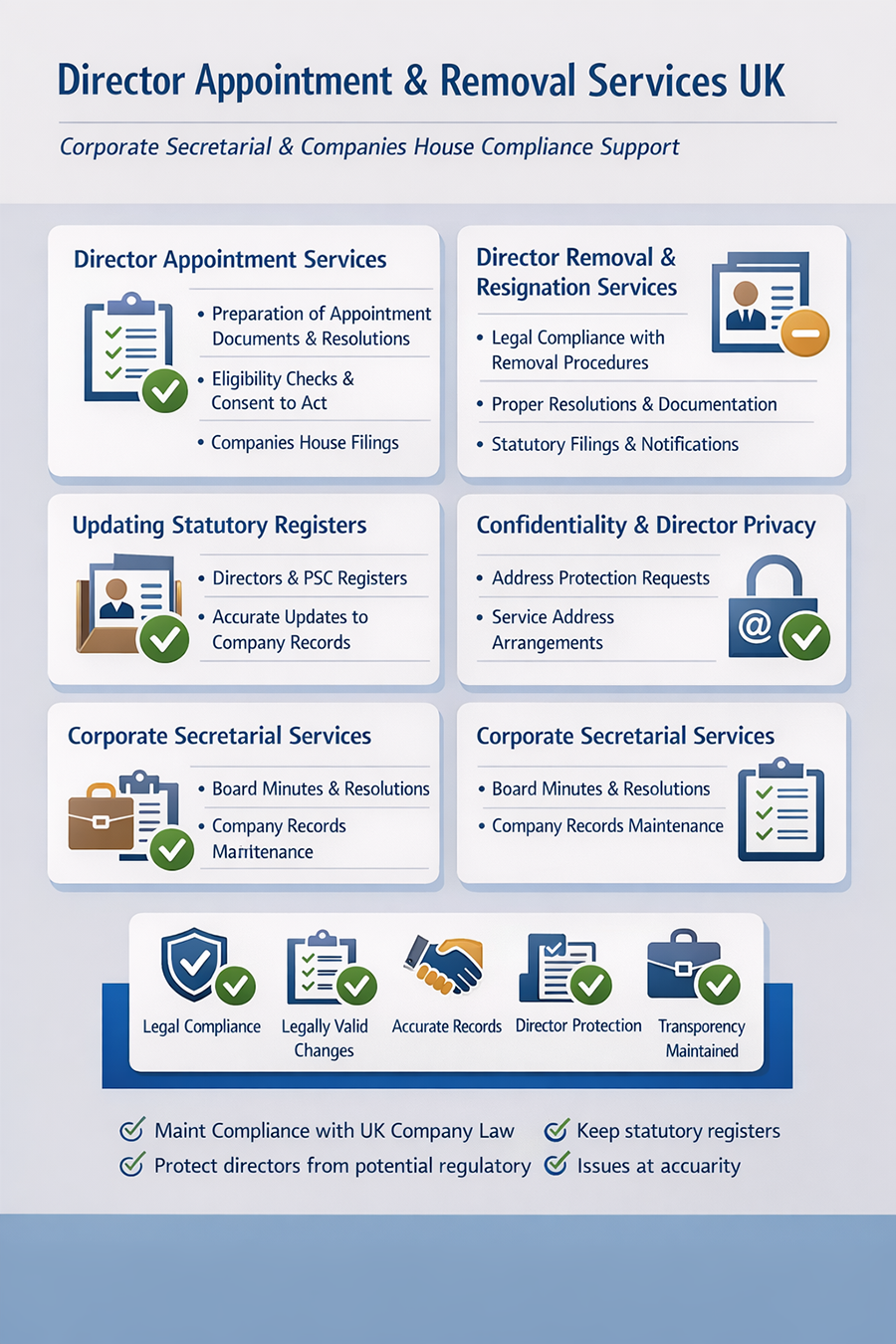
Image depicting services for appointing and removing directors in the UK, highlighting professional business support. Visual representation of UK director appointment and removal services, emphasizing corporate governance assistance.

Director Appointment: Help with appointing new directors, ensuring compliance with legal requirements and preparing necessary documentation.
Director Removal Services: Help with terminating directors, ensuring legal compliance and preparing necessary documentation.
Updating Statutory Registers: Making certain that all statutory registers and company records are accurately updated to represent changes in directors and adhere to legal obligations.
Confidentiality Services: Assisting with address protection or confidentiality requests to ensure the safeguarding of directors’ personal information, particularly in delicate circumstances.
Corporate Secretarial Services: All-encompassing secretarial services that manage administrative duties and ensure compliance for the organization, including the submission of annual returns and financial statements.
Corporate Filings and Registrations: Guidance on all forms of filings and registrations necessary as per Companies House or other applicable authorities.


How to Legally Appoint a Limited Company Director.

How to Simplify Your Business Expert Corporate Secretarial & Compliance

Professional corporate secretarial and compliance services encompass the expert management of legal, administrative, and regulatory processes associated with the appointment and resignation of board members.
Our exciting services guarantee that adding or removing a director meets all legal standards (like the Companies Act 2006 in the UK), reducing the risk of penalties and keeping public records precise and up-to-date

Simplify your documentation needs with our professional services; we create resignation letters, appointment letters, and board minutes for seamless changes.

Documentation Preparation: Drafting essential legal documents, including letters of resignation, appointment letters, and board minutes authorizing the change.

Streamline your regulatory filings with our expert services; we handle the preparation and electronic submission of statutory forms to Companies House.

Regulatory Filings: Handling the preparation and electronic submission of statutory forms to official bodies (e.g., Form AP01 for appointments and Form TM01 for resignations to Companies House in the UK).

Keep your company’s statutory records up to date! Learn how to maintain the Register of Directors and their residential addresses effectively.

Updating Statutory Records: Ensuring the company’s internal registers—specifically the Register of Directors and Register of Directors’ Residential Addresses—are updated to reflect the changes.
Compliance & Due Diligence: Verifying the legitimacy of the appointment or resignation, including conducting necessary identity checks (ID checks) for new directors to meet legal requirements.

Stay compliant and informed in your advisory role. We provide essential guidance on legal duties, notice periods, and minimum director requirements for your board.

Advisory Role: Providing guidance on legal duties, notice periods, and ensuring the board remains compliant with its minimum director requirements.

Enhance your directorship role with expert insights on legal duties and notice periods. Ensure your board meets compliance with minimum director requirements effortlessly.

Master your advisory responsibilities with our expert guidance on legal duties and notice periods, ensuring your board remains compliant with director requirements.

Key Takeaway

For business startups and new ventures in the UK, having the right leadership is essential for success. Appointing a new director is a significant decision that can shape the future direction of your company. To formalize this appointment, you will need to complete and submit Form AP01 to Companies House. In this article, we’ll guide you through the process of correctly completing this form. Understanding Form AP01
Form AP01, also known as the "Appointment of Director" form, is a legal document that officially records the appointment of a new director in your company. This form ensures that the individual’s details are accurately filed with Companies House, promoting transparency and compliance with UK company law.
Step-by-Step Guide to Filling Out Form AP01
1. Download the Form
You can easily download Form AP01 from the official UK Government website or access it through Companies House. Make sure to have the most current version to avoid any issues.
2. Company Details
At the top of the form, provide your company’s name and registration number. This information helps identify your business and links the new appointment directly to your company records with Companies House.
3. Director’s Information
This section is vital, as it requires details of the new director you wish to appoint. Here’s a breakdown of the information needed:
- Full Name: Enter the director’s legal name as it appears on their identification.
- Date of Birth: Include the director’s date of birth, as this is part of the identification process.
- Nationality: Specify the nationality of the new director, which is essential for compliance with company law.
- Service Address: Provide the address where the director can be contacted. This does not need to be a residential address but must be valid.
- Residential Address: You may use the same address as the service address or provide a different one. This information remains confidential and is not publicly available.
- Occupation: State the director's occupation, as this offers additional context about their professional background.
4. Signature and Date
After filling out all the details, the new director must sign and date the form. This signature indicates their agreement to accept the role and their responsibilities under the Companies Act.
5. Submission of the Form
After completing the form and obtaining the director’s signature, the next step is to submit it to Companies House. You can do this electronically through the Companies House online services or by mailing a physical copy. If you choose to mail it, be aware of the processing time.
6. Confirmation of Appointment
Once your Form AP01 is submitted, Companies House will process it and update your company records. You will receive confirmation of the appointment, and it is advisable to keep a copy for your records.
Final Thoughts
Appointing a new director is a crucial step for any business startup. Properly filling out Form AP01 ensures that your business remains compliant with the legal frameworks governing company operations in the UK. It’s always wise to double-check your completed form to avoid any errors that could lead to processing delays. With accurate information and a careful approach, appointing a new director can be a seamless and efficient process.
Appointing a new director for your limited company is a crucial step that can significantly impact the direction and success of your business. Whether you are a startup, an early-stage company, or a foreign business seeking to establish a presence, understanding the appointment process is essential. This guide will walk you through the process of using the official government form to appoint a new director.
Understanding the Role of a Director
Before diving into the appointment process, it’s important to understand the role a director plays in your company. A director is responsible for guiding the business toward its objectives, making critical decisions, managing resources, and ensuring legal compliance. Therefore, selecting the right individual is paramount for future growth.
Prerequisites for Appointment
To appoint a new director, there are several key prerequisites:
1. Eligibility: The individual must be at least 16 years old and should not be an undischarged bankrupt or prohibited from operating a company.
2. Company Structure: Ensure that your company’s articles of association allow for the appointment of new directors.
3. Agreement: It is advisable to discuss the prospective director’s role and responsibilities before proceeding.
Official Form: AP01
The official form used for appointing a new director in the UK is the AP01 form. This form can be completed online via the Companies House website or downloaded as a paper form. Here is a step-by-step guide on how to fill out and submit the AP01 form:
1. Gather Information: Before completing the AP01 form, collect the necessary details about the new director, such as:
- Full name
- Date of birth
- Nationality
- Occupation
- Service address (this can be the company’s registered office)
2. Complete the Form: If filling it out online, navigate to the Companies House portal. If using a paper form, ensure all boxes are filled out accurately. Pay attention to the following:
- Use the correct code relevant to the appointment type.
- Double-check all information for accuracy to avoid delays in processing.
3. Signatory Requirement: The form needs to be signed by the new director (for paper submissions) or validated online if submitted digitally.
4. Submission: For online submissions, follow the prompts on the Companies House website. If submitting a paper form, send it to the appropriate Companies House office for your area, ensuring to include any necessary cover letters.
5. Await Confirmation: After submission, Companies House will process your application. You should receive confirmation of the new director’s appointment, usually within a few days.
6. Inform Relevant Parties: Once the appointment is confirmed, communicate with your team, stakeholders, and relevant bodies to ensure everyone is aligned regarding the organizational structure.
Final Thoughts
Appointing a new director is an important decision that requires careful consideration and adherence to the correct procedures. By utilizing the AP01 form, you can ensure that the appointment is officially recognized, facilitating a smooth transition within your company’s leadership. Properly integrating your new director will not only meet legal obligations but also leverage their expertise to drive your business forward.
In conclusion, whether you are a fledgling startup or a foreign venture, understanding how to effectively appoint directors paves the way for building strong leadership in your company, setting the stage for future success.
When adding a new director to your business, it is crucial to understand the necessary documentation and forms required by regulatory authorities. In the UK, one essential document is the AP01 form, which is used to appoint directors to a company. This form is vital for ensuring that your company remains compliant with regulatory standards while providing transparency about its governance. Below, we outline the information required when filling out the AP01 form.
Basic Company Information
At the top of the AP01 form, provide basic details about your company, including:
1. Company Registration Number: This is the unique number issued to your company upon registration with Companies House.
2. Company Name: The official name of your business as registered.
Director’s Personal Information
The next section of the form requires detailed personal information about the new director. Essential details include:
1. Full Name: Include the director’s first name(s) and surname.
2. Date of Birth: Providing the full date of birth is crucial for identifying the individual.
3. Nationality: Specify the director’s nationality or nationalities, as this helps clarify the individual’s identity.
4. Service Address: Provide the director’s service address, which will be publicly available. This differs from the residential address, which is confidential.
5. Residential Address: While this can remain confidential, it is still required for verification purposes and is not generally disclosed to the public.
Appointment Details
This section explains the context of the appointment:
1. Date of Appointment: Specify the date the director officially starts their position in the company.
2. Position: Include any specific roles or titles associated with the director’s position (e.g., Managing Director, Finance Director).
Additional Information
In some instances, you may be required to provide additional information depending on the nature of the director’s appointment:
1. Occupation: Disclose the director’s previous or current occupation, particularly if relevant to their role within the company.
2. Identification: While the form does not specifically request ID documents, it’s good practice to have identification such as a passport or driver’s license readily available for verification if needed.
3. Other Directorships: If the new director holds other directorships, consider disclosing this information to provide a complete picture of their professional background.
Final Steps
After compiling all the necessary information, ensure that the form is signed by an existing director or the company secretary. This signature acts as verification of the application.
Conclusion
Completing the AP01 form is a fundamental step in appointing a new director to your business. Ensuring accurate and complete information on this form not only facilitates a smooth appointment process but also promotes transparency in your company’s operations. By providing the required details outlined above, new ventures and startups can navigate this important regulatory requirement with confidence. Maintaining compliance with governance standards will lay a strong foundation for future growth and success.
For business startups and entrepreneurial ventures, appointing a new director is a significant step that requires careful attention to procedures and compliance. One important aspect of this process in the UK is the electronic filing of Form AP01, which officially appoints a new director to your company. This guide will walk you through the necessary steps to file this form electronically, ensuring that your appointment is recorded correctly and efficiently.
Understanding Form AP01
Form AP01 is a statutory form required by Companies House to appoint someone as a director of your company. It includes details such as the director’s name, address, date of birth, and any previous names. For early-stage companies and foreign businesses operating in the UK, understanding how to file this form correctly is crucial for compliance with legal regulations.
Preparation Before Filing
Before you begin filing Form AP01 electronically, gather the following information:
1. Director’s Personal Information: Obtain the full name, address, date of birth, nationality, and occupation of the individual you are appointing. If the director has held a different name in the past, make sure to include this information as well.
2. Company Information: Confirm your company registration number and ensure that your company complies with all relevant regulations before making a new appointment.
3. Authorization: Ensure that the appointment of the new director has been approved according to your company’s articles of association. This may involve a board meeting or a resolution passed by existing directors.
Step-by-Step Electronic Filing Process
Now that you have prepared the necessary information, follow these steps to file Form AP01 electronically:
1. Access the Companies House Website: Start by visiting the official Companies House website. You will need to log in to your account or create one if you haven’t yet.
2. Navigate to Online Filing: Once logged in, go to the Online Filing section where you can submit various forms electronically, including Form AP01.
3. Complete the Form: Fill in the required details on Form AP01, using all the information you gathered about the new director. Double-check for any errors or omissions.
4. Confirm and Submit: Review your entries for accuracy, as any mistakes may delay the filing process. Once you are satisfied, submit the form online. You should receive an acknowledgment from Companies House confirming your submission.
5. Receive Confirmation: After the form has been processed—usually within a few working days—you will receive confirmation of the new director’s appointment. This confirmation is typically sent via email or is accessible through your Companies House account.
Conclusion
Filing Form AP01 electronically is a straightforward process that can be completed in just a few simple steps. For business startups, new ventures, and foreign businesses, ensuring compliance with this process is essential for establishing a solid foundation for future growth. By taking the time to understand and correctly complete this form, you are setting yourself on the right path toward effective governance and management in your entrepreneurial endeavor. If you have any doubts or require assistance, consider consulting a legal expert or an accountant specializing in corporate law to ensure that all steps are followed correctly.
Starting a new business often involves navigating a complex array of legal and administrative tasks. For early-stage companies and startups, meeting compliance requirements can be overwhelming, especially when it comes to the administrative aspects of company formation and operation. One crucial document that new businesses must submit to Companies House in the UK is the AP01 form, which notifies the government of the appointment of new directors. But can digital company secretarial services efficiently manage this task for you? Let’s explore the details.
Understanding the AP01 Submission
The AP01 form is essential for any company looking to appoint a director. It includes vital information such as the director’s name, address, date of birth, and a confirmation of their acceptance of the appointment. Filing this form accurately and on time is critical for maintaining compliance with the regulations governing corporate governance in the UK. Failing to submit the AP01 can lead to penalties and potential legal issues down the line, making it imperative to handle this process correctly. For startups and new ventures, which may have limited resources, utilizing a digital company secretarial service can relieve some of this administrative pressure.
What is a Digital Company Secretarial Service?
Digital company secretarial services are specialized firms that provide online solutions for managing the administrative responsibilities of companies. They streamline various functions, including filing statutory documents, maintaining company records, and offering ongoing compliance support. Many of these services cater specifically to startups and entrepreneurs, tailoring their offerings to meet the unique needs of businesses in their early stages.
How They Handle the AP01 Submission
When you engage a digital company secretarial service, you typically gain access to a user-friendly platform designed to manage various administrative tasks, including the AP01 submission. Here’s how the process generally works:
1. Information Gathering: The service will request essential information about the newly appointed director, including their full name, address, and other relevant personal details.
2. Drafting and Filing: The service will prepare the AP01 form on your behalf, ensuring that all data is entered accurately. Once the draft is ready, they will obtain your approval before proceeding with the submission.
3. Timely Submission: Digital secretarial services understand the importance of timely submissions. They will file the AP01 form with Companies House on your behalf, ensuring that it is submitted within the required timeframe.
4. Confirmation and Record Keeping: After the successful submission of the AP01, these services usually provide confirmation and retain a record for your company’s official documents. This helps businesses stay organized and ensures you have all necessary records available for future reference.
Benefits of Using Digital Company Secretarial Services
One of the major advantages of using a digital company secretarial service is the efficiency and convenience they provide. For startups and entrepreneurs, this means spending less time on administrative tasks and more time focused on growing the business. Additionally, leveraging their expertise can help you avoid common pitfalls and ensure compliance with the law.
In conclusion, if you’re a startup or new venture seeking an efficient way to handle your AP01 submission, a digital company secretarial service can be a valuable ally. By entrusting this task to professionals, you can concentrate on what truly matters—building and expanding your business. Whether you’re a local startup or a foreign company entering the UK market, utilizing these services can simplify the bureaucratic challenges of launching and managing your company.
As business startups and early-stage companies grow, there often arises a need for additional leadership to guide the company, bring in new expertise, or share responsibilities. If you are considering adding a director to your company in the UK, Companies House offers a straightforward process for doing so. Here’s a guide to help entrepreneurs navigate this important step in expanding their business.
Step 1: Understand the Requirements
Before adding a new director, it’s essential to understand the legal criteria. The Companies Act 2006 states that a director must be at least 16 years old and not disqualified from holding the position. Additionally, make sure that your company’s articles of association do not impose any restrictions on the appointment of new directors.
Step 2: Choose the Right Candidate
Selecting the right person for the director role is crucial, as their influence will shape business strategy, decisions, and overall culture. Consider the skills, experience, and qualities you want the new director to possess. It may also be beneficial to assess whether this addition aligns with your company’s long-term vision.
Step 3: Obtain Consent
Once you’ve identified a candidate for the director position, it’s vital to obtain their consent. The prospective director must agree to take on the responsibilities and risks that accompany the role. It’s common practice to get this agreement in writing. Consider drafting a letter that outlines their duties, expectations, and any specific conditions related to the position.
Step 4: Complete the Necessary Forms
To officially add a director, you need to fill out the appropriate forms for Companies House. The key document is the "Appointment of Director" form, commonly referred to as Form AP01 for individuals. This form requires details such as:
- The full name and surname of the director
- Their date of birth
- Their nationality
- Their usual residential address
- The company’s name and registration number
Ensure that all provided information is accurate to avoid any processing issues.
Step 5: Submit to Companies House
Once the form is completed, you need to submit it to Companies House. This can be done online through the Companies House web filing service or by mailing a paper version of the form. If using the online service, make sure you have the necessary software and access to the company’s authentication codes. Typically, there is no fee for submitting this form, and the process is usually handled quickly. A confirmation of the appointment will be sent to your company’s registered address once the form is processed.
Step 6: Update Your Company Records
After the new director has been officially added, it’s crucial to update your company’s internal records. This includes any board meeting minutes, registers of directors, and other related documentation. Maintaining accurate records not only ensures compliance but also facilitates clear communication among existing team members.
Step 7: Inform Stakeholders
Finally, it’s important to inform relevant stakeholders about the new appointment. This includes shareholders, employees, and external partners. A formal announcement can help ensure a smooth transition and foster trust among your audience.
Adding a director can significantly shape the future of your startup or growing venture. By following these steps to register properly with Companies House, you can facilitate a smooth transition and pave the way for continued success.

How to Ensure Compliance Resign a Director.

Impact Beyond Filing the TM01 Form

Expert corporate secretarial and compliance services for director appointments and resignations offer specialized, outsourced support to navigate the complex legal, administrative, and regulatory requirements involved in changing a company’s board of directors.
These services help ensure that companies, especially in the UK, comply with the Companies Act 2006 when appointing or emoving directors. This adherence helps avoid potential penalties and the risk of the company being struck off the register.

Experience seamless transitions in leadership that ensure swift, error-free changes, allowing your business to maintain focus on operations and growth.

Seamless Transitions: We facilitate swift, error-free changes to company leadership, allowing businesses to focus on operations.

Safeguard your business with effective risk mitigation strategies. Prevent legal issues and penalties from improper documentation and missed deadlines.

Risk Mitigation: We prevent legal complications, potential disputes, and penalties arising from improper documentation or missed deadlines.

Accuracy matters! We specialize in verifying public records at Companies House, ensuring transparency and reliability for your business and stakeholders.

Accuracy: We ensure that public records (like those at Companies House) are accurate, which is crucial for maintaining transparency.

Gain specialized knowledge in corporate governance for your SME. Our expertise helps you meet statutory requirements without the need for an in-house legal team.

Expertise: We provide specialized knowledge of corporate governance and statutory requirements, which is particularly valuable for small and medium enterprises (SMEs) without in-house legal teams.

Discover essential corporate governance expertise designed for SMEs. We simplify statutory requirements, helping you focus on growth without legal worries.

Empower your small or medium enterprise with our expert insights on corporate governance; stay compliant with statutory requirements and thrive in your industry.

Keep your company’s statutory registers up to date with our expert maintenance services for directors, secretaries, and residential addresses. Learn more now!

Statutory Register Maintenance: Updating the company’s internal registers of directors, secretaries, and directors’ residential addresses.

Discover the Details

When starting a business in the UK, it is essential to understand the various forms and regulations necessary for compliance and smooth operation. Among these, the AP01 and AP02 forms are critical for specific corporate filings with Companies House. For business startups, new ventures, early-stage companies, and foreign businesses entering the UK market, understanding the distinction between these two forms can help navigate the bureaucratic landscape effectively.
What is the AP01 Form?
The AP01 form is used to appoint a director to a company. This form is crucial for all entrepreneurial endeavors aimed at establishing a formal structure. When a new director is appointed—whether it’s the entrepreneur themselves or another individual—the AP01 must be submitted to Companies House. This document requires basic details, including the director’s name, address, and date of birth. It also indicates whether the individual is a corporate or individual director, ensuring that the company’s leadership team is accurately recorded. For startups, completing the AP01 form is often one of the first tasks when forming a business entity. It not only legitimizes the appointment but also provides transparency to shareholders and potential investors regarding who is responsible for the company’s operations.
What is the AP02 Form?
In contrast, the AP02 form is used to appoint an individual as a company secretary. Although not all companies are required to have a company secretary, this position can be pivotal in managing corporate governance and compliance. For startups structured as public companies or those that want to demonstrate commitment to best practices in management and governance, appointing a company secretary can be advantageous. The AP02 form requires similar information to the AP01, including the secretary’s name, address, and date of birth. This form is vital not only for meeting regulatory requirements but also for enhancing the company’s credibility by showcasing formalized management practices that may appeal to investors and partners.
Key Differences Between AP01 and AP02
1. Purpose: The AP01 form is for appointing a company director, while the AP02 form is for appointing a company secretary. Directors are primarily responsible for the overall management of the company, whereas company secretaries play a significant role in ensuring compliance with legal regulations and reporting.
2. Requirements: While both forms require similar information, their significance and implications differ. An AP01 is crucial for establishing leadership, whereas an AP02 reflects a commitment to governance.
3. Regulatory Necessity: Not all companies are required to have a company secretary, making the AP02 optional in many cases. However, appointing directors via the AP01 form is mandatory for all companies, making it more universally applicable.
Conclusion
For business startups and new ventures, understanding the nuances between the AP01 and AP02 forms is crucial when navigating the foundational steps of establishing a company. Properly utilizing these forms promotes compliance with UK law and sets the stage for a robust management structure that enhances credibility with stakeholders. By understanding the roles of directors and secretaries, entrepreneurs can build compliant and successful business ventures in a competitive marketplace. Embracing the entrepreneurial spirit, clarity in these administrative matters lays the groundwork for future growth and innovation.
There is a considerable risk that bank accounts may be frozen if the resigning director is the sole signatory on the bank mandate, and a new signatory has not been appointed at the same time. This situation can arise because banks require at least one authorized signatory to conduct transactions on behalf of the company. If the only person with the authority to manage the account steps down without a replacement being appointed, it can lead to interruptions in access to funds. To avoid this potential issue, it is essential to ensure that a replacement is designated in advance and the necessary changes to the bank mandate are made promptly. This proactive approach will help maintain smooth financial operations and prevent any unforeseen disruptions.
It is essential to thoroughly assess and outline the terms related to any outstanding loans between the director and the company. This includes determining repayment schedules, interest rates, and any potential implications for the company’s financial health. Additionally, attention must be given to final remuneration packages, which encompass base salary, bonuses, and any share options the director may be entitled to. Each case should be evaluated on its own merits to ensure that all financial arrangements are clearly defined and compliant with company policies and regulations.
A well-defined handover plan is essential for ensuring business continuity, especially in situations where the director holds vital knowledge or authorizations. Such a plan provides a structured approach for transferring responsibilities and information, minimizing disruptions to operations. It should outline key tasks, designate appropriate personnel for each responsibility, and include a timeline for the transition. Additionally, incorporating a knowledge transfer process that captures critical insights and decision-making criteria will help to sustain the organization’s effectiveness during leadership changes. By addressing these elements, businesses can safeguard against potential gaps in leadership and maintain smooth operations even in the director’s absence.
Formation service providers are responsible for the efficient submission of the TM01 form to Companies House, which is essential for formally notifying any changes regarding a company’s appointment of directors or secretaries. However, these service providers typically do not offer the specialized, in-depth legal and commercial advice that professional solicitors or accountants can provide. This type of expert guidance is critical for ensuring a smooth and secure separation, as it helps businesses navigate the complexities of the process, assess potential risks, and understand their legal obligations. Without this professional advice, companies may face pitfalls that could jeopardize their operations or lead to compliance issues in the future. Therefore, seeking comprehensive support from qualified professionals is vital for a successful transition.
Yes — a director can still be liable after resignation, depending on the circumstances. Resigning from a director position does not automatically eliminate responsibility for actions taken while still in office. A former director can be held liable for breaches of duty that occurred during their tenure, which may include:
  • Breach of fiduciary duties.
  • Acting in their own interest rather than the company’s.
  • Misusing company assets.
  • Failing to exercise reasonable care, skill, and diligence.
  • Engaging in wrongful or fraudulent trading.
If the company later becomes insolvent, a former director may still be held liable if they allowed the company to continue trading while it was insolvent. Any wrongful actions taken before resignation can still lead to legal repercussions.
When it comes to corporate governance, the appointment or termination of a director is a critical decision that demands careful consideration. One significant question that often arises in this context is whether these changes can take effect retrospectively.
In general, appointments or terminations of directors can be structured to be effective from a specific date. However, the legality of retrospective effect predominantly depends on the governing laws of the jurisdiction and the articles of association of the company.
Most jurisdictions prefer transparency and the clear delineation of responsibility, which tends to discourage retrospective changes in director appointments or terminations. For example, in the UK, companies must maintain accurate records of directors for statutory compliance, aligning with the principle that such appointments should take effect from the date of a formal resolution.
Yet, circumstances may arise—such as resolving prior legal disputes or addressing internal governance issues—where retroactive decisions may be justified. It is crucial for companies to seek legal counsel before implementing any retrospective changes to ensure compliance with corporate governance standards.
In conclusion, while it is possible for the appointment or termination of a director to take effect retrospectively, it is essential to navigate the legal implications carefully to maintain corporate integrity and accountability.

You can register a new company and appoint the first private individual directors with the use of Companies House electronic or portal form IN01. Appoint a new company director, who can be a non-UK or UK based private individual quickly and stay compliant, using our electronic form AP01. To add new directors, we send you a secure webform to complete with the new director’s details, making the process quick and easy, just in 5 minutes. Appointing a new non-executive director of a UK listed company, you can either use the Companies House online service or download and fill in the correct forms.

Companies House WebFiling can be used to fulfill the legal requirements for appointing and adding a new director to a limited company in the UK. Here’s how it works:

  1. Online Filing:
    Companies House provides an online portal (WebFiling) that allows companies to submit various forms and documents, including those needed to appoint new directors.
  2. Form AP01:
    To appoint a new director, you would typically need to complete and submit Form AP01 (Appointment of Director). This form can be easily filled out online via the WebFiling system.
  3. Information Required:
    The form requires specific information about the new director, including their full name, address, date of birth, and nationality. When completed, this information is filed with Companies House.
  4. Immediate Processing:
    Submitting the appointment through WebFiling enables immediate processing of the form. This allows for quick updates to the company’s public records, ensuring that the new director’s details are publicly available as required by law.
  5. Compliance:
    Using WebFiling helps ensure compliance with the Companies Act 2006, as it allows for the correct form to be submitted in the appropriate format and within the required timeframe.
  6. Confirmation:
    Once the appointment is processed, Companies House provides confirmation that the new director has been officially appointed, which can be beneficial for the company’s records and for the new director.
  7. Cost-Effective:
    WebFiling is typically cost-effective, as it often involves lower fees compared to traditional filing methods.
  8. User-Friendly Interface:
    The WebFiling platform is designed to be user-friendly, making it accessible even for those who may not have extensive experience with corporate filings.

In summary, Companies House WebFiling is a convenient and efficient method for fulfilling the legal requirements to appoint and add a new director for a limited company in the UK, ensuring compliance with statutory obligations.

While Companies House WebFiling allows you to appoint additional directors directly, using a corporate secretarial and compliance service provider offers several benefits that can enhance the process and ensure thorough compliance. Here are some reasons to consider using such services:

  1. Expert Guidance:
    Corporate secretarial services have a deep understanding of company law and corporate governance. They can provide expert advice on the appointment process and ensure that you are following all legal requirements.
  2. Comprehensive Documentation:
    These providers assist in preparing all necessary documents and forms, ensuring that they are completed accurately and submitted correctly. This minimizes the risk of errors that could lead to complications later.
  3. Tailored Compliance Strategies:
    They can develop a compliance strategy specific to your company's needs, which may include additional governance considerations beyond just appointing a director.
  4. Risk Mitigation:
    Professional services help to identify and mitigate potential risks associated with appointing new directors, such as conflicts of interest, eligibility issues, or non-compliance with the company’s articles of association.
  5. Record Keeping:
    Corporate secretarial services maintain accurate records and statutory registers, providing a comprehensive overview of your company’s governance structure and changes over time. This can be crucial for audits and regulatory reviews.
  6. Communication Management:
    They can handle communications with all relevant stakeholders, including existing directors and shareholders, to ensure transparency and maintain good relationships within the company.
  7. Confidentiality:
    In situations where privacy is important, especially regarding directors’ personal information, professional services can help navigate confidentiality requirements effectively.
  8. Ongoing Support:
    After the appointment, corporate secretarial services can continue to offer support, including training for new directors, advising on their roles and responsibilities, and managing future changes in governance.
  9. Time Efficiency:
    Outsourcing the process allows company executives to focus on their core business activities instead of getting bogged down in administrative and compliance tasks.
  10. Dealing with Complex Situations:
    If the appointment involves any complexities, such as board conflicts or regulatory concerns, having a professional handle the situation can lead to smoother resolutions.

In summary, while WebFiling can facilitate the basic appointment of directors, corporate secretarial and compliance service providers offer comprehensive expertise, support, and resources that can enhance the overall governance and management of your company.


In today’s fast-paced commercial environment, especially for startups, scale-ups and overseas entrepreneurs entering the UK market, effective corporate compliance and governance are not optional — they are fundamental. A company is more than an idea at launch; it is a regulated legal entity that must operate within the framework of the Companies Act 2006 and maintain accurate records with Companies House.

This is where Coddan plays a pivotal role. As a leading provider of expert corporate secretarial and compliance services, Coddan delivers structured, technology-driven solutions designed specifically for early-stage businesses and international founders establishing a UK presence.

Corporate Compliance as a Strategic Advantage
For new ventures, compliance with UK corporate law is not merely a procedural requirement — it is a foundation for sustainable growth. Failure to adhere to statutory obligations can result in penalties, rejected filings, reputational damage, and complications during fundraising or due diligence. Coddan’s corporate secretarial services ensure that:

  • Officer appointments and resignations are handled correctly
  • Companies House filings are submitted within statutory deadlines
  • Internal statutory registers are accurately maintained
  • Governance documentation is properly recorded
  • Identity verification requirements are met

By removing uncertainty around regulatory obligations, Coddan enables founders to focus on scaling operations rather than navigating compliance complexity.

Digital Tools That Simplify Governance Corporate administration has traditionally been paper-heavy and time-consuming. Coddan addresses this challenge with advanced digital secretarial software that streamlines corporate governance management. Through its intuitive platform, businesses can efficiently manage:

  • Director and officer appointments and resignations
  • Corporate record updates
  • Board documentation
  • Statutory compliance tracking

The user-friendly interface improves transparency and provides stakeholders with a clear overview of corporate structure and governance status. For startups without in-house compliance teams, this technology offers structured oversight without unnecessary administrative burden.

Tailored Support for Startups and International Businesses
Every business has unique requirements. Coddan recognises that early-stage companies and foreign enterprises entering the UK face distinct regulatory challenges. With deep knowledge of UK corporate legislation, Coddan provides tailored support to ensure:

  • Proper company formation
  • Compliant board structuring
  • Accurate statutory reporting
  • Ongoing corporate secretarial oversight
  • Smooth officer transitions

For overseas businesses, having experienced guidance from the outset protects credibility and prevents costly regulatory missteps.

Managing Officer Appointments and Resignations Efficiently
One of the most critical compliance responsibilities for any company is managing its appointed officers. Leadership changes must be documented accurately and filed promptly to avoid regulatory exposure. Coddan delivers efficient solutions that ensure:

  • Proper preparation of board resolutions
  • Accurate Companies House filings
  • Timely statutory register updates
  • Clear documentation of governance changes

This structured process safeguards the company’s legal standing and preserves confidence among investors, banks and commercial partners.

A Trusted Partner for Sustainable Growth
Choosing Coddan means partnering with a corporate service provider that prioritises disciplined governance and long-term business stability. Beyond compliance execution, Coddan empowers companies with insight and best practices that strengthen overall governance frameworks.

For startups, scale-ups and foreign enterprises entering the UK market, corporate compliance does not have to be overwhelming. With Coddan’s expert support and digital infrastructure, managing officer appointments, resignations and statutory responsibilities becomes seamless and reliable.

By working with a trusted corporate secretarial partner, businesses can allocate their time and energy to innovation, expansion and strategic growth — confident that their governance framework is secure.

If you are uncomfortable using our fast-track online application forms to remove or appoint key managerial officers through our LegalTech Platform, or if you have a complex situation, please call our landline to schedule an appointment at our headquarters in central London.

At Coddan CPM, we understand that navigating the complexities of appointing or removing key managerial officers can be challenging, especially for startups, new ventures, early-stage companies, foreign businesses, and ambitious entrepreneurial projects. To assist you, we offer personalized, in-person consultations at our headquarters for those who prefer not to use the online application process or who have unique circumstances requiring tailored guidance.

Our experienced team is committed to ensuring your compliance, streamlining your operations, and empowering your business to thrive in today’s ever-evolving landscape. Schedule your appointment with us today, and let us help you take the next step toward achieving your business goals with confidence.

Please reach out to us 033 0808 0089 info@coddan.co.uk to discuss your needs or set up a visit. Your business deserves clarity and support—let’s make it happen together!

Expert Corporate Secretarial & Compliance Services (UK)

Expert Corporate Secretarial and Compliance Services provide structured, professional management of a company’s legal, administrative, and regulatory obligations to ensure it remains in good standing. In the UK, this means maintaining full compliance with the Companies Act 2006 and ensuring accurate filings with Companies House.

These services go beyond routine paperwork. They address complex corporate governance issues, oversee board procedures, maintain statutory registers, and manage regulatory filings. By doing so, they mitigate legal and reputational risk while ensuring that the company operates within both local and international regulatory frameworks.

For startups, SMEs, and overseas groups operating in the UK, professional corporate secretarial support provides clarity, structure, and compliance discipline — particularly during periods of change.

Shareholder Appointment & Resignation Services (Ownership Changes)

Changes in shareholding — whether through share transfers, allotments, investor entry, or shareholder exits — trigger statutory and governance obligations.

Expert Corporate Secretarial and Compliance Shareholder Appointment and Resignation Services provide professional, outsourced support to manage the legal, administrative, and regulatory requirements arising from ownership changes. These services ensure that:

  • Share transfers comply with the Articles of Association
  • Pre-emption rights are observed
  • Board approvals are properly documented
  • Stock transfer forms are prepared correctly
  • Stamp duty (if applicable) is addressed
  • The Register of Members is updated accurately
  • PSC implications are reviewed and reported
  • Companies House filings (e.g., SH01 where relevant) are submitted on time

Ownership transitions must be internally valid before they are publicly recorded. Proper documentation and governance sequencing are essential to avoid disputes, rejected filings, or due diligence complications.

Director Appointment & Resignation Services (Board Changes)

Leadership changes are regulated corporate events that require careful handling.

Expert Corporate Secretarial and Compliance Director Appointment and Resignation Services in the UK manage the full lifecycle of director changes, including legal documentation, board resolutions, statutory updates, and Companies House filings. This includes:

  • Preparing board or shareholder resolutions
  • Drafting consent to act documents
  • Filing Form AP01 (appointment of director)
  • Filing Form TM01 (termination of director’s appointment)
  • Updating the Register of Directors
  • Updating the Register of Directors’ Residential Addresses
  • Reviewing PSC implications
  • Ensuring identity verification compliance
  • Confirming statutory deadlines (14-day filing requirement)

These services ensure compliance with the Companies Act 2006, reduce the risk of penalties, and maintain clean public records.

Why Professional Corporate Secretarial & Compliance Services Matter

Corporate changes — whether at shareholder or board level — create regulatory exposure. Improper sequencing, missed deadlines, or incomplete documentation can lead to:

  • Statutory breaches
  • Financial penalties
  • Invalid governance decisions
  • Investor concerns
  • Reputational damage
  • Due diligence delays

Professional corporate secretarial support ensures:

  • ✔ Structured governance
  • ✔ Accurate statutory registers
  • ✔ Timely Companies House filings
  • ✔ Legally valid board authority
  • ✔ Reduced compliance risk
  • ✔ Investor-ready documentation

Governance as a Strategic Asset

Expert Corporate Secretarial and Compliance Services are not merely administrative support. They are part of a company’s risk management and growth strategy.

Whether managing routine compliance or complex shareholder and director transitions, disciplined governance strengthens credibility, protects directors, and supports long-term business resilience in the UK regulatory environment.

If helpful, I can convert this into a high-conversion service page targeting “corporate secretarial services UK” and “Companies House compliance services.”

Change of Control Advisory Services – Event-Driven Compliance for Strategic Transitions

A corporate restructuring or change of control is not just a transaction — it is a regulatory event. Every shift in ownership, voting power, board composition, or capital structure triggers legal, statutory and governance obligations.

Our Corporate Restructuring UK and Change of Control Advisory Services are built around one core principle: event-driven compliance.

When control changes, compliance must move at the same speed as the deal.

What Is Event-Driven Compliance?

Event-driven compliance means anticipating and managing all regulatory consequences triggered by:

  • Share acquisitions
  • Investor entry
  • Founder exits
  • Mergers & acquisitions
  • Group reorganisations
  • Debt restructurings
  • Management buy-outs
  • Capital reductions
  • Share allotments
  • Board restructuring

Every corporate event creates statutory filing obligations and governance risk exposure. We manage those obligations before they become liabilities.

Corporate Restructuring UK – What We Handle
Our advisory support covers:

  • ✔ Ownership restructuring
  • ✔ Holding company insertions
  • ✔ Group simplification
  • ✔ Share capital reorganisations
  • ✔ Pre-sale clean-ups
  • ✔ Investor readiness restructuring
  • ✔ Governance re-alignment
  • ✔ Risk mitigation planning

All filings and statutory updates are managed in line with requirements at Companies House and under the Companies Act 2006.

Change of Control Advisory Services
A change of control can be triggered by:

  • Transfer of majority shares
  • Issuance of new shares altering voting power
  • Indirect acquisition via holding companies
  • Investor rights granting board control
  • Shareholder agreement amendments

Many companies underestimate how broad the concept of “control” is. We provide structured advisory covering:

  • Control analysis
  • PSC implications
  • Shareholder rights review
  • Director appointment implications
  • Contractual change-of-control clause review
  • Banking covenant exposure
  • Regulatory notification mapping

Why Change of Control Is a High-Risk Event
Control transitions can trigger:

  • Breach of loan agreements
  • Automatic termination clauses
  • Investor disputes
  • PSC update failures
  • Governance invalidity
  • Tax consequences
  • Reputational risk

Companies House filings record the outcome — they do not validate whether the transition was lawfully structured. This is where proactive advisory becomes critical.

Our Event-Driven Restructuring Framework

  1. Pre-Event Risk Mapping
    We identify:
    • Ownership thresholds
    • Voting power shifts
    • Director control implications
    • Contractual trigger points
    • Regulatory reporting obligations
  2. Structural Strategy Design
    We assess optimal structures:
    • Share purchase vs asset purchase
    • Debt-for-equity conversion
    • New share allotments
    • Holding structure implementation
    • Capital reduction or reorganisation. Each option has governance, tax and compliance implications.
  3. Board & Shareholder Governance Support
    We prepare:
    • Resolutions
    • Meeting minutes
    • Shareholder approvals
    • Articles amendments
    • Board reconstitution documentation. Ensuring internal validity is as important as external filings.
  4. Statutory Filing & Register Updates
    We manage:
    • PSC updates
    • SH01 filings
    • AP01/TM01 filings
    • Confirmation statement updates
    • Register of Members revisions. All event-driven filings are coordinated to prevent compliance gaps.
  5. Post-Completion Governance Reset
    After control changes, we assist with:
    • Board composition review
    • Governance framework redesign
    • Director duties refresh
    • Risk oversight strengthening
    • Reporting structure optimisation. Restructuring should leave the company stronger, not destabilised.

Who We Support

  • UK startups preparing for funding
  • Founder-led businesses undergoing succession
  • Private equity transactions
  • Overseas groups restructuring UK subsidiaries
  • Distressed companies implementing turnaround strategies
  • SMEs preparing for sale

Whether growth-driven or distress-driven, restructuring requires precision.

Growth Restructuring vs Distressed Restructuring

Growth-Led Corporate Restructuring UK

  • Pre-investment reorganisation
  • Tax optimisation
  • Governance strengthening
  • International expansion structuring

Distressed Restructuring

  • Debt renegotiation
  • Asset disposals
  • Management reorganisation
  • Solvency risk mitigation

The regulatory and strategic approach differs — but compliance remains central.

Why Specialist Change of Control Advisory Services Matter

Corporate events move quickly. Regulatory compliance does not forgive errors. Professional advisory ensures:

  • ✔ Clean Companies House record
  • ✔ Accurate PSC reporting
  • ✔ Valid board authority
  • ✔ Protection from statutory breach
  • ✔ Investor-ready documentation
  • ✔ Reduced litigation risk

Event-driven compliance protects enterprise value.

Corporate Restructuring UK – Protecting the Future
A change of control can redefine ownership, culture and strategic direction. Handled strategically, it:

  • Unlocks capital
  • Improves governance
  • Strengthens balance sheets
  • Positions the company for growth

Handled poorly, it creates lasting governance damage.

Planning a Change of Control or Corporate Restructuring?

If your company is:

  • Entering an acquisition
  • Undergoing ownership transfer
  • Bringing in new investors
  • Reorganising group structure
  • Preparing for sale or exit
  • Facing financial restructuring

Our Corporate Restructuring UK and Change of Control Advisory Services provide structured, compliance-driven support from planning through completion.

We align strategy, governance and statutory compliance — so your transition strengthens your business rather than exposing it. Contact us to discuss your restructuring event confidentially.

Purchase Coddan CPM fast-track company director removal or appointment anywhere in the UK

How to Appoint a Director Using Form AP01 in the UK

Appointing a new company director in the UK requires submitting Form AP01 (Appointment of Director) to Companies House. This form notifies the registrar that a new individual has joined the company’s board.

The process is largely the same for private companies limited by shares and private companies limited by guarantee, including cooperatives and community organisations. However, each company’s Articles of Association may impose additional governance requirements.

Understanding the correct procedure ensures the appointment is legally valid and compliant with the Companies Act 2006.

Step-by-Step: Appointing a Director Using Form AP01

1. Check the Company’s Articles of Association

Before appointing a director, review the company’s Articles of Association. These rules may specify:

  • the minimum or maximum number of directors
  • who has authority to appoint new directors
  • qualification requirements for board members
  • whether shareholder or member approval is required

Ensuring the appointment complies with the Articles avoids governance disputes later.

2. Obtain Board or Member Approval

Most companies require the board of directors to approve the appointment through a board resolution. Depending on the Articles, the appointment may also require approval from:

  • shareholders (for companies limited by shares), or
  • members (for companies limited by guarantee).

The approval should be documented in board minutes or a written resolution.

3. Complete Form AP01

Download Form AP01 from the Companies House website or complete the appointment through the Companies House online filing system. The form requires the following details:

  • company name
  • company registration number
  • full name of the new director
  • date of birth
  • nationality and occupation
  • residential address (not shown on the public record)
  • service address (publicly visible address)
  • country of residence

Ensure all information is accurate to avoid processing delays.

4. Confirm the Director’s Consent

The individual being appointed must confirm that they consent to act as a director and that they are not disqualified from holding the role under UK law. Although a signature is not always required for online filings, the company must keep evidence that consent was given.

5. Submit the AP01 Form

The completed AP01 must be submitted to Companies House within 14 days of the appointment. Submission options include:

  • Online filing through the Companies House WebFiling system
  • Postal filing using the completed paper form

Online submissions are typically processed faster.

6. Update the Company’s Statutory Registers

After the appointment, the company must update its internal records, including:

  • the Register of Directors
  • the Register of Directors’ Residential Addresses

Maintaining accurate statutory registers is a legal requirement and helps ensure corporate transparency.

Key Considerations When Appointing a Director

Director Eligibility
A director must:

  • be at least 16 years old
  • not be disqualified under the Company Directors Disqualification Act
  • not be an undischarged bankrupt (unless permitted)

Companies should verify eligibility before filing the AP01.

Identity Verification Requirements

Recent transparency reforms have introduced identity verification requirements for individuals interacting with the UK company register. Directors may need to complete identity verification through Companies House or an authorised corporate service provider.

Differences Between Companies Limited by Shares and by Guarantee

The AP01 filing itself is identical regardless of company type. However, governance structures may differ.

Companies Limited by Shares

These companies are owned by shareholders. Directors are typically appointed to represent the interests of shareholders and manage the business for profit. Shareholders may have voting rights that influence director appointments.

Companies Limited by Guarantee

Companies limited by guarantee usually operate for non-profit, charitable or community purposes. Instead of shareholders, they have members who guarantee a nominal amount if the company is wound up.

Directors are often appointed from among the members and may focus on advancing the organisation’s objectives rather than generating profit.

Summary

Appointing a director using Form AP01 is a straightforward process when the correct steps are followed. Companies must ensure the appointment complies with their Articles of Association, obtain the necessary approvals, and submit the form to Companies House within the required timeframe.

By maintaining accurate records and following the statutory process, businesses can ensure that board appointments remain compliant and transparent.

Company Director Appointment Services UK. Add or Appoint a New Director – Companies House Compliance Support

Adding a new director is a significant governance decision for any UK company. Whether your business is expanding its leadership team, onboarding a co-founder, or strengthening board expertise, the director appointment process must comply with UK company law and be properly reported to Companies House.

Our company director appointment or adding a new director services UK provide professional support to ensure your director appointments are legally compliant, correctly documented, and accurately filed. We help businesses across the UK navigate the regulatory process efficiently while avoiding common filing errors that could delay approval or trigger compliance issues.

Professional Director Appointment Services in the UK

Our adding a new director advisory UK service provides comprehensive guidance and filing support for companies that need to appoint or add directors. This includes:

  • Preparing the director appointment documentation
  • Completing and submitting Form AP01 to Companies House
  • Ensuring compliance with the Companies Act 2006
  • Drafting board resolutions and corporate records
  • Updating statutory registers and company records
  • Advising on governance and director responsibilities

By using professional Companies House compliance services, businesses can ensure that leadership changes are handled correctly and efficiently.

How to Add a New Director in the UK (AP01 Process)

The process for appointing a new director generally follows a clear legal framework under UK company law. While the steps are similar for private companies limited by shares and companies limited by guarantee, the company’s Articles of Association may contain additional requirements.

1. Review the Articles of Association

Before appointing a new director, the company must review its Articles of Association. These internal governance rules may specify:

  • The minimum or maximum number of directors
  • Eligibility requirements for directors
  • Whether board approval or shareholder approval is required
  • Appointment procedures specific to the company

Ensuring compliance with these rules is essential for a valid director appointment.

2. Complete Form AP01

The AP01 form (Appointment of Director) is the official filing used to notify Companies House that a new director has been appointed. The form requires detailed information including:

  • Company name and company registration number
  • Director’s full name and former names (if applicable)
  • Service address and residential address
  • Date of birth
  • Nationality and occupation

Our company director appointment services UK ensure the form is prepared accurately to prevent filing rejection.

3. Obtain Board or Shareholder Approval

The appointment must be formally approved in accordance with the company’s governance structure. Approval may come from:

  • The existing board of directors
  • A shareholder resolution
  • Member approval for companies limited by guarantee or cooperatives

This approval should be properly documented in board minutes or written resolutions.

4. File the Director Appointment with Companies House

Once approved, the AP01 form must be submitted to Companies House. Companies typically file the form:

  • Online through the Companies House WebFiling system
  • By post

Professional Companies House compliance services ensure that filings are submitted correctly and within required timeframes.

5. Update Statutory Registers

After the director appointment has been processed, the company must update its internal records. This includes:

  • Register of Directors
  • Register of Directors’ Residential Addresses
  • Register of Persons with Significant Control (PSC) where relevant

Maintaining accurate statutory registers is a legal requirement for all UK companies.

Director Appointments for Different Company Types

Although the AP01 filing process is similar, the governance structure may differ depending on the company type.

Private Companies Limited by Shares

In these companies:

  • Directors may also be shareholders
  • Appointments may reflect shareholder interests
  • Governance is typically focused on profit generation and shareholder value

Companies Limited by Guarantee

For companies limited by guarantee:

  • Members do not hold shares
  • Directors may be appointed from the membership
  • Governance often reflects charitable, community, or non-profit objectives

Despite these differences, both company types must file the AP01 director appointment form with Companies House.

Why Businesses Use Director Appointment Advisory Services

Appointing a director may appear straightforward, but incorrect procedures can create compliance problems.

Professional adding a new director advisory UK services help companies:

  • Ensure compliance with UK company law
  • Avoid rejected filings at Companies House
  • Prepare correct board resolutions and documentation
  • Maintain accurate statutory records
  • Protect the company during governance transitions

These services are particularly valuable for startups, growing companies, and international businesses operating in the UK.

Our Companies House Compliance Services

Our Companies House compliance services support companies with a full range of corporate governance and secretarial needs, including:

  • Director appointment filings (AP01)
  • Director resignation and removal filings
  • Updating statutory registers
  • Board resolutions and corporate documentation
  • PSC updates and compliance checks
  • Ongoing corporate secretarial support

We ensure your company remains fully compliant with UK regulatory requirements while allowing you to focus on growing your business.

Add a New Director to Your Company with Confidence

If you need professional support with company director appointment or adding a new director services UK, our compliance specialists can help manage the entire process—from preparing documentation to filing with Companies House.

With expert adding a new director advisory UK services, your business can ensure that leadership changes are handled correctly, efficiently, and in full compliance with UK company law.

Case Studies: Director Appointment & Companies House Compliance Services

Case Study 1: Helping a UK Startup Add a New Director for Growth

Client Profile
A London-based technology startup approached Coddan CPM after securing seed investment and expanding its leadership team. The founders needed assistance with adding a new director to their UK limited company while ensuring full compliance with Companies House regulations.

The Challenge
The startup’s founders wanted to appoint an experienced advisor to the board but were unsure about:

  • The legal process for appointing a company director in the UK
  • Preparing and submitting Form AP01
  • Updating statutory company records
  • Ensuring the appointment complied with the Companies Act 2006

They also wanted the process handled quickly so that the new director could begin participating in board decisions immediately.

Coddan’s Solution
Coddan provided a full company director appointment service UK, which included:

  • Reviewing the company’s Articles of Association
  • Preparing the board resolution approving the director appointment
  • Completing and filing Form AP01 with Companies House
  • Updating the Register of Directors
  • Verifying compliance with corporate governance requirements

The Outcome
The new director was successfully appointed and registered within days. The startup benefited from:

  • Fully compliant Companies House filing
  • Proper corporate documentation for future due diligence
  • A stronger leadership structure for investor confidence

The company now relies on Coddan for ongoing company secretarial and Companies House compliance services.

Case Study 2: Adding a Non-Executive Director to a Growing SME

Client Profile
A UK manufacturing SME needed to appoint an independent non-executive director to strengthen corporate governance and improve strategic oversight.

The Challenge
The company’s management team had never previously changed its board structure and required guidance on:

  • Adding a new director to a UK company
  • Ensuring shareholder approval procedures were followed
  • Preparing compliant board documentation
  • Filing director appointment details with Companies House

They wanted expert advice to ensure the appointment was legally valid and correctly recorded.

Coddan’s Solution
Coddan delivered a comprehensive adding a new director advisory UK service, including:

  • Reviewing the company’s governance structure
  • Preparing the required board minutes and resolutions
  • Completing the AP01 director appointment filing
  • Updating statutory registers and company records
  • Advising directors on ongoing governance obligations

The Outcome
The non-executive director was appointed successfully and the company strengthened its governance structure. Benefits included:

  • Improved board accountability and strategic oversight
  • Fully compliant Companies House filings
  • Proper statutory documentation for future audits

Case Study 3: Director Appointment for an International Business Entering the UK

Client Profile
An overseas company expanding into the UK needed to appoint a local resident director for its newly formed UK subsidiary.

The Challenge
The international management team lacked familiarity with UK corporate regulations and required help with:

  • Understanding UK director appointment rules
  • Filing Form AP01 with Companies House
  • Preparing board approvals and corporate records
  • Maintaining compliance with UK company law

They wanted to ensure the process was handled correctly to avoid delays or regulatory issues.

Coddan’s Solution
Coddan provided complete Companies House compliance services, including:

  • Advisory on UK director responsibilities and governance
  • Preparation of director appointment documentation
  • Filing the AP01 form electronically
  • Updating statutory registers
  • Ensuring compliance with the Companies Act 2006

The Outcome
The UK subsidiary successfully appointed its director and established a compliant governance framework. Key benefits included:

  • Smooth entry into the UK regulatory environment
  • Accurate and compliant Companies House records
  • Ongoing corporate secretarial support from Coddan

Case Study 4: Governance Restructuring for a Company Limited by Guarantee

Client Profile
A membership organisation structured as a company limited by guarantee needed to appoint additional directors as part of a governance restructuring.

The Challenge
The organisation required assistance with:

  • Appointing directors from its membership base
  • Ensuring the appointment process complied with its Articles of Association
  • Filing the director appointment correctly with Companies House
  • Updating internal statutory registers

Coddan’s Solution
Coddan delivered tailored director appointment services for guarantee companies, including:

  • Reviewing governance rules within the Articles
  • Drafting member resolutions approving the appointment
  • Filing Form AP01
  • Updating the Register of Directors
  • Advising on compliance best practices for non-profit organisations

The Outcome
The organisation successfully expanded its board and strengthened governance oversight. The directors gained:

  • Transparent governance processes
  • Accurate Companies House filings
  • Ongoing corporate governance advisory support

Why Businesses Choose Coddan for Director Appointment Services

Companies across the UK rely on Coddan for:

  • Company director appointment services UK
  • Adding a new director advisory UK
  • Companies House compliance services
  • Corporate secretarial and governance support

With expert guidance and efficient filing processes, Coddan ensures that director appointments are legally compliant, properly documented, and completed without unnecessary delays.

An appointed company director in the UK typically needs to file a Self-Assessment tax return with HMRC for any income earned during the time of being a director. Here are the key points to consider:

  1. Requirement to File a Self-Assessment:,br /> If you are a director of a company, you are required to register for Self-Assessment if you earn income above the personal allowance threshold. This includes income from salary, dividends, or any other sources.
  2. Income Sources:
    Salary: If you receive a salary as a director, this income must be reported on your Self-Assessment tax return. Dividends: If you receive dividends from your company, these also need to be reported. Other Income: Any other income you may have (e.g., rental income, freelance work) must be included in your Self-Assessment.
  3. Registration:
    If you have not previously registered for Self-Assessment, you will need to do so. You can register online via the HMRC website.
  4. Deadline for Filing:
    Self-Assessment tax returns must be filed by 31 January following the end of the tax year (which runs from 6 April to 5 April). For example, for income earned in the 2025-2026 tax year, the tax return would be due by 31 January 2027.