We use cookies on this website, you can read about cookies and GDPR Privacy Policy here
Coddan CPM Ltd. – Company Registration Agent in the UK

Learn about our efficient 6-step process for shareholder appointments and resignations, tailored to enhance your corporate governance and ensure compliance.

Step 1
Instruction Received.
Step 2
Compliance Review.
Step 3
Documentation Prepared.
Step 4
Approval & Sign-Off.
Step 5
Companies House e-Filing.
Step 6
Confirmation & Records Updated.

Swift and compliant service for shareholder appointments, replacements, and changes in London


Explore the essential steps for passing resolutions among directors and shareholders. Ensure your organization adapts to changes smoothly and efficiently.

Introduction: Why London Companies Need Expert Shareholder Management
Changing shareholders in a UK private limited company is more than a paperwork task—it’s a legal process with long-term business implications. Whether you’re adding new investors, removing exiting shareholders, or restructuring ownership, getting it right ensures compliance under the Companies Act 2006 and protects your business from disputes. London-based startups, SMEs, and international founders increasingly rely on specialist ACSP providers like Coddan CPM for fast, compliant, and cost-effective solutions.
Why Shareholders Leave — and What Must Happen to Their Shares
Shareholders leave UK limited companies for many reasons: business exits, investment restructures, retirement, disputes, or estate planning. Regardless of why a shareholder exits, their shares cannot simply disappear. A UK company cannot hold unassigned shares, so ownership must always transfer—either by sale or gift—to another individual or entity. This makes share transfers a legal change of ownership, not a simple administrative update. When handled incorrectly, they can invalidate ownership, trigger disputes, or cause compliance issues later.
Recording New Shareholders Correctly
Once shares are transferred, the company must update its Register of Members, which is the legally definitive record of ownership. This update takes effect immediately and is far more important than the public Companies House record. Companies House is then notified via the next Confirmation Statement (CS01). There is no requirement to notify Companies House instantly, but many businesses choose to file early so the public record reflects the change without delay—particularly after funding rounds or exits.

Learn how to effectively remove shareholders in London. Our guide covers legal requirements, share transfers, and maintaining accurate company records.

Removing Company Shareholders in London
In London, companies may need to remove shareholders for a variety of reasons—whether a shareholder is selling their stake, stepping down, or transferring ownership to a new investor. While the process is straightforward in principle, it requires precise legal compliance to ensure ownership changes are fully valid and recognised under UK law.
The first step is agreeing on the transfer of shares. This can be done via a private sale, gift, or transfer to another individual or entity. Once the transfer is finalised, share certificates must be updated, and the Register of Members amended to reflect the new ownership.
This internal record is legally binding: in the UK, a shareholder is only officially recognised once the Ltd Company’s statutory register has been updated. Filing changes with Companies House, though essential for public transparency, does not by itself transfer legal ownership.
Updating Shareholder Information at Companies House in Cardiff, Belfast and Edinburgh
Every change in a company’s shareholding structure must be accurately reported to Companies House. This ensures the public record is correct, providing clarity for investors, creditors, and stakeholders. In practice, updates can be made when filing the next Confirmation Statement (CS01), but many London companies prefer to update immediately to maintain transparency and avoid potential compliance issues. The responsibility for keeping the statutory register of members accurate falls on the company directors or secretary. Maintaining up-to-date records not only meets legal obligations but also builds trust with current and future shareholders, protecting the company’s governance and reputation. Pro Tip for London Companies: Using a professional share transfer service in London, such as Coddan CPM, ensures all steps—share transfer, register updates, and Companies House filings—are handled quickly, accurately, and fully compliant with UK company law.

Fast selling packages. FREE delivery Thursday, April 2nd 2026. 49 orders are in the queue. The last order was sent 14h 26m ago.

Streamline your company operations with Coddan’s expert services; we handle shareholder removals, compliance, and complex stakeholder management efficiently

Ensure compliance and smooth operations with Coddan's expert services; we specialize in shareholder removals, appointment processes, and Stamp Duty management
£270.00
+VAT

“Stakeholder Shift”

Recommended for

1
package

Buy Now Coddan CPM makes removing an Ltd Company shareholder, changing a Pvt Ltd Company shareholder, or adding a new shareholder for a UK Pvt limited by shares company surprisingly straightforward. Our London-based service handles all the paperwork and legal requirements, so you can focus on running your business. Whether you’re bringing on investors, restructuring ownership, or parting ways with existing stakeholders, we’ve got you covered. The process of removing a limited company shareholder doesn't have to be complicated—our experts guide you through every step. Changing a private limited company shareholder is one of our specialties, as is adding a new shareholder for a private limited by shares company in Wales, England, Northern Ireland or Scotland at any point after incorporation.

We transform what could be a bureaucratic headache into a simple administrative task, keeping your business moving forward without missing a beat. Coddan CPM in London offers expert services to handle all your shareholding modifications with ease. Whether you're removing a limited company shareholder due to retirement, changing a private limited company shareholder following an investment round, or adding a new shareholder for a private limited by shares company, our team provides comprehensive support throughout the process. We simplify adding a new shareholder for a private limited by shares company, ensuring all legal requirements are met and properly filed with Companies House. Let Coddan handle the administrative burden while you focus on growing your business.


£270.00
+VAT

“ShareShift Solutions”

Recommended for

2
package

Buy Now Coddan CPM makes amending a limited company shareholder or changing a private limited company shareholder straightforward and hassle-free. Based in London, our specialist team guides you through the entire process, ensuring all legal requirements are properly met when adding a new shareholder for a private limited by shares company. Did you know it’s possible to adjust your shareholder structure at any point after incorporation? Whether you’re removing a limited company shareholder due to retirement, changing a private limited company shareholder following an investment round, or adding a new shareholder for a private limited by shares company to bring in fresh expertise, we handle the paperwork and legal formalities while you focus on running your business in United Kingdom (UK).

Our professional service makes it simple to transfer the shares or allotment the shares in your private limited company. Whether you need to complete a stock transfer form for existing shares or issue new shares through an allotment, we've got the expertise to guide you through every step. There are several key points to consider when removing a shareholder, including legal documentation, company articles review, and proper notification procedures—all areas where our specialists excel. We ensure the process is handled with precision and compliance to avoid future complications. When you need to transfer shares to new investors or carefully navigate issuing new shares through an allotment, our team provides the confidence and clarity you need.


£270.00
+VAT

“Stakeholder Shift”

Recommended for

3
package

Buy Now When you need to add a new shareholder for your limited company or remove a current stockholder from your private company, Coddan CPM makes the process refreshingly straightforward. The paperwork doesn’t need to be a headache—whether you’re completing stock transfer forms for existing shares or issuing fresh ones through allotment. Perhaps your startup is bringing on investors, or maybe a founding partner is stepping away. Whatever your reason to change shareholders in your private limited company, our London specialists handle the legal requirements so you can focus on running your business. Our team ensures all documentation complies with Companies House regulations, helping you change shareholders in your private limited company with minimal fuss.

Coddan CPM makes the process straightforward. When you need to change shareholders in your private limited company, we handle all the paperwork efficiently, whether you’re transferring existing shares via stock transfer forms or creating new shareholdings through allotment. Our London-based team specialises in helping business owners add a new shareholder for your limited company without the administrative headache. Perhaps you want to remove a current shareholder from your private company? We’ll guide you through every step. Whether restructuring ownership or bringing in investors, our expertise ensures you can change shareholders in your private limited company with minimal disruption to your business operations.


£270.00
+VAT

“ShareShift Solutions”

Recommended for

4
package

Buy Now When you need to add a new stockholder for your UK Ltd Company, our streamlined service handles the paperwork while you focus on business growth. Whether you wish to remove a current stockholder from your private company or simply adjust your ownership structure, we'll guide you through completing stock transfer forms or issuing new shares through allotment. Our London-based experts specialise in helping you change stack-holders in your private limited company with minimal fuss and maximum compliance. No more wading through confusing legal jargon or risking costly mistakes when you add a new shareholder to your limited company. We’ve simplified the process of adjusting your company’s DNA, making it straightforward to remove a current shareholder without disrupting your operations.

Whether you need to add a new shareholder for your limited company, welcome a key investor, or change a current shareholder from your private company, Coddan CPM makes the process straightforward. No legal headaches, just simple solutions. We guide you through completing stock transfer forms for existing shares or issuing new ones via allotment. Ready to change shareholders in your private limited company? Our London-based experts handle the paperwork while you focus on growing your business. Add a new shareholder for your limited company with confidence, knowing every detail is properly filed. We’l ensure all regulatory requirements are met. When it’s time to change shareholders in your private limited company, trust the specialists who speak paperwork fluently.


Fast selling packages. FREE delivery Thursday, April 2nd 2026. 26 orders are in the queue. The last order was sent 14h 26m ago.

Update shareholder details in your private limited company easily; learn how to amend records, notify Companies House, and manage share transfers effectively.

Learn how to change, remove, or amend shareholder details in your private limited company; follow our guide for seamless updates and compliance with Companies House
£18.99
+VAT

SH01 “ShareGuard Solutions”

Recommended for

1
package

Buy Now Manage shareholder changes with confidence using our professional SH01 filing service, designed for private limited companies by shares. Whether you need to remove a shareholder or update your share structure, we provide end-to-end support to ensure every step is handled correctly and in line with Companies House requirements. Shareholder changes involve more than submitting Form SH01. They often require additional corporate actions, such as a share transfer or share buyback, supported by a board resolution and, where applicable, a share purchase agreement. Our experienced team guides you through the full process, ensuring your register of members is updated and all statutory filings accurately reflect the revised share capital.

We take a meticulous, compliance-first approach to protect the integrity of your company’s records and reduce the risk of errors, delays, or rejected filings. All changes are documented properly, helping safeguard shareholder rights, voting control, and future transactions. Don’t leave critical ownership changes to chance. Trust our SH01 service to manage shareholder transitions efficiently, professionally, and in line with your company’s strategic objectives.To get started, contact us 033 0808 0089 or info@coddan.co.uk for expert assistance with your shareholder management needs.


£18.99
+VAT

SH02 “CapitalClear Filing”

Recommended for

2
package

Buy Now Ensure your company remains compliant when its share capital changes with our Professional SH02 Filing Service, available for just £18.99. Form SH02 is the official notice used to report alterations to a company’s share capital structure to Companies House, and it must be filed within one month of the change. This form is required for a range of share capital events, including share consolidations, subdivisions (share splits), redemptions, and re-conversion of stock into shares. Accuracy is critical, as the form must clearly show the share capital position before and after the change, including correct totals and nominal values.

With Coddan CPM, the process is handled professionally and efficiently. We assist with preparing and submitting Form SH02, reducing the risk of errors, delays, or rejected filings, and ensuring your statutory records remain up to date. Our service allows you to meet your legal obligations with confidence while focusing on the day-to-day running of your business. Avoid unnecessary compliance issues and keep your corporate records accurate with a fast, reliable, and cost-effective SH02 filing solution. Choose our Professional SH02 Filing Service and manage your share capital changes with clarity, compliance, and ease.


£18.99
+VAT

J30 “GovernPro Filing”

Recommended for

3
package

Buy Now Managing share transfers doesn’t have to be complex. Our Professional J30 Filing Service provides a reliable and compliant solution for handling changes in share ownership, ensuring your company meets all statutory requirements with confidence. The J30 stock transfer form is the prescribed UK document used to transfer shares, update shareholder details, or remove a shareholder where fully paid shares are involved. Our expert team ensures the form is completed accurately and submitted correctly, safeguarding the integrity of your company’s records and share capital structure. Where the consideration for shares exceeds £1,000, the J30 Form must be submitted to HMRC for stamping, with Stamp Duty payable at 0.5%.

We manage this process on your behalf, including preparation for submission and guidance on payment. For transfers valued at £1,000 or less, or where shares are gifted, we assist with the required self-certification, ensuring compliance without unnecessary delays. Our service is designed to remove administrative burden while maintaining strict adherence to regulatory standards set by Companies House. With professional oversight, your share transfers are processed efficiently, accurately, and in line with best corporate governance practices. Choose the Professional J30 Filing Service for peace of mind and expert handling of your share transactions.


£18.99
+VAT

SH19 “ShareSafe Stream”

Recommended for

4
package

Buy Now If you are looking to restructure your company’s share capital, Form SH19 is the prescribed statutory document used to notify Companies House of a reduction in issued share capital or share premium. Officially titled “Statement of Capital when Reducing Capital in a Company”, this form ensures your reduction is recorded accurately and lawfully on the public register. Form SH19 is required when a company cancels shares, reduces their nominal value, or otherwise alters its capital structure following shareholder approval. For private companies, the filing is typically supported by a directors’ solvency statement, confirming the company can meet its liabilities as they fall due. Precision is critical—errors or late filings may invalidate the reduction and expose directors to regulatory risk.

It is important to note that Form SH19 is not used for share transfers or changes to shareholder personal details. Share transfers must be completed using the J30 stock transfer form, while director or shareholder detail changes require separate statutory filings. Using the correct form safeguards your company’s legal standing, creditor protection, and future transactions. With proper preparation and timely submission, Form SH19 enables a compliant and effective capital reduction process. For expert guidance or assistance with filing Form SH19, contact us 033 0808 0089.


How to Legally Appoint an Ltd Company Shareholder .

How to Simplify Your Business Shareholder Appointment in the UK

Streamline your shareholder appointment process with Coddan CPM’s expert service; we handle all legal documents, saving you time and ensuring compliance.

Coddan CPM is the UK firm and Authorised Corporate Service Provider (ACSP) that offers a variety of legal services in Great Britain UK:
  • A shareholder appointment service for your limited company in just 24 hours.
  • Manage the administrative and legal requirements.
    • J30 Stock Transfer Form: This is the most critical document. It is the legal "deed" that moves ownership from the person leaving to the person arriving.
    • Stamp Duty Assessment: If the shares are sold for more than £1,000, you must generally pay 0.5% Stamp Duty to HMRC. A professional service will help calculate if this is due and handle the "Stamping" process.
    • Form SH01: This is the form filed at Companies House to announce that new shares have been "allotted" (issued).
    • Board Resolutions: Directors must formally resolve to issue the shares, ensuring they have the "authority to allot" under the Companies Act 2006.
    • New Share Certificate & Letter of Application for shares.

How to Ensure Compliance Adding a New Director.

Impact Beyond Just Filing the Appointment SH01 Form

Appoint a new director effortlessly! Our service manages all paperwork and compliance, including AP01 filings, so you can focus on your business growth.
Ensure compliance with UK company law by managing all administrative and legal requirements for new directors, from identity verification to record updates.

  • Identity Verification.
    Effortlessly simplify your identity verification process, ensuring a smoother experience for all.
  • AP01 Form Filing.
    Effortlessly achieve precise AP01 filings with ease and confidence.
  • Consent Management.
    Smoothly management of director consent letters for a seamless experience.
  • Board Resolutions.
    Support in crafting and submitting impactful resolutions.

Is Adding a Director a Hassle?

Companies face complex paperwork, from AP01 forms to consent letters. Ensuring compliance while updating public records can be overwhelming.

The "Vital" Record: The Register of Members

This is the most important legal distinction. Companies House is not the official record of who owns a company; the company’s own Register of Members is. A professional service ensures your internal statutory register is updated. If you update Companies House but forget your internal register, the "appointment" or "resignation" of that shareholder may not be legally valid in a dispute.
Unlike directors (where you must notify Companies House within 14 days), shareholder changes are usually only reported to the public register once a year via the Confirmation Statement. However, the internal legal transfer happens the moment the J30 form is signed and the Register of Members is updated.


Compliance expert services for shareholder appointments and resignations of a member

Change, or remove a shareholder with the help of our experts in London.

Image depicting the formal process of appointing and removing a company shareholder, with relevant documents. UK shareholders appointment and resignation services by Coddan.

Non-resident shareholder changes in the UK can be completed online within 1 to 3 working days, with some updates processed in as little as 24 hours.
Specialized corporate service providers, rated 4.9, can assist in streamlining the process for non-resident shareholders.
These providers offer services such as electronic filing with Companies House, identity verification for regulatory compliance, and accurate updates to the statutory register.
Utilizing these services helps non-residents efficiently navigate the complexities of shareholder changes.
Efficiently manage non-resident shareholder changes in the UK; our top-rated services ensure updates are processed online within 1-3 business days.
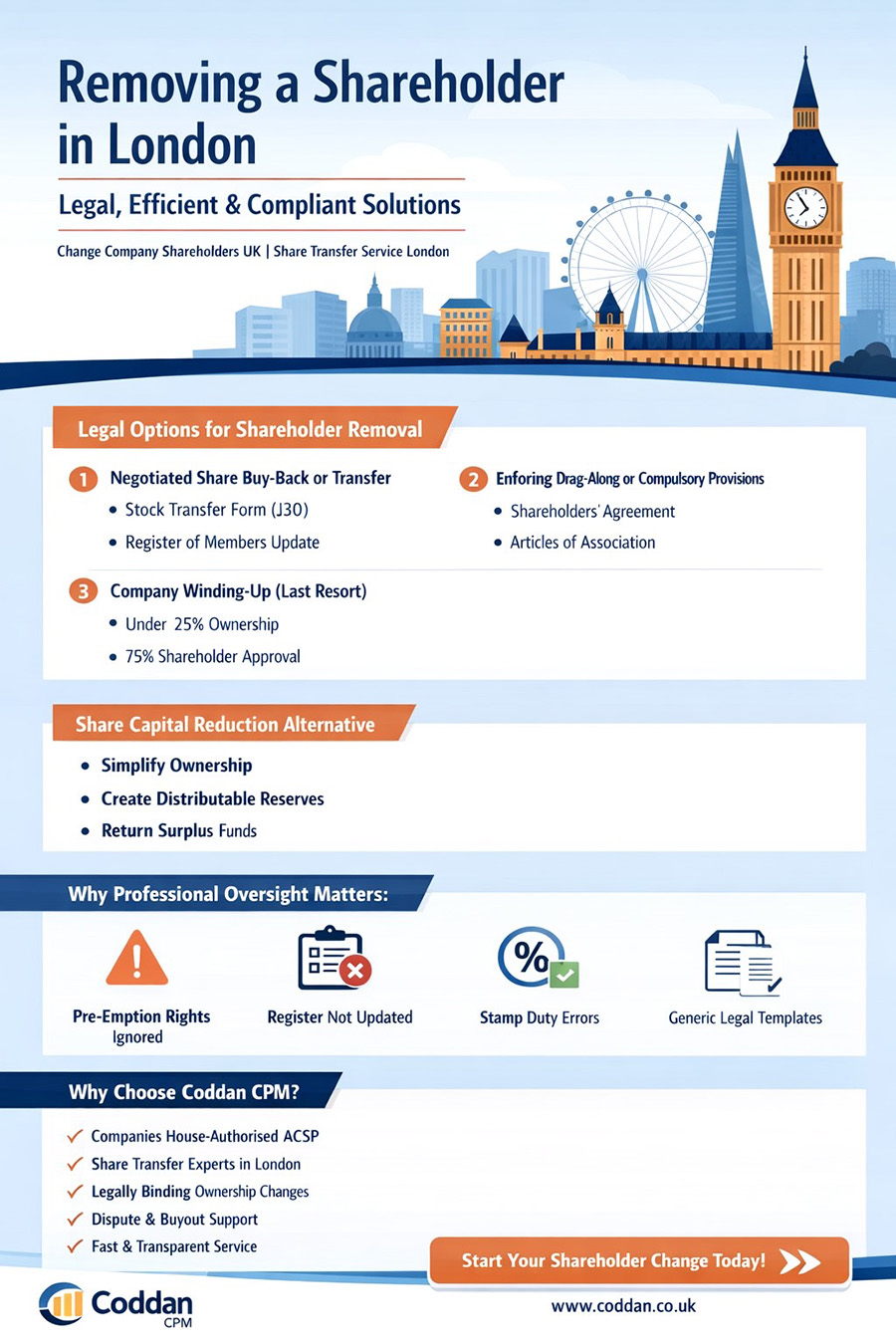
Removing a shareholder from a limited company is generally not straightforward and can be quite complex, particularly if the shareholder is unwilling to leave. It is not possible to simply delete a shareholder; their shares must be transferred, sold, or bought back.


Appointing a foreign or overseas shareholder to a UK limited company is a straightforward and well-established process. UK company law permits 100% foreign ownership, making the UK one of the most accessible jurisdictions globally for international investors, founders, and holding structures.

This flexibility allows overseas individuals and corporate entities to legally hold shares in UK companies without residency or nationality restrictions—an important advantage for global entrepreneurs looking to establish or expand their UK presence.

While the legal process itself is simple, appointing a foreign shareholder does require strict compliance with identification and anti-money laundering (AML) regulations. These checks are essential to maintain transparency and protect the integrity of the UK corporate system.

For overseas shareholders, AML and Know Your Customer (KYC) checks can be more detailed than for UK residents. The UK remains one of the most investor-friendly jurisdictions in the world. Appointing a foreign shareholder is not legally complex—but procedural accuracy and AML compliance are essential.

With the right preparation and professional oversight, overseas shareholders can be added efficiently, securely, and in full compliance—allowing businesses to benefit from global capital, expertise, and strategic growth opportunities.

Removing a foreign or overseas shareholder from a UK limited company can range from relatively straightforward to legally complex, depending on several critical factors. The key variables are whether the shareholder is willing to sell, the company’s Articles of Association and shareholders’ agreement, and whether the foreign shareholder holds UK property or other regulated assets through the company.

Removing a foreign shareholder from a UK limited company is not harder because they are foreign—it becomes complex due to consent, contractual rights, and structure, not nationality. Handled correctly, many overseas shareholder exits can be resolved efficiently and compliantly. Handled poorly, they can escalate into prolonged disputes.


Change Company Shareholders UK – Fast, Compliant Online Service in London.

Changing company shareholders in the UK requires precision, speed, and strict compliance with Companies House regulations. Coddan CPM, an Authorised Corporate Service Provider (ACSP), delivers a trusted share transfer service in London designed for startups, SMEs, investors, and international founders who need changes handled the first time correctly.

Our online shareholder change service enables UK private limited companies to transfer shares, issue new shares, or update ownership structures quickly—often within 24 hours to a few working days—using secure electronic filing rather than slow, error-prone postal submissions.

Expert Share Transfer Service London Businesses Trust.

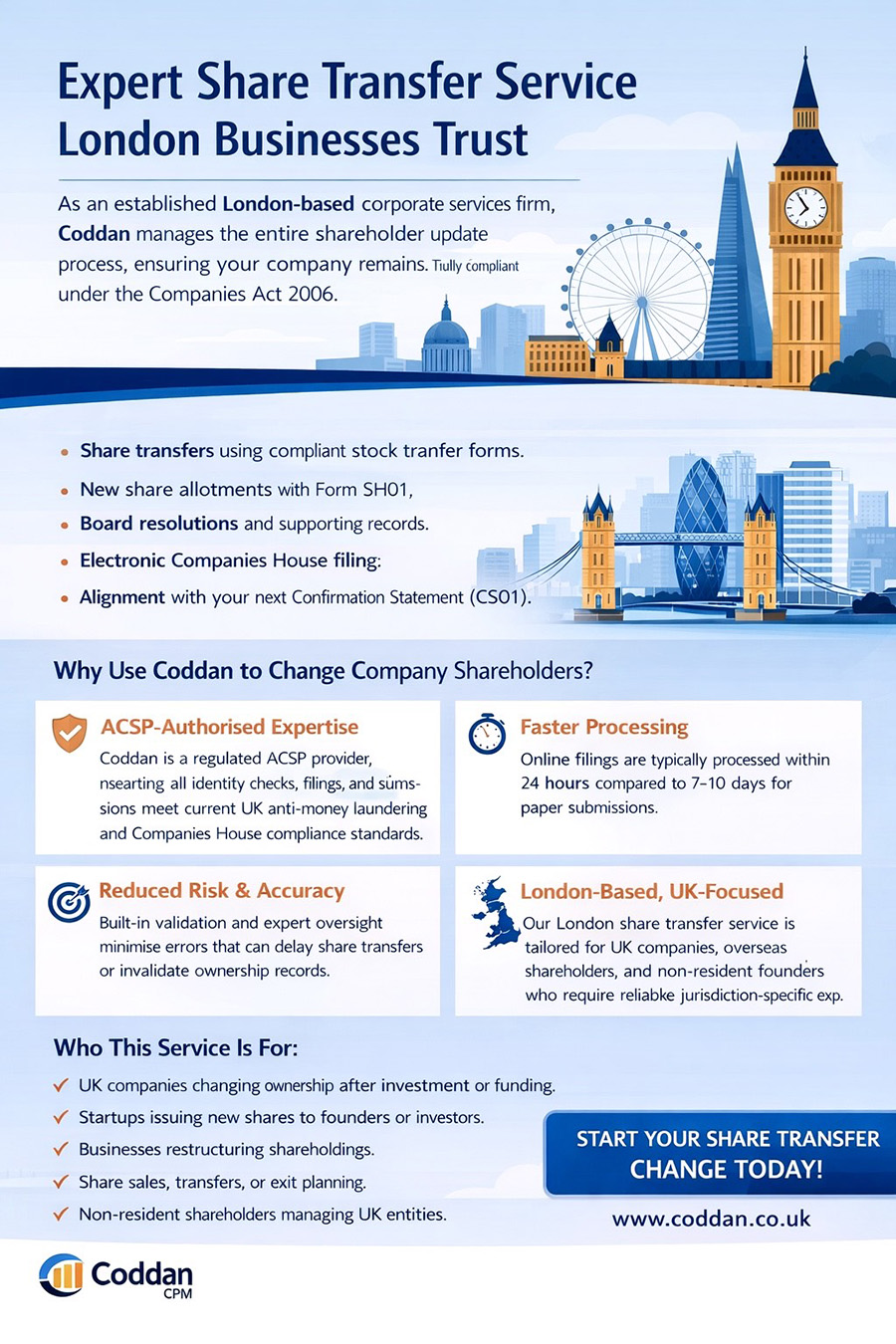
As an established London-based corporate services firm, Coddan manages the entire shareholder update process, ensuring your company remains fully compliant under the Companies Act 2006. We handle:

  • Share transfers using compliant stock transfer forms.
  • New share allotments with Form SH01 and Form SH02.
  • Board resolutions and supporting records.
  • Updates to the Register of Members.
  • Electronic Companies House filing.
  • Alignment with your next Confirmation Statement (CS01).

Every filing is reviewed by experienced company formation specialists to reduce rejection risk and ensure your statutory records are accurate and audit-ready.

Why Use Coddan to Change Company Shareholders?

ACSP-Authorised Expertise
Coddan is a regulated ACSP provider, meaning all identity checks, filings, and submissions meet current UK anti-money laundering and Companies House compliance standards.

Faster Processing
Online filings are typically processed within 24 hours, compared to 7–10 days for paper submissions.

Reduced Risk & Accuracy
Built-in validation and expert oversight minimise errors that can delay share transfers or invalidate ownership records.

London-Based, UK-Focused
Our London share transfer service is tailored for UK companies, overseas shareholders, and non-resident founders who require reliable, jurisdiction-specific expertise.

End-to-End Governance Support
We can combine shareholder changes with:

  • Director appointments or resignations.
  • PSC updates.
  • Registered office and service addresses.
  • Post-formation compliance support.

Who This Service Is For:

  • UK companies changing ownership after investment or funding.
  • Startups issuing new shares to founders or investors.
  • Businesses restructuring shareholdings.
  • Share sales, transfers, or exit planning.
  • Non-resident shareholders managing UK entities.
  • Trusted, Transparent, Fully Compliant.

With Coddan, you are working with a provider that demonstrates real-world experience, technical expertise, and regulatory authority. We do not offer legal advice, but we deliver procedurally accurate, compliance-led execution backed by years of hands-on corporate services experience.

Our professional service makes it simple to transfer the shares or allotment the shares in your private limited company. Whether you need to complete a stock transfer form for existing shares or issue new shares through an allotment, we’ve got the expertise to guide you through every step.
There are several key points to consider when removing a shareholder, including legal documentation, company articles review, and proper notification procedures—all areas where our specialists excel. We ensure the process is handled with precision and compliance to avoid future complications. When you need to transfer the shares to new investors or carefully navigate how to issue new shares through an allotment, our team provides the confidence and clarity you need. Don’t risk costly mistakes by going it alone—let our experts handle the paperwork while you focus on running your business.

Compliance expert services for stockholder designation and removal in London

Add, or change a stockholder with the help of our experts in London.

Image depicting the formal process of appointing and removing a company shareholder, with relevant documents. UK stockholder appointment and resignation services by Coddan.

Non-resident shareholders in the UK can update their shareholder information online, typically within 2 to 3 working days, with some updates possible in as little as 24 hours.
This efficient process allows individuals and businesses outside the UK to manage shareholder changes easily. Authorized specialist agents, such as Coddan CPM, provide expedited services through a user-friendly platform.
Key features include digital document signing for secure paperwork execution and provision of necessary share transfer forms (J30 or J10). Agents also facilitate updates to the statutory register, ensuring compliance with UK company law
The remote completion of the process eliminates the need for non-resident shareholders to travel to the UK, allowing for timely investment decisions while reducing hassle and travel costs.


Steps for Smooth Shareholder Transitions.

How to Navigate Shareholder Transitions Under UK Law

To ensure smooth shareholder transitions in private companies, it is essential to engage specialists who can effectively manage the legal, tax, and administrative tasks in accordance with the UK Companies Act 2006.

Coddan CPM is the UK firm and Authorised Corporate Service Provider (ACSP) that offers a variety of legal services in United Kingdom UK:
  • Appoint or resign a Shareholder with the help of our experts.
    • The "Joining" Paperwork: Drafting the Board Resolution to approve the new shareholder and issuing a Share Certificate.
    • The "Leaving" Paperwork: Drafting the J30 Stock Transfer Form (the "deed" of sale) and a Board Minute noting the transfer.
    • Statutory Compliance: Updating the internal Register of Members. Note: Updating Companies House is not enough; if your internal register isn't updated, the shareholder hasn't legally joined or left.
    • Stamp Duty Filing: If shares are sold for more than £1,000, the buyer must pay 0.5% Stamp Duty to HMRC. Expert services will handle the HMRC "Stamping" process, which is required before the company can legally register the new owner.
    • Capital Gains Tax (CGT) Advice: The "resigning" shareholder may owe tax on any profit made from the shares. Accountants provide "Valuation Services" to ensure the shares are sold at a "fair market value" to avoid HMRC penalties..

How to Ensure Compliance Changing a Shareholder.

How to Manage Shareholders with Ease and Accuracy

Under new UK laws (2025/2026), anyone becoming a Person with Significant Control (PSC)—usually someone owning more than 25% of shares—must have their identity verified by an Authorised Corporate Service Provider (ACSP) before the change is recorded at Companies House.

  • The Register of Members:
    In the UK, the Register of Members is the only definitive legal proof of ownership. Experts ensure this is updated immediately; if you only update Companies House and miss this internal book, the transfer may be legally invalid.
  • Allotment vs. Transfer:
    They determine if you need an allotment (creating brand-new shares via Form SH01) or a transfer (moving existing shares via a J30 Stock Transfer Form).
  • Verification (ACSP):
    As of 2026, if a new shareholder becomes a "Person with Significant Control" (usually 25%+), their identity must be verified by an Authorised Corporate Service Provider (ACSP) before filing.

How to Enhance Business Agility with Our Platform

With a professional interface designed for efficiency, you can complete the necessary processes swiftly and accurately. Say goodbye to complicated paperwork and lengthy procedures; our platform simplifies everything for you, allowing you to focus on what truly matters – growing your business.
Take control of your corporate ownership today and experience the convenience of seamless shareholder management. For personalised support, contact us at +44 (0) 207 935 5171 or info@coddan.co.uk. Let us help you enhance your business's agility and responsiveness in an ever-changing market.


A Practical Guide for Startups and Growing Businesses.

For UK startups and early-stage private limited companies, effective share management is essential for growth, investment readiness, and legal compliance. Whether you are changing company shareholders, issuing new shares, or restructuring ownership, every action must follow strict procedures under the Companies Act 2006.

This guide explains how share transfers, share allotments, shareholder replacements, and new shareholder additions work in a UK Ltd company—and how using an ACSP-authorised provider like Coddan helps ensure accuracy, speed, and compliance.

Understanding Shares and Shareholders in a UK Ltd Company.

Shares represent legal ownership in a private limited company. Shareholders may benefit through dividends, voting rights, and capital growth. However, any change to share ownership must be properly documented, approved, and recorded to remain valid.

Common shareholder changes include:

  1. Transferring shares to another person or entity.
  2. Issuing new shares to founders or investors.
  3. Replacing exiting shareholders.
  4. Restructuring ownership after funding rounds.

Failure to follow correct procedures can invalidate transfers, create disputes, or expose directors to compliance risks.

Share Transfer Process (Change Company Shareholders UK).

A share transfer occurs when existing shares move from one owner to another. This is common during exits, restructuring, or private sales.

Key steps include:

  1. Check the Articles of Association
    Many UK companies include restrictions such as director approval or pre-emption rights.
  2. Shareholder or Board Approval
    Consent may be required under a shareholders’ agreement or the company’s articles.
  3. Complete a Stock Transfer Form
    This records the transferor, transferee, number of shares, and consideration paid.
  4. Update the Register of Members
    The transfer is not legally effective until the internal register is updated.

Coddan’s share transfer service in London manages this entire process digitally, reducing errors and delays.

Share Allotment Process (Issuing New Shares UK).

Share allotment involves issuing new shares, commonly used for fundraising, founder equity, or employee incentives.

The process includes:

  • Board Resolution authorising the allotment.
  • Review of Pre-Emption Rights to protect existing shareholders.
  • Filing Form SH01/SH02 with Companies House.
  • Updating the Register of Members and PSC records.

Using an ACSP-authorised service provider ensures allotments are filed correctly and within statutory deadlines.

Adding or Replacing Shareholders.

Adding New Shareholders
New shareholders usually join via share allotment or share transfer. They must be correctly recorded and, where applicable, assessed for PSC (Person with Significant Control) status.

Replacing Existing Shareholders
Outgoing shareholders must have their shares transferred or redeemed in line with company rules. Clear documentation protects both the company and remaining owners.

Coddan provides end-to-end shareholder change services, including statutory register updates and Companies House alignment.

Why Use Coddan for Shareholder Changes?

  • ACSP-Authorised Provider –
    compliant with UK AML and Companies House standards.
  • London-Based Expertise –
    trusted by startups, SMEs, and international founders.
  • Fast Online Filing –
    often processed within 24 hours to a few working days.
  • Accuracy & Risk Reduction –
    expert review before submission.
  • Integrated Services –
    directors, PSC updates, registered office, and post-formation support.

Conclusion: Build a Compliant Ownership Structure from Day One.

For startups and growing UK companies, share management is not just administrative—it is strategic. Properly handling share transfers, allotments, and shareholder changes protects your business, supports investment, and ensures long-term scalability.
By working with Coddan, an established ACSP-authorised corporate services provider in London, you gain confidence that every shareholder change is handled professionally, compliantly, and efficiently—so you can focus on growing your business in the United Kingdom (UK).

Adding or Removing a Shareholder in a UK Private Limited Company
The process of adding or removing a shareholder in a UK private limited company is administratively straightforward, but it must follow strict legal and governance requirements to remain valid and compliant.

Updating the Register of Members
The first and most critical step is updating the company’s Register of Members. This statutory register records the company’s ownership structure and determines who legally holds shares. A share transfer or allotment is not legally effective until this register is updated.

Issuing Share Certificates
Once the change is completed, new share certificates must be issued to reflect the updated shareholdings. These certificates act as formal evidence of ownership and are essential for internal records, future transactions, and investor due diligence.

Notifying Companies House
Companies must ensure that shareholder changes are reflected in the Confirmation Statement (CS01) filed with Companies House. While some changes can be reported immediately, all updates must appear on the next confirmation statement to keep the public register accurate and compliant.

Compliance with Articles and Shareholders’ Agreements
All shareholder changes must comply with the company’s Articles of Association and any Shareholders’ Agreement. These documents often impose rules such as:

  • Director or shareholder approval.
  • Pre-emption rights.

Restrictions on transfers to third parties
Ignoring these provisions can invalidate the transaction and expose the company to disputes.

Board Approval and Governance
In many cases, board approval is required before a share transfer or allotment can proceed. This is especially important where governance controls exist or where shareholder relationships are sensitive. Disputes between shareholders can significantly delay or complicate the process.

Financial and Tax Considerations
Share transfers may trigger stamp duty if consideration exceeds the applicable threshold. Companies must assess this early to avoid compliance issues or penalties.

Key Takeaway
While changing company shareholders in the UK is a common corporate action, it involves multiple interconnected legal, administrative, and governance steps. Proper execution protects the company’s legal standing, reduces dispute risk, and ensures compliance with Companies House requirements.

Using an experienced UK corporate services provider helps ensure that share transfers, shareholder removals, and ownership updates are handled accurately, efficiently, and in full compliance—allowing directors and founders to focus on growing the business.

Step-by-Step Checklist: Changing Company Shareholders in the UK.

Use this checklist to ensure your share transfer or shareholder change is completed correctly and remains fully compliant.

  1. Step 1: Review Company Documents
    Check the Articles of Association and any Shareholders’ Agreement for:
    • Transfer restrictions.
    • Pre-emption rights.
    • Required approvals.
    • Ignoring these can invalidate the transaction.
  2. Step 2: Obtain Required Approvals
    Depending on your documents, approval may be needed from:
    • The board of directors.
    • Existing shareholders.
    • This is usually recorded via a board resolution or written consent.
  3. Step 3: Complete the Share Transfer or Allotment
    • For transfers: complete a Stock Transfer Form.
    • For new shares: approve and issue an allotment of shares.
    • Ensure details (names, share class, consideration) are accurate.
  4. Step 4: Update the Register of Members
    • The Register of Members must be updated immediately.
    • This step legally completes the shareholder change.
  5. Step 5: Issue New Share Certificates
    New or revised share certificates should be issued to reflect:
    • Updated ownership.
    • Share class and number.
    • These are essential for audits, investors, and future transactions.
  6. Step 6: Assess Stamp Duty (If Applicable)
    Stamp duty may apply if shares are transferred for value above the threshold.
    Failure to assess this early can delay completion.
  7. Step 7: Notify Companies House
    Ensure the change is reflected in the next Confirmation Statement (CS01) or filed promptly where required to keep the public register accurate.

Coddan CPM offers professional services for adding or removing shareholders from your limited company with minimal hassle. Whether you need to transfer the shares between existing members or issue new shares through an allotment, our experts handle the paperwork efficiently. We’ll complete a stock transfer form for existing shares and manage all documentation required when you allotment the shares to new investors.
There are key points to consider when removing a shareholder, including valuation, taxation, and legal implications—all areas where our specialists provide crucial guidance. Don’t risk costly mistakes when you transfer the shares or issue new shares through an allotment; trust our experienced team to ensure compliance with Companies House requirements. We’ve streamlined the process to save you time while protecting your company’s interests.


Managing Company Shareholdings in the UK: A Practical Guide for Ltd Companies.

Managing a company’s shareholding is a core element of corporate governance in the UK, particularly for private limited companies (Ltd). Whether you need to add a shareholder, remove a shareholder, transfer shares, or update shareholder details at Companies House, strict legal and administrative procedures must be followed to remain compliant with the Companies Act 2006.

This guide provides a clear, step-by-step overview of how UK companies can manage shareholdings efficiently—while protecting both the business and its shareholders.

Adding Company Shareholders in a UK Private Limited Company.

Adding shareholders is common for startups and growing businesses seeking investment, restructuring ownership, or onboarding strategic partners. In the UK, shareholders can be added after incorporation using one of two legally recognised methods.

  1. Transferring Existing Shares (Share Transfer)
    A share transfer occurs when an existing shareholder sells or transfers shares to another person or entity. Key steps include:
    • Completing a Stock Transfer Form, including:
    • Company name.
    • Share class and number.
    • Consideration paid (if applicable).
    • Details of the transferor and transferee.
    • Reviewing the Articles of Association and any Shareholders’ Agreement for transfer restrictions or consent requirements.
    • Assessing whether Stamp Duty applies (typically where consideration exceeds the HMRC threshold).
    • Updating the Register of Members, which legally completes the transfer.
    • For businesses seeking a share transfer service in London, using an ACSP-regulated provider ensures documents are prepared accurately and processed without delay.
  2. Issuing New Shares (Allotment of Shares)
    Issuing new shares—known as an allotment of shares—is commonly used to raise capital or bring in new shareholders without transferring existing ownership. The process includes:
    • Board or shareholder approval (as required by the Articles).
    • Considering and addressing pre-emption rights, which give existing shareholders first refusal.
    • Filing Form SH01 (Return of Allotment) with Companies House within one month.
    • Updating statutory registers and issuing new share certificates.
    • Issuing new shares can dilute existing ownership, so transparency and proper approvals are essential.

Issuance of New Shares: Key Compliance Considerations. When issuing new shares in a UK company, directors must ensure:

  • Pre-emption rights are waived where applicable.
  • Board resolutions are properly recorded.
  • Form SH01 is filed accurately and on time.
  • Internal records reflect the new ownership structure.
  • Failure to comply can result in penalties or complications during fundraising, audits, or exit transactions.

How Many Shares Can a Shareholder Hold in a UK Company?
There is no statutory limit on the number of shares a shareholder can hold in a UK private limited company. Many startups initially issue:
1 share (100% ownership), or
100 or 1,000 shares, allowing easier division of equity later.

Each share represents ownership and potential liability, making careful structuring important as the company grows.

Removing a Shareholder from a UK Company
A shareholder can exit a company voluntarily or due to strategic restructuring. Removal typically occurs through:

  • Selling or transferring shares to another party.
  • The company or existing shareholders buying back shares (subject to strict rules).

Once shares are transferred:

  • The Register of Members must be updated immediately.
  • Share certificates must be reissued.
  • Companies House records must reflect the change via the Confirmation Statement (CS01).
  • Professional handling is recommended where disputes or complex agreements exist.

Updating Shareholder Information at Companies House
UK companies are legally required to keep shareholder information accurate and up to date. Updates must include:

  • Changes to shareholders.
  • Share classes or numbers.
  • Transfers or allotments.

These updates are normally submitted via the Confirmation Statement, although best practice is to update records promptly after any change. Responsibility for accuracy lies with the directors or company secretary.

Coddan offers a comprehensive Shareholder Appointment & Removal Bundle designed specifically for UK private limited companies that need to change company shareholders efficiently and compliantly. This all-in-one service is ideal for London-based businesses, startups, and overseas founders who require a reliable share transfer service in London without unnecessary legal risk or administrative burden.
Our bundle covers the full lifecycle of shareholder changes, ensuring that both the appointment of new shareholders and the removal or exit of existing shareholders are handled correctly under the Companies Act 2006. Every step is managed with precision, from preparing compliant Stock Transfer Forms (J30) or share allotment documentation, to updating the statutory Register of Members, issuing share certificates, and aligning filings with Companies House and your Confirmation Statement (CS01).
As a Companies House–authorised ACSP, Coddan applies strict compliance controls, identity verification standards, and procedural accuracy to ensure shareholder changes are legally effective, not merely filed. Our experienced corporate services specialists review every submission to minimise rejection risk, prevent governance errors, and protect your company’s ownership structure.
By choosing Coddan’s Shareholder Appointment & Removal Bundle, you gain a fast, secure, and fully compliant solution—allowing you to manage shareholder changes with confidence while staying focused on growing your business. Change company shareholders in the UK the right way—with a trusted London ACSP.


Change or Remove Shareholders in a UK Private Limited Company.

Managing shareholding in a UK limited company can be complex, especially when a shareholder needs to exit or new shareholders are being added. Whether you’re dealing with a voluntary departure, a buyout, or replacing a shareholder, it’s critical to follow the correct legal and administrative procedures to maintain compliance and protect your company.

At Coddan CPM, we provide expert share transfer and shareholder removal services in the UK, ensuring every step—from updating the register of members to filing with Companies House—is handled efficiently and accurately.

Why Shareholder Changes Are Critical
Changes in shareholding occur for a variety of reasons:

  • Voluntary exit:
    Shareholders may wish to sell their shares to raise personal funds or pursue other investments.
  • Conflict resolution:
    Disputes between shareholders may necessitate the removal or buyout of a shareholder to protect business operations.
  • Corporate restructuring:
    Aligning the ownership structure with strategic goals may require issuing new shares or transferring existing shares.
  • Death or incapacity:
    Shares may need to be legally transferred to beneficiaries or remaining shareholders.

Understanding the difference between legal ownership, statutory obligations, and shareholders’ agreements is crucial. A failure to follow these procedures can lead to invalid transfers, disputes, or penalties from HMRC and Companies House.

Methods to Remove or Replace a Shareholder

  1. Transfer of Shares.
    • Voluntary departures usually involve transferring shares to an existing or new shareholder. Coddan handles:
    • Completing the Stock Transfer Form.
    • Assessing Stamp Duty obligations (0.5% for transfers over £1,000).
    • Issuing new share certificates.
    • Updating the Register of Members.
    • Notifying Companies House.
    • For share sales, we also guide you on capital gains tax implications to avoid unexpected liabilities.
  2. Buying Out Minority Shareholders.
    • When disputes arise, majority shareholders may seek to buy out minority shareholders. This requires:
    • Reviewing the Articles of Association for forced sale provisions.
    • Engaging in negotiation if forced sale clauses are absent.
    • Drafting agreements to determine fair value pricing.
    • Minimising disputes with legal expertise.
    • Coddan provides professional guidance to ensure a smooth, legally compliant buyout, reducing the risk of costly litigation.
  3. Voluntary Liquidation as a Last Resort
    In rare cases, a majority of shareholders (holding 75% or more) may consider members’ voluntary liquidation to restructure ownership. While possible, this is a drastic measure and is only recommended after exploring all other options.
  4. Death of a Shareholder
    • Coddan assists in handling share transfers when a shareholder passes away, ensuring:
    • Compliance with Articles of Association or shareholders’ agreements.
    • Correct execution of Stock Transfer Forms.
    • Smooth transition of shares to beneficiaries or remaining shareholders.
  5. Shareholders Who Are Also Directors or Employees
    Many shareholders hold multiple roles in the company. Removing them may require separate processes:
    • Director removal (following Companies Act 2006 and company articles).
    • Termination of employment (if applicable).
    • Updating statutory registers.
    • Coddan ensures all associated roles are addressed simultaneously, avoiding operational disruption or legal challenges.

Why Choose Coddan CPM for Shareholder Changes
Changing or removing shareholders involves legal, financial, and procedural complexities. Coddan’s services provide:

  • Full compliance with UK company law and Companies House filings.
  • Preparation of all documents, including Stock Transfer Forms, share certificates, and deeds of adherence.
  • Expert advice on Stamp Duty, capital gains, pre-emption rights, and shareholders’ agreements.
  • Fast, efficient service to minimise business disruption.
  • Protection for directors and remaining shareholders.

With Coddan, you can manage shareholder changes confidently, knowing all regulatory obligations are met and your company’s governance is secure.

Get Started Today
Ensure your shareholder changes are legally compliant, properly documented, and hassle-free. Contact Coddan CPM to:

  • Add or remove shareholders.
  • Transfer shares or issue new shares.
  • Handle buyouts or voluntary exits.
  • Update statutory registers and Companies House filings.

Secure your company’s governance and shareholder compliance with Coddan CPM — the trusted ACSP provider for UK limited companies.

What Happens If a Shareholder Dies?
When a shareholder dies:

  • Their shares pass to their estate.
  • Executors manage the shares until transferred to beneficiaries.

Many companies include clauses giving existing shareholders the right of first refusal, helping maintain control and continuity.

  • Proper legal and administrative handling is essential to avoid disputes or invalid transfers.
  • Protecting the Company and Its Shareholders.
  • To maintain stability and governance, UK companies often rely on:
  • Pre-emption rights.
  • Share transfer restrictions.
  • Clearly drafted Articles of Association.
  • Shareholders’ Agreements.

These mechanisms protect ownership balance and reduce the risk of hostile or unintended share transfers.

Why Use an ACSP-Regulated Shareholder Change Service?
Using an Authorised Corporate Service Provider (ACSP) such as Coddan provides:

  • End-to-end handling of share transfers and allotments.
  • Accurate statutory register updates.
  • Digital Companies House filings.
  • Compliance with UK anti-money laundering and identity verification rules.
  • Reduced risk of rejection, delays, or future disputes.

For businesses searching for change company shareholders UK or share transfer service London, an ACSP-led service ensures speed, accuracy, and regulatory confidence.


Fast, Compliant Share Transfers & Allotments in London.

Managing company shareholders in the UK doesn’t need to be complex or time-consuming. Coddan provides a fully managed shareholder change service for UK private limited companies, helping you add, remove, or replace shareholders quickly, accurately, and in full compliance with the UK Companies Act 2006.

Whether you’re completing a share transfer, issuing new shares, or restructuring ownership, our London-based ACSP-regulated team handles everything—digitally, securely, and efficiently.

Introducing our streamlined service designed specifically for limited company shareholders! With our fast and simple solutions, making changes, amendments, or adjustments to your shareholder list has never been easier. Whether you’re looking to add or remove a shareholder, or simply modify existing details, we provide an efficient, professional approach to ensure your company stays compliant and up to date.

Our professional dedicated team is here to guide you through every step, ensuring a smooth process with quick turnaround times. Say goodbye to the hassle of paperwork and confusion! Experience the peace of mind that comes from knowing your company’s records are in expert hands.

Get started today and let us help you assist your shareholders’ needs with enthusiasm and professionalism. For more information, contact us at 033 0808 0089, don’t let shareholder changes be a daunting task – we’re here to make it seamless for you!

Our Shareholder Change Services
We support startups, SMEs, foreign founders, and professional advisers with all types of UK shareholding changes, including:

  • Change company shareholders UK.
  • Share transfer service London.
  • Issue new shares (SH01 filing).
  • Add or remove shareholders.
  • Update Register of Members.
  • Companies House shareholder updates.
  • PSC (Person with Significant Control) changes.

All services are delivered paperless, with expert validation to reduce delays or rejections.

How to Add or Remove a Shareholder (Step-by-Step)

  1. Confirm the Method of Change.
    • Shareholder changes are completed in one of two ways:
    • Transfer existing shares (sale or gift).
    • Issue new shares (allotment).
    • We review your Articles of Association and any Shareholders’ Agreement to confirm the correct route.
  2. Prepare the Legal Documents.
    We prepare all required documentation, including:
    • Stock Transfer Forms.
    • Board Resolutions.
    • Share Certificates.
    • SH01 (Return of Allotment) where applicable.
    • The SH02 Form (Notice of consolidation, sub-division, redemption of shares, or re-conversion of stock into shares).
    • If stamp duty applies, we guide you on HMRC requirements.
  3. Update Statutory Registers.
    Coddan updates your:
    • Register of Members.
    • Shareholder records.
    • PSC register, if thresholds change.
    • These records are legally required and must remain accurate at all times.
  4. Notify Companies House.
    Changes are filed digitally and reflected via:
    • Immediate electronic filings, or
    • The next Confirmation Statement (CS01)

Our fast-track London service aims to complete most updates within 24 hours to 3 working days.

Why Use Coddan for Share Transfers & Shareholder Changes?

  • ACSP-Regulated Provider
    Coddan is an Authorised Corporate Service Provider (ACSP), ensuring:
    1. Verified identities.
    2. Anti-money laundering compliance.
    3. Trusted Companies House submissions.
  • London-Based Expertise
    We specialise in UK company administration, supporting:
    1. London startups.
    2. Overseas founders.
    3. Investment-ready businesses.
  • Accuracy-First Approach.
    Built-in checks reduce:
    1. Filing errors.
    2. Rejections.
    3. Costly corrections later.
  • End-to-End Management.
    From documents to filings, we handle everything, saving you time and risk.

Get Started Today
Whether you need to change company shareholders in the UK, complete a share transfer in London, or issue new shares for investment, Coddan delivers a fast, compliant, and cost-effective solution.

  • Start your shareholder change now.
  • Speak to a London company formation specialist.
  • Protect your records. Stay compliant. Move faster.

Fast, Compliant Share Transfers & Allotments with Coddan CPM (ACSP)
Changing company shareholders in the UK must be handled accurately to remain compliant with Companies House and the Companies Act 2006. Whether you are adding a new shareholder, removing an existing one, or restructuring ownership, Coddan CPM provides a fully managed, ACSP-regulated shareholder change service—quick, secure, and legally compliant.

As a trusted UK corporate services provider, we manage the entire process on your behalf, ensuring your company’s ownership records are updated correctly and without delay.

Our Shareholder Change Services
We support private limited companies (Ltd) and unlimited companies across the UK with:

  1. Change company shareholders UK.
  2. Share transfer services (London & nationwide).
  3. Issue new shares (SH01 filings).
  4. Add or remove shareholders.
  5. Update Register of Members.
  6. Companies House Confirmation Statement (CS01) updates.
  7. PSC (Person with Significant Control) updates where required.

All filings are completed electronically, reducing errors and speeding up approval.

How We Change Company Shareholders

  1. Review Your Company Structure
    We check your Articles of Association and any shareholder agreements to confirm transfer or allotment permissions.
  2. Prepare Legal Documentation
    We draft and process:
    • Stock transfer forms (for share sales or transfers).
    • Board resolutions.
    • SH01 – Return of Allotment (for new shares).
  3. Update Statutory Registers
    Your Register of Members and internal company records are updated in line with UK law.
  4. File with Companies House
    We update shareholder details via your Confirmation Statement or immediate electronic filing—keeping the public register accurate and compliant.

Why Choose Coddan CPM?

  • ACSP-Authorised Provider –
    Trusted, regulated, and compliant.
  • Fast Turnaround –
    Most changes processed within 24–48 hours.
  • End-to-End Management –
    No paperwork, no confusion.
  • UK & London Expertise –
    Ideal for startups, investors, and advisers.
  • Clear Pricing –
    No hidden costs.

Our service is designed for business owners who want certainty, speed, and professional execution. Who This Service Is For:

  • UK startups raising investment.
  • Founders restructuring ownership.
  • Shareholder exits or replacements.
  • Corporate reorganisations.
  • Accountants, solicitors, and advisers acting for clients.
  • Overseas entrepreneurs with UK companies.

Change Company Shareholders with Confidence
Incorrect or delayed shareholder updates can cause compliance issues, transaction delays, and legal risk. With Coddan CPM, every shareholder change is handled professionally—ensuring your company remains compliant, transparent, and investment-ready.

Changing Shareholders in a UK Private Company: The Critical Details Most Businesses Miss.

Changing shareholders in a UK private limited company is often described as “straightforward—but this is misleading. While Companies House filings are important, they do not, on their own, make a share transfer legally effective. Many compliance failures occur because key statutory and contractual steps are overlooked.

If you are adding, removing, or replacing shareholders, understanding the distinction between legal ownership, statutory records, and contractual obligations is essential to avoid invalid transfers, disputes, or HMRC penalties.

The Most Overlooked Legal Requirements When Changing Shareholders

  1. Legal Ownership vs Companies House Filing
    Updating Companies House is not enough.
    A share transfer becomes legally effective only when the company’s statutory Register of Members is updated. Companies House is a public record—not proof of ownership.
    If the register is not updated immediately, the transfer may be legally invalid, even if Companies House has been notified.
  2. Mandatory Deed of Adherence (Often Missed)
    When a new shareholder joins, they must sign a Deed of Adherence to the existing shareholders’ agreement. Without this:
    • The new shareholder is not bound by key provisions.
    • Restrictions, voting rights, and exit clauses may be unenforceable.
    • The agreement may be partially undermined.
    • This is one of the most common—and costly—oversights.
  3. Pre-emption Rights Must Be Checked First
    Most UK companies have pre-emption rights embedded in their:
    • Articles of Association.
    • Shareholders’ Agreement.
    • These rights give existing shareholders first refusal before shares can be sold or issued to an outside party. Ignoring them can invalidate the transfer and expose directors to claims.
  4. Stamp Duty Is the Buyer’s Responsibility
    If shares are transferred for more than £1,000:
    • Stamp Duty (0.5%) is payable by the buyer.
    • The Stock Transfer Form must be submitted to HMRC.
    • Failure to do so can block future transactions (including exits or fundraising).
    • This step is frequently missed in informal transfers.
  5. Shareholder ≠ Director ≠ Employee
    Removing a shareholder does not automatically:
    • Remove them as a director.
    • Terminate employment.
    • Cancel service agreements.
    • Each role requires separate legal action, filings, and documentation. Confusing these roles is a common governance error.
  6. Strict and Different Filing Deadlines
    Different changes have different statutory deadlines:
    • PSC changes: within 14 days.
    • Articles of Association changes: within 15 days.
    • Share allotments (SH01): within 1 month.
    • Confirmation Statement updates: annually (or earlier if advised).
    • Missing deadlines can result in penalties and compliance flags.
  7. You Cannot Simply Remove a Missing Shareholder
    If a shareholder cannot be located, you cannot bypass them.

Special statutory procedures apply, often involving:

  • Formal notices.
  • Gazette publications.
  • Extended timelines.
  • Court involvement in some cases.
  • This is a high-risk area requiring specialist handling.

Why Companies Add or Change Shareholders
Businesses change ownership structures for many reasons, including:

  • Raising investment (e.g. angel or venture capital).
  • Founder exits or retirement.
  • Employee share schemes.
  • Strategic restructuring.
  • Succession planning.

Whether you are adding one investor or implementing a large employee ownership structure, the same legal principles apply.

How to Add a New Shareholder: The Two Legal Routes

Option 1: Issuing New Shares (Allotment). Common when raising capital.

Key steps include:

  • Board or shareholder resolution.
  • Checking and waiving pre-emption rights (if required).
  • Filing Form SH01.
  • Updating the Register of Members.
  • Issuing share certificates.
  • Updating PSC records (if over 25%).
  • Issuing new shares dilutes existing shareholders unless addressed.

Option 2: Transferring Existing Shares. Used when a shareholder exits or reallocates ownership.

Required steps:

  • Stock Transfer Form completion.
  • Stamp Duty assessment (if applicable).
  • Board approval (if required).
  • Register of Members update.
  • New share certificate issuance.
  • Deed of Adherence signed by the new shareholder.
  • Protecting the Company and Its Shareholders.

Well-drafted Articles of Association and shareholders’ agreements are critical. These typically include:

  • Pre-emption rights.
  • Transfer restrictions.
  • Drag-along and tag-along clauses.
  • Exit provisions.
  • Dispute resolution mechanisms.

Ignoring these documents is the fastest way to create disputes or invalidate a transaction.

Why Professional Handling Matters
While changing shareholders may appear administrative, errors can invalidate ownership, trigger disputes, or block future funding or exits. Using a specialist UK provider ensures:

  • Legal ownership is correctly transferred.
  • Statutory registers are updated immediately.
  • HMRC and Companies House compliance is maintained.
  • Shareholder agreements remain enforceable.
  • Directors meet their fiduciary duties.

Final Thought
Whether you started as a solo founder or a small team, shareholder changes are a natural part of business growth. The key is ensuring every step is legally sound—not just visible on Companies House.

Handled properly, shareholder changes strengthen your company. Handled incorrectly, they create long-term risk.


Change Company Shareholders UK – Specialist Share Allotments NS Shares Transfer Service in London.

Changing company shareholders in the UK is not just an administrative update — it is a legal transfer of ownership that must be handled correctly to be valid. Coddan provides a fully managed share transfer service in London, helping UK private limited companies add, remove, or replace shareholders with absolute compliance and legal certainty.

Whether you are transferring shares between founders, bringing in an investor, or removing a shareholder as part of a restructuring, Coddan ensures the change is legally effective, properly documented, and correctly reported.

London-Based Share Transfer Experts for UK Limited Companies
As a UK Authorised Corporate Service Provider (ACSP), Coddan acts as a trusted intermediary between your company, Companies House, and HMRC. Our London-based share transfer service is designed for:

  • Founder-led businesses and startups.
  • Owner-managed UK limited companies.
  • Overseas shareholders in UK companies.
  • Investment-led share changes.
  • Shareholder exits and buyouts.

We do not rely on automated filings alone. Every share transfer is reviewed against the company’s Articles of Association, existing shareholders’ agreements, and statutory obligations to ensure nothing is missed.

What Our Share Transfer Service in London Covers
Coddan’s share transfer service is end-to-end. We handle everything required to change company shareholders in the UK, including:

  1. Reviewing Articles of Association and transfer restrictions.
  2. Checking and applying pre-emption rights.
  3. Preparing Stock Transfer Forms (J30).
  4. Advising on Stamp Duty and HMRC submission (where applicable).
  5. Updating the statutory register of members (the legally binding step).
  6. Issuing share certificates.
  7. Filing Companies House updates via the Confirmation Statement.
  8. PSC updates where control thresholds are crossed.
  9. Deeds of Adherence for new shareholders.

This approach ensures the transfer is valid not only today, but during future due diligence, investment rounds, or exits.

Changing Company Shareholders in the UK: What Most Services Get Wrong
Many providers advertise change company shareholders UK but only update Companies House. This is not sufficient.

A share transfer is only legally effective once the register of members is updated. If this step is missed, the ownership change may be invalid — even if Companies House shows the update. Coddan’s process prioritises:

  • Legal ownership first.
  • Registry updates second.
  • Public filings last.

This compliance-first sequencing is why our share transfer service is relied upon by businesses that cannot afford mistakes.

Adding or Removing Shareholders – UK Compliance Made Simple
You may need to change company shareholders in the UK because:

  • A founder is exiting the business.
  • An investor is joining.
  • Shares are being transferred between existing shareholders.
  • A minority shareholder is being bought out.
  • A shareholder has passed away.

Each scenario carries different legal, tax, and procedural requirements. Coddan identifies the correct route — issuing new shares or transferring existing ones — and ensures the correct filings and internal updates are completed.

Share Transfers in London for UK and Overseas Shareholders
Coddan regularly manages share transfers involving non-UK resident shareholders, ensuring compliance with UK company law while accounting for cross-border considerations. If you operate a UK limited company but are based overseas, our London share transfer service provides:

  • Clear guidance.
  • Secure identity verification (ACSP-compliant).
  • UK-based accountability.
  • Documentation suitable for banks, investors, and advisors.

Why Choose Coddan for Share Transfers and Shareholder Changes?

  1. ACSP-regulated UK provider.
  2. London-based expertise with national coverage.
  3. Proven experience across thousands of UK companies.
  4. Compliance-led, not automation-led.
  5. Clear pricing and no hidden steps.
  6. Suitable for future fundraising, exits, and audits.

We do not simply “file forms”. We make sure the ownership change stands up legally.

Ready to Change Company Shareholders in the UK?
If you need a reliable share transfer service in London, Coddan can handle the entire process — quickly, compliantly, and correctly. We’ll confirm:

  • Whether Stamp Duty applies.
  • Whether pre-emption rights must be followed.
  • Whether PSC thresholds are triggered.
  • Whether additional documentation is required.

Speak to Coddan today to change company shareholders in the UK with confidence — and without costly mistakes.

Several London-based, Companies House-authorised agents, including Coddan CPM, provide fast, cost-effective solutions to change company shareholders in the UK. These services typically involve the lawful appointment or removal of shareholders through a share transfer, using a Stock Transfer Form (J30), alongside the immediate update of the company’s statutory register of members—the step that makes the transfer legally binding under UK company law.

For straightforward cases, such as a voluntary shareholder exit or the introduction of a new investor, a professional share transfer service in London will manage the entire process end to end. This includes preparing transfer documentation, issuing new share certificates, checking Articles of Association for restrictions, and ensuring Companies House records are updated correctly via the Confirmation Statement.

However, not all shareholder removals are simple. Where a shareholder refuses to sell, additional legal considerations arise. In these situations, companies may need to explore negotiated buyouts based on fair market value, often guided by provisions in the Articles of Association or any existing shareholders’ agreement. If the departing shareholder holds a minority stake below 25%, and no other route is available, majority shareholders may—subject to legal advice—consider more drastic restructuring options, including a members’ voluntary liquidation.

Coddan CPM’s approach goes beyond basic filings. As a UK Authorised Corporate Service Provider (ACSP), Coddan ensures that every shareholder change is handled with full legal accuracy, protecting the company from future disputes, investor due diligence issues, or Companies House compliance risks. This compliance-first methodology is particularly important for London-based startups, owner-managed businesses, and companies preparing for funding, exit, or restructuring.London-based, Companies House-authorised agents.


How to Legally Appoint an Pvt Ltd Company Member.

How to Simplify Your Shareholder Appointment in London

Take control of your company's shares; find out how to add or remove shareholders and complete stock transfers or issue new shares with our expert tips.

Need to manage shareholders? Coddan, a London-based agent, provides quick and cost-effective services for share transfers and allotments. Get started now!

Coddan specializes in efficient, low-cost services for appointing and removing shareholders, share transfers, and allotments—trust our London expertise!

Coddan simplifies the transfer of shares—trust us for Stock Transfer Forms, board minutes, and seamless updates to your Register of Members.

Coddan provides a complete Transfer of Shares service, including Stock Transfer Forms and board minutes, ensuring your Register of Members is updated.

Coddan offers efficient corporate services, specializing in quick online shareholder replacements and changes with a turnaround of just 24 hours to 2 days.

Coddan simplifies corporate services with fast online shareholder changes and replacements, ensuring a quick turnaround of 24 hours to 2 days.
Appointing or removing a company stockholder is hassle-free with Coddan ACSP Formations; we take care of all the details and inform Companies House for you

Trust Coddan ACSP Formations to simplify your company stack-holder changes; we manage the paperwork and liaise with Companies House, making it effortless for you.

Simplify the process of appointing or removing a company director with Coddan ACSP Formations; we handle the paperwork and notify Companies House for you.

Update your ownership details promptly with a voluntary confirmation statement; prove your ownership to banks before the next annual statement.

Make ownership changes public instantly with a voluntary confirmation statement; essential for proving ownership to banks before the annual update.

Key Takeaway

Changing company shareholders in the UK means legally transferring ownership of shares in a limited company. This can involve:
  • Adding a new shareholder.
  • Removing an existing shareholder.
  • Transferring shares between current owners.
  • Issuing new shares (allotment).
Crucially, this is not just a Companies House update. The change only becomes legally effective once the statutory Register of Members is updated.
No.
This is one of the most common and costly mistakes UK companies make.
  • Companies House records are declarative.
  • Legal ownership changes only take effect when the company’s internal Register of Members is updated.
Coddan CPM ensures both are handled correctly, so your share transfer is legally binding, not just visible online.
A shareholder cannot simply be “removed”. Their shares must be:
  • Sold or transferred to another person, or
  • Bought back by the company (subject to strict rules).
This is typically done using a Stock Transfer Form (J30), followed by updates to statutory registers and Companies House filings.
If the shareholder refuses to sell, legal options depend on:
  • The Articles of Association.
  • Any shareholders’ agreement.
  • Whether compulsory transfer provisions exist.
Coddan CPM can guide you through both straightforward and complex removals.
No — they are completely different legal processes.
  • Removing a director is a statutory procedure (TM01).
  • Removing a shareholder requires a transfer of ownership.
Even if the same person holds both roles, removing them as a director does not remove their shares. This distinction is critical for compliance, investment readiness, and dispute prevention.
Depending on the scenario, documents may include:
  • Stock Transfer Form (J30).
  • Share certificates.
  • Register of Members update.
  • Board resolutions.
  • Deed of Adherence to shareholders’ agreement.
  • SH01 (if issuing new shares).
  • Confirmation Statement update.
As a Companies House–authorised ACSP, Coddan CPM prepares and files all required documentation correctly and securely.
In most UK companies, existing shareholders have first refusal when shares are sold or newly issued. These rights are usually set out in:
  • The Articles of Association.
  • TA shareholders’ agreement.
Ignoring pre-emption rights can invalidate a share transfer. Coddan CPM always checks these provisions before processing a change.

How to Ensure Compliance Remove a Member.

Impact Beyond Just Filing the Changes J30 Form

Removing a shareholder from a UK limited company requires more than a form; explore the legal process and the importance of the Stock Transfer Form (J30).

Learn how to legally remove a shareholder from a UK limited company—the Stock Transfer Form (J30) is key to initiating this important process.

Understand the legal process for removing a shareholder from a UK limited company—the Stock Transfer Form (J30) is crucial for a smooth transition.

Complete your stock transfer form easily to transfer shares to another person or company; ensure a smooth transaction with our step-by-step guide.

Simplify your share transfer process with our comprehensive guide on completing a stock transfer form for individuals and companies alike.

Discover the differences between stock transfer forms J30 and J10—learn how to transfer fully paid and unpaid shares effectively with our comprehensive guide.

Understand the essentials of stock transfer forms J30 and J10; get expert insights on transferring fully paid and partly paid shares with ease.

Learn the essentials of transferring shares with form J30 for fully paid shares and form J10 for unpaid or partly paid shares; streamline your transactions now!

Master the share transfer process with our guide on using form J30 for fully paid shares and Form J10 for unpaid or partly paid shares. Get started today!

Learn about the J30 form, the standard UK Stock Transfer Form for transferring shares; essential for legal compliance and updating company ownership records.

The J30 form is vital for transferring fully paid shares in the UK; understand its role in legal ownership transfer and updating company records effectively.

Understand the J30 form for fully paid shares and when to opt for the J10 for unpaid or partly paid shares. Get the clarity you need today!

If your share transfer exceeds £1,000, find out how to handle HMRC stamping and the 0.5% tax; stay informed and compliant with tax regulations.

Discover the Details

Stamp Duty may apply if:
  • Shares are transferred for more than £1,000.
  • Duty is charged at 0.5% of the consideration.
  • The buyer is responsible for payment to HMRC.
We flag this early and ensure the process is handled correctly where required.
Coddan CPM is a London-based, Companies House–authorised ACSP with deep expertise in UK corporate compliance. We offer:
  • End-to-end share transfer management.
  • Legally binding ownership changes (not just filings).
  • Clear guidance on disputes and edge cases.
  • Transparent pricing and fast turnaround
  • Trusted support for startups, SMEs, and international founders.
Our approach is practical, compliant, and designed to protect your business long term.
A shareholder cannot simply be removed. Shares must be legally transferred, bought back, or otherwise dealt with in accordance with the company’s Articles of Association and any Shareholders’ Agreement. Ownership rights are protected under UK law.
Is removing a shareholder the same as removing a director?
No. Shareholders and directors are legally separate roles.
  • A director can be removed by shareholder resolution.
  • A shareholder can only exit by transferring or selling their shares.
Removing someone as a director does not remove their shareholding.
The most common and commercially sensible method is a negotiated share transfer or buy-back, where:
  • A fair value is agreed.
  • A Stock Transfer Form (J30) is completed.
  • The Register of Members is updated immediately.
  • New share certificates are issued.
Coddan CPM manages this process end-to-end for London and UK companies.
Yes—but Companies House updates alone are not legally sufficient. The share transfer becomes legally effective only when the company’s Register of Members is updated. Companies House is updated via:
  • The next Confirmation Statement (CS01), or
  • Supporting filings (e.g. SH01 for allotments).
Coddan ensures both internal and public records are aligned.
In some cases, yes. A share capital reduction may be used to:
  • Simplify ownership.
  • Return funds to shareholders.
  • Remove redundant shareholdings.
This requires:
  • A special resolution.
  • ADirector solvency statements.
  • APrecise Companies House filings.
Errors can trigger director liability—professional oversight is essential.
Changing a shareholder in a London-based private limited company can be completed quickly and cost-effectively, typically within 2–3 working days, when handled correctly. Although the process is relatively straightforward, it must follow strict UK legal requirements. This includes preparing a valid Stock Transfer Form (J30), issuing updated share certificates, and—most importantly—updating the company’s statutory Register of Members, which is the step that makes the transfer legally effective.
Contrary to common belief, you are not required to notify Companies House immediately. Shareholder changes can be reported in the company’s next Confirmation Statement (CS01). However, if you want the public record updated without delay, an early Confirmation Statement can be filed to reflect the new ownership structure straight away. Using a London-based share transfer service ensures accuracy, compliance, and rapid turnaround while avoiding costly mistakes

Is Removing a Shareholder the Same as Removing a Director?

No — removing a shareholder is not the same as removing a director. Although the same individual often acts as both shareholder and director in UK SMEs, these roles are legally distinct, and the procedures for removing them are governed by entirely different rules under UK company law.

This distinction is one of the most misunderstood—and costly—areas of corporate governance. Many businesses mistakenly assume that filing a director resignation is enough, only to discover later that the individual still legally owns shares in the company. At Coddan CPM, this is one of the most common compliance errors we correct for London-based companies.

Understanding the difference is essential if you are planning to change company shareholders in the UK or restructure ownership safely.

The Difference Between Shareholders and Directors
A shareholder is a legal owner of the company. Their rights are tied to shares, not job titles. These rights include voting, dividends, and entitlement to company value.

A director, by contrast, is an appointed officer responsible for managing the company’s day-to-day affairs. Directors can be removed, replaced, or resigned relatively easily under the Companies Act 2006.

Because ownership rights are protected by law, you cannot simply remove a shareholder in the same way you remove a director.

Removing a Director: A Statutory Process
Removing a director in a UK limited company is usually straightforward:

  • Shareholders can remove a director by ordinary resolution (50%+).
  • Special notice is required.
  • The director has the right to make representations.
  • The change is filed at Companies House (TM01).

From an administrative perspective, this is a statutory procedure, not a transfer of ownership. Removing a director does not affect who owns the company.

Removing a Shareholder: A Legal Ownership Change
Removing a shareholder is not an administrative act — it is a change of legal ownership.

Key points that many providers overlook:

  • Shares cannot be deleted or cancelled without a lawful process.
  • A shareholder must sell or transfer their shares, or the company must lawfully buy them back.
  • The transfer is only legally effective once the Register of Members is updated.
  • Companies House filings alone do not complete the process.

This is why professional share transfer services in London are critical when ownership changes are involved.

Common Ways to Remove a Shareholder

  1. Voluntary Share Transfer
    The most common and cleanest route. The shareholder agrees to sell or gift their shares, documented via a Stock Transfer Form (J30). Stamp Duty may apply if consideration exceeds £1,000.
  2. Buyout of Minority Shareholders
    Majority shareholders cannot force a sale unless:
    • The Articles of Association allow it, or
    • A shareholders’ agreement includes compulsory transfer provisions.
    • Without these, negotiated settlement is required, often based on fair market value.
  3. Share Buyback or Restructuring
    In limited scenarios, the company may buy back shares, subject to strict statutory conditions.
  4. Extreme Scenarios (Last Resort)
    If a shareholder holds less than 25% and disputes are irreconcilable, restructuring options such as members’ voluntary liquidation may be explored with legal advice.

Why This Matters for Compliance and Risk
Incorrectly removing a shareholder can result in:

  • Invalid ownership records.
  • Failed due diligence during investment or sale.
  • Shareholder disputes and unfair prejudice claims.
  • HMRC and Companies House compliance issues.

As a Companies House–authorised ACSP, Coddan CPM ensures that every shareholder change is legally effective, fully documented, and audit-proof — not just filed online.

How Coddan CPM Helps
Coddan provides a fully managed share transfer service in London, including:

  • Share transfer documentation (J30 / SH01 where applicable).
  • Articles of Association and pre-emption rights checks.
  • Register of Members updates (the legally binding step).
  • Share certificates and deeds of adherence.
  • Companies House filings and Confirmation Statement updates.
  • Practical guidance where disputes or refusals arise.

This end-to-end approach ensures your company remains legally compliant, investor-ready, and protected.

Need to Remove or Replace a Shareholder?
If you are planning to change company shareholders in the UK, don’t rely on partial filings or generic advice. Speak to Coddan CPM for a compliant, fast, and professionally managed solution tailored to London-based businesses.

Is the Process for Adding or Removing a Shareholder the Same Under Model and Bespoke Articles?

When changing company shareholders in the UK, the headline process is broadly the same whether your company uses Model Articles or Bespoke Articles—but the practical reality can differ significantly. Understanding this distinction is critical if you want to avoid invalid share transfers, shareholder disputes, or Companies House inconsistencies.

At a statutory level, adding or removing a shareholder in a UK private limited company always involves updating the Register of Members, executing the correct share transfer or allotment documentation, and ensuring the change is accurately reflected in your next Confirmation Statement (CS01). These requirements apply to all companies under the Companies Act 2006.

However, the Articles of Association determine whether and how those steps are legally permitted.

How Model Articles Affect Shareholder Changes
Companies operating under the Model Articles follow a standardised framework designed for simplicity and broad applicability. While this works well for many startups and small businesses, it also means there is limited flexibility when ownership changes become complex. Under the Model Articles:

  • Pre-emption rights usually apply, meaning existing shareholders must be offered shares before they are transferred or issued to new parties.
  • Share transfers typically require director approval.
  • There is no automatic mechanism to force a shareholder to sell.
  • Valuation and exit terms are not tightly defined.

For straightforward share transfers, the Model Articles are often sufficient. But when disputes arise—or when investors, exits, or restructures are involved—they can become restrictive.

How Bespoke Articles Change the Rules
Bespoke articles can materially alter the process of changing shareholders and often override the assumptions people make based on the Model Articles. Well-drafted bespoke articles may include:

  • Modified or removed pre-emption rights.
  • Compulsory transfer provisions.
  • Drag-along and tag-along rights.
  • Defined share valuation mechanisms.
  • Restrictions on transfers to third parties.
  • Clear exit triggers linked to deadlock or misconduct.

These clauses can either streamline a share transfer or block it entirely if not followed precisely. Ignoring bespoke provisions is one of the most common reasons share transfers later get challenged—even when Companies House filings look correct on the surface.

Removing a Shareholder: Why the Articles Matter More Than the Filing
A key misconception is that removing a shareholder works like removing a director. It does not.

Shareholders hold property rights, not appointments. Under Model Articles, a shareholder generally cannot be removed without consent. Under bespoke articles, removal may be possible—but only if the articles explicitly allow it, and only if the process is followed exactly.

This is why shareholder exits must be handled as legal ownership changes, not just administrative filings.

Do Companies House Requirements Change? No. Companies House filing requirements remain the same regardless of the articles in place. What does change is whether the underlying transaction is legally valid. Companies House will record:

  • Share allotments (Form SH01).
  • Ownership snapshots via Confirmation Statements (CS01).

But Companies House does not verify compliance with:

  • Articles of Association.
  • Shareholder agreements.
  • Pre-emption rights.
  • Forced transfer clauses.

That responsibility sits with the company—and with any professional agent managing the process.

Why Expert Oversight Is Essential When Changing Shareholders
Most failed or disputed share transfers occur because companies:

  • Assume Model Article rules apply when bespoke articles exist.
  • Ignore pre-emption or compulsory transfer clauses.
  • Use generic templates that conflict with their articles.
  • Confuse shareholder removal with director resignation.
  • Update Companies House without validating authority.

As a London-based, Companies House–authorised ACSP, Coddan CPM reviews your articles before executing any shareholder change—ensuring your ownership update is legally defensible, compliant, and future-proof.

Share Transfer Service London Businesses Can Rely On
Coddan CPM provides fully managed solutions for companies looking to:

  • Change company shareholders in the UK.
  • Transfer or issue shares compliantly.
  • Remove or replace shareholders correctly.
  • Maintain clean, audit-ready statutory records.

We focus on procedural accuracy, compliance, and commercial clarity—not just filings. If you need a compliant share transfer service in London, start with an ACSP you can trust.


Share Ownership in the UK — and How to Change or Transfer Shares Legally.

The UK’s open approach to share ownership makes it one of the most attractive jurisdictions globally for founders and investors. There are no residency or nationality restrictions on owning shares in a UK company. However, while who can own shares is simple, changing or transferring shares must follow strict legal steps to be valid.

Understanding this distinction is critical for startups, SMEs, and overseas shareholders.

Who Can Own Shares in a UK Company?

Anyone can legally own shares in a UK limited company, including:

  • Overseas individuals.
  • Non-UK residents.
  • Foreign companies.
  • International investors.
  • Non-resident founders.

You do not need to live in the UK, be a UK citizen, or hold a visa. This applies equally to London-based companies and businesses registered anywhere in England, Wales, Scotland, or Northern Ireland.

Ownership Is Open — Transfers Are Regulated.

Although share ownership is unrestricted, share transfers are not automatic. UK company law requires a formal legal process to change shareholders. Simply updating Companies House is not enough to transfer ownership.

The transfer becomes legally effective only when the company’s internal Register of Members is updated.

How to Change or Transfer Shares in a UK Company.

There are two main ways to change shareholders in a UK private limited company:

1. Transferring Existing Shares (Most Common).
This is used when a shareholder exits or sells/gifts shares to another person. Required steps:

  • Complete a Stock Transfer Form (J30).
  • Check Articles of Association for restrictions or pre-emption rights.
  • Obtain any required board or shareholder approval.
  • Update the Register of Members immediately.
  • Issue a new share certificate.
  • Pay Stamp Duty if consideration exceeds £1,000.

Reflect the change in the Confirmation Statement (CS01)
Key point: Legal ownership changes when the register is updated — not when Companies House is notified.

2. Issuing New Shares (Allotment)
Often used for:

  • Investment rounds.
  • Adding co-founders.
  • Employee share schemes.

Required steps:

  • Board/shareholder approval.
  • Consider or waive pre-emption rights.
  • Issue shares and update statutory registers.
  • File Form SH01 with Companies House within 30 days.

Issuing new shares dilutes existing shareholders unless they participate.

Critical Checks Many Companies Miss.

When changing shareholders, companies often overlook:

  • Pre-emption rights (existing shareholders’ first refusal).
  • Deeds of Adherence (new shareholders must formally agree to existing shareholder agreements).
  • Stamp Duty obligations.
  • PSC updates (if ownership exceeds 25%).
  • Confusing shareholder removal with director removal (they are legally separate).

These mistakes can invalidate transfers or create future disputes.

What If a Shareholder Is Overseas or Non-Resident?

Non-UK shareholders follow the exact same legal process. There are no additional approval steps based on nationality. However, overseas shareholders should also consider:

  • Tax treatment of dividends or gains.
  • Double taxation treaties.
  • UK reporting obligations if they become a PSC.

What Happens If a Shareholder Dies?

Shares form part of the deceased’s estate and are transferred by executors. Common outcomes:

  • Transfer to beneficiaries.
  • Sale to existing shareholders.
  • Buy-back by the company (if permitted).

Many companies include death clauses in shareholder agreements to avoid disputes.

Why Professional Oversight Matters.
Share transfers fail most often because companies:

  • Update Companies House but not the register.
  • Ignore shareholder agreements.
  • Use generic templates.
  • Miss statutory deadlines.

A compliant share transfer is a legal event, not an administrative formality. Key Takeaway:

  • The UK allows anyone, anywhere to own company shares.
  • Changing shareholders requires strict legal steps.
  • Ownership transfers are only valid once internal records are updated.
  • Overseas shareholders follow the same process as UK residents.

Handled correctly, share changes are fast, cost-effective, and legally secure. Handled poorly, they can expose directors and shareholders to disputes, tax issues, and invalid ownership claims.

Removing a Foreign Shareholder from a UK Limited Company.

Removing a foreign or overseas shareholder from a UK limited company is not procedurally more complex than removing a UK-based shareholder. The core legal process is identical under UK company law. However, in practice, overseas shareholdings can introduce logistical, tax, and communication challenges that require careful handling.

From a compliance perspective, the key steps remain the same: the company must lawfully transfer the shares, update its Register of Members, and ensure Companies House records are aligned. What differs is how smoothly those steps can be completed when the shareholder is based abroad.

You Cannot Delete a Foreign Shareholder.

A critical legal principle applies regardless of nationality: a shareholder cannot be removed unless their shares are transferred or bought back.

If a foreign shareholder is unwilling to sell or transfer their shares, you cannot simply remove their name from the register. Involuntary removal is only possible if:

  • The Articles of Association allow compulsory transfers, or
  • A Shareholders’ Agreement contains enforceable exit provisions, or
  • A court orders a remedy (for example, following an unfair prejudice claim).

Without these mechanisms, removal requires negotiation or legal action, not administrative filings.

Practical Challenges with Overseas Shareholders.

While the legal framework is straightforward, foreign shareholders can introduce delays due to:

  • Obtaining signatures on Stock Transfer Forms (J30).
  • Time zone differences and slower correspondence.
  • Cross-border tax considerations.
  • Verification requirements where the shareholder is a foreign corporate entity.

These are practical obstacles rather than legal barriers—but they can slow down otherwise simple share transfers.

Removing a Foreign Corporate Shareholder.

Where shares are held by an overseas company, additional checks may apply. The entity’s details must be accurate and, in some cases, verified through a UK-regulated agent, particularly where:

  • The shareholder is also a Person with Significant Control (PSC).
  • Anti-money laundering (AML) verification is required.
  • The entity is involved in multiple UK companies.

Ensuring corporate shareholder records are up to date is essential before any removal or transfer.

Appointing a Foreign Shareholder to a UK Company.

Adding a foreign shareholder to a UK limited company is one of the simplest processes in UK company law. The UK imposes no nationality or residency restrictions on share ownership. The process depends on how the shares are acquired:

  • Buying Existing Shares.
  • Complete a Stock Transfer Form (J30).
  • Update the Register of Members.
  • Address any Stamp Duty obligations (if applicable).
  • Reflect the change in the Confirmation Statement (CS01).
  • Issuing New Shares.
  • Obtain board/shareholder approval.
  • Consider or waive pre-emption rights.
  • File Form SH01 (Return of Allotment of Shares) within 30 days.

For individual overseas shareholders, this can usually be completed entirely online.

KYC and PSC Considerations for Overseas Shareholders.
While Companies House does not require identity checks for all shareholders, KYC checks are commonly required where:

  • The shareholder is also becoming a director.
  • The shareholder holds more than 25% (PSC status).
  • An ACSP provider is used for filings.

This is standard practice and does not prevent or delay lawful appointments when handled correctly.

Key Takeaway for UK Companies.

  • Foreign shareholders are treated the same as UK shareholders under company law.
  • Shares must be transferred or bought back—they cannot be removed administratively.
  • Overseas shareholders may introduce practical delays, not legal complexity.
  • Using a regulated corporate service provider reduces risk and friction.

Handled correctly, adding or removing an overseas shareholder is routine, compliant, and cost-effective. Removing a non-resident shareholder in the UK involves transferring their shares via a stock transfer form, updating the internal Register of Members, and filing the change with Companies House online via their WebFiling service or in the next confirmation statement. The process requires following the company’s Articles of Association and updating PSC details within 14 days.


Essential Steps for Terminate a Shareholder (not Form SH01).

Use Form SH01 to Shares Allotment in the UK

Form SH01 is for notifying new share allotments, not for removing shareholders; get expert help with shareholder changes for £ 270 within 24 hours.

What Form SH01 Is For.
  • Form SH01 – Return of Allotment of Shares is filed with Companies House.
  • When a company issues new shares.
  • Allots shares to new or existing shareholders.
SH01 does NOT.
  • Remove a shareholder.
  • Cancel existing shares.
  • Transfer shares away from a shareholder.
  • Record share buybacks.
  • Terminate ownership.
  • So there is no Companies House form that directly terminates a shareholder.
How Shareholders Are Actually Removed (UK).
  • A shareholder stops being a shareholder only if they no longer hold shares.
Option 1: Share Transfer (Most Common).
  • Stock Transfer Form (J30 / J10).
  • Board approval (if required by Articles).
  • Share certificate cancelled and reissued.

How to Ensure Compliance Removing a Shareholder.

Step-by-Step to Terminate a Shareholder

Form SH01 is designed for new share allotments only. For shareholder changes, we provide quick assistance for £270, delivered within 24 hours.

Option 2: Company Share Buyback.
  • Buyback agreement.
  • Shareholder resolution.
  • Solvency statement (if required).
Option 3: Forfeiture of Shares (Rare).
  • Must be explicitly allowed in the Articles of Association.
  • Strict procedural compliance required.
What You Must Update at Companies House.
  • The Confirmation Statement (CS01) provides an overview of the current shareholders and must be updated at least once every 12 months.
  • If the shareholder is a Person with Significant Control, you may need to file PSC07 or PSC09.
Key Legal Point.
  • Shareholders cannot be terminated like directors.
  • They can only cease to exist if their shares are transferred, bought back, or forfeited.
  • Shareholders and directors have distinct roles within a company.
  • Directors can be dismissed or removed from their positions, while shareholders cannot be terminated in the same way.

Essential Steps for Terminate a Shareholder (Form J30).

Use Form J30 to Stock Transfer in the UK

Coddan UK simplifies shareholder resignations and appointments, affordable, electronic services and expert help with J30 Stock Transfer Forms and Companies House filings from £ 270 within 24 hours.

What Form J30 Is For.
  • Form J30 – Stock Transfer Form is used to transfer shares valued over £1,000.
  • Transfer shares for consideration (i.e. sold, not gifted).
  • There is no Companies House form that directly removes a shareholder.
Step-by-Step: Removing a Shareholder Using Form J30.
  • Confirm number and class of shares.
  • Price paid (consideration).
  • Buyer (transferee).
  • Transfer date.
Complete Form J30.
  • The form includes company name.
  • Description of shares (e.g. 100 ordinary shares).
  • Consideration paid.
  • Transferor (selling shareholder).
  • Transferee (new shareholder).
  • Signatures of transferor (and transferee if required).

Coddan UK provides affordable and compliant services for shareholder resignations and appointments, including J30 Stock Transfer Form preparation and filing.

How to Ensure Compliance Changing a Shareholder.

Step-by-Step to Change a Shareholder

Trust Coddan UK for efficient shareholder resignations and appointments; our affordable services ensure compliance and expert handling of J30 Stock Transfer Forms.

Pay Stamp Duty (If Applicable).
  • Stamp duty is payable if consideration exceeds £1,000.
  • Rate: 0.5% of consideration (rounded up).
  • Submit J30 to HM Revenue & Customs for stamping before the company registers the transfer.
Board Approval & Registration.
  • Approve the transfer (board resolution, if required).
  • Enter the transferee in the Register of Members.
  • Remove the transferor from the register (for those shares).
  • Cancel old share certificate.
  • Issue new share certificate(s).
  • his step legally ends the shareholder’s status.
Companies House Updates.
  • No immediate form is filed for the transfer.
  • You must update shareholder details in the next Confirmation Statement (CS01) filed with Companies House.
Update PSC Records (If Relevant).
  • If the outgoing shareholder was a Person with Significant Control (PSC).
  • Update the PSC register internally.
  • File PSC07 / PSC09 if control changes.

Why ACSPs Are Now Essential for Changing Company Shareholders (2025–2026)
In 2025–2026, changing company shareholders in the UK is no longer a simple administrative task. The introduction of mandatory digital identity verification under the Economic Crime and Corporate Transparency Act 2023 (ECCTA) has fundamentally changed how shareholder changes must be handled.

This is where Authorised Corporate Service Providers (ACSPs) have become essential.

Mandatory Identity Verification Is Now Non-Negotiable
Under the ECCTA reforms, shareholder changes can no longer be processed without verified identities. ACSPs now act as a mandated intermediary between companies and Companies House, carrying out regulated identity checks on shareholders, directors, and PSCs before any filing is accepted.

This replaces outdated, paper-based processes and removes the risk of anonymous or fraudulent ownership changes.

Secure Digital Filing Replaces Manual Processes
ACSPs provide secure electronic filing, allowing shareholder changes—including transfers, allotments, and removals—to be processed in 1–3 working days, and often within 24 hours. Without an ACSP:

  • Filings are more likely to be rejected.
  • Identity verification failures can stall changes indefinitely.
  • Compliance risks increase significantly.

With an ACSP:ilings are validated before submission

  • Errors are reduced.
  • Turnaround times are dramatically faster.

Centralised Shareholder Registers (A Major 2025 Shift)
From late 2025, companies can opt to keep their Register of Members centrally at Companies House, rather than maintaining it internally. ACSPs manage this centralisation process, ensuring:

  • Legal ownership changes are correctly reflected.
  • Public records remain accurate.
  • Companies avoid invalid or inconsistent registers.
  • This is a critical compliance area that many businesses overlook.

AML Regulation Turns Shareholder Changes Into a High-Risk Area

ACSPs are AML-regulated, meaning they must:

  • Verify identities.
  • Assess ownership structures.
  • Detect suspicious activity.
  • Maintain audit trails.

As a result, shareholder changes are now treated as regulated compliance events, not routine paperwork.

Why This Matters for UK Companies and Overseas Shareholders
For UK companies, startups, and non-resident founders, using an ACSP is no longer optional—it is the safest and often the only viable route to:

  • Change company shareholders in the UK.
  • Transfer shares compliantly.
  • Avoid rejected filings or enforcement issues.
  • Meet Companies House verification standards.

Key Takeaway
ACSPs have transformed shareholder management from a manual task into a secure, regulated, technology-driven process. In 2025–2026, using an authorised provider is not just convenient—it is essential for legal, fast, and defensible shareholder changes.

If you are planning a share transfer, shareholder removal, or ownership restructure, working with a regulated ACSP ensures your changes are processed correctly, verified properly, and future-proofed against evolving UK compliance rules.


Form SH19 is used to notify Companies House that a company has reduced its share capital in accordance with the Companies Act. This process is commonly undertaken to simplify a company’s equity structure, remove or consolidate shareholders, or address balance-sheet and capital management considerations.

Before filing Form SH19, companies must ensure they are legally eligible to reduce share capital and that the reduction has been pr/operly approved. This typically requires a special resolution of shareholders and, depending on the method used, may also involve a solvency statement or court approval. Supporting documents must be prepared and retained to demonstrate compliance with statutory requirements.

Reducing share capital can have significant implications for shareholders, including changes to shareholdings, voting rights, and distributions. Directors should carefully consider the commercial and legal impact before proceeding and ensure that all affected parties are properly informed.

A thorough understanding of the legal framework, procedural steps, and filing obligations is essential to avoid errors or delays. By preparing the required information in advance and following the correct process, companies can complete a share capital reduction efficiently while maintaining full compliance with Companies House requirements.

Form SH19 is a UK Companies House document used to submit a statement of capital when a company reduces its share capital or cancels share warrants. It is essential for documenting capital reductions supported by a solvency statement (private companies) or a court order (public/private companies).

Form SH19 is a statutory document filed with Companies House in the UK to notify a reduction of a company’s share capital.

Form SH19 can be used to remove a shareholder if the method of removing them involves the cancellation of their shares as part of a formal, legal reduction of capital.

Key Aspects of Form SH19:

  • Purpose:
    Notifies Companies House of changes to a company's share capital structure.
  • When to Use:
    When a company reduces its share capital, reduces its share premium account, or cancels share warrants.
  • Required Information:
    Details the company's capital, including class of shares, number of shares, nominal value, total aggregate nominal value, and total amount unpaid.
  • Process:
    For private companies, it is usually accompanied by a solvency statement and special resolution. For public companies, it requires a court order.
  • Submission:
    It must be submitted alongside relevant legal documentation to ensure the reduction is valid.

What is Form SH19?

  • Purpose:
    It is used to declare a change in the statement of capital when a company reduces its share capital (e.g., cancelling shares, reducing the nominal value of shares, or reducing the share premium account).
  • Context:
    It is primarily used by private limited companies that are reducing their capital, often to clean up shareholdings or remove a shareholder, supported by a directors' solvency statement.
  • Process:
    The form must be filed within 15 days of a special resolution being passed to reduce the capital.
  • Cost:
    A fee is payable to Companies House (e.g., £20 or £33 depending on the exact nature of the reduction and filing method).

In the UK, Form SH19 can be used as part of a process that results in a shareholder ceasing to be a shareholder, but it does not itself terminate a shareholder.

SH19 is used only when a company reduces its share capital, and a shareholder stops being a shareholder because their shares are cancelled as part of that reduction.

Form SH19 is the statutory notice required by Companies House to record any reduction of share capital or share premium account. This filing must be made within 15 days of the relevant shareholder resolution to ensure the company’s public record remains accurate and legally effective.

For private companies, a reduction of capital is commonly carried out using a special resolution supported by a solvency statement made by the directors. Public companies—and certain private companies—must instead obtain court approval before proceeding. Failure to follow the correct procedure may render the reduction invalid.

Streamlining Shareholder Removal via Capital Reduction

  1. Special Resolution
    Shareholders must approve a special resolution authorising the capital reduction. This method is often used to remove shareholders efficiently, offering an alternative to share buybacks while simplifying the ownership structure.
  2. Solvency Statement
    Directors must confirm that the company can meet its liabilities as they fall due for the following 12 months. This declaration protects creditors and is a legal prerequisite for non-court capital reductions.
  3. File Form SH19
    The form must include the company name and number, details of the resolution, and the revised share capital structure—specifying share classes, quantities, and nominal values following the reduction.
  4. Update Statutory Records
    After filing, the register of members must be updated and new share certificates issued where applicable to reflect the revised ownership.

Failure to file Form SH19 correctly and on time can invalidate the capital reduction and expose the company and its directors to regulatory penalties. Strict compliance is therefore essential to protect both legal standing and corporate governance.

Do you need to reduce your private company’s share capital or remove a shareholder in a compliant and controlled manner? Our specialist service guides you through every stage of the process, ensuring accuracy, efficiency, and full compliance with Companies House requirements.

Reducing share capital can significantly affect a company’s ownership structure, including voting rights, dividend entitlements, and shareholder control. Our experienced team provides end-to-end support, helping you navigate the legal framework, prepare the required resolutions and statements, and complete all statutory filings correctly and on time.

We take a meticulous approach to compliance, minimising the risk of errors, delays, or rejected filings. All affected parties are kept informed throughout the process, and your company records are updated accurately to reflect the revised capital structure.

By partnering with us, you can proceed with confidence, knowing your company’s legal position is protected while you remain focused on growth and strategic objectives.

Shareholder Removal & Appointment Service – London & UK

Looking for a shareholder removal service in or a fast, compliant way to appoint a shareholder with Companies House?

Coddan delivers a cheap shareholder change service in the UK that is legally precise, electronically filed, and fully compliant with the Companies Act 2006 and current Companies House requirements.

We handle the entire process — correctly, securely, and without unnecessary legal risk.

Shareholder Removal Service London – Done Properly
Removing a shareholder from a UK limited company is not a simple deletion. Shares must be legally transferred and ownership must be correctly recorded.

Our shareholder removal UK service includes:

  • Preparation of Stock Transfer Form (J30) .
  • Review of Articles of Association and transfer restrictions.
  • Checking pre-emption rights.
  • Updating the Register of Members.
  • PSC register updates (if applicable).
  • Guidance on Stamp Duty obligations (if consideration exceeds £1,000).
  • Alignment with your next Confirmation Statement (CS01) or early filing if required.

The removal is not legally effective until the Register of Members is updated. We ensure this critical step is never missed.

Appoint Shareholder Companies House – Add or Replace Owners
If you need to appoint a new shareholder in the UK, there are two lawful methods:

  1. Share Transfer
    Existing shares are transferred using a Stock Transfer Form (J30) .
  2. New Share Allotment
    New shares are issued and filed via Form SH01 within 1 month. We manage:
    • Board resolutions.
    • Share certificates.
    • Register updates.
    • PSC notifications (for holdings over 25%).
    • Companies House filings.

Most online submissions are processed within 1–3 working days.

Cheap Shareholder Change Service UK – Transparent Pricing
Our pricing is designed for startups, SMEs, and overseas founders.

  • ✔ Shareholder Transfer Service – from £18.99 + VAT.
  • ✔ Share Allotment (SH01 Filing) – from £18.99 + VAT.
  • ✔ Combined Appointment & Removal Bundle – discounted package available.

No hidden fees. No hourly billing. No unnecessary solicitor costs.

When Shareholder Removal Becomes Complex
If a shareholder refuses to sell, removal may involve:

  • Enforcing drag-along provisions.
  • Reviewing compulsory transfer clauses.
  • Negotiated buy-outs at fair value.
  • Court-based unfair prejudice remedies (if required).

While we do not provide litigation services, we ensure the administrative and statutory steps are executed correctly to support any legal process.

Why Businesses Choose Coddan

  • London-based corporate services provider.
  • ACSP-authorised and AML compliant.
  • Fast electronic Companies House filing.
  • Accurate statutory record updates.
  • Support for UK and non-resident shareholders.
  • Audit-ready documentation.

We focus on compliance first — because errors in shareholder changes can invalidate ownership, delay funding, or create disputes.

Who This Service Is For

  • Startups issuing equity to investors.
  • Founders restructuring ownership.
  • Companies removing inactive shareholders.
  • Share sales or exit planning.
  • Overseas investors entering the UK market.
  • SMEs needing fast, low-cost shareholder changes.

Start Your Shareholder Change Today
If you need a shareholder removal service London, want to change company shareholders UK, or need help to appoint a shareholder via Companies House, we deliver a fast, compliant, and cost-effective solution.

Order your shareholder change service today and protect your company’s ownership structure the right way.


SH03- Return of Purchase of Own Shares.

e-Filing SH03 Share Purchase Returns

Change or Remove the shareholder SH03- Return of Purchase of Own Shares

Simplify your share repurchase process with our SH03 form; file easily for just £ 18.99 and ensure compliance with your company's financial regulations.

Simplify your share buyback process with a service designed for precision, compliance, and speed. Coddan CPM provides professional support for filing a Return of Purchase of Own Shares (Form SH03) , ensuring your transaction is handled correctly and within the statutory deadlines.
When a UK limited company purchases its own shares, Form SH03 must be completed and submitted to Companies House within 28 days of the purchase. Where consideration exceeds £1,000, Stamp Duty at 0.5% is payable and the form must first be sent to HMRC for stamping before Companies House filing. Missing steps or deadlines can invalidate the transaction and expose the company to compliance risks.
Our streamlined service manages the entire process. We prepare Form SH03 accurately, coordinate Stamp Duty payment where required, obtain HMRC confirmation, and ensure timely electronic submission to Companies House. Every detail is reviewed to minimise errors, prevent delays, and maintain full regulatory compliance.
Share buybacks involve more than administrative paperwork—they affect share capital, shareholder rights, and statutory records. We ensure your documentation is complete, compliant, and correctly recorded, giving you confidence that the transaction has been executed properly.
With Coddan CPM, your Return of Purchase of Own Shares is processed efficiently and professionally, allowing you to focus on running and growing your business while we manage the regulatory obligations. Coddan CPM, as your UK-based authorised ACSP agent, ensures your Return of Purchase of Own Shares is managed professionally, so you can focus on business growth without regulatory concerns.


Form SH03: Get it Now for £18.99

SH006 Notice of Cancellation of Shares.

e-Filing SH06 Notice of Cancellation of Shares

Change or Remove Shareholder SH006 Notice of Cancellation of Shares

Simplify your share cancellation process with Form SH06; required by UK Companies House, this document is available for just £ 18.99.

Accurate reporting of a Cancellation of Shares is essential to maintaining compliant company records. When a company purchases and cancels its own shares, both Form SH03 (Return of Purchase of Own Shares) and, where applicable, Form SH06 must be correctly prepared and filed with Companies House within the statutory deadlines. Errors or late submissions can invalidate the transaction and expose the company to regulatory risk.
Coddan CPM provides a structured preparation and electronic filing service designed to ensure your share cancellation is handled accurately and efficiently. We prepare Form SH03, coordinate Stamp Duty requirements with HMRC where consideration exceeds £1,000, obtain confirmation where required, and support the correct submission of SH06 to reflect the updated statement of capital.
Whether your cancellation involves a single buyback or multiple transaction dates, our process ensures that the correct cancellation date, revised share capital figures, and statutory details are properly recorded. Electronic filing reduces administrative errors and accelerates Companies House processing, helping you remain fully compliant within the 28-day filing window.
Share cancellations affect ownership structure, voting rights, and statutory registers. Our compliance-focused service ensures that all filings are completed precisely, protecting the legalintegrity of your transaction. With Coddan CPM managing SH03 and SH06 requirements, your Cancellation of Shares is processed professionally, efficiently, and in full accordance with UK company law—allowing you to focus on running your business with confidence.


Form SH06: Get it Now for £18.99

Is the Law for Appointing or Removing Shareholders Different in England, Wales, Scotland or Northern Ireland?

Short answer: No.

The legal framework for appointing shareholders, removing shareholders, or transferring shares in a UK limited company is the same across:

  • England.
  • Wales.
  • Scotland
  • Northern Ireland.

This is because company law is a reserved matter, governed UK-wide by the Companies Act 2006.

If your company is registered anywhere in the UK, the core legal process for changing shareholders is identical.

The Unified UK Legal Framework (Applies Everywhere)

Whether your company is registered in London, Cardiff, Edinburgh or Belfast, the same principles apply:

  1. Share Allotment (Adding a New Shareholder)
    • New shares are issued by board resolution.
    • You must file Form SH01 (Return of Allotment of Shares) within 1 month.
    • The person becomes a shareholder once entered in the Register of Members.
  2. Share Transfer (Replacing a Shareholder)
    • Shares are transferred using a Stock Transfer Form (J30) .
    • Stamp Duty applies if consideration exceeds £1,000 (0.5%).
    • The legal transfer becomes effective when the Register of Members is updated — not when Companies House is notified.
  3. Removal of a Shareholder
    You cannot simply delete a shareholder. Removal must occur through:
    • A voluntary share transfer.
    • A company share buyback.
    • Enforcement of drag-along or compulsory transfer clauses.
    • A court order (in dispute cases)

These mechanisms are identical throughout the UK.

Minor Jurisdictional Differences (Administrative, Not Substantive)

While company law is unified, some administrative elements differ.

Feature England & Wales Scotland Northern Ireland
Registrar Location Cardiff Edinburgh Belfast
Company Number Prefix Numeric only SC prefix NI prefix
Deed Execution Law English contract law Scottish writing law NI contract la

These differences do not change shareholder law — they only affect registration identifiers and certain local legal formalities.

The “Source of Truth” Rule (Critical Across the UK)

A common misconception is that Companies House controls ownership.

It does not.

In all UK jurisdictions:

A person legally becomes (or stops being) a shareholder when their name is entered (or removed) in the company’s Register of Members.

Companies House is a notification body — not the authority that creates ownership. If your internal register is incorrect, your shareholder change is legally incomplete.

The Registered Office Lock-In Rule

One key difference to understand:

  • A company registered in Scotland must keep its registered office in Scotland.
  • A Northern Ireland company must remain in Northern Ireland.
  • An England & Wales company cannot move its jurisdiction to Scotland.

You can trade anywhere in the world — but the company’s legal home cannot change.

2025–2026 Compliance Update

From late 2025 onward, companies must strictly maintain their own internal statutory registers, even if certain records are centralised at Companies House.

Failure to maintain an accurate Register of Members can:

  • Invalidate share transfers.
  • Create disputes in funding rounds.
  • Complicate company sales.
  • Expose directors to compliance risk.

This applies UK-wide.

UK-Wide Shareholder Change Checklist

If you are changing shareholders anywhere in the UK:

  • Approve share issue or transfer (board/shareholder resolution)
  • Complete Stock Transfer Form (if applicable)
  • Update the Register of Members immediately
  • Issue a new Share Certificate
  • Update PSC register (if more then 25% control)
  • Notify Companies House via SH01 or next Confirmation Statement (CS01)

Final Practical Summary
The law for appointing or removing shareholders is the same throughout England, Wales, Scotland, and Northern Ireland.

What changes slightly are administrative details — not the legal mechanics.

The most important compliance point across the entire UK:

Ownership changes are legally effective when recorded internally — not when filed at Companies House.
If handled correctly, the process is straightforward. If handled incorrectly, it can create serious ownership disputes.

Share Transfer England vs Scotland: What’s the Difference?
If you're searching for share transfer England vs Scotland, the key question is simple:

Is the legal process for transferring shares different in Scotland compared to England?
Short answer: No — the core company law is the same.

However, there are important administrative and legal system differences that business owners, directors, and investors should understand before completing a share transfer in England or a share transfer in Scotland.

This guide breaks it down clearly.

The Legal Framework: Identical Across the UK

Both England and Scotland operate under:

  • Companies Act 2006.
  • UK-wide Companies House regulations.
  • The same statutory filing requirements.

Whether your company is registered in London or Edinburgh, the legal mechanics of a share transfer UK are the same:

  • Complete a Stock Transfer Form (J30) .
  • Pay Stamp Duty (0.5%) if consideration exceeds £1,000.
  • Update the Register of Members.
  • Reflect the change in the next Confirmation Statement (CS01).

The shareholder legally changes when the Register of Members is updated, not when Companies House is notified.

That rule applies in both England and Scotland.

Side-by-Side Comparison: Share Transfer England vs Scotland

Feature Share Transfer England Share Transfer Scotland
Governing Law Companies Act 2006 Companies Act 2006
Companies House Office Cardiff (England & Wales register) Edinburgh (Scottish register)
Company Number Prefix Numeric only (e.g. 12345678) SC prefix (e.g. SC123456)
Stock Transfer Form Standard J30 Standard J30
Stamp Duty Rules Same UK-wide HMRC rules Same UK-wide HMRC rules
Register of Members Rule Must update internally Must update internally
Share Allotment (SH01) Same filing process Same filing process

Conclusion: The process is legally identical.

Where Scotland Is Slightly Different

While company law is unified, Scotland operates under a separate legal system (Scots law). This affects:

  1. Execution of Documents
    • England follows English contract law principles.
    • Scotland follows the Requirements of Writing (Scotland) Act 1995.
    • In practice, this rarely affects routine share transfers, but may matter in disputes.
  2. Court Jurisdiction
    • Disputes in England are heard in English courts.
    • Disputes in Scotland are heard in Scottish courts.
    • Legal remedies may follow different procedural routes.

For standard share transfer services in Scotland or England, these differences usually do not impact the administrative process — but they matter in litigation scenarios.

The Critical Compliance Rule (Both Jurisdictions)

Many business owners mistakenly believe Companies House controls share ownership.

It does not.

In both England and Scotland:

A share transfer becomes legally effective only when the company updates its internal Register of Members.

If this register is not updated:

  • The transfer is legally incomplete.
  • Voting rights may be challenged.
  • Dividends may be disputed.
  • Company sales can collapse.

This rule is identical across the UK.

Stamp Duty: England vs Scotland

There is no difference.

If the share transfer consideration exceeds £1,000:

  • The buyer must pay 0.5% Stamp Duty.
  • The Stock Transfer Form must be submitted to HMRC for stamping.

Stamp Duty rules apply UK-wide, including Scotland.

Registered Office Lock-In Rule

A key structural difference:

  • An SC company must maintain its registered office in Scotland.
  • An England & Wales company cannot move its legal home to Scotland.
  • You can trade anywhere — but your jurisdiction cannot change.

This does not affect the share transfer process — only the company’s registered jurisdiction.

SEO Summary: Share Transfer England vs Scotland

If you are searching for:

  • Share transfer England.
  • Share transfer Scotland.
  • Change shareholder Scotland.
  • Change shareholder England.
  • Transfer shares UK limited company.

The legal process is the same. The only differences are:

  • Registrar location.
  • Company number prefix.
  • Court system if disputes arise.

The administrative steps, deadlines, forms, and legal effect are identical.

Practical Checklist (England & Scotland)
To complete a compliant share transfer in either jurisdiction:

  • Complete Stock Transfer Form (J30).
  • Pay Stamp Duty (if required) .
  • Board approval (if required under Articles) .
  • Update Register of Members immediately.
  • Issue new Share Certificate.
  • Update PSC Register (if control changes) .
  • Reflect change in next Confirmation Statement.

Final Takeaway
From a compliance perspective, there is no difference between share transfer in England and share transfer in Scotland.

The risks arise not from jurisdiction — but from:

  • Failing to update statutory registers.
  • Ignoring pre-emption rights.
  • Mishandling Stamp Duty.
  • Overlooking shareholder agreements.

If handled properly, the process is straightforward across the entire UK.

Crucial Changes to Statutory Registers: What Every UK Company Owner Must Know

If you are forming or managing a UK limited company, this is a critical compliance point:

Under the Companies Act 2006, the official legal evidence of share ownership is not the Companies House website.
It is your company’s own internal Register of Members.

This distinction is frequently misunderstood — and it can cause serious legal and commercial problems if ignored.

The Register of Members Is Prima Facie Evidence

Under Section 127 of the Companies Act 2006, the Register of Members is prima facie evidence of ownership.

What this means in practice:

If there is a dispute about who owns shares:

  • A court will look at your internal Register of Members first.
  • If someone appears on Companies House but is not recorded in your internal register, they are legally not yet a shareholder.
  • Companies House is not proof of ownership — your statutory register is.

For CEOs, founders, and investors, this is a fundamental governance issue.

Companies House Is a Notice System — Not Ownership Proof

When you file:

  • Confirmation Statement (CS01)
  • Company incorporation (IN01)
  • Return of Allotment (SH01)

You are notifying Companies House of something that has already happened internally.

Think of it like this:

  1. Internal Register of Members = Transactional system (legal ownership happens here)
  2. Companies House = Public notice system (snapshot of data)

If your internal register is wrong, your company’s legal position is exposed — regardless of what the public record shows.

Legal Requirements for Maintaining the Register of Members

Every UK limited company must:

  1. Location
    Keep the Register of Members at:
    • The Registered Office, or
    • A registered SAIL address (Single Alternative Inspection Location)
  2. Format
    It can be:
    • A bound book
    • Loose-leaf folder
    • Digital spreadsheet or statutory register software
    • If digital: you must be able to produce a hard copy on request.
  3. Inspection Rights
    • Shareholders can inspect it free of charge.
    • Non-members may request access (for a proper purpose) — usually for a fee.

This is not optional — it is a statutory obligation.

What Must Be Recorded in the Register?

For every shareholder, you must record:

  • Full name.
  • Address.
  • Date they were registered as a member.
  • Date they ceased to be a member (retain for 10 years after exit) .
  • Number of shares held.
  • Class of shares (e.g., Ordinary, Preference)
  • Amount paid (or agreed to be paid) on those shares.

Missing any of this can create due diligence red flags.

Serious Consequences of Non-Compliance

Failing to maintain an accurate Register of Members can result in:

  1. Criminal Offence
    The company and every defaulting director commit an offence.
  2. Daily Default Fines
    Penalties can accrue daily until corrected.
  3. Deal-Killing Due Diligence Failures
    When:
    • Selling the company
    • Raising investment
    • Applying for bank finance

Lawyers and banks will request your Statutory Books.

If you provide only a Companies House printout:

  • It signals governance weakness.
  • It can delay or terminate transactions.
  • It raises investor risk concerns.

For startups planning exit or funding, this is critical.

Practical Best Practice for New Companies

If you are forming a new limited company:

Immediately create a Statutory Registers folder

This should contain:

  • Register of Members.
  • Register of Directors.
  • PSC Register.
  • Share certificates.
  • Board resolutions.
  • Stock Transfer Forms.

Whether digital or physical, organise this from day one.

Strong governance early prevents expensive legal problems later.

Key Takeaway for Founders & Directors The Register of Members is the legal source of truth for share ownership in the UK.

Companies House is only a notification platform.

If your internal statutory registers are inaccurate, incomplete, or missing:

  • Ownership may be legally challenged.
  • Directors may face penalties.
  • Corporate transactions may collapse.

For any company issuing shares, transferring ownership, or changing shareholders, updating the Register of Members immediately is not administrative housekeeping — it is a legal act.

Statutory Register Maintenance Service UK
Stay Compliant. Stay Audit-Ready. Stay Protected.

Your Statutory Registers are not a formality — they are the legal proof of who owns and controls your company.

Under the Companies Act 2006, your internal Register of Members is the prima facie evidence of share ownership — not what appears on Companies House. If your registers are incomplete or inaccurate, your company could face fines, legal disputes, or failed due diligence during a sale or investment round.

Our Statutory Register Maintenance Service UK ensures your company books are accurate, compliant, and professionally maintained at all times.

Why Statutory Registers Matter
Many directors mistakenly believe that filing a Confirmation Statement (CS01) is enough.

It isn’t.

Companies House is a notification system.

Your statutory books are the legal transaction record.

If there is a dispute over shares, voting rights, or ownership, a court will examine your internal registers first.

Failure to maintain proper registers can result in:

  • Criminal offences for directors.
  • Daily default fines.
  • Delays in funding or company sale.
  • Bank compliance issues.
  • Investor red flags.

This is where professional oversight makes the difference.

What Our Statutory Register Maintenance Service Includes We maintain and update all required statutory books, including:

  • Register of Members.
  • Register of Directors.
  • Register of Directors’ Residential Addresses.
  • PSC Register (Persons with Significant Control) .
  • Register of Allotments & Share Transfers.
  • Minutes & Written Resolutions.

All records are structured in compliance with the Companies Act 2006 and ready for inspection, audit, or due diligence.

Who This Service Is For

  • Startups issuing new shares.
  • Companies changing shareholders.
  • Businesses preparing for investment.
  • Directors restructuring ownership.
  • Overseas founders managing UK entities.
  • Companies with historic compliance gaps.

If you’ve recently completed a share transfer, director appointment, or share allotment, your statutory books must reflect those changes immediately.

Common Compliance Risks We Fix

  • Shareholders listed at Companies House but not in internal register
  • Missing historical transfer dates
  • No record of share consideration paid
  • PSC register not aligned with shareholding
  • No maintained register since incorporation

We bring your books fully up to date and keep them that way.

Digital & Physical Register Options You may keep statutory registers:

  • At your Registered Office
  • At a SAIL address
  • Digitally (with printable hard-copy capability)

We provide structured digital register systems with downloadable audit-ready files.

Why Use a Professional Statutory Register Service?

  1. Legal Accuracy
    We ensure compliance with Sections 112–129 of the Companies Act 2006.
  2. Due Diligence Ready
    Prepared for banks, investors, and legal review.
  3. Reduced Director Risk
    Avoid personal liability for statutory default.
  4. Faster Share Transactions
    Future share transfers and funding rounds proceed smoothly.

Pricing – Transparent & Fixed

  1. Statutory Register Setup (One-Off Clean-Up)
    From £39.00 + VAT
  2. Ongoing Statutory Register Maintenance
    From £9.99 per month + VAT
  3. Full Compliance Package (Share Changes + Registers + PSC Update)
    From £59.00 + VAT

No hidden fees. No hourly billing. Fully structured service.

Prepare for 2025–2026 Compliance Changes
With tighter identity verification rules, AML compliance requirements, and increased Companies House enforcement under the Economic Crime and Corporate Transparency reforms, accurate internal records are more important than ever.

Banks and investors are now routinely requesting full statutory books — not just Companies House printouts.

Ready to Secure Your Company Records?
If you are searching for:

  • statutory register maintenance service UK
  • update register of members UK
  • company statutory books service London
  • fix company registers UK

You’re in the right place.

Protect your company, reduce director liability, and ensure your ownership records are legally sound.

Order Your Statutory Register Maintenance Service Today Fast turnaround. Fully compliant. Professionally managed.

How to Record the First Entry in the Register of Members (UK Limited Company)

Recording the first entry in your Register of Members is not just paperwork — it is the legal moment your company’s ownership is created.

Under the Companies Act 2006, the internal Register of Members is the prima facie evidence of share ownership. Not Companies House. Not your bank. Not your accountant.

If you are forming a new limited company in the UK, this is how to record the first shareholder entry correctly and stay fully compliant.

Step 1: Obtain Your Certificate of Incorporation

You cannot complete your statutory register until your company legally exists.

After submitting Form IN01 to Companies House, you will receive your Certificate of Incorporation.

  • ✔ The Date of Incorporation shown on that certificate is the exact date your founding shareholders (Subscribers) legally acquired their shares.
  • ✔ This date must be recorded as the Date Entered as Member.

This is the legal birth date of your company’s ownership.

Step 2: Create an Individual Record for Each Subscriber

In your Statutory Books (physical or digital), create a separate record page for each founding shareholder.

Do not combine founders on one page unless they are legally registered as Joint Holders (rare in standard startup formations).

Each page must contain:

  • Full Legal Name (e.g., John Edward Smith)
  • Registered Address (residential or service address)
  • Date Entered as Member (Date of Incorporation)

Each shareholder must have their own dedicated entry.

Step 3: Record the Share Allotment Properly

Key compliance points:

  • The total shares must match the Statement of Capital on your IN01.
  • Share certificate numbers must be sequential (001, 002, 003, etc.).
  • The class of share must match your Articles (e.g., Ordinary).

This is the legal transaction record — it must be accurate.

Step 4: Issue the Share Certificate

Once the register entry is created, you must issue a Share Certificate to each founder.

Requirements:

  1. Certificate number must match the Register of Members.
  2. Signed by:
    • Two directors, or
    • One director and the company secretary (if appointed).
  3. Dated the same as the incorporation date.

Without issuing a certificate, your statutory process is incomplete.

Step 5: Confirm the Paid-Up Status

In the “Amount Paid” column, you must state whether shares are:

  • Fully Paid
  • Partly Paid
  • Nil Paid

Standard practice for most startups:
£1 ordinary shares – fully paid on incorporation.

Important:
If 100 shares at £1 are issued, the founder must actually transfer £100 into the company bank account once opened. Otherwise, the register may not reflect economic reality — which can cause problems during audits or investment.

First Entry Compliance Checklist

  • ✔ Date matches Certificate of Incorporation.
  • ✔ Separate page for each shareholder.
  • ✔ Share certificates issued and signed.
  • ✔ Certificate numbers sequential.
  • ✔ Total shares match IN01 Statement of Capital.
  • ✔ Amount paid accurately recorded.
  • ✔ Digital copy backed up (if maintained electronically) .

Why This Matters
If your Register of Members is incorrect:

  • Share transfers can be legally invalid.
  • Investors may delay funding.
  • Banks may refuse onboarding.
  • Directors can face fines for non-compliance.
  • A company sale can collapse during due diligence.

Companies House is a notification system.
Your Register of Members is the legal evidence.

CEO-Level Best Practice
Create a clearly labelled folder on incorporation:

Statutory Registers – Legal Ownership Records

Include:

  • Register of Members.
  • Register of Directors.
  • PSC Register.
  • Share Certificates.
  • Memorandum & Articles.
  • Board Minutes.

Keep it audit-ready from day one.

If you're setting up a new company and want to ensure your statutory registers are compliant from the start, professional register setup and maintenance services can eliminate risk and protect your ownership structure long term.

Your first register entry sets the foundation for every future investment, transfer, or sale. Get it right from day one.