We use cookies on this website, you can read about cookies and GDPR Privacy Policy here
Coddan CPM Ltd. – Company Registration Agent in the UK

Follow the journey from choosing the right charitable-purpose CLG structure through incorporation and the organisation's next stages of development.

Step 1
Define Your Purpose
Step 2
Compare Structure Options
Step 3
Review CLG Requirements
Step 4
Choose Formation Support
Step 5
Establish Your CLG
Step 6
Plan Future Requirements
Companies Registry's e-Services Portal Non-For-Profit Companies Non-Profit & CLG Advisory Set Up a Proper Company Limited by Guarantee for Charitable Purposes

Set Up a Proper Company Limited by Guarantee for Charitable Purposes

Charitable-Purpose CLG Formation

Company Limited by Guarantee for Charitable Purposes

Build a UK Company Limited by Guarantee (CLG) around your organisation's charitable purposes, with a corporate structure designed for members, directors, employees, contracts, services and appropriate income-generating activities, subject to the company's purposes, governing document and applicable requirements.

Whether you are creating a new organisation or formalising an existing community group, association or project, the first question is not simply how to register a company — it is whether a Company Limited by Guarantee provides the appropriate corporate foundation for what you want to build.

New or Existing Organisation — Establish or formalise your structure UK & Overseas Founders — Professional formation support Purpose-Led Organisation — Structure considered around your objectives

Want to understand whether a CLG is appropriate for your organisation? Contact Coddan on +44 (0) 207 935 5171 or 0330 808 0089 , or email info@coddan.co.uk .

Secure Online Ordering & Data Protection — Coddan's online order forms use SSL/TLS encryption to help protect information transmitted through our website. Personal information is handled in accordance with applicable UK GDPR and data protection requirements.

Professional Charitable-Purpose CLG Formation Through an Authorised ACSP & TCSP

A Company Limited by Guarantee established for charitable purposes can provide a corporate framework for a wide range of purpose-led organisations. Depending on its purposes and governing framework, a CLG can potentially operate services, employ people, enter contracts, hold assets and generate income without this meaning that it is automatically a Charity Commission-registered charity.

Coddan CPM Ltd is an Authorised Corporate Service Provider (ACSP) and a Trust and Corporate Service Provider (TCSP). We provide professional corporate formation and related support within the agreed scope of each service.

Companies House, HMRC and the Charity Commission remain responsible for their respective statutory decisions, registrations, recognitions and requirements. If your organisation may later require Charity Commission registration, HMRC recognition or consideration of a trading subsidiary, those matters can be considered separately as the organisation develops.

ACSP Authorised corporate service provider support within the applicable framework.
TCSP Professional trust and corporate services within the agreed service scope.
Secure Ordering Online order forms use SSL/TLS encryption to help protect transmitted information.
GDPR Personal information handled in accordance with applicable UK GDPR obligations.

Start Your Business Today: Fast Formation Services to Meet All Compliance Standards
£249.00
+VAT

Charitable CLG Essential™

Recommended for

1
package

Buy Now Essential Charitable CLG Formation — £249 + VAT. Including the Companies House fee · A straightforward professional starting point
Charitable CLG Essential™ is designed for founders, small community organisations and associations that already understand their intended charitable purpose and structure and primarily require professional assistance establishing their Company Limited by Guarantee at Companies House. You provide the proposed company name, directors, members or guarantors and relevant organisational information; Coddan reviews the information, prepares the formation and submits the incorporation to Companies House within the agreed scope.

Flexible Charitable CLG Formation Without Artificial Structural Charges
The formation can accommodate one or more directors, individual or corporate members/guarantors and mixed participation, where applicable. Your proposed charitable purposes and company objects can be considered within the agreed formation scope. An initial consultation is available by email, telephone or video call. Coddan professionally reviews your formation information before submission and provides digital incorporation documents following successful registration.
Included:
• CLG incorporation and Companies House registration
• £100 Companies House filing fee
• One or more directors
• Individual or corporate members/guarantors, where applicable
• Proposed charitable purposes and company objects, within the agreed scope
• Memorandum and Articles of Association and core formation documentation
• Applicable Companies House identity-verification guidance
• Professional pre-submission review and Companies House submission
• Digital incorporation documents
Normal 24–48 hour formation, subject to a complete application and Companies House processing


£349.00
+VAT

Charitable CLG Pro™

Recommended for

2
package

Buy Now Recommended Charitable CLG Professional™ — £349 + VAT. Including the Companies House fee · Professional formation with purpose and structure review.
Charitable CLG Professional™ is designed for organisations that understand their intended charitable purpose but want additional professional review before establishing the Company Limited by Guarantee. You receive everything included in Charitable CLG Essential™, together with a review of the proposed charitable purposes, company structure, members or guarantors, directors and governance approach before the formation is submitted to Companies House.

Professional Charitable CLG Review and Formation Support
The Charitable CLG Professional™ package provides additional professional review before incorporation, helping ensure that the proposed charitable purposes, company structure, members or guarantors, directors and governance approach are considered before submission. The package is designed for organisations that want more than core incorporation assistance while keeping the scope of formation support clearly defined.
Included:
• Everything in Charitable CLG Essential™
• Review of the proposed charitable purposes before incorporation
• Review of the proposed company name and corporate structure
• Guidance concerning directors, members and guarantors
• Review of the proposed governance approach
• Tailored formation documentation within the agreed scope
• Professional pre-submission review
• Companies House incorporation and filing
£100 Companies House filing fee included
• Post-incorporation corporate support relating to the formation
• Digital incorporation documents
Normal 24–48 hour formation, subject to a complete application and Companies House processing


£499.00
+VAT

CLG HMRC Ready™

Recommended for

3
package

Buy Now HMRC Ready Charitable CLG HMRC Ready™ — £499 + VAT. Including the Companies House fee · Prepare your organisation for the HMRC recognition stage.
Charitable CLG HMRC Ready™ is designed for organisations that intend to pursue HMRC recognition for charitable tax purposes after incorporation and want to prepare their CLG appropriately for that later stage. You receive everything included in Charitable CLG Professional™, together with an HMRC recognition readiness review and guidance on the information and supporting documentation likely to be required.

HMRC Recognition Readiness Without Promising an Outcome
The package helps you prepare for the separate HMRC recognition stage by reviewing relevant charitable purposes, governing-document provisions and organisational information. Coddan identifies information and supporting documents likely to be required and provides a practical readiness framework for the next stage.
Included:
• Everything in Charitable CLG Professional™
• HMRC tax-recognition readiness review
• Review of charitable purposes and relevant governing-document provisions
• Review of organisational information likely to be required for HMRC recognition
• Identification of likely supporting information and documentation
HMRC recognition readiness checklist
• Guidance concerning Gift Aid and relevant charitable tax reliefs and schemes
• Guidance concerning information to have available for the HMRC application stage
Preparation support only — HMRC recognition is not guaranteed


£699.00
+VAT

HMRC Recognition™

Recommended for

4
package

Buy Now Premium Charitable CLG HMRC Recognition™ — £699 + VAT. Including the Companies House fee · Professional support through the HMRC recognition process.
Charitable CLG HMRC Recognition™ is designed for organisations that are ready to pursue HMRC recognition for charitable tax purposes and want professional assistance with the application process. You receive everything included in Charitable CLG HMRC Ready™, together with assistance preparing the HMRC application, reviewing supporting information and coordinating routine HMRC correspondence within the agreed scope.

Professional HMRC Application and Recognition Support
The package provides structured assistance through the HMRC recognition process, including preparation and review of the application information, identification of relevant supporting documentation and guidance concerning authorised officials and responsible persons. Coddan can also assist with routine HMRC clarification requests within the agreed scope, while HMRC remains responsible for the recognition decision and applicable tax treatment.
Included:
• Everything in Charitable CLG HMRC Ready™
• Assistance preparing the HMRC recognition application
• Review of information supplied for the application
• Assistance identifying relevant supporting information and documentation
• Guidance concerning authorised officials and responsible persons
• Assistance with the HMRC application process
• Assistance with relevant HMRC correspondence within the agreed scope
• Coordination of responses to routine HMRC clarification requests
Professional support through the recognition process
HMRC recognition is not guaranteed


Different Organisational Models

Different Organisations Can Use a CLG for Different Purposes

A Company Limited by Guarantee (CLG) can provide a corporate framework for many different types of purpose-led, membership-based or mission-driven organisations. The important point is not whether the organisation looks like a traditional charity, but whether the proposed purposes, membership, governance and activities are appropriately reflected in its corporate structure.

The examples below are deliberately broad. They are illustrative organisational models, not automatic qualifications for charitable status. Whether a particular organisation can properly operate on a charitable-purpose basis depends on its proposed purposes, governing document, activities, beneficiaries, application of resources and the requirements applicable to its circumstances.

Community & Membership

A community organisation, membership association, neighbourhood initiative or other member-based body could use a CLG structure to bring together members, directors, programmes and activities around an identified purpose.

Sports & Culture

A sports body, cultural organisation, arts initiative or community programme could potentially use a CLG to organise memberships, events, facilities, projects and related activities around its intended purpose.

Education & Training

An organisation could be established around education, vocational training, skills development, courses or learning programmes, potentially employing staff and charging appropriate fees where its purposes and activities support that model.

Health & Care

A purpose-led organisation may develop health, care, wellbeing, support or community-based services, subject to the relevant purposes, governance, regulatory requirements and operating model.

Restaurant / Café / Retail

A community café, social-impact restaurant, cultural venue, charity shop or other retail operation could potentially form part of a wider mission-led organisational model. The commercial activity itself does not automatically determine charitable status.

Digital / AI / Software

A purpose-led organisation could potentially develop AI tools, educational technology, accessibility software, digital services or other technology-based initiatives, provided the proposed purposes and activities are appropriately structured.

Property / Premises

A CLG may potentially operate from or make use of community buildings, cultural venues, training centres, offices or other premises, with the appropriate property, contractual, rates and governance considerations addressed separately.

Social-Impact / Mission-Led Organisation

A wider mission-led organisation could combine services, projects, employment, memberships, contracts or income-generating activities around a defined social, community or other qualifying purpose, subject to the applicable framework.

The activity alone does not determine whether the organisation qualifies for charitable treatment. A café is not automatically charitable because it operates through a CLG, just as an AI platform, training business, retail operation or property-based organisation is not automatically charitable because it has a social purpose. The relevant assessment depends on the organisation's purposes, governing document, activities, beneficiaries and application of its resources, together with any applicable legal, regulatory and tax requirements.

This is why the same corporate structure can be considered by organisations that look very different in practice. A community group, sports organisation, training provider, social-impact café, digital platform or property-based initiative may each have very different operating models while still needing to consider the same fundamental questions about purpose, membership, governance and corporate structure.

The next decision is therefore not simply whether your organisation will generate income. It is whether a Company Limited by Guarantee or Company Limited by Shares better reflects the way you intend the organisation to be owned, governed, financed and operated.

Choose the Right Corporate Structure

Company Limited by Shares or Guarantee: Which Structure Fits?

Before establishing your organisation, it is important to understand the difference between a Company Limited by Shares and a Company Limited by Guarantee (CLG). Both are UK company structures, but they are designed around different approaches to ownership, membership, governance, finance and the application of organisational resources.

The right question is therefore not simply, “Will the organisation generate income?”. An organisation can generate income under different corporate structures. The more important question is how the organisation is intended to be owned, governed, financed and operated.

Ownership & Equity

Company Limited by Shares

A company limited by shares is generally structured around shareholders and share capital. Shares represent an ownership interest in the company and can form the basis for investment, ownership arrangements and potential shareholder distributions, subject to the company's circumstances and applicable rules.

  • Shareholders — individuals or entities holding shares in the company.
  • Share capital — the company is structured around issued shares and their associated rights.
  • Ownership / equity — shareholders have an ownership interest represented through shares.
  • Potential distributions — subject to the company's circumstances, profits may potentially be distributed to shareholders where legally permitted.
  • Commercial / investment model — commonly used where ownership, investment, equity participation or shareholder returns form part of the intended business model.
Membership & Purpose

Company Limited by Guarantee

A CLG is generally structured around members or guarantors rather than shareholders holding shares. Members agree to contribute a specified guarantee if the company is wound up, subject to the terms of the company's constitution.

  • Members / guarantors — the organisation is structured around membership rather than share ownership.
  • Guarantee rather than shares — members provide a guarantee instead of holding shares in the company.
  • Purpose-led / member-based structure — often suitable where the organisation is intended to operate around a defined purpose, membership or collective objective.
  • Different resource framework — organisational resources are considered within the company's purposes, governing document and applicable legal framework rather than through a conventional shareholder-equity model.
  • No share ownership — the absence of shares does not mean the company cannot operate, contract, employ people or generate income.

Income Generation Alone Does Not Determine the Structure

An organisation can potentially charge customers, enter contracts, employ people, sell products, provide services and generate income without automatically needing a company limited by shares. Likewise, the fact that an organisation describes itself as purpose-led or non-profit does not by itself determine that a CLG is the correct structure. The decision should instead reflect the organisation's purpose, ownership model, membership, governance, financing arrangements and intended activities.

Consider a Company Limited by Shares

Where the organisation is intended to have shareholders, equity ownership, investors or a conventional ownership and distribution model, a company limited by shares may warrant consideration.

Consider a Company Limited by Guarantee

Where the organisation is intended to operate around members, guarantors, a defined purpose or collective objective rather than share ownership, a CLG may be the more appropriate structure to investigate.

Important: Choosing a CLG does not automatically make an organisation charitable, tax-exempt or eligible for any particular regulatory or tax treatment. Similarly, choosing a company limited by shares does not automatically prevent an organisation from pursuing social, community or other purpose-led objectives. The proposed structure should be considered in the context of the organisation's actual purposes and intended activities.

Once the distinction between shares and guarantee is understood, there is another important question for an organisation considering a charitable-purpose CLG: Does establishing a CLG for charitable purposes automatically make it a registered charity? It does not. The next section explains the difference between Companies House incorporation and Charity Commission registration.

Decision Support

Which Organisational Path Are You Considering?

A Company Limited by Guarantee is not the only possible corporate route for a purpose-led organisation. Depending on what you want to build, you may be considering a general Company Limited by Guarantee, a charitable-purpose CLG or a Community Interest Company (CIC).

These structures can serve different organisational purposes. The important question is not simply which structure sounds most appropriate, but what your organisation is intended to achieve, how it will operate, who will participate in it and how its resources are intended to be applied.

Option A

Company Limited by Guarantee

Membership / purpose-led company

A CLG can provide a corporate structure for organisations built around members, guarantors, directors and an identified organisational purpose.

  • Uses members/guarantors rather than ordinary shareholder ownership.
  • Can be suitable for associations, clubs, community organisations and other purpose-led structures.
  • Can potentially operate services, enter contracts, employ people and generate income.
  • Does not automatically mean the organisation is a registered charity.

Ask yourself: Do you need a membership/guarantee structure without necessarily pursuing charitable status?

This Page
Option B

Charitable-Purpose CLG

CLG established around intended charitable purposes

A CLG can be established around intended charitable purposes where the proposed organisation is being designed to pursue purposes that are charitable within the applicable legal framework.

  • Uses members/guarantors rather than ordinary shareholder ownership.
  • Can potentially operate services, employ people, enter contracts and generate income.
  • Charitable purposes and constitutional provisions require appropriate consideration.
  • Charity Commission registration is a separate matter and is not created automatically by incorporation.
  • HMRC recognition is also a separate matter where relevant.

Ask yourself: Are the organisation's intended purposes genuinely charitable, and do you want to build around that charitable-purpose framework?

Option C

Community Interest Company (CIC)

Community-benefit social enterprise structure

A CIC is a distinct company structure designed for organisations established to pursue community benefit under the specific CIC framework.

  • Can be limited by guarantee or by shares.
  • Operates under the CIC regulatory framework.
  • Subject to the statutory CIC asset-lock regime.
  • Can operate commercially while pursuing its stated community purpose.
  • Is not the same legal/regulatory route as a charitable-purpose CLG.

Ask yourself: Is a community-benefit social-enterprise framework more appropriate than a charitable-purpose structure?

At a Glance

Consideration CLG Charitable-Purpose CLG CIC
Core direction Membership / organisational purpose Intended charitable purposes Community benefit
Members / ownership Members / guarantors Members / guarantors Guarantee or shares
Charity status Not automatic Separate registration route Not a charity simply because it is a CIC
Income generation Potentially yes Potentially yes Yes, subject to its framework
Separate regulator / route Companies House Companies House + separate Charity Commission / HMRC considerations where applicable Companies House + CIC regulatory framework

There Is No Universal “Best” Structure

The appropriate structure depends on the organisation's purposes, intended activities, membership or ownership model, governance arrangements and how it expects to use its resources. The fact that an organisation generates income, operates commercially or describes itself as “non-profit” does not, by itself, determine which legal structure is appropriate.

If the Charitable-Purpose CLG Route Is the One You Are Considering

The rest of this page focuses specifically on organisations considering a Company Limited by Guarantee established for charitable purposes. Before proceeding, it is important to understand what incorporation creates, what charitable purposes mean in practice, how the organisation can operate, how income may be generated and what separate HMRC or Charity Commission considerations may become relevant.

Not sure which organisational route fits your plans? Contact Coddan on +44 (0) 207 935 5171 or 0330 808 0089 , or email info@coddan.co.uk .
Secure Online Communication — Coddan's online order forms use SSL/TLS encryption to help protect information transmitted through the website. Personal information is handled in accordance with applicable UK GDPR and data-protection requirements.

Important Status Distinction

A Charitable-Purpose CLG Is Not Automatically a Registered Charity

One of the most important distinctions to understand before forming a Company Limited by Guarantee for charitable purposes is that Companies House incorporation and Charity Commission registration are separate matters.

Incorporating the CLG creates the company as a legal corporate entity. It does not, simply by virtue of incorporation, complete a separate application for registration as a charity. Where an organisation is required or otherwise appropriate to register as a charity, that registration is a separate regulatory process with its own requirements and decision-making.

The Simple Rule to Remember

Companies House incorporation creates the company. It does not, by itself, create official Charity Commission registration.

The Two-Stage Corporate & Charity Journey

For an organisation intending to pursue registered charity status, it is useful to understand the journey as two distinct stages rather than treating incorporation and charity registration as one event.

1
Stage 1 — Establish the Company

Companies House Incorporation

The CLG is incorporated at Companies House and receives its company number. This establishes the organisation's corporate identity and company structure, subject to the incorporation information accepted by Companies House.

2
Stage 2 — Consider the Separate Charity Route

Charity Commission Registration, Where Applicable

If the organisation is intended to operate as a registered charity and the applicable registration requirements are met, a separate Charity Commission application and regulatory process may follow.

Separate Regulatory Decision

Charity Commission Decision

Charity registration is determined through the separate regulatory process. Companies House incorporation does not guarantee registration or a particular Charity Commission outcome.

Your CLG Can Be Incorporated First

Establishing the company provides the corporate framework around which the organisation can develop its purpose, membership, governance and activities.

Registration Is a Separate Question

Whether Charity Commission registration is required or appropriate depends on the organisation's circumstances, purposes and applicable requirements.

What This Page Is — and Is Not — Explaining

This page explains the difference between forming a charitable-purpose CLG and becoming a registered charity. It is not intended to replace the Charity Commission's own guidance or provide a complete registration guide. If registration becomes relevant to your organisation, the separate application process, eligibility requirements and regulatory considerations should be considered at that stage.

Where Coddan fits: Coddan can assist with the Companies House formation stage and, where separately purchased and within the agreed scope, provide professional support relating to later stages. Companies House and the Charity Commission remain responsible for their respective statutory decisions and requirements.

Understanding this distinction makes the next question much easier: what can a charitable-purpose CLG actually do before any separate charity registration stage? The answer is important because incorporation creates a functioning company that can potentially begin developing its operations, contracts, services and activities.

Understanding the Operating Stage

A Charitable-Purpose CLG Can Operate Before Charity Registration

Once a Company Limited by Guarantee has been incorporated, it is a functioning company with its own corporate identity, subject to the company's constitutional documents, applicable company law and any other requirements relevant to its activities. The fact that a separate charity-registration route has not been completed does not mean that the company itself does not exist or cannot undertake legitimate corporate activities.

This is an important practical distinction. A charitable-purpose CLG may potentially begin developing its organisation and carrying out appropriate activities before any separate Charity Commission registration, provided that what it does is consistent with its purposes, governing document and the legal and regulatory requirements applicable to those activities.

What Can the Company Potentially Do?

01

Enter Contracts

The company can potentially enter appropriate contracts with suppliers, partners, customers, service providers or other organisations as part of its activities.

02

Employ People

Where appropriate, the CLG can potentially employ staff or engage people to support its programmes, services and operations, subject to the employment and other requirements that apply.

03

Invoice Customers

A CLG can potentially charge for appropriate services or activities and invoice customers or contracting parties where this is consistent with its purposes and operating model.

04

Operate Services

The organisation can potentially develop and operate education, training, community, cultural, digital or other appropriate services within its stated purposes and applicable requirements.

05

Generate Income

A charitable-purpose CLG may potentially generate income through appropriate activities. Income generation itself does not automatically determine whether the organisation should instead be a company limited by shares.

06

Acquire or Use Premises

Depending on its circumstances, the organisation may potentially use, lease or acquire premises for activities such as community programmes, training, cultural work or other purposes connected with its operations.

07

Own Assets

The company can potentially own and use assets required for its activities, subject to its constitutional framework and the requirements applying to particular assets or transactions.

08

Conduct Appropriate Trading Activities

Where consistent with its purposes and applicable requirements, a CLG may potentially undertake trading or other income-generating activities as part of its wider operating model.

A Functioning Company Is Not the Same Thing as Charity Registration

A Company Limited by Guarantee becomes a functioning corporate entity when it is incorporated. It can have directors and members, maintain corporate records, enter into arrangements and carry out activities within the scope of its constitution and applicable law.

Charity Commission registration is a separate matter. It should therefore not be assumed that an organisation has to wait for charity registration before its incorporated company can exist or undertake appropriate corporate activities.

For Example: A New Purpose-Led Organisation

Imagine an organisation established around a defined educational or community purpose. Once its CLG has been incorporated, the company could potentially begin developing its operating infrastructure — for example, entering supplier agreements, engaging staff, delivering appropriate programmes, invoicing for relevant services or using premises — provided those activities are consistent with its purposes, governing document and applicable requirements.

Corporate Foundation The CLG exists as the legal corporate entity through which the organisation operates.
Operational Activity Appropriate services, contracts, staffing and income-generating activities can form part of its operation.
Separate Regulatory Routes Any later charity-registration or tax-recognition route remains a separate consideration.

This Does Not Mean “Anything Goes”

The ability of an incorporated CLG to operate before separate charity registration does not remove the need to comply with its governing document, company-law obligations and other legal, tax, employment, property or sector-specific requirements that may apply to its activities. The organisation's purposes and the way its resources are applied remain important considerations.

The company can function while the wider organisational journey develops.

The next question is therefore not simply whether the CLG can operate, but how its guarantee, members, directors and governance arrangements should be designed to support the organisation's intended purpose and activities.

Income & Sustainability

A Charitable-Purpose CLG Can Generate Income

One of the most common misconceptions about charitable-purpose organisations is that charitable purpose means having no income. In practice, a purpose-led organisation may need income to employ people, deliver programmes, maintain premises, develop services, purchase equipment and continue pursuing its organisational objectives.

A Company Limited by Guarantee can therefore potentially have a real operating and income-generating model. The important question is not simply whether money comes into the organisation, but whether the activities generating that income are appropriate to the organisation's purposes, governing document and applicable requirements.

Where Could the Income Come From?

01

Membership Subscriptions

A membership-based organisation may potentially receive membership subscriptions or fees from people participating in the organisation, where appropriate to its structure and purposes.

02

Service Fees

The organisation may potentially charge fees for appropriate services, such as educational, training, community, cultural or other activities connected with its purposes.

03

Ticket Sales

Sports, cultural, educational or community organisations may potentially generate income through ticket sales or admission charges for appropriate events and activities.

04

Course Fees

An education or training organisation may potentially receive course, workshop or programme fees where those activities are consistent with its purposes and operating model.

05

Product Sales

Depending on its purposes and structure, an organisation may potentially sell appropriate physical or digital products as part of its wider activities.

06

Contracts

The CLG may potentially receive income under contracts with public bodies, businesses, partners or other organisations for appropriate services or programmes.

07

Trading Activities

Appropriate trading activities may potentially form part of the organisation's wider operating model, subject to its purposes, governing document and applicable requirements.

08

Property-Related Income

Depending on the organisation and its circumstances, income may potentially arise from property or premises-related activities, subject to the applicable constitutional, legal and tax considerations.

09

Donations & Grants

Donations, grants and other forms of voluntary funding may also provide financial resources to support the organisation's purposes and activities.

Commercial Activity Does Not Automatically Mean Shareholder Profit

A company can sell products, charge fees, employ staff, enter contracts and generate a surplus without being structured around shareholders and shareholder distributions. Income generation and the company's underlying corporate structure are separate questions.

For a charitable-purpose CLG, the important consideration is how the organisation's resources are applied in accordance with its purposes, governing document and applicable requirements. The existence of customers, sales or trading activity does not by itself transform the organisation into a shareholder-owned business.

Income Can Support the Organisation

Revenue can help fund staff, premises, equipment, programmes, technology, administration and further organisational activities. Generating a surplus can therefore be part of making an organisation financially sustainable.

Different From Shareholder Distributions

In a CLG, there are no shares simply because the organisation generates income. The treatment and application of resources must instead be considered within the company's constitutional and legal framework.

What Could This Look Like in Practice?

Consider a purpose-led organisation that operates an education platform, community café, cultural venue or training programme. Its activities may involve real customers, payments, suppliers, employees and operating costs. The fact that money changes hands does not, on its own, determine that the organisation should have shareholders.

Education Platform Course fees or service contracts could provide income to support the organisation's activities.
Community Café Customer sales could form part of a wider community, training or mission-led operating model.
Cultural Venue Ticket sales, venue-related income or programme fees could help fund appropriate activities.
Digital / AI Initiative Appropriate subscriptions, licences or service income could potentially support a defined purpose.

Income Is a Means of Operating — Not the Definition of the Organisation

The presence of commercial activity does not, by itself, determine whether an organisation is charitable, whether a CLG is appropriate or how its resources should ultimately be treated. The relevant analysis depends on the organisation's purposes, governing document, activities and applicable legal and regulatory framework.

A charitable-purpose organisation can be financially active without being shareholder-owned.

The next question is therefore what happens when income exceeds the organisation's immediate operating costs — and how surplus, reinvestment and the application of organisational resources differ from the shareholder-profit model commonly associated with companies limited by shares.

Income, Surplus & Organisational Resources

What Happens to the Income?

Generating income and having shareholders entitled to private distributions are two different concepts. A charitable-purpose organisation may receive money from services, subscriptions, contracts, trading activities, grants, donations or other appropriate sources. The important question is what the organisation is established to achieve and how its resources are applied within its governing framework.

It is therefore too simplistic to say that “a CLG cannot make a profit.” A Company Limited by Guarantee can potentially generate a surplus. The more useful question is what happens to that surplus and how the organisation's constitutional structure governs the application of its resources.

Concept 01

Generating Income

Income is money received by the organisation through activities that form part of its operating model. Depending on its circumstances, this might include service fees, membership subscriptions, course fees, ticket sales, contracts, product sales, trading activities, grants or donations.

Income can be used to meet operating costs, employ people, maintain premises, develop programmes, purchase equipment, invest in technology and support the organisation's continuing activities.

Concept 02

Shareholder Distributions

A company limited by shares has a shareholder and equity framework. Subject to the company's constitution and applicable rules, shareholders may potentially receive distributions such as dividends.

A CLG does not have shares merely because it generates income. Its resources therefore need to be understood through its membership, guarantee and governing framework.

A CLG Can Generate a Surplus

If an organisation receives more income than it spends on its activities during a particular period, it may have a surplus. That does not mean the organisation has automatically become a shareholder-owned commercial company.

For a charitable-purpose organisation, the critical consideration is how its resources are applied in accordance with its purposes, governing document and applicable legal and regulatory framework. The existence of a surplus and the existence of shareholder distributions are therefore not the same question.

What Could the Organisation Do With Its Resources?

Depending on the organisation's purposes and governing framework, available resources may support the continued development and operation of the organisation. The examples below illustrate the kinds of organisational needs that income and surplus can potentially help fund.

Develop Programmes Fund new educational, community, cultural, sporting or other activities connected with the organisation's purposes.
Employ & Develop People Support employees, specialist personnel and other people needed to deliver the organisation's activities.
Invest in Infrastructure Maintain or improve premises, equipment, technology, digital systems and other organisational infrastructure.
Build Financial Resilience Retain appropriate resources to help the organisation manage future costs, development and operational needs.
Expand Appropriate Activities Develop services, programmes or other activities that remain connected to the organisation's established purposes.
Support the Organisational Mission Apply resources in a way that supports the organisation's purposes and the objectives set out in its governing framework.

Income, Surplus and Distribution Are Different Concepts

Concept What It Means Key Question
Income Money received through appropriate organisational activities or funding sources. How is the organisation generating its income?
Surplus Income remaining after the organisation's relevant expenditure for a period. How is the available surplus treated within the organisational framework?
Shareholder Distribution A potential distribution to shareholders within a company limited by shares, subject to applicable rules. Does the company's structure provide shareholder equity and distribution rights?

Avoid the “No Profit” Simplification

It is not accurate to reduce every Company Limited by Guarantee to the statement that it “cannot make a profit”. A CLG can potentially generate income and a surplus. The more useful analysis is the organisation's purpose, constitutional structure, membership arrangements and application of its resources. Different CLGs can have different constitutions and circumstances, so the treatment of income and surplus must be considered within the framework that applies to the particular organisation.

The real distinction is not “income versus no income”.

The important distinction is between generating income and having a corporate structure in which shareholders may have private distribution rights. For a charitable-purpose CLG, the central consideration is how its resources are applied in accordance with its purposes and governing framework. The next section takes this one step further by looking at what commercial activity can actually look like in practice.

Modern Operating Models

Can a Charitable-Purpose CLG Build a Modern Business Model?

Yes, a purpose-led organisation can potentially have a modern, commercially active operating model. It does not necessarily have to rely only on donations or operate as a traditional volunteer-led association. A CLG may potentially develop services, products, membership programmes, premises and other activities that generate real income.

The important distinction is between how an organisation operates commercially and why the organisation exists and how its resources are applied. The presence of customers, sales, contracts or trading activity does not by itself determine whether the underlying organisation can have charitable purposes.

The Key Idea

“Commercially Active” Does Not Automatically Mean “Shareholder-Owned”

An organisation can have customers, employees, contracts, products, premises, subscriptions and trading income while operating through a Company Limited by Guarantee rather than a shareholder-equity structure. The decisive questions remain the organisation's purposes, governing framework, activities and application of its resources.

What Could “Commercially Active” Actually Look Like?

The following examples are intended to make the concept practical. They are illustrative operating models, not statements that the activity itself automatically qualifies as charitable.

01

AI Education Platform

A digital platform could potentially provide courses, educational resources, subscriptions or technology-enabled learning services around a defined educational purpose.

02

Digital Accessibility Product

A technology initiative could potentially develop software, accessibility tools or digital products designed around an identified accessibility or public-benefit objective.

03

Training Organisation

A training organisation could potentially deliver courses, workshops, professional development or skills programmes, with fees or contracts forming part of its income model.

04

Community Café

A café could potentially operate alongside community programmes, training, employment initiatives or other mission-led activities. Customer sales would form part of the operating model.

05

Cultural Venue

A venue could potentially generate income through tickets, programmes, events, venue use or related services while supporting an identified cultural, educational or community purpose.

06

Charity Shop

A retail operation could potentially form part of a wider purpose-led model, with product sales contributing to the organisation's activities and objectives, subject to the applicable requirements.

07

Membership Service

A membership organisation could provide resources, events, training, networks or other member services, with subscriptions or membership fees supporting its operating model.

08

Health / Care Service

A purpose-led organisation might operate wellbeing, support, community health or care-related services, potentially receiving service fees or contractual income where appropriate.

09

Social-Impact Consultancy

A consultancy could potentially provide specialist services, research, training or advisory work around a defined social, environmental or other mission-led objective.

The Same Business Model Can Serve Different Organisational Purposes

A café, software product, training service or consultancy does not tell you, by itself, what the organisation is established to achieve. The same type of activity could appear in very different corporate structures depending on the organisation's purpose, governance, ownership and intended use of its resources.

That is why the question should not simply be “Is this a business?”. The better question is “What is this organisation established to achieve, and how does its operating model support that purpose?”

The Activity Does Not Automatically Determine Charitable Status or Tax Treatment

Operating a café, selling software, providing consultancy, charging membership fees or running a training service does not, by itself, establish whether an organisation is charitable or determine its tax treatment.

The relevant circumstances include the organisation's purposes, governing document, actual activities and application of its resources, together with the legal and tax rules applicable to the particular organisation and activity.

Before Choosing the Structure, Ask Three Questions

01
What is the purpose? What is the organisation actually established to achieve, and who is intended to benefit?
02
What will it actually do? What services, products, programmes, contracts, premises or trading activities will form part of the operating model?
03
How will resources be applied? How will income and other resources support the organisation's purposes within its governing and legal framework?
The Aha Moment

A Purpose-Led Organisation Can Look Surprisingly Like a Business

It can have customers, employees, premises, subscriptions, contracts, products, software, service fees and trading income. What distinguishes the organisational model is not simply whether it operates commercially, but the purpose for which it is established and the framework governing how its resources are applied.

A modern operating model does not automatically require a shareholder company.

Once you understand what a purpose-led CLG can potentially look like in practice, the next question is how the organisation's governance, members, directors and constitutional arrangements need to work together to support that model.

HMRC & Charitable Tax Recognition

Could HMRC Recognition Become Relevant?

Once you understand the organisation, its purposes and how it may operate, another question may become relevant: could the organisation eventually seek recognition from HM Revenue & Customs (HMRC) for charitable tax purposes?

HMRC recognition is a separate tax-recognition layer. It is not created automatically when the CLG is incorporated at Companies House, and it is distinct from any separate Charity Commission registration process. HMRC determines whether the organisation qualifies for the relevant charitable tax treatment and reliefs under the applicable rules. :contentReference[oaicite:0]{index=0}

Three Different Stages — Three Different Questions

Layer 1

Companies House

Incorporation creates the Company Limited by Guarantee as a corporate entity and establishes its registered company structure.

Layer 2

Charity Commission

Where relevant, formal charity registration is a separate regulatory route with its own requirements and decision-making process.

Layer 3

HMRC

HMRC recognition concerns charitable tax recognition and relevant tax reliefs, subject to the organisation meeting the applicable conditions.

Why Could HMRC Recognition Matter?

HMRC recognition can become relevant where an organisation intends to access charitable tax reliefs and tax-recognition benefits. HMRC states that a charity must be recognised by HMRC to obtain the relevant charity tax reliefs. These can include relief relating to donations, certain trading profits, rental or investment income and other qualifying areas, subject to the applicable conditions. :contentReference[oaicite:1]{index=1}

This is broader than Gift Aid alone. Gift Aid is an important example because recognised charities can reclaim qualifying tax on donations, but HMRC recognition can also be relevant to the wider charitable tax framework. The precise treatment depends on the organisation's circumstances and the particular income, expenditure or activity involved. :contentReference[oaicite:2]{index=2}

Gift Aid Is One Part of the Bigger Picture

Donations Where the relevant conditions are satisfied, recognised charities may be able to reclaim tax on qualifying donations through Gift Aid. :contentReference[oaicite:3]{index=3}
Wider Tax Reliefs HMRC recognition can also be relevant to other charitable tax reliefs, depending on the organisation and the nature of its income and activities. :contentReference[oaicite:4]{index=4}
Recognition Is Not Automatic Forming a CLG or describing its purposes as charitable does not itself create HMRC tax recognition. HMRC applies its own requirements and makes the relevant tax-recognition decision.

HMRC Recognition Is About More Than Receiving Donations

A modern purpose-led organisation may have a mixture of service income, trading activity, property income, grants, donations and other sources of funding. HMRC recognition can therefore form part of a wider tax framework rather than being relevant only because the organisation expects to claim Gift Aid.

HMRC guidance confirms that recognised charities may receive relief in relation to a range of qualifying areas, while also identifying circumstances in which tax can remain payable, including certain non-charitable expenditure and other activities. Recognition therefore does not mean that every form of income or activity is automatically tax-free. :contentReference[oaicite:5]{index=5}

HMRC Makes Its Own Recognition Decision

Coddan can provide professional support in preparing an organisation for an HMRC recognition process where that service is selected, but HMRC remains responsible for deciding whether recognition and the relevant tax treatment are available. No formation service or professional support package should be understood as a guarantee of HMRC recognition, Gift Aid eligibility or any particular tax outcome.

The Practical Sequence

1
Establish the Organisation Create the CLG and its corporate framework.
2
Develop the Organisation Operate according to its purposes and governing framework.
3
Consider Recognition Assess whether separate charity or HMRC routes become relevant.
4
Apply for the Relevant Route Where appropriate, proceed through the applicable authority's process.
The Bigger Picture

Companies House, Charity Regulation and HMRC Are Different Layers

The organisation can therefore be understood in stages: Companies House creates the company; a separate charity-registration route may apply; and HMRC recognition may become relevant to charitable tax treatment. These are different processes with different purposes. Keeping them separate makes the overall structure much easier to understand.

HMRC recognition is a potential next layer — not the definition of the organisation.

Once the organisation understands its corporate structure, operating model and potential tax-recognition pathway, the next question becomes more practical: what governance and constitutional arrangements need to be in place before the CLG is formed?

Understanding the HMRC Layer

What HMRC Recognition Could Mean for Your Organisation

If your organisation is established for charitable purposes and later seeks HMRC recognition, the potential tax consequences become another layer of the organisation's development. This is separate from Companies House incorporation and also separate from any Charity Commission registration.

HMRC recognition can be relevant because recognised charities may, where the applicable conditions are satisfied, have access to certain charitable tax reliefs, exemptions and schemes. The precise treatment depends on the organisation's circumstances, the nature of its activities and the relevant HMRC rules.

Gift Aid

HMRC recognition can become relevant to Gift Aid, which can allow eligible charities to claim additional amounts in relation to qualifying donations, subject to the applicable conditions and donor requirements.

Certain Charitable Trading Exemptions

Certain forms of trading by recognised charities may benefit from specific tax exemptions or reliefs, depending on the nature of the activity and whether the relevant statutory conditions are satisfied.

Relevant Income & Tax Treatment

Certain forms of charitable income may receive specific tax treatment. This does not mean that every source of income generated by a charitable organisation is automatically exempt from tax.

Property-Related Treatment

Certain property-related transactions or uses may receive specific charitable tax treatment where the relevant conditions are met. Property ownership, occupation, disposal and use should therefore be considered in the context of the organisation's actual circumstances.

Certain Capital Gains Treatment

Recognised charities may also benefit from particular treatment in relation to certain capital gains, subject to the nature of the transaction and the applicable statutory conditions.

Other Applicable Charitable Tax Reliefs

Depending on the organisation and its activities, other charitable tax reliefs or exemptions may become relevant. Eligibility should always be considered against the specific rules applicable at the time.

Recognition Does Not Make Every Form of Income Tax-Free

HMRC recognition should not be understood as a blanket exemption from taxation. The tax treatment of an organisation's income, trading, property and other activities depends on the nature of the activity and the conditions attached to the relevant exemption or relief.

Subject to eligibility and the applicable conditions: different sources of income and different activities may be treated differently for tax purposes. Where the organisation has substantial trading, property or other commercial activities, specialist tax advice may be appropriate.

Gift Aid Is Important — But It Is Not the Whole HMRC Proposition

Gift Aid may be particularly relevant where an organisation expects to receive qualifying donations, but HMRC recognition can involve a much broader range of tax, income, trading, property and charitable-relief considerations. The relevance of each area depends on what the organisation actually does and the conditions that apply.

HMRC's Role

What HMRC Decides

HMRC is responsible for determining whether the organisation satisfies the relevant requirements for charity tax recognition and what tax treatment applies under the relevant rules.

  • Whether the organisation satisfies the applicable recognition requirements.
  • Whether relevant charitable tax reliefs or exemptions are available.
  • Whether particular income, trading, property or other activities receive the relevant tax treatment.
  • Whether further information or clarification is required.
Professional Support

What Coddan Can Help With

Where the relevant service is purchased, Coddan can provide professional preparation and application support within the agreed scope. This support does not replace HMRC's statutory decision.

  • Explain the information and requirements relevant to the recognition process.
  • Help prepare organisational information and supporting documentation.
  • Help the organisation assess its readiness for the recognition stage.
  • Review information prepared for submission within the agreed scope.
  • Assist with an HMRC recognition application where the relevant service has been purchased.
  • Assist with routine HMRC correspondence within the agreed scope, where included in the selected service.

Important boundary: Coddan's professional assistance does not guarantee HMRC recognition, tax relief, Gift Aid eligibility or any particular tax outcome. HMRC remains responsible for its statutory decisions, and the organisation remains responsible for ensuring that its activities and affairs comply with the requirements applicable to it.

HMRC recognition is therefore best understood as a potential additional layer in the organisation's development, rather than the definition of the organisation itself. The next question is what happens when an organisation's wider commercial activities become sufficiently substantial or different that another corporate structure may need to be considered.

Thinking About the Next Structure?

When Wider Commercial Trading May Need a Different Structure

A charitable-purpose Company Limited by Guarantee can potentially operate services, enter contracts, employ people and generate income. As an organisation develops, however, its activities may become broader, more commercial or structurally different from the activities originally contemplated.

At that point, it may be appropriate to consider whether all activities should continue within the existing CLG or whether a separate trading subsidiary or another corporate structure should be considered for particular activities. This is a structural question rather than an automatic consequence of generating income.

Existing Organisation

The Charitable-Purpose CLG

Activities that are appropriately connected with the organisation's purposes, governing document and operating model may potentially continue within the CLG. The fact that an activity generates income does not, by itself, mean that it must be moved elsewhere.

Potential Additional Structure

A Separate Trading Subsidiary

Where wider commercial activities require a different ownership, governance, risk, financing or tax structure, a separate trading subsidiary may sometimes be considered as part of the organisation's wider corporate structure.

When Might This Question Arise?

A separate structure might be considered where the organisation develops activities such as a substantial commercial operation, wider trading activity, a distinct business line or activities carrying a different commercial or operational risk profile.

These are examples of circumstances in which the question may become relevant. They do not mean that a trading subsidiary is automatically required. The appropriate structure depends on the organisation's particular purposes, activities, governance, resources and wider plans.

Commercial activity does not automatically require a separate company. A charitable-purpose CLG may potentially undertake appropriate trading or income-generating activities itself. The question of whether a separate trading subsidiary is appropriate is a matter of corporate structure and organisational planning, not simply whether the organisation earns money.

Explore the Next Structural Question

Considering a Trading Subsidiary?

Explore how a charitable-purpose CLG and a separate trading subsidiary can potentially work together, and when a different corporate structure may become relevant as the organisation develops.

Explore Charitable CLG Registration & Trading Subsidiaries

The decision to establish a separate trading subsidiary can involve corporate, tax, accounting, governance and legal considerations. Specialist advice may be appropriate where the proposed structure is complex.

Premises, Property & Operations

Your Premises, Property and Operating Base

Once the corporate structure is understood, the next practical question is where and how the organisation will operate. A charitable-purpose CLG may be managed from a professional business address, operate from dedicated premises, use a home-based office, own or lease property, or combine several locations depending on its activities.

It is therefore useful to distinguish between the company's registered office and its actual operating or trading premises. They can be the same address, but they do not have to be.

Important Distinction

Your Registered Office Does Not Have to Be Your Operating Premises

The registered office is the company's official registered address for statutory purposes. Your organisation's trading, service, community, educational, retail or other operational activities may take place somewhere else.

Four Practical Questions About Your Operating Base

01

Where Is the Registered Office?

The company needs an appropriate registered office address for official company communications and statutory purposes. This address can be different from where the organisation actually carries out its day-to-day activities.

02

Professional or Home Address?

Some founders may use an appropriate home address where permitted and suitable. Others may prefer a professional registered-office arrangement to separate their personal residential address from the company's public corporate address.

03

Where Will the Organisation Operate?

A café, training centre, cultural venue, care service, retail operation or other activity may require separate operational premises that have little or no connection with the registered office.

04

Will the Organisation Use or Own Property?

A CLG may potentially lease, occupy, acquire or otherwise use property in connection with its activities, subject to the relevant contractual, legal, financial and regulatory considerations.

Registered Office vs Operating Premises

Registered Office Operating / Trading Premises
Official company address used for statutory company purposes. Physical or operational location from which activities are actually carried out.
May be a professional registered-office service. Could be a café, office, shop, centre, venue, workshop, care facility or other premises.
Does not necessarily need to be where customers or beneficiaries are served. May involve separate lease, occupation, licensing, insurance and operational arrangements.
Can be separate from the organisation's physical operating base. Can change as the organisation grows without necessarily changing the registered office.

Why Might a Professional Registered Office Be Useful?

A founder may prefer not to use a residential address as the company's registered office where a suitable professional alternative is available. This can provide a clearer distinction between personal residential information and the company's corporate address.

This can be particularly relevant for organisations whose founders or directors work remotely, operate internationally or are establishing the organisation before securing dedicated premises.

A Registered-Office Service Remains Optional

Your CLG formation package does not need to assume that every organisation requires a professional registered-office service. If you already have an appropriate registered office, you can use it subject to the applicable requirements.

If you would prefer a professional address, Coddan's registered-office service can be considered separately. It should therefore be treated as an optional corporate service rather than something artificially bundled into every CLG formation package.

Property and Business-Rates Considerations

If the organisation occupies premises for its activities, additional practical considerations may arise. Depending on the property and how it is used, these can include lease terms, occupation arrangements, insurance, planning or licensing requirements and business-rates considerations.

Business Rates Occupation of non-domestic premises may create business-rates considerations, depending on the property and its use.
Lease or Occupation The organisation may need to consider its contractual rights and responsibilities when taking premises.
Property Use The permitted use of a property can matter where the organisation operates a customer-facing, retail, educational or specialist service.
Charitable Reliefs Where relevant, property-related charitable tax treatment may need to be considered separately and is subject to its own conditions.

Your Operating Base Could Look Very Different Depending on the Organisation

Digital Organisation

A software or AI initiative may operate remotely while maintaining a separate professional registered office.

Community Organisation

A community group may have a professional registered office while delivering programmes from hired community venues.

Café or Retail Model

A café, shop or similar operation may require dedicated customer-facing premises separate from the company's registered office.

Property-Based Organisation

An organisation operating from its own premises may need to consider property, occupation, rates and related operational responsibilities.

Practical Takeaway

Your Corporate Address and Your Operating Base Are Two Different Questions

A CLG can have a professional registered office while operating from a completely different location. Conversely, an organisation may have its registered office at its operating premises if that arrangement is appropriate. The right approach depends on how the organisation is actually structured and where it conducts its activities.

A CLG is not just a company address — it is an operating organisation.

Once the organisation's corporate address and operating base are understood, the next practical consideration is how its directors, members, guarantors and governance arrangements should be established around the purpose it intends to pursue.

Corporate Infrastructure

Build the Corporate Record From the Beginning

Incorporating your Company Limited by Guarantee creates the company, but the corporate structure does not end with the Certificate of Incorporation. From the beginning, it is important to establish and maintain an appropriate corporate record reflecting the company's constitution, members, directors and statutory information.

This becomes particularly important where the CLG has been established for charitable purposes. The organisation's governing document provides the constitutional framework within which its purposes, membership, governance and application of organisational resources are intended to operate.

Statutory Registers

Maintain the company's relevant statutory registers and corporate information in accordance with the requirements applicable to the CLG.

Member & Guarantor Records

Keep appropriate records concerning the company's members and guarantors, including information relevant to the company's guarantee structure.

Director Records

Maintain appropriate information and corporate records relating to the company's directors and appointments.

Constitutional Documents

Keep the company's Memorandum and Articles of Association and other relevant constitutional documents as part of the permanent corporate record.

Companies House Documents

Retain incorporation information, certificates, filed documents and subsequent Companies House records relevant to the company's history.

Digital Records

Maintain an organised digital record of corporate documents, correspondence, filings and other information needed to manage the organisation effectively.

Printed Records

Printed versions of corporate documents can also be maintained where they are required or useful for the organisation's internal governance and record-keeping arrangements.

Particularly Important for Purpose-Led CLGs

Your Governing Document Matters From Day One

A charitable-purpose CLG is not created simply by describing the organisation as “charitable” or “non-profit”. Its Memorandum and Articles of Association provide the constitutional framework for the company's purposes, membership, governance and the way its resources are intended to be applied.

Where a CLG is intended to pursue charitable purposes, appropriate charitable objects and constitutional provisions concerning the organisation's purposes and application of its resources are important. The appropriate wording and structure depend on the organisation's proposed activities, membership and circumstances.

Purpose and Objects

The constitutional purposes should reflect what the organisation is actually established to achieve and should be considered alongside its proposed activities and governance arrangements.

Resources and Assets

For organisations pursuing charitable purposes, the governing framework should address the appropriate application of organisational resources and assets in accordance with the relevant constitutional and legal framework.

Governance

Directors, members and guarantors operate within the company's constitutional framework, making clear governance arrangements an important part of the organisation's foundation.

What Coddan Can Help With

Coddan can assist with the preparation and review of formation documentation within the agreed scope of the selected package, including the corporate information and constitutional documents required for the Companies House formation process.

Where an organisation requires complex charitable-purpose drafting, specialist legal analysis, detailed public-benefit analysis or unusual constitutional arrangements, additional specialist advice may be appropriate. Formation support does not guarantee Charity Commission registration, HMRC recognition or any other regulatory outcome.

Your Corporate Record Should Grow With the Organisation

As the CLG develops, its corporate record may need to reflect changes to directors, members, governance, activities, premises, contracts, filings and other organisational matters. Good corporate record-keeping helps preserve a clear history of how the organisation has been structured and managed.

Once you understand that formation creates the beginning of the corporate infrastructure, the next practical question is how much professional formation support your organisation actually needs. The following packages are designed around different formation situations, from core incorporation through to HMRC recognition support.

Choose Your Formation Support

Which Charitable CLG Formation Package Fits Your Organisation?

The right formation package depends on where you are in your organisational journey and how much professional support you need. Some founders already understand their intended purpose and structure and mainly need professional incorporation support. Others want a more detailed review before incorporation or are already planning for a later HMRC recognition stage.

Our four packages are therefore designed around different customer situations, rather than simply creating arbitrary feature levels. Each package has a defined scope, and additional services can be considered separately where your organisation requires them.

Start with the level of support you actually need. You do not need to purchase the most comprehensive package simply because your organisation may develop further in the future. The appropriate package depends on the formation stage, complexity and support requirements of your organisation at the time you place your order.

Core Formation

Charitable CLG Essential™

£249 + VAT

Including the Companies House filing fee

For founders, small community organisations and associations that already understand their intended charitable purpose and structure and primarily require professional assistance establishing the CLG at Companies House.

Included

  • Company Limited by Guarantee incorporation.
  • Establishment of the company as a CLG intended for charitable purposes.
  • Preparation and submission of the required Companies House incorporation information.
  • Memorandum and Articles of Association.
  • Guarantee and member structure.
  • Director and guarantor/member requirements.
  • Guidance concerning applicable Companies House identity-verification requirements.
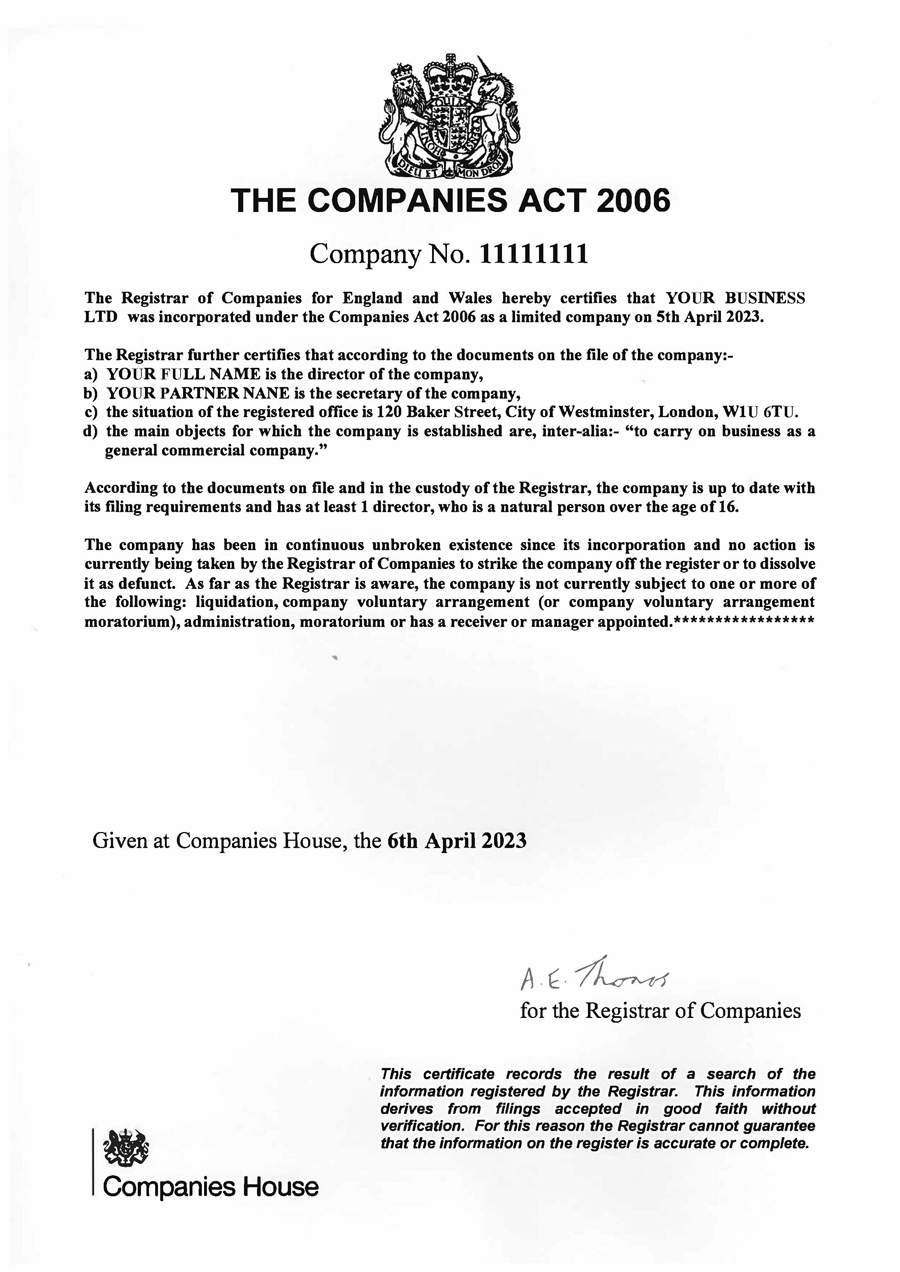
  • Certificate of Incorporation.
  • Core statutory company documents.
  • Basic post-incorporation procedural guidance.

Not Included

Charity Commission registration, substantive charitable-purpose legal drafting, detailed public-benefit analysis, complex constitutional drafting, Charity Commission correspondence or objection handling, HMRC charitable-status or Gift Aid applications, specialist tax or legal advice, complex trustee/member structures, and property, asset-transfer or specialist regulatory advice.

Recommended
Formation + Review

Charitable CLG Professional™

£349 + VAT

Including the Companies House filing fee

For organisations that want more than basic incorporation and would benefit from a professional review of their proposed charitable purposes, company structure and governance approach before the formation is submitted.

Everything in Charitable CLG Essential™, plus:

  • Review of the proposed charitable purposes before incorporation.
  • Review of the proposed company name and corporate structure.
  • Guidance concerning guarantors, members and directors.
  • Review of the proposed governance approach.
  • Tailored formation documentation within the agreed scope.
  • Professional pre-submission review.
  • Post-incorporation corporate support relating to the formation.
  • Companies House incorporation and filing.
  • Companies House filing fee included.

Important Scope Boundary

This package does not include Charity Commission registration, a guarantee of Charity Commission registration, specialist legal advice on charitable status, substantive legal drafting of complex charitable purposes, detailed public-benefit legal analysis, complex constitutional restructuring, specialist tax advice, HMRC/Gift Aid registration, Charity Commission objection or dispute handling, or complex trustee, corporate-member or international structures requiring specialist advice.

HMRC Preparedness

Charitable CLG HMRC Ready™

£499 + VAT

Including the Companies House filing fee

For organisations that intend to pursue HMRC recognition for charitable tax purposes after incorporation and want to prepare their CLG appropriately for that later stage.

Everything in Charitable CLG Professional™, plus:

  • HMRC tax-recognition readiness review.
  • Review of charitable purposes and governing-document provisions relevant to HMRC recognition.
  • Review of organisational information likely to be required for the HMRC recognition process.
  • Identification of information and supporting documents likely to be required.
  • Preparation of an HMRC recognition readiness checklist.
  • Guidance concerning Gift Aid and relevant charitable tax reliefs and schemes.
  • Guidance concerning information that should be available when the organisation reaches the HMRC application stage.

This package sells preparedness, not an outcome. HMRC determines whether the organisation satisfies the applicable requirements for recognition and what tax treatment applies. Professional preparation does not guarantee HMRC recognition or any particular tax result.

Premium Application Support

Charitable CLG HMRC Recognition™

£699 + VAT

Including the Companies House filing fee

For organisations that are ready to move beyond preparation and want professional assistance with the HMRC recognition application and recognition process within the agreed scope.

Everything in Charitable CLG HMRC Ready™, plus:

  • Assistance preparing the HMRC recognition application.
  • Review of the information supplied for the application.
  • Assistance identifying and preparing relevant supporting information and documentation.
  • Guidance concerning authorised officials and responsible persons.
  • Assistance with the HMRC application process.
  • Assistance with relevant HMRC correspondence within the agreed scope.
  • Coordination of responses to routine HMRC clarification requests.
  • Professional support through the recognition process.

Important Boundary

This package does not guarantee HMRC recognition, Charity Commission registration or any particular tax outcome. It does not include specialist tax advice outside the agreed scope, tax planning, complex HMRC investigations or compliance checks, appeals or formal disputes, legal representation, substantive redrafting of charitable purposes requiring specialist legal advice, complex constitutional restructuring, or accounting work unless separately agreed.

Which Situation Describes You?

“I know what I want.” You already understand your intended purpose and structure. Essential™ may be the appropriate starting point.
“I want a professional review.” You want additional review of your purpose, structure and governance. Professional™ may fit better.
“I am preparing for HMRC.” You want to prepare the organisation for a later HMRC stage. HMRC Ready™ is designed for this situation.
“I am ready to apply.” You want assistance with the recognition application and process. HMRC Recognition™ provides this higher level of support.

Your Formation Package Does Not Have to Include Everything

The packages are designed to give you a clear starting point. You can also consider additional services separately where your organisation requires them, such as registered-office services, director or member-related support, company secretarial assistance, document services or other corporate requirements.

Additional services are subject to their own scope, requirements and fees and are not automatically included simply because they may become relevant to your organisation later.

Important: Companies House incorporation creates the CLG as a company. It does not itself create Charity Commission registration or HMRC recognition. Where an HMRC service is selected, Coddan provides professional assistance within the agreed scope, while HMRC remains responsible for its statutory recognition and tax decisions.

Choose the Level of Support That Matches Your Organisation

Start with the package that reflects your current formation and support needs. If your organisation develops further, additional services or different structural considerations can be addressed separately.

Start Your Charitable CLG Formation

Need help deciding which package fits your organisation? Contact Coddan on +44 (0) 207 935 5171 or 0330 808 0089 , or email info@coddan.co.uk .

Secure Online Ordering — Coddan's online order forms use SSL/TLS encryption to help protect information transmitted through the website. Personal information is handled in accordance with applicable UK GDPR and data-protection requirements.

Your Organisation After Formation

What Happens After Incorporation?

Incorporation is not the end of the process. It is the point at which your Company Limited by Guarantee becomes the corporate framework through which your organisation can begin developing its activities, relationships, governance and operational infrastructure.

What happens next will depend on what you are building. Some organisations may begin operating immediately, while others may first establish their membership, premises, services, contracts, funding arrangements or internal systems. Additional regulatory, tax or corporate requirements may then become relevant as the organisation develops.

1

Establish the CLG

The company is incorporated at Companies House with its directors, members/guarantors and constitutional framework established.

2

Begin Operating

The organisation can begin developing its intended services, projects, programmes, contracts, membership activities or other appropriate operations.

3

Members / Customers / Donors / Trading Activities

Depending on the organisation's model, it may develop relationships with members, customers, donors, funders, suppliers, employees, contractors and other stakeholders.

4

Generate Income

Depending on the model, income may arise through fees, subscriptions, contracts, product sales, trading activities, donations, grants or other appropriate sources.

5

Apply Resources Toward the Organisation's Purposes

The organisation's resources should be managed and applied in accordance with its purposes, governing framework and applicable legal and regulatory requirements.

6

Consider Additional Requirements as the Organisation Develops

As activities develop, the organisation may need to consider additional tax, governance, trading, property, corporate or regulatory requirements.

What Might Become Relevant Later?

Not every organisation will need all of these. The appropriate requirements depend on what your CLG actually does and how it develops.

HMRC Recognition
Where relevant to the organisation's charitable tax position.
Gift Aid
Where eligible donations and the relevant HMRC conditions apply.
Tax Matters
Depending on income, activities and applicable tax rules.
Trading
As services, products or commercial activities develop.
Trading Subsidiary
Potentially where a separate structure becomes appropriate.
Premises
Operational space, property and related considerations.
Corporate Records
Statutory registers, company records and ongoing filings.
Registered Office
Maintaining an appropriate official company address.
Company Secretarial Support
Where ongoing corporate administration requires support.
Charity Commission Registration
Where registration eventually becomes appropriate for the organisation.

Your Organisation's Journey Will Not Necessarily Follow Every Step

The lifecycle above is a decision framework, not a mandatory sequence. A small membership organisation may have very different requirements from a digital platform, community café, training organisation or property-based initiative. Some organisations may consider HMRC recognition early, while others may never require it. The relevant requirements depend on the organisation's actual activities and circumstances.

Formation Is the Beginning — Not the End

Establishing the CLG creates the corporate foundation. What happens afterwards depends on what you are building: how you operate, who you serve, how you generate income and what additional requirements become relevant as the organisation develops.

This is why it can be useful to think about the organisation as a developing corporate structure rather than a one-time Companies House filing. The next section brings the focus back to the practical corporate infrastructure that helps establish and maintain the organisation's formal record from the beginning.

A Separate Regulatory Route

Charity Commission Registration Is a Separate Route

A Company Limited by Guarantee established for charitable purposes is not automatically a registered charity. The fact that Companies House has incorporated the company does not, by itself, mean that the organisation has completed the separate Charity Commission registration process.

Corporate Formation

Companies House

Companies House incorporation creates the company as a Company Limited by Guarantee and establishes its corporate framework, subject to the information accepted for incorporation.

Separate Regulation

Charity Commission

Charity Commission registration is a separate regulatory process that may become relevant where the organisation is eligible and registration is appropriate to its circumstances.

Your Development

Your Organisation

Registration may be considered later as the organisation develops, depending on its purposes, activities and circumstances.

The Key Distinction

Incorporation and charity registration are two different processes. Companies House creates the corporate entity. Charity Commission registration is a separate regulatory route. Establishing a CLG with intended charitable purposes does not itself complete that registration.

Registration is not the focus of this page. This page explains the formation and development of a charitable-purpose CLG. If Charity Commission registration later becomes relevant to your organisation, it should be considered as a separate stage with its own requirements, process and regulatory considerations.

Explore the Separate Registration Route

Considering Charity Commission Registration?

If your organisation may eventually require formal charity registration, explore the separate process, eligibility considerations and the relationship between a charitable-purpose CLG and Charity Commission registration.

Explore Charity Commission Registration

Charity Commission registration is subject to the organisation satisfying the applicable requirements. Incorporation of the CLG does not guarantee registration or any particular regulatory outcome.

Professional Formation Support

Why Professional Formation Support Can Make Sense

Incorporating a Company Limited by Guarantee is more than entering information into a Companies House application. The information used to create the company establishes the foundation around which the organisation may later operate, govern itself, develop its activities and maintain its corporate record.

Professional formation support can therefore be useful where a founder wants to understand the proposed structure before submission, identify potential formation issues and choose a service level that reflects the organisation's actual circumstances.

The Professional Difference

Start With the Organisation — Not Just the Incorporation Form

The useful question is not simply “Can this company be incorporated?” It is also “Does the proposed corporate structure properly reflect what this organisation is trying to establish?” Professional formation support is designed to help address that distinction within the agreed service scope.

What Professional Support Can Add

01

Understand the Organisation Behind the Company

A professional formation process can begin by understanding the organisation's intended purpose, membership model, activities, governance approach and development plans, rather than treating incorporation as an isolated filing exercise.

02

CLG-Specific Formation Experience

A CLG has a different corporate architecture from a company limited by shares. Understanding members, guarantors, directors and the guarantee structure helps ensure that the formation process is approached as a CLG rather than simply adapting a conventional commercial-company model.

03

Professional Pre-Submission Review

Where the selected package includes a review, the proposed company information, purpose, structure and relevant formation details can be considered before submission, helping identify issues that may need attention within the agreed scope.

04

Structured Package Choices

Different organisations need different levels of assistance. The four formation packages allow the customer to choose between core incorporation, professional review, HMRC preparation and HMRC recognition-process support.

05

Transparent Scope

Each package makes a distinction between what is included and what is not. This helps prevent the common assumption that a formation service automatically includes legal advice, Charity Commission registration, tax advice or specialist restructuring.

06

Support Beyond the Filing

Formation can be followed by relevant corporate services such as Companies House filings, registered-office services, company secretarial support or other assistance where required and separately agreed.

Tailored Support Does Not Mean Unlimited Scope

A professional approach should adapt to the organisation's circumstances while remaining clear about what the service actually covers. That is why Coddan's formation packages define the scope of professional support rather than presenting every possible corporate, legal or tax service as part of incorporation.

Where an organisation has complex charitable purposes, specialist tax questions, unusual constitutional arrangements, property matters or other issues outside the agreed formation scope, additional specialist advice may be appropriate.

Add Only the Additional Services You Actually Need

Professional formation does not mean every organisation needs a large bundle of additional services. A founder may already have a suitable registered office, while another organisation may need a professional address, company secretarial assistance or additional corporate documentation.

Services such as a registered office, director service address, printed corporate documents, notarisation, apostille or other corporate support can therefore be considered separately where relevant.

Coddan's Role

Professional Corporate Formation Through an ACSP and TCSP

Coddan CPM Ltd is an Authorised Corporate Service Provider (ACSP) and a Trust and Corporate Service Provider (TCSP). Our role is to provide professional corporate formation and related services within the agreed scope of the service selected.

The relevant statutory authorities remain responsible for their own decisions. Companies House determines matters within its statutory remit, while HMRC and the Charity Commission remain responsible for their respective recognition, registration and tax processes.

A Professional Formation Approach Should Give You Clarity

Understand Understand the organisation and intended structure before selecting the route.
Review Use professional review where your circumstances justify additional preparation.
Choose Select the package that corresponds to your actual stage and requirements.
Develop Add further corporate support only when the organisation's needs develop.
Key Takeaway

Professional Formation Is About Getting the Foundation Right

The value of professional formation support is not simply that someone submits an incorporation application on your behalf. It is the combination of CLG-specific understanding, structured review, clearly defined services and a corporate approach that recognises what may happen after incorporation.

Not Sure Which Level of Support You Need?

You can discuss your proposed CLG structure with Coddan before selecting the appropriate formation route.

Secure Online Ordering & Data Protection — Coddan's online order forms use SSL/TLS encryption to help protect information transmitted through the website. Personal information is handled in accordance with applicable UK GDPR and data-protection requirements.

Decision-Support FAQ

Frequently Asked Questions About Charitable-Purpose CLGs

The questions below address the practical issues that commonly arise when deciding whether a Company Limited by Guarantee established for charitable purposes could be an appropriate corporate foundation. They are designed to help you make a more informed structural decision rather than simply repeat basic definitions.

Can a CLG have charitable purposes without being registered as a charity?

Yes. A CLG can be established with intended charitable purposes without that Companies House incorporation itself creating Charity Commission registration. Incorporation creates the company. Charity Commission registration is a separate regulatory route that may be considered later where appropriate and where the applicable requirements are satisfied.

Can a charitable-purpose CLG generate income?

Yes. A charitable-purpose CLG can potentially generate income through appropriate activities such as membership subscriptions, service fees, course fees, product sales, contracts, trading activities, property-related income, donations or grants. The important considerations are the organisation's purposes, governing framework, activities and how its resources are applied.

Can a charitable-purpose CLG employ people?

Yes. A functioning CLG can potentially employ staff where employment is appropriate to its activities. The organisation would then need to consider the relevant employment, payroll, tax and other obligations arising from employing people.

Can a charitable-purpose CLG charge customers?

Potentially, yes. A CLG can operate services or other activities for which customers pay fees, provided the activities are appropriate to the organisation's purposes and are conducted within the applicable legal, constitutional and tax framework. Charging customers does not by itself turn a CLG into a shareholder-owned company.

Can a charitable-purpose CLG operate a restaurant or café?

Potentially, depending on the organisation's purposes, governing document, activities and wider circumstances. A community café, social-impact café, cultural venue or similar model could be an illustrative example of a purpose-led organisation with commercial activity. The fact that an organisation operates a restaurant or café does not, by itself, establish charitable status or determine its tax treatment.

Can a charitable-purpose CLG develop an AI or software platform?

Potentially. An organisation could, for example, develop an AI education platform, accessibility technology, software product or other digital service around a mission-led purpose. The technology or commercial activity itself does not automatically determine whether the organisation qualifies for charitable treatment. Its purposes, governing document, activities and application of resources remain important.

Does a CLG need shareholders?

No. A Company Limited by Guarantee is structured around members and guarantors rather than shareholders holding shares. This is one of the fundamental structural differences between a CLG and a company limited by shares.

When might a Company Limited by Shares be more appropriate?

A Company Limited by Shares may be more appropriate where the organisation is fundamentally intended to operate around share ownership, equity investment and potential shareholder distributions. However, income generation alone does not determine the answer. A purpose-led organisation can also generate income, so the decision should consider the intended purpose, ownership model, governance, financing and application of resources.

Does incorporation automatically create charity status?

No. Companies House incorporation creates the company. It does not, by itself, create Charity Commission registration or HMRC recognition. Those are separate matters with their own requirements and decision-making processes.

What is the difference between Charity Commission registration and HMRC recognition?

They are separate routes serving different purposes. Charity Commission registration concerns the organisation's status as a registered charity, where registration is appropriate and the applicable requirements are met. HMRC recognition concerns the availability of relevant charitable tax treatment. One does not simply become the other because a CLG has been incorporated.

Can HMRC recognition be considered later?

Yes. An organisation can consider HMRC recognition as it develops and as the relevant circumstances arise. Preparation for that stage can also be considered during formation. HMRC determines whether recognition and the relevant tax treatment are available, subject to the applicable conditions.

What happens if the organisation later wants a trading subsidiary?

A separate trading subsidiary can sometimes be considered where wider commercial activity develops and a different corporate structure becomes appropriate. The relationship between the charitable-purpose organisation and the subsidiary requires careful consideration of governance, ownership, transactions, tax and the application of resources. It is a separate structural decision rather than an automatic requirement for every CLG.

Can an existing community group incorporate as a CLG?

Potentially, yes. An existing informal community group, association, project or mission-led initiative may decide that a formal corporate structure would better support its activities. The appropriate route depends on its existing arrangements, proposed purposes, membership, governance and the activities it intends to undertake.

Which Coddan package is appropriate?

It depends on where your organisation is in its formation and recognition journey:

  • Charitable CLG Essential™ — £249 + VAT: for organisations that already understand their intended structure and primarily need professional incorporation support.
  • Charitable CLG Professional™ — £349 + VAT: for organisations wanting professional review of their proposed purpose, structure and governance approach before incorporation.
  • Charitable CLG HMRC Ready™ — £499 + VAT: for organisations preparing for a possible future HMRC recognition stage.
  • Charitable CLG HMRC Recognition™ — £699 + VAT: for organisations seeking professional assistance with the HMRC recognition application and process within the agreed scope.

All four packages include the Companies House filing fee. None guarantees Charity Commission registration or HMRC recognition. The appropriate package is the one that matches the organisation's actual situation and the level of professional support required.

Decision Point

The Question Is Not Simply “Can I Form a CLG?”

The more useful question is whether a Company Limited by Guarantee is the right corporate foundation for the organisation you are trying to build. That means considering its purpose, members, governance, activities, income model, future development and any later recognition or structural requirements.

Ready to Establish Your Charitable-Purpose CLG?

Choose the formation package that matches your organisation's current situation, or contact Coddan if you need help understanding which route is appropriate.

Or call 0330 808 0089 or email info@coddan.co.uk .

Secure Online Ordering & Data Protection — Coddan's online order forms use SSL/TLS encryption to help protect information transmitted through the website. Personal information is handled in accordance with applicable UK GDPR and data-protection requirements.

Final Decision Point

What Are You Building?

A community organisation? A membership body? An education or training organisation? A social-impact service? A digital or AI platform? A café, venue or other mission-led operation?

The right starting point is not simply “I need to register a company.” It is understanding what you want the organisation to achieve, who it is intended to benefit and how you expect it to operate. From there, you can consider whether a Company Limited by Guarantee established for charitable purposes provides the appropriate corporate foundation.

01 Define your purpose
02 Consider the structure
03 Choose your support
04 Build the organisation
£249 Essential™ — Core CLG formation £349 Professional™ — Formation + purpose/structure review £499 HMRC Ready™ — Recognition preparedness £699 HMRC Recognition™ — Application-process support

Coddan CPM Ltd is an Authorised Corporate Service Provider (ACSP) and Trust and Corporate Service Provider (TCSP). Professional formation services are provided within the agreed scope.

Companies House incorporation does not automatically create Charity Commission registration or HMRC recognition. Any registration, recognition or tax outcome remains subject to the applicable requirements and the decision of the relevant authority.

Have questions about establishing your charitable-purpose CLG? Call Coddan on +44 (0) 207 935 5171 or 0330 808 0089 , or email info@coddan.co.uk .

Secure Online Ordering & Data Protection — Coddan's online order forms use SSL/TLS encryption to help protect information transmitted through the website. Personal information is handled in accordance with applicable UK GDPR and data-protection requirements.