We use cookies on this website, you can read about cookies and GDPR Privacy Policy here
Coddan CPM Ltd. – Company Registration Agent in the UK

Follow a structured route from defining the charitable organisation to aligning its purpose, governance and constitution, completing incorporation and progressing the applicable charity-registration process.

Step 1
Define Charitable Organisation
Step 2
Clarify Charitable Purpose
Step 3
Establish Governance Requirements
Step 4
Prepare Formation Materials
Step 5
Complete Company Incorporation
Step 6
Progress Charity Registration
Companies Registry's e-Services Portal Non-For-Profit Companies Secretarial Services for CLGs Establishing a Charity Company Limited by Guarantee: Trusted Professionals

Establishing a Charity Company Limited by Guarantee: Trusted Professionals

Charitable Company Limited by Guarantee Formation with Company Secretary Support

Establish the charitable company you actually intend to operate — not simply a company that can be registered.

A charitable Company Limited by Guarantee is created at Companies House, but the incorporation application is only one part of establishing the organisation.

Its purposes, beneficiaries, activities, directors, members or guarantors, governance arrangements and constitutional documents need to belong to the same organisation. Where charitable status, particular funding arrangements, overseas involvement or unusual governance requirements are relevant, those circumstances may also affect how the company should be established.

Coddan's company-secretarial support brings those elements together around the formation of the CLG. We help turn the organisation you intend to establish into the corporate structure, constitution and formation arrangements required to create it — and provide a route into the corporate administration that follows incorporation.

The objective is not simply to obtain a certificate of incorporation. It is to establish a company capable of serving the organisation for which it was created.

View charitable CLG formation packages

Start Your Business Today: Fast Formation Services to Meet All Compliance Standards
£495.00
+VAT

CharityReg Essential™

Recommended for

1
package

Buy Now Essential Charitable CLG Formation & Charity Registration Support — £495 + VAT · Companies House incorporation and essential charity-registration support
CharityReg Essential™ is designed for founders, small community organisations and associations that have already established their intended charitable purpose, proposed structure and basic governing arrangements and require professional assistance to establish their Company Limited by Guarantee and prepare for the applicable charity-registration process. The service is appropriate where the organisation's core information is substantially prepared and the principal requirement is professional support with the company formation and essential charity-registration stages within the agreed scope. You provide the proposed company name, directors, members or guarantors and relevant organisational information; Coddan reviews the information, prepares the applicable company-formation and supporting charity-registration materials and coordinates the relevant stages within the agreed scope. Companies House incorporation and charity registration are separate processes, and charity registration remains subject to the requirements and independent decision of the relevant charity regulator.

Flexible Charitable Company Formation & Essential Charity Registration Support
The formation can accommodate one or more directors, individual or corporate members/guarantors and mixed participation, where applicable. Your proposed charitable purposes and company objects can be considered within the agreed formation and registration-support scope. An initial consultation is available by email, telephone or video call. Coddan professionally reviews the formation and registration information, prepares the applicable documentation and supports the relevant submission processes within the agreed scope. Following successful Companies House incorporation, digital incorporation documents are provided, while the charity-registration application is progressed in accordance with the requirements of the relevant regulator.
Included:
• Company Limited by Guarantee incorporation and Companies House registration
• £100 Companies House filing fee
• One or more directors
• Individual or corporate members/guarantors, where applicable
• Proposed charitable purposes and company objects, within the agreed scope
• Memorandum and Articles of Association and core formation documentation
• Applicable Companies House identity-verification guidance
• Professional pre-submission review and Companies House submission
• Essential preparation and support for the applicable charity-registration process
• Preparation of relevant charity-registration information and supporting documentation within the agreed scope
• Professional support with the applicable charity-registration submission
• Digital incorporation documents
Normal 24–48 hour formation, subject to a complete application and Companies House processing
Charity registration remains subject to the requirements and decision of the relevant charity regulator


£795.00
+VAT

CharityReg Professional™

Recommended for

2
package

Buy Now Professional Comprehensive Charitable Company Formation & Charity Registration Support — £795 + VAT · Companies House incorporation and comprehensive registration preparation
CharityReg Professional™ is designed for founders, organisations and associations that require broader professional preparation and coordination when establishing a Company Limited by Guarantee and preparing the organisation for the applicable charity-registration process. The service is appropriate where the proposed charitable company requires more developed consideration of its charitable purposes, governance arrangements, governing documentation and charity-registration information within the agreed scope. You provide the proposed company name, directors, members or guarantors and relevant organisational information; Coddan professionally reviews the proposed structure and information, assists with the development and preparation of the applicable formation and charity-registration materials and coordinates the relevant stages within the agreed scope. Charity registration remains subject to the requirements and independent decision of the relevant charity regulator.

Comprehensive Charitable Company Formation & Professional Charity Registration Support
The formation can accommodate one or more directors, individual or corporate members/guarantors and mixed participation, where applicable. Your proposed charitable purposes, company objects, governance arrangements and relevant organisational information can be considered within the agreed formation and registration-support scope. An initial consultation is available by email, telephone or video call. Coddan professionally reviews the proposed structure and supporting information, assists with the preparation and review of the applicable incorporation and charity-registration documentation and provides professional support throughout the relevant submission stages. Following successful Companies House incorporation, digital incorporation documents are provided, while the charity-registration application is prepared and progressed in accordance with the requirements of the relevant regulator.
Included:
• Company Limited by Guarantee incorporation and Companies House registration
• £100 Companies House filing fee
• One or more directors
• Individual or corporate members/guarantors, where applicable
• Proposed charitable purposes and company objects, within the agreed scope
• Consideration of proposed governance arrangements within the agreed scope
• Memorandum and Articles of Association and core formation documentation
• Applicable Companies House identity-verification guidance
• Professional pre-submission review and Companies House submission
• Comprehensive preparation and professional support for the applicable charity-registration process
• Review and preparation of relevant charity-registration information and supporting documentation within the agreed scope
• Professional support with the applicable charity-registration submission and related correspondence within the agreed scope
• Digital incorporation documents
Normal 24–48 hour formation, subject to a complete application and Companies House processing
Charity registration remains subject to the requirements and decision of the relevant charity regulator


£895.00
+VAT

CharityReg Scotland™

Recommended for

3
package

Buy Now Scotland Scottish Charitable Company Formation & Charity Registration Support — £895 + VAT · Companies House incorporation and Scottish charity-registration support
CharityReg Scotland™ is designed for founders, organisations and associations establishing a Company Limited by Guarantee where formal charity registration is intended in Scotland. The package is appropriate where the organisation requires professional support with both the Companies House incorporation stage and the applicable Scottish charity-registration process. You provide the proposed company name, directors, members or guarantors and relevant organisational information; Coddan professionally reviews the proposed structure and information, prepares the applicable formation and registration materials and provides professional assistance throughout the relevant stages within the agreed scope. Companies House incorporation and Scottish charity registration are separate processes, and Scottish charity registration remains subject to the requirements and independent decision of the Office of the Scottish Charity Regulator (OSCR).

Scottish Charitable Company Formation & Essential Charity Registration Support
The formation can accommodate one or more directors, individual or corporate members/guarantors and mixed participation, where applicable. Your proposed charitable purposes and company objects can be considered within the agreed formation and Scottish registration-support scope. An initial consultation is available by email, telephone or video call. Coddan professionally reviews the formation and registration information, prepares the applicable documentation and supports the relevant submission processes within the agreed scope. Following successful Companies House incorporation, digital incorporation documents are provided, while the charity-registration application is progressed in accordance with the requirements of the Office of the Scottish Charity Regulator (OSCR).
Included:
• Company Limited by Guarantee incorporation and Companies House registration
• £100 Companies House filing fee
• One or more directors
• Individual or corporate members/guarantors, where applicable
• Proposed charitable purposes and company objects, within the agreed scope
• Memorandum and Articles of Association and core formation documentation
• Applicable Companies House identity-verification guidance
• Professional pre-submission review and Companies House submission
• Essential preparation and support for the Scottish charity-registration process
• Preparation of relevant Scottish charity-registration information and supporting documentation within the agreed scope
• Professional support with the applicable OSCR charity-registration submission
• Digital incorporation documents
Normal 24–48 hour formation, subject to a complete application and Companies House processing
Scottish charity registration remains subject to the requirements and decision of OSCR


£895.00
+VAT

CharityReg NI™

Recommended for

4
package

Buy Now Northern Ireland Northern Irish Charitable Company Formation & Charity Registration Support — £895 + VAT · Companies House incorporation and Northern Ireland charity-registration support
CharityReg Northern Ireland™ is designed for founders, organisations and associations establishing a Company Limited by Guarantee where formal charity registration is intended in Northern Ireland. The package is appropriate where the organisation requires professional support with both the Companies House incorporation stage and the applicable Northern Ireland charity-registration process. You provide the proposed company name, directors, members or guarantors and relevant organisational information; Coddan professionally reviews the proposed structure and information, prepares the applicable formation and registration materials and provides professional assistance throughout the relevant stages within the agreed scope. Companies House incorporation and Northern Ireland charity registration are separate processes, and Northern Ireland charity registration remains subject to the requirements and independent decision of the Charity Commission for Northern Ireland (CCNI).

Northern Irish Charitable Company Formation & Essential Charity Registration Support
The formation can accommodate one or more directors, individual or corporate members/guarantors and mixed participation, where applicable. Your proposed charitable purposes and company objects can be considered within the agreed formation and Northern Ireland registration-support scope. An initial consultation is available by email, telephone or video call. Coddan professionally reviews the formation and registration information, prepares the applicable documentation and supports the relevant submission processes within the agreed scope. Following successful Companies House incorporation, digital incorporation documents are provided, while the charity-registration application is progressed in accordance with the requirements of the Charity Commission for Northern Ireland (CCNI).
Included:
• Company Limited by Guarantee incorporation and Companies House registration
• £100 Companies House filing fee
• One or more directors
• Individual or corporate members/guarantors, where applicable
• Proposed charitable purposes and company objects, within the agreed scope
• Memorandum and Articles of Association and core formation documentation
• Applicable Companies House identity-verification guidance
• Professional pre-submission review and Companies House submission
• Essential preparation and support for the Northern Ireland charity-registration process
• Preparation of relevant Northern Ireland charity-registration information and supporting documentation within the agreed scope
• Professional support with the applicable CCNI charity-registration submission
• Digital incorporation documents
Normal 24–48 hour formation, subject to a complete application and Companies House processing
Northern Ireland charity registration remains subject to the requirements and decision of CCNI


I Already Know the Route

I Already Know We Want a Charitable Company Limited by Guarantee

If you are already pursuing a charitable company limited by guarantee, you do not need to begin with a broad comparison of every charity or corporate structure before understanding the establishment route.

Start with the organisation, its charitable purpose, people and intended governance. Coddan can then consider how the requested charitable CLG route should be implemented.

Go to the structure-fit stage →
I Know the Charity We Want

I Know the Charity — Not the Company Machinery

Explain the organisation in ordinary terms: its charitable purpose, intended beneficiaries, activities, directors, members and how you expect decisions and participation to work.

You do not need to translate those facts into company-law, constitutional or governance machinery yourself. The organisation comes first; Coddan performs the professional translation.

Start with the organisation →
Charity + Company Relationship

I Need to Understand How the Company and Charity Positions Fit Together

A charitable company limited by guarantee has a corporate life and a charitable purpose, but those do not collapse into one single registration event. Companies House incorporation, charity regulation and relevant tax or HMRC treatment perform different functions.

This page separates those functions so you can understand what is being established, what Coddan implements, and what may need separate regulatory treatment afterwards.

See the implementation and regulatory stages →
I Need the Short Route

I Have Limited Time — Show Me the Essential Route

You do not need to read every technical detail before understanding the charitable company establishment journey. Start with the organisation and charitable purpose, establish the requested CLG route, bring the governance and constitutional position together, and then move into implementation and the continuing charity position.

Four CharityReg™ Routes

Choose the Package by the Organisation, Preparation Level and Jurisdiction

The four CharityReg™ packages are not four grades of the same service. They address different establishment situations. In England and Wales, the distinction is principally how much professional preparation the organisation already has in place. Scotland and Northern Ireland follow separate charity-registration frameworks and therefore require different regulatory routes.

The appropriate package is the one that matches the organisation's actual position. A charity whose structure and governing information are already substantially prepared should not be made unnecessarily complicated, while an organisation requiring broader preparation or a different jurisdictional route should receive the professional treatment that circumstance requires.

England & Wales — Already Substantially Prepared

CharityReg Essential™

£495 + VAT

For a charitable Company Limited by Guarantee in England and Wales where the intended charitable purpose, corporate structure, governing arrangements and core registration information are already substantially prepared.

The job: professionally review the prepared position, establish the company and prepare/check the Charity Commission application within the agreed scope.
England & Wales — Broader Preparation Required

CharityReg Professional™

£795 + VAT

For an organisation in England and Wales that needs Coddan to take greater responsibility for bringing together the charitable structure, objects, governing framework and supporting registration information before the Charity Commission application is progressed.

The job: coordinate the wider professional preparation needed to turn the proposed organisation into a coherent charitable-company and registration route.
Scotland — Separate Regulatory Route

CharityReg Scotland™

£895 + VAT

For organisations establishing a charitable Company Limited by Guarantee where Scottish charitable registration is intended and the establishment must be coordinated through the applicable Scottish regulatory framework.

The job: coordinate the company formation with the separate Scottish charity-registration route, including the relevant OSCR preparation and supporting documentation within scope.
Northern Ireland — CCNI Route

CharityReg Northern Ireland™

£895 + VAT

For organisations establishing a charitable Company Limited by Guarantee in Northern Ireland and preparing for the separate CCNI registration framework, including the applicable eligibility and call-forward process.

The job: establish the corporate foundation and prepare the organisation for the Northern Ireland charity-registration process at the stage when the applicable CCNI route permits the application to proceed.
Compare the CharityReg™ Routes

What Changes From One Package to Another?

The difference is not the number of features. In England and Wales, the packages reflect different levels of preparation already completed by the organisation. Scotland and Northern Ireland are different because the charity-regulation route itself changes.

Compare by circumstance Essential™
£495 + VAT
Professional™
£795 + VAT
Scotland™
£895 + VAT
Northern Ireland™
£895 + VAT
Jurisdiction England & Wales England & Wales Scotland Northern Ireland
Designed for An organisation whose charitable-company structure, governing information and core application material are already substantially prepared. An organisation requiring broader professional preparation of its charitable-company structure and registration information. An organisation pursuing charitable registration under the Scottish framework. An organisation pursuing the Northern Ireland route and preparing for the applicable CCNI process.
Main professional job Review the prepared position, establish the company and prepare or check the Charity Commission application within scope. Coordinate broader preparation of structure, objects, governing framework and supporting registration information. Coordinate Companies House incorporation with the separate Scottish charity-registration preparation and OSCR route. Coordinate the corporate foundation with the Northern Ireland registration framework and applicable CCNI sequencing.
Why this package exists Most of the structural preparation is already in place; the principal need is professional implementation and application support. More of the professional preparation job still needs to be done before the registration application is ready. Scotland has its own charity regulator and regulatory framework; this is a separate route rather than a higher service tier. Northern Ireland has its own charity-registration framework and CCNI process, including applicable call-forward arrangements.
Regulator Charity Commission for England and Wales Charity Commission for England and Wales OSCR Charity Commission for Northern Ireland
How to recognise the fit "We have already completed most of the structural work and need professional formation and application support." "We need Coddan to help bring the charitable structure and registration preparation together before submission." "Our charitable company is being established for the Scottish charity-registration route." "Our charitable company is being established in Northern Ireland and needs to follow the applicable CCNI route."
Registration decision Independent decision of the Charity Commission Independent decision of the Charity Commission Independent decision under the OSCR framework Independent decision under the CCNI framework
Support Beyond Formation

Support the Charitable Company Can Call On — When the Organisation Needs It

A charitable Company Limited by Guarantee has a continuing corporate life as a company and, where charity registration applies, a continuing regulatory life as a charity. Those responsibilities do not end when the company is incorporated or when charity registration is obtained.

Coddan can provide additional corporate, governance, charity-compliance, accounting and document support where a particular job actually arises. These services are not compulsory additions to a CharityReg™ package. They show the professional capability available around the organisation during different stages of its life.

Establish & Organise

Address, Identity and Initial Corporate Support

Some charitable companies need additional practical arrangements alongside formation. These can be put in place where they genuinely support the organisation's corporate and governance position.

Registered office address
Professional registered-office support with location options available according to the company's requirements.
From £35 / year
Director / PSC correspondence address
Correspondence-address support where directors or persons with significant control require an appropriate service address.
£15 / person / year
Director identity verification
Standard identity-verification support for directors where Companies House identity requirements apply.
£40
PSC identity verification
Standard identity-verification support where a person with significant control requires verification.
£40
Non-standard / manual identity verification
For circumstances requiring additional professional handling beyond the standard identity-verification route.
From £125
Put the Governance Record in Place

Registers, Minutes, Membership and Company-Secretarial Support

Incorporation creates the company, but the organisation may also need the records and governance materials through which its directors, trustees and members can administer the charitable company properly.

Digital statutory / company registers
£5
Printed statutory / company registers
£12
First board meeting / initial governance documents
Initial minutes or governance materials within the defined professional scope.
£5
Membership / guarantor records
Membership certificates and establishment records where they form part of the organisation's intended membership arrangements.
£7.50
Professionally printed memorandum & articles
Professionally prepared printed constitutional documents where a physical corporate record is wanted.
£18
Company rubber stamp / company seal
Corporate stamp or seal where the organisation chooses to use one as part of its corporate administration.
£18
Company-secretarial & governance support
Continuing professional corporate administration where the charitable company actually needs support.
From £125 / year
Maintain the Company & Charity

Companies House, Charity Reporting, Accounts and Tax

A registered charitable company may have continuing responsibilities both as a company and as a charity. The precise work depends on the organisation's jurisdiction, income, activities and regulatory position rather than arising automatically from the original formation package.

Confirmation statement & annual company compliance
Standard Companies House annual-compliance service including the applicable Companies House filing fee.
£85
Annual charity-regulator reporting
Professional assistance with the applicable annual charity reporting cycle for the organisation's jurisdiction and circumstances.
Priced according to scope
Charitable-company annual accounts
Annual accounting and associated company/charity reporting support according to the organisation's accounting requirements, income and activities.
Priced according to scope
Charity tax / HMRC support
HMRC registration, tax-return or charity-tax support where a separate tax matter actually arises from the organisation's circumstances.
Priced according to scope
VAT registration / VAT support
VAT support where the organisation's activities and tax position make registration or continuing VAT work relevant.
From £45
PAYE / payroll support
Payroll support where the charitable company becomes an employer. Entry pricing applies to the minimum service level for 1–3 employees.
From £75
Change, Prove or Restructure

Corporate Changes, Documents and Later Organisational Events

During its life a charitable company may change trustees or directors, amend corporate particulars, require evidence of its status, use documents internationally, alter its governing arrangements or eventually need assistance with closure or restoration. Those are separate professional jobs when they arise.

Director, secretary, PSC and corporate changes
Companies House changes and related corporate implementation where the organisation's circumstances require them.
From £18.99
Governing-document / constitutional changes
Professional support where the charitable company later needs to consider or implement a material change to its objects, articles, governance or other governing arrangements.
Priced according to the required change
Certified corporate / charity documents
Certified copies of appropriate company or charity documents where evidence of the organisation or its status is required.
From £60
Certificate of Good Standing / status documents
Corporate-status evidence and related documentation according to the required use and certification route.
£75 / From £125
Notarisation, apostille or consular legalisation
Authentication and legalisation support where company or charity documents need to be used or relied upon internationally.
From £40
Closure / dissolution support
Professional assistance where the organisation needs to consider both its corporate and charitable position before bringing the company or charity to an end.
Priced according to the required route
Administrative restoration
Company-restoration support where the applicable corporate route is available, with the charity position considered separately where relevant.
From £415 + disbursements
Court restoration
Specialist restoration support where court proceedings are required, with separate attention to any continuing charity implications.
From £1,000 + disbursements
Organisation Charitable purpose CLG fit & governance Professional convergence Implementation
Go to the professional convergence stage →

Is This the Right Route for the Organisation You Want to Establish?

If you are establishing a charitable or genuinely non-profit organisation through a Company Limited by Guarantee, the job may involve more than registering a company at Companies House.

You may already know what you want the organisation to achieve, who it should benefit and how you expect it to operate. You should not also have to arrive knowing how those intentions need to be translated into company structure, governance and constitutional arrangements.

That is the specialist destination of this service.

You bring the organisation you want to establish. Coddan helps turn it into the company that needs to be created.

What Sits Behind a Charitable CLG Formation?

A charitable CLG is not assembled from a collection of unrelated boxes.

Its purposes, intended beneficiaries and activities need to make sense alongside its directors, members or guarantors, governance arrangements and constitution. Those circumstances then have to be translated into the information and documents required to establish the company.

That does not mean you need to learn the professional language first.

Tell us about the organisation in ordinary terms — what it is for, how it should work and the circumstances you already know. Coddan deals with the professional translation within the scope of the formation and company-secretarial work.

The objective is not to make you complete the professional analysis. It is to use that analysis to build the company around the organisation you are actually trying to establish.

One Organisation — Different Legal and Regulatory Steps

Creating a charitable company can involve several things that are easily mistaken for the same event.

Companies House incorporation creates the company. It does not, by itself, make the organisation a registered charity or establish charitable tax treatment with HMRC.

Where they apply, Companies House, the relevant charity regulator and HMRC perform different functions in relation to the same organisation.

That distinction matters when the company is being established. A formation can be technically completed at Companies House while other parts of the organisation's intended charitable destination still need separate consideration.

Professional coordination helps keep those different steps connected without pretending that one registration accomplishes them all.

Why Use Company-Secretarial Support for the Formation?

A basic incorporation service can submit the information required to register a company. The specialist job is broader: making sure the company being created is capable of serving the organisation behind it.

That means keeping the route connected:

organisation → purpose → governance → constitution → formation → incorporated company → initial corporate administration.

Professional company-secretarial support does not mean that every CLG is legally required to appoint a company secretary. It means applying company-secretarial knowledge to the formation and corporate administration where that support is useful.

Coddan's role is therefore not simply to transmit information to Companies House.

Coddan handles the route, not just the submission.

The certificate of incorporation is an important result, but it is not the ultimate destination. The company is the instrument through which the organisation will operate.

View Charitable CLG Formation Packages

01

What Organisation Are You Trying to Establish?

Before considering the mechanics of forming the company, start with the organisation the company is intended to serve.

You may be establishing an organisation to support a community, advance a particular cause, provide services or facilities, carry out charitable activities, manage funding or pursue another charitable or non-profit objective. What matters at this stage is understanding what you are trying to establish and what you want it to achieve.

That is different from asking you to arrive with the professional solution already worked out.

You should not need to know how the organisation's purposes should be expressed legally, which constitutional provisions it requires, how its charitable position should be treated, or which Companies House procedures are needed before approaching Coddan.

Those questions follow from understanding the organisation rather than replacing it.

The organisation comes before the formation mechanics

A company formation application necessarily asks for particular corporate information. But those individual pieces of information do not explain, by themselves, the organisation that is being created.

For a charitable CLG, the wider circumstances matter because its purpose, intended beneficiaries, activities, governance and constitution ultimately need to work together.

This is where company-secretarial involvement begins to have a different role from simply processing an incorporation.

You provide the organisation you have in mind and the facts you know. Coddan considers how those circumstances should be translated into the appropriate formation and constitutional work within the scope of the service.

We start with the destination. The corporate machinery follows.

02

Why Is the Organisation Intended to Be Charitable?

Once we understand the organisation you are trying to establish, the next question is what you mean when you say that it is intended to be charitable.

For the people creating the organisation, that usually begins with something practical: the change they want to make, the benefit they want the organisation to produce, or the reason they believe its resources and activities should be directed towards a charitable purpose.

That intention matters. It helps us understand the organisation the company is being created to serve.

But you should not have to translate that intention into charity-law terminology before approaching Coddan. You do not need to arrive with a statutory charitable-purpose classification, a public-benefit analysis or legally drafted charitable objects simply to explain what you are trying to achieve.

Start with the charitable intention, not the legal label.

Coddan can then consider that intention alongside the organisation's beneficiaries, proposed activities, geographic circumstances, governance and other relevant facts as the formation takes shape.

This matters because the company's constitution should ultimately reflect the organisation it is intended to support. The charitable character of the organisation cannot sensibly be separated from the purposes for which the company is established or from the governance framework within which it will operate.

At this stage, however, charitable intention is one part of the developing picture — not a conclusion reached in isolation.

The deeper questions of charitable purpose and public benefit come later, once there is enough of the organisation in view to consider them properly.

03

Who Is the Organisation Intended to Benefit?

A charitable organisation exists to produce benefit for someone or something beyond the company itself.

That may mean a community, people experiencing particular circumstances, members of a defined group, people within a geographical area, or another identifiable class of beneficiaries connected with the organisation's intended purpose.

Understanding who is intended to benefit helps give practical meaning to the charitable intention established earlier.

It also matters because beneficiary circumstances do not exist separately from the organisation's purposes. The people the organisation intends to help, the reason it exists and the activities it plans to undertake should ultimately make sense together.

A defined group does not automatically create a problem

Some organisations intend their work to benefit the public generally. Others exist for people sharing particular circumstances, characteristics, locations or connections.

A factual limitation may therefore be an important part of describing the organisation without, by itself, determining whether the proposed charitable route works.

The fact comes first. Its professional significance depends on the wider circumstances.

The customer should not have to decide whether a particular beneficiary group satisfies the legal public-benefit requirement, creates an issue of private benefit or belongs within a particular charitable classification.

Those questions are considered from the organisation as a whole.

For company-secretarial formation work, this matters because the intended beneficiaries help inform how the organisation's purposes and constitutional position should ultimately be expressed. They are part of constructing the company around the charitable organisation it is intended to serve, rather than simply completing an incorporation application.

The next part of that picture is practical: what will the organisation actually do to pursue the benefit it has been established to provide?

04

What Will the Organisation Actually Do?

A charitable purpose only becomes meaningful when it is connected to what the organisation expects to do in practice.

An organisation may deliver services directly, run programmes or events, employ staff, work through volunteers, provide grants or funding to others, operate facilities, undertake projects or use another practical arrangement to pursue its aims.

Those activities help explain how the charitable intention described earlier is expected to become real.

For a charitable CLG, this matters because the organisation's stated purpose, the people it intends to benefit and the work it actually carries out should ultimately belong to the same picture.

Activities are facts before they are classifications

The people establishing the organisation will normally know what they intend to do and how they expect that work to operate.

They should not also have to decide whether an activity is legally charitable or non-charitable, whether it constitutes a particular type of trading, or what Corporation Tax, VAT or other treatment may eventually apply.

Describe the activity first. Its professional significance comes afterwards.

The same principle applies where the organisation expects to charge for a service, sell something, receive payment for access to an activity or otherwise receive money in connection with its work.

The existence of payment may be relevant, but it does not by itself tell us whether the activity is charitable, trading, taxable or subject to another professional treatment.

Those conclusions depend on the wider circumstances.

Why this matters when the company is being established

The activities expected of the organisation help give practical meaning to its purposes and can influence how its constitutional position needs to be understood.

That is why company-secretarial formation work should not treat the objects of the company as wording disconnected from the organisation's actual plans.

Purpose, beneficiaries and activities should make sense together.

Coddan considers those practical circumstances as part of the wider formation picture, without requiring the customer to convert ordinary operational facts into legal or tax terminology first.

Once the work itself is understood, the next part of the picture is where that work will take place and where the organisation will actually be governed.

05

Where Will the Organisation Operate and Be Governed?

Where an organisation carries out its work and where it is governed are related questions, but they are not necessarily the same question.

A charitable CLG may carry out most of its activities in one part of the UK while its directors and principal governance arrangements are based somewhere else. Another organisation may work across several parts of the UK, operate substantially overseas, or involve directors, members or other participants based in different countries.

Those circumstances are part of understanding the organisation that is being created.

Geography is part of the organisation, not just an address

For formation purposes, it can matter where the organisation expects to carry out its activities, where its principal management and governance will take place, and whether overseas involvement forms a substantial part of its intended operation.

That does not mean the people establishing the organisation should first have to determine the company-law, charity-regulatory or tax consequences themselves.

Tell us where the organisation will operate and how its governance will be situated. The professional significance of those facts comes afterwards.

An overseas activity, an overseas director or a governance arrangement involving more than one country does not, by itself, determine whether the proposed CLG route works or what regulatory treatment ultimately follows.

Those facts need to be considered alongside the organisation's purposes, beneficiaries, activities and the structure being established.

Why the distinction matters during formation

A company is incorporated within a particular corporate jurisdiction, but the organisation using that company may have a much wider operational footprint.

The company-secretarial formation process therefore needs to keep the corporate structure connected to the practical organisation behind it rather than treating location as nothing more than an address entered on an incorporation application.

Where the organisation operates, where important governance takes place and where the people responsible for it are based can all become relevant to how the formation and constitutional arrangements are coordinated.

Location is another part of the picture. It is not the conclusion by itself.

By this stage, we have established progressively what the organisation is for, why it is intended to be charitable, who it is intended to benefit, what it plans to do and where that work and governance will be situated.

The next step is to consider the corporate instrument intended to support that organisation.

06

What Legal Structure Fits the Organisation?

By this point, the organisation is beginning to come into view.

We have considered what it is intended to achieve, why it is intended to operate charitably, who it is intended to benefit, what it expects to do and the geographic and governance circumstances surrounding it.

The legal structure should support that organisation rather than become the starting point around which everything else has to be rearranged.

The Company Limited by Guarantee as a corporate instrument

A Company Limited by Guarantee is a company without share capital. Instead of shareholders, it has members or guarantors whose liability is limited to the amount they undertake to contribute to the company's assets if it is wound up.

That structure is commonly used by charitable and non-profit organisations because it can provide a separate corporate body, continuity beyond the individuals involved and a framework within which directors and members can govern the organisation.

Those characteristics explain why the CLG can be a useful corporate vehicle.

They do not mean that every organisation with charitable intentions should automatically use one.

The organisation comes first. The company is the instrument chosen to carry it.

Structure follows the combined picture

A charitable intention by itself does not determine the structure.

Neither does having no shareholders, receiving grants, working overseas, serving a particular beneficiary group or any other single characteristic considered in isolation.

The relevant question is how the organisation's purposes, intended beneficiaries, activities, geographic circumstances and governance requirements work together and what kind of corporate framework is needed to support them.

That is why specialist company-secretarial formation work should not begin by asking the customer to select a legal structure from a menu and then make the organisation conform to that choice.

The customer brings the organisation and the ordinary circumstances they know. Coddan considers how those circumstances translate into the corporate and constitutional route being implemented within the scope of the service.

A CLG does not, by itself, create charitable status

The distinction established earlier remains important.

Incorporating a Company Limited by Guarantee creates the company. The corporate form itself does not make the organisation a registered charity or establish charitable tax recognition with HMRC.

Those are separate questions from the existence of the company.

So the CLG should be understood for what it is: the corporate vehicle through which the organisation may operate, with its charitable purposes, governance and regulatory position considered in their proper places.

The next stage is therefore not another structure comparison. It is to consider whether the organisation being carried by that corporate vehicle has purposes and intended benefit that work within the charitable framework.

07

Does the Organisation Have a Charitable Purpose and Public Benefit?

Wanting to do something worthwhile and intending an organisation to operate charitably are important starting points. They are not, however, the professional conclusion. For an organisation intended to follow a charitable route, its purposes need to be capable of being charitable in law and those purposes must be for the public benefit.

By this stage, the picture is becoming much clearer. We have considered what the organisation is intended to achieve, who it is intended to benefit and what it expects to do in practice. Those circumstances belong together. They help establish what the organisation is really being created to pursue and how that purpose should be understood when the company is being constructed.

This is why charitable purpose and public benefit should not be reduced to isolated tests. A defined group of beneficiaries, a membership arrangement, an activity for which payment may be received, work carried out overseas or another individual circumstance may be relevant, but none supplies the charitable conclusion by itself. Purpose, beneficiaries, activities and the wider circumstances have to make sense together.

The founders do not need to arrive having selected a statutory charitable-purpose category, conducted their own public-benefit analysis or decided how their intentions should be expressed professionally. They describe the organisation they are trying to establish and the ordinary facts surrounding it. Coddan considers the professional significance of that combined picture when coordinating the appropriate purposes, constitutional and formation work within the scope of the service.

This also preserves an important distinction. Choosing a Company Limited by Guarantee provides the organisation with a corporate vehicle; it does not answer the separate question of whether the purposes pursued through that company are charitable and for the public benefit. Nor does incorporation by itself confer registered-charity status or determine HMRC charitable recognition or tax treatment.

The organisation therefore comes before the wording used to construct it. Once its intended purpose, beneficiaries and activities are understood together, those circumstances can inform the corporate arrangements that are intended to support it. The next part of that construction is how the organisation itself will be governed.

08

How Will the Organisation Be Governed?

A charitable organisation needs people to take responsibility for running it, but it may also have members who participate in important decisions about the company. Understanding how those roles are intended to work together is part of constructing the organisation — not simply completing the incorporation application.

In a Company Limited by Guarantee, directors manage the company, while members/guarantors have the rights and responsibilities attached to membership. The same individuals can sometimes occupy both positions, while other organisations may have a membership extending beyond the board. What matters is how that arrangement is intended to work for the particular organisation being established.

The founders will usually know the ordinary facts: who they want to manage the organisation, who should participate as members, and broadly how responsibility and important decisions are intended to operate. They should not have to convert those intentions into voting thresholds, quorum rules, reserved powers, appointment mechanisms or other constitutional machinery before approaching Coddan.

Governance begins with the organisation and the people involved, not with a collection of clauses. A particular number of directors, a wider membership, corporate members, overseas participants or the same people acting as both directors and members may each be relevant. None determines the appropriate governance arrangement by itself.

Coddan considers those circumstances together with the organisation already understood — its purposes, beneficiaries, activities, structure and wider circumstances — and translates the intended governance relationship into the appropriate company-secretarial and constitutional arrangements within the service scope.

That is an important part of the specialist formation route. Putting people's names into company-formation fields creates a record of participants; it does not by itself construct the governance relationship through which the organisation will operate.

Once that intended relationship is understood, the next question is how the company's governing document should support it.

09

What Should the Company's Governing Document Achieve?

A Company Limited by Guarantee needs articles of association, but having articles is not the same as having a governing document that properly supports the organisation being established.

By this stage, the organisation has begun to take shape: what it exists to achieve, who it is intended to benefit, what it will do, the corporate structure being used and how its directors and members are intended to relate to it. The governing document is where those different parts need appropriate corporate expression.

For a charitable CLG, that can mean giving proper effect to the company's purposes, membership structure and governance arrangements, together with appropriate restrictions and safeguards arising from its intended charitable character. The document may also need to deal appropriately with what happens when circumstances change, including relevant decisions about the organisation and its assets.

That does not mean the founders should arrive knowing which clauses they need.

A wider membership, a particular relationship between directors and members, corporate members, overseas participants or an unusual governance arrangement may all matter. But none of those facts, considered alone, tells the founders which constitutional provision should be used.

The organisation and its governance come first. The constitutional machinery follows.

The founders can explain the organisation they are creating, the people involved and how they broadly expect it to operate. They should not have to convert that understanding into charitable objects, voting thresholds, quorum provisions, appointment mechanisms, amendment provisions or other technical drafting before approaching Coddan.

Coddan's company-secretarial role is to consider those circumstances together and translate them into the appropriate constitutional arrangements within the scope of the service. This is why the governing document forms part of constructing the company rather than simply being another document attached to an incorporation application.

The result should be a constitution that serves the company the organisation actually needs — not an organisation subsequently forced to operate around constitutional choices made without that wider picture.

Once that framework is understood, the next question is whether there is anything particular about the proposed organisation that needs to be recognised before the company is incorporated.

10

Does Anything About the Organisation Need Particular Attention?

By this stage, the organisation is no longer being considered simply as an idea for a charitable company. Its intended purpose, beneficiaries, activities, geographic circumstances, corporate structure, charitable character, governance and constitutional needs have progressively formed a much clearer picture.

There may, however, be something particular about the organisation that matters to how that picture should be translated into the company being established.

That circumstance does not have to arrive with a legal label attached to it. The founders may simply know that something about their proposed organisation is different, important or needs to be accommodated. They should not have to decide in advance whether it creates a company-law, charity-law, governance, constitutional, regulatory or other professional issue.

Particular circumstances belong in the wider picture

Sometimes there will be something about the proposed organisation that deserves particular attention before the company is incorporated. It may concern the organisation itself, the people involved, an existing arrangement, a third-party requirement or another circumstance relevant to the formation.

A particular circumstance is a fact to understand before it is a problem to classify. The founders do not need to determine its legal, constitutional, regulatory or other professional significance themselves.

The organisation comes first. The particular circumstance is interpreted within that organisation — not in isolation from it.

Its significance depends on the organisation around it.

The same circumstance can have a different professional significance when the purpose, beneficiaries, activities, people, geography, governance or intended constitution are different. Equally, something that initially appears unusual may require no fundamental change once it is understood in its proper context.

This is why particular circumstances should not be treated as a checklist of automatic problems or solutions.

The founders explain the circumstances they know. Coddan considers them against the organisation already understood and determines, within the scope of the service, whether they affect the corporate or constitutional work required to establish the proposed charitable CLG.

That completes an important part of the formation road. Before the company can be constructed and incorporated coherently, there needs to be a sufficiently complete understanding not only of the organisation normally intended, but also of anything particular about this organisation that the corporate arrangements may need to recognise.

11

Turning Your Organisation into a Registered Company

By this stage, the formation journey has moved a considerable distance beyond the idea of simply completing an incorporation application.

The organisation has been understood: what it is intended to achieve, who it is intended to benefit, what it will do, where it will operate and be governed, how the corporate structure is intended to serve it, how governance should work, what its governing document needs to achieve and whether anything particular about the organisation needs to be recognised.

Incorporation is where that work is brought together into the company that is actually registered.

The incorporation should describe one coherent company

An incorporation application contains individual pieces of information, but those pieces should not be treated as though they belong to separate decisions.

The company name, its registered-office jurisdiction and address, the people becoming directors, its initial members/guarantors and their guarantees, its constitutional documents and the other information applicable to the formation all need to describe the same corporate organisation.

Current Companies House requirements also mean that identity verification forms part of the incorporation position for new directors. A new company registration requires the Companies House personal code for each director as part of the registration filing.

The founders do not need to turn those different components into a Companies House filing strategy themselves. They provide the ordinary information about the organisation and the people involved; Coddan coordinates the professional translation, preparation and incorporation work falling within the service scope.

Submitting information is one stage of formation. Understanding what company should be submitted comes first.

Incorporation gives the company its corporate existence

Before registration, the founders may have developed the organisation, agreed who will be involved and established the intended constitutional framework. Those preparations matter, but they do not themselves create the company.

Under the Companies Act 2006, registration has the effect of making the subscribers and subsequent members a body corporate under the name stated in the certificate of incorporation. The company can then exercise the functions of an incorporated company.

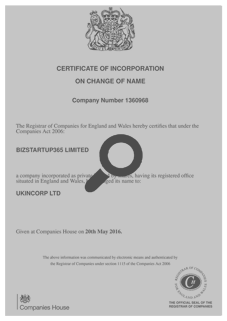
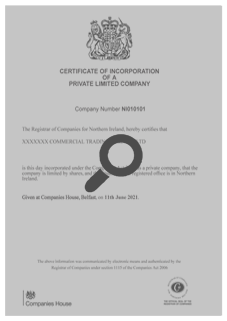
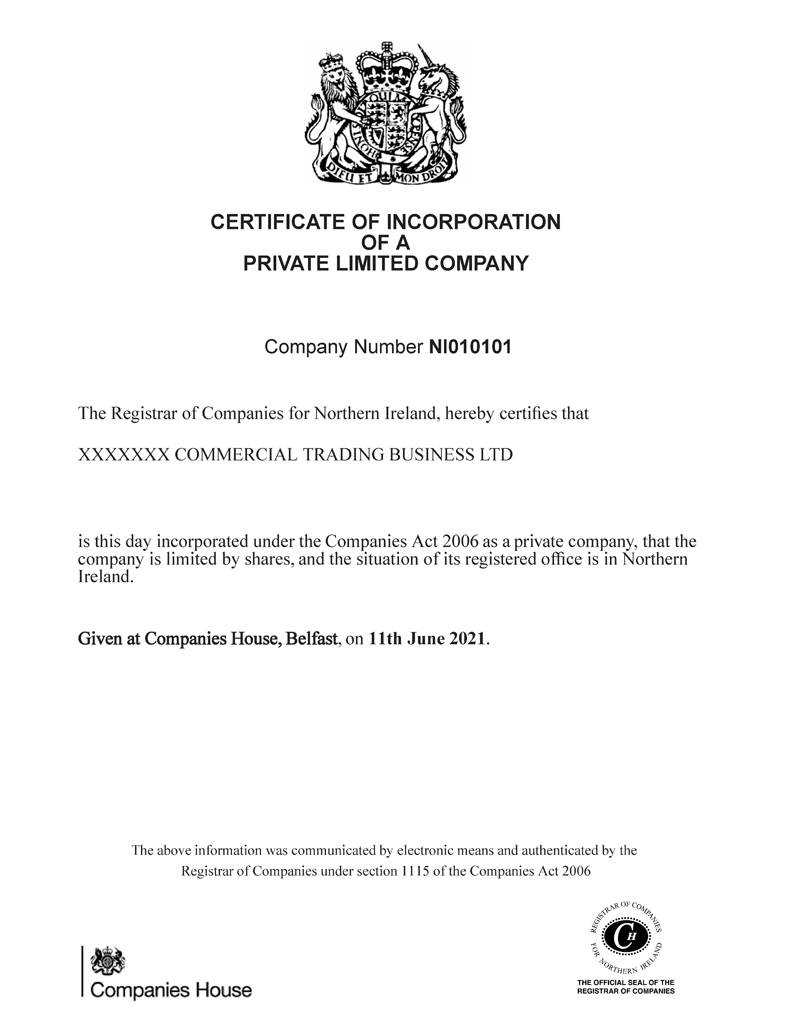
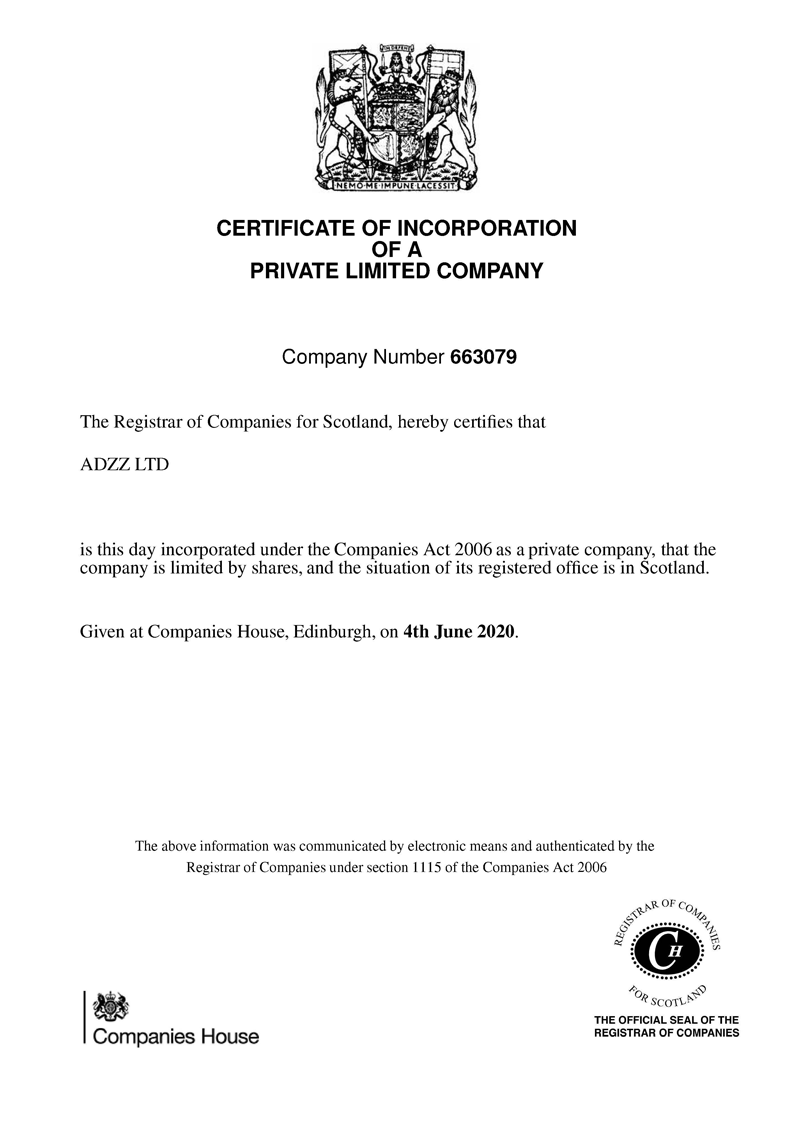
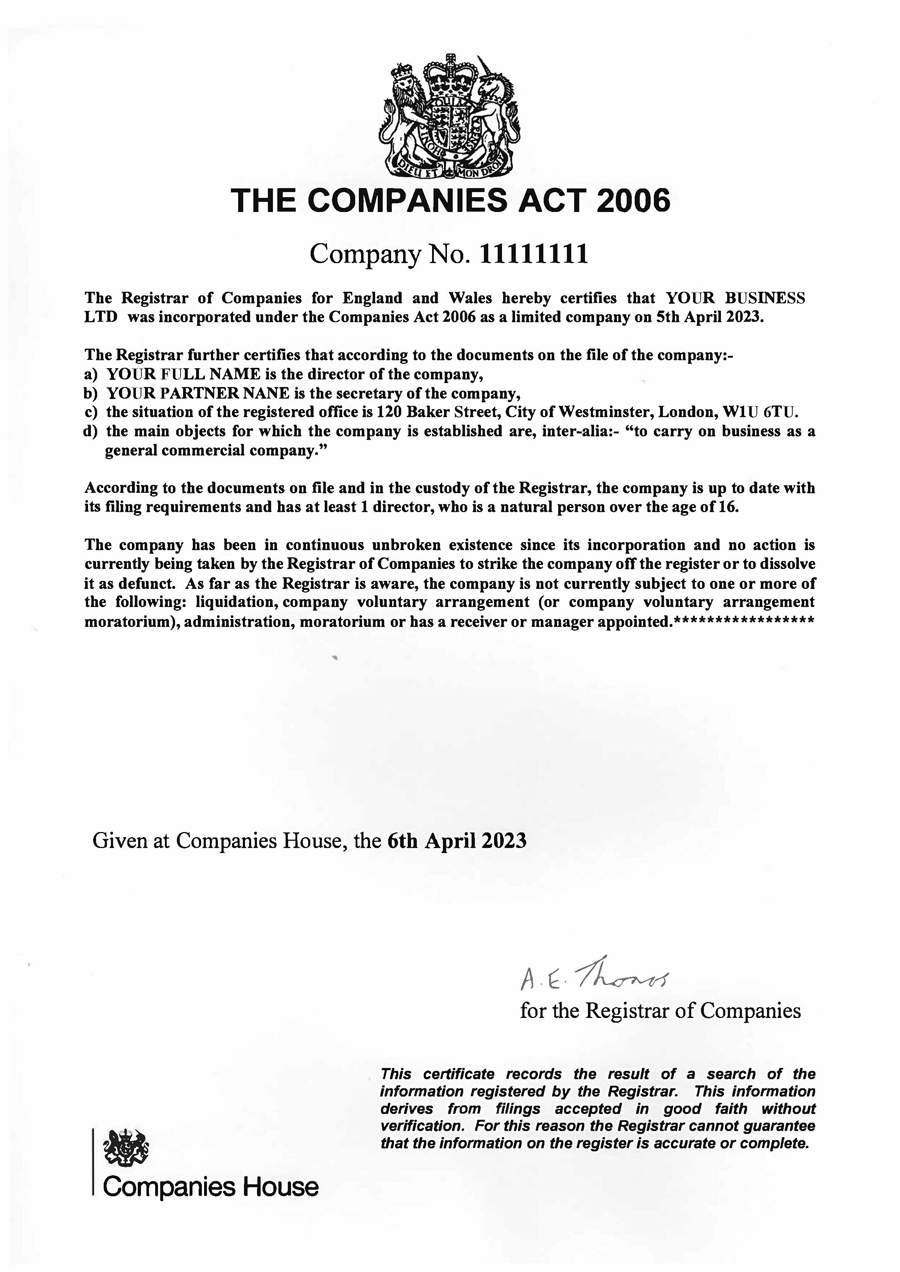
Companies House describes the certificate of incorporation as confirmation that the company legally exists. The certificate records, among other things, the company's name, number, incorporation date, whether it is limited by shares or guarantee and the jurisdiction of its registered office.

The certificate records the birth. The company is what has been born.

That distinction matters. The professional destination is not simply possession of a certificate. It is the creation of the corporate body intended to carry the organisation that has been progressively understood and constructed.

The company should emerge from the organisation — not from the form

No single incorporation fact determines the whole company.

An overseas participant, a wider membership, a corporate member, a particular company name or an individual constitutional feature may affect part of the formation. Its significance comes from how it fits with the purposes, people, governance, constitution and particular circumstances already understood.

The sequence therefore remains:

organisation understood → company constructed → incorporation submitted → company registered

This is the incorporate it stage of the formation road. It brings the work already done into legal corporate existence; it does not replace that work.

And incorporation is not the end of the organisation's corporate life. Once the company exists, the journey moves from creating the company to what follows from having a registered corporate body.

12

Your CLG Has Been Incorporated — What Happens Next?

Incorporation changes the position fundamentally. What began as an organisation to be understood and a company to be constructed now exists as a registered corporate body.

The certificate of incorporation confirms that the company has been duly registered. From that point, the directors, members or guarantors, governing document and registered corporate information are no longer simply parts of a formation proposal. They belong to an existing Company Limited by Guarantee. Companies House guidance likewise distinguishes incorporation from the responsibilities that follow it: once incorporated, a company has continuing filing and notification obligations.

From a newly incorporated company to an organised corporate position

The immediate question is therefore not simply whether the certificate has arrived. It is whether the company created through the formation process is ready to begin functioning as the corporate instrument intended for the organisation.

Depending upon the company and its circumstances, that transition may involve putting its incorporation documents and appropriate corporate records into order, recognising its initial directors and members or guarantors within those records, recording relevant initial corporate decisions, dealing with appropriate membership or guarantee documentation, and making sure that its registered corporate arrangements operate as intended.

It also means knowing that the company has moved into a continuing corporate life. Companies must provide information to Companies House after incorporation, including annual information and relevant changes, and the first confirmation-statement review period runs from incorporation.

These are not identical steps for every charitable CLG. The appropriate initial administration follows the organisation, constitution, people and particular circumstances of the company that has actually been created.

The founders do not need to diagnose the next corporate procedure

The people establishing the organisation will normally know what they intend to do next. They should not have to determine for themselves which corporate records apply, which initial decisions require formal recording, how membership information should technically be maintained, or which later Companies House procedures may become relevant.

Those ordinary circumstances can instead be considered in the context of the company that has been incorporated, with the appropriate company-secretarial significance dealt with within the scope of the service.

That preserves the same principle followed throughout the formation journey: the organisation comes first, and the corporate administration follows the organisation.

Incorporation does not complete every other route

The creation of the CLG at Companies House should also be kept separate from other processes that may apply to the organisation.

Incorporation does not by itself complete charity registration, establish HMRC charitable recognition or tax treatment, complete banking or funding arrangements, or resolve every other regulatory step that the organisation may need. Those are separate matters whose relevance depends upon the organisation and the route it is following.

Section 12 does not need to determine those matters. What matters here is the transition: the company now exists, and its corporate position must begin to operate accordingly.

That is where the formation road moves beyond incorporate it and begins maintain it.

13

Keeping the Company's Corporate Position in Order

Once the immediate post-incorporation position has been established, the company enters a different stage of its corporate life. It continues to exist, recurring responsibilities arise, and circumstances that were correct when the CLG was incorporated may later change.

Keeping the company in order therefore involves more than remembering that Companies House filings exist. The company's actual corporate position, its records and decisions, and the information that needs to appear on the public register should continue to describe the same organisation coherently.

Some responsibilities arise because time passes. Others arise because something happens.

There are two broad reasons why continuing company-secretarial work may become necessary.

Some responsibilities are recurring. They arise because the company continues to exist and reaches particular corporate dates or reporting points.

Others are event-triggered. They arise because something changes — perhaps somebody joins or leaves, an address changes, the organisation wants to alter an existing corporate arrangement, or another event affects the company's recorded position.

That distinction matters because a corporate event is not necessarily just a filing event.

A change may need to be understood against the company's existing constitution, governance arrangements, membership and corporate records before the appropriate action can be identified. Where a Companies House filing is required, that filing may be one part of the resulting corporate work rather than necessarily the whole of it.

The customer supplies the fact; the professional response follows

Directors and founders should not have to diagnose the company-secretarial machinery themselves.

They ordinarily know the relevant fact: a person has joined or left, something has changed, the company wants to do something differently, or a recurring responsibility is approaching. They should not first have to decide which filing, register entry, corporate decision, resolution or constitutional procedure follows from it.

The ordinary corporate event comes first. Its professional significance is considered within the corporate position of the company that already exists.

That also means apparently similar events do not have to produce identical responses in every charitable CLG. The appropriate treatment depends upon what has happened and how it fits with that company's constitution, people, governance and existing corporate position.

Maintaining the company means maintaining coherence

This is the continuing part of the formation road.

The organisation was understood, the company was constructed and incorporated, and its initial corporate position was put into order. From that point, maintaining it means keeping the corporate position coherent as responsibilities recur and circumstances change.

Company-secretarial support therefore connects what is happening in the organisation with what, if anything, needs to happen within the company's corporate records, decision-making arrangements and applicable public filings.

The organisation continues to develop. Its corporate position needs to develop with it.

14

Companies House, HMRC and the Company's Wider Regulatory Position

A charitable CLG can be one organisation while having several different institutional relationships.

Companies House, the applicable charity regulator and HMRC do not perform the same job. Incorporating the company, establishing or registering its position under charity law where applicable, and obtaining recognition for charitable tax purposes are separate matters, even though they may concern the same organisation.

Understanding which relationship a particular matter belongs to is therefore part of maintaining the organisation's wider position.

One organisation does not mean one regulatory route

Companies House deals with the company as a corporate body: its incorporation and the company information and filings required under company law.

Charity regulation has a different purpose. Depending upon the organisation and the part of the UK concerned, its charitable position may involve a separate charity regulator and separate registration or regulatory requirements. The rules are not identical throughout the UK, and not every charitable organisation follows precisely the same registration route. Current official guidance expressly distinguishes the England and Wales process from Scotland and Northern Ireland.

HMRC performs another function. Recognition by HMRC for charitable tax purposes is distinct from Companies House incorporation and from registration with a charity regulator. Current HMRC guidance also recognises that some organisations must first register with the appropriate charity regulator, while organisations not required to register with one may follow a different route to HMRC recognition.

The same CLG can therefore have a corporate position, a charity-regulatory position and a tax position that are connected but not interchangeable.

One completed route does not answer every other question

A company can have charitable purposes without that fact alone answering every question about charity registration or tax treatment.

Likewise, incorporation at Companies House does not itself give the company HMRC recognition for charitable tax purposes. HMRC requires recognition for access to relevant charitable tax reliefs, subject to the applicable conditions.

Nor should the founders have to work backwards through those different systems and decide which institutional label or procedure applies before approaching Coddan.

They provide the ordinary facts about the organisation: what it exists to achieve, what it does, where it operates, who is involved and what position it is trying to establish. Those circumstances can then be considered against the relevant corporate, charitable and tax relationships within the scope of the service.

The ordinary organisational position comes first. The appropriate institutional route follows from it.

Keeping the different positions connected without confusing them

These distinctions do not mean that the different regimes exist in isolation.

The organisation, its purposes, governing document, activities and people can be relevant in more than one institutional context. For example, charitable purposes matter to charity status and are also relevant to HMRC's consideration of charitable tax recognition.

The professional task is therefore not to pretend that Companies House, charity regulation and HMRC are one process. It is to recognise where they are separate, where information or decisions interact, and which route a particular matter belongs to.

Companies House does its job by creating and maintaining the corporate register for the company. The applicable charity regulator performs its charity-law role. HMRC determines the organisation's position for charitable tax purposes.

The organisation sits at the centre of those relationships.

Maintaining its wider position means understanding the difference between them without losing sight of the fact that they concern the same organisation.

15

Money Coming Into the CLG — What Is It Actually For?

Once the organisation begins operating, money may come into the CLG in different ways and for different reasons.

Someone may support the organisation without receiving something in return. Funding may be provided for a particular project or purpose. Members may make payments connected with membership. The organisation may charge for an activity or service, sell something, receive sponsorship or obtain money through another arrangement.

Those receipts may all put money into the same company bank account. That does not make them the same thing.

The payment comes second. The reason for it comes first.

Understanding a receipt begins with the ordinary circumstances behind it.

Why was the money paid? What was the organisation doing? Was anything supplied or promised in return? Was the payment connected with membership, a particular project, the organisation's activities or another relationship?

Those are questions about what actually happened. They are not questions requiring the people running the organisation to determine the tax or accounting conclusion themselves.

That distinction matters because charitable organisations can receive income from different sources, and the tax treatment does not arise simply from the fact that the organisation has charitable purposes. HMRC's current guidance confirms that charities receive relief on many forms of income when the applicable conditions are satisfied, while income or expenditure outside those conditions can have different consequences.

Not every payment connected with a charitable organisation has the same character

This is particularly important where the CLG carries out activities for which money is received.

A charitable organisation can charge for goods or services as part of carrying out its purposes. HMRC distinguishes this kind of primary-purpose trading from trading undertaken principally to raise funds. The fact that both activities produce money does not make their treatment identical.

The same caution applies more widely. A receipt should not automatically be called a donation merely because the organisation is charitable. Nor should a grant, membership payment, sponsorship arrangement or payment for an activity be classified solely from the name attached to it.

The ordinary facts come first. The professional treatment follows from what the payment actually represents within the organisation and the applicable rules.

The customer should not have to become the tax adviser

The people running the CLG ordinarily know the underlying facts. They know why somebody paid the organisation, what the organisation provided or agreed to do, and how the receipt relates to its activities.

They should not first have to decide whether the receipt constitutes taxable trading income, qualifies for a charitable exemption, affects VAT, is capable of attracting Gift Aid, or requires some other accounting or tax treatment.

Those are separate professional questions arising from the underlying circumstances.

This follows the same principle used throughout the formation journey:

ordinary fact → understand its place within the organisation → determine its professional significance

rather than:

money received → choose a label → assume the legal or tax consequence

The organisation remains the starting point

Understanding money coming into the CLG therefore returns us to the organisation that Page 10 began by understanding.

Its purposes, activities, beneficiaries, membership arrangements and the circumstances in which it receives money can all help explain what a particular receipt represents.

That does not mean every receipt requires complicated analysis. It means its treatment should follow its real character rather than an assumption created by the words charitable company.

The company is the instrument through which the organisation operates. Money entering that instrument needs to be understood in the context of what the organisation is actually doing.

That keeps the financial and tax position connected to the organisation rather than allowing a payment label to determine the answer on its own.

16

Is Your New Company Ready for Its Intended Life?

By this point, the organisation has travelled a considerable distance.

It has been understood, translated into an appropriate corporate structure, constructed around its purposes, people and governance, incorporated as a Company Limited by Guarantee, and considered in the context of the corporate, regulatory and financial circumstances relevant to its intended operation.

The final question is not whether the people running it have learned every rule that could ever apply.

It is whether, on the circumstances presently known, the new company is ready to begin the life for which it has been established.

What has already been dealt with should stay dealt with

Some matters will already have been identified and addressed during the formation journey.

They do not need to be reopened simply because the company has now been incorporated. Nor should additional work be manufactured where the organisation's circumstances do not require it.

That is an important part of professional readiness.

The purpose of this final checkpoint is not to find another problem. It is to make sure that something genuinely important has not been left unresolved between understanding the organisation, constructing the company and preparing it for its intended use.

Has anything important changed or remained unresolved?

Sometimes circumstances develop while a company is being established. Something expected at the beginning may have changed, new information may have emerged, or a matter previously uncertain may now be clearer.

The founders and directors do not need to decide whether that circumstance creates a company-law, charity, governance, accounting, tax, regulatory or other professional requirement.

They provide the ordinary fact: what has changed, what remains uncertain, or what they now expect the organisation to do.

Its significance can then be considered in the context of the company and organisation already understood.

A changed or unusual circumstance does not automatically mean something is wrong. It may require an additional corporate step, document, filing, registration or other appropriate action. It may affect a separate professional or regulatory route.

Or it may require no further action at all.

Readiness does not mean doing more

There is an important difference between completing something genuinely required and adding work merely because more work is possible.

If the company has been appropriately established, the relevant matters have been dealt with and nothing else in the presently known circumstances requires action, nothing further may presently be required.

That is a valid professional outcome.

Equally, where something does require attention, the appropriate response should follow the actual circumstance rather than forcing the founders to search through every possible obligation and decide for themselves which one might apply.

The same principle therefore remains intact at the end of the road:

the customer provides the reality; the professional response follows from that reality.

Ready for the company's intended life

Readiness does not mean that nothing will ever change.

The company now has a continuing corporate life. Responsibilities will recur, people and circumstances may change, the organisation may develop and future events may require further corporate, regulatory, accounting, tax or other attention.

Those future matters should be dealt with when their actual circumstances arise.

The purpose of this journey has been different: to establish the organisation coherently rather than leave the founders with a certificate and another list of professional questions to investigate for themselves.

At this point, the organisation has been understood, the company has been constructed and incorporated, its immediate corporate position and wider circumstances have been considered, and any genuine matter presently requiring further attention can be identified from the facts.

The company can then begin its intended life.

17

Frequently Asked Questions About Forming and Running a Charitable Company Limited by Guarantee

The journey above explains how the organisation, company, governance, constitution, incorporation and continuing corporate position fit together. These questions address some of the practical points that can remain when those parts are considered together.

Does forming a Company Limited by Guarantee automatically make the organisation a charity?

No.

A Company Limited by Guarantee is a corporate structure. Whether an organisation is charitable depends upon the applicable charity-law position, including its purposes and public benefit. Incorporation at Companies House should therefore not be confused with charity status, registration with an applicable charity regulator or HMRC recognition for charitable tax purposes.

Those are different questions even where they concern the same organisation.

Does every charitable organisation need to register with a charity regulator?

Not simply because it has charitable intentions or has been incorporated as a Company Limited by Guarantee.

The position depends upon the organisation, the applicable charity-law jurisdiction and its circumstances. The founders should provide the facts about the organisation rather than having to decide for themselves which registration, exception or other regulatory route applies.

Does Companies House decide whether the organisation is a charity?

No.

Companies House incorporates and registers companies and maintains the company register under company law. Charity regulation and HMRC's treatment of an organisation for charitable tax purposes perform different functions.

The fact that the same organisation may have relationships with more than one public body does not make those relationships interchangeable.

Do we need to know the exact charitable objects before approaching Coddan?

No.

The founders should be able to explain what the organisation is intended to achieve, who it is intended to benefit and what it expects to do.

They should not have to translate those ordinary facts into technically drafted charitable objects before seeking formation support. The constitutional expression should follow the organisation that has been understood.

Can we simply use standard articles of association?

The appropriate governing document depends upon the company being established.

The important question is not whether a document is described as standard or bespoke. It is whether the constitution appropriately supports the organisation's purposes, membership, governance and other relevant circumstances.

The organisation and its governance come first. The constitutional machinery follows.

Does a charitable CLG have to appoint a company secretary?

Not merely because it is a charitable Company Limited by Guarantee.

A private company is not generally required under company law to appoint a company secretary. An organisation may nevertheless choose company-secretarial support because of the corporate administration, governance and coordination it requires.

The existence of the professional function should not be confused with a universal legal requirement to appoint somebody to the statutory office.

Is company formation finished when the certificate of incorporation is issued?

The certificate marks an essential legal point: the company has been incorporated.

But the professional journey does not necessarily end there. The newly created company moves into its own corporate life, with its constitution, directors, members or guarantors, corporate records and continuing responsibilities now belonging to an existing corporate body.

What needs attention after incorporation depends upon the company actually created and the wider route being followed.

Does incorporation also complete HMRC or charity-registration requirements?

No.

Companies House incorporation, charity regulation or registration, and HMRC recognition and tax treatment are separate institutional processes.

Completion of one should not automatically be treated as completion of the others. Which additional route is relevant depends upon the organisation and its circumstances.

Do all charitable CLGs have the same post-incorporation requirements?

No.

There are company-law responsibilities that apply according to the legal framework, but the practical corporate and regulatory position of one organisation can differ from another.

Its constitution, people, activities, governance, regulatory position and later events can all affect what needs attention. That is why the appropriate route follows the company and organisation actually established rather than a universal post-incorporation checklist.

If something changes later, do we just file the change at Companies House?

Not necessarily.

Some changes require a Companies House filing, but the filing may be only one part of the corporate work arising from the event.

The change may first need to be considered against the company's constitution, governance arrangements, membership, corporate decisions and records. The appropriate public filing, where one is required, should then form part of a coherent corporate response.

A corporate event is not necessarily just a filing event.

Do we need to understand which filing, resolution or corporate procedure applies before contacting Coddan?

No.

The directors or people involved should ordinarily be able to explain the fact they know: somebody has joined or left, something has changed, the organisation wants to do something differently, or there is another circumstance requiring attention.

They should not have to convert that fact into a Companies House form, resolution, register entry, constitutional procedure or other technical instruction first.

The fact comes first. Its professional significance follows from the company's circumstances.

Does money received by a charitable CLG automatically count as a donation?

No.

The description given to money does not by itself determine its character or treatment.

What the payment is actually for and the circumstances in which it is received matter. Money that is freely given may stand differently from a payment connected with goods, services or other substantive benefits, but the surrounding circumstances still need to be considered.

The organisation should therefore describe the real transaction rather than trying to select its tax or accounting classification first.

What if our organisation has an unusual circumstance?

Explain the circumstance in ordinary language.

Something unusual does not automatically mean that something is wrong, that the CLG structure is unsuitable or that an additional service is required. Its significance depends upon how it fits with the organisation, its purposes, people, governance, constitution and wider circumstances.

A particular circumstance is a fact to understand before it is a problem to classify.

What if something changes while the company is being formed?

The changed fact should be considered rather than ignored merely because an earlier stage of the formation journey has already been completed.

Whether it affects the incorporation, constitution, participants, regulatory route or nothing material at all depends upon what changed and the point the formation has reached.

The customer supplies the changed circumstance. Its professional consequence should not have to be diagnosed by the customer.

What if everything has already been dealt with and nothing else appears to be required?

That is a perfectly valid outcome.

The purpose of the formation journey is not to manufacture additional work after incorporation. If the company has been appropriately established, the relevant circumstances have been considered and there is no genuine outstanding matter requiring immediate attention, nothing further may presently need to be done.

The company will still have responsibilities as time passes and circumstances change. But being ready does not mean inventing future problems before they exist.

View Charitable CLG Formation Packages