We use cookies on this website, you can read about cookies and GDPR Privacy Policy here
Coddan CPM Ltd. – Company Registration Agent in the UK

Follow the journey from identifying each LLP role to distinguishing designated and corporate members, assessing significant control and confirming the appropriate filing or governance route.

Step 1
Identify LLP Members
Step 2
Confirm Designated Status
Step 3
Assess Corporate Participation
Step 4
Determine PSC Status
Step 5
Review Control Evidence
Step 6
Confirm Filing Route
Companies Registry's e-Services Portal LLP & Limited Partnerships Compliant Corporate Formations: LLPs & LPs UK LLP Governance: Decoding Member Roles, Corporate Partners & PSC Status

UK LLP Governance: Decoding Member Roles, Corporate Partners & PSC Status

  Ensure clarity in your LLP's structure! For £195 + VAT, Coddan provides a detailed assessment of members and control roles. No hidden fees!

Know who belongs to the LLP, who carries filing duties and who controls it.
LLP Members, Designated Members, Corporate Members and PSCs Assessment — £195 + VAT. Recommended for an existing or proposed LLP whose member, designated-member, corporate-member, authority or PSC position needs a documented route assessment. Coddan reviews the supplied membership, control, agreement and corporate evidence, distinguishes the relevant capacities and produces a written recommendation for formation, filing, identity or professional follow-up. The professional outcome is a documented role-and-control route without conflating membership, designated status, corporate participation and PSC status. You must provide the complete factual and documentary position; identity verification does not itself prove authority, ownership, membership or control, and Coddan does not provide a legal opinion through this assessment.
The fixed £195 + VAT is Coddan’s professional fee; there is no Companies House fee for the assessment itself. This is a one-off commissioned assessment with no automatic renewal. Actual event filings, identity verification, agreement amendments, disputed rights, foreign-law analysis and legal or tax advice remain separate. Actual member and PSC events use the LLP changes service. Agreement work is separately explained at LLP agreements and governance. The A06 destination itself remains non-clicking until its separate live URL is confirmed. The assessment recommends a route; Companies House, advisers and verification providers retain their own decisions.

Price: £195.00

LLP Roles & Control™

Recommended for


LLP roles, responsibility and significant control

LLP Members, Designated Members, Corporate Members and PSCs

Understand which role a person or organisation holds, what the role places on the Companies House record, and which internal or professional questions remain to be settled.

Membership, designated status and significant control are not interchangeable labels. One person may hold more than one role, while another member may not meet any PSC condition. The correct position depends on the LLP’s members, agreement, voting and management rights, ownership chain and actual control arrangements.

Free guidance: complete on this page. Optional assessment: £195 + VAT where the roles or control position remain unclear. The assessment has no official fee or renewal and does not include formation, a change filing, identity verification, an LLP agreement or legal or individual tax advice.

Four questions that must not be collapsed into one

An LLP’s people and organisations need to be recognised by function. The incorporation or change filing records particulars; it does not replace the internal decisions, evidence or professional analysis behind them.

Question 1

Who is a member?

The LLP must identify the individuals or bodies admitted as members. Membership is the legal relationship with the LLP—not a shareholding and not merely a job title.

Question 2

Which members are designated?

The LLP may designate every member or specify particular members. Designated members carry additional statutory administration and filing responsibilities.

Question 3

Is a member a body corporate?

A corporate member needs its own filing particulars, existence and authority evidence, authorised-person arrangements and ownership-and-control analysis.

Question 4

Who has significant control?

PSC status follows statutory conditions concerning economic rights, voting, management appointments or significant influence or control. It does not follow automatically from membership.

The public filing and the internal organisation do different jobs

Companies House needs the prescribed member, designated-status and PSC information. Those public particulars do not, by themselves, decide how the members will manage the LLP, divide profits, contribute capital, vote, admit or retire members, or resolve disagreements.

The Companies House record

  • identifies the registered members and their required particulars;
  • records which members are designated, or that all are designated;
  • records the registrable PSC or relevant legal entity position; and
  • must be updated when a reportable event occurs.

The internal organisation

  • allocates management, voting and decision authority;
  • settles profit, capital and economic arrangements;
  • sets admission, retirement, incapacity, death and exit provisions; and
  • assigns practical responsibility for records, filings and professional work.

Registration records an instructed legal position; it does not organise the complete working relationship. The detailed agreement and governance route belongs to LLP agreements and governance.

An ordinary member is still an LLP member

“Ordinary member” is useful shorthand for a member who is not designated. It does not mean a passive investor, a shareholder or a limited partner. The member’s rights and responsibilities towards the LLP and the other members arise from the applicable legislation, the LLP agreement and the general law.

What membership identifies

  • the person or body admitted to the LLP;
  • a participant in the LLP relationship;
  • the person to whom the applicable internal rights and duties attach; and
  • a role that may also carry designated or PSC status, if the separate tests are met.

What membership does not establish alone

  • that the member is passive or has no management role;
  • that profits, votes or capital must follow the same proportions;
  • that the member is or is not a PSC;
  • that a particular tax outcome applies; or
  • that internal authority has been allocated appropriately.

Designated members carry additional statutory administration

A designated member remains a member. Designation adds statutory responsibilities; it does not convert the member into a company director or make that person generally liable for every LLP debt.

Ordinary and designated LLP member comparison
Question Ordinary member Designated member Important control
Member statusA member of the LLP.A member of the LLP with additional statutory responsibilities.Designation does not create a separate ownership class.
Internal rights and dutiesGoverned by legislation, the LLP agreement and applicable general law.The same starting point applies to mutual rights and duties towards the LLP and other members.Designated status does not, by itself, decide votes, profit or management authority.
Statutory filing workNo designated-member status merely from being an ordinary member.Additional responsibility for prescribed accounts, confirmation-statement, change and dissolution work.The LLP may allocate practical work, but statutory responsibility cannot be dismissed as an internal label.
Liability meaningNot equivalent to a passive limited partner.Not unlimited liability merely because the member is designated.Personal exposure may arise under particular law or conduct; designation alone is not universal debt liability.

All members or specified members

The incorporation filing can state that every person who is a member is designated, or identify specified members as designated. A later change must follow the applicable member agreement and notification route.

At least two designated members

An LLP must have at least two designated members. If there would otherwise be fewer than two designated members, every member is treated as a designated member.

Additional statutory responsibilities

Companies House identifies accounts, confirmation statements, prescribed change notifications, audit appointment where needed, and acting in a winding up or dissolution among the additional responsibilities.

The annual-accounts owner handles preparation, evidence and designated-member approval and signature. The continuing-compliance owner handles the confirmation statement and filing calendar; LLP members, designated members, corporate members and PSCs explains the role rather than performing those services.

The two-member continuity control

One departure can create two different minimum-number problems

A retirement, death, removal or other cessation may affect both the number of members and the number of designated members. The change should therefore be checked as a structural event, not treated only as a form submission.

At least two members at incorporation

Two or more persons subscribe to incorporate an LLP for carrying on lawful business with a view to profit. A one-person business should not manufacture a nominal second member merely to obtain an LLP.

The six-month statutory consequence

If the LLP carries on business with only one member for more than six months, a remaining member who knows it is operating alone can become jointly and severally liable with the LLP for obligations incurred during the period after those six months.

The designated-member fallback

If fewer than two designated members remain, every member is treated as designated. This does not cure a one-member structure; it addresses designated status under the separate rule.

A proposed event should be routed to Change members, designated status and PSC details for the actual member or designated-status change filing and to LLP agreements and governance where the LLP agreement, retirement or exit documents also need attention.

A corporate member adds an entity, authority and control layer

A body corporate may be an LLP member. Its name on the filing is only the beginning of the professional route: the entity must exist, have authority to enter the LLP, act through authorised persons and sit within an ownership and control chain that can be understood.

Corporate LLP member evidence and boundaries
MatterWhat may need to be establishedWhat it does not prove
Corporate existenceLegal name, number, legal form, jurisdiction, registered office and current existence.That the entity has internally authorised the LLP relationship.
AuthorityConstitutional capacity, governing approval, authorised signatory and representative arrangements.That Companies House has approved the commercial decision or authority evidence.
Ownership and controlDirect and indirect owners, beneficial owners, control rights and the corporate member’s place in the LLP PSC analysis.That the corporate member itself is necessarily the only registrable controller.
Professional consequencesRelevant accounting, tax, agreement, filing and professional-advice dependencies.That corporate membership creates a guaranteed tax or liability outcome.

UK corporate member

A transparent UK body may follow a bounded evidence and assessment route, but its authority, ownership, control and relevant PSC position still need to be established from the supplied facts.

Overseas corporate member

Foreign registry, constitutional, authority, translation, certification, ownership-chain, CDD or EDD requirements move the case to International and non-UK LLP formation.

Review formation with non-UK or international members

Membership does not automatically answer the PSC question

PSC recognition tests rights and control, not labels. A member may satisfy one or more statutory conditions; another member may satisfy none. A non-member may also be relevant where the statutory conditions are met directly or indirectly.

Five LLP PSC conditions
Condition Defined recognition question Evidence commonly relevant Boundary
1. Surplus assetsDoes the person hold, directly or indirectly, rights over more than 25% of the surplus assets on a winding up?LLP agreement, capital or economic rights and indirect arrangements.Ordinary profit allocation alone should not be used as a substitute for the statutory test.
2. Voting rightsDoes the person hold, directly or indirectly, more than 25% of the voting rights?Agreement, voting schedule, reserved decisions and indirect holdings.One-member-one-vote must not be assumed where the agreement says otherwise.
3. Management appointmentsDoes the person hold the right to appoint or remove the majority of those entitled to take part in management?Appointment rights, management committee terms and governance documents.Designated-member status does not itself settle this condition.
4. Significant influence or controlDoes the person otherwise have the right to exercise, or actually exercise, significant influence or control over the LLP?Actual decision patterns, veto or approval rights, contractual arrangements and statutory guidance.Fact-sensitive or disputed influence may require legal analysis.
5. Trust or firm influenceWhere trustees of a trust or members of a firm meet another condition, does a person have the right to exercise, or actually exercise, significant influence or control over that trust or firm?Trust, partnership, nominee and control documents, plus the complete ownership chain.This is not suitable for a title-only or instant conclusion.

Roles can overlap without becoming the same role

The same participant may need to be recorded or assessed in several capacities. Each capacity has its own question and consequence.

LLP role overlap matrix
Example positionMember?Designated?PSC or RLE?What must be checked
Individual admitted as member and specified as designatedYesYesOnly if a statutory control condition is metAgreement, rights and actual control—not designation alone.
Individual ordinary memberYesNo, unless the fallback appliesPossiblyEconomic, voting, appointment and influence/control conditions.
Corporate memberYesMay beMay be an RLE if the statutory requirements are metEntity status, authority, rights and ownership chain.
Non-member controllerNoNoPossibly, if a condition is metDirect or indirect rights, actual influence/control and any trust or firm relationship.

Role recognition and identity verification remain separate controls

Companies House includes individual LLP members within the director-or-equivalent identity-verification framework. PSCs have their own verification and personal-code obligations, with the timing and use of the code depending on the role and when it began. Companies House currently identifies corporate LLP-member verification as a later implementation stage.

Individual member

The current framework requires the relevant individual to verify and use the personal code in the manner and at the time applicable to the role.

Individual PSC

PSC verification and the provision of the personal code are role-specific. A person holding another verified role may still have a separate PSC connection step.

Corporate LLP member

Corporate-member identity verification is listed by Companies House as a later stage. Corporate existence, authority, ownership and anti-money-laundering evidence may nevertheless be required now for Coddan’s acceptance.

LLP members, designated members, corporate members and PSCs identifies the dependency. The detailed document, proof-of-address, liveness, Credas, Coddan review, ACSP submission, personal-code and exception process belongs to the specialist verification owner.

Follow Coddan’s LLP identity-verification route

Optional professional assessment

A clearly defined role-and-route record where the position is unclear

The free explanation on this page is complete. The assessment is for a proposed or existing LLP whose actual member, designated-status, corporate or control facts need to be mapped before formation, a change filing, an agreement instruction or professional referral.

Coddan identifies what can be recognised administratively, what evidence is missing and which destination covers the next job. The assessment is not a legal opinion, tax recommendation or approval of the your commercial strategy.

Enquiry and assessment route

LLP Role and Control Assessment

£195 + VAT

  • map the supplied members and designated status;
  • identify minimum-number or continuity concerns;
  • record corporate-member and supplied ownership-chain facts;
  • identify apparent routine PSC conditions from complete supplied information;
  • identify missing evidence and verification dependencies; and
  • route formation, governance, change filing or professional advice.

Official fee: none.

Renewal: none.

Not included: formation, change filing, identity verification, LLP agreement, legal advice or individual tax advice.

Order treatment: enquiry and professional assessment; complex control is not instant checkout.

The assessment follows the evidence, not the preferred label

A reliable role-and-control map may require more than the current Companies House record. Coddan starts with the actual arrangement supplied by the you.

Member facts

Current and proposed members, admission or cessation dates, designated status and the intended continuing minimum.

Rights and agreement

Relevant voting, management, appointment, economic and control provisions from the LLP agreement or other arrangements.

Corporate chain

Corporate existence, authority, direct and indirect ownership, beneficial owners and authorised representatives.

Actual control

Reserved decisions, vetoes, appointment rights, actual influence and any trust, nominee or firm relationship.

Incomplete, disputed, indirect, trust-based, nominee or legally uncertain facts may be held for further evidence or referred to a solicitor or another appropriately responsible professional.

Once the role is recognised, send the work to its owner

LLP members, designated members, corporate members and PSCs resolves recognition and route. It does not absorb the professional job that follows.

Form a UK LLP

Where the role and control decisions are settled and the members are within the ordinary accepted route.

Proceed to UK LLP formation

International or overseas member

Where foreign evidence, corporate authority, ownership-chain, CDD or EDD work changes acceptance.

Use the international LLP formation route

Agreement and governance

Where internal rights, voting, authority, profit, admission or exit provisions need a document route.

Member, designation or PSC change

Where an existing LLP needs an appointment, retirement, designated-status, corporate-member or PSC event filed.

Annual accounts

Where the LLP needs accounts preparation, filing or designated-member approval and signature support.

Review LLP annual-accounts services

Confirmation and compliance

Where the continuing filing calendar or confirmation-statement work needs to be managed.

Review LLP confirmation-statement services

Clarity proved by role separation

A more straightforward next step starts with the correct question

The administrative friction usually begins when “member”, “designated member”, “corporate member”, “PSC” and “verified person” are treated as different names for the same status. Coddan separates those questions before routing the work.

Role first

Identify membership, designation, corporate status and control separately so that the next filing or document is not selected from an incorrect label.

Evidence next

Use the agreement, rights, ownership chain and actual control facts needed for the particular question, rather than requesting every possible document.

Correct owner last

Route the result to formation, governance, verification, accounts, compliance, a change filing or professional advice. That defined dispatch makes the administrative route more straightforward.

The underlying legal and control questions are not described as fast, quick, simple or easy. Clarity comes from separating the jobs and stating what Coddan can and cannot determine.

Why Coddan can connect the administrative routes

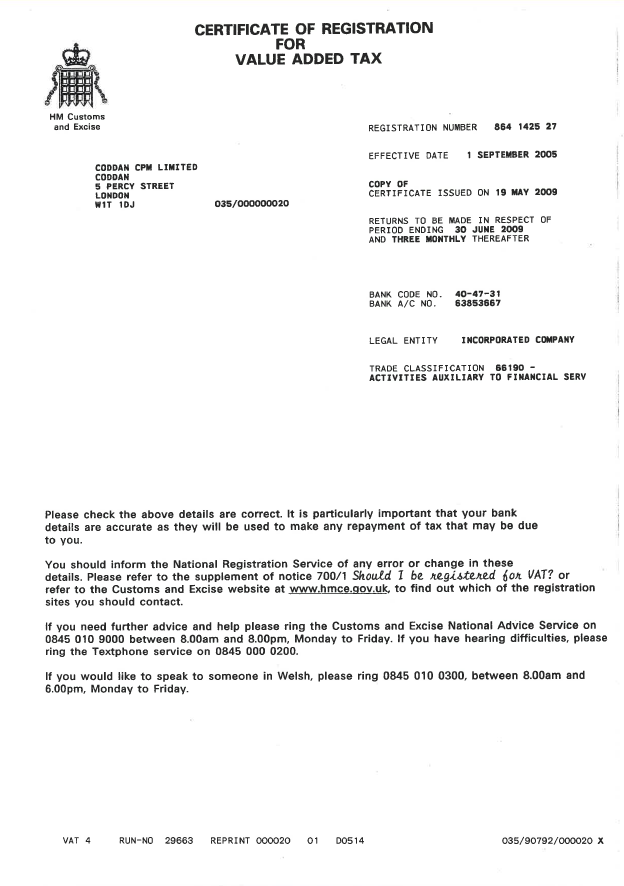
Coddan’s status is relevant here because the role map can lead into formation, anti-money-laundering acceptance and Companies House identity verification. It is supporting evidence—not governmental approval of the LLP or its chosen structure.

Formation services since 2005

Coddan has used commercial formation software and provided LLP formation administration since 2005.

Formation-agent route

Coddan can translate an accepted, settled role instruction into the relevant formation particulars. Companies House controls registration.

HMRC-supervised TCSP

Coddan applies its trust or company service provider acceptance and anti-money-laundering controls. HMRC supervision is not approval of a you or structure.

Companies House-registered ACSP

Coddan CPM Limited may provide approved identity-verification work through its registered ACSP role. Registration is not Companies House endorsement.

Some conclusions belong to another professional

Coddan can identify roles, examine supplied administrative evidence, recognise routine conditions and route the next service within the approved scope. It does not turn a role-and-control assessment into legal or individual tax advice.

Coddan’s administrative scope

  • role and evidence mapping;
  • routine filing-data recognition;
  • apparent routine PSC-condition recognition from complete facts;
  • identity and acceptance dependency recognition; and
  • routing to the correct filing, document or professional owner.

Professional referral

  • disputed ownership, authority or control;
  • trust, nominee or legally uncertain arrangements;
  • agreement interpretation, enforceability or negotiated rights;
  • individual or structure-specific tax conclusions;
  • complex accounting, audit or insolvency consequences.

Current authoritative position used for this page

The legal and filing position was checked on 22 September 2026. Identity-verification implementation can change, so the live Companies House position must be checked again before you rely on the service or submit a filing and at instruction.

Select the route after recognising the role

Proceed with the known instruction—or assess the unresolved position

If the members, designated status and routine PSC position are settled, continue to the appropriate formation or change owner. If the roles, corporate chain or control facts remain unclear, use the one-off £195 + VAT assessment to identify the evidence and correct next destination.

Request the LLP role and control assessment Proceed to ordinary UK LLP formation

The assessment depends on complete and accurate information. Complex or disputed legal, control, tax, accounting or insolvency conclusions may require the responsible professional.