We use cookies on this website, you can read about cookies and GDPR Privacy Policy here
Coddan CPM Ltd. – Company Registration Agent in the UK

Follow the LLP restoration journey from understanding the dissolution circumstances to identifying the appropriate restoration route and planning the next steps towards compliance.

Step 1
Review Dissolution Circumstances
Step 2
Assess Restoration Eligibility
Step 3
Identify Outstanding Requirements
Step 4
Select Restoration Route
Step 5
Coordinate Restoration Application
Step 6
Address Ongoing Compliance
Companies Registry's e-Services Portal LLP & Limited Partnerships Compliant Corporate Formations: LLPs & LPs Restoring a Dissolved LLP: Legal Process & Companies House Reinstatement

Restoring a Dissolved LLP: Legal Process & Companies House Reinstatement


Start Your Business Today: Fast Formation Services to Meet All Compliance Standards

Need to restore your LLP? Coddan offers a £195 diagnostic to assess your situation and recommend the best restoration route. Start your journey today!

For just £195 + VAT, Coddan provides a thorough LLP restoration diagnostic, guiding you through eligibility and next steps. Get started on your restoration!
£195.00
+VAT

Restoration Diagnostic™

Recommended for

1
package

Buy Now Before restoring the LLP, identify the route that actually exists.
Restoration Diagnostic — £195 + VAT. Recommended for a former member, creditor or other interested participant who needs the dissolution history, eligibility, missing filings, property and purpose reviewed before choosing a restoration route. Coddan examines the supplied register history and evidence, distinguishes administrative from court restoration and provides a written route, dependency and cost recommendation. The professional outcome is a documented restoration route showing whether Coddan can coordinate the next step or a solicitor must lead it. You must provide the dissolution facts, former LLP records and restoration purpose; the diagnostic does not itself restore the LLP or resolve Bona Vacantia, court or disputed-rights issues.

The fixed £195 + VAT is Coddan’s professional fee; no restoration application fee is charged at the diagnostic stage. This is a one-off assessment with no renewal. Missing accounts, penalties, tax work, property recovery, court proceedings, solicitor work and official fees remain separate. An eligible administrative case may proceed to Administrative Restoration. Court cases use Court Restoration. The diagnostic recommends the available route; Companies House, the court, the Crown and professional advisers retain their own decisions.


£991.00
+VAT

Administrative Restoration™

Recommended for

2
package

Buy Now The administrative route works only when the statutory conditions fit.
Administrative Restoration — from £650 + VAT. Recommended for a dissolved LLP whose completed diagnostic confirms eligibility for administrative restoration and identifies the missing filings, consents and other prerequisites. Coddan issues a written quotation, coordinates the accepted Companies House restoration work and connects separately required accounts, documents and Crown-related steps within the approved scope. The professional outcome is an eligible administrative-restoration application coordinated through the confirmed statutory route. You must satisfy every eligibility condition, provide the historic records and pay all official, penalty and professional charges; acceptance is not guaranteed.

Coddan’s professional fee starts at £650 + VAT. The £341 Companies House administrative-restoration fee and all penalties, filing fees and third-party charges are separate. The engagement is individually quoted and one-off. Accounts, tax returns, penalties, Bona Vacantia property work, legal advice, court proceedings and professional fees are excluded unless expressly scoped. The route must first be established through Restoration Diagnostic. An ineligible administrative case may require Court Restoration. Companies House and any other authority decide whether the conditions are met and the LLP is restored.


Establish why the LLP was dissolved, then select the lawful restoration route

LLP Restoration

A professional diagnosis of administrative or court restoration for a dissolved limited liability partnership, followed by coordinated administrative work or the correct solicitor-led route.

Restoration is not achieved by choosing a form. The dissolution history, applicant, statutory standing, time limit, outstanding filings, former name and Crown-property position determine the route.

Commercial position: the restoration diagnostic is £195 + VAT. Eligible administrative-restoration coordination starts from £650 + VAT after diagnosis. The £341 Companies House fee, £64 waiver-letter charge, outstanding filings, penalties and professional costs are separate. Court restoration is individually quoted and solicitor-led.

Diagnose the event before selecting the instrument

Why the LLP was dissolved decides what can happen next

A dissolved LLP may return to the register through administrative restoration or by court order. These routes have different applicants, statutory conditions, documents, decision-makers, costs and effective dates. They are not interchangeable.

Coddan begins with the public register and Gazette history, then establishes the your relationship to the LLP, the reason for restoration, the date and legal route of dissolution, outstanding filings and the position of any assets or liabilities.

Registrar strike-off

Administrative restoration may be available to a qualifying former member if the precise statutory conditions are met and the LLP's record is brought up to date.

Members' voluntary strike-off

Administrative restoration is unavailable. A qualifying applicant must use the court route and should obtain independent legal advice.

Insolvency dissolution

Restoration after liquidation, administration or another insolvency process belongs to a solicitor and, where relevant, a licensed insolvency practitioner.

Creditor, claimant or property interest

A creditor, contractual claimant, liquidator or other person with a qualifying interest normally requires court restoration rather than LL RT01.

Two routes, different legal tests

Administrative restoration and court restoration compared

The correct route follows the dissolution history and the applicant's standing. A preferred price, timetable or form cannot convert one route into the other.

Administrative and court restoration comparison
QuestionAdministrative restorationCourt restoration
Who may apply?A person who was a member of the LLP when it was struck off or dissolved and satisfies the statutory route.A qualifying former member, creditor, liquidator, contractual claimant, property-interest holder, pension trustee or another person appearing to the court to have an interest.
Dissolution routeRestricted to eligible Registrar strike-off routes and their individual statutory conditions.Available for a wider group of qualifying dissolution routes, including voluntary strike-off and specified insolvency dissolutions.
Members applied for strike-offNot available.Court order required if the legal conditions are met.
Ordinary time limitWithin six years after dissolution.Generally within six years after dissolution. The current law has a distinct personal-injury exception.
Main instrumentLL RT01 with the complete restoration package.Court claim, petition or originating process, supported by evidence and followed by delivery of the order to the Registrar.
Decision-makerRegistrar of Companies.The appropriate court, followed by the required delivery to Companies House.
Current principal official charge£341 Companies House fee, plus the current £64 waiver-letter charge and other applicable amounts.Court, solicitor, service, Registrar, Crown, filing and professional costs depend on jurisdiction and facts. The £341 administrative fee is not the court fee.
Outstanding filingsDocuments needed to bring the LLP record up to date form part of the package.The court evidence and order commonly address outstanding filings, which still require completion and payment.
When restoration takes effectOn the date the Registrar sends the notification of the decision to restore.When the sealed or certified order is delivered to the Registrar under the applicable jurisdictional route.
Coddan route£195 + VAT diagnostic, then administrative coordination from £650 + VAT if eligible and accepted.Diagnostic followed by an individual solicitor-led quotation or referral.
RenewalNo annual renewal for the restoration instruction.No annual renewal for the restoration instruction.

A restricted statutory package

LL RT01 is available only when every administrative condition is met

A former member can use LL RT01 only for a qualifying Registrar dissolution within six years. The exact strike-off ground matters. Where the Registrar treated the LLP as defunct, the LLP must have been carrying on business or in operation at the time of strike-off. Other current routes have their own evidence tests.

Applicant and time

  • former member with the required historic role;
  • application within six years of dissolution;
  • identity, standing and evidence consistent with the public record.

Eligible history

  • qualifying Registrar strike-off;
  • business or operation condition where applicable;
  • false-basis or default-address evidence where relevant.

Record brought up to date

  • outstanding documents and filing fees;
  • penalties, fines and financial penalties dealt with;
  • required address, email and Crown documents included.

Companies House decides whether the statutory conditions have been met. Dormant status, previous membership or payment of the official fee does not by itself establish eligibility.

One coordinated postal package

LL RT01 must travel with the documents that make restoration possible

Current Companies House instructions require the completed LL RT01, the correct £341 fee, all required outstanding documents and fees, outstanding applicable penalties and a bona-vacantia waiver letter to be sent as a package by post. An incomplete package may be rejected.

Core application

  • current LL RT01;
  • LLP name and registration number;
  • former-member applicant;
  • statement of compliance and current authentication;
  • £341 Companies House fee.

Register completion

  • outstanding accounts;
  • confirmation statements or annual returns;
  • associated filing fees;
  • applicable late-filing penalties;
  • other outstanding fines or financial penalties.

Supporting material

  • bona-vacantia waiver letter;
  • alternative name where needed;
  • LL AD01 and address-use evidence where applicable;
  • EM01 where applicable;
  • evidence for the particular strike-off ground.

Restoration does not erase the filing history

Outstanding documents, fees and penalties remain separate work

Companies House normally disregards the period during which the LLP was dissolved when measuring how late a pre-dissolution accounts obligation is. Accounts that became due only while the LLP was dissolved are treated differently under the current restoration rules. That distinction is not a blanket cancellation of every penalty or default.

Overdue before dissolution

Accounts, statements, filing fees and penalties already due must be identified and dealt with under their current rules.

Due during dissolution

The current late-filing treatment is applied document by document; do not assume that every later obligation or filing fee disappears.

Register corrections

Member, PSC, name, address and registered-email issues require their own current forms and lifecycle owners.

After restoration

The restored LLP must resume the relevant accounts, confirmation-statement, tax and event-driven compliance cycle.

LLP annual accounts covers accounts preparation. LLP confirmation statements and continuing compliance covers confirmation statements and registered-email administration. Change an LLP name, Change members, designated status and PSC details and Change LLP addresses and records own the relevant name, member, PSC and address events. Their fees and official charges are not included automatically in Restore a dissolved LLP.

A legal proceeding, not a substitute form

Court restoration follows the LLP's registration jurisdiction

Court restoration can serve a wider group of qualifying applicants and dissolution histories. It requires evidence, service on the proper parties, a court decision and delivery of the resulting order to Companies House. Coddan routes this work to an appropriate solicitor.

England and Wales

The current route uses a Part 8 claim, including form N208 where applicable, in the appropriate court. The Registrar must receive the required notice and service. The sealed order must be delivered to Companies House.

Scotland

The current route is through the Court of Session or the appropriate Sheriff Court. The petition must be served as required, and a certified copy of the order must be delivered to the Registrar in Scotland.

Northern Ireland

The current process involves an originating summons, supporting evidence and service on the required bodies before the court date. The sealed order must then be delivered to Companies House.

Evidence commonly required

Incorporation and membership, trading and cessation history, solvency, filing defaults, strike-off and dissolution, the applicant's interest, service evidence and the reason restoration is required.

Costs remain case-specific

Court fees, solicitor work, service, Registrar's costs, Crown costs, accounts, outstanding filings, penalties and specialist work are outside the administrative £341 fee and cannot be reduced to one public fixed price.

If the Registrar refuses administrative restoration, a qualifying applicant may apply to the court within 28 days of the decision, even where the ordinary restoration period has expired. This is a time-sensitive legal route, not an automatic appeal outcome.

Restoration and asset recovery are separate jobs

Property left in the LLP may have vested in the Crown

Money, land, receivables, shares, intellectual property, domain names, contractual rights and other property still belonging to the LLP at dissolution may become bona vacantia.

Current Companies House instructions require a waiver letter in the administrative-restoration package. The former member obtains it from the appropriate Crown representative. The standard current charge is £64, with further costs possible where the Crown representative has dealt with an asset.

What the waiver does not do

  • It does not transfer an asset to a former member.
  • It does not decide beneficial ownership.
  • It does not reverse a disclaimer or disposal automatically.
  • It does not require a bank or registry to release property immediately.
  • It does not guarantee recovery after restoration.

Scope boundary: Coddan identifies the Crown-property dependency and can coordinate supplied documents within an accepted restoration package. Asset tracing, Crown negotiations, property recovery, conveyancing, disclaimer questions, bank recovery and litigation are outside Restore a dissolved LLP and require the appropriate Crown or solicitor route.

Evidence follows the actual route

Information needed for a reliable restoration diagnosis

Coddan requests only the information relevant to the you, dissolution history and intended outcome. A former member's administrative case and a creditor's court application do not use the same evidence set.

LLP and dissolution record

  • former name and LLP number;
  • registration jurisdiction and incorporation date;
  • strike-off and dissolution dates;
  • Gazette and filing history;
  • Companies House correspondence or refusal.

Applicant and purpose

  • identity and relationship to the LLP;
  • historic membership evidence where relevant;
  • reason restoration is required;
  • business, claim, creditor or property interest;
  • professional advice already obtained.

Business and compliance

  • trading or operation at strike-off;
  • last trading date and solvency;
  • outstanding accounts and statements;
  • fees, penalties and fines;
  • member, PSC, address and email discrepancies.

Assets and liabilities

  • bank balances and receivables;
  • land, contracts and intellectual property;
  • creditors, claims and litigation;
  • Crown correspondence or waiver;
  • insolvency or court documents.

Each stage has a different legal effect

From dissolved record to effective restoration

A diagnostic report, completed form, postal delivery, issued court claim and Companies House acknowledgement are not restoration. The effective event comes later and depends on the route.

LLP restoration process and responsibility sequence
StageLegal or operational effectyou responsibilityCoddan roleExternal dependency
1. Identify the entityConfirms that the dissolved body is an LLP and establishes its jurisdiction.Supply the former name, number and known history.Review the public register and Gazette record.Companies House and relevant Gazette.
2. Diagnose dissolutionEstablishes whether administrative restoration can be considered or court restoration is required.Explain the reason and intended outcome accurately.Test the history, applicant and time limit.Solicitor where standing or route is uncertain.
3. Map dependenciesIdentifies outstanding filings, penalties, address, name, identity and Crown work.Supply records and engage the required owners.Produce the written diagnostic and route schedule.Accountant, tax adviser, solicitor, Crown or insolvency practitioner.
4. Complete outstanding workMakes the administrative package complete or prepares the court evidence.Approve accurate filings and pay applicable amounts.Coordinate only the work expressly accepted.Lifecycle owners and professional advisers.
5A. LL RT01 packageAsks the Registrar to decide an eligible administrative application.Authenticate the statement and provide the complete package.Prepare, assemble and post the accepted package.Companies House, postal delivery and Crown representative.
5B. Court proceedingAsks the appropriate court to order restoration.Instruct the solicitor and supply evidence.Provide an accepted administrative pack or coordination support.Court, solicitor, Registrar and Crown representative.
6. Decision or orderThe Registrar decides the administrative application, or the court makes or refuses an order.Respond to queries or directions and meet additional requirements.Record the outcome and identify separate remedial work.Registrar or court controls the decision and timing.
7. Effective restorationAdministrative: date the Registrar sends the restoration notification. Court: delivery of the sealed or certified order under the applicable route.Do not represent the LLP as restored before the effective event.Deliver the verified outcome record within the accepted scope.Companies House register and Gazette publication.
8. Post-restoration workThe LLP resumes its continuing legal, filing, accounting and operational lifecycle.Complete all remaining tasks through their correct owners.Coordinate only separately accepted work.Companies House, HMRC, banks, regulators, counterparties and advisers.

The former name may no longer be available

Restoration may require an alternative LLP name

The LLP is normally restored under its former registered name. If that name can no longer be registered, an alternative name may be supplied through the current administrative or court route.

If no acceptable alternative can be registered, the LLP may be restored as if its registration number were also its name. It must then complete the required LLP name-change procedure within 14 days.

Change an LLP name covers the resulting name change

The post-restoration route uses the applicable LLP name-change notice, including LL NM01 where required. The new name takes effect only when Companies House issues the relevant certificate.

A Companies House availability check does not reserve the name, confer trade-mark rights or remove the need to satisfy sensitive-word and other name restrictions.

Diagnosis first, then a defined route

Restoration fees and accepted scope

The diagnostic is the first paid service because the correct restoration route and the cost of making the LLP compliant cannot be known safely from its name and number alone.

Paid assessment

LLP Restoration Diagnostic

One dissolved LLP, one proposed applicant and one defined reason for restoration.

£195 + VAT

Searches and external documents separate where required

Included

  • register and Gazette history review;
  • applicant and preliminary standing check;
  • administrative-versus-court diagnosis;
  • six-year and route-timing check;
  • preliminary filings, address, name, asset and Crown review;
  • written route, dependencies and next steps.

Not included

LL RT01 submission, official fees, filings, penalties, accounts, court, legal, Crown, insolvency, tax or asset-recovery work.

One-off service. No renewal. No automatic credit against later work unless a written quotation expressly provides it.

Quotation after diagnostic

Administrative Restoration Coordination

For an eligible LL RT01 case with complete, consistent evidence and a defined restoration package.

From £650 + VAT

£341 Companies House fee and £64 waiver charge separate

Quoted scope may include

  • defined package checklist;
  • LL RT01 preparation;
  • review of supplied evidence and statement of compliance;
  • coordination of authentication and accepted outstanding documents;
  • assembly and postal submission;
  • submission and Registrar-outcome record.

Separate

Accounts, statements, change filings, fees, penalties, fines, Crown work, professionals, court work and asset recovery unless expressly stated in the quotation.

One-off service. No renewal. “From” is not a fixed price for every restoration.

Solicitor-led route

Court Restoration

For voluntary strike-off, qualifying creditors or claimants, insolvency histories, refusals, disputes and other cases outside LL RT01.

Individual quotation

Court and all professional or third-party costs separate

Route treatment

  • standing and jurisdiction verified;
  • solicitor appointed;
  • court evidence and service scoped;
  • outstanding filings and professional work identified;
  • Coddan administrative pack or coordination stated separately, if accepted.

No fixed-price implication

The £195 diagnostic is not court representation. The from-£650 administrative fee and £341 Companies House charge do not apply as a court package.

One-off instruction. No renewal. No guaranteed court order or asset outcome.

Evidence determines acceptance

Diagnostic, administrative quotation or professional referral

Paid diagnostic

Available where the dissolved entity and LLP number are known, the proposed applicant can be identified and the you explains why restoration is required.

The diagnostic produces a route and dependency record, not a restoration outcome.

Administrative quotation

Offered only after diagnosis confirms the eligible strike-off route, former-member standing, time limit, applicable operational condition, complete filings, address, name, Crown documents and ability to pay the required amounts.

Stop and refer

Use a solicitor, accountant, tax adviser, Crown route or insolvency practitioner for voluntary strike-off, disputed standing, court work, substantial property, litigation, limitation, insolvency, concealed facts or matters requiring professional interpretation.

Coddan may pause or refuse an instruction where eligibility cannot be established, dates appear false, evidence is withheld, the you seeks a false filing, required amounts will not be dealt with or the work falls outside Coddan's competence or risk appetite.

A returned package and a refused application are not the same

Rejection, refusal and resubmission require different responses

Companies House may return an incomplete package, request further evidence or decide that the statutory conditions for administrative restoration have not been met.

A corrected administrative package may be possible where the problem is curable. A substantive refusal, expired period, ineligible strike-off route or disputed standing may require urgent solicitor-led court work.

No automatic cure

Resubmission does not suspend a time limit. A court does not have to reverse the Registrar's decision. Later acceptance does not prove that every historic filing, liability or professional issue has been resolved.

Rejection, refusal, resubmission and court work are separately assessed unless the accepted written scope expressly includes them.

Formation Completeness and Professional Review & Lifecycle Continuity

Restoration returns the LLP to the register; it does not rebuild every part of its organisation

The restored LLP does not receive a new legal identity merely because it returned to the register. It is generally treated as having continued in existence, but still needs professional implementation across its records, filings, assets and external relationships.

1. Diagnose

Establish entity, dissolution, applicant, standing, time limit and intended outcome.

2. Prepare

Complete outstanding filings, evidence, fees, penalties, address, name and Crown dependencies.

3. Restore

Obtain the Registrar's decision or court order and complete the route-specific effective step.

4. Implement

Resume filing, accounting, tax, banking, regulatory, contractual and organisational work as required.

The compliance lifecycle resumes

Work that may still be required after restoration

Companies House

Accounts, confirmation statements, registered email, member and PSC particulars, addresses and any required name change.

Finance and tax

Accounting records, tax returns, HMRC administration, VAT, PAYE, penalties and treatment of recovered money or property.

External relationships

Banks, payment providers, insurers, landlords, regulators, licences, counterparties, employees and pension arrangements.

Rights and property

Claims, contracts, litigation, land, intellectual property and recovery of assets through their proper legal or Crown processes.

Each external body controls its own evidence and processing. Restoration does not require a bank, regulator, landlord or counterparty to reinstate an operational arrangement automatically. Coddan undertakes only the additional work expressly included or separately accepted.

Relevant operational evidence

Defined lifecycle administration since 2005

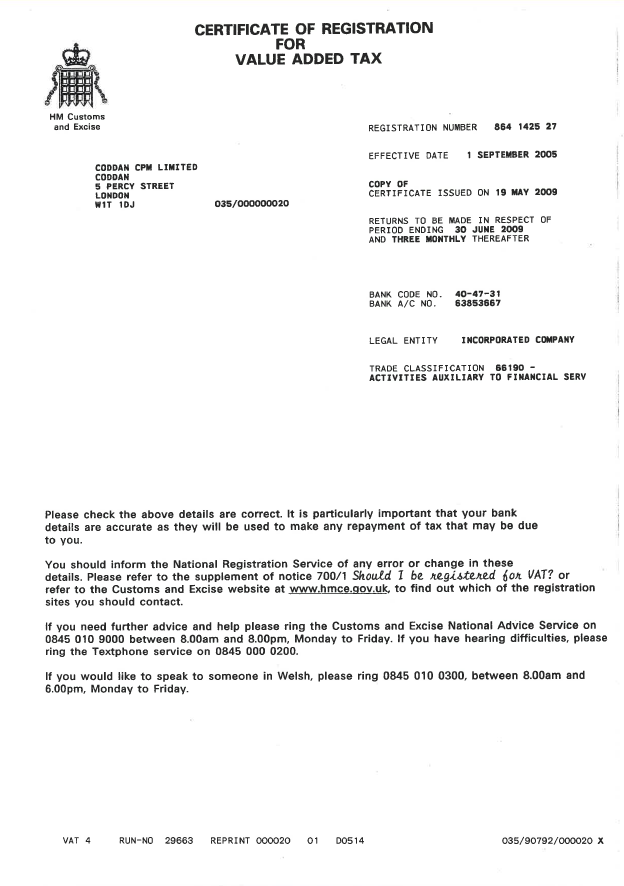
Coddan has provided formation and continuing corporate services since 2005. It operates as a formation agent, is supervised by HM Revenue & Customs as a trust or company service provider and is registered with Companies House as an Authorised Corporate Service Provider.

What that supports

These facts support Coddan's restoration diagnosis, accepted administrative document preparation, package coordination and identification of connected LLP filings.

They do not amount to government endorsement, legal representation, accounting or insolvency advice, Crown authority, guaranteed acceptance, guaranteed court relief or guaranteed asset recovery.

Use the correct lifecycle owner

Connected restoration and compliance destinations

Consider a new LLP separatelyUK LLP formation covers formation. A new LLP does not automatically inherit the dissolved LLP's assets, contracts, liabilities or history.Internal separate specialist assistance — UK LLP formation URL to be confirmed when live
Understand the former member's roleLLP members, designated members, corporate members and PSCs provides the complete explanation of LLP members, designated members, corporate members and PSCs.Internal separate specialist assistance — LLP members, designated members, corporate members and PSCs URL to be confirmed when live
Resolve disputed internal rightsLLP agreements and governance covers the LLP agreement, governance, profit and asset entitlements and member disputes.Internal separate specialist assistance — LLP agreements and governance URL to be confirmed when live
Secure a compliant registered officeRegistered office, service addresses and LLP records covers address, statutory-mail and records services needed after restoration.Internal separate specialist assistance — Registered office, service addresses and LLP records URL to be confirmed when live
Prepare outstanding accountsLLP annual accounts covers overdue, restoration and post-restoration accounts preparation and filing.Internal separate specialist assistance — LLP annual accounts URL to be confirmed when live
Complete statements and registered emailLLP confirmation statements and continuing compliance covers confirmation statements, registered email, verification readiness and later compliance.Internal separate specialist assistance — LLP confirmation statements and continuing compliance URL to be confirmed when live
Change the restored LLP's nameChange an LLP name covers the LL NM01 route and name restrictions where the former name is unavailable.Internal separate specialist assistance — Change an LLP name URL to be confirmed when live
Correct member or PSC particularsChange members, designated status and PSC details covers member, designated-status, corporate-member and PSC event filings.Internal separate specialist assistance — Change members, designated status and PSC details URL to be confirmed when live
Change an LLP addressChange LLP addresses and records covers registered-office, member-address and records-location filings.Internal separate specialist assistance — Change LLP addresses and records URL to be confirmed when live
LLP not yet dissolvedClose an LLP voluntarily covers voluntary strike-off while an eligible LLP remains registered.Internal separate specialist assistance — Close an LLP voluntarily URL to be confirmed when live
Court restoration or legal issueUse the approved solicitor route for court proceedings, disputed standing, property, claims, service and legal advice.Professional specialist referrals — destination to be confirmed
Accounts and tax referralUse the approved accountant or tax-adviser route for records, returns, tax consequences and recovered assets.Professional specialist referrals — destination to be confirmed
Crown or asset-recovery routeUse the appropriate Crown representative and specialist solicitor for waiver, disclaimer, disposal or asset recovery.External authority or professional route — not included in Restore a dissolved LLP
Insolvency-related restorationUse a licensed insolvency practitioner and solicitor where liquidation, administration or creditor protection is involved.Professional specialist referrals — routine administrative route unavailable

Current authoritative basis

Legal and operational position checked on 23 September 2026

This page uses current LLP legislation, LLP-specific Companies House restoration guidance, LL RT01 version 9.0, the current fee schedule, Crown waiver guidance, current court-route information and current identity-verification guidance. Forms, fees, filing channels, court procedures and commencement-sensitive requirements are rechecked when an instruction is accepted.

Select the route that matches the dissolved LLP's record

Diagnose standing, history and dependencies before restoration work begins

Use the diagnostic to establish the lawful route. Proceed to administrative coordination only where LL RT01 is available and the complete package can be assembled. Route court, Crown, asset, insolvency and professional matters to their proper owners.

LLP Restoration Diagnostic — £195 + VATImplementation separate route — paid assessment URL required
Administrative Restoration — From £650 + VAT£341 official fee and other costs separate — quotation only
Court Restoration AdviceImplementation separate route — solicitor-led route required
Accounts or Filing ReadinessImplementation separate route — LLP annual accounts or LLP confirmation statements and continuing compliance route required
Crown or Asset-Recovery MatterImplementation separate route — external authority or solicitor required
LL RT01 Rejection or RefusalImplementation separate route — time-sensitive assessed enquiry
Insolvency-Related RestorationImplementation separate route — licensed professional route
Post-Restoration FilingsImplementation separate route — correct lifecycle owner required

No instant checkout or guaranteed restoration is represented. Coddan accepts substantive coordination only after the dissolution route, applicant, standing, time limit, filings, evidence, costs and professional dependencies have been established.