We use cookies on this website, you can read about cookies and GDPR Privacy Policy here
Coddan CPM Ltd. – Company Registration Agent in the UK

Follow these six steps to complete any required identity verification, resign as a company director correctly and keep your Companies House records up to date.

Step 1
Review Resignation Duties
Step 2
Confirm Verification Status
Step 3
Prepare Supporting Information
Step 4
Choose Verification Route
Step 5
Submit Director Resignation
Step 6
Maintain Accurate Records

Director Resignation: Director ID Verification


Leaving a board involves more than a simple resignation. Uncover the essential steps for compliance and governance to ensure a smooth transition for your company

Leaving the Board Requires More Than Filing a Resignation
Resigning as a company director has always involved more than stepping away from day-to-day management. Today, under the UK's evolving corporate transparency framework, board changes form part of a wider governance process that extends beyond submitting a resignation to Companies House. Directors, company secretaries and businesses must now understand how identity verification, historical company records and ongoing compliance interact throughout the final stage of a directorship.
Director Resignation Process: Ensuring Accurate Records and Seamless Transitions in Leadership
For many directors, resignation raises new practical questions. Does identity verification affect the resignation process? What happens to your 11-character Personal Code after leaving office? Can you move directly from one company to another without repeating identity verification? How are historical appointments recorded, and what responsibilities remain with the company after a director departs? Understanding these issues before planning a board change helps businesses maintain accurate corporate records while supporting orderly governance and smooth leadership transitions.
Understanding the Dynamics of Director Resignation: A Guide to Corporate Compliance and Identity Verification
Since 2005, Coddan CPM has advised entrepreneurs, overseas investors, SMEs and professional advisers on company formation, board appointments, company secretarial administration and long-term corporate compliance. As a regulated Authorised Corporate Service Provider (ACSP) and Trust and Company Service Provider (TCSP), we recognise that every resignation is different. Some directors simply retire, while others move between companies, participate in corporate restructures or transfer leadership as part of succession planning. Choosing the most appropriate identity verification and compliance pathway therefore depends upon the wider circumstances surrounding the board change.
Ensuring Corporate Governance: A Comprehensive Guide to Director Identity Verification Solutions
The verification packages below have been designed to support a variety of director identity verification requirements, from straightforward digital verification to professionally managed solutions for more complex situations. Before deciding which approach best suits your circumstances, we encourage you to explore the guidance throughout this Resource Centre. The articles explain not only how identity verification relates to director resignations, but also how careful planning, accurate Companies House records and sound corporate governance help ensure that every leadership transition is completed efficiently, transparently and with confidence.
????
Seamless Standalone Support

Already Working with Another Provider? That's Absolutely Fine.

You don't need to become a full Coddan client to receive professional help with Director Identity Verification.

If your company was incorporated by another formation agent, accountant, or solicitor, you are still welcome to use our identity verification service independently.

Our aim is not to replace your existing advisers. Our aim is to help directors successfully complete their Companies House identity verification requirements with clear guidance and practical support.

If, at any point in the future, you decide you would like additional assistance, we will be pleased to help. Until then, let's simply focus on completing the verification you need today.


Start Your Business Today: Fast Formation Services to Meet All Compliance Standards

Ensure compliance with Companies House through rapid, secure ID verification for Directors and PSCs. Complete the process online with an authorized ACSP

treamline your compliance with Companies House using our fast, secure ID verification for Directors and PSCs, all completed online by an authorized ACSP
£40.00
+VAT

IdentityGuard Pro™

Recommended for

1
package

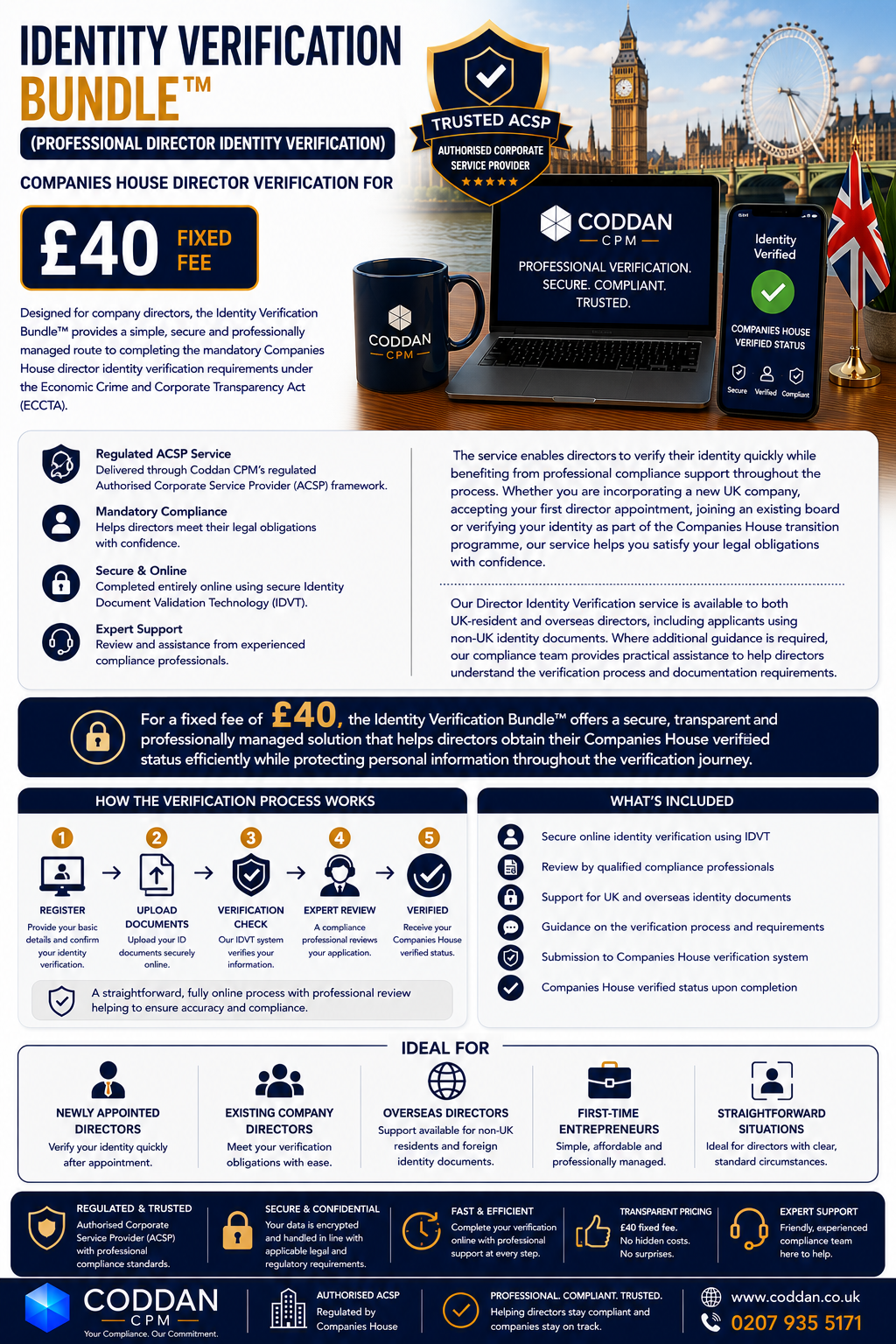
Buy Now Identity Verification Bundle™ (Professional Director Identity Verification) – Companies House Director Identity Verification for £40.
The Identity Verification Bundle™ provides a fast, secure and professionally managed solution for company directors who need to complete mandatory Companies House director identity verification before or in connection with their resignation from office. Delivered through Coddan CPM's regulated Authorised Corporate Service Provider (ACSP) framework, this managed service helps directors satisfy the identity verification requirements introduced under the Economic Crime and Corporate Transparency Act (ECCTA) while ensuring their Companies House records remain accurate throughout the resignation process. Whether you are resigning from your own UK company, stepping down from an existing board, leaving one of several directorships or completing identity verification during the Companies House transition period, our service offers a straightforward route to maintaining verified director status where required. Verification is completed entirely online using secure Identity Document Validation Technology (IDVT), with every application supported by experienced compliance professionals who help ensure your identity verification is completed accurately and in accordance with Companies House requirements.

The service is available to both UK-based and overseas company directors, including individuals using eligible non-UK identity documents. Where additional assistance is required, our compliance team provides practical guidance throughout the verification process, helping you understand the documentation requirements before your resignation and reducing the likelihood of unnecessary delays. For a fixed fee of £40, the Identity Verification Bundle™ offers a secure, transparent and professionally managed route to maintaining verified Companies House status through a regulated ACSP. It is ideally suited to directors resigning from UK companies, existing company officers, overseas directors and anyone preparing to leave a directorship who requires trusted professional support with Companies House director identity verification. Complete your verification with confidence and ensure your resignation is supported by accurate and compliant Companies House records. Ideal for the vast majority of straightforward applicants.


£65.00
+VAT

RapidVerify Pro™

Recommended for

2
package

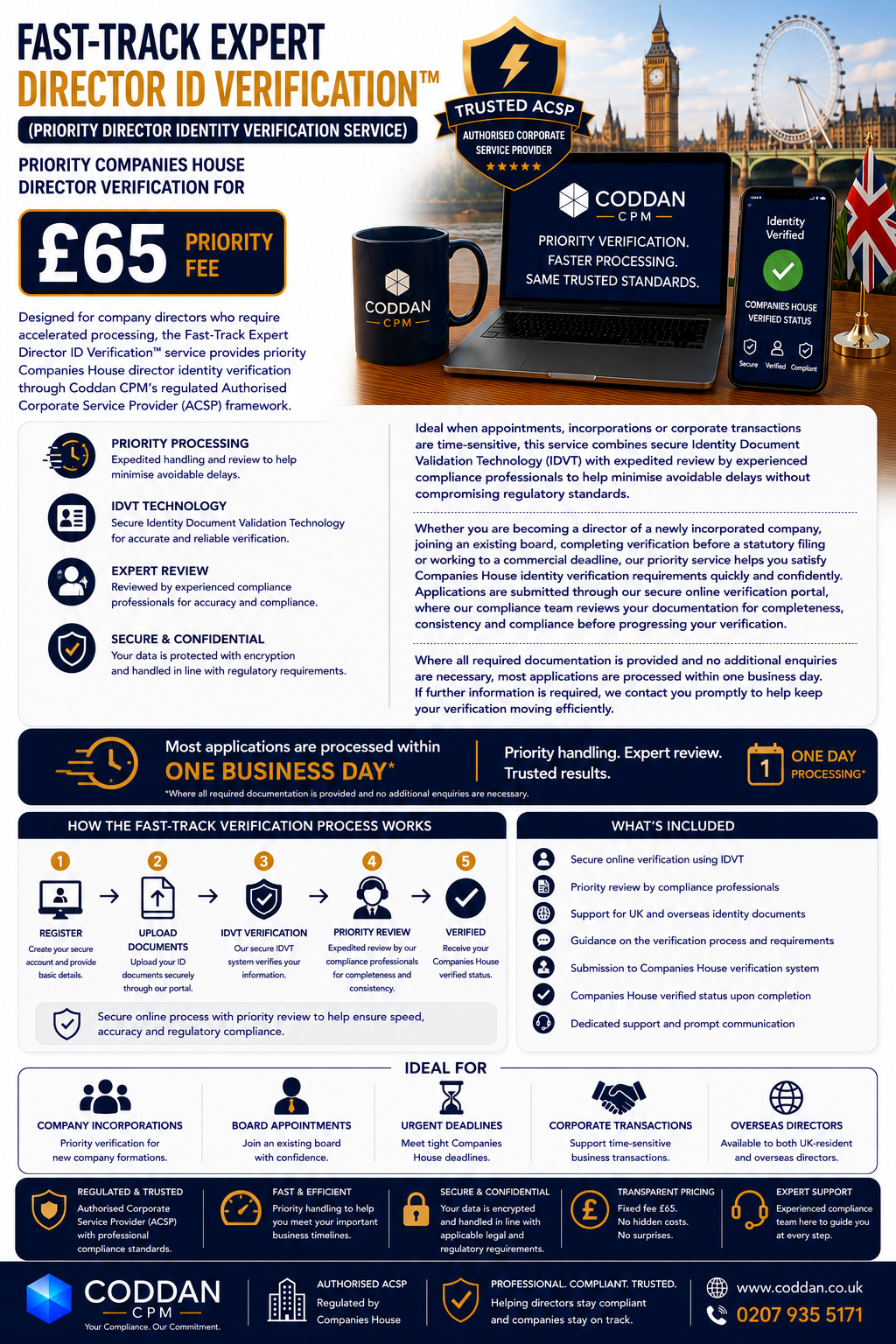
Buy Now Fast-Track Expert Director ID Verification™ (Priority Director Identity Verification Service) – Priority Companies House Director Identity Verification for £65.
The Fast-Track Expert Director ID Verification™ service is designed for company directors who require priority Companies House director identity verification without compromising accuracy or compliance before or in connection with resigning from office. Delivered through Coddan CPM's regulated Authorised Corporate Service Provider (ACSP) framework, this premium managed service combines secure Identity Document Validation Technology (IDVT) with expedited review by experienced compliance professionals to help you complete the verification process as quickly as possible while preparing your resignation. Ideal for time-sensitive director resignations, board restructures, corporate transactions, business sales and statutory filing deadlines, this service provides priority handling from the moment your application is received. Every submission is carefully reviewed to help ensure your documentation is complete, consistent and compliant before progressing through the identity verification process, reducing the likelihood of unnecessary delays. Where all required information is provided and no additional enquiries are needed, most applications are processed within one business day.

If further documentation is required, our compliance team contacts you promptly to help keep your verification progressing efficiently. The service is available to both UK-based and overseas company directors, including individuals using eligible non-UK identity documents. For £65, the Fast-Track Expert Director ID Verification™ service provides a faster, professionally managed route to maintaining verified Companies House status while completing your resignation and associated compliance obligations. It is ideally suited to resigning directors, existing company officers, overseas directors and businesses working to urgent commercial or regulatory deadlines. Complete your Companies House director identity verification quickly, securely and with the confidence of experienced ACSP professionals supporting your resignation process from start to finish.


£125.00
+VAT

VerifyFlex Solutions™

Recommended for

3
package

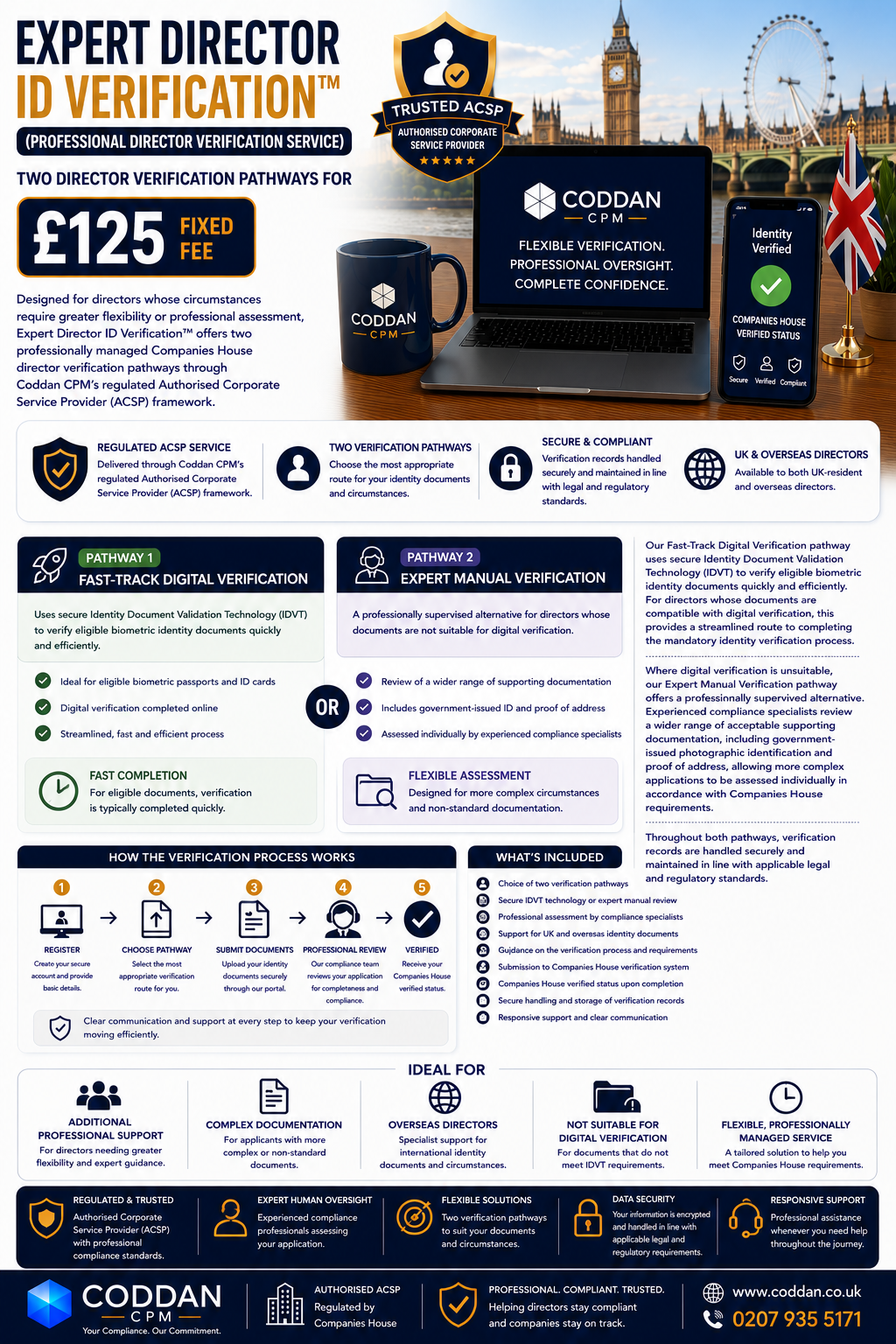
Buy Now Expert Director ID Verification™ (Professional Director Verification Service) – Two Companies House Director Identity Verification Pathways for £125.
The Expert Director ID Verification™ service is designed for company directors who require greater flexibility when completing Companies House director identity verification before or in connection with resigning from office. Delivered through Coddan CPM's regulated Authorised Corporate Service Provider (ACSP) framework, this professionally managed service offers two verification pathways, allowing directors to choose the option that best matches their identity documents and individual circumstances while satisfying Companies House requirements during the resignation process. Our Fast-Track Digital Verification pathway uses secure Identity Document Validation Technology (IDVT) to verify eligible biometric identity documents quickly and efficiently. Where digital verification is not suitable, our Expert Manual Verification pathway provides a professionally supervised alternative, enabling experienced compliance specialists to review a broader range of acceptable identity documents and supporting evidence in accordance with applicable regulatory requirements. Both verification pathways are available to UK-based and overseas company directors, including individuals using eligible non-UK identity documents.

Throughout the verification process, our compliance team provides practical guidance, carefully reviews every application and helps ensure all documentation satisfies Companies House requirements before your resignation is completed, reducing the likelihood of delays caused by incomplete or unsuitable submissions. For £125, Expert Director ID Verification™ combines advanced verification technology with experienced professional oversight, providing a flexible and reliable managed solution for more complex verification circumstances. It is ideally suited to overseas directors, applicants whose identity documents are unsuitable for standard digital verification, directors resigning from UK companies and anyone seeking experienced assistance with Companies House director identity verification through a trusted regulated ACSP while completing their resignation and associated compliance obligations.


£220.00
+VAT

FlexiVerify Option™

Recommended for

4
package

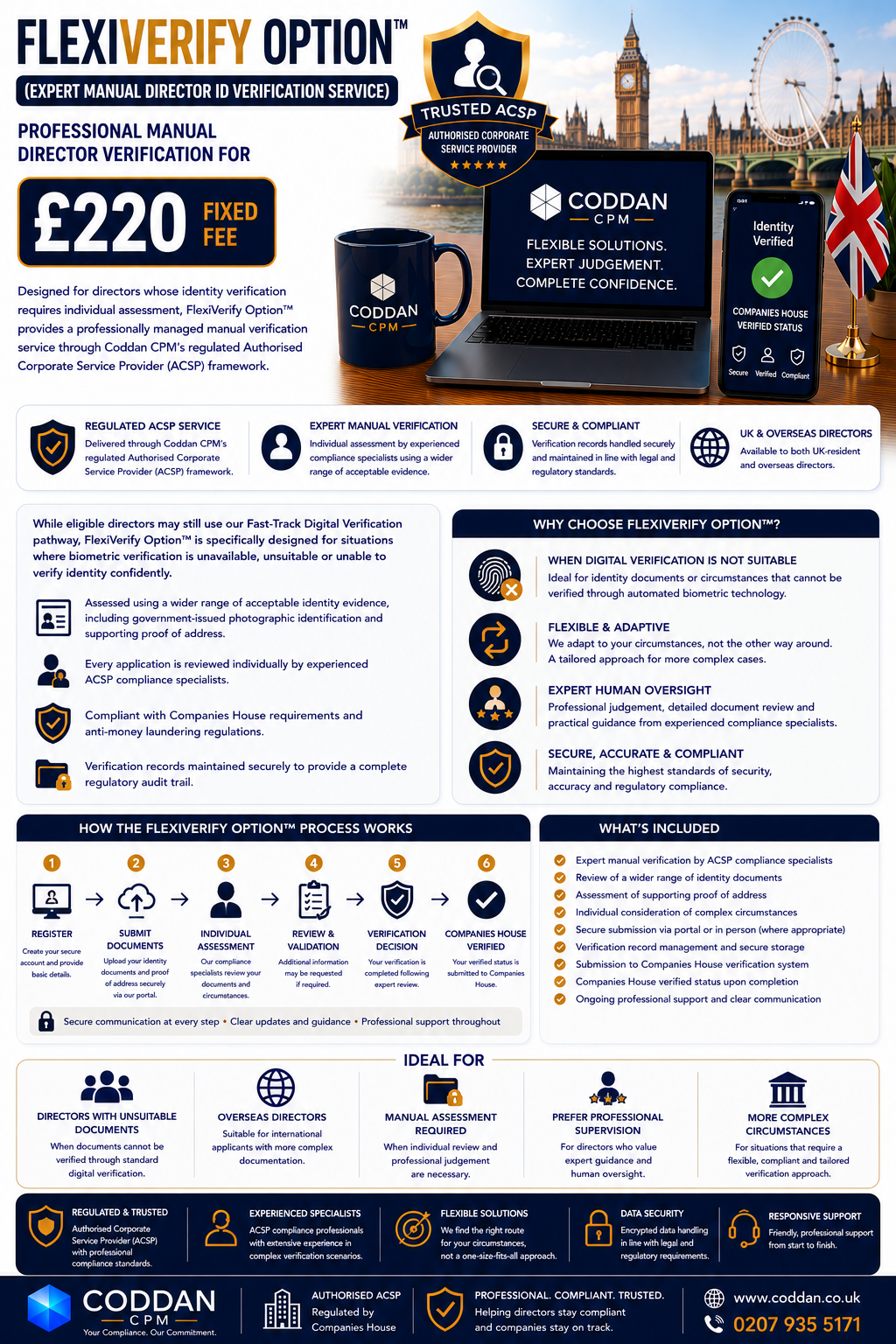
Buy Now FlexiVerify Option™ (Expert Manual Director ID Verification Service) – Professional Manual Companies House Director Identity Verification for £220.
The FlexiVerify Option™ is designed for company directors whose Companies House director identity verification requires individual assessment beyond standard digital verification before or in connection with resigning from office. Delivered through Coddan CPM's regulated Authorised Corporate Service Provider (ACSP) framework, this professionally managed manual verification service provides a flexible and compliant route for directors whose circumstances are more complex or whose identity documents are unsuitable for automated verification while completing their resignation process. While eligible applicants may still use our Fast-Track Digital Verification pathway, FlexiVerify Option™ is specifically intended for situations where biometric verification is unavailable, unsuitable or unable to verify identity with sufficient confidence. Instead of relying solely on automated technology, experienced compliance specialists assess each application individually, reviewing a wider range of acceptable identity evidence, including government-issued photographic identification and supporting proof of address, in accordance with Companies House and anti-money laundering requirements. Applications can be submitted securely through our online verification portal or, where appropriate, completed in person.

Every application receives an individual review, with comprehensive verification records maintained to provide a secure regulatory audit trail and demonstrate compliance with applicable legal obligations. For £220, FlexiVerify Option™ offers the highest level of professionally managed support for complex director identity verification requirements. It is ideally suited to UK-based and overseas company directors requiring manual assessment, individuals with non-standard identity documentation, and directors seeking a fully supervised Companies House identity verification service supported by experienced ACSP compliance specialists and expert regulatory guidance throughout the verification process while completing their resignation and ensuring their Companies House records remain accurate.


Understand the modern approach to director resignations, integrating identity verification and governance for effective leadership transitions and compliance

Understanding Director Resignations in the Modern Companies House Framework
Completing a director's resignation is no longer simply a matter of notifying Companies House that an individual has left the board. As the UK's corporate transparency framework continues to evolve, board changes now form part of a broader system of identity verification, corporate governance and accurate public record keeping. Understanding how these elements work together helps companies manage leadership transitions efficiently while maintaining confidence in their statutory records and ongoing compliance.
Navigating Director Departures: A Comprehensive Guide for Company Leaders
The guidance below has been created as a practical knowledge centre for company directors, entrepreneurs, company secretaries, shareholders, professional advisers and businesses responsible for managing board changes. Rather than focusing solely on the administrative process of filing a resignation, these articles explain the wider lifecycle of a director's departure—from understanding whether identity verification affects outgoing directors to maintaining accurate Companies House records long after a resignation has been recorded.
Navigating Director Resignations: Key Insights into the Modern Identity Verification Framework
Throughout this Resource Centre, you will learn how director resignations interact with the modern identity verification framework, how the Form TM01 resignation process fits within the post-ECCTA regulatory environment, and how historical directorship records continue to form part of the public register after an individual leaves office. The articles also explain the purpose of the 11-character Personal Code, why it remains associated with the individual throughout their corporate career, and how verified identity supports future appointments across multiple companies without creating unnecessary duplication.
Ensuring Compliance During Board Changes: The Importance of Accurate Records and Succession Planning
In addition, the guidance explores many of the practical situations businesses encounter when directors leave the board. These include coordinating simultaneous resignations and new appointments during corporate restructures, understanding the governance responsibilities of remaining directors and company secretaries, managing board succession planning, maintaining accurate statutory records and recognising how unresolved identity verification issues or incomplete corporate records may influence wider compliance and commercial due diligence

Efficient Online Verification for Company Office Holders: The Benefits of Using Coddan's Services

You can verify your identity either directly with Companies House through a GOV.UK One Login account, or through a registered Authorised Corporate Service Provider. Coddan's ID Check service verifies company directors and office holders online — quickly, reliably, and in minutes, wherever they are.

View Both Paths

The Resource Centre also looks beyond Companies House procedures to examine the broader commercial environment in which today's businesses operate. As banks, payment service providers, investors, lenders and professional advisers increasingly undertake their own corporate due diligence, maintaining transparent governance and reliable public records has become an important part of building confidence with organisations that rely on accurate company information when establishing or reviewing business relationships. The guidance further explains how forthcoming changes affecting authorised filers and regulated Authorised Corporate Service Providers (ACSPs) are reshaping the way statutory filings are prepared and submitted, extending identity verification considerations beyond directors alone to the wider administration of UK companies.

At Coddan CPM, we believe that a director's resignation should be managed with the same care and professionalism as their original appointment. Since 2005, we have supported entrepreneurs, SMEs, multinational organisations and professional advisers with company formation, company secretarial services and long-term corporate governance. As a regulated Authorised Corporate Service Provider (ACSP) and Trust and Company Service Provider (TCSP), we help businesses understand not only the statutory procedures surrounding director resignations, but also the wider governance principles that protect the integrity of their corporate records throughout every stage of the company lifecycle.

Whether you are preparing to retire from the board, restructuring a corporate group, appointing replacement directors or managing governance on behalf of a growing business, the articles below are designed to provide the practical knowledge, regulatory context and professional guidance needed to navigate director resignations confidently while maintaining accurate Companies House records and strong corporate governance.

Verification That Adapts to Your Circumstances

No two directors have exactly the same circumstances. Some applicants complete digital verification within minutes, while others require additional documentation, overseas identity evidence or manual review. Our multi-tier verification services recognise these differences and provide solutions tailored to a wide range of verification scenarios.

Instead of expecting every applicant to fit a single automated process, we offer flexible verification pathways designed to accommodate both straightforward and more complex requirements.


Do Outgoing Directors Need to Verify Their Identity Before Resigning? Understanding Director Identity Verification and Board Resignations

Resigning as a company director has always been an important corporate event. Whether stepping down because of retirement, a change in business ownership, a career move or a company restructuring, a director's resignation formally brings one period of corporate responsibility to an end while ensuring that the company's public record accurately reflects its current leadership.

Under the UK's modern corporate transparency framework, however, many directors now ask an important question before beginning the resignation process:

Ongoing Corporate Maintenance

Managing an Established Company? Understanding Your Active Obligations

Directors and company secretaries running active enterprises often look at filing cycles with specific questions:

  • Do sitting board members need to take retroactive action?
  • How do statutory updates affect upcoming annual returns?
  • What happens if organizational profiles require synchronization?

Compliance updates roll out across corporate registry platforms to safeguard business transparency. Existing entities must align their administrative habits with these modern standards.

Uncertainty around filing triggers can cause unnecessary stress. Knowing your timeline helps prevent last-minute administrative blockages.

Coddan assists active management boards in clarifying corporate obligations, mapping out exact timelines, and maintaining smooth administrative operations year-round.

Review your active corporate position calmly before filing your next statement.

"Do I need to complete identity verification before I can resign as a director?"
The introduction of mandatory identity verification under the Economic Crime and Corporate Transparency Act (ECCTA) has understandably created uncertainty around many Companies House procedures. Directors who are leaving office often wonder whether they must first obtain their 11-character Personal Code before their resignation can be recorded, particularly if they have never previously completed identity verification.

Understanding how identity verification interacts with director resignations helps companies plan board changes more effectively, avoid unnecessary confusion and maintain accurate corporate records throughout the entire lifecycle of a directorship.

Director Identity Verification and Director Resignation Are Separate Processes
One of the most common misunderstandings is that every Companies House procedure now requires identity verification before it can take place.

In reality, identity verification and director resignation serve different legal purposes.

Identity verification is designed to establish confidence in the identity of individuals participating in the UK's corporate framework, while a director's resignation is the legal process of bringing that appointment to an end.

Understanding this distinction helps directors appreciate where identity verification fits within the wider framework of company administration rather than assuming it automatically applies to every corporate filing.

Why Directors Ask This Question
The introduction of the 11-character Personal Code has changed the way many people think about Companies House procedures.

Prospective directors are now expected to prepare for identity verification before appointment, and existing directors are becoming familiar with the wider verification framework.

As a result, directors who are leaving office often ask whether the same requirement applies when they resign.

This is a sensible question because board appointments and board resignations are both significant corporate events, even though they serve very different administrative purposes.

Identity Verification Supports the Director Lifecycle
Identity verification should not be viewed solely as part of becoming a director.

It forms part of the wider lifecycle of company administration, which includes:

  • Company incorporation.
  • Director appointments.
  • Changes to director details.
  • Corporate governance.
  • Statutory compliance.
  • Board succession planning.
  • Director resignations.

Each stage has its own legal procedures, documentation and governance considerations.

Understanding how these processes interact enables businesses to manage board changes more efficiently and maintain accurate company records throughout the life of the organisation.

Accurate Company Records Remain Essential
Regardless of the identity verification framework, maintaining accurate Companies House records remains one of the most important responsibilities of every company.

When a director resigns, businesses should ensure that:

  • Internal board records are updated.
  • Statutory registers accurately reflect the change.
  • Company governance documentation remains current.
  • Companies House is notified through the appropriate statutory process.
  • Remaining directors continue to satisfy the company's governance requirements.

Keeping company records accurate supports transparency and confidence in the public register.

Board Changes Require Careful Planning
Director resignations often occur alongside wider corporate events.

Examples include:

  • Retirement.
  • Sale of a business.
  • Investment transactions.
  • Management buy-outs.
  • Group restructures.
  • Family business succession.
  • Appointment of replacement directors.

Planning these events carefully enables businesses to coordinate appointments, resignations and governance changes without unnecessary administrative disruption.

Identity verification may form part of the wider planning where new directors are joining the board at the same time that existing directors are leaving.

Companies Should Consider the Wider Governance Picture
A director's resignation affects more than the Companies House register.

Businesses should also consider:

  • Board composition.
  • Decision-making authority.
  • Banking mandates.
  • Shareholder communications.
  • Internal governance procedures.
  • Company secretarial records.
  • Regulatory responsibilities.

Treating a resignation as part of a broader governance review helps ensure that all corporate records remain aligned after the board change has taken place.

Overseas Directors Should Plan Their Resignation Carefully
International directors often resign while continuing to live outside the United Kingdom.

Although the practical administration may differ from domestic appointments, overseas businesses should still ensure that resignations are properly documented and coordinated with any incoming director appointments or wider corporate restructuring.

Where board changes involve international ownership or cross-border corporate groups, careful planning helps maintain continuity throughout the transition.

Resignation & Removal Compliance Router

Stepping Down or Removing a Director? Choose Your Route

Under updated Companies House rules, changes to corporate officers require structured compliance and verification handling. Select your exact situation below for instant ACSP guidance.

Official ACSP Framework Compliant record updates with Companies House.
Strict AML Adherence Rigorous regulatory compliance tracking.
UK GDPR Compliant Secure and confidential data handling.

Director Resignations Often Coincide with New Appointments
>Many board changes involve both outgoing and incoming directors.

For example:

  • A founder retires and appoints a successor.
  • An investor joins the board following funding.
  • A corporate group restructures its management.
  • A family business transfers leadership to the next generation.

In these situations, businesses benefit from viewing appointments and resignations as part of one coordinated governance project rather than as isolated administrative tasks.

This enables identity verification for incoming directors to be completed while ensuring outgoing appointments are concluded efficiently.

Professional Guidance Supports Smooth Board Transitions
Director resignations can be straightforward, but they frequently form part of more complex corporate events involving new appointments, ownership changes or governance restructuring.

Since 2005, Coddan CPM has supported entrepreneurs, SMEs, multinational organisations and professional advisers with company formation, company secretarial services and long-term corporate compliance. As an Authorised Corporate Service Provider (ACSP) and regulated Trust and Company Service Provider (TCSP), we help businesses understand how identity verification interacts with the wider lifecycle of company administration, including appointments, resignations and board transitions.

Our governance-led approach ensures that companies consider not only the resignation itself but also the broader compliance responsibilities that accompany changes in company leadership.

Successful Board Changes Depend on Good Governance
A director's resignation represents the conclusion of one chapter in a company's governance history and often marks the beginning of another.

While identity verification has introduced important changes to the appointment of new directors, resignations should always be considered within the wider context of maintaining accurate company records, orderly governance procedures and effective board succession planning.

By understanding how identity verification and director resignations fit together within the broader Companies House framework, businesses can manage leadership transitions more confidently while protecting the integrity of their corporate records.

At Coddan CPM, we believe that good governance extends throughout the entire lifecycle of a directorship—from the first identity verification and appointment through to an orderly resignation and the successful transition to the next generation of company leadership.

Your Companies House Personal Code Doesn't End With Verification

Receiving your Companies House Personal Code is more than simply confirming your identity. The code becomes your unique identifier within the Companies House system and may be used when you accept new appointments, update corporate records or perform other regulated activities connected with your verified identity.

Coddan helps directors understand how their Personal Code fits into the wider compliance framework, ensuring that identity verification becomes part of a well-managed corporate governance process rather than an isolated administrative task.


The Coddan Advantage

Why Coddan Stands Apart in Director ID Verification

By establishing a human-vetted, multi-tiered Authorised Corporate Service Provider (ACSP) pathway (such as IdentityGuard Pro™ using technologies like Credas alongside manual compliance reviews), Coddan offers a vital pressure valve. We take clients who would otherwise be locked out by rigid government tech and safely guide them to compliance.

Filing a Director Resignation (Form TM01) After ECCTA: How Director Identity Records Continue Beyond a Board Resignation

A director's resignation marks the end of an individual's appointment to a company, but it does not erase their place in the company's history. Every appointment and resignation forms part of the permanent corporate record maintained by Companies House, helping ensure that the public register accurately reflects who has managed a company at different points in its lifecycle.

As the Economic Crime and Corporate Transparency Act (ECCTA) continues to modernise the UK's corporate framework, many directors and company secretaries are asking how these reforms affect the resignation process.

Common questions include:

  • Has the resignation process changed?
  • Is Form TM01 still used?
  • What information must be provided to Companies House?
  • What happens to a director's identity record after they leave office?
  • Does a resignation remove a director's Personal Code or verified identity?

Understanding how director resignations operate within the modern Companies House framework helps businesses manage board changes efficiently while maintaining accurate corporate records and supporting good governance.

Form TM01 Remains the Statutory Method for Recording a Director's Resignation
Although ECCTA has introduced significant reforms to identity verification and corporate transparency, the legal process for notifying Companies House that a director has left office continues to rely on the appropriate statutory filing.

When a director resigns, the company should ensure that the resignation is properly documented and submitted using the prescribed Companies House procedure.

The purpose of the filing is to update the public register so that it accurately reflects the company's current board.

Prompt and accurate filing helps maintain confidence in the register and reduces the likelihood of inconsistencies between the company's internal records and its public information.

A Director's Resignation Does Not Remove Their Corporate History
One of the most important principles of the Companies House register is that it records the history of a company's officers, not simply its current management.

When a director resigns:

  • The appointment remains part of the company's historical record.
  • The resignation is recorded against that appointment.
  • The public register reflects the period during which the individual served.
  • The company continues to maintain an accurate governance history.

This historical record contributes to corporate transparency by allowing interested parties to understand how a company's leadership has changed over time.

Identity Verification Supports Continuity Rather Than Replacement
The introduction of director identity verification has strengthened the way Companies House associates verified individuals with their corporate appointments.

Rather than creating separate identities for each appointment, the framework is designed to maintain continuity between the verified individual and the various roles they hold throughout their corporate career.

Consequently, a resignation normally represents the conclusion of a particular appointment rather than the deletion of the individual's verified identity within the wider Companies House framework.

This distinction is important because directors may:

  • Join another company in the future.
  • Hold appointments with multiple organisations.
  • Become a Person with Significant Control (PSC).
  • Return to the board of the same company at a later date.

Maintaining continuity supports a more accurate and transparent corporate register.

Accurate Information Matters Throughout the Resignation Process
When preparing a director resignation, companies should ensure that the information supplied to Companies House is complete and consistent with their internal corporate records.

Good practice includes confirming:

  • The correct company details.
  • The identity of the resigning director.
  • The effective resignation date.
  • Board resolutions and internal records, where applicable.
  • Statutory registers are updated to reflect the change.

Careful preparation helps reduce administrative delays and supports efficient company administration.

Board Changes Often Involve More Than One Filing
A director's resignation frequently forms part of a wider governance exercise.

For example, a company may be:

  • Appointing a replacement director.
  • Restructuring its board.
  • Completing an investment transaction.
  • Transferring ownership.
  • Preparing for succession planning.
  • Reorganising a corporate group.

Managing these events together helps ensure that Companies House records remain consistent throughout the transition.

Where new directors are joining the board, identity verification should be considered alongside the wider appointment process so that incoming appointments can proceed smoothly.

Historical Directorships Continue to Support Corporate Transparency
Corporate transparency is not limited to identifying who currently manages a company.

It also involves maintaining a reliable record of who has previously served as a director and when those appointments began and ended.

This historical information assists:

  • Investors carrying out due diligence.
  • Professional advisers.
  • Financial institutions.
  • Regulatory authorities.
  • Businesses reviewing corporate governance.

Maintaining accurate historical records is one of the key objectives of the modern Companies House framework.

Companies Should Integrate Resignations Into Their Governance Procedures
Director resignations should not be viewed as isolated administrative events.

Well-managed organisations often incorporate board changes into wider governance procedures by ensuring that:

  • Internal registers are updated promptly.
  • Board composition is reviewed.
  • Signing authorities are amended where necessary.
  • Banking mandates and corporate authorities are updated.
  • New appointments are coordinated with resignations.
  • Future compliance obligations are considered.

A structured approach helps businesses maintain continuity during periods of organisational change.

Overseas Companies and International Directors
Businesses with overseas shareholders or internationally based directors often experience more complex board transitions.

Where directors resign while replacement appointments are being prepared across multiple jurisdictions, careful planning helps ensure that governance changes are completed in a coordinated manner.

Understanding how identity verification, historical appointments and Companies House filings interact can simplify these international transitions.

Professional Support for Director Resignations and Board Changes
Although filing a director resignation is often straightforward, many businesses require broader support when board changes occur alongside incorporations, new appointments, corporate restructures or ownership changes.

Since 2005, Coddan CPM has assisted entrepreneurs, SMEs, overseas investors and professional advisers with company secretarial services, Companies House filings and long-term corporate compliance. As an Authorised Corporate Service Provider (ACSP) and regulated Trust and Company Service Provider (TCSP), we help businesses understand how director resignations fit within the wider governance framework, ensuring that board changes are managed accurately, efficiently and in accordance with modern Companies House requirements.

Our approach extends beyond submitting statutory forms by helping clients maintain complete and reliable corporate records throughout the lifecycle of every directorship.

A Director's Resignation Ends the Appointment—Not the Corporate Record
Resigning as a director concludes an individual's role within a particular company, but it does not remove the historical record of that appointment. Modern corporate governance relies on accurate information that reflects both current leadership and the individuals who have previously served on the board.

By understanding how Form TM01, historical directorship records and identity verification work together, companies can manage board transitions with greater confidence while preserving the integrity of their Companies House records.

At Coddan CPM, we believe that every stage of a directorship—from appointment and identity verification to resignation and succession planning—should be managed with the same commitment to accuracy, transparency and responsible corporate governance.


Resigning While Unverified: Understanding the Potential Complications of Leaving Office Before Completing Identity Verification

A director's resignation is often viewed as the final administrative step in concluding a period of service with a company. In practice, however, a resignation forms part of a much broader corporate compliance framework that includes accurate company records, statutory filings and, under the UK's modern corporate transparency reforms, director identity verification.

As identity verification requirements have become an established feature of company administration, some directors have begun asking an important question:

"What happens if I resign before my identity verification has been completed?"
The answer depends on the individual circumstances, the applicable legal requirements and the company's wider compliance position. While resigning from office and completing identity verification are separate processes, directors and companies should recognise that unresolved compliance matters may still require attention after a resignation has taken effect.

Understanding these issues before leaving office can help businesses plan board transitions more effectively and reduce unnecessary uncertainty.

A Resignation Does Not Automatically Resolve Outstanding Compliance Matters
Resigning as a director brings an appointment to an end, but it does not necessarily conclude every responsibility or compliance issue connected with that period of office.

For example, a company may still need to address matters relating to:

  • Statutory filings.
  • Corporate record keeping.
  • Identity verification requirements.
  • Historic governance decisions.
  • Regulatory enquiries.
  • Company administration.

A resignation should therefore be viewed as one stage in the wider governance lifecycle rather than the final step in every compliance process.

Identity Verification and Resignation Serve Different Purposes
It is helpful to distinguish between two separate concepts.

Identity verification is intended to establish confidence in the identity of individuals participating in the UK's corporate framework.

A director's resignation records the end of an individual's appointment to a particular company.

Although these processes may occur around the same time, they perform different legal and administrative functions.

Understanding this distinction helps directors avoid assuming that completing one process automatically satisfies the requirements of the other.

Unresolved Compliance Issues May Continue After Resignation
Where a director or company has outstanding compliance matters, those issues may still need to be resolved even after the individual's appointment has ended.

Depending on the circumstances, businesses may need to consider matters such as:

  • Outstanding Companies House obligations.
  • Accuracy of corporate records.
  • Identity verification requirements where applicable.
  • Historic filing issues.
  • Governance documentation.
  • Internal company records.

Addressing these matters promptly supports accurate public records and helps maintain confidence in the company's governance arrangements.

Public Records Should Remain Accurate Throughout the Director's Lifecycle
One of the principal objectives of the Companies House register is to provide an accurate record of company officers, both past and present.

This means that:

  • Director appointments should be correctly recorded.
  • Changes during a directorship should be reflected accurately.
  • Resignations should be notified through the appropriate statutory process.
  • Historical appointments should remain consistent with the company's records.

Identity verification supports the integrity of this wider framework by helping ensure that corporate records relate to correctly identified individuals.

Board Changes Should Be Planned Rather Than Rushed
Director resignations frequently occur during periods of organisational change.

Examples include:

  • Business sales.
  • Management restructures.
  • Investment rounds.
  • Insolvency procedures.
  • Family succession planning.
  • Group reorganisations.

Where identity verification or other compliance matters remain outstanding, companies benefit from coordinating board changes carefully rather than treating each filing as an isolated event.

Early planning often reduces administrative complexity and supports smoother transitions.

Good Governance Continues Beyond the Date of Resignation
A director's responsibilities do not disappear simply because their name is removed from the current list of company officers.

Companies should continue to ensure that:

  • Corporate records remain complete.
  • Statutory registers are updated.
  • Internal governance documentation reflects the board change.
  • Any outstanding administrative matters are reviewed.
  • Future appointments are properly coordinated.

Viewing resignation as part of an ongoing governance process helps businesses maintain orderly company administration.

Incoming and Outgoing Directors Should Coordinate the Transition
Many resignations coincide with the appointment of one or more replacement directors.

In these circumstances, businesses should consider the transition as a single governance project.

This allows companies to:

  • Prepare incoming directors for identity verification where required.
  • Complete appointment documentation efficiently.
  • Record resignations accurately.
  • Maintain continuity of board decision-making.
  • Preserve accurate Companies House records throughout the transition.

A coordinated approach reduces the likelihood of inconsistencies developing between internal records and the public register.

Overseas Directors Should Prepare Early
International directors may face additional practical considerations when leaving a UK company, particularly where the resignation forms part of a wider restructuring or ownership change involving several jurisdictions.

Preparing documentation in advance and coordinating the resignation with any related board appointments helps ensure that governance changes progress efficiently and that corporate records remain consistent across all relevant entities.

Professional Support Can Simplify Complex Board Changes
Some director resignations are straightforward, while others form part of wider corporate projects involving multiple filings, governance reviews or changes in company ownership.

Since 2005, Coddan CPM has supported entrepreneurs, SMEs, overseas investors and professional advisers with company secretarial services, Companies House filings and long-term corporate compliance. As an Authorised Corporate Service Provider (ACSP) and regulated Trust and Company Service Provider (TCSP), we help businesses understand how identity verification, director resignations and board transitions interact within the broader Companies House framework.

Our governance-focused approach enables clients to plan board changes carefully, maintain accurate corporate records and address compliance matters in an organised and transparent manner.

Plan Your Resignation as Carefully as Your Appointment
Resigning from a company is more than submitting a statutory form. It represents an important stage in the lifecycle of a directorship and should be managed with the same attention to accuracy, governance and compliance as the original appointment.

Where identity verification requirements or other compliance matters remain unresolved, directors and companies benefit from understanding how these issues interact with the resignation process before changes are made.

At Coddan CPM, we believe that effective corporate governance extends beyond incorporation and appointment. By helping businesses manage every stage of a director's lifecycle—from identity verification and appointment through to resignation and succession planning—we support transparent, well-managed companies that remain compliant throughout periods of change.


Does Your 11-Character Personal Code Remain Valid After You Resign as a Director?

Resigning as a company director marks the end of an appointment, but it does not bring an end to your professional identity within the UK corporate framework. Many directors who leave a company later establish a new business, join the board of another organisation or return to a previous company in a different capacity. As a result, one of the most common questions arising from the UK's identity verification reforms is:

"Do I lose my 11-character Personal Code when I resign as a director?"
For entrepreneurs, investors and experienced business leaders, understanding the answer is important because the 11-character Personal Code is intended to identify the individual—not the company they serve. A resignation changes your relationship with a particular company, but it does not necessarily alter your verified identity within the Companies House framework.

Understanding this distinction helps directors plan future appointments with greater confidence while supporting accurate and consistent corporate records throughout their professional careers.

Your Personal Code Belongs to You, Not to a Particular Company
One of the most important principles of the identity verification framework is that the Personal Code is linked to the individual, rather than to a single directorship.

Once identity verification has been successfully completed and a Personal Code has been issued, that code is intended to provide a consistent way of identifying the verified individual when interacting with Companies House.

The code is therefore separate from any individual company appointment.

Whether you serve as a director of one company or several organisations during your career, your verified identity remains connected to you rather than to a particular business.

Resigning Ends the Appointment, Not Your Verified Identity
A director's resignation concludes a specific appointment.

It does not erase the individual's corporate history, and it does not mean that a completely new identity must be created if that person later becomes involved with another UK company.

Instead, the resignation simply records that the individual's period of service with that company has ended.

The verified identity established through the identity verification process continues to exist independently of that appointment, supporting continuity across future corporate activities.

Why a Lifetime Personal Identifier Supports Corporate Transparency
Companies House has introduced identity verification to improve confidence in the public register and strengthen corporate transparency.

Using a consistent personal identifier offers several advantages.

It helps:

  • Associate verified individuals with their company appointments.
  • Maintain continuity across multiple directorships.
  • Improve the accuracy of corporate records.
  • Reduce unnecessary duplication of identity information.
  • Support long-term confidence in the public register.

Rather than treating every appointment as the beginning of a completely new identity record, the framework enables verified individuals to build a continuous corporate history over time.

Future Director Appointments Become Simpler
Many directors do not remain with one company throughout their careers.

An individual may:

  • Launch a second business.
  • Join the board of another company.
  • Become a non-executive director.
  • Participate in a family business.
  • Join an investor-backed startup.
  • Accept appointments within a corporate group.

Because the Personal Code is linked to the individual, it provides continuity when new appointments are made within the Companies House framework.

This supports more efficient company administration and helps maintain accurate identity records throughout a director's professional career.

Entrepreneurs Often Build More Than One Business
Successful entrepreneurs frequently establish several companies over many years.

A founder may sell one business before creating another or move from operating companies into investment, consultancy or advisory roles.

Maintaining a single verified identity throughout these changes helps provide consistency as new appointments arise and supports an accurate record of the individual's involvement across different organisations.

Identity verification therefore becomes part of a director's long-term professional journey rather than a one-off event connected with a single incorporation.

Historical Directorships Continue to Form Part of Your Corporate Record
Although a resignation concludes an appointment, the period during which the individual served as a director remains part of the company's historical record.

This contributes to corporate transparency by showing:

  • When the appointment began.
  • When the appointment ended.
  • The individual's role within the company.
  • The company's governance history.

Maintaining continuity between historical appointments and the individual's verified identity helps preserve the integrity of the Companies House register.

Good Governance Extends Beyond a Single Appointment
Identity verification supports more than regulatory compliance.

It contributes to broader governance principles by helping companies maintain accurate records of the individuals responsible for managing corporate affairs throughout different stages of the company's development.

For directors, this means thinking beyond the immediate appointment and recognising that identity verification forms part of an ongoing relationship with the UK's corporate framework.

Whether serving one company or many, maintaining accurate identity information supports transparency for businesses, investors and the wider public.

Planning Ahead for Your Next Directorship
Many directors resign because they are preparing for a new opportunity.

Some establish their own company, others accept appointments elsewhere, while some return to company leadership after a period away from executive responsibilities.

Understanding that your Personal Code continues to identify you throughout these changes allows future appointments to be planned with greater confidence and encourages a more structured approach to company administration.

Thinking ahead also helps businesses coordinate appointments, resignations and governance changes more effectively.

Professional Support Throughout Your Corporate Journey
A director's relationship with Companies House rarely ends after a single appointment.

Many entrepreneurs, investors and business leaders continue to establish companies, accept new board positions and manage evolving governance responsibilities throughout their careers.

Since 2005, Coddan CPM has assisted startups, SMEs, overseas investors and professional advisers with company formation, company secretarial services and corporate compliance. As an Authorised Corporate Service Provider (ACSP) and regulated Trust and Company Service Provider (TCSP), we help clients understand how identity verification, Personal Codes, appointments and resignations fit together within the wider lifecycle of company administration.

Our objective is not simply to help directors complete individual procedures, but to support accurate governance throughout every stage of their corporate journey.

Your Personal Code Is Designed for the Long Term
Resigning from a company changes your role within that organisation, but it does not define your future as a business leader. The modern identity verification framework recognises that directors often move between companies, establish new ventures and contribute to multiple organisations over the course of their careers.

By linking a verified identity to the individual rather than to a single appointment, the Companies House framework supports greater continuity, stronger corporate transparency and more reliable public records.

At Coddan CPM, we believe that identity verification should support directors throughout their entire professional journey. From your first appointment and your initial Personal Code through to future directorships, new business ventures and eventual board resignations, a consistent and well-managed identity helps build stronger governance and lasting confidence in the UK's corporate register.


Simultaneous Director Resignation and New Appointment: Managing Board Changes Across Multiple Companies

Corporate leadership rarely remains static. Entrepreneurs launch new ventures, investors join growing businesses, management teams restructure group companies and experienced directors move between organisations as businesses evolve. It is therefore common for a director to resign from one company while being appointed to another at around the same time.

Under the UK's modern corporate transparency framework, these transitions involve more than coordinating board resolutions and Companies House filings. Directors and businesses must also understand how identity verification and the 11-character Personal Code fit into appointments that span multiple companies.

A common question is:

"If I resign from Company A and immediately become a director of Company B, do I need to complete identity verification again?"
Understanding how verified identity operates across different companies helps businesses plan board transitions more effectively, maintain accurate Companies House records and support good corporate governance throughout periods of organisational change.

Your Verified Identity Travels With You
Identity verification is designed to establish confidence in the individual rather than in a particular company.

Once a director has successfully completed identity verification and obtained their 11-character Personal Code, that verified identity remains associated with the individual within the Companies House framework.

As a result, moving from one company to another does not normally mean creating a new verified identity for every appointment.

Instead, the same verified identity supports future appointments, providing continuity throughout the director's corporate career.

A Resignation Does Not Cancel Your Personal Code
When a director resigns from Company A, the resignation concludes that particular appointment.

It does not remove the individual's verified identity or automatically invalidate their Personal Code.

This distinction is particularly important during corporate restructures because directors frequently leave one board only to join another immediately afterwards.

Maintaining continuity between appointments helps Companies House preserve a consistent record of the individual's corporate activities while reducing unnecessary duplication.

A Typical Board Transition
Although every restructuring is different, a coordinated transition often follows a structured sequence.

A company may:

  1. Prepare the resignation from Company A.
  2. Confirm that the director's identity verification has already been completed.
  3. Ensure the Personal Code is available for the new appointment.
  4. Prepare the appointment documentation for Company B.
  5. Complete the relevant Companies House filings.
  6. Update the statutory registers of both companies.

Planning each stage carefully helps both companies maintain accurate governance records throughout the transition.

Corporate Restructures Frequently Involve Multiple Board Changes
Simultaneous resignations and appointments commonly occur during:

  • Group company reorganisations.
  • Business acquisitions.
  • Management buy-outs.
  • Investment transactions.
  • Family succession planning.
  • Internal promotions.
  • Corporate mergers.
  • Startup launches by existing directors.

These projects often involve several appointments and resignations taking place within a relatively short period.

Viewing the transition as a coordinated governance exercise rather than a series of unrelated filings helps reduce administrative complexity.

Identity Verification Supports Continuity Across Companies
One of the objectives of the identity verification framework is to provide a reliable connection between verified individuals and the companies they serve.

Where a director moves between organisations, maintaining the same verified identity helps:

  • Improve the accuracy of Companies House records.
  • Support corporate transparency.
  • Reduce duplicate identity processes.
  • Create continuity across multiple appointments.
  • Preserve the individual's professional corporate history.

This continuity benefits companies, regulators and anyone carrying out due diligence on corporate appointments.

Group Companies Benefit From Early Planning
Many corporate groups regularly move directors between subsidiaries.

Where appointments and resignations are planned in advance, businesses can coordinate:

  • Board approvals.
  • Appointment documentation.
  • Resignation procedures.
  • Statutory filings.
  • Internal governance records.
  • Company secretarial administration.

A structured approach helps ensure that each company maintains accurate records while minimising disruption to business operations.

Entrepreneurs Often Move Between Businesses
Founders frequently resign from one company before launching another venture or accepting a new board position.

Examples include:

  • Selling an existing business before establishing a new company.
  • Moving from an operating company into a holding company.
  • Joining an investor-backed business.
  • Becoming a non-executive director.
  • Participating in several startup ventures simultaneously.

Because the Personal Code identifies the individual rather than a specific company, directors can build a continuous corporate identity throughout these changes.

Coordinate Appointments and Resignations Carefully
Although resignation and appointment are separate legal processes, they often influence one another from a practical governance perspective.

Businesses should ensure that:

  • Board responsibilities remain clearly allocated.
  • Company records remain accurate.
  • Statutory registers reflect each change.
  • Appointment documentation is prepared in good time.
  • Internal governance procedures are completed consistently.

Planning transitions carefully helps maintain continuity of leadership while supporting reliable public records.

Professional Support for Multi-Company Board Changes
Corporate restructures involving several companies, multiple directors or international ownership often require careful coordination between appointments, resignations and identity verification requirements.

Since 2005, Coddan CPM has assisted entrepreneurs, SMEs, overseas investors, professional advisers and corporate groups with company formation, company secretarial services and Companies House compliance. As an Authorised Corporate Service Provider (ACSP) and regulated Trust and Company Service Provider (TCSP), we help businesses manage board transitions efficiently by coordinating identity verification, director appointments, resignations and statutory filings within a single governance-focused process.

Our experience enables organisations to manage complex board changes while maintaining accurate corporate records across every company involved.

Board Transitions Should Be Planned as One Governance Process
Moving from one board to another is becoming increasingly common in today's business environment. Whether the change forms part of a corporate restructuring, succession plan or entrepreneurial journey, it should be managed as a coordinated governance exercise rather than a collection of isolated administrative tasks.

By understanding that identity verification is linked to the individual—not to a single company—directors can approach new appointments with greater confidence while maintaining continuity across their professional careers.

At Coddan CPM, we believe that successful board transitions begin with careful planning. By helping businesses coordinate resignations, appointments and identity verification within the wider Companies House framework, we support transparent governance, accurate public records and smooth leadership transitions across every stage of the corporate lifecycle.


Director Resignations and Company Responsibilities: The Role of Remaining Directors and Company Secretaries

A director's resignation does not conclude with the departing individual leaving the boardroom. Once a resignation has been accepted, the company itself assumes responsibility for ensuring that its corporate records remain accurate and that the appropriate changes are reflected on the Companies House register.

Maintaining accurate information about a company's directors is one of the fundamental principles of good corporate governance. Investors, lenders, regulators, suppliers and members of the public all rely upon the Companies House register to identify the individuals who are currently responsible for managing a business. For that reason, every board change should be managed carefully, accurately and within the applicable statutory framework.

Whether a company has a dedicated company secretary or the remaining directors administer company filings themselves, understanding these responsibilities helps ensure that director resignations are completed efficiently and that the company's public record continues to reflect its actual governance structure.

A Director's Resignation Creates Responsibilities for the Company
When a director steps down, the company must ensure that the resignation is properly reflected throughout its governance records.

This involves more than acknowledging the resignation itself.

The business should consider:

  • Updating its internal records.
  • Recording the board change appropriately.
  • Updating statutory registers.
  • Ensuring Companies House is notified using the appropriate filing procedure.
  • Reviewing the company's governance arrangements following the resignation.

Treating the resignation as part of a wider governance process helps maintain consistency across both internal and public records.

Accurate Companies House Records Support Corporate Transparency
The Companies House register exists to provide reliable information about UK companies and the individuals responsible for managing them.

Keeping this information current benefits:

  • Shareholders.
  • Investors.
  • Banks and financial institutions.
  • Customers and suppliers.
  • Professional advisers.
  • Regulatory authorities.

Promptly recording board changes helps maintain confidence in the accuracy and integrity of the public register.

Remaining Directors Have an Ongoing Governance Role
Once a resignation has taken effect, the remaining directors continue to be responsible for overseeing the company's administration and governance.

Among other matters, they should ensure that:

  • Company records remain accurate.
  • Corporate decisions continue to be properly authorised.
  • Statutory obligations continue to be met.
  • Governance procedures remain effective.
  • Board composition supports the company's operational requirements.

Good governance depends upon maintaining continuity even when board membership changes.

The Company Secretary Plays an Important Administrative Role
Many companies appoint a company secretary or engage professional company secretarial advisers to assist with corporate administration.

Although the precise responsibilities will vary according to the company's governance arrangements, the company secretary often helps coordinate matters such as:

  • Preparing board documentation.
  • Maintaining statutory registers.
  • Organising Companies House filings.
  • Updating internal governance records.
  • Supporting communication between directors and shareholders.
  • Coordinating board transitions.

Professional administration helps reduce the risk of inconsistencies developing during periods of organisational change.

Director Resignations Often Trigger Wider Governance Reviews
A resignation may affect more than the composition of the board.

Companies frequently use board changes as an opportunity to review:

  • Board structure.
  • Decision-making procedures.
  • Signing authorities.
  • Banking mandates.
  • Internal delegations of authority.
  • Governance policies.
  • Future succession planning.

Taking a broader view enables organisations to strengthen their governance while responding to changes in leadership.

Coordinating Resignations and New Appointments
Many resignations occur alongside the appointment of one or more replacement directors.

Where this happens, businesses benefit from coordinating the entire transition rather than treating each filing independently.

Planning appointments and resignations together helps ensure that:

  • Board continuity is maintained.
  • Governance responsibilities remain clearly allocated.
  • Incoming directors complete identity verification where applicable.
  • Companies House records remain accurate.
  • Internal documentation reflects each stage of the transition.

A coordinated approach reduces administrative complexity while supporting orderly company management.

Corporate Records Should Remain Consistent
Good governance depends upon consistency across all company records.

Following a resignation, businesses should review whether updates are required to:

  • Statutory registers.
  • Internal board records.
  • Shareholder documentation.
  • Company policies.
  • Authorised signatory lists.
  • Professional adviser records.
  • Regulatory registrations where applicable.

Keeping records aligned reduces confusion and supports efficient future administration.

International Businesses Should Plan Board Changes Carefully
Companies with overseas directors or multinational ownership structures often face additional coordination challenges when board members resign.

Time zones, documentation requirements and simultaneous appointments across multiple jurisdictions can increase administrative complexity.

Preparing a structured transition plan helps ensure that board changes are implemented efficiently while maintaining accurate governance records in every jurisdiction involved.

Good Governance Extends Beyond Filing Requirements
Although notifying Companies House is an important part of the resignation process, effective governance involves much more than completing statutory paperwork.

Well-managed businesses view director resignations as an opportunity to:

  • Review governance procedures.
  • Strengthen board administration.
  • Confirm compliance processes.
  • Update corporate documentation.
  • Prepare for future leadership changes.

This proactive approach supports long-term organisational resilience and helps companies adapt more effectively to periods of transition.

Professional Support for Company Secretarial Administration
Managing director resignations can become increasingly complex where businesses operate across multiple companies, international jurisdictions or evolving ownership structures.

Since 2005, Coddan CPM has assisted entrepreneurs, SMEs, overseas investors and professional advisers with company secretarial services, Companies House filings and corporate governance. As an Authorised Corporate Service Provider (ACSP) and regulated Trust and Company Service Provider (TCSP), we help companies coordinate director resignations, board appointments and ongoing compliance while maintaining accurate corporate records throughout every stage of the company's development.

Our governance-focused approach helps ensure that board changes are managed efficiently, transparently and in accordance with modern Companies House requirements.

Effective Board Administration Continues After a Director Leaves
A director's resignation represents an important governance event, but it is the company's response that ensures the transition is completed successfully. Remaining directors and company secretaries play a central role in maintaining accurate records, supporting statutory compliance and preserving confidence in the company's public profile.

By treating every resignation as part of a wider governance process rather than a single administrative task, businesses strengthen their corporate administration, improve transparency and create a more resilient foundation for future growth.

At Coddan CPM, we believe that excellent governance is demonstrated not only by how directors are appointed, but also by how leadership transitions are managed. Supporting accurate records, orderly board administration and responsible company secretarial practices helps businesses maintain confidence throughout every stage of the corporate lifecycle.


The "Unverified" Status on the Companies House Register: Understanding the Commercial Consequences Beyond Regulatory Compliance

For many company directors, identity verification is viewed as another regulatory requirement that simply needs to be completed to satisfy Companies House. While compliance is undoubtedly important, the practical implications of remaining unverified often extend well beyond the Companies House register itself.

Modern businesses operate within an increasingly interconnected compliance environment. Banks, payment service providers, lenders, accountants, investors, professional advisers and commercial partners all conduct their own due diligence when deciding whether to establish or maintain a business relationship.

As a result, many directors are now asking an important question:

"What happens if my Companies House record indicates that my identity has not been verified?"
Although the precise consequences depend on the circumstances of the company, the applicable legal framework and the policies of individual organisations, an unresolved identity verification issue may have implications that extend beyond statutory compliance alone.

Understanding these wider commercial considerations helps directors appreciate why identity verification has become an important part of modern corporate governance.

Identity Verification Is About More Than Meeting a Legal Requirement
The UK's identity verification framework was introduced to improve confidence in the Companies House register and strengthen corporate transparency.

A verified identity helps demonstrate that the individuals recorded as company officers are the people they claim to be.

For businesses, this contributes to:

  • More reliable corporate records.
  • Improved transparency.
  • Greater confidence for investors.
  • Better corporate governance.
  • Increased trust in the public register.

These objectives benefit not only Companies House but also organisations that rely upon accurate corporate information when assessing business relationships.

The Public Register Is Used by Many Organisations

Companies House information is widely consulted by organisations carrying out commercial due diligence.

Depending on the nature of the transaction, information from the public register may be reviewed by:

  • Banks.
  • Electronic money institutions.
  • Payment service providers.
  • Commercial lenders.
  • Investors.
  • Insurance providers.
  • Professional advisers.
  • Corporate service providers.
  • Suppliers undertaking credit assessments.
  • Businesses considering strategic partnerships.

Each organisation operates under its own regulatory obligations and internal risk policies.

Consequently, Companies House information often forms part of a broader assessment rather than serving as the sole basis for a commercial decision.

Identity Verification Can Form Part of Commercial Due Diligence
Financial institutions and regulated businesses are increasingly expected to understand who they are doing business with.

As part of their own compliance procedures, organisations may consider a wide range of factors, including:

  • Corporate ownership.
  • Company filing history.
  • Director information.
  • Beneficial ownership.
  • Identity verification where relevant.
  • Internal risk indicators.

Exactly how this information is assessed varies between organisations and depends upon their individual legal obligations, regulatory requirements and internal policies.

Why an Unresolved Verification Issue May Create Practical Challenges
An identity verification issue does not automatically prevent a business from operating, nor does it predetermine how another organisation will respond.

However, unresolved compliance matters may prompt additional enquiries or requests for clarification during routine due diligence.

Depending on the circumstances, organisations may:

  • Request further information.
  • Ask for additional identity documentation.
  • Carry out enhanced compliance reviews.
  • Delay onboarding until outstanding matters are clarified.
  • Reassess their internal risk profile.

These decisions are made independently by each organisation in accordance with its own compliance framework.

Banks and Financial Institutions Have Their Own Compliance Obligations

Banks and other regulated financial institutions operate under extensive anti-money laundering, fraud prevention and customer due diligence obligations.

When reviewing business customers, they typically assess numerous factors rather than relying upon a single source of information.

Where identity verification or corporate records require clarification, a financial institution may decide to:

  • Request additional documentation.
  • Seek confirmation regarding company officers.
  • Carry out enhanced customer due diligence.
  • Review account activity in accordance with its compliance procedures.

The precise approach varies significantly between institutions and individual cases.

Payment Providers and Fintech Platforms Also Assess Corporate Risk
Payment processors, merchant service providers and digital financial platforms increasingly operate within sophisticated compliance frameworks.

When onboarding or periodically reviewing business customers, they may consider:

  • Company information.
  • Director details.
  • Ownership structure.
  • Verification documentation.
  • Regulatory requirements.
  • Internal fraud prevention policies.

Because each provider applies its own risk methodology, businesses benefit from maintaining accurate and up-to-date corporate information wherever possible.

Investors, Lenders and Professional Advisers Value Transparent Governance
Commercial due diligence extends beyond the financial sector.

Investors, lenders and professional advisers frequently review governance information before making important commercial decisions.

A company that demonstrates:

  • Accurate public records.
  • Well-maintained governance.
  • Transparent leadership.
  • Proper statutory compliance.
  • Organised company administration.

is often better positioned to support efficient due diligence processes and build confidence among external stakeholders.

Identity Verification Should Form Part of a Wider Governance Strategy
Rather than viewing identity verification as an isolated administrative exercise, many businesses now integrate it into their broader governance framework.

This may include:

  • Director onboarding procedures.
  • Company secretarial administration.
  • Compliance reviews.
  • Board succession planning.
  • Corporate restructuring.
  • Ongoing governance monitoring.

Embedding verification within wider governance processes helps reduce administrative uncertainty and supports more consistent company administration.

A Proactive Approach Reduces Commercial Friction
Many organisations only discover the importance of accurate corporate records when they begin a fundraising exercise, apply for finance, onboard a new payment provider or undergo enhanced due diligence.

Preparing in advance often allows companies to address governance matters before they become part of a larger commercial transaction.

This proactive approach can contribute to smoother business relationships and more efficient compliance processes.

Professional Support for Modern Corporate Compliance
Identity verification is now one element of a much broader corporate compliance landscape in which businesses are expected to maintain transparent governance and accurate public records throughout their lifecycle.

Since 2005, Coddan CPM has assisted entrepreneurs, startups, SMEs, overseas investors and professional advisers with company formation, company secretarial services and corporate governance. As an Authorised Corporate Service Provider (ACSP) and regulated Trust and Company Service Provider (TCSP), we help businesses integrate identity verification into their wider compliance strategy, ensuring that Companies House records, director appointments and ongoing governance remain accurate and well managed.

Our objective is to help clients build companies that inspire confidence—not only with regulators, but also with banks, investors, payment providers and commercial partners who rely on accurate corporate information during their own due diligence processes.

Strong Corporate Records Build Strong Commercial Relationships
The significance of identity verification extends well beyond satisfying a statutory requirement. In today's business environment, accurate corporate records contribute to trust, transparency and confidence across a wide range of commercial relationships.

While every financial institution, payment provider or investor applies its own assessment criteria, maintaining an accurate and compliant Companies House record places businesses in a stronger position when undergoing due diligence or establishing new commercial relationships.

At Coddan CPM, we believe that identity verification should be viewed as part of a long-term governance strategy. By helping businesses maintain reliable public records and robust corporate administration, we support companies in building credibility that extends far beyond the Companies House register.


Third-Party Filers, Authorised Agents and Identity Verification: How Companies House Filing Responsibilities Are Changing

For many years, Companies House filings have often been prepared and submitted by people other than the directors themselves. Company secretaries, administrative teams, accountants, solicitors, formation agents and corporate service providers have routinely assisted businesses by preparing statutory documents and communicating with Companies House on their behalf.

The Economic Crime and Corporate Transparency Act (ECCTA) is gradually reshaping this landscape. While much of the public discussion has focused on directors completing identity verification, the reforms also introduce wider changes affecting the individuals and organisations responsible for submitting information to Companies House.

As a result, businesses are increasingly asking questions such as:

  • Will anyone still be able to submit Companies House filings?
  • Do administrative staff need to be verified?
  • What role will Authorised Corporate Service Providers (ACSPs) play?
  • How will these changes affect company secretarial procedures?

Understanding these developments helps companies prepare not only their directors, but also the wider teams responsible for maintaining statutory compliance.

Identity Verification Is Part of a Broader Modernisation Programme
Identity verification is often discussed in relation to company directors and People with Significant Control (PSCs), but the wider reforms are intended to strengthen confidence in the information submitted to Companies House as a whole.

The objective is not simply to verify the identities of company officers. It is also to improve the integrity of the filing process by providing greater assurance about the individuals and organisations interacting with the register.

This represents a significant evolution in the way Companies House operates as an active registrar.

Filing Documents Is Becoming a More Controlled Process
Historically, a wide range of individuals could prepare and submit statutory filings on behalf of companies.

As the Companies House framework evolves, businesses should expect greater emphasis on identifying the individuals or regulated organisations responsible for making filings.

This reflects broader goals of:

  • Improving corporate transparency.
  • Reducing opportunities for fraudulent filings.
  • Strengthening accountability.
  • Supporting reliable public records.
  • Increasing confidence in information submitted to Companies House.

For companies, this means reviewing not only who approves filings internally but also who is responsible for submitting them.

Identity Verification Extends Beyond Directors

One of the most common misconceptions is that identity verification affects only company directors.

In reality, businesses should consider how the wider reforms may influence everyone involved in company administration, including:

  • Company secretaries.
  • Corporate administrators.
  • Compliance managers.
  • Professional advisers.
  • Company formation specialists.
  • External corporate service providers.

Understanding these wider operational changes allows businesses to adapt their governance procedures well in advance of future requirements.

The Role of Authorised Corporate Service Providers (ACSPs)
The reforms recognise the important role played by regulated intermediaries.

Authorised Corporate Service Providers (ACSPs) are authorised to carry out specified activities within the Companies House framework while operating under regulatory supervision.

For many businesses, particularly overseas companies, startups and organisations without dedicated in-house company secretarial teams, working with an ACSP provides access to experienced professionals who understand evolving filing procedures, identity verification requirements and corporate compliance obligations.

Rather than simply submitting documents, an ACSP helps ensure that filings are prepared accurately and supported by appropriate governance processes.

Companies Should Review Their Internal Filing Procedures
Many organisations have developed internal filing practices over several years.

As the Companies House framework continues to evolve, businesses may benefit from reviewing:

  • Who prepares statutory filings.
  • Who authorises submissions.
  • Which individuals interact with Companies House.
  • Internal governance controls.
  • Record-keeping procedures.
  • Compliance responsibilities across the organisation.

Periodic reviews help ensure that filing procedures remain aligned with current regulatory expectations.

Administrative Teams Play an Important Governance Role
Administrative professionals frequently coordinate much of a company's statutory compliance.

Their responsibilities may include:

  • Maintaining statutory registers.
  • Preparing board documentation.
  • Organising Companies House filings.
  • Coordinating director appointments and resignations.
  • Managing confirmation statements.
  • Liaising with professional advisers.

As filing procedures become increasingly structured, these teams continue to play a central role in supporting effective corporate governance.

Businesses Should Think Beyond One-Off Identity Verification
Identity verification should not be viewed as a single event completed during company formation.

Instead, it forms part of a wider governance framework that continues throughout the life of the company.

Well-managed businesses increasingly integrate identity verification into:

  • Director onboarding.
  • Company secretarial procedures.
  • Governance reviews.
  • Corporate restructuring.
  • Board succession planning.
  • Ongoing compliance management.

This broader perspective enables organisations to respond more effectively as Companies House procedures continue to develop.

Overseas Companies and Growing Businesses
International businesses and rapidly expanding companies often rely heavily on external advisers to manage UK corporate administration.

Understanding the respective responsibilities of directors, internal staff and regulated service providers helps these organisations establish clear governance processes while maintaining efficient communication with Companies House.

Early planning becomes particularly valuable where several companies, jurisdictions or advisers are involved.

Professional Support for Modern Companies House Compliance
Managing statutory filings is becoming increasingly sophisticated as identity verification and corporate transparency requirements continue to evolve.

Since 2005, Coddan CPM has assisted entrepreneurs, SMEs, multinational organisations and professional advisers with company formation, company secretarial services and ongoing corporate compliance. As an Authorised Corporate Service Provider (ACSP) and regulated Trust and Company Service Provider (TCSP), we help businesses understand not only director identity verification but also the wider operational changes affecting Companies House filings, authorised submissions and long-term governance.

Our approach supports companies in developing filing procedures that remain accurate, transparent and aligned with the modern regulatory environment.

Effective Governance Depends on More Than Verified Directors
The future of Companies House compliance extends beyond verifying company directors. It increasingly encompasses the wider processes, controls and people responsible for maintaining accurate corporate records throughout a company's lifecycle.

Businesses that understand these broader changes are better positioned to build resilient governance systems, support efficient statutory administration and adapt confidently as the Companies House framework continues to evolve.

At Coddan CPM, we believe that successful corporate governance involves every stage of the compliance process—from verifying directors and preparing statutory filings to supporting company secretaries, administrative teams and regulated service providers who help keep the UK's corporate register accurate and trustworthy.

Ready to Complete Your Companies House Director Identity Verification?

Whether you are becoming a director for the first time, joining an existing company, managing multiple appointments or completing your Companies House identity verification during the transition period, our regulated Authorised Corporate Service Provider (ACSP) service provides the professional support you need.

Choose from four professionally managed verification pathways, from straightforward digital verification to expert manual assessment for more complex applications. Our experienced compliance team helps you complete the verification process efficiently, securely and with confidence.

Compare Director ID Verification Packages →

How to Legally Add a Pro-Company Secretary.

How to Simplify Your Business Expert Corporate Secretarial & Compliance

Launch, expand, or manage your business, with Coddan CPM’s Named Expert Governance™, integrating compliance, identity verification, and expert support seamlessly.
Ensure your business thrives with Coddan CPM’s Named Expert Governance™, a complete solution for company secretarial services and ongoing compliance management.

Learn the importance of structured governance for growing companies, providing predictable support and easing compliance amidst corporate changes.

Explore how predictable annual governance support helps companies manage compliance efficiently, avoiding the pitfalls of ad hoc administrative tasks.

Understand the benefits of structured governance as companies grow, ensuring budget-friendly compliance and minimising uncertainty during corporate transitions.

Find out how structured governance can streamline compliance for expanding businesses, offering predictable support and reducing the need for ad hoc solutions.

Coddan CPM’s Named Expert Governance™ model offers proactive support for statutory records and compliance, ensuring your business stays on track all year.

Stay compliant with Coddan CPM’s Named Expert Governance™ model, providing ongoing support for statutory records, governance documentation, and Companies House submissions.
Experience Coddan CPM’s Named Expert Governance™ model, designed for proactive compliance and expert assistance with statutory records and governance documentation.

Explore the vital role of identity verification in modern corporate governance. Partner with an ACSP for authorised verification and compliance guidance.

Understand the importance of identity verification in today’s business landscape. Collaborate with an ACSP for expert support on compliance and documentation.

Identity verification is key to corporate governance. Find out how working with an ACSP can streamline your compliance and documentation processes.

Enhance your business’s corporate governance with effective identity verification. Learn how an ACSP can provide authorised routes and compliance assistance.

Key Takeaway

Not always. While your statutory duties as a director generally end once your resignation becomes effective and Companies House records are updated, you may still remain responsible for decisions made while you were in office. Certain obligations, such as cooperating with company records, regulatory enquiries or legal proceedings relating to your period as a director, may continue after resignation. It is therefore important to ensure your resignation is properly documented and recorded.
The appropriate timing depends on your circumstances and the applicable Companies House requirements. If identity verification is required in connection with your Companies House role, completing it before or during the resignation process can help avoid delays with statutory filings and ensure your records remain accurate. Reviewing your compliance position before resigning is often the most practical approach.
You should first consider whether the company will continue to meet its legal obligations after your resignation. Most private limited companies must have at least one natural person acting as a director. If your resignation would leave the company without a legally required director, alternative arrangements may need to be made before your resignation takes effect. Professional advice may be appropriate where governance arrangements are changing.
Your Companies House Personal Code is linked to your verified identity rather than to a single company. If you resign from one company but later become involved with another UK entity in a role requiring identity verification, your Personal Code may continue to be relevant. Keeping your verification details accurate can simplify future appointments and Companies House interactions.
Delays in updating Companies House records can result in inaccurate public information and may create uncertainty about who remains responsible for company decisions. This can also affect third parties who rely on the public register. Ensuring resignation filings are completed promptly helps maintain accurate corporate records and reduces the risk of unnecessary compliance issues.
Yes. Many individuals hold directorships in multiple companies. Resigning from one appointment does not affect your position in other companies unless separate resignations are submitted. Each company maintains its own Companies House record, and any applicable identity verification requirements continue to apply to your remaining appointments where relevant.

The Process for Appointing a Secretary.

Impact Beyond Filing the AP03 Form

Learn about the impact of the ECCTA on company administration, emphasizing the need for comprehensive governance support beyond basic filing services.
Uncover the changes brought by the Economic Crime and Corporate Transparency Act, enhancing corporate governance and requiring more than just filing services.

Enhance your business’s compliance with Coddan CPM’s Named Expert Governance™ service, offering identity verification and structured governance support.

Coddan CPM’s Named Expert Governance™ service combines identity verification and compliance administration, ensuring your business thrives in the Companies House landscape.

Streamline your business governance with Coddan CPM’s Named Expert Governance™ service, integrating identity verification and ongoing compliance support.

Navigate the modern Companies House environment with Coddan CPM’s Named Expert Governance™ service, ensuring robust governance and compliance for your business.

Learn why digital verification systems may fall short in complex scenarios and how professional assistance can bridge the gap for successful verification.

Explore the limitations of digital verification systems in handling intricate ownership structures and international documents, and the value of expert support.

Understand the challenges of digital verification for complex cases and how professional help can ensure accurate verification when standard processes fail.

Find out how professional support enhances digital verification systems, especially for complex ownership structures and international documentation challenges.

Learn about the significant changes in UK company administration with the introduction of identity verification and its effects on Companies House interactions.

Explore the implications of identity verification for UK companies, including its role in company formations and ongoing obligations with Companies House.

Understand the new identity verification requirements for UK companies and how they will affect your dealings with Companies House moving forward.

Stay informed on the identity verification changes in UK company administration and their importance for your company’s compliance with Companies House.

Discover the Details

If your personal details have changed, it is sensible to ensure Companies House records accurately reflect your current information where required. Consistent identity information can help avoid unnecessary queries during verification or when updating the public register. Where documentation differs from existing records, additional evidence may sometimes be required to confirm your identity.
Yes. Overseas directors can generally complete Companies House identity verification through the appropriate verification route, including services provided by regulated Authorised Corporate Service Providers (ACSPs). The most suitable pathway depends on factors such as your country of residence, the identity documents you hold and whether digital or manual verification is more appropriate for your circumstances.
A professionally managed service can be helpful where a resignation forms part of a wider corporate change, involves overseas documentation or is subject to commercial deadlines. Experienced compliance professionals can review your documentation, explain the available verification pathways and identify potential issues before submission. This can reduce avoidable delays and help support accurate Companies House records throughout the resignation process.
No. Resigning as a director does not automatically end any other position you may hold, such as shareholder, Person with Significant Control (PSC), company secretary or employee. Each role has its own legal status and may require separate action if changes are needed. Reviewing your overall relationship with the company before resigning helps ensure all relevant records remain accurate.
Good preparation usually involves reviewing your statutory responsibilities, ensuring company records are up to date, confirming whether identity verification requirements apply and gathering any information needed for Companies House filings. Where your resignation forms part of a business sale, board restructure or ownership change, planning ahead can help avoid unnecessary disruption and ensure compliance obligations are met.
Professional assistance may be worthwhile if your resignation involves multiple directorships, overseas residency, complex ownership structures, pending Companies House filings or uncertainty about identity verification requirements. A regulated ACSP such as Coddan CPM can explain the available verification pathways, review supporting documentation and help you understand the compliance implications of your resignation, enabling you to leave office with confidence and maintain accurate Companies House records.

Institutional-Grade Protection

Regulatory Alignment & Data Security

Your sensitive verification documents and personal data are protected by elite cryptographic standards and rigorous compliance frameworks.

Official ACSP Protocols
Authorized Corporate Service Provider standards for direct government sync.
Strict AML Adherence
Fully aligned with UK anti-money laundering and Know Your Customer rules.
UK GDPR Compliant
Secure, encrypted data storage hosted entirely within the United Kingdom.
ISO Standards Aligned
Rigorous operational security and information management protocols.