We use cookies on this website, you can read about cookies and GDPR Privacy Policy here
Coddan CPM Ltd. – Company Registration Agent in the UK

Follow these six steps to understand director changes, complete any required identity verification and keep your Companies House records accurate.

Step 1
Identify Board Changes
Step 2
Review Legal Requirements
Step 3
Prepare Verification Evidence
Step 4
Select Compliance Pathway
Step 5
Update Companies House
Step 6
Maintain Governance Records

Director Changes: Director ID Verification


Leaving a board involves more than a simple resignation. Uncover the essential steps for compliance and governance to ensure a smooth transition for your company

Leaving the Board Requires More Than Filing a Resignation
Resigning as a company director has always involved more than stepping away from day-to-day management. Today, under the UK's evolving corporate transparency framework, board changes form part of a wider governance process that extends beyond submitting a resignation to Companies House. Directors, company secretaries and businesses must now understand how identity verification, historical company records and ongoing compliance interact throughout the final stage of a directorship.
Navigating Director Resignation: Key Considerations for Effective Governance
For many directors, resignation raises new practical questions. Does identity verification affect the resignation process? What happens to your 11-character Personal Code after leaving office? Can you move directly from one company to another without repeating identity verification? How are historical appointments recorded, and what responsibilities remain with the company after a director departs? Understanding these issues before planning a board change helps businesses maintain accurate corporate records while supporting orderly governance and smooth leadership transitions.
Understanding Board Changes: The Importance of Customized Identity Verification Pathways
Since 2005, Coddan CPM has advised entrepreneurs, overseas investors, SMEs and professional advisers on company formation, board appointments, company secretarial administration and long-term corporate compliance. As a regulated Authorised Corporate Service Provider (ACSP) and Trust and Company Service Provider (TCSP), we recognise that every resignation is different. Some directors simply retire, while others move between companies, participate in corporate restructures or transfer leadership as part of succession planning. Choosing the most appropriate identity verification and compliance pathway therefore depends upon the wider circumstances surrounding the board change.
From Digital Solutions to Professional Support: A Comprehensive Guide to Director Verification
The verification packages below have been designed to support a variety of director identity verification requirements, from straightforward digital verification to professionally managed solutions for more complex situations. Before deciding which approach best suits your circumstances, we encourage you to explore the guidance throughout this Resource Centre. The articles explain not only how identity verification relates to director resignations, but also how careful planning, accurate Companies House records and sound corporate governance help ensure that every leadership transition is completed efficiently, transparently and with confidence.
Existing Company Reassurance

Already Have a Company? You're Welcome Here.

Many of the directors we assist have already incorporated their companies directly with Companies House or through another company formation provider.

If your company already exists, you do not need to move it to Coddan. You do not need to change your accountant, company secretary, or registered office provider simply to complete your Director Identity Verification.

If your priority today is meeting the Companies House identity verification requirement, we are happy to help with that single step. If you ever need additional company compliance support in the future, we're here whenever you need us.


Start Your Business Today: Fast Formation Services to Meet All Compliance Standards

Ensure compliance with Companies House through rapid, secure ID verification for Directors and PSCs. Complete the process online with an authorized ACSP

treamline your compliance with Companies House using our fast, secure ID verification for Directors and PSCs, all completed online by an authorized ACSP
£40.00
+VAT

IdentityGuard Pro™

Recommended for

1
package

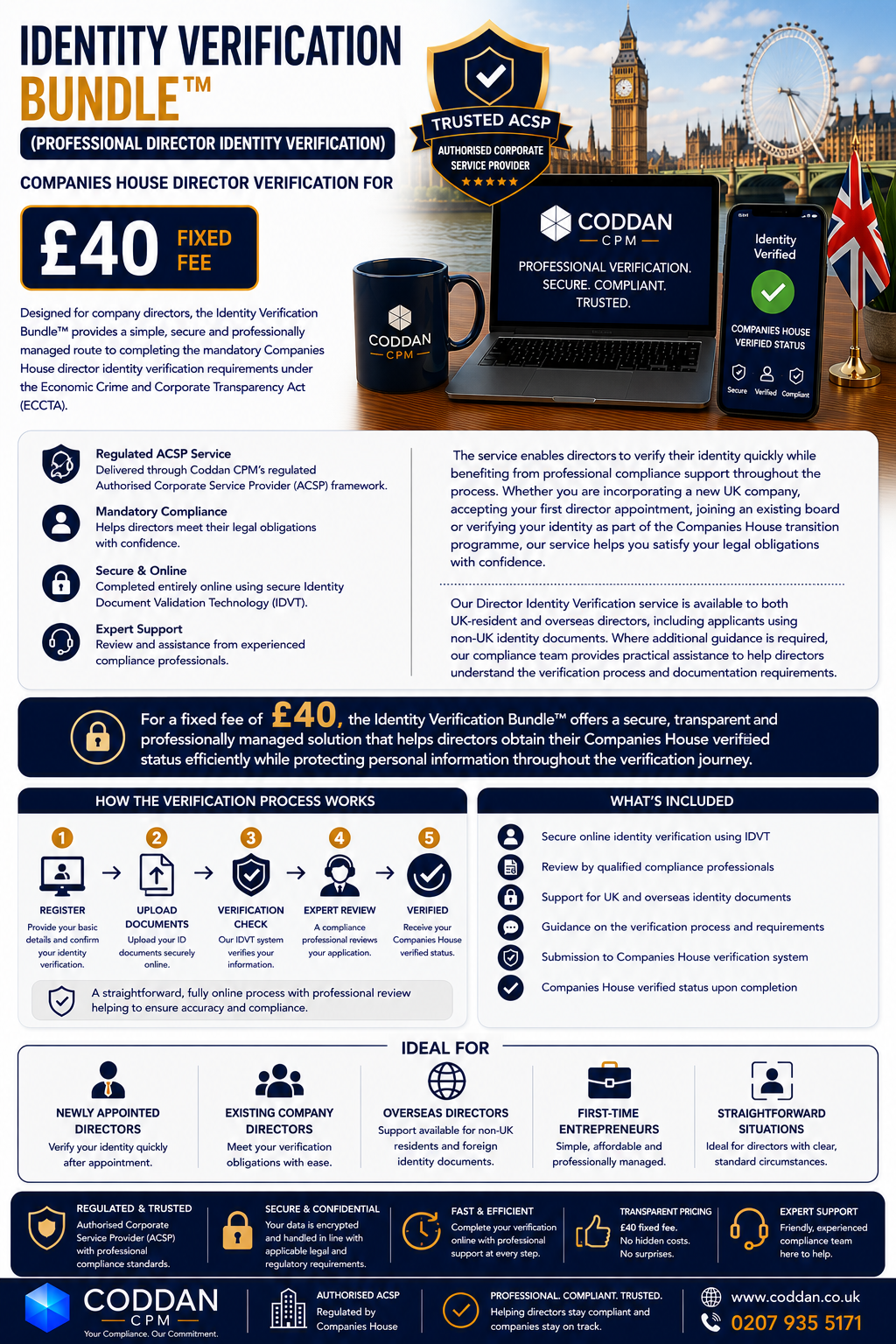
Buy Now Identity Verification Bundle™ (Professional Director Identity Verification) – Companies House Director Identity Verification for £40.
The Identity Verification Bundle™ provides a fast, secure and professionally managed solution for company directors and individuals involved in Companies House director changes who need to complete mandatory director identity verification. Delivered through Coddan CPM's regulated Authorised Corporate Service Provider (ACSP) framework, this managed service helps applicants satisfy the identity verification requirements introduced under the Economic Crime and Corporate Transparency Act (ECCTA) while supporting accurate Companies House records throughout appointments, resignations and other board changes. Whether you are accepting a new directorship, resigning from an existing board, replacing a company director, joining a UK company or completing identity verification during the Companies House transition period, our service offers a straightforward route to obtaining or maintaining verified director status where required. Verification is completed entirely online using secure Identity Document Validation Technology (IDVT), with every application supported by experienced compliance professionals who help ensure your identity verification is completed accurately and in accordance with Companies House requirements.

The service is available to both UK-based and overseas directors, including individuals using eligible non-UK identity documents. Where additional assistance is required, our compliance team provides practical guidance throughout the verification process, helping you understand the documentation requirements for your particular director change and reducing the likelihood of unnecessary delays. For a fixed fee of £40, the Identity Verification Bundle™ offers a secure, transparent and professionally managed route to obtaining or maintaining verified Companies House status through a regulated ACSP. It is ideally suited to newly appointed directors, resigning directors, existing company officers, overseas applicants and anyone involved in a change to a company's board who requires trusted professional support with Companies House director identity verification. Complete your verification with confidence and ensure your director changes are supported by accurate, compliant and up-to-date Companies House records. Ideal for the vast majority of straightforward applicants.


£65.00
+VAT

RapidVerify Pro™

Recommended for

2
package

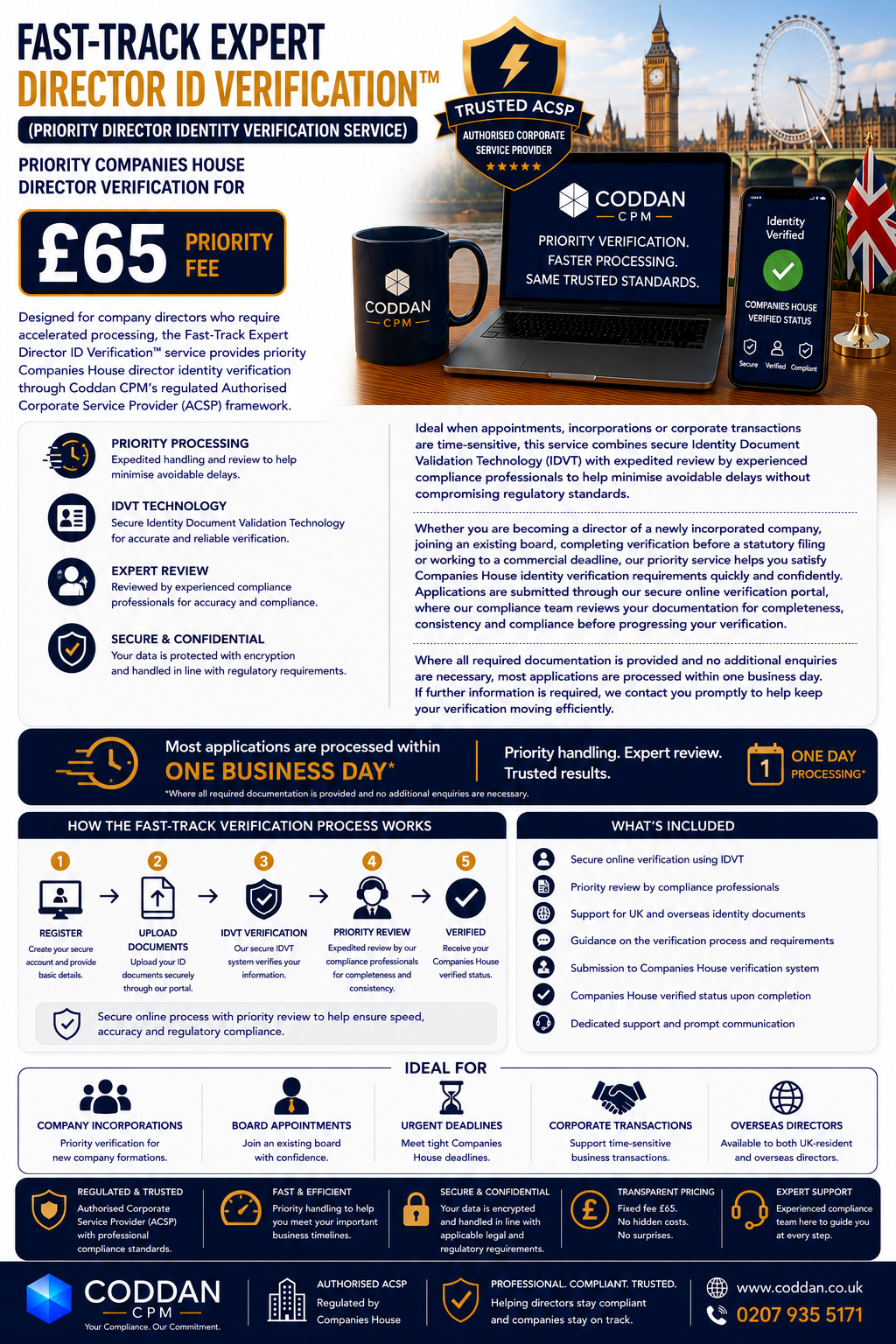
Buy Now Fast-Track Expert Director ID Verification™ (Priority Director Identity Verification Service) – Priority Companies House Director Identity Verification for £65.
The Fast-Track Expert Director ID Verification™ service is designed for company directors and individuals involved in board changes who require priority Companies House director identity verification without compromising accuracy or compliance. Delivered through Coddan CPM's regulated Authorised Corporate Service Provider (ACSP) framework, this premium managed service combines secure Identity Document Validation Technology (IDVT) with expedited review by experienced compliance professionals to help you complete the verification process as quickly as possible during appointments, resignations or other director changes. Ideal for time-sensitive director appointments, resignations, board restructures, corporate transactions, business sales and statutory filing deadlines, this service provides priority handling from the moment your application is received. Every submission is carefully reviewed to help ensure your documentation is complete, consistent and compliant before progressing through the identity verification process, reducing the likelihood of unnecessary delays. Where all required information is provided and no additional enquiries are needed, most applications are processed within one business day.

If further documentation is required, our compliance team contacts you promptly to help keep your verification progressing efficiently. The service is available to both UK-based and overseas directors, including individuals using eligible non-UK identity documents. For £65, the Fast-Track Expert Director ID Verification™ service provides a faster, professionally managed route to obtaining or maintaining verified Companies House status while completing appointments, resignations and other director changes. It is ideally suited to newly appointed directors, resigning directors, existing company officers, overseas applicants and businesses working to urgent commercial or regulatory deadlines. Complete your Companies House director identity verification quickly, securely and with the confidence of experienced ACSP professionals supporting your board changes from start to finish.


£125.00
+VAT

VerifyFlex Solutions™

Recommended for

3
package

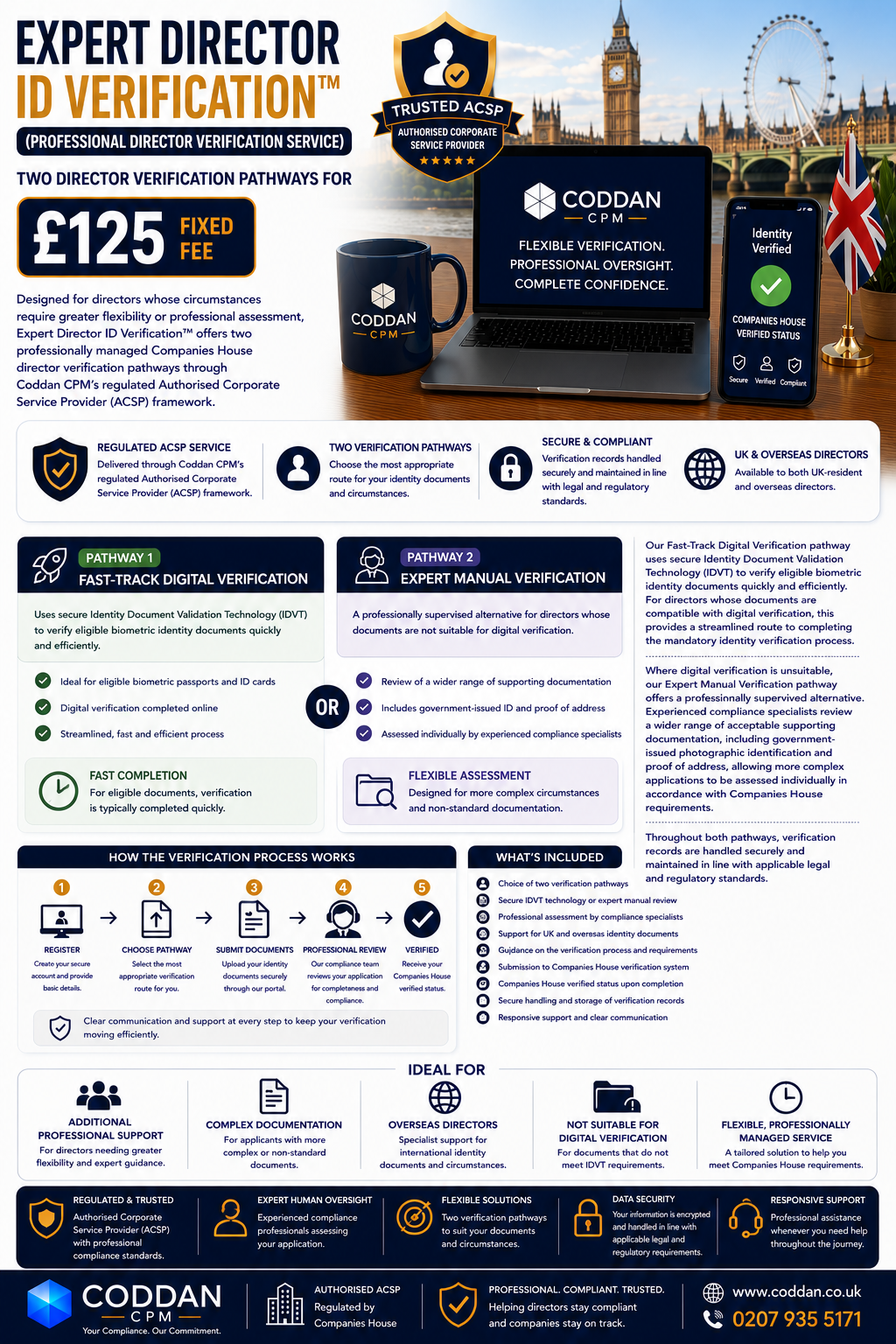
Buy Now Expert Director ID Verification™ (Professional Director Verification Service) – Two Companies House Director Identity Verification Pathways for £125.
The Expert Director ID Verification™ service is designed for company directors and individuals involved in board changes who require greater flexibility when completing Companies House director identity verification. Delivered through Coddan CPM's regulated Authorised Corporate Service Provider (ACSP) framework, this professionally managed service offers two verification pathways, allowing applicants to choose the option that best matches their identity documents and individual circumstances while satisfying Companies House requirements during director appointments, resignations and other board changes. Our Fast-Track Digital Verification pathway uses secure Identity Document Validation Technology (IDVT) to verify eligible biometric identity documents quickly and efficiently. Where digital verification is not suitable, our Expert Manual Verification pathway provides a professionally supervised alternative, enabling experienced compliance specialists to review a broader range of acceptable identity documents and supporting evidence in accordance with applicable regulatory requirements. Both verification pathways are available to UK-based and overseas directors, including individuals using eligible non-UK identity documents.

Throughout the verification process, our compliance team provides practical guidance, carefully reviews every application and helps ensure all documentation satisfies Companies House requirements before your director changes are completed, reducing the likelihood of delays caused by incomplete or unsuitable submissions. For £125, Expert Director ID Verification™ combines advanced verification technology with experienced professional oversight, providing a flexible and reliable managed solution for more complex verification circumstances. It is ideally suited to overseas directors, applicants whose identity documents are unsuitable for standard digital verification, newly appointed directors, resigning directors and anyone seeking experienced assistance with Companies House director identity verification through a trusted regulated ACSP while managing appointments, resignations or other corporate board changes.


£220.00
+VAT

FlexiVerify Option™

Recommended for

4
package

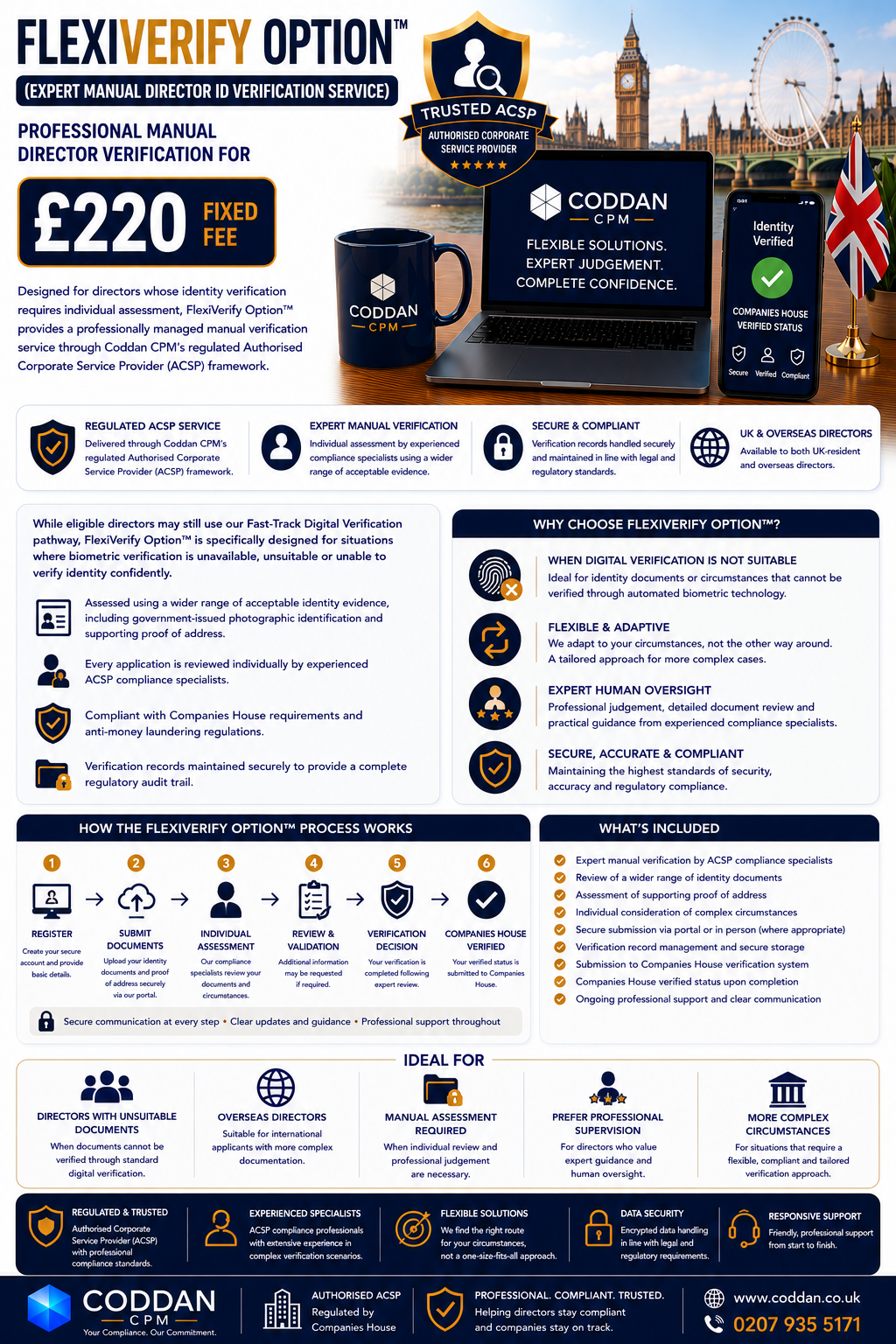
Buy Now FlexiVerify Option™ (Expert Manual Director ID Verification Service) – Professional Manual Companies House Director Identity Verification for £220.
The FlexiVerify Option™ is designed for company directors and individuals involved in board changes whose Companies House director identity verification requires individual assessment beyond standard digital verification. Delivered through Coddan CPM's regulated Authorised Corporate Service Provider (ACSP) framework, this professionally managed manual verification service provides a flexible and compliant route for applicants whose circumstances are more complex or whose identity documents are unsuitable for automated verification during director appointments, resignations or other board changes. While eligible applicants may still use our Fast-Track Digital Verification pathway, FlexiVerify Option™ is specifically intended for situations where biometric verification is unavailable, unsuitable or unable to verify identity with sufficient confidence. Instead of relying solely on automated technology, experienced compliance specialists assess each application individually, reviewing a wider range of acceptable identity evidence, including government-issued photographic identification and supporting proof of address, in accordance with Companies House and anti-money laundering requirements. Applications can be submitted securely through our online verification portal or, where appropriate, completed in person.

Every application receives an individual review, with comprehensive verification records maintained to provide a secure regulatory audit trail and demonstrate compliance with applicable legal obligations. For £220, FlexiVerify Option™ offers the highest level of professionally managed support for complex director identity verification requirements. It is ideally suited to UK-based and overseas directors requiring manual assessment, individuals with non-standard identity documentation, and applicants seeking a fully supervised Companies House identity verification service supported by experienced ACSP compliance specialists and expert regulatory guidance throughout appointments, resignations and other corporate board changes while ensuring Companies House records remain accurate and fully compliant.


?
Decision Support & Guidance

Not Sure Which Option Is Right for You?

Every director's circumstances are different. The most suitable Director Identity Verification option may depend on your location, documents, company situation, and the level of support you require.

If you are unsure which route best fits your needs, you are welcome to contact our team for a simple and free conversation with an experienced adviser.

We can explain the available options, answer your questions, and help you understand the next steps.

There is no obligation to proceed with any service. Our aim is to help you make a clear and informed decision.


Explore how director changes impact identity verification in the Companies House framework. Stay informed on maintaining accurate company records

Understanding Director Changes Within the Companies House Identity Verification Framework
Identity verification is often associated with becoming a company director, but in practice it extends far beyond the initial appointment. Throughout a director's time in office, personal circumstances, business structures and governance responsibilities naturally evolve. A director may change their legal name, update their residential or service address, join additional company boards, assume new executive responsibilities, or oversee complex corporate restructures. Each of these developments can influence how company records should be maintained and how identity verification supports accurate information on the Companies House register.
Maintaining Corporate Integrity: Best Practices for Directors Post-Verification
The articles in this knowledge centre examine the practical issues that arise after a director has already been verified. Rather than focusing solely on the verification process itself, they explore how directors and businesses can maintain accurate records throughout the entire corporate lifecycle. Topics include updating personal information, understanding the continuing role of the 11-character Personal Code, coordinating governance across multiple directorships, resolving discrepancies between identity verification records and Companies House information, managing administrative corrections, and supporting overseas directors whose identity documents require a more flexible verification pathway.
The Ongoing Duty of Identity Verification: A Guide to Effective Governance
Together, these guides demonstrate that effective identity verification is not a single compliance event but an ongoing governance responsibility. By keeping corporate records accurate, reviewing director information regularly and understanding how identity verification interacts with everyday company administration, businesses can strengthen transparency, support regulatory compliance and reduce the likelihood of avoidable administrative complications.
Understanding the Companies House Reforms: A Practical Guide for Business Leaders
Whether you are an entrepreneur managing your first company, a company secretary responsible for statutory administration, an experienced director serving on multiple boards or an international founder establishing a UK presence, this resource centre has been designed to provide practical guidance that reflects the realities of modern corporate governance under the Companies House reforms.

Verify with Confidence

Completing Companies House director identity verification is an important regulatory step. Choosing professional assistance gives you the reassurance that your application has been reviewed before progressing through the verification process, helping to minimise avoidable issues caused by incomplete or unsuitable documentation.

Our experienced compliance team supports directors throughout the verification journey, providing clear guidance and practical assistance whenever additional information is required.


Updating a Director's Personal Details: Identity Verification, Legal Name Changes and Companies House Records

A company director's personal information does not always remain the same throughout their time in office. People change their legal names following marriage or divorce, relocate to new residential addresses, or update other personal information during the course of their professional careers. While these changes are a normal part of life, they can also have important implications for corporate administration and the accuracy of the Companies House register.

Under the UK's modern corporate transparency framework, maintaining accurate director information has become increasingly important. Identity verification is intended to provide confidence that the individual recorded on the public register is correctly identified, while company records should continue to reflect accurate and up-to-date information throughout the director's appointment.

For directors, company secretaries and business owners, a common question is:

"What should I do if my personal details change after I have already completed identity verification?"

Understanding how changes to personal information interact with identity verification helps companies maintain reliable statutory records, support effective governance and ensure that public information remains consistent throughout the lifecycle of a directorship.

Your Verified Identity Continues Throughout Your Directorship
Identity verification is not simply a one-time event connected with incorporation or appointment.

Instead, it establishes confidence in the identity of the individual serving as a company director.

Once a director has been verified, maintaining accurate information throughout their appointment becomes an important aspect of good corporate governance. As personal circumstances change, company records should continue to reflect information that is accurate, complete and consistent with the applicable Companies House requirements.

This ongoing approach supports both regulatory compliance and public confidence in the register.

Corporate Changes Compliance Router

Modifying Director Details? Select Your Change Type

Updating names, service addresses, or personal particulars requires strict adherence to ECCTA standards and Companies House updates. Choose your modification category below for instant routing.

Official ACSP Framework Seamless sync with Companies House filings.
Strict AML Adherence Compliant anti-money laundering controls.
UK GDPR Compliant Encrypted, secure local data processing.

Why Accurate Personal Details Matter
The Companies House register is relied upon by a wide range of organisations when reviewing company information.

These include:

  • Banks and financial institutions.
  • Investors.
  • Professional advisers.
  • Regulatory bodies.
  • Suppliers.
  • Customers carrying out due diligence.
  • Corporate service providers.

Maintaining accurate director information helps ensure that businesses present a consistent and reliable corporate profile while supporting transparency across the wider business community.

Legal Name Changes
One of the most common changes affecting company directors is a legal change of name.

This may occur following:

  • Marriage.
  • Civil partnership.
  • Divorce.
  • Personal choice.
  • Court-approved name changes.

Where a director legally changes their name, the company's records should be reviewed to ensure that the information held internally and submitted to Companies House remains accurate and reflects the director's current legal identity.

Keeping records up to date helps preserve continuity between the director's verified identity and their public company profile.

Changes to Residential Addresses
A director may move home several times during their appointment.

Although a residential address change does not alter the individual's identity, it remains important that company records reflect the correct information where required under the applicable Companies House framework.

Businesses should ensure that address updates are managed carefully alongside any associated company secretarial records so that corporate information remains consistent across all relevant documentation.

Changes to Other Personal Information
In addition to names and residential addresses, directors may occasionally need to update other personal details during their appointment.

Depending on the circumstances, this may include information such as:

  • Corrections to previously recorded details.
  • Changes arising from official documentation.
  • Updates required following administrative errors.
  • Information necessary to maintain accurate statutory records.

Promptly reviewing and updating these details helps reduce the likelihood of inconsistencies developing between identity records and company information.

Identity Verification and Accurate Company Records Work Together
Identity verification establishes confidence in the individual, while company administration ensures that the information associated with that individual remains accurate over time.

These two principles complement one another.

Together they help:

  • Maintain reliable public records.
  • Improve corporate transparency.
  • Support effective governance.
  • Reduce administrative inconsistencies.
  • Build confidence among those relying on Companies House information.

Good governance therefore involves both verifying identity and maintaining accurate records throughout a director's appointment.

Companies Should Review Internal Records as Well
Updating Companies House information is only one aspect of maintaining accurate corporate records.

Businesses should also consider whether changes need to be reflected in:

  • Statutory registers.
  • Board records.
  • Internal governance documentation.
  • Banking records.
  • Regulatory registrations where appropriate.
  • Professional adviser records.
  • Company policies and authorisations.

A coordinated approach helps ensure that all corporate information remains aligned following any change to a director's personal details.

International Directors Should Plan Ahead
Many UK companies appoint directors who reside outside the United Kingdom.

International directors may experience additional administrative considerations when updating official documentation issued in different jurisdictions.

Planning these updates in advance helps minimise delays and supports accurate company administration across multiple countries where necessary.

Accurate Records Support Future Corporate Activities
Keeping personal information current benefits more than day-to-day compliance.

Accurate director records can also contribute to smoother:

  • Company restructures.
  • Future board appointments.
  • Banking reviews.
  • Investment transactions.
  • Due diligence exercises.
  • Corporate acquisitions.
  • Regulatory interactions.

Maintaining accurate information throughout a director's appointment reduces the need for corrective work later in the company's lifecycle.

Fast and Reliable ID Checks for Remote Director Verification: The Coddan Advantage

Two verification paths are available: a direct route with Companies House via GOV.UK One Login, or verification through an Authorised Corporate Service Provider. Verify your directors in minutes, wherever they are located, through Coddan's fast and reliable ID Check service — built for remote compliance

Verify Through Coddan

Professional Support for Director Record Updates
Updating a director's personal information may appear straightforward, but ensuring that company records remain accurate across multiple registers, filings and governance documents often requires careful administration.

Since 2005, Coddan CPM has assisted entrepreneurs, startups, SMEs, overseas investors and professional advisers with company formation, company secretarial services and ongoing corporate compliance. As an Authorised Corporate Service Provider (ACSP) and regulated Trust and Company Service Provider (TCSP), we help businesses understand how changes to a director's personal information interact with identity verification, Companies House requirements and wider governance responsibilities.

Our objective is to ensure that director information remains accurate throughout the entire lifecycle of the appointment, supporting reliable corporate records and transparent company administration.

The Coddan Advantage

Why Coddan Stands Apart in Director ID Verification

By establishing a human-vetted, multi-tiered Authorised Corporate Service Provider (ACSP) pathway (such as IdentityGuard Pro™ using technologies like Credas alongside manual compliance reviews), Coddan offers a vital pressure valve. We take clients who would otherwise be locked out by rigid government tech and safely guide them to compliance.

Accurate Director Information Strengthens Corporate Governance
A director's personal details may change over time, but the importance of maintaining accurate corporate records remains constant. By ensuring that legal names, residential addresses and other core information are updated promptly where required, companies demonstrate their commitment to transparency, responsible governance and effective administration.

Identity verification establishes confidence in who a director is, while ongoing record maintenance ensures that this confidence continues throughout the director's period of office.

At Coddan CPM, we believe that good corporate governance extends beyond incorporation and appointment. Helping businesses maintain accurate director information throughout every stage of the corporate lifecycle supports stronger Companies House records, more efficient administration and greater confidence for everyone who relies on the UK's public register.

Professional Support Beyond Identity Verification

Identity verification is only one stage of establishing and maintaining a compliant company. Directors frequently have questions about using their Personal Code, managing appointments across multiple companies, updating statutory information or understanding new Companies House requirements.

Rather than treating identity verification as a stand-alone transaction, Coddan supports clients throughout the wider compliance journey, helping directors manage future obligations with confidence as their businesses develop.


What Happens to Your 11-Character Personal Code If Your Personal Details Change?

Identity verification is intended to establish a trusted connection between an individual and their role within the UK's corporate framework. Once a company director has successfully completed identity verification, Companies House issues an 11-character Personal Code that becomes an important part of future appointments, company administration and ongoing compliance.

As directors progress through their professional and personal lives, however, their circumstances may change. A legal name may be updated following marriage, a residential address may change after moving home, or official identity documents may be renewed or replaced.

This naturally leads many directors to ask:

"If my personal details change, do I need to complete identity verification again and obtain a new Personal Code?"

Understanding how the Personal Code relates to an individual's verified identity helps directors, company secretaries and businesses manage changes confidently while maintaining accurate Companies House records and supporting long-term corporate governance.

Your Personal Code Identifies You as an Individual
One of the most important features of the identity verification framework is that the 11-character Personal Code is intended to identify the individual rather than a particular document, address or company appointment.

Although personal information may change during the course of a director's career, the verified identity established through the verification process is designed to provide continuity across different corporate activities.

This approach supports a more reliable Companies House register by maintaining a consistent identity throughout the director's professional lifecycle.

Personal Circumstances Naturally Change
Most directors will experience changes to their personal information at some point.

Examples include:

  • A legal change of name.
  • Moving to a new residential address.
  • Renewing an expired passport.
  • Replacing a driving licence.
  • Updating official documentation.
  • Correcting historical administrative errors.

These changes are a normal part of everyday life and do not necessarily alter the individual's underlying identity.

Understanding this distinction is central to understanding how the Personal Code functions within the wider identity verification framework.

Your Identity Is Broader Than Individual Documents
Identity verification is intended to establish confidence in the individual rather than in a single document.

Passports expire.

Driving licences are renewed.

Addresses change.

Names may change during a person's lifetime.

The objective of the verification framework is therefore to provide continuity despite these normal life events, allowing verified individuals to continue participating in company administration while maintaining accurate corporate records.

Keeping Companies House Information Accurate Remains Important
Although a Personal Code is intended to remain associated with the individual, directors should continue to ensure that information held by their company and, where applicable, Companies House remains accurate and up to date.

Good corporate governance includes maintaining:

  • Accurate legal names.
  • Correct residential information where required.
  • Consistent company records.
  • Current governance documentation.
  • Reliable statutory registers.

Maintaining accurate information helps preserve confidence in the Companies House register while reducing the likelihood of administrative inconsistencies.

Updating Records Is Different from Establishing Identity
One area that often causes confusion is the difference between updating information and verifying identity.

Identity verification establishes who the individual is.

Updating company records ensures that information relating to that individual remains current.

These are complementary processes rather than identical ones.

Recognising this distinction helps directors understand why routine administrative updates form part of ongoing governance rather than representing a completely new identity verification exercise.

Continuity Supports Future Company Appointments
Many directors remain active in business for decades.

They may:

  • Establish additional companies.
  • Join new boards.
  • Become non-executive directors.
  • Participate in corporate groups.
  • Invest in growing businesses.
  • Accept appointments with charitable organisations.

Maintaining one continuous verified identity supports these future activities by reducing unnecessary duplication and promoting consistency across multiple company appointments.

Good Governance Requires Ongoing Record Maintenance

Identity verification should never be viewed as the final step in maintaining accurate corporate records.

  • Director information remains current.
  • Internal governance records are accurate.
  • Statutory registers require updating.
  • Board documentation reflects current information.
  • Professional advisers hold consistent records.

  • Regular governance reviews help ensure that changes are addressed promptly and efficiently.

    International Directors Should Monitor Official Documentation
    Overseas directors frequently hold documentation issued by different jurisdictions.

    As passports, national identity cards or other official documents are renewed over time, businesses should ensure that any necessary administrative updates are managed carefully while maintaining accurate records throughout the director's appointment.

    Early preparation helps minimise unnecessary administrative disruption.

    The Personal Code Supports a Director's Long-Term Corporate Journey
    A director's career rarely consists of one appointment with one company.

    Over time, individuals may establish businesses, resign from boards, accept new appointments and participate in increasingly complex corporate structures.

    The Personal Code supports this long-term professional journey by providing continuity across these different stages of corporate involvement.

    Rather than creating a new identity whenever circumstances change, the framework encourages the development of one consistent corporate identity that accompanies the individual throughout their business career.

    Professional Support for Identity and Corporate Record Management
    Understanding how personal changes interact with identity verification and Companies House administration can sometimes be challenging, particularly where directors operate across several companies or international jurisdictions.

    Since 2005, Coddan CPM has supported entrepreneurs, SMEs, overseas investors and professional advisers with company formation, company secretarial services and long-term corporate compliance. As an Authorised Corporate Service Provider (ACSP) and regulated Trust and Company Service Provider (TCSP), we help directors understand how changes to personal information fit within the wider identity verification framework while supporting accurate Companies House records and effective corporate governance.

    Our governance-led approach helps businesses maintain reliable corporate information throughout every stage of a director's professional lifecycle.

    Your Personal Code Is Designed to Provide Continuity
    Personal circumstances inevitably change, but a director's verified corporate identity is intended to provide stability throughout those changes. Understanding the distinction between updating personal information and maintaining an established verified identity helps businesses manage director records more effectively while supporting transparent and accurate corporate administration.

    By keeping company records current and understanding how the Personal Code fits within the wider Companies House framework, directors can approach future appointments, governance responsibilities and business opportunities with greater confidence.

    At Coddan CPM, we believe that identity verification should support directors throughout their entire corporate journey. From your first verification and Personal Code through to future appointments, updated records and evolving personal circumstances, maintaining one consistent and well-managed identity helps build stronger governance and greater trust in the UK's corporate register.


    Mid-Term Board Changes and Role Transitions: Managing Director Identity Verification During Corporate Restructuring

    A company's leadership structure rarely remains unchanged throughout its lifetime. As businesses grow, attract investment, expand into new markets or reorganise their management teams, directors often take on new responsibilities without leaving the board. A non-executive director may become a managing director, a founder may assume the role of chief executive, or directors may be given additional operational authority as the business evolves.

    These changes are an entirely normal part of corporate development. However, under the UK's modern corporate transparency framework, businesses increasingly ask how identity verification interacts with these internal board changes.

    Common questions include:

    • Do I need to complete identity verification again if my role changes?
    • Does my 11-character Personal Code change when I become Managing Director?
    • What happens if my service address or other company information changes?
    • How should Companies House records be maintained during internal board restructures?

    Understanding how identity verification supports directors throughout organisational change helps businesses maintain accurate records while strengthening long-term corporate governance.

    Your Verified Identity Is Separate from Your Job Title
    One of the key principles of the Companies House identity verification framework is that verification relates to the individual, not to their position within a company.

    A director's responsibilities may evolve considerably during their period of office.

    For example, an individual may:

    • Become Managing Director.
    • Be appointed Chief Executive Officer (CEO).
    • Take responsibility for a new business division.
    • Join additional board committees.
    • Assume wider executive authority.

    These organisational changes do not alter the director's underlying identity.

    The Personal Code remains associated with the verified individual rather than with a particular management title.

    Corporate Structures Naturally Evolve
    Successful businesses regularly review and adjust their leadership structures.

    Board changes may occur because of:

    • Business growth.
    • Investment funding.
    • International expansion.
    • Succession planning.
    • Internal promotions.
    • Corporate restructuring.
    • Operational reorganisation.

    These developments are signs of an evolving organisation and often reflect positive business progress rather than administrative disruption.

    Identity verification supports this evolution by providing continuity as directors move between different leadership responsibilities.

    Role Changes Are Different from New Appointments
    A director who changes responsibilities within the same company is not necessarily becoming a different individual.

    The distinction between:

    • A change of role; and
    • The appointment of a new director

    is an important governance principle.

    Identity verification establishes confidence in the person serving as a company officer.

    Changes to internal management responsibilities generally relate to the company's governance arrangements rather than to the director's verified identity.

    Understanding this distinction helps businesses avoid unnecessary confusion during board reorganisations.

    Service Address Changes Should Be Managed Carefully
    During organisational changes, directors may also update their service address or other contact information.

    For example:

    • The company relocates.
    • A director begins working from a different office.
    • A new registered office is adopted.
    • Administrative arrangements change.
    • Company secretarial procedures are reorganised.

    Where changes affect company records, businesses should ensure that relevant information is updated appropriately so that public records remain accurate and consistent.

    Maintaining reliable company information supports both transparency and efficient corporate administration.

    Internal Governance Should Reflect Leadership Changes
    Board restructures frequently involve more than revised job titles.

    Businesses may also review:

    • Delegations of authority.
    • Decision-making procedures.
    • Board committees.
    • Reporting responsibilities.
    • Authorised signatories.
    • Governance policies.
    • Internal compliance procedures.

    Updating governance documentation alongside leadership changes helps ensure that company administration remains aligned with the organisation's current operating structure.

    Identity Verification Supports Long-Term Continuity
    ps.

    A director may:

    • Move between executive and non-executive roles.
    • Lead several business divisions.
    • Join group company boards.
    • Assume wider strategic responsibilities.
    • Participate in acquisitions or restructures.

    Throughout these developments, the verified identity established through the identity verification framework continues to provide continuity across changing corporate responsibilities.

    Board Restructures Often Form Part of Wider Corporate Projects
    Internal leadership changes frequently occur alongside other governance activities, including:

    • Director appointments.
    • Director resignations.
    • Investment transactions.
    • Mergers.
    • Group reorganisations.
    • Succession planning.
    • Company acquisitions.

    Viewing these events as part of one coordinated governance programme enables businesses to manage corporate records more efficiently and reduce administrative complexity.

    International Companies Should Coordinate Governance Changes
    Businesses operating across multiple jurisdictions often experience more complex organisational changes.

    Directors may oversee subsidiaries in several countries while holding different executive responsibilities across a corporate group.

    Maintaining consistent identity records while coordinating leadership changes helps support transparent governance throughout the wider organisation.

    Early planning becomes particularly valuable where multiple companies and professional advisers are involved.

    Accurate Company Records Support Corporate Confidence
    As directors' responsibilities evolve, maintaining accurate Companies House records and internal governance documentation becomes increasingly important.

    Reliable corporate information helps support:

    • Investor confidence.
    • Banking relationships.
    • Regulatory compliance.
    • Due diligence exercises.
    • Professional adviser engagement.
    • Long-term company administration.

    Strong governance depends not only on verifying directors at the beginning of their appointment but also on maintaining accurate records as the organisation develops.

    Professional Support for Board Restructuring and Director Changes
    Corporate restructures often involve numerous governance considerations extending well beyond changes to management titles.

    Since 2005, Coddan CPM has assisted entrepreneurs, SMEs, overseas investors and multinational organisations with company formation, company secretarial services and long-term corporate compliance. As an Authorised Corporate Service Provider (ACSP) and regulated Trust and Company Service Provider (TCSP), we help businesses understand how director identity verification interacts with evolving board structures, internal leadership changes and ongoing Companies House administration.

    Our governance-focused approach enables organisations to manage role transitions confidently while maintaining accurate statutory records and supporting transparent corporate governance.

    Strong Governance Supports Leadership Evolution
    Businesses evolve, and their leadership structures evolve with them. Directors frequently assume new responsibilities, move into executive positions or participate in wider organisational restructuring without changing their underlying corporate identity.

    Understanding how identity verification supports these transitions helps companies maintain continuity while ensuring that corporate records remain accurate throughout every stage of organisational development.

    At Coddan CPM, we believe that effective governance extends far beyond the initial appointment of a director. By helping businesses manage role changes, board restructures and ongoing corporate administration, we support companies in building leadership structures that remain transparent, compliant and well organised throughout their entire lifecycle.


    Resolving Data Discrepancies Between Companies House and Identity Verification Records

    Maintaining accurate company records is a fundamental responsibility of every company director and business. As the UK's corporate transparency framework continues to evolve, information held by Companies House increasingly works alongside verified identity records established through the identity verification process. In most cases, these records remain consistent throughout a director's appointment. Occasionally, however, differences can arise when personal information is updated or corporate records are amended.

    These differences may lead directors, company secretaries and businesses to ask an important question:

    "What happens if my updated Companies House information does not match my identity verification record?"

    Whether the discrepancy relates to a legal name change, an updated residential address, renewed identity documentation or another change to a director's personal information, resolving inconsistencies promptly helps maintain accurate corporate records and supports efficient company administration.

    Understanding how identity verification records interact with Companies House information enables businesses to identify potential issues early and reduce unnecessary delays when managing director changes.

    Identity Verification and Companies House Records Must Work Together
    Identity verification and the Companies House register perform different but closely connected functions.

    Identity verification establishes confidence in the identity of the individual.

    Companies House maintains the public record of company officers and corporate information.

    Together, these systems contribute to:

    • Reliable company records.
    • Greater corporate transparency.
    • Stronger governance.
    • Improved confidence in public information.
    • More efficient company administration.

    Maintaining consistency between identity records and corporate records helps support these wider objectives.

    Why Data Differences Can Occur
    Information may change during the course of a director's appointment for entirely legitimate reasons.

    Examples include:

    • A legal change of name.
    • Moving to a new residential address.
    • Renewing an expired passport.
    • Replacing identity documentation.
    • Correcting historic administrative errors.
    • Updating company records following internal governance reviews.

    Where these changes are not reflected consistently across the relevant records, discrepancies may arise that require further attention.

    Understanding Notices of Inconsistency
    As identity verification becomes more closely integrated with Companies House procedures, businesses may encounter situations where information supplied during a filing differs from previously verified identity records.

    In some circumstances, these differences may result in additional enquiries or administrative checks intended to establish that the information held across different records remains accurate and consistent.

    The purpose of these processes is not simply to identify differences but to help preserve the integrity of the Companies House register and the wider identity verification framework.

    Early identification of inconsistencies often allows them to be resolved more efficiently.

    Common Causes of Record Mismatches
    Many inconsistencies arise from routine life events rather than errors or misconduct.

    Examples include:

    • A company updates a director's legal name before other records are amended.
    • Identity documents are renewed after identity verification.
    • Internal company records differ from previously submitted information.
    • Historical records contain minor administrative inconsistencies.
    • Different organisations hold information that has been updated at different times.

    Recognising these situations helps businesses approach record maintenance in a structured and proactive manner.

    Good Governance Includes Regular Record Reviews
    Businesses should not wait until a filing is being prepared before reviewing director information.

    Regular governance reviews help ensure that:

    • Personal details remain accurate.
    • Internal company records are consistent.
    • Statutory registers are current.
    • Identity documentation reflects recent changes.
    • Governance documentation remains aligned.

    Periodic reviews reduce the likelihood of discrepancies developing over time.

    Coordinating Internal and External Records
    Many organisations maintain director information across several systems.

    These may include:

    • Companies House records.
    • Internal statutory registers.
    • Company secretarial records.
    • Banking documentation.
    • Professional adviser records.
    • Identity verification documentation where applicable.

    Coordinating updates across these different records helps minimise inconsistencies and supports more efficient administration.

    International Directors May Face Additional Administrative Challenges
    Directors living outside the United Kingdom often renew passports, national identity documents or official records issued by overseas authorities.

    Where documentation changes across different jurisdictions, businesses benefit from reviewing whether corresponding company records also require updating.

    Planning these updates in advance can reduce unnecessary delays during future Companies House filings or governance reviews.

    Preparing for Future Company Filings
    Maintaining accurate records today helps simplify future corporate activities.

    Consistent information supports:

    • Director appointments.
    • Director resignations.
    • Changes to director details.
    • Corporate restructures.
    • Due diligence exercises.
    • Banking and investor reviews.
    • Ongoing statutory compliance.

    By resolving discrepancies early, businesses are generally better prepared for future governance events.

    Professional Support When Records Require Review
    Where director information has changed over time, understanding how Companies House records interact with identity verification records can become increasingly important.

    Since 2005, Coddan CPM has assisted entrepreneurs, startups, SMEs, overseas investors and professional advisers with company formation, company secretarial services and long-term corporate compliance. As an Authorised Corporate Service Provider (ACSP) and regulated Trust and Company Service Provider (TCSP), we help businesses review director information, understand how identity verification fits within the wider Companies House framework and support accurate governance throughout the corporate lifecycle.

    Our objective is to help organisations resolve administrative inconsistencies efficiently while maintaining transparent and reliable company records.

    Accurate Records Create Stronger Corporate Governance
    Minor differences between identity verification records and Companies House information can occur as directors' personal circumstances evolve. The key to effective governance is recognising these changes early, maintaining consistent records and ensuring that company information continues to reflect the director's verified identity as accurately as possible.

    By treating record maintenance as an ongoing governance responsibility rather than a one-off administrative exercise, businesses strengthen the quality of their corporate information and reduce the likelihood of unnecessary complications during future filings.

    At Coddan CPM, we believe that accurate corporate records are the foundation of effective governance. Supporting directors through identity verification, record updates and ongoing company administration helps build transparent organisations that inspire confidence among regulators, investors, financial institutions and everyone who relies on the UK's public register.


    Maintaining Accurate Director Information Across Multiple Companies: Managing Personal Data Changes for Multiple Directorships

    Many experienced business professionals serve as directors of more than one company at the same time. An entrepreneur may operate several businesses, an investor may sit on multiple boards, or a senior executive may oversee several companies within a corporate group. While these appointments may span different industries and ownership structures, they all share one common requirement—accurate and consistent director information.

    When a director's personal circumstances change, the implications often extend beyond a single company. A legal change of name, a new residential address or updated identity documentation may affect every organisation where that individual serves as a director.

    As identity verification becomes an increasingly important part of the UK's corporate transparency framework, directors frequently ask:

    "If I hold appointments with several companies, what happens when my personal details change?"
    Understanding how personal information should be managed across multiple directorships helps businesses maintain accurate Companies House records, supports effective governance and reduces the likelihood of inconsistencies developing between different corporate entities.

    One Verified Identity Can Support Multiple Directorships
    The identity verification framework is designed around the individual rather than around individual companies.

    Once a director has completed identity verification and obtained their 11-character Personal Code, that verified identity can support future appointments across multiple organisations within the applicable Companies House framework.

    This continuity allows one individual to build a consistent corporate identity throughout their professional career, regardless of the number of boards on which they serve.

    Maintaining accurate personal information is therefore important not only for one company but across every appointment connected with that verified identity.

    Personal Changes Affect More Than One Organisation
    Directors with multiple appointments should recognise that a change to their personal information may have wider administrative implications.

    Examples include:

    • A legal change of name.
    • A new residential address.
    • Updated identity documentation.
    • Corrections to previously recorded information.
    • Official changes recorded on personal documents.

    Although these changes relate to one individual, they may influence the corporate records of every company in which that person currently serves.

    A coordinated approach helps maintain consistency across all organisations.

    Good Governance Requires Consistent Corporate Records
    Every company is responsible for maintaining accurate information about its directors.

    Where an individual serves on several boards, businesses should work to ensure that their records remain aligned wherever appropriate.

    Consistency supports:

    • Reliable Companies House information.
    • Accurate statutory registers.
    • Efficient company administration.
    • Strong corporate governance.
    • Improved transparency.

    Maintaining consistent information also reduces the likelihood of discrepancies emerging during future filings or governance reviews.

    Directors Should Consider Their Entire Corporate Portfolio
    Experienced directors often think strategically about their businesses.

    The same approach should be applied to corporate administration.

    Rather than updating information on a company-by-company basis over an extended period, directors benefit from considering all of their current appointments together.

    This enables changes to be planned systematically while reducing administrative complexity across multiple organisations.

    Corporate Groups Require Coordinated Administration
    Many directors serve across parent companies, subsidiaries and associated businesses within the same corporate group.

    When personal information changes, coordinated governance procedures help ensure that:

    • Internal records remain consistent.
    • Statutory registers are reviewed.
    • Company secretarial documentation is updated.
    • Board records reflect current information.
    • Companies House filings are prepared accurately where required.

    A structured approach supports effective governance across the wider group.

    Company Secretaries Play an Important Coordinating Role
    Where businesses employ company secretaries or professional company secretarial advisers, they often assist in managing changes affecting directors who hold multiple appointments.

    Their responsibilities may include:

    • Reviewing corporate records.
    • Coordinating governance documentation.
    • Maintaining statutory registers.
    • Supporting Companies House administration.
    • Communicating with professional advisers.
    • Planning governance updates across several entities.

    Effective coordination helps reduce the likelihood of inconsistent information being maintained by different companies.

    Consistent Records Support Future Corporate Activity
    Maintaining accurate information across all appointments provides benefits well beyond day-to-day compliance.

    Reliable corporate records support:

    • Investment transactions.
    • Banking relationships.
    • Due diligence exercises.
    • Corporate restructures.
    • Mergers and acquisitions.
    • Board appointments.
    • Succession planning.

    Businesses that maintain consistent director information are often better prepared when significant corporate events arise.

    International Directors Face Additional Considerations
    Directors serving on UK boards while residing overseas frequently manage appointments across several jurisdictions.

    Where official documentation is updated by overseas authorities, businesses should consider whether corresponding company records also require review.

    Coordinating updates across different countries, advisers and companies helps maintain consistency while reducing administrative delays.

    Early planning becomes particularly valuable where multiple corporate structures are involved.

    Identity Verification Supports Long-Term Continuity
    A director's career may involve numerous appointments over several decades.

    During that time, businesses may be formed, acquired, restructured or sold, while the director continues to build an extensive corporate portfolio.

    The Personal Code provides continuity by linking these appointments to one verified individual rather than creating separate identities for each company.

    Maintaining accurate information throughout this journey supports reliable public records and strengthens long-term corporate governance.

    Professional Support for Multi-Company Governance
    Managing director information across several companies requires careful planning, particularly where businesses operate within complex ownership structures or international corporate groups.

    Since 2005, Coddan CPM has supported entrepreneurs, SMEs, multinational organisations and professional advisers with company formation, company secretarial services and ongoing corporate compliance. As an Authorised Corporate Service Provider (ACSP) and regulated Trust and Company Service Provider (TCSP), we help directors understand how changes to personal information interact with identity verification, Companies House administration and governance across multiple companies.

    Our governance-led approach enables businesses to maintain accurate records, coordinate updates efficiently and support transparent corporate administration throughout every stage of a director's professional career.

    One Director, One Identity, Multiple Companies
    Serving on several boards creates additional governance responsibilities, particularly when personal information changes. Although each company maintains its own statutory records, the individual director remains the common link across every appointment.

    By taking a coordinated approach to updating personal information, businesses can maintain accurate Companies House records, reduce administrative inconsistencies and strengthen confidence in their corporate governance.

    At Coddan CPM, we believe that effective governance should follow directors wherever their business careers take them. Whether managing one appointment or an extensive portfolio of companies, maintaining one consistent and accurately documented identity supports stronger compliance, greater transparency and more reliable corporate records across the entire business landscape.


    Correcting Director Information at Companies House: Administrative Corrections, Identity Records and Good Corporate Governance

    No company maintains perfect records forever. As businesses grow and directors' personal circumstances evolve, minor administrative errors can occasionally be discovered within company records. A spelling mistake in a legal name, an outdated address, an incorrect date or another clerical inconsistency may seem insignificant, but maintaining accurate information remains an essential part of responsible corporate governance.

    Under the UK's modern corporate transparency framework, accurate information has become increasingly important because Companies House records now operate alongside director identity verification. This means that businesses should not only establish a director's identity correctly at the beginning of an appointment but should also ensure that company records continue to reflect that verified identity throughout the director's period of office.

    A common question therefore arises:

    "What should a company do if it discovers an administrative error in a director's information after the appointment has already taken place?"
    Understanding how administrative corrections fit within the wider Companies House framework helps businesses maintain reliable public records while supporting transparency, efficient governance and long-term compliance.

    Accurate Company Records Are an Ongoing Responsibility
    Maintaining company records is not a task completed only at incorporation or when a director is appointed.

    Businesses should regularly review whether information remains:

    • Accurate.
    • Complete.
    • Consistent.
    • Current.
    • Properly supported by internal documentation.

    Regular governance reviews allow organisations to identify minor discrepancies before they become larger administrative issues.

    Administrative Errors Can Occur Naturally
    Most corrections do not arise because of wrongdoing.

    Instead, they often result from routine administrative circumstances such as:

    • Typographical errors.
    • Misspelt legal names.
    • Incomplete information.
    • Data entry mistakes.
    • Historical filing inaccuracies.
    • Information copied from outdated records.
    • Minor clerical inconsistencies.

    Recognising these issues early helps businesses preserve the integrity of their corporate records.

    Correcting Records Supports Identity Verification
    Identity verification establishes confidence in the individual.

    Corporate record maintenance ensures that the information associated with that individual remains accurate over time.

    Where administrative errors are identified, correcting company records helps maintain consistency between:

    • Companies House information.
    • Internal statutory registers.
    • Company secretarial records.
    • Identity verification documentation where applicable.
    • Governance documentation.

    These processes work together to support reliable corporate administration.

    Company Secretaries Play an Important Governance Role
    Many businesses rely upon company secretaries or professional company secretarial advisers to oversee statutory administration.

    Their responsibilities frequently include:

    • Maintaining statutory registers.
    • Reviewing director information.
    • Coordinating governance documentation.
    • Preparing Companies House filings.
    • Monitoring corporate records.
    • Identifying administrative inconsistencies.

    Regular reviews help ensure that minor issues are resolved before they affect future corporate activities.

    Authorised Corporate Service Providers Support Accurate Administration
    Many organisations also choose to work with regulated Authorised Corporate Service Providers (ACSPs) when managing company administration.

    An ACSP can assist businesses by:

    • Reviewing company records.
    • Identifying inconsistencies.
    • Supporting governance procedures.
    • Preparing statutory filings.
    • Coordinating identity verification requirements where applicable.
    • Helping maintain accurate Companies House records.

    Professional oversight often contributes to stronger governance throughout the life of the company.

    Mid-Term Governance Reviews Create Valuable Opportunities
    Administrative corrections are frequently identified during routine governance reviews rather than during major corporate events.

    Examples include:

    • Annual compliance reviews.
    • Company secretarial audits.
    • Investment preparation.
    • Banking due diligence.
    • Internal governance assessments.
    • Corporate restructuring projects.

    Regular reviews allow businesses to identify and address administrative issues before they become more complex.

    Consistency Across Corporate Records Is Essential
    Updating one record may not always be sufficient.

    Businesses should consider whether corrections are also required within:

    • Statutory registers.
    • Internal board records.
    • Shareholder documentation.
    • Banking information.
    • Professional adviser records.
    • Regulatory registrations where appropriate.

    Maintaining consistency across all governance documentation supports accurate company administration.

    International Businesses Should Review Records Carefully
    Companies operating across several jurisdictions often maintain information within multiple administrative systems.

    Where directors hold overseas appointments or official documentation issued by foreign authorities, businesses should ensure that company records remain aligned across all relevant jurisdictions.

    Careful coordination helps reduce unnecessary discrepancies while supporting effective governance internationally.

    Accurate Information Benefits Future Corporate Activities
    Administrative corrections are rarely important only for today's compliance obligations.

    Reliable company records also contribute to smoother:

    • Director appointments.
    • Director resignations.
    • Corporate restructures.
    • Due diligence exercises.
    • Banking reviews.
    • Investment transactions.
    • Future Companies House filings.

    Businesses that maintain accurate records throughout their lifecycle are generally better prepared for future governance events.

    Professional Support for Companies House Record Maintenance
    Maintaining accurate corporate records requires ongoing attention rather than occasional administration.

    Since 2005, Coddan CPM has supported entrepreneurs, SMEs, overseas investors and professional advisers with company formation, company secretarial services and long-term corporate compliance. As an Authorised Corporate Service Provider (ACSP) and regulated Trust and Company Service Provider (TCSP), we help businesses understand how administrative corrections, identity verification and Companies House record maintenance fit together within the wider framework of modern corporate governance.

    Our governance-focused approach helps organisations review company records systematically, resolve administrative inconsistencies and maintain reliable information throughout every stage of the corporate lifecycle.

    Small Corrections Help Build Strong Corporate Governance
    Minor administrative errors may appear insignificant, but accurate company records are built through careful attention to detail. Correcting clerical inconsistencies promptly helps preserve confidence in Companies House information, supports transparent governance and reduces the likelihood of future administrative complications.

    Identity verification establishes confidence in who a director is, while accurate record maintenance ensures that this confidence is reflected consistently across every stage of the company's administration.

    At Coddan CPM, we believe that good governance is achieved through continual record management rather than one-off compliance exercises. By helping businesses identify, review and correct administrative inconsistencies, we support stronger Companies House records, more efficient company administration and greater trust in the UK's corporate register.

    ECCTA Compliance Roadmap

    Director ID Verification: Step-by-Step Lifecycle Process

    Navigating Companies House identity requirements is simple when broken down. Follow this straightforward 5-stage workflow to achieve full statutory compliance.

    Step 1
    Confirm Requirements
    Identify your director, PSC, or corporate entity verification obligations under ECCTA rules.
    Step 2
    Choose Route
    Select Coddan's authorised ACSP gateway for fast-track processing and human oversight.
    Step 3
    Document Check
    Submit biometrics or IDVT credentials through our secure portal for forensic verification.
    Step 4
    Receive Code
    Obtain your official 11-character personal verification code directly from the registry record.
    Step 5
    Link to Roles
    Sync your verified status seamlessly with company formations, appointments, or filings.
    Pro Tip: Completing this workflow through Coddan avoids standard government queue delays and ensures zero compliance errors.


    Managing Multiple Directorships with One 11-Character Personal Code: A Practical Guide to Coordinating Companies House Compliance

    Many business owners and experienced directors do not serve on just one company board. Entrepreneurs frequently establish several businesses, investors may sit on the boards of portfolio companies, and senior executives often hold appointments across subsidiaries, joint ventures and associated organisations.

    As the Companies House identity verification framework becomes part of everyday corporate administration, one question is becoming increasingly relevant for experienced directors:

    "How does one 11-character Personal Code work when I am a director of several companies at the same time?"
    Closely linked to this is another practical concern:

    "How should I manage my compliance responsibilities when different companies have different filing dates, governance reviews and Confirmation Statement deadlines?"

    Understanding how one verified identity supports multiple directorships enables directors to organise their governance responsibilities more effectively while helping every company maintain accurate Companies House records.

    One Verified Identity Across Multiple Companies
    The identity verification framework is centred on the individual rather than on individual companies.

    Once a director has successfully completed identity verification and received their 11-character Personal Code, that verified identity accompanies the individual throughout their corporate career.

    Whether the individual serves as a director of one company or twenty, the Personal Code represents the same verified person.

    This continuity reduces unnecessary duplication and provides a consistent method of identifying directors across the Companies House framework.

    Your Personal Code Does Not Belong to One Company
    One of the most common misunderstandings is that each company appointment requires its own Personal Code.

    In reality, the Personal Code is intended to remain associated with the verified individual rather than with a particular company.

    As directors accept additional appointments throughout their careers, the same verified identity supports those appointments within the applicable Companies House procedures.

    This approach helps create greater consistency throughout the public register while allowing directors to build a continuous corporate history.

    Multiple Companies Mean Multiple Governance Responsibilities
    Although one Personal Code may support several appointments, each company continues to have its own statutory obligations.

    Every company maintains its own:

    • Confirmation Statement.
    • Statutory registers.
    • Board records.
    • Governance documentation.
    • Filing timetable.
    • Internal compliance procedures.

    Directors should therefore distinguish between having one verified identity and managing several independent corporate compliance programmes.

    Confirmation Statement Deadlines Rarely Align
    One practical challenge for directors serving on multiple boards is that each company has its own review cycle.

    For example, one company may prepare its Confirmation Statement during the spring, while another completes its annual review in late summer.

    A third company within the same corporate group may operate on an entirely different timetable.

    Managing these overlapping governance obligations requires careful organisation to ensure that each company maintains accurate information throughout the year.

    Coordinating Multiple Corporate Calendars
    Experienced directors often benefit from viewing their appointments as part of one broader governance portfolio.

    Rather than treating each company as a completely separate administrative exercise, businesses frequently coordinate:

    • Annual governance reviews.
    • Director information updates.
    • Internal compliance checks.
    • Statutory register reviews.
    • Board administration.
    • Company secretarial activities.

    A coordinated approach helps identify common administrative tasks while recognising that each company remains legally responsible for maintaining its own records.

    Consistent Director Information Benefits Every Company
    Where a director serves across several organisations, maintaining consistent personal information becomes increasingly important.

    Businesses should periodically review whether:

    • Director names remain current.
    • Service addresses are accurate.
    • Internal governance records are aligned.
    • Statutory registers contain consistent information.
    • Company secretarial records remain up to date.

    Consistency across multiple companies reduces the likelihood of discrepancies developing during future Companies House filings or governance reviews.

    Corporate Groups Require Structured Administration
    Many directors serve simultaneously on the boards of parent companies, subsidiaries and associated entities.

    Within these structures, governance responsibilities often overlap.

    Coordinating administrative reviews across the wider corporate group helps ensure that:

    • Director information remains consistent.
    • Governance documentation is maintained.
    • Board records are accurate.
    • Compliance activities are properly planned.
    • Companies House filings are supported by reliable internal records.

    A structured governance programme can simplify administration without reducing each company's individual legal responsibilities.

    Professional Company Secretarial Support Can Improve Coordination
    As the number of directorships increases, corporate administration naturally becomes more complex.

    Professional company secretarial support can assist by helping businesses:

    • Maintain governance calendars.
    • Review statutory records.
    • Coordinate board administration.
    • Monitor Companies House obligations.
    • Prepare corporate filings.
    • Maintain accurate director information across multiple entities.

    This coordinated approach supports efficient governance while reducing the administrative burden placed on individual directors.

    Long-Term Governance Depends on Planning Rather Than Deadlines
    Directors with multiple appointments often find that compliance is easier to manage when approached as a continuous process rather than a series of isolated filing events.

    Regular governance reviews help businesses prepare for:

    • Confirmation Statements.
    • Director appointments.
    • Director resignations.
    • Company restructures.
    • Investment transactions.
    • Due diligence exercises.
    • Future administrative changes.

    Planning ahead allows directors to manage several appointments with greater confidence while supporting consistent corporate records across every organisation.

    Professional Support for Directors with Multiple Board Appointments
    Managing governance across several companies requires more than simply remembering filing dates. Directors must also ensure that their verified identity, corporate records and internal governance procedures remain consistent throughout every organisation in which they serve.

    Since 2005, Coddan CPM has assisted entrepreneurs, group companies, overseas investors and experienced directors with company formation, company secretarial services and ongoing corporate compliance. As an Authorised Corporate Service Provider (ACSP) and regulated Trust and Company Service Provider (TCSP), we help businesses understand how identity verification, Personal Codes and Companies House administration operate across multiple directorships while supporting accurate governance throughout the corporate lifecycle.

    Our governance-led approach enables directors to coordinate compliance efficiently without losing sight of each company's individual statutory responsibilities.

    One Identity, Many Responsibilities
    Serving on multiple boards reflects experience, trust and professional achievement, but it also brings additional governance responsibilities. While a single 11-character Personal Code provides continuity across every appointment, each company continues to require accurate records, effective administration and careful attention to its own statutory obligations.

    By maintaining consistent director information, coordinating governance activities and planning ahead for overlapping compliance events, directors can support every organisation they serve while reducing unnecessary administrative complexity.

    At Coddan CPM, we believe that identity verification should simplify long-term corporate administration rather than complicate it. By helping directors manage multiple appointments through one verified identity, we support stronger governance, better organised companies and a more reliable Companies House register throughout every stage of a director's business career.


    Director Identity Verification for Non-UK Residents: Navigating Passport and International Documentation Challenges

    The United Kingdom continues to attract entrepreneurs, investors and business owners from around the world. Many establish UK companies without ever becoming UK residents, while others manage international corporate groups from overseas. These founders bring valuable experience, investment and innovation to the UK economy, but they also encounter unique administrative challenges when complying with Companies House identity verification requirements.

    One of the most common difficulties arises when an overseas director attempts to complete digital identity verification using official documentation that differs from the documents typically expected by automated verification systems.

    Questions frequently include:

    • Can I complete identity verification if my country does not issue a biometric passport?
    • What happens if my identity documents are not recognised by automated verification technology?
    • Can overseas directors still comply without using the GOV.UK ID Check app?
    • Is there an alternative verification route for international applicants?

    Understanding the different verification pathways available helps overseas founders prepare more effectively while ensuring that identity verification supports, rather than delays, their business plans.

    Identity Verification Applies Equally to UK and Overseas Directors
    The Companies House identity verification framework is designed to establish confidence in the identity of company officers, regardless of where they live.

    Whether a director resides in:

    • London,
    • Singapore,
    • Dubai,
    • Toronto,
    • Cape Town,
    • Sydney, or
    • São Paulo,

    the objective remains the same—to confirm the identity of the individual serving within the UK corporate framework.

    International entrepreneurs therefore participate in the same wider governance system as UK-based directors, even though the documentation available to them may differ significantly.

    Identity Documents Vary Around the World
    Not every country issues the same types of identity documents.

    Depending on the jurisdiction, applicants may possess:

    • Biometric passports.
    • Non-biometric passports.
    • National identity cards.
    • Government-issued residence documents.
    • Alternative official identification recognised within their home country.

    The format, security features and digital compatibility of these documents vary considerably from one country to another.

    As a result, some overseas applicants may encounter challenges when using systems designed primarily around automated document recognition.

    Automated Verification Does Not Reflect Every Global Document Standard
    Digital identity verification technology has transformed many administrative processes by allowing identity documents to be reviewed quickly and securely.

    However, automated systems are necessarily designed around technical standards and document formats that can be recognised electronically.

    Because identity documents differ significantly between jurisdictions, some genuine applicants may find that their documentation requires further review before verification can be completed.

    This does not necessarily indicate that there is a problem with the individual's identity. Instead, it often reflects the practical reality that global documentation standards are not completely uniform.

    Human Review Can Support More Complex Verification Scenarios
    Some verification situations require professional assessment rather than relying solely on automated document recognition.

    Examples may include:

    • Non-biometric passports.
    • Older passport formats.
    • Documents issued by jurisdictions with different technical standards.
    • International identity documentation requiring additional review.
    • Circumstances where automated systems cannot confidently assess available documentation.

    Professional review enables these applications to be considered individually while maintaining the integrity of the wider verification framework.

    International Founders Should Prepare Documentation Early
    Entrepreneurs establishing a UK company from overseas often manage several regulatory processes simultaneously.

    These may include:

    • Company incorporation.
    • Identity verification.
    • Banking arrangements.
    • Tax registrations.
    • Corporate governance.
    • International business planning.

    Preparing identity documentation at an early stage helps reduce the likelihood of unnecessary delays as the business progresses through these different stages.

    Forward planning is particularly valuable where international documentation may require additional assessment.

    Identity Verification Is About Confidence, Not Convenience
    It is easy to assume that the quickest verification method will always be the most appropriate.

    In practice, the primary objective of identity verification is to establish confidence that the individual presenting the documentation is the person who intends to serve as a company director.

    Where automated systems cannot reach that level of confidence using available documentation, an alternative verification pathway may provide a more suitable solution without compromising governance standards.

    This reflects an important principle of the Companies House reforms: effective verification should prioritise reliability and accuracy over speed alone.

    Professional Verification Pathways Support International Business
    The introduction of Authorised Corporate Service Providers (ACSPs) provides businesses with additional flexibility when identity verification requires professional assessment.

    An ACSP can assist with verification processes in accordance with the applicable regulatory framework, helping applicants whose circumstances extend beyond straightforward automated verification.

    This is particularly valuable for:

    • Overseas entrepreneurs.
    • International investors.
    • Directors with complex documentation.
    • Individuals managing multinational corporate structures.
    • Applicants whose identity documents require careful review.

    Professional support enables businesses to navigate more complex verification requirements while maintaining confidence in the integrity of the process.

    International Corporate Governance Requires More Than Identity Verification
    For overseas founders, identity verification is only one part of establishing and managing a successful UK company.

    Long-term governance also includes:

    • Maintaining accurate Companies House records.
    • Updating director information where required.
    • Managing statutory obligations.
    • Coordinating international corporate administration.
    • Preparing for future board changes and company growth.

    Viewing identity verification as part of this broader governance journey helps businesses build stronger administrative foundations from the outset.

    Professional Support for Overseas Directors
    International company formation frequently involves documentation, governance considerations and regulatory requirements that differ from those encountered by UK-resident directors.

    Since 2005, Coddan CPM has assisted entrepreneurs, overseas investors, international corporate groups and professional advisers with UK company formation, company secretarial services and long-term corporate compliance. As an Authorised Corporate Service Provider (ACSP) and regulated Trust and Company Service Provider (TCSP), we support directors from a wide range of jurisdictions by helping them understand the identity verification framework and the verification pathways available where automated systems are not appropriate for their particular circumstances.

    Our governance-led approach recognises that international founders require practical guidance that reflects the diversity of global identity documentation rather than assuming every applicant possesses the same forms of identification.

    Building Inclusive Corporate Governance for an International Business Community
    The UK's corporate landscape is increasingly international, bringing together founders, investors and directors from every region of the world. As identity verification becomes an established part of company administration, it is important that the verification framework accommodates the legitimate diversity of global identity documentation while maintaining high standards of corporate transparency.

    Understanding the distinction between automated verification and professionally managed verification pathways allows overseas directors to approach the process with greater confidence and to plan their UK business activities more effectively.

    At Coddan CPM, we believe that robust corporate governance should be accessible to every legitimate entrepreneur, regardless of nationality or the type of official documentation issued by their home country. By combining professional expertise with regulated verification services, we help international founders build trusted UK companies supported by accurate identity verification, reliable corporate records and long-term governance.

    Ready to Complete Your Companies House Director Identity Verification?

    Whether you are becoming a director for the first time, joining an existing company, managing multiple appointments or completing your Companies House identity verification during the transition period, our regulated Authorised Corporate Service Provider (ACSP) service provides the professional support you need.

    Choose from four professionally managed verification pathways, from straightforward digital verification to expert manual assessment for more complex applications. Our experienced compliance team helps you complete the verification process efficiently, securely and with confidence.

    Compare Director ID Verification Packages →

    How to Legally Add a Pro-Company Secretary.

    How to Simplify Your Business Expert Corporate Secretarial & Compliance

    Launch, expand, or manage your business, with Coddan CPM’s Named Expert Governance™, integrating compliance, identity verification, and expert support seamlessly.
    Ensure your business thrives with Coddan CPM’s Named Expert Governance™, a complete solution for company secretarial services and ongoing compliance management.

    Learn the importance of structured governance for growing companies, providing predictable support and easing compliance amidst corporate changes.

    Explore how predictable annual governance support helps companies manage compliance efficiently, avoiding the pitfalls of ad hoc administrative tasks.

    Understand the benefits of structured governance as companies grow, ensuring budget-friendly compliance and minimising uncertainty during corporate transitions.

    Find out how structured governance can streamline compliance for expanding businesses, offering predictable support and reducing the need for ad hoc solutions.

    Coddan CPM’s Named Expert Governance™ model offers proactive support for statutory records and compliance, ensuring your business stays on track all year.

    Stay compliant with Coddan CPM’s Named Expert Governance™ model, providing ongoing support for statutory records, governance documentation, and Companies House submissions.
    Experience Coddan CPM’s Named Expert Governance™ model, designed for proactive compliance and expert assistance with statutory records and governance documentation.

    Explore the vital role of identity verification in modern corporate governance. Partner with an ACSP for authorised verification and compliance guidance.

    Understand the importance of identity verification in today’s business landscape. Collaborate with an ACSP for expert support on compliance and documentation.

    Identity verification is key to corporate governance. Find out how working with an ACSP can streamline your compliance and documentation processes.

    Enhance your business’s corporate governance with effective identity verification. Learn how an ACSP can provide authorised routes and compliance assistance.

    Key Takeaway

    Not every board change creates a new identity verification requirement, but Companies House identity verification applies to individuals who hold roles covered by the current legislation, including company directors. Whether you are appointing a new director, replacing an existing one or updating the board following a corporate restructure, it is important to understand which individuals must be verified before the relevant Companies House filings are completed. Checking the requirements before making changes helps avoid unnecessary delays.
    Yes. Businesses often appoint and remove directors as part of a single board restructuring, acquisition, succession plan or internal reorganisation. Where multiple changes are taking place, planning the identity verification process alongside the required Companies House filings can help ensure the updates are completed in the correct order and that the public register accurately reflects the new board structure.
    Where identity verification is required for the proposed appointment, completing the verification before or alongside the appointment process is generally the most efficient approach. This helps ensure the new director can be entered onto the Companies House register without avoidable delays and reduces the likelihood of further information being requested before the appointment is processed.
    Each individual's verification status is considered separately. If one person involved in the board change has completed the required identity verification while another has not, this may affect how quickly the associated Companies House updates can be finalised. Ensuring every relevant individual understands their verification responsibilities before submitting board changes helps maintain an orderly compliance process.
    Yes, although overseas applicants may require different supporting documentation depending on their identity documents and personal circumstances. Many overseas directors successfully complete Companies House identity verification through a regulated Authorised Corporate Service Provider (ACSP), which can provide guidance where additional evidence or manual review is appropriate.
    Yes. Many individuals hold directorships in multiple companies. Resigning from one appointment does not affect your position in other companies unless separate resignations are submitted. Each company maintains its own Companies House record, and any applicable identity verification requirements continue to apply to your remaining appointments where relevant.

    The Process for Appointing a Secretary.

    Impact Beyond Filing the AP03 Form

    Learn about the impact of the ECCTA on company administration, emphasizing the need for comprehensive governance support beyond basic filing services.
    Uncover the changes brought by the Economic Crime and Corporate Transparency Act, enhancing corporate governance and requiring more than just filing services.

    Enhance your business’s compliance with Coddan CPM’s Named Expert Governance™ service, offering identity verification and structured governance support.

    Coddan CPM’s Named Expert Governance™ service combines identity verification and compliance administration, ensuring your business thrives in the Companies House landscape.

    Streamline your business governance with Coddan CPM’s Named Expert Governance™ service, integrating identity verification and ongoing compliance support.

    Navigate the modern Companies House environment with Coddan CPM’s Named Expert Governance™ service, ensuring robust governance and compliance for your business.

    Learn why digital verification systems may fall short in complex scenarios and how professional assistance can bridge the gap for successful verification.

    Explore the limitations of digital verification systems in handling intricate ownership structures and international documents, and the value of expert support.

    Understand the challenges of digital verification for complex cases and how professional help can ensure accurate verification when standard processes fail.

    Find out how professional support enhances digital verification systems, especially for complex ownership structures and international documentation challenges.

    Learn about the significant changes in UK company administration with the introduction of identity verification and its effects on Companies House interactions.

    Explore the implications of identity verification for UK companies, including its role in company formations and ongoing obligations with Companies House.

    Understand the new identity verification requirements for UK companies and how they will affect your dealings with Companies House moving forward.

    Stay informed on the identity verification changes in UK company administration and their importance for your company’s compliance with Companies House.

    Discover the Details

    Before making changes to a company's board, it is sensible to confirm that identity documents are valid, personal details match Companies House records where appropriate, and any supporting evidence required for verification is readily available. Preparing documentation in advance helps minimise interruptions during appointments, resignations and other corporate governance changes.
    Yes. Changes to directors often occur alongside other statutory filings, such as confirmation statements, updates to Persons with Significant Control (PSCs) or registered office changes. Considering the wider compliance picture before making board changes helps ensure that all related Companies House records remain accurate and consistent.
    A board restructure usually involves multiple governance changes occurring together, such as appointing new directors, removing existing directors or changing board responsibilities. These situations often require greater planning because several statutory records and compliance obligations may need to be updated at the same time. Coordinating identity verification with the wider restructuring process can help the transition proceed more smoothly.
    Professional assistance can be particularly valuable where director changes involve overseas applicants, complex ownership structures, urgent filing deadlines or identity documents that are unsuitable for standard digital verification. An ACSP can review documentation, explain the available verification pathways and help identify potential issues before submissions are made to Companies House.
    Yes. Leaving the board does not necessarily end your relationship with the company. A former director may continue as a shareholder, Person with Significant Control (PSC), employee or consultant, depending on the company's arrangements. Each role has different legal responsibilities, so it is important to ensure the relevant Companies House records accurately reflect your continuing position.
    Planning ahead is usually the most effective approach. Confirming which individuals require identity verification, checking documentation before submission, understanding Companies House filing requirements and coordinating appointments or resignations in the correct sequence can significantly reduce avoidable delays. Businesses managing several changes simultaneously often benefit from establishing a clear compliance timetable before implementing the new board structure.

    Institutional-Grade Protection

    Regulatory Alignment & Data Security

    Your sensitive verification documents and personal data are protected by elite cryptographic standards and rigorous compliance frameworks.

    Official ACSP Protocols
    Authorized Corporate Service Provider standards for direct government sync.
    Strict AML Adherence
    Fully aligned with UK anti-money laundering and Know Your Customer rules.
    UK GDPR Compliant
    Secure, encrypted data storage hosted entirely within the United Kingdom.
    ISO Standards Aligned
    Rigorous operational security and information management protocols.