We use cookies on this website, you can read about cookies and GDPR Privacy Policy here
Coddan CPM Ltd. – Company Registration Agent in the UK

Follow these six steps to prepare for your directorship, complete Companies House identity verification and begin your new role with confidence.

Step 1
Plan Your Appointment
Step 2
Review Director Requirements
Step 3
Gather Identity Documents
Step 4
Select Verification Route
Step 5
Become Verified Director
Step 6
Begin Your Directorship

Becoming a Director: Director ID Verification


Becoming a company director in the UK? Know the importance of identity verification before your appointment to enhance governance and avoid delays

Becoming a Company Director Starts Before Your Appointment
Accepting an appointment as a company director has always been an important legal milestone. Today, however, becoming a director involves more than agreeing to join a company's board or submitting incorporation documents to Companies House. Under the UK's modern corporate transparency framework, identity verification has become an essential part of the appointment process, requiring prospective directors to establish their verified identity and obtain their 11-character Personal Code before they can be formally appointed to a UK limited company or included in a new company registration.
Streamlining Board Appointments: How Early Identity Verification Enhances Corporate Governance
For many entrepreneurs, startups and growing businesses, this represents a significant change in the way company formation and board appointments are planned. Identity verification is no longer a task to complete after incorporation—it is one of the first practical steps in becoming a company director. Understanding this change before beginning the appointment process helps businesses avoid unnecessary delays, supports efficient Companies House filings and creates stronger corporate governance from the very beginning of a director's tenure.
Essential Preparations for First-Time Directors: Navigating the AP01 Appointment Process
Whether you are launching your first startup, joining the board of an established company, accepting your first directorship or appointing directors on behalf of your business, preparing in advance is essential. Questions such as which identity documents are acceptable, whether to use the GOV.UK One Login service or an Authorised Corporate Service Provider (ACSP), how your Personal Code is used during an appointment, and how identity verification fits into the modern AP01 appointment process are now important considerations before a directorship can begin.
Understanding the Role of Authorised Corporate Service Providers in Company Formation
Since 2005, Coddan CPM has supported entrepreneurs, overseas investors, SMEs and professional advisers through every stage of the company formation and director appointment process. As a regulated Authorised Corporate Service Provider (ACSP) and Trust and Company Service Provider (TCSP), we understand that successful appointments begin with preparation rather than paperwork alone. Every prospective director has different circumstances, and selecting the most appropriate verification pathway depends on the individual's documentation, the nature of the appointment and the wider objectives of the business.
Empowering Directors: The Essential Role of Identity Verification in Corporate Leadership
The verification packages below have been designed to support a range of appointment scenarios, from straightforward digital verification to professionally managed verification for more complex situations. Before selecting the most appropriate option, we encourage you to explore the guidance throughout this Resource Centre. The articles explain not only how to complete identity verification before becoming a director, but also how the process supports responsible company formation, compliant board appointments and confident corporate leadership from the very first day of your directorship.
i
Independent Verification Support

Registered Directly with Companies House? We Can Still Help.

Many directors choose to register their companies directly with Companies House. When a new compliance requirement such as Director Identity Verification arises, professional guidance can still be useful.

Whether your company was formed online through Companies House or by another provider, you are welcome to use our identity verification service on its own.

Our role is simple: help you understand the process, guide you through the available verification routes, and provide professional support where needed—without asking you to transfer any of your existing company services.


Start Your Business Today: Fast Formation Services to Meet All Compliance Standards

Ensure compliance with Companies House through rapid, secure ID verification for Directors and PSCs. Complete the process online with an authorized ACSP

treamline your compliance with Companies House using our fast, secure ID verification for Directors and PSCs, all completed online by an authorized ACSP
£40.00
+VAT

IdentityGuard Pro™

Recommended for

1
package

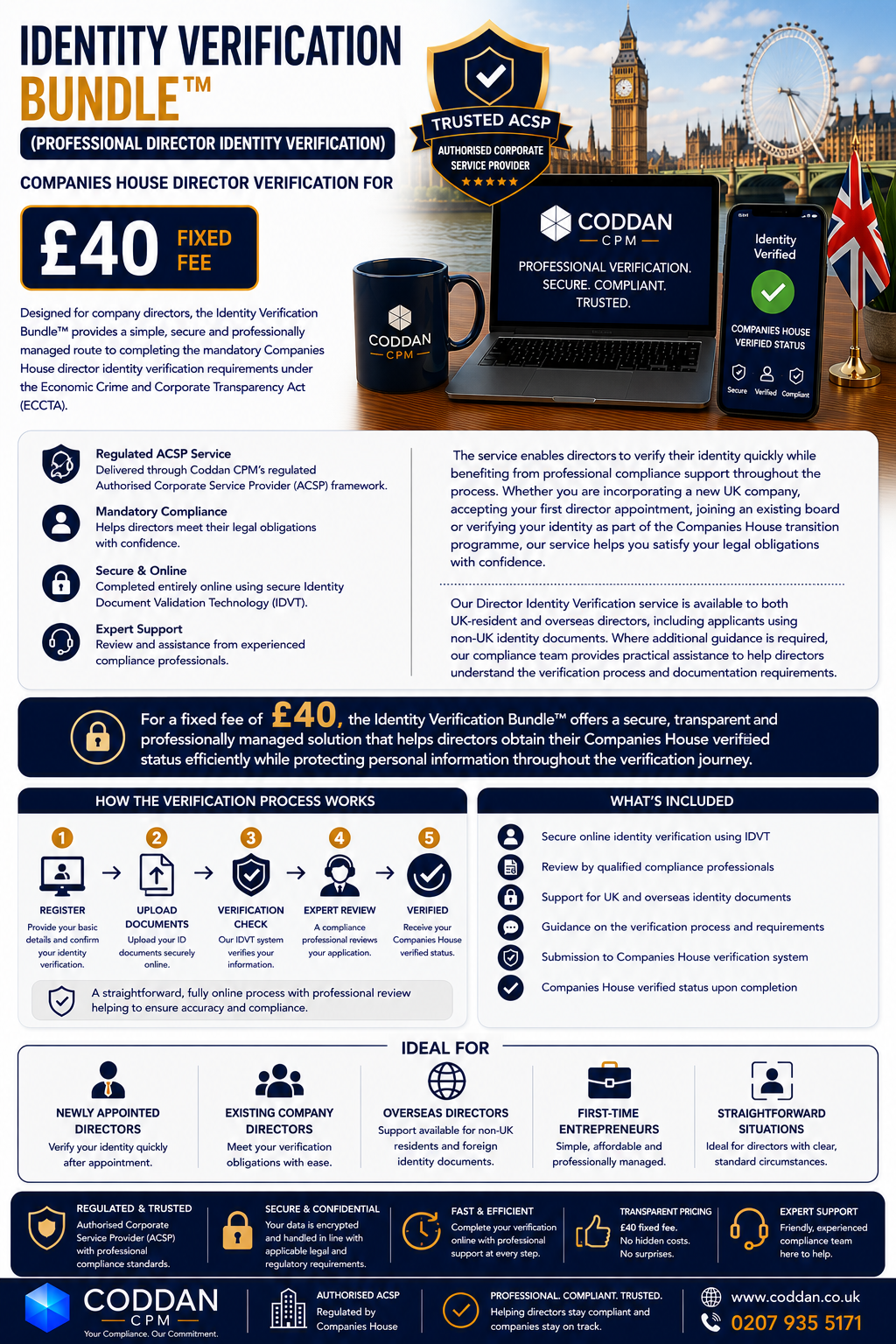
Buy Now Identity Verification Bundle™ (Professional Director Identity Verification) – Companies House Director Identity Verification for £40.
The Identity Verification Bundle™ provides a fast, secure and professionally managed solution for individuals preparing to become company directors and complete mandatory Companies House director identity verification. Delivered through Coddan CPM's regulated Authorised Corporate Service Provider (ACSP) framework, this managed service helps prospective directors satisfy the identity verification requirements introduced under the Economic Crime and Corporate Transparency Act (ECCTA) before formally taking up their appointment. Whether you are incorporating your own UK company, accepting your first board position, joining an existing company as a newly appointed director or completing verification during the Companies House transition period, our service offers a straightforward route to becoming a verified company director. Verification is completed entirely online using secure Identity Document Validation Technology (IDVT), with every application supported by experienced compliance professionals who help ensure your identity verification is completed accurately and in accordance with Companies House requirements.

The service is available to both UK-based and overseas applicants intending to become company directors, including individuals using eligible non-UK identity documents. Where additional assistance is required, our compliance team provides practical guidance throughout the verification process, helping you understand the documentation requirements before your appointment and reducing the likelihood of unnecessary delays. For a fixed fee of £40, the Identity Verification Bundle™ offers a secure, transparent and professionally managed route to obtaining verified Companies House status through a regulated ACSP. It is ideally suited to first-time directors, newly appointed directors, entrepreneurs establishing UK companies and anyone preparing to accept a directorship who requires trusted professional support with Companies House director identity verification. Complete your verification with confidence and begin your directorship fully prepared for your new legal responsibilities. Ideal for the vast majority of straightforward applicants.


£65.00
+VAT

RapidVerify Pro™

Recommended for

2
package

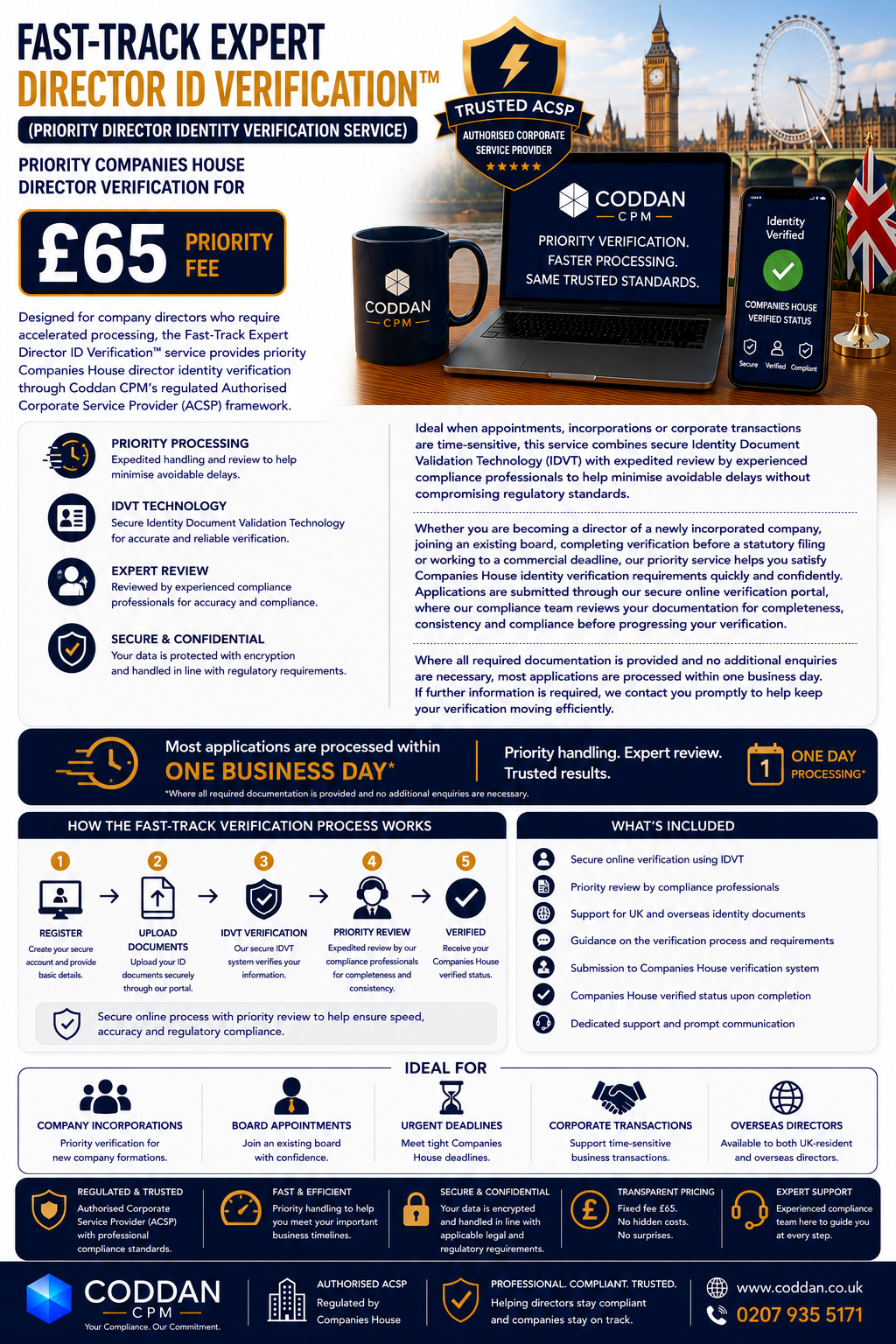
Buy Now Fast-Track Expert Director ID Verification™ (Priority Director Identity Verification Service) – Priority Companies House Director Identity Verification for £65.
The Fast-Track Expert Director ID Verification™ service is designed for individuals preparing to become company directors who require priority Companies House director identity verification without compromising accuracy or compliance. Delivered through Coddan CPM's regulated Authorised Corporate Service Provider (ACSP) framework, this premium managed service combines secure Identity Document Validation Technology (IDVT) with expedited review by experienced compliance professionals to help you complete the verification process as quickly as possible before accepting your directorship. Ideal for time-sensitive director appointments, company incorporations, board changes, corporate transactions and statutory filing deadlines, this service provides priority handling from the moment your application is received. Every submission is carefully reviewed to help ensure your documentation is complete, consistent and compliant before progressing through the identity verification process, reducing the likelihood of unnecessary delays. Where all required information is provided and no additional enquiries are needed, most applications are processed within one business day.

If further documentation is required, our compliance team contacts you promptly to help keep your verification progressing efficiently. The service is available to both UK-based and overseas applicants preparing to become company directors, including individuals using eligible non-UK identity documents. For £65, £ the £Fast-Track Expert Director ID Verification™£ service provides a faster, professionally managed route to obtaining verified Companies House status before taking up a directorship. It is ideally suited to newly appointed directors, first-time directors, entrepreneurs incorporating UK companies, overseas applicants and businesses working to urgent commercial or regulatory deadlines. Complete your Companies House director identity verification quickly, securely and with the confidence of experienced ACSP professionals supporting your appointment from start to finish.


£125.00
+VAT

VerifyFlex Solutions™

Recommended for

3
package

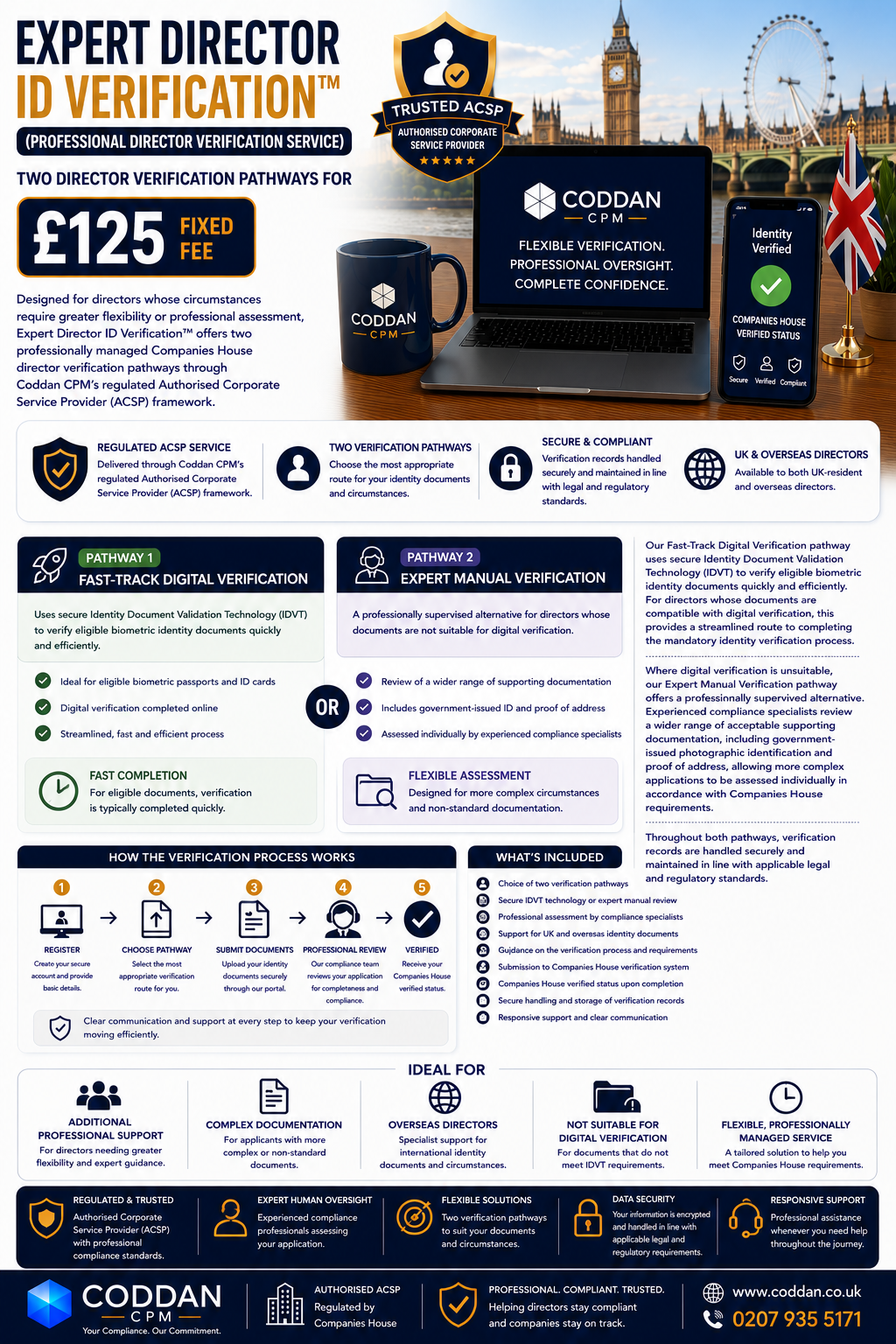
Buy Now Expert Director ID Verification™ (Professional Director Verification Service) – Two Companies House Director Identity Verification Pathways for £125.
The Expert Director ID Verification™ service is designed for individuals preparing to become company directors who require greater flexibility when completing Companies House director identity verification. Delivered through Coddan CPM's regulated Authorised Corporate Service Provider (ACSP) framework, this professionally managed service offers two verification pathways, allowing prospective directors to choose the option that best matches their identity documents and individual circumstances while satisfying Companies House requirements before accepting a directorship. Our Fast-Track Digital Verification pathway uses secure Identity Document Validation Technology (IDVT) to verify eligible biometric identity documents quickly and efficiently. Where digital verification is not suitable, our Expert Manual Verification pathway provides a professionally supervised alternative, enabling experienced compliance specialists to review a broader range of acceptable identity documents and supporting evidence in accordance with applicable regulatory requirements. Both verification pathways are available to UK-based and overseas applicants preparing to become company directors, including individuals using eligible non-UK identity documents.

Throughout the verification process, our compliance team provides practical guidance, carefully reviews every application and helps ensure all documentation satisfies Companies House requirements before your director appointment, reducing the likelihood of delays caused by incomplete or unsuitable submissions. For £125, Expert Director ID Verification™ combines advanced verification technology with experienced professional oversight, providing a flexible and reliable managed solution for more complex verification circumstances. It is ideally suited to overseas applicants, future directors whose identity documents are unsuitable for standard digital verification, first-time directors, newly appointed directors and anyone seeking experienced assistance with Companies House director identity verification through a trusted regulated ACSP before taking up their new role.


£220.00
+VAT

FlexiVerify Option™

Recommended for

4
package

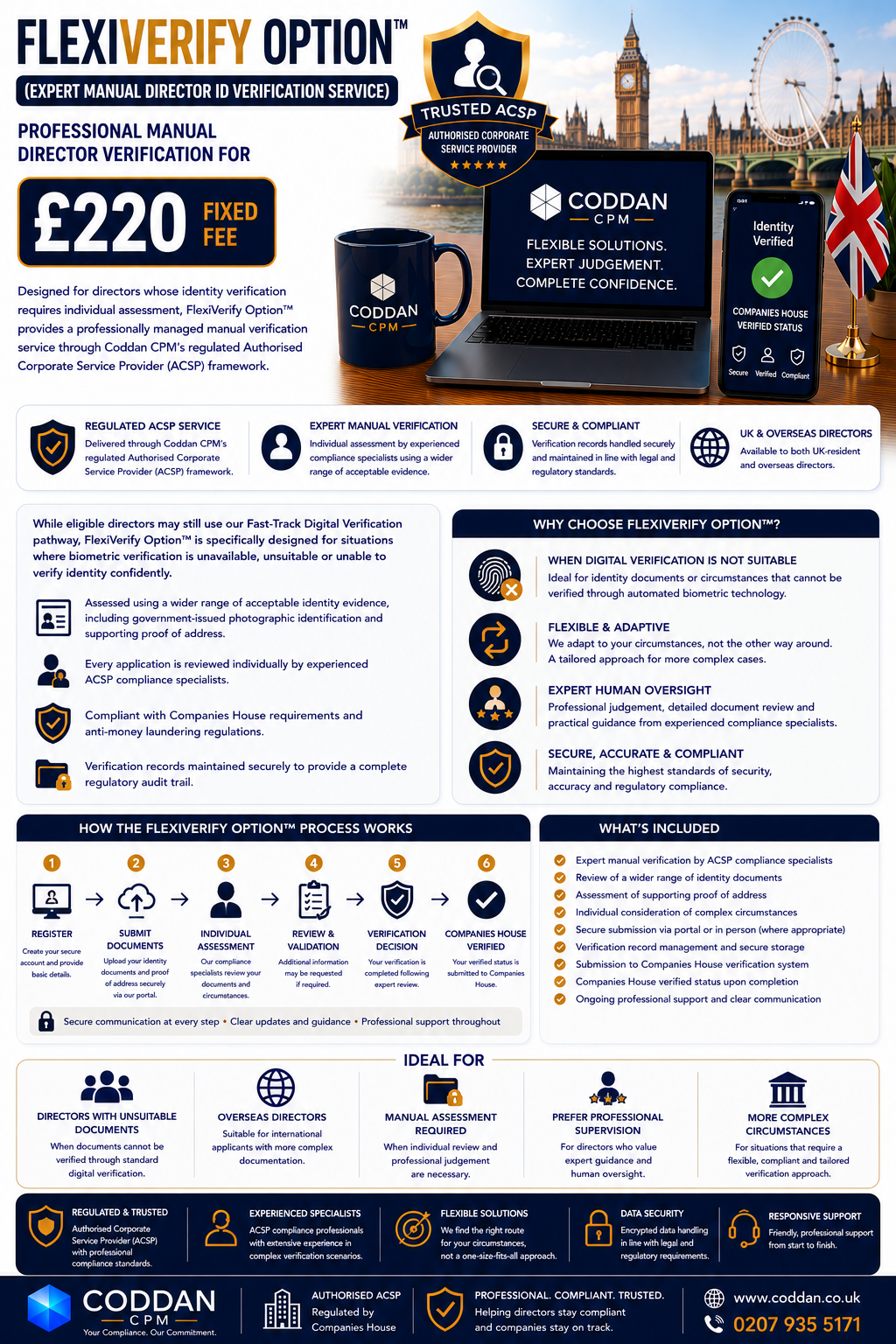
Buy Now FlexiVerify Option™ (Expert Manual Director ID Verification Service) – Professional Manual Companies House Director Identity Verification for £220.
The FlexiVerify Option™ is designed for individuals preparing to become company directors whose Companies House director identity verification requires individual assessment beyond standard digital verification. Delivered through Coddan CPM's regulated Authorised Corporate Service Provider (ACSP) framework, this professionally managed manual verification service provides a flexible and compliant route for prospective directors whose circumstances are more complex or whose identity documents are unsuitable for automated verification before accepting a directorship. While eligible applicants may still use our Fast-Track Digital Verification pathway, FlexiVerify Option™ is specifically intended for situations where biometric verification is unavailable, unsuitable or unable to verify identity with sufficient confidence. Instead of relying solely on automated technology, experienced compliance specialists assess each application individually, reviewing a wider range of acceptable identity evidence, including government-issued photographic identification and supporting proof of address, in accordance with Companies House and anti-money laundering requirements. Applications can be submitted securely through our online verification portal or, where appropriate, completed in person.

Every application receives an individual review, with comprehensive verification records maintained to provide a secure regulatory audit trail and demonstrate compliance with applicable legal obligations. For £220, FlexiVerify Option™ offers the highest level of professionally managed support for complex director identity verification requirements. It is ideally suited to UK-based and overseas applicants preparing to become company directors who require manual assessment, individuals with non-standard identity documentation, and prospective directors seeking a fully supervised Companies House identity verification service supported by experienced ACSP compliance specialists and expert regulatory guidance throughout the verification process before taking up their appointment.


Existing Company Guidance

Need Help Choosing the Right Verification Route?

If your company is already registered with Companies House, you may only need support with completing your Director Identity Verification requirement.

The right solution depends on your individual circumstances. Some directors complete the process independently, while others prefer professional guidance to understand the requirements and avoid uncertainty.

If you are not sure which option suits your situation, contact our team for a straightforward discussion.

We will help you understand your choices without pressure to purchase additional services.

Find Your Exact Verification Pathway:

Click your scenario to jump straight to your matching service tier.


Unlock your potential as a company director! Our resource offers insights on identity verification and the complete journey to effective governance and incorporation

Your Journey to Becoming a Company Director Starts Here
Completing identity verification is only one stage in becoming a company director. Understanding when verification should take place, why it is required before appointment and how it fits into the wider company formation process is equally important. Directors who prepare before their appointment are generally able to complete incorporation and board appointments more efficiently while establishing stronger governance from the outset.
From Aspiration to Appointment: Understanding Your Journey as a Director in the UK
The guidance below has been developed as a practical knowledge centre for aspiring entrepreneurs, startup founders, first-time directors, overseas investors, company secretaries and businesses appointing new directors. Rather than focusing solely on the identity verification process, these articles explain the complete journey of becoming a director under the UK's modern corporate transparency framework—from preparing for your first appointment through to understanding how your verified identity becomes permanently connected with your company record.
Evolving Beyond AP01 and AP02: A Guide to the Contemporary Director Appointment Process
Throughout this resource, you will learn why identity verification must normally be completed before a director appointment can proceed, how the appointment process has evolved beyond the traditional Form AP01 and Form AP02 filings, and why obtaining your 11-character Personal Code before incorporation or appointment has become an important part of modern company administration. The articles also explain which identity documents are commonly accepted, how startup founders can prepare for incorporation, how the GOV.UK One Login service compares with verification through an Authorised Corporate Service Provider (ACSP), and how your Personal Code is linked to your appointment within the Companies House framework.
Understanding Identity Verification: Key Insights for Effective Board Appointments
In addition, the resource explores practical issues that many new directors encounter during the appointment process, including preparing suitable documentation, avoiding common verification delays, understanding the relationship between identity verification and company formation, and recognising the governance considerations that accompany a new directorship. You will also gain a clearer understanding of why identity verification has become an integral part of responsible board appointments and how early preparation can help support a smoother incorporation or director onboarding process.
Empowering Future Leaders: The Essentials of Becoming a Company Director with Coddan CPM
At Coddan CPM, we believe that becoming a company director should begin with knowledge rather than paperwork. Since 2005, we have helped entrepreneurs, startups, overseas founders and established businesses navigate company formation, director appointments and long-term corporate compliance. As an Authorised Corporate Service Provider (ACSP) and regulated Trust and Company Service Provider (TCSP), our role extends beyond completing identity verification—we help prospective directors understand the legal framework, governance principles and practical responsibilities that support successful company leadership.
Whether you are preparing to launch your first limited company, joining the board of an existing business or planning several future appointments, the articles below are designed to provide the knowledge, confidence and practical guidance needed to begin your directorship on a strong legal and governance foundation.

Professional Guidance Every Step of the Way

Companies House identity verification has introduced new responsibilities for directors, but completing the process doesn't have to become another administrative burden. Rather than relying solely on automated systems, Coddan CPM provides professional guidance from the moment you begin your verification until your application has been completed through our regulated ACSP framework.

Whether your verification is straightforward or requires additional assessment, our flexible verification pathways are designed to help you complete the process efficiently while understanding each stage of the journey.


The Pre-Appointment Rule: Why New Directors Must Complete Identity Verification Before Joining a UK Company

Accepting an appointment as a company director has always carried important legal responsibilities. Today, however, becoming a director involves an additional step that takes place before the appointment itself. Under the UK's modern corporate transparency framework, identity verification has become an integral part of the director appointment process, ensuring that the individuals entrusted with managing companies can be confidently identified before they assume their corporate role.

For anyone preparing to become a director—whether they are establishing a new company, joining an existing board or accepting their first corporate appointment—understanding the pre-appointment rule is essential.

In practical terms, this means that identity verification is no longer something that should be considered after incorporation or after joining a company. It should be completed beforehand so that the individual is ready to participate in the appointment process with confidence and in accordance with the applicable Companies House requirements.

This principle has become one of the foundations of modern UK corporate governance and is often regarded as the golden rule for new directors: verify your identity before you become a director, not afterwards.

Ongoing Corporate Maintenance

Managing an Established Company? Understanding Your Active Obligations

Directors and company secretaries running active enterprises often look at filing cycles with specific questions:

  • Do sitting board members need to take retroactive action?
  • How do statutory updates affect upcoming annual returns?
  • What happens if organizational profiles require synchronization?

Compliance updates roll out across corporate registry platforms to safeguard business transparency. Existing entities must align their administrative habits with these modern standards.

Uncertainty around filing triggers can cause unnecessary stress. Knowing your timeline helps prevent last-minute administrative blockages.

Coddan assists active management boards in clarifying corporate obligations, mapping out exact timelines, and maintaining smooth administrative operations year-round.

Review your active corporate position calmly before filing your next statement.

Why Identity Verification Takes Place Before Appointment
he purpose of pre-appointment identity verification is straightforward.

Before an individual is formally connected with a UK company, there should be confidence that the person accepting that legal responsibility is who they claim to be. This supports the integrity of the public register while helping businesses, investors, lenders, regulators and the wider business community rely upon accurate corporate information.

By establishing identity at the beginning of the appointment process, companies can build stronger governance from the very first day of a director's tenure.

Identity verification therefore forms part of the broader movement towards greater corporate transparency introduced under the Economic Crime and Corporate Transparency Act (ECCTA).

Your 11-Character Personal Code Comes First
Once identity verification has been successfully completed, the individual is issued with their 11-character Personal Code.

This Personal Code acts as the individual's unique identifier within the Companies House identity verification framework and supports future corporate appointments throughout their business career.

Rather than obtaining a new identifier every time they join another company, the verified individual retains the same Personal Code for use across eligible appointments and corporate activities.

For prospective directors, this means that obtaining the Personal Code should be viewed as one of the first milestones on the journey towards becoming a company director.

Becoming a Director Is No Longer a Single-Step Process
Many first-time entrepreneurs assume that becoming a director simply involves completing incorporation documents or agreeing to join an existing company's board.

In reality, the appointment process has evolved into a sequence of connected stages that typically include:

  • Preparing for the directorship.
  • Completing identity verification.
  • Receiving the Personal Code.
  • Proceeding with the director appointment.
  • Participating in the company's ongoing governance and compliance responsibilities.

Viewing the process in this structured way helps businesses avoid unnecessary delays and ensures that governance requirements are considered from the outset rather than retrospectively.

The Rule Applies to New Companies and Existing Companies
The pre-appointment principle is relevant in a variety of situations.

For example, it applies when:

  • Forming a new private limited company.
  • Joining the board of an existing company.
  • Accepting appointment within a corporate group.
  • Becoming the first director of a newly established business.
  • Accepting a directorship following investment or acquisition.
  • Joining a family business or growing SME.

Regardless of how the appointment arises, early preparation helps ensure that identity verification does not become an avoidable obstacle during the appointment process.

Why Early Planning Benefits Businesses
Businesses increasingly incorporate identity verification into their director appointment procedures.

Rather than waiting until incorporation documents are being prepared or board appointments are scheduled, many organisations verify prospective directors in advance.

This proactive approach helps support:

  • Efficient company formation.
  • Smoother board appointments.
  • Better governance planning.
  • Accurate corporate records.
  • Reduced administrative disruption.
  • Greater confidence throughout the appointment process.

Identity verification is therefore becoming a routine element of good corporate administration rather than an additional compliance exercise.

New Director Compliance Router

Ready to Appoint a New Director? Choose Your Pathway

Under ECCTA regulations, new directors must verify their identity before appointment. Select your scenario below for instant ACSP guidance and fast-track processing.

Official ACSP Framework Direct registration sync with Companies House.
Strict AML Adherence Compliant anti-money laundering controls.
UK GDPR Compliant Secure, encrypted local data handling.

First-Time Directors Should Understand Their Wider Responsibilities
Identity verification is only the beginning of a director's corporate journey.

Once appointed, directors assume a range of legal and governance responsibilities that include acting in the best interests of the company, maintaining proper corporate administration and supporting ongoing statutory compliance.

Understanding these wider responsibilities before accepting appointment enables individuals to approach their new role with greater confidence and professionalism.

Verification should therefore be viewed as the first step in responsible directorship rather than the final objective.

Overseas Directors Should Prepare Before UK Appointments
The pre-appointment rule is equally important for international entrepreneurs.

Many overseas founders establish UK companies or join the boards of existing British businesses while continuing to live abroad.

Because international appointments may involve additional documentation or different identity circumstances, overseas directors often benefit from preparing their identity verification well before incorporation or board appointment discussions begin.

Early planning helps reduce the likelihood of unnecessary delays while supporting efficient cross-border corporate administration.

Strong Governance Begins Before the Appointment Letter Is Signed
Well-governed organisations recognise that director appointments begin long before Companies House records are updated.

They begin with careful planning, appropriate due diligence and ensuring that every proposed director is ready to assume their responsibilities.

By integrating identity verification into the earliest stages of the appointment process, companies demonstrate a commitment to transparency, accountability and responsible governance from the outset.

This approach benefits not only the incoming director but also the wider business, its shareholders, professional advisers and future stakeholders.

Professional Guidance Can Simplify the Appointment Process
Becoming a company director is an important milestone, particularly for first-time entrepreneurs, overseas investors and businesses making multiple board appointments.

Understanding how identity verification fits within the wider appointment process can help directors prepare more effectively and reduce uncertainty before accepting office.

Since 2005, Coddan CPM has assisted entrepreneurs, SMEs, overseas investors and professional advisers with company formation, director appointments and long-term corporate compliance. As an Authorised Corporate Service Provider (ACSP) and regulated Trust and Company Service Provider (TCSP), we help prospective directors understand the identity verification framework, obtain their Personal Code through the appropriate verification pathway and prepare confidently for their new corporate responsibilities.

Fast and Reliable Online Identity Checks with Coddan: Confirming Company Office Holders in Minutes

Identity verification can be completed in one of two ways — directly through Companies House using a GOV.UK One Login account, or via an Authorised Corporate Service Provider. Confirm the identity of your company's office holders in minutes, regardless of location, with Coddan's fast and reliable online ID Check service.

See Your Options

Our governance-led approach ensures that identity verification is considered as part of the broader director appointment process rather than as an isolated administrative requirement.

Preparing First Creates Stronger Directorships
The introduction of pre-appointment identity verification represents an important evolution in UK company administration. Rather than treating identity verification as a task to complete after becoming a director, the modern framework encourages prospective directors to establish their verified identity before their appointment takes effect.

This simple change in sequencing supports stronger corporate governance, more reliable company records and greater confidence in the public register.

For individuals preparing to become directors, the golden rule is clear: complete identity verification, obtain your Personal Code and begin your directorship with the confidence that you are fully prepared for the responsibilities ahead.

At Coddan CPM, we believe that successful directorships begin with good preparation. By combining secure identity verification, experienced professional guidance and long-term governance expertise, we help new directors build a strong foundation for their role from the very beginning.

From Identity Verification to Ongoing Corporate Compliance

Many directors believe identity verification is the final requirement. In reality, it often becomes the starting point for a series of statutory responsibilities throughout the life of a company. Your verified identity and Personal Code may be required whenever Companies House records need to identify you in an official capacity.

As a regulated Authorised Corporate Service Provider (ACSP), Coddan helps clients understand not only how to complete identity verification, but also how that verification supports future appointments, corporate changes and ongoing compliance.


The Coddan Advantage

Why Coddan Stands Apart in Director ID Verification

By establishing a human-vetted, multi-tiered Authorised Corporate Service Provider (ACSP) pathway (such as IdentityGuard Pro™ using technologies like Credas alongside manual compliance reviews), Coddan offers a vital pressure valve. We take clients who would otherwise be locked out by rigid government tech and safely guide them to compliance.

From AP01 to Identity Verification: How the Director Appointment Process Has Changed

For many years, appointing a new director to a UK company was a relatively straightforward administrative process. Once the company had decided to appoint an individual, the appointment was formalised by submitting the appropriate notification to Companies House. For individual directors, this was typically completed using Form AP01, while Form AP02 was used when appointing an eligible corporate director.

The process focused primarily on recording the appointment itself.

Today, however, the appointment of a director involves an important preliminary stage. Before a new director can be appointed to a company or included on a new incorporation filing, the individual must first complete identity verification through an approved verification route and obtain their 11-character Personal Code.

This additional step represents one of the most significant changes to UK company administration introduced by the Economic Crime and Corporate Transparency Act (ECCTA). Rather than replacing the director appointment process, it strengthens it by ensuring that identity verification takes place before the appointment is formally registered.

The Traditional Director Appointment Process
Historically, companies followed a simple sequence when appointing a director.

The board or shareholders would make the appointment in accordance with the company's Articles of Association, after which the appointment would be notified to Companies House using the appropriate statutory form.

For many businesses, the process consisted of:

  • Selecting a suitable director.
  • Obtaining the individual's consent to act.
  • Completing Form AP01 or Form AP02 where applicable.
  • Filing the appointment with Companies House.
  • Updating the company's statutory registers.

The emphasis was on recording the appointment accurately rather than verifying the individual's identity before they became part of the public register.

The Modern Appointment Process Includes a Verification Stage
Under today's framework, identity verification has become an integral part of the appointment journey.

Instead of moving directly from selecting a director to filing an appointment, there is now an additional stage that takes place beforehand.

The process is better understood as follows:

  • Identify the proposed director.
  • Complete identity verification through the appropriate verification route.
  • Obtain the individual's 11-character Personal Code.
  • Proceed with the director appointment.
  • Submit the relevant appointment filing to Companies House.
  • Update the company's internal governance records.

The appointment filing remains an important legal step, but it is no longer the first compliance activity in the process.

Why the Sequence Has Changed
The revised appointment process reflects the UK's broader commitment to improving corporate transparency and strengthening confidence in the accuracy of the Companies House register.

By verifying an individual's identity before they become a company director, the framework seeks to ensure that company appointments are linked to real, identifiable individuals from the outset.

This supports:

  • Greater confidence in company records.
  • Improved corporate transparency.
  • Stronger governance.
  • Better accountability.
  • More reliable public information.
  • Increased trust in UK companies.

Identity verification therefore complements the appointment process rather than replacing it.

AP01 and AP02 Still Play an Important Role
This is not the case.

Form AP01 continues to be the statutory notification used for appointing an individual director, while Form AP02 remains relevant where an eligible corporate director is being appointed under the applicable legal framework.

What has changed is when these filings should be made.

Identity verification now precedes the submission of the appointment, creating an additional compliance stage before Companies House records the new director.

Understanding this distinction helps companies avoid confusion when planning future board appointments.

Identity Verification Should Be Built Into Appointment Planning
Because verification now occurs before the appointment filing, many organisations have adapted their internal governance procedures.

Rather than preparing appointment documents immediately after selecting a new director, businesses increasingly include identity verification within their appointment planning.

This enables companies to:

  • Prepare board appointments more efficiently.
  • Reduce avoidable administrative delays.
  • Coordinate governance activities.
  • Maintain accurate statutory records.
  • Support smoother Companies House filings.

Treating identity verification as part of the appointment process creates a more structured and predictable workflow.

The New Process Benefits Newly Formed Companies
The revised approach is particularly important for entrepreneurs incorporating a new company.

Previously, founders often focused primarily on completing the incorporation documents before considering wider compliance matters.

Today, prospective directors benefit from preparing their identity verification before incorporation documentation is submitted.

This early preparation helps establish a stronger governance framework from the very beginning of the company's existence.

Existing Companies Should Update Their Appointment Procedures
Companies that regularly appoint directors may wish to review their internal procedures to reflect the modern verification framework.

For example, organisations may incorporate identity verification into:

  • Board recruitment.
  • Director onboarding.
  • Company secretarial procedures.
  • Governance checklists.
  • Corporate restructuring projects.
  • Succession planning.

Updating these procedures helps ensure that future appointments progress smoothly while supporting compliance with the evolving regulatory framework.

Overseas Appointments Require Additional Planning
International businesses appointing directors to UK companies often benefit from allowing additional time before appointment filings are prepared.

Overseas directors may have different documentation, multiple nationalities or more complex identity circumstances that require careful preparation before verification is completed.

Beginning the verification process early enables international appointments to proceed more efficiently and supports effective cross-border corporate administration.

Director Appointments Are Now Part of a Broader Governance Process
The introduction of pre-appointment identity verification reflects a wider shift in UK company law.

Director appointments are no longer viewed solely as statutory filings. They now form part of a broader governance process that begins with verifying the individual, continues through the formal appointment and extends throughout the director's period of office.

This governance-led approach encourages businesses to think beyond filing requirements and to consider how each appointment contributes to the long-term integrity of the company's corporate records.

Professional Support Helps Companies Adapt to the New Framework
Many businesses, particularly first-time founders and overseas entrepreneurs, are still becoming familiar with the updated appointment process.

Understanding when identity verification should take place, how the Personal Code fits into the process and when the appointment filing should be submitted helps companies avoid unnecessary uncertainty and administrative disruption.

Since 2005, Coddan CPM has supported entrepreneurs, SMEs, multinational organisations and professional advisers with company formation, director appointments and ongoing corporate compliance. As an Authorised Corporate Service Provider (ACSP) and regulated Trust and Company Service Provider (TCSP), we help clients understand every stage of the modern appointment process—from identity verification through to Companies House filings and long-term governance.

Our objective is not simply to assist with compliance requirements but to help businesses establish robust governance procedures that support future growth.

A Strong Director Appointment Begins Before the Filing Is Submitted
The appointment of a director remains one of the most significant events in the life of a company, but the process has evolved.

Where businesses once moved directly from selecting a director to submitting Form AP01 or Form AP02, they must now first establish the individual's verified identity and obtain the Personal Code before the appointment can proceed through the Companies House framework.

This additional verification stage strengthens confidence in the public register, supports greater corporate transparency and encourages companies to adopt more structured governance practices from the very beginning of every director appointment.

At Coddan CPM, we believe that successful director appointments are built on preparation, compliance and professional guidance. By integrating identity verification into the appointment process, businesses can create stronger governance foundations while ensuring that new directors begin their role with confidence and clarity.


How to Verify Your Identity Before Launching a Startup: A Step-by-Step Guide for Future Company Directors

Launching a startup has never been more accessible. Entrepreneurs can register a UK limited company quickly, build an online presence within days and begin trading with customers around the world. Yet before a new company can be successfully incorporated, every proposed director should understand one of the most significant changes introduced to UK company administration in recent years: mandatory director identity verification.

Under the Economic Crime and Corporate Transparency Act (ECCTA), individuals intending to become directors are expected to complete identity verification and obtain their 11-character Personal Code before they are included in a new company incorporation or appointed to an existing company's board. This change means that identity verification is no longer simply another compliance task to complete after incorporation—it has become one of the first practical steps in launching a new business.

For aspiring founders, preparing early can help prevent avoidable delays, reduce uncertainty during incorporation and ensure that the company is built on a strong governance foundation from the outset.

Step One: Understand That Identity Verification Comes Before Incorporation
Many first-time entrepreneurs naturally focus on choosing a company name, preparing their business plan and deciding who will own the business.

However, before incorporation documents are submitted, every proposed director should first establish their verified identity.

Rather than thinking of company formation as beginning with the incorporation application, founders should now view identity verification as the first formal stage of becoming a company director.

Completing this step early helps ensure that the incorporation process can proceed more efficiently once the company is ready to be registered.

Step Two: Obtain Your 11-Character Personal Code
The primary objective of identity verification is obtaining your 11-character Personal Code.

This unique identifier confirms that your identity has been successfully verified within the Companies House framework and can be used for future director appointments and other corporate activities.

Importantly, the Personal Code belongs to the individual rather than to a particular company.

Whether you establish one business or several during your entrepreneurial career, your verified identity provides continuity throughout your future corporate appointments.

For this reason, securing your Personal Code before incorporation should be viewed as an important milestone rather than simply another administrative requirement.

Step Three: Prepare Your Identity Documents
Preparation plays an important role in making the verification process as straightforward as possible.

Before beginning identity verification, founders should review the documents that will support their application and ensure that the information presented is accurate and consistent.

Depending on individual circumstances, preparation may include:

  • A current government-issued photographic identity document.
  • Supporting evidence where appropriate.
  • Accurate residential address information.
  • Documentation explaining legitimate changes to personal details.
  • Reviewing personal information for consistency before submission.

Taking time to prepare these documents in advance can reduce avoidable interruptions later in the process.

Step Four: Choose the Appropriate Verification Route
Not every entrepreneur has the same circumstances.

Some founders can complete digital verification quickly using standard identity documentation, while others may require additional support because of international residency, more complex identity histories or documentation that requires individual assessment.

Understanding which verification pathway is most appropriate before beginning the process helps founders avoid unnecessary uncertainty and allows them to plan their company launch more effectively.

Choosing the correct route from the outset often contributes to a smoother incorporation journey.

Step Five: Complete Verification Before Preparing the Incorporation Application
One of the most common mistakes made by new entrepreneurs is leaving identity verification until the incorporation documents have already been prepared.

Modern company formation is generally more efficient when verification is completed first.

A practical sequence typically looks like this:

  • Develop the business concept.
  • Decide who will become the directors.
  • Complete identity verification.
  • Receive the Personal Code.
  • Prepare the incorporation documents.
  • Register the company with Companies House.
  • Begin trading with confidence.

By separating identity verification from the final stages of incorporation, founders reduce the risk of last-minute administrative complications.

Step Six: Plan Ahead If You Have Overseas Connections
Many UK startups are established by entrepreneurs living outside the United Kingdom.

International founders may hold non-UK identity documents, dual nationality or more complex personal records that require additional consideration during verification.

Preparing identity verification well before the intended incorporation date gives overseas entrepreneurs greater flexibility and allows sufficient time for any additional review that may be appropriate.

Forward planning is particularly valuable where business launch dates, investment schedules or commercial agreements depend upon timely incorporation.

Step Seven: Think Beyond Incorporation
Receiving a Personal Code should not be viewed as the final objective.

Instead, it marks the beginning of a director's ongoing relationship with the UK's corporate governance framework.

After incorporation, directors continue to assume important responsibilities relating to:

  • Company management.
  • Corporate governance.
  • Statutory filings.
  • Maintaining accurate company records.
  • Board decision-making.
  • Long-term regulatory compliance.

Understanding these responsibilities from the beginning helps founders establish good governance habits that support sustainable business growth.

Why Early Identity Verification Helps Prevent Incorporation Delays
Launching a startup often involves coordinating multiple activities simultaneously.

Entrepreneurs may be arranging funding, opening business bank accounts, negotiating contracts, developing products and preparing marketing campaigns while also incorporating the company.

Leaving identity verification until the final stages of this process increases the likelihood that an unexpected issue could interrupt the planned launch timetable.

By securing a Personal Code before incorporation begins, founders can significantly reduce the risk of unnecessary delays and proceed with greater confidence when the company registration is submitted.

Preparation remains one of the simplest ways to support an efficient incorporation process.

Good Governance Starts Before Your Company Exists
The strongest companies are rarely built through administration alone.

They are built through careful planning, informed decision-making and a commitment to good governance from the earliest stages of development.

Identity verification represents one of the first opportunities for aspiring directors to establish those standards.

Rather than viewing verification as a regulatory obstacle, successful entrepreneurs increasingly see it as part of building a transparent, credible and professionally managed business from day one.

This governance-led approach supports not only incorporation but also the long-term reputation and resilience of the company.

Professional Support for New Founders
Starting a company is an exciting milestone, but it also introduces legal and administrative responsibilities that many first-time entrepreneurs have never encountered before.

Understanding when identity verification should take place, how to obtain a Personal Code and how verification fits within the wider incorporation process allows founders to launch their businesses with greater certainty and fewer unexpected obstacles.

Since 2005, Coddan CPM has helped entrepreneurs, startups, SMEs and overseas investors establish UK limited companies while supporting them through every stage of the corporate lifecycle. As an Authorised Corporate Service Provider (ACSP) and regulated Trust and Company Service Provider (TCSP), we assist prospective directors with identity verification, Personal Code registration, company formation and long-term corporate compliance.

Our role extends beyond incorporation. We help founders understand the governance principles that support successful businesses from their first day of trading through every stage of future growth.

Build Your Business on the Right Foundations
Every entrepreneur wants their startup to launch smoothly, but successful company formation begins well before the incorporation documents are submitted.

By completing identity verification early, securing a Personal Code and understanding the modern appointment framework, future directors can approach incorporation with greater confidence while reducing the likelihood of avoidable delays or administrative complications.

Identity verification is more than a regulatory requirement—it is one of the first building blocks of responsible company leadership. When founders prepare properly before incorporation, they create stronger corporate foundations that support transparency, compliance and sustainable growth throughout the life of their business.

At Coddan CPM, we believe that every successful startup begins with informed preparation. By combining professional identity verification, company formation expertise and governance-led guidance, we help entrepreneurs move from business idea to incorporated company with confidence, clarity and a solid foundation for long-term success.


Required Documentation for Incoming Directors: Preparing Your Identity Verification Before Joining a UK Company

One of the most common questions asked by prospective company directors is surprisingly simple:

"What documents do I need before I can complete identity verification?"
For many people, the answer appears straightforward. They assume that providing a passport or driving licence is all that is required. In reality, successful identity verification depends not only on having suitable identity documents, but also on ensuring that those documents accurately reflect the individual's current identity and are appropriate for the chosen verification pathway.

Preparing the correct documentation before beginning the verification process is one of the simplest ways to reduce unnecessary delays and help ensure that the appointment or incorporation process proceeds efficiently.

For first-time directors, overseas entrepreneurs and businesses appointing multiple directors, understanding the documentation requirements in advance forms an important part of responsible corporate planning.

Why Documentation Matters Before Verification Begins
Identity verification is designed to establish confidence that the person accepting a directorship is genuinely the individual they claim to be.

To achieve this, the verification process relies upon trusted identity evidence that enables an individual's identity to be assessed through the appropriate verification framework.

Providing suitable documentation at the outset allows the verification process to begin with accurate and reliable information, reducing the likelihood of avoidable interruptions later.

Preparation therefore benefits both the prospective director and the company making the appointment.

Biometric Passports
For many applicants, a biometric passport is the most commonly used identity document during director identity verification.

Modern biometric passports contain enhanced security features that support electronic document validation and help establish confidence in the authenticity of the identity document presented.

Applicants should ensure that their passport:

  • Is valid.
  • Is undamaged.
  • Clearly displays personal information.
  • Contains a readable photograph.
  • Can be presented in a clear, complete format where digital verification is used.

A current biometric passport is often sufficient for many straightforward verification circumstances, although additional documentation may sometimes be appropriate depending on the individual's situation.

UK Photocard Driving Licences
A UK photocard driving licence is another widely recognised form of photographic identification.

Where appropriate within the chosen verification pathway, a current driving licence may be used to support identity verification by providing reliable photographic identity information.

Before beginning verification, directors should ensure that:

  • The licence is current.
  • Personal details remain accurate.
  • The document is complete and legible.
  • Any recent changes to personal information have been reflected where appropriate.

Maintaining accurate identity documents supports a smoother verification experience.

Biometric Residence Permits and Immigration Documents
Some prospective directors may rely upon Biometric Residence Permits (BRPs) or other recognised immigration documentation where appropriate to their individual circumstances and the applicable verification requirements.

International entrepreneurs, foreign nationals living in the United Kingdom and individuals with permission to reside or work in the UK may hold documentation that assists in establishing their identity within the verification framework.

Because immigration documentation can vary depending on individual circumstances, applicants may benefit from confirming which documents are appropriate before beginning verification.

Overseas Identity Documents
The United Kingdom remains one of the world's leading destinations for international entrepreneurs.

As a result, many directors present identity documents issued outside the UK.

Depending on the applicant's circumstances, suitable documentation may include:

  • Foreign biometric passports.
  • National identity cards where appropriate.
  • Official government-issued photographic identification.
  • Supporting documentation required for international verification.

The precise documentation required may vary according to the individual's country of residence, nationality and chosen verification pathway.

Preparing these documents in advance helps facilitate efficient cross-border identity verification.

Non-Standard Identity Circumstances
Not every director has a straightforward documentation profile.

Some applicants may have circumstances that require additional consideration, including:

  • Recent legal name changes.
  • Dual nationality.
  • Multiple current passports.
  • Replacement identity documents.
  • Recently renewed passports.
  • Historic differences in personal information.
  • Long-term residence in multiple countries.

These situations are common and do not necessarily prevent successful identity verification.

However, they often benefit from early preparation and, where appropriate, professional review before the verification process begins.

Supporting Evidence May Sometimes Be Appropriate
While photographic identification forms the foundation of identity verification, some applicants may also need supporting information to explain legitimate changes or provide additional context.

Examples may include documentation relating to:

  • Legal changes of name.
  • Current residential address.
  • Recent document replacement.
  • Other official records relevant to the individual's identity.

Preparing supporting information in advance can help reduce unnecessary delays where additional clarification becomes appropriate.

Document Quality Is Just as Important as the Documents Themselves
Even where the correct identity documents are available, the quality of the information presented remains important.

Applicants should ensure that:

  • Documents are clear and complete.
  • Images are readable.
  • No information is obscured.
  • Personal details are consistent across documentation.
  • Expired or damaged documents are identified before verification begins.

Good document preparation supports a more efficient verification process regardless of the verification method used.

Preparing Documentation Before Incorporation
For entrepreneurs establishing a new limited company, identity verification should be completed before incorporation documents are submitted.

Preparing documentation in advance allows founders to obtain their 11-character Personal Code before beginning the company registration process.

This structured approach helps:

  • Reduce avoidable incorporation delays.
  • Support efficient company formation.
  • Improve governance planning.
  • Strengthen confidence during business launch.
  • Create accurate director records from the outset.

Verification therefore becomes part of good startup planning rather than an unexpected administrative requirement.

Documentation Supports Long-Term Corporate Governance
Identity documents are not simply used to complete an initial verification exercise.

They contribute to establishing confidence in the identity of the individual throughout their corporate career.

As directors join additional companies, participate in corporate restructures or accept future appointments, maintaining accurate and consistent identity documentation continues to support good governance and responsible company administration.

Preparing documentation properly today can therefore benefit future corporate activities as well.

Professional Guidance for More Complex Documentation
While many directors complete identity verification using standard documentation, others have international backgrounds, multiple nationalities or more complex personal circumstances that require additional consideration.

Since 2005, Coddan CPM has supported entrepreneurs, overseas investors, startups and established businesses with company formation and corporate compliance. As an Authorised Corporate Service Provider (ACSP) and regulated Trust and Company Service Provider (TCSP), we assist directors in understanding which documentation is appropriate for their circumstances and how best to prepare before beginning identity verification.

Our experience enables us to support both straightforward digital verification and more complex situations requiring individual assessment, helping directors approach the verification process with greater confidence and clarity.

Good Preparation Makes Identity Verification Simpler
The success of director identity verification often depends on preparation long before any documents are submitted.

Understanding which identity documents are appropriate, ensuring that personal information is accurate and assembling supporting evidence where necessary all contribute to a smoother verification experience and stronger corporate governance.

Whether you are launching your first startup, joining the board of an existing company or accepting an international appointment, preparing your documentation carefully helps establish the foundations for a successful verification process and a confident start to your role as a company director.

At Coddan CPM, we believe that successful identity verification begins with informed preparation. By combining professional guidance, secure verification procedures and long-term governance expertise, we help directors ensure that the right documentation is in place before the verification journey begins.


GOV.UK One Login or an Authorised Corporate Service Provider (ACSP): Choosing the Right Identity Verification Route Before Becoming a Director

For anyone preparing to become a director of a UK company, one of the first practical decisions is how to complete identity verification.

Today, prospective directors generally have two recognised verification pathways. Some individuals choose to verify their identity themselves using the GOV.UK One Login service and compatible identity verification technology. Others prefer to complete the process through an Authorised Corporate Service Provider (ACSP), where identity verification forms part of a professionally managed onboarding and compliance service.

Both routes are designed to support the same objective: establishing a verified identity before an individual becomes a company director and receives their 11-character Personal Code.

The most appropriate choice depends on the director's circumstances, the documentation available, the complexity of the appointment and the level of professional support required throughout the verification process.

Why There Is More Than One Verification Route
No two directors have identical circumstances.

Some applicants have straightforward UK-issued identity documents, modern smartphones and simple personal records that allow them to complete verification independently.

Others may be:

  • Establishing their first UK company.
  • Living outside the United Kingdom.
  • Holding non-UK identity documents.
  • Joining several companies.
  • Experiencing document inconsistencies.
  • Managing more complex corporate structures.

Recognising these different circumstances, the identity verification framework provides more than one route to achieving a verified identity.

The objective is not to encourage one method over another, but to ensure that directors can select the pathway most appropriate for their individual situation.

The GOV.UK One Login Route
The GOV.UK One Login service provides a government-operated route that allows eligible individuals to verify their identity directly.

For applicants whose circumstances align with the technical and documentary requirements of the service, this can be an efficient self-service option.

Many first-time directors appreciate that the process can be completed independently without involving a third-party provider.

The GOV.UK route is often suitable for individuals who:

  • Have straightforward identity documentation.
  • Meet the technical requirements for digital verification.
  • Are comfortable managing the process themselves.
  • Do not require additional professional guidance.

For these applicants, self-service verification may represent an appropriate starting point.

The Role of an Authorised Corporate Service Provider (ACSP)
An Authorised Corporate Service Provider (ACSP) offers an alternative verification pathway by combining identity verification with professional compliance support.

Rather than completing the process entirely independently, directors work with an organisation authorised to carry out identity verification as part of wider corporate services.

This approach is often attractive to businesses that prefer:

  • Professional guidance.
  • Assistance throughout the verification journey.
  • Support for overseas directors.
  • Help with more complex identity circumstances.
  • Integration with company formation and company secretarial services.
  • A structured onboarding process.

For many organisations, identity verification is only one element of a much broader company formation or governance project.

Comparing the Two Approaches
Both verification routes ultimately support the same regulatory objective.

The principal difference lies in the level of support provided throughout the process.

Direct verification through the GOV.UK One Login service places responsibility for managing the verification journey with the individual applicant.

Verification through an ACSP combines the identity verification process with professional administration, enabling directors to receive guidance where appropriate and integrate verification into the wider process of establishing or managing a company.

Neither route changes the legal purpose of identity verification.

Instead, they provide different ways of reaching the same destination.

When Self-Service Verification May Be Suitable
Many applicants successfully complete verification independently.

The self-service approach may be appropriate where the individual:

  • Has a current biometric passport or other suitable identity documentation.
  • Has consistent personal information across official records.
  • Meets the technical requirements of the digital verification process.
  • Requires no additional assistance with company formation or corporate compliance.
  • Prefers to manage the process personally.

For these directors, self-service verification may provide a straightforward route to obtaining their Personal Code.

When Professional Support May Add Value
Other directors may prefer a professionally managed verification experience.

This can be particularly helpful where the individual:

  • Lives overseas.
  • Has recently changed their legal name.
  • Holds multiple nationalities.
  • Has more complex identity documentation.
  • Is establishing several companies.
  • Requires wider company formation assistance.
  • Wants identity verification incorporated into a complete governance process.

Professional support does not simply focus on the verification itself. It also helps directors understand how identity verification fits within company appointments, corporate governance and long-term compliance.

Technology Is Only Part of the Verification Process
Modern Identity Document Validation Technology (IDVT) has transformed identity verification by enabling documents to be assessed securely and efficiently.

However, successful verification often depends on more than technology alone.

Applicants may occasionally encounter:

  • Differences in personal information.
  • Document quality issues.
  • International identity documents.
  • Legitimate changes to personal records.
  • Circumstances requiring additional review.

Where appropriate, professional guidance can help directors understand these situations and prepare the information needed to support the verification process.

The objective is not to replace technology but to complement it with informed human oversight where necessary.

Identity Verification Is the First Step in Director Onboarding
Whether verification is completed independently or through an ACSP, it should be viewed as the beginning of the director onboarding process rather than an isolated administrative exercise.

After verification, directors continue with responsibilities relating to:

  • Company formation.
  • Director appointments.
  • Corporate governance.
  • Maintaining statutory records.
  • Ongoing Companies House compliance.
  • Long-term company administration.

Viewing verification within this wider framework enables businesses to build stronger governance from the outset.

Choosing the Right Route for Your Business
There is no universally correct verification pathway.

The most suitable approach depends upon the individual director's circumstances, the complexity of the appointment and the level of professional support required.

Some entrepreneurs value the independence of managing identity verification themselves.

Others prefer the reassurance of working with experienced corporate professionals who can support both verification and the wider company formation process.

Selecting the appropriate route at the beginning often contributes to a smoother incorporation journey and better long-term governance.

Coddan CPM's ACSP Identity Verification Service
Since 2005, Coddan CPM has supported entrepreneurs, startups, overseas investors, SMEs and multinational organisations with company formation and corporate compliance. As an Authorised Corporate Service Provider (ACSP) and regulated Trust and Company Service Provider (TCSP), we provide a professionally managed identity verification service designed to integrate seamlessly with the wider process of establishing and managing a UK company.

Our approach combines secure Identity Document Validation Technology (IDVT) with experienced compliance oversight, helping directors navigate the verification process while also providing guidance on company formation, director appointments, statutory obligations and ongoing governance.

For clients whose circumstances extend beyond a straightforward self-service verification, our ACSP framework offers an alternative pathway that brings identity verification together with broader corporate support under one professional service.

The Best Verification Route Is the One That Matches Your Circumstances
The introduction of multiple identity verification pathways reflects the diverse nature of today's business community.

Some directors will complete verification independently through the GOV.UK One Login service with ease. Others will benefit from the additional support, experience and governance expertise provided by an Authorised Corporate Service Provider.

The important decision is not which route is universally "better," but which route best reflects your own circumstances, documentation and business objectives.

At Coddan CPM, we believe that identity verification should be the beginning of a well-managed corporate journey. By helping directors choose the verification pathway that best suits their needs, we support not only successful verification but also stronger governance, more efficient company formation and confident leadership from the very first day of a company's existence.

ECCTA Compliance Roadmap

Director ID Verification: Step-by-Step Lifecycle Process

Navigating Companies House identity requirements is simple when broken down. Follow this straightforward 5-stage workflow to achieve full statutory compliance.

Step 1
Confirm Requirements
Identify your director, PSC, or corporate entity verification obligations under ECCTA rules.
Step 2
Choose Route
Select Coddan's authorised ACSP gateway for fast-track processing and human oversight.
Step 3
Document Check
Submit biometrics or IDVT credentials through our secure portal for forensic verification.
Step 4
Receive Code
Obtain your official 11-character personal verification code directly from the registry record.
Step 5
Link to Roles
Sync your verified status seamlessly with company formations, appointments, or filings.
Pro Tip: Completing this workflow through Coddan avoids standard government queue delays and ensures zero compliance errors.


Linking Your Personal Code During a Director Appointment: How Your Identity Connects to Form AP01

Becoming a company director now involves more than simply completing an appointment form. Before an individual can be formally appointed to a UK company, they must first complete identity verification and obtain their 11-character Personal Code. Once that step has been completed, the Personal Code becomes an important part of the appointment process, linking the verified individual to their new corporate role.

For many first-time directors, this raises an understandable question:

How is my Personal Code actually used when I am appointed as a director?
The answer lies in the modern relationship between identity verification and the director appointment process. Rather than treating identity verification and director appointments as separate administrative events, the current framework connects them together, helping ensure that Companies House can associate the verified identity of the individual with the company to which they are being appointed.

Understanding how this process works enables directors and companies to prepare their appointments more effectively while supporting accurate corporate records from the outset.

Your Personal Code Is the Link Between You and Your Appointment
Once identity verification has been successfully completed, Companies House issues the individual with an 11-character Personal Code.

This Personal Code serves as a permanent identifier for the verified individual within the identity verification framework.

When the individual is subsequently appointed as a director, the Personal Code enables Companies House to associate the verified identity with the relevant corporate appointment.

Rather than creating a completely new identity record every time a director joins another company, the system connects the appointment to the individual's existing verified profile.

This provides greater continuity throughout the director's corporate career.

Identity Verification Comes Before Form AP01
Historically, the appointment process focused almost entirely on the submission of Form AP01.

Today, however, the sequence has changed.

A modern director appointment generally follows this order:

  • The proposed director completes identity verification.
  • The individual receives their 11-character Personal Code.
  • The company prepares the appointment.
  • The Personal Code is linked during the appointment process.
  • The appointment is submitted to Companies House using the appropriate filing.
  • The verified individual becomes associated with the company on the public register.

This revised sequence ensures that identity has already been established before the appointment is formally recorded.

Why the Personal Code Is Included During the Appointment Process
The purpose of linking the Personal Code is to help ensure that the individual recorded on the Companies House register is the same person whose identity has already been verified.

This supports:

  • More reliable company records.
  • Improved corporate transparency.
  • Greater confidence in director appointments.
  • Stronger public register integrity.
  • Better continuity across multiple appointments.

Rather than relying solely on personal details such as names or dates of birth, the Personal Code provides a consistent reference that remains associated with the verified individual.

One Personal Code Can Support Multiple Directorships
Many experienced business people serve as directors of more than one company.

The Personal Code is designed to support this reality.

Once an individual's identity has been verified, the same Personal Code can be used when the person is appointed to additional companies, subject to the applicable Companies House framework.

This avoids unnecessary duplication and helps create a consistent identity record throughout the individual's corporate activities.

For entrepreneurs establishing several businesses, professional directors and members of corporate groups, this continuity simplifies future appointments.

Accuracy Matters Throughout the Appointment Process
Although the Personal Code provides a reliable way of linking identity to a company appointment, accurate company information remains equally important.

Businesses should ensure that:

  • Director details are accurate.
  • Appointment information is prepared carefully.
  • Company records remain consistent.
  • Internal governance procedures are followed.
  • Corporate registers are updated appropriately.

Identity verification supports these objectives, but good governance still depends upon maintaining accurate information throughout the appointment process.

Appointing Directors During Company Formation
>The Personal Code is equally important when incorporating a brand-new limited company.

Prospective directors should obtain their Personal Code before incorporation begins so that identity verification has already been completed when the company's registration is prepared.

By verifying identity in advance, founders reduce the likelihood of administrative interruptions during incorporation and establish stronger governance from the company's first day of existence.

Preparation before incorporation is increasingly recognised as good corporate practice.

Existing Companies Should Update Their Appointment Procedures
Companies that regularly appoint directors may wish to review their internal appointment procedures to reflect the modern verification framework.

Many organisations now include identity verification within their director onboarding process, ensuring that:

  • Identity verification is completed before appointment.
  • Personal Codes are available before filing.
  • Appointment documentation is prepared efficiently.
  • Governance records remain complete.
  • Future statutory filings proceed smoothly.

Integrating verification into existing governance procedures helps companies adapt to the evolving regulatory landscape.

Overseas Directors Benefit from Early Preparation
International entrepreneurs frequently join UK companies while living overseas.

Because overseas appointments sometimes involve additional documentation or more complex identity circumstances, obtaining the Personal Code well before the appointment filing is prepared often contributes to a smoother onboarding process.

Early preparation enables businesses to coordinate identity verification, board appointments and company administration more effectively across different jurisdictions.

The Personal Code Supports Long-Term Corporate Identity
Receiving a Personal Code is not simply about completing one appointment.

It establishes a verified corporate identity that can support the individual throughout their future business activities.

As directors:

  • Join additional companies.
  • Resign from boards.
  • Become Persons with Significant Control (PSCs).
  • Participate in mergers or acquisitions.
  • Establish new businesses.

their verified identity continues to provide continuity across these corporate events.

The Personal Code therefore forms an important part of the individual's long-term relationship with the Companies House register.

Professional Support Throughout the Appointment Process
Many businesses appoint directors only occasionally, while others manage multiple appointments each year across several companies or jurisdictions.

Understanding how identity verification, the Personal Code and director appointment filings fit together helps organisations prepare appointments more efficiently while supporting good corporate governance.

Since 2005, Coddan CPM has assisted entrepreneurs, startups, SMEs, overseas investors and professional advisers with company formation, director appointments and ongoing compliance. As an Authorised Corporate Service Provider (ACSP) and regulated Trust and Company Service Provider (TCSP), we help clients complete identity verification, obtain their Personal Code and integrate these requirements into a structured appointment process that supports accurate Companies House filings and long-term corporate administration.

Our governance-led approach ensures that every stage of a director's appointment contributes to building transparent and well-managed companies.

Official ACSP Commercial Package

IdentityGuard Pro™ Compliance Gateway

Secure your mandatory Companies House verification under the ECCTA framework. Fast-track your director status with human-led forensic checks and guaranteed personal code delivery.

All-Inclusive Verification Fee
£40 + VAT
No Hidden Government Surcharges
IDVT Forensic Review Advanced identity verification technology & expert checks.
ACSP Regulatory Attestation Authorized filing submission straight to Companies House.
11-Character Personal Code Instant generation of your mandatory verification reference.
AML & GDPR Compliant Fully encrypted data handling and regulatory compliance.
Start Verification & Get Code (£40)
Approved Authorised Corporate Service Provider (ACSP) Gateway. Safe, encrypted, and recognized directly by UK official registries.

Strong Director Appointments Begin with a Verified Identity
The introduction of the Personal Code has transformed the way director appointments connect with the Companies House register.

Instead of treating identity verification and director appointments as separate administrative exercises, the modern framework links them together, helping establish a trusted connection between the verified individual and the company they are appointed to serve.

This approach strengthens the integrity of the public register, supports more reliable corporate records and encourages businesses to build governance into every stage of the appointment process.

At Coddan CPM, we believe that successful director appointments begin long before Form AP01 is submitted. By helping directors verify their identity, obtain their Personal Code and prepare properly for appointment, we support stronger governance, greater transparency and confident company leadership from the very beginning.


Linking Your Personal Code During a Director Appointment: How Your Identity Connects to Form AP01

Becoming a company director now involves more than simply completing an appointment form. Before an individual can be formally appointed to a UK company, they must first complete identity verification and obtain their 11-character Personal Code. Once that step has been completed, the Personal Code becomes an important part of the appointment process, linking the verified individual to their new corporate role.

For many first-time directors, this raises an understandable question:

How is my Personal Code actually used when I am appointed as a director?
The answer lies in the modern relationship between identity verification and the director appointment process. Rather than treating identity verification and director appointments as separate administrative events, the current framework connects them together, helping ensure that Companies House can associate the verified identity of the individual with the company to which they are being appointed.

Understanding how this process works enables directors and companies to prepare their appointments more effectively while supporting accurate corporate records from the outset.

Your Personal Code Is the Link Between You and Your Appointment
Once identity verification has been successfully completed, Companies House issues the individual with an 11-character Personal Code.

This Personal Code serves as a permanent identifier for the verified individual within the identity verification framework.

When the individual is subsequently appointed as a director, the Personal Code enables Companies House to associate the verified identity with the relevant corporate appointment.

Rather than creating a completely new identity record every time a director joins another company, the system connects the appointment to the individual's existing verified profile.

This provides greater continuity throughout the director's corporate career.

Identity Verification Comes Before Form AP01
Historically, the appointment process focused almost entirely on the submission of Form AP01.

Today, however, the sequence has changed.

A modern director appointment generally follows this order:

  • The proposed director completes identity verification.
  • The individual receives their 11-character Personal Code.
  • The company prepares the appointment.
  • The Personal Code is linked during the appointment process.
  • The appointment is submitted to Companies House using the appropriate filing.
  • The verified individual becomes associated with the company on the public register.

This revised sequence ensures that identity has already been established before the appointment is formally recorded.

Why the Personal Code Is Included During the Appointment Process
The purpose of linking the Personal Code is to help ensure that the individual recorded on the Companies House register is the same person whose identity has already been verified.

This supports:

  • More reliable company records.
  • Improved corporate transparency.
  • Greater confidence in director appointments.
  • Stronger public register integrity.
  • Better continuity across multiple appointments.

Rather than relying solely on personal details such as names or dates of birth, the Personal Code provides a consistent reference that remains associated with the verified individual.

One Personal Code Can Support Multiple Directorships
Many experienced business people serve as directors of more than one company.

The Personal Code is designed to support this reality.

Once an individual's identity has been verified, the same Personal Code can be used when the person is appointed to additional companies, subject to the applicable Companies House framework.

This avoids unnecessary duplication and helps create a consistent identity record throughout the individual's corporate activities.

For entrepreneurs establishing several businesses, professional directors and members of corporate groups, this continuity simplifies future appointments.

Accuracy Matters Throughout the Appointment Process
Although the Personal Code provides a reliable way of linking identity to a company appointment, accurate company information remains equally important.

Businesses should ensure that:

  • Director details are accurate.
  • Appointment information is prepared carefully.
  • Company records remain consistent.
  • Internal governance procedures are followed.
  • Corporate registers are updated appropriately.

Identity verification supports these objectives, but good governance still depends upon maintaining accurate information throughout the appointment process.

Appointing Directors During Company Formation
The Personal Code is equally important when incorporating a brand-new limited company.

Prospective directors should obtain their Personal Code before incorporation begins so that identity verification has already been completed when the company's registration is prepared.

By verifying identity in advance, founders reduce the likelihood of administrative interruptions during incorporation and establish stronger governance from the company's first day of existence.

Preparation before incorporation is increasingly recognised as good corporate practice.

Existing Companies Should Update Their Appointment Procedures
Companies that regularly appoint directors may wish to review their internal appointment procedures to reflect the modern verification framework.

Many organisations now include identity verification within their director onboarding process, ensuring that:

  • Identity verification is completed before appointment.
  • Personal Codes are available before filing.
  • Appointment documentation is prepared efficiently.
  • Governance records remain complete.
  • Future statutory filings proceed smoothly.

Integrating verification into existing governance procedures helps companies adapt to the evolving regulatory landscape.

Overseas Directors Benefit from Early Preparation
International entrepreneurs frequently join UK companies while living overseas.

Because overseas appointments sometimes involve additional documentation or more complex identity circumstances, obtaining the Personal Code well before the appointment filing is prepared often contributes to a smoother onboarding process.

Early preparation enables businesses to coordinate identity verification, board appointments and company administration more effectively across different jurisdictions.

The Personal Code Supports Long-Term Corporate Identity
Receiving a Personal Code is not simply about completing one appointment.

It establishes a verified corporate identity that can support the individual throughout their future business activities.

As directors:

  • Join additional companies.
  • Resign from boards.
  • Become Persons with Significant Control (PSCs).
  • Participate in mergers or acquisitions.
  • Establish new businesses.

their verified identity continues to provide continuity across these corporate events.

The Personal Code therefore forms an important part of the individual's long-term relationship with the Companies House register.

Professional Support Throughout the Appointment Process
Many businesses appoint directors only occasionally, while others manage multiple appointments each year across several companies or jurisdictions.

Understanding how identity verification, the Personal Code and director appointment filings fit together helps organisations prepare appointments more efficiently while supporting good corporate governance.

Since 2005, Coddan CPM has assisted entrepreneurs, startups, SMEs, overseas investors and professional advisers with company formation, director appointments and ongoing compliance. As an Authorised Corporate Service Provider (ACSP) and regulated Trust and Company Service Provider (TCSP), we help clients complete identity verification, obtain their Personal Code and integrate these requirements into a structured appointment process that supports accurate Companies House filings and long-term corporate administration.

Our governance-led approach ensures that every stage of a director's appointment contributes to building transparent and well-managed companies.

Strong Director Appointments Begin with a Verified Identity
The introduction of the Personal Code has transformed the way director appointments connect with the Companies House register.

Instead of treating identity verification and director appointments as separate administrative exercises, the modern framework links them together, helping establish a trusted connection between the verified individual and the company they are appointed to serve.

This approach strengthens the integrity of the public register, supports more reliable corporate records and encourages businesses to build governance into every stage of the appointment process.

At Coddan CPM, we believe that successful director appointments begin long before Form AP01 is submitted. By helping directors verify their identity, obtain their Personal Code and prepare properly for appointment, we support stronger governance, greater transparency and confident company leadership from the very beginning.

Ready to Complete Your Companies House Director Identity Verification?

Whether you are becoming a director for the first time, joining an existing company, managing multiple appointments or completing your Companies House identity verification during the transition period, our regulated Authorised Corporate Service Provider (ACSP) service provides the professional support you need.

Choose from four professionally managed verification pathways, from straightforward digital verification to expert manual assessment for more complex applications. Our experienced compliance team helps you complete the verification process efficiently, securely and with confidence.

Compare Director ID Verification Packages →

How to Legally Add a Pro-Company Secretary.

How to Simplify Your Business Expert Corporate Secretarial & Compliance

Launch, expand, or manage your business, with Coddan CPM’s Named Expert Governance™, integrating compliance, identity verification, and expert support seamlessly.
Ensure your business thrives with Coddan CPM’s Named Expert Governance™, a complete solution for company secretarial services and ongoing compliance management.

Learn the importance of structured governance for growing companies, providing predictable support and easing compliance amidst corporate changes.

Explore how predictable annual governance support helps companies manage compliance efficiently, avoiding the pitfalls of ad hoc administrative tasks.

Understand the benefits of structured governance as companies grow, ensuring budget-friendly compliance and minimising uncertainty during corporate transitions.

Find out how structured governance can streamline compliance for expanding businesses, offering predictable support and reducing the need for ad hoc solutions.

Coddan CPM’s Named Expert Governance™ model offers proactive support for statutory records and compliance, ensuring your business stays on track all year.

Stay compliant with Coddan CPM’s Named Expert Governance™ model, providing ongoing support for statutory records, governance documentation, and Companies House submissions.
Experience Coddan CPM’s Named Expert Governance™ model, designed for proactive compliance and expert assistance with statutory records and governance documentation.

Explore the vital role of identity verification in modern corporate governance. Partner with an ACSP for authorised verification and compliance guidance.

Understand the importance of identity verification in today’s business landscape. Collaborate with an ACSP for expert support on compliance and documentation.

Identity verification is key to corporate governance. Find out how working with an ACSP can streamline your compliance and documentation processes.

Enhance your business’s corporate governance with effective identity verification. Learn how an ACSP can provide authorised routes and compliance assistance.

Key Takeaway

Yes. Many prospective directors choose to complete their Companies House identity verification before their formal appointment. Doing so can help ensure you are ready to accept the role without unnecessary delays once the appointment process begins. Verifying your identity in advance is particularly useful if you are incorporating a new company, joining an existing board or working to a commercial deadline where timing is important.
Yes. First-time directors are subject to the same Companies House identity verification requirements as experienced directors. If you are becoming a director for the first time, you must satisfy the applicable verification requirements before or during your appointment, depending on the relevant Companies House rules. Completing verification early helps you begin your new role with confidence and a clear understanding of your compliance responsibilities.
The timing of identity verification depends on the Companies House requirements that apply when your appointment is made. Where verification is required before appointment, it is advisable to complete the process before taking up the role. If verification is outstanding, it may affect your ability to complete certain Companies House procedures. Planning ahead reduces the likelihood of delays during your appointment.
No. A company director and a Person with Significant Control (PSC) are separate legal roles. Some individuals hold both positions, while others are only directors or only PSCs. Whether you qualify as a PSC depends on factors such as share ownership, voting rights or the ability to exercise significant influence or control over the company. If you hold both roles, separate compliance obligations may apply.
If your identity document is close to expiry, it is sensible to check whether it will still be acceptable for the chosen verification route before starting the process. In some situations, alternative identity evidence or additional documentation may be appropriate. If you are unsure, obtaining professional guidance before submitting your application can help avoid unnecessary delays or requests for further information.
No. Although a regulated Authorised Corporate Service Provider (ACSP) can assist with the verification process, the identity being verified must always belong to the individual who will become the company director. You may receive guidance on preparing documents and completing the verification steps, but the verification itself relates to your own identity and cannot be delegated to another person.

The Process for Appointing a Secretary.

Impact Beyond Filing the AP03 Form

Learn about the impact of the ECCTA on company administration, emphasizing the need for comprehensive governance support beyond basic filing services.
Uncover the changes brought by the Economic Crime and Corporate Transparency Act, enhancing corporate governance and requiring more than just filing services.

Enhance your business’s compliance with Coddan CPM’s Named Expert Governance™ service, offering identity verification and structured governance support.

Coddan CPM’s Named Expert Governance™ service combines identity verification and compliance administration, ensuring your business thrives in the Companies House landscape.

Streamline your business governance with Coddan CPM’s Named Expert Governance™ service, integrating identity verification and ongoing compliance support.

Navigate the modern Companies House environment with Coddan CPM’s Named Expert Governance™ service, ensuring robust governance and compliance for your business.

Learn why digital verification systems may fall short in complex scenarios and how professional assistance can bridge the gap for successful verification.

Explore the limitations of digital verification systems in handling intricate ownership structures and international documents, and the value of expert support.

Understand the challenges of digital verification for complex cases and how professional help can ensure accurate verification when standard processes fail.

Find out how professional support enhances digital verification systems, especially for complex ownership structures and international documentation challenges.

Learn about the significant changes in UK company administration with the introduction of identity verification and its effects on Companies House interactions.

Explore the implications of identity verification for UK companies, including its role in company formations and ongoing obligations with Companies House.

Understand the new identity verification requirements for UK companies and how they will affect your dealings with Companies House moving forward.

Stay informed on the identity verification changes in UK company administration and their importance for your company’s compliance with Companies House.

Discover the Details

Yes. UK company directors do not generally have to live in the United Kingdom. Overseas residents can become directors provided they satisfy the relevant legal and Companies House requirements, including identity verification where applicable. Depending on your country of residence and the documents you hold, different verification pathways may be available to support your application.
Once your identity verification has been successfully completed, your verified status can be associated with your Companies House roles in accordance with the applicable procedures. You should then continue with your director appointment and fulfil your ongoing statutory responsibilities, including ensuring that company information remains accurate and that future Companies House filing obligations are met.
The most appropriate verification pathway depends on your circumstances rather than simply the cost or speed of the service. Factors such as the type of identity documents you hold, your country of residence, whether biometric verification is suitable and the complexity of your situation all influence the most appropriate route. Comparing the available options helps you select a service that reflects your individual verification needs.
Professional assistance may be beneficial where your appointment is time-sensitive, your identity documents require additional review, you are based overseas, or you are unfamiliar with the Companies House verification process. A regulated ACSP can review your documentation, explain the available verification pathways and provide practical guidance throughout the process. This can help prospective directors understand their obligations before accepting office.
Identity verification is an important legal requirement, but it is only one part of becoming a company director. Directors are also responsible for acting in the company's best interests, maintaining accurate statutory records, complying with Companies House filing requirements and meeting their wider legal duties under UK company law. Understanding these responsibilities before your appointment is just as important as completing verification itself.
If your director appointment is subject to commercial deadlines, funding requirements or a planned company incorporation, it is advisable to begin the identity verification process as early as possible. Preparing your documentation in advance and choosing a verification pathway that matches your circumstances can help reduce delays. Where timing is critical, professionally managed verification services can provide additional guidance and prioritised handling where appropriate.

Institutional-Grade Protection

Regulatory Alignment & Data Security

Your sensitive verification documents and personal data are protected by elite cryptographic standards and rigorous compliance frameworks.

Official ACSP Protocols
Authorized Corporate Service Provider standards for direct government sync.
Strict AML Adherence
Fully aligned with UK anti-money laundering and Know Your Customer rules.
UK GDPR Compliant
Secure, encrypted data storage hosted entirely within the United Kingdom.
ISO Standards Aligned
Rigorous operational security and information management protocols.