We use cookies on this website, you can read about cookies and GDPR Privacy Policy here
Coddan CPM Ltd. – Company Registration Agent in the UK

Follow these six simple stages to complete your Companies House identity verification and continue acting as a verified company director with confidence.

Step 1
Confirm Your Role
Step 2
Understand Verification Rules
Step 3
Prepare Identity Evidence
Step 4
Select Verification Package
Step 5
Complete ACSP Verification
Step 6
Maintain Verified Status

Director ID Verification


Learn why director identity verification is crucial for UK companies. Delve into its comprehensive approach to ensuring legal eligibility and transparency

Director Identity Verification Is About More Than Verifying Your Identity
Director identity verification has become one of the most important developments in UK corporate governance. While many people assume the process simply involves uploading a passport or driving licence, modern identity verification is designed to achieve far more. It helps establish confidence that the individuals managing UK companies are correctly identified, legally eligible to act, appropriately connected to their corporate appointments and able to participate in an increasingly transparent business environment.
For many directors, the verification process raises practical questions that extend well beyond identity documents. What happens if you are both a director and a Person with Significant Control (PSC)? How are overseas directors verified? What if your passport expires after verification has been completed? How are corporate directors treated differently from individual directors? What happens if verification technology cannot reconcile your records automatically? How is sensitive personal information protected throughout the verification process?
Understanding these questions before beginning verification helps businesses avoid unnecessary delays, reduces compliance risks and creates stronger foundations for long-term corporate governance. Well-managed organisations increasingly view identity verification as part of their wider governance strategy, alongside director appointments, company secretarial administration, statutory record maintenance and ongoing compliance planning.
At Coddan CPM, we have supported entrepreneurs, professional advisers, overseas investors and established organisations since 2005. As a regulated Authorised Corporate Service Provider (ACSP) and Trust and Company Service Provider (TCSP), we have seen that successful identity verification depends not only on secure technology but also on experience, professional judgement and a thorough understanding of UK corporate administration. Every director's circumstances are different, and the most appropriate verification pathway often depends upon the individual's role, documentation, company structure and future business plans.
The verification packages below have been developed to accommodate those different circumstances, whether you are verifying as a newly appointed director, an existing company officer, an overseas entrepreneur or someone requiring a more flexible verification pathway. Before deciding which option is right for you, we encourage you to explore the guidance throughout this Resource Centre. The articles have been written to explain not only how director identity verification works, but also how it fits into the wider lifecycle of company management, helping you make informed decisions with greater confidence.
Existing Company Reassurance

Already Have a Company? You're Welcome Here.

Many of the directors we assist have already incorporated their companies directly with Companies House or through another company formation provider.

If your company already exists, you do not need to move it to Coddan. You do not need to change your accountant, company secretary, or registered office provider simply to complete your Director Identity Verification.

If your priority today is meeting the Companies House identity verification requirement, we are happy to help with that single step. If you ever need additional company compliance support in the future, we're here whenever you need us.


Start Your Business Today: Fast Formation Services to Meet All Compliance Standards

Ensure compliance with Companies House through rapid, secure ID verification for Directors and PSCs. Complete the process online with an authorized ACSP

treamline your compliance with Companies House using our fast, secure ID verification for Directors and PSCs, all completed online by an authorized ACSP
£40.00
+VAT

IdentityGuard Pro™

Recommended for

1
package

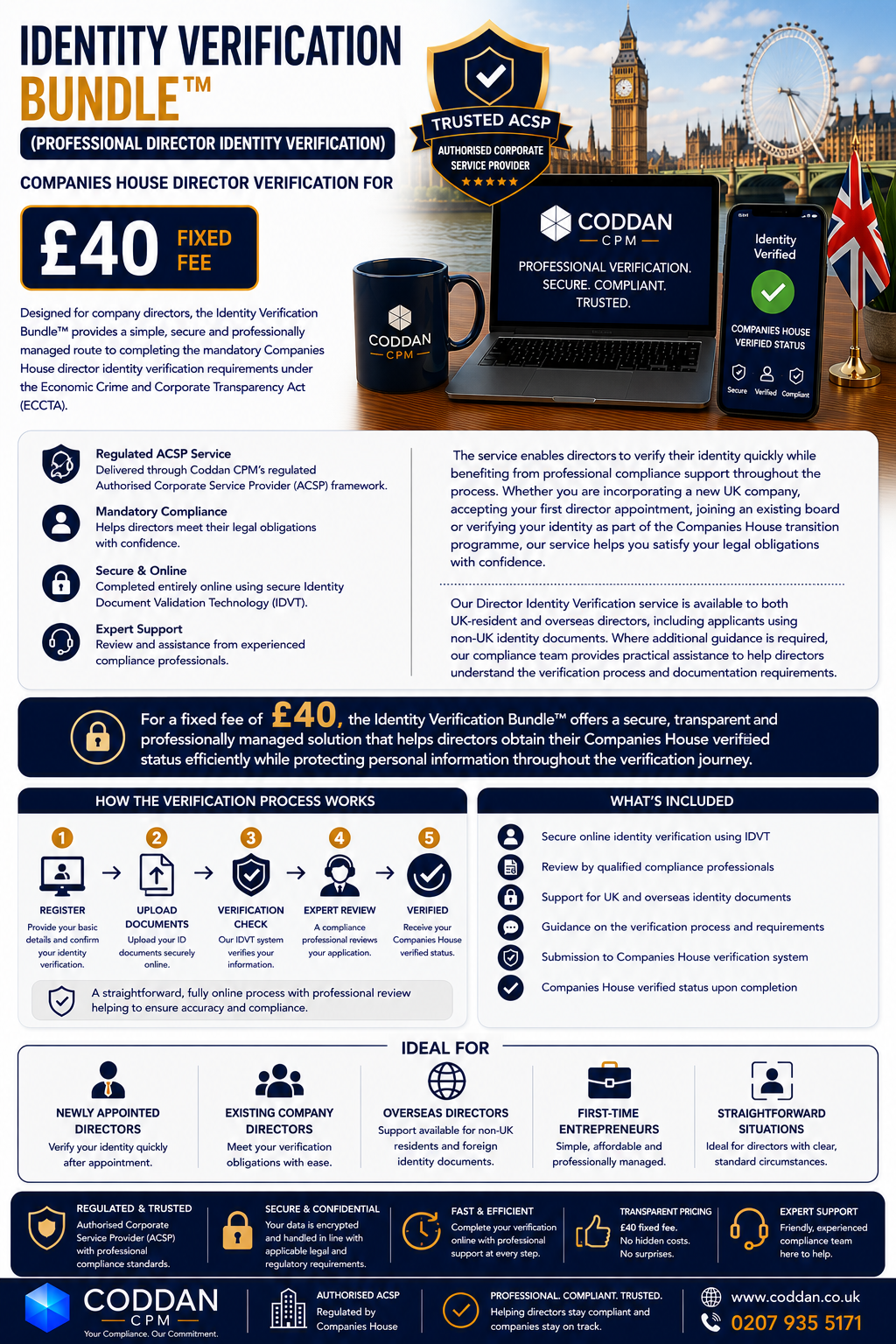
Buy Now Identity Verification Bundle™ (Professional Director Identity Verification) – Companies House Director Identity Verification for £40.
The Identity Verification Bundle™ provides a fast, secure and professionally managed solution for completing mandatory Companies House director identity verification. Delivered through Coddan CPM's regulated Authorised Corporate Service Provider (ACSP) framework, this service helps company directors meet the identity verification requirements introduced under the Economic Crime and Corporate Transparency Act (ECCTA) with confidence and ease. Whether you are incorporating a new UK company, accepting your first directorship, joining an existing board or completing identity verification during the Companies House transition period, our service offers a straightforward route to compliance. Verification is completed entirely online using secure Identity Document Validation Technology (IDVT) , with every application supported by experienced compliance professionals who help ensure your submission is accurate and meets Companies House requirements.

The service is available to both UK and overseas directors, including applicants using eligible non-UK identity documents. Where additional assistance is required, our compliance team provides practical guidance throughout the verification process, helping you understand the documentation requirements and avoid unnecessary delays. For a fixed fee of £40, the Identity Verification Bundle™ offers a secure, transparent and efficient way to obtain your verified Companies House status through a regulated ACSP. It is ideal for newly appointed directors, existing company directors, overseas entrepreneurs and anyone requiring professional support with Companies House director identity verification. Complete your verification quickly and confidently with trusted expert assistance. Ideal for the vast majority of straightforward applicants.


£65.00
+VAT

RapidVerify Pro™

Recommended for

2
package

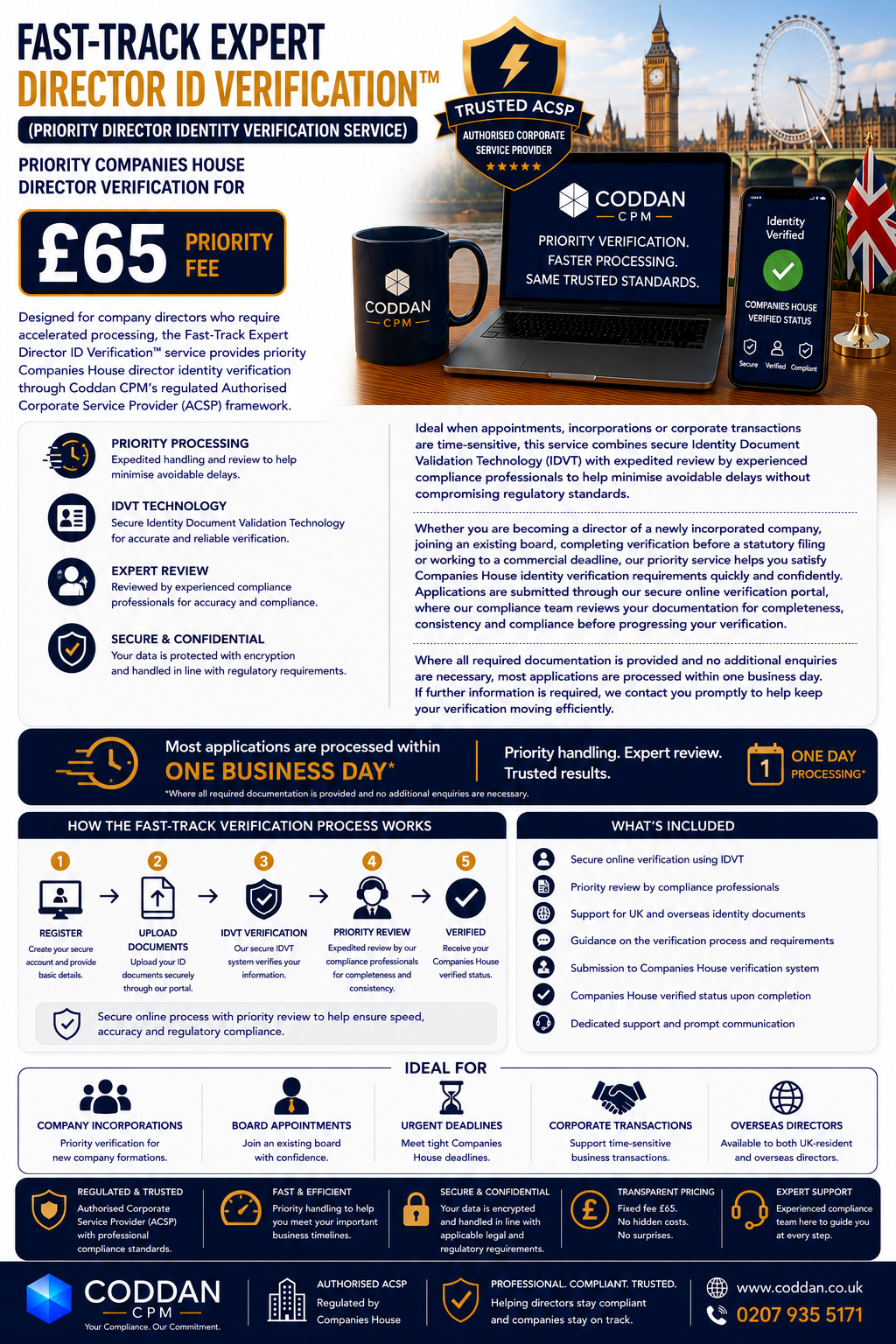
Buy Now Fast-Track Expert Director ID Verification™ (Priority Director Identity Verification Service) – Priority Companies House Director Identity Verification for £65.
The Fast-Track Expert Director ID Verification™ service is designed for directors who need priority Companies House director identity verification without compromising accuracy or compliance. Delivered through Coddan CPM's regulated Authorised Corporate Service Provider (ACSP) framework, this premium service combines secure Identity Document Validation Technology (IDVT) with expedited review by experienced compliance professionals to help you complete the verification process as quickly as possible. Ideal for time-sensitive appointments, company incorporations, corporate transactions and statutory filing deadlines, this service provides priority handling from the moment your application is received. Every submission is carefully reviewed to help ensure your documentation is complete, consistent and compliant before progressing through the identity verification process, reducing the risk of unnecessary delays. Where all required information is provided and no additional enquiries are needed, most applications are processed within one business day.

If further documentation is required, our compliance team contacts you promptly to help keep your verification moving efficiently. The service is available to both UK and overseas directors, including applicants using eligible non-UK identity documents. For £65, the Fast-Track Expert Director ID Verification™ service provides a faster, professionally managed route to obtaining verified Companies House status. It is ideal for newly appointed directors, existing company officers, overseas entrepreneurs and businesses working to urgent commercial or regulatory deadlines. Complete your Companies House director identity verification quickly, securely and with the confidence of expert ACSP support.


£125.00
+VAT

VerifyFlex Solutions™

Recommended for

3
package

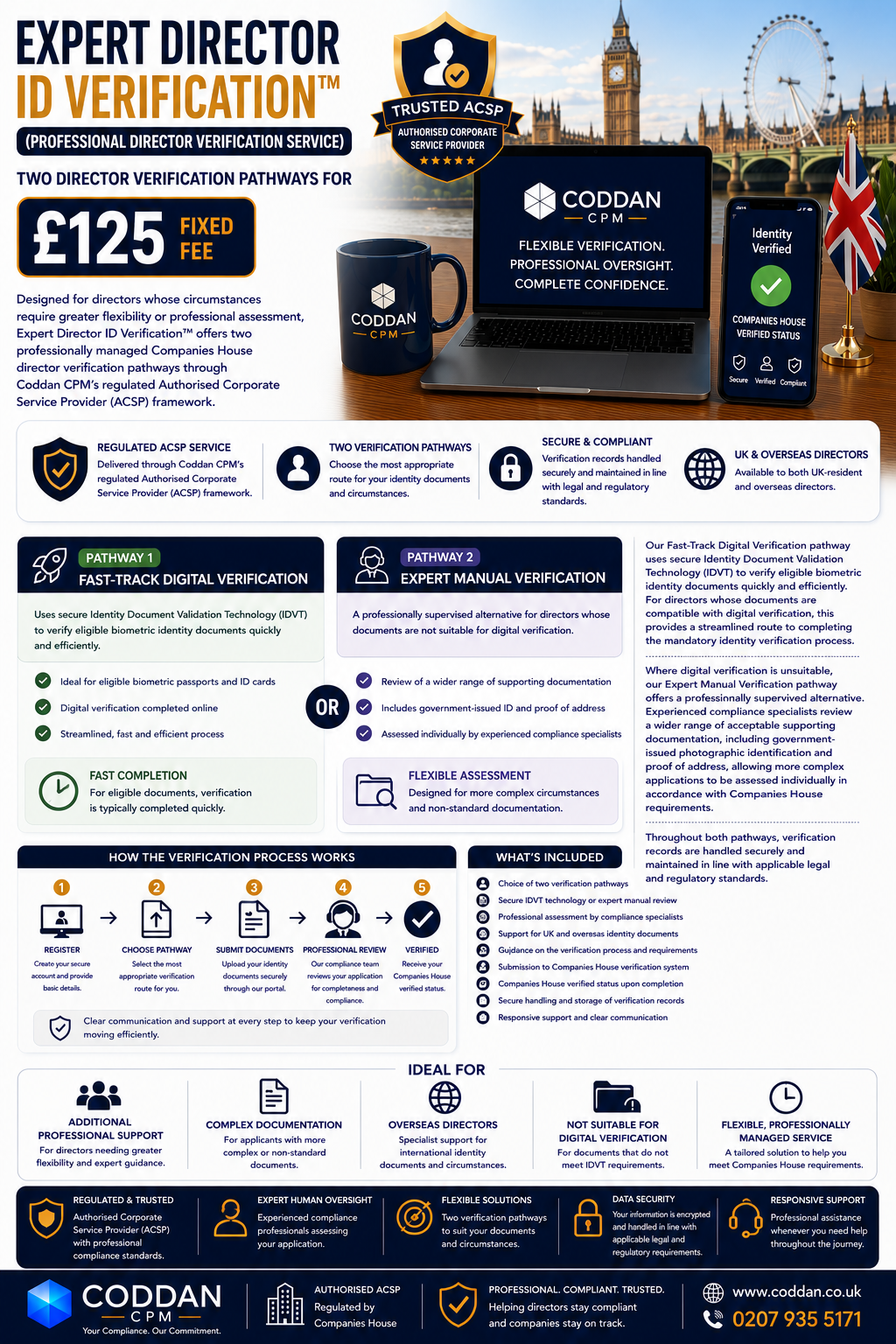
Buy Now Expert Director ID Verification™ (Professional Director Verification Service) – Two Companies House Director Identity Verification Pathways for £125. The Expert Director ID Verification™ service is designed for directors who require greater flexibility when completing Companies House director identity verification. Delivered through Coddan CPM's regulated Authorised Corporate Service Provider (ACSP) framework, this service offers two professionally managed verification pathways, allowing directors to choose the option that best matches their identity documents and individual circumstances while meeting Companies House requirements. Our Fast-Track Digital Verification pathway uses secure Identity Document Validation Technology (IDVT) to verify eligible biometric identity documents quickly and efficiently. Where digital verification is not suitable, our Expert Manual Verification pathway provides a professionally supervised alternative, enabling experienced compliance specialists to review a broader range of acceptable identity documents and supporting evidence in accordance with regulatory requirements. Both pathways are available to UK and overseas directors, including applicants using eligible non-UK identity documents.

Throughout the verification process, our compliance team provides practical guidance, carefully reviews each application and helps ensure all documentation satisfies Companies House standards, reducing the likelihood of delays caused by incomplete or unsuitable submissions. For £125, Expert Director ID Verification™ combines advanced verification technology with experienced professional oversight, providing a flexible and reliable solution for more complex verification requirements. It is ideal for overseas directors, applicants whose documents are unsuitable for standard digital verification, newly appointed directors and anyone seeking expert assistance with Companies House director identity verification through a trusted regulated ACSP.


£220.00
+VAT

FlexiVerify Option™

Recommended for

4
package

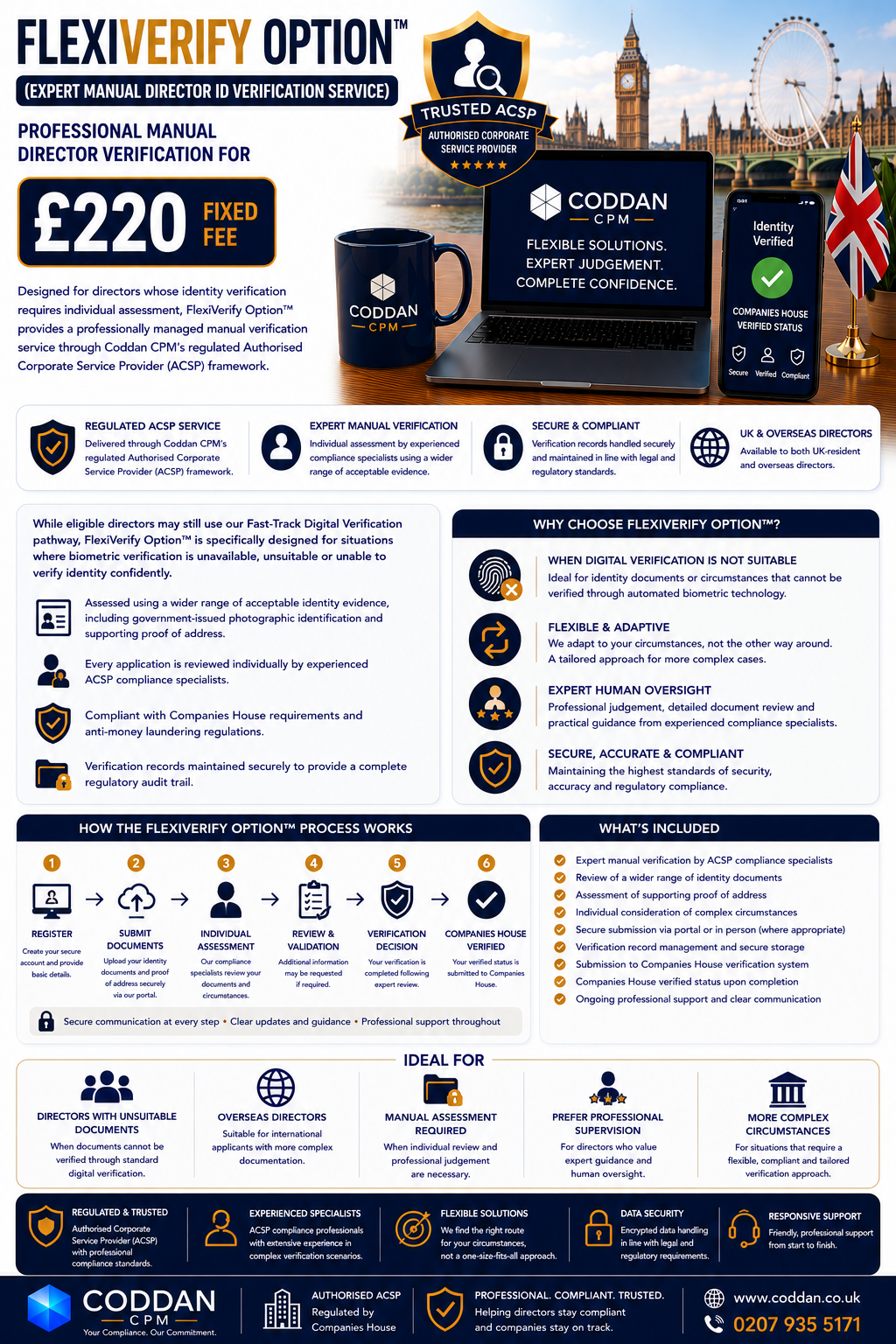
Buy Now FlexiVerify Option™ (Expert Manual Director ID Verification Service) – Professional Manual Companies House Director Identity Verification for £220.
The FlexiVerify Option™ is designed for directors whose Companies House director identity verification requires individual assessment beyond standard digital verification. Delivered through Coddan CPM's regulated Authorised Corporate Service Provider (ACSP) framework, this professionally managed manual verification service provides a flexible and compliant route for applicants whose circumstances are more complex or whose identity documents are unsuitable for automated verification. While eligible applicants may still use our Fast-Track Digital Verification pathway, FlexiVerify Option™ is specifically intended for situations where biometric verification is unavailable, unsuitable or unable to verify identity with sufficient confidence. Instead of relying solely on automated technology, experienced compliance specialists assess each application individually, reviewing a wider range of acceptable identity evidence, including government-issued photographic identification and supporting proof of address, in accordance with Companies House and anti-money laundering requirements. Applications can be submitted securely through our online verification portal or, where appropriate, completed in person.

Every application receives an individual review, with comprehensive verification records maintained to provide a secure regulatory audit trail and demonstrate compliance with applicable legal obligations. For £220, FlexiVerify Option™ offers the highest level of professional support for complex verification requirements. It is ideal for UK and overseas directors requiring manual assessment, applicants with non-standard documentation or individuals seeking a fully supervised Companies House director identity verification service backed by experienced ACSP compliance professionals and expert regulatory guidance throughout the verification process.


?
Decision Support & Guidance

Not Sure Which Option Is Right for You?

Every director's circumstances are different. The most suitable Director Identity Verification option may depend on your location, documents, company situation, and the level of support you require.

If you are unsure which route best fits your needs, you are welcome to contact our team for a simple and free conversation with an experienced adviser.

We can explain the available options, answer your questions, and help you understand the next steps.

There is no obligation to proceed with any service. Our aim is to help you make a clear and informed decision.

Need Help Deciding?

Every company's compliance position is slightly different, and the most appropriate identity verification route will depend on your individual circumstances. Factors such as where you are based, the identity documents you hold, whether your verification has already started, your Confirmation Statement filing timetable and the level of professional assistance you would like can all influence which option is most suitable.

If you're uncertain after reviewing the available packages, you're welcome to speak with one of our compliance advisers before making a decision. We'll be happy to answer your questions, explain how each verification pathway works, discuss any documentation requirements and help you understand which level of support is likely to be the most appropriate for your particular situation. Our aim is to help you complete your Companies House identity verification and Confirmation Statement obligations confidently and with a clear understanding of the process.

No obligation to purchase — just practical, expert guidance. Speak With a Compliance Adviser

Uncover the vital connection between identity verification and corporate governance. Essential reading for directors and company secretaries in the UK.

Understanding Director Identity Verification Beyond the Verification Process
Choosing the appropriate identity verification pathway is only one part of preparing for your role as a company director. Equally important is understanding how identity verification fits within the wider framework of UK company law, corporate governance and ongoing compliance. Directors who understand their responsibilities from the outset are generally better equipped to manage future appointments, statutory obligations and changes throughout the lifetime of their company.
Beyond Verification: Key Considerations for Effective Company Administration in the UK
The guidance below has been created as a practical knowledge centre for new and existing directors, overseas entrepreneurs, company secretaries, professional advisers and anyone responsible for the administration of a UK company. Rather than focusing solely on the verification process itself, these articles explore the wider questions that directors commonly encounter before, during and after identity verification has been completed.
Ensuring Compliance and Security: Best Practices for Managing Identity Verification in the Corporate Sector
Within this resource, you will learn how director eligibility is assessed before verification begins, how identity verification differs for corporate directors and Persons with Significant Control (PSCs), how the Companies House Personal Code supports multiple appointments, and what happens when personal circumstances change after verification, such as renewing a passport or changing your legal name. The articles also explain how professionally managed identity verification combines secure Identity Document Validation Technology (IDVT) with experienced compliance oversight, why data security and UK GDPR protections are essential when handling sensitive personal information, and how early preparation can help reduce delays caused by document inconsistencies or complex international circumstances.
Directors’ Guide to Compliance: Maintaining Accurate Company Records and the Importance of Timely Identity Verification
You will also find guidance on maintaining accurate company records, understanding the relationship between identity verification and corporate governance, and appreciating why timely verification has become an important part of responsible company administration under the UK's evolving transparency framework. These topics are intended to help directors make informed decisions, minimise unnecessary compliance risks and understand how identity verification supports the long-term integrity of the public company register.
Essential Governance Principles for Directors: Understanding the Regulatory Landscape
At Coddan CPM, we believe that informed directors make stronger business decisions. Since 2005, we have supported entrepreneurs, SMEs, overseas investors and professional advisers with company formation, company secretarial services and corporate compliance. As an Authorised Corporate Service Provider (ACSP) and regulated Trust and Company Service Provider (TCSP), our objective is not simply to help clients complete identity verification, but to provide the knowledge and professional guidance that supports confident decision-making throughout the entire lifecycle of a UK company.
Whether you are verifying your identity for the first time, joining the board of an existing company, managing several corporate appointments or planning international expansion, the articles below are designed to give you a clearer understanding of the regulatory framework, practical considerations and governance principles that underpin modern director identity verification.

You're Not Alone with Companies House Identity Verification

Many directors become frustrated when automated identity verification does not proceed as expected or when they are unsure which verification route is appropriate for their circumstances. Rather than navigating the process alone, Coddan CPM provides professional support through our regulated Authorised Corporate Service Provider (ACSP) framework.

Our flexible verification services combine secure Identity Document Validation Technology (IDVT) with experienced compliance guidance, helping directors choose the most suitable verification pathway based on their documentation and individual circumstances. From straightforward digital verification to professionally managed manual assessment, we offer practical solutions designed to support both UK and overseas applicants.

Complete your Companies House director identity verification with confidence through a trusted professional partner—not by facing the process alone.


Compliance Clarification

Do I Need Companies House Identity Verification?

Many directors first ask the same questions:

  • Do I need to complete Companies House identity verification?
  • Is director verification mandatory?
  • Who needs to verify their identity?
  • Do existing company directors need to take action?

The answer depends on your role, your company circumstances, and the Companies House requirements that apply to you.

Identity verification is part of the wider Companies House reform designed to improve transparency and confidence in UK company records. Directors and other individuals connected with companies may need to verify their identity through one of the available verification routes.

However, understanding the requirement is the first step. Many directors are unsure whether the rules apply to them, when they need to complete verification, or which route is the most suitable for their circumstances.

At Coddan, we believe compliance should start with clarity. We help directors understand what Companies House identity verification means, who may need to complete it, and what options are available before they decide how to proceed.

Whether you are:

✓ Forming a new UK company
✓ An existing director of an established company
✓ Based in the UK or overseas
✓ Managing a company with multiple directors

Understanding your obligations first can help you avoid unnecessary delays, confusion, or incorrect assumptions.

You do not need to start by choosing a service. Start by understanding your situation, and then choose the verification route that best fits your needs.

Historical Director Disqualification & Eligibility Checks: Why Identity Verification Begins with Legal Capacity

Director identity verification is often described as the process of confirming that an individual is who they claim to be. While this is certainly one of its primary functions, modern corporate compliance extends considerably further. Before an individual can confidently assume or continue in a position of corporate responsibility, there is another equally important question that businesses should consider:

Is this person legally eligible to act as a company director?
The distinction is significant. A verified identity confirms the individual behind the appointment. An eligibility assessment helps establish whether that individual has the legal capacity to serve as a director under the UK's corporate governance framework.

As the UK's corporate transparency regime continues to evolve, identity verification increasingly forms part of a wider compliance process that seeks to improve the integrity of company records, reduce corporate misuse and strengthen confidence in those entrusted with managing UK businesses. For responsible companies, identity verification should therefore never be viewed as a standalone administrative exercise. It should be integrated into a broader programme of director due diligence, governance and regulatory compliance.

Identity Verification and Director Eligibility Are Closely Connected
Every company director occupies a position of legal responsibility.

Directors make decisions affecting shareholders, employees, creditors, customers and regulators. They approve statutory filings, oversee financial management and are expected to act in the best interests of the company while complying with their duties under UK company law.

For that reason, confirming a director's identity represents only one part of the appointment process. Businesses should also be satisfied that the individual is legally capable of holding office.

Professional corporate service providers increasingly treat these two considerations as complementary:

  • Identity verification establishes who the individual is.
  • Eligibility assessment helps determine whether the individual can lawfully act as a director.

Together, these checks contribute to stronger governance and reduce the risk of inappropriate appointments.

Why Historical Eligibility Checks Matter
Many businesses naturally focus on the immediate appointment of a director. However, experienced advisers understand that a person's corporate history may also be relevant when evaluating governance risk.

Depending on the circumstances of the appointment, organisations may wish to consider whether there are factors that could affect a person's ability to serve as a director or require further legal consideration.

Examples may include reviewing publicly available information relating to:

  • Director disqualification.
  • Bankruptcy or insolvency restrictions.
  • Individual voluntary arrangements where relevant.
  • Court-imposed restrictions affecting company management.
  • Previous directorship history.
  • Historic regulatory findings.
  • Other legal restrictions that may affect eligibility.

These considerations do not replace identity verification. Instead, they provide additional assurance that the proposed appointment aligns with good corporate governance practices.

Stuck in a Verification Loop on the GOV.UK App?

There are two routes to identity verification: directly with Companies House via a GOV.UK One Login account, or through an Authorised Corporate Service Provider. Verify company directors in minutes, wherever they're based, through our fast and reliable ID Check service for identifying office holders online.

Compare Verification Options

Director Disqualification Is a Separate Legal Consideration
One area that frequently causes confusion is director disqualification.

A person may successfully establish their identity yet still be subject to legal restrictions that prevent them from acting as a company director.

Director disqualification arises under separate legal provisions and is distinct from the identity verification process itself. Verification confirms identity; it does not automatically determine legal eligibility.

For businesses appointing new directors, particularly where appointments involve investment, acquisitions, overseas ownership or significant commercial responsibility, understanding this distinction is an important aspect of responsible governance.

Why Businesses Carry Out Broader Due Diligence
Well-managed organisations rarely rely upon a single compliance check when appointing senior decision-makers.

Instead, many incorporate identity verification into a wider due diligence process that may include reviewing:

  • Director eligibility.
  • Corporate appointment history.
  • Existing company interests.
  • Potential conflicts of interest.
  • Governance responsibilities.
  • Ownership structures.
  • Internal appointment procedures.

This broader approach helps companies make informed decisions while reducing the likelihood of governance issues arising after appointments have been made.

Identity Verification Supports Corporate Transparency
One of the principal objectives of the UK's corporate transparency reforms is to increase confidence in the accuracy of company information.

Identity verification contributes to this objective by helping establish that directors are genuine individuals whose appointments can be confidently associated with verified identities.

When combined with appropriate eligibility checks and sound governance procedures, businesses benefit from:

  • Greater confidence in board appointments.
  • Improved accuracy of company records.
  • Stronger governance controls.
  • Better compliance planning.
  • Reduced administrative risk.
  • Increased confidence among investors, lenders and commercial partners.

These benefits extend far beyond regulatory compliance and contribute directly to the credibility of the organisation.

Overseas Directors and International Appointments
International businesses often face additional considerations when appointing directors.

Overseas ownership structures, multinational boards and cross-border investments frequently require greater planning than straightforward domestic appointments. While the legal principles remain the same, businesses should ensure that international appointments are supported by appropriate identity verification and governance procedures from the outset.

For many overseas organisations entering the UK market, director identity verification forms one element of a wider corporate compliance strategy that also includes company formation, company secretarial administration, registered office arrangements and ongoing statutory compliance.

Director ID Verification Hub

Choose Your Verification Path & Compliance Requirement

Comply with the Economic Crime and Corporate Transparency Act (ECCTA). Select your specific scenario below for instant ACSP routing and verification processing.

Official ACSP Framework Direct sync with Companies House registries.
Strict AML Adherence Rigorous anti-money laundering protocols.
UK GDPR Compliant Encrypted, secure local document handling.

Why Professional Governance Matters
Modern businesses increasingly recognise that director appointments represent strategic decisions rather than simple administrative filings.

An effective governance framework considers not only whether an appointment can be made, but whether appropriate checks have been completed before responsibilities are entrusted to a new director.

This includes understanding:

  • Whether the individual's identity has been verified.
  • Whether there are any legal restrictions affecting eligibility.
  • Whether company records accurately reflect appointments.
  • Whether governance procedures support future compliance.
  • Whether appropriate documentation has been retained.

Treating these considerations as part of a single governance process helps create stronger, more resilient businesses.

Coddan CPM's Governance-Led Approach
Since 2005, Coddan CPM has assisted entrepreneurs, SMEs, international investors, professional advisers and corporate groups with the establishment and ongoing administration of UK companies. As an Authorised Corporate Service Provider (ACSP) and regulated Trust and Company Service Provider (TCSP), we recognise that identity verification represents only one aspect of responsible corporate administration.

Our experience has shown that businesses achieve the best outcomes when identity verification is integrated with wider governance procedures rather than managed in isolation. This means considering the complete picture surrounding a director's appointment, including corporate records, statutory responsibilities, legal capacity and long-term compliance planning.

Rather than focusing solely on verifying documents, we help clients understand how identity verification supports board appointments, corporate governance, company lifecycle management and regulatory confidence.

Building Stronger Boards Through Responsible Due Diligence
Effective director identity verification begins long before documents are uploaded or verification technology is applied. It starts with understanding whether the proposed director has the legal capacity to serve, whether appropriate governance procedures have been followed and whether the appointment strengthens the integrity of the company.

Historical director disqualification and eligibility checks are therefore not separate from identity verification—they are part of the wider due diligence that responsible organisations increasingly undertake when appointing those entrusted with corporate leadership.

As UK corporate governance continues to develop, businesses that combine robust identity verification with careful eligibility assessment and sound governance practices will be better positioned to build transparent, well-managed and resilient organisations. That philosophy has underpinned Coddan CPM's corporate services since 2005 and continues to guide the way we support directors, shareholders and businesses throughout every stage of the corporate lifecycle.

Identity Verification Is Only the First Step

Completing your Companies House director identity verification is an important milestone, but it is only the beginning of your compliance journey. Once your identity has been successfully verified, you will receive your unique Companies House Personal Code, which forms part of your ongoing relationship with the Companies House register.

Depending on your role, you may need to associate your Personal Code with director appointments, People with Significant Control (PSC) notifications or other statutory filings. Coddan supports directors beyond verification by helping them understand how their verified identity integrates with future Companies House obligations.


The Coddan Advantage

Why Coddan Stands Apart in Director ID Verification

By establishing a human-vetted, multi-tiered Authorised Corporate Service Provider (ACSP) pathway (such as IdentityGuard Pro™ using technologies like Credas alongside manual compliance reviews), Coddan offers a vital pressure valve. We take clients who would otherwise be locked out by rigid government tech and safely guide them to compliance.

Director and PSC Identity Verification Codes: Do You Need Separate Personal Codes for Each Role?

One of the most common questions arising from the UK's new identity verification framework concerns individuals who perform more than one role within the same company. Entrepreneurs, company founders and business owners frequently ask whether they need separate identity verification for each appointment, particularly when they serve as both a company director and a Person with Significant Control (PSC).

The short answer is that identity verification belongs to the individual—not to each corporate role.

This distinction is important because many UK companies are managed by individuals who wear several hats. A founder may be the sole director, majority shareholder and PSC. A family business may have directors who are also controlling shareholders. An overseas investor may serve on the board while simultaneously qualifying as a PSC through ownership or voting rights.

Understanding how identity verification applies across these different capacities helps businesses avoid unnecessary duplication, reduces administrative confusion and supports more efficient corporate governance.

Rather than thinking about separate verification for every appointment, it is more helpful to view identity verification as creating a single verified identity that can be associated with an individual's various roles throughout the UK corporate register.

Directors and PSCs Are Different Legal Roles
Although directors and Persons with Significant Control are often the same people, the two positions perform very different functions within company law.

A director is responsible for managing the company and making decisions on its behalf. Directors oversee strategy, fulfil statutory duties, approve filings and act in the company's best interests.

A Person with Significant Control, by contrast, is identified because they exercise a prescribed level of ownership or influence over the company. A PSC may control shares, voting rights or otherwise have significant influence or control over the business, even if they are not involved in its day-to-day management.

Many entrepreneurs satisfy both definitions simultaneously.

For example:

  • A sole company owner is often both the director and the PSC.
  • A founder who owns most of the shares typically occupies both roles.
  • Family businesses frequently appoint directors who also qualify as PSCs.
  • Overseas investors may become both board members and controlling shareholders.

While the legal responsibilities attached to each role differ, identity verification is centred on the individual rather than the title they hold.

One Verified Identity Across Multiple Corporate Roles
The introduction of the 11-character Companies House Personal Code reflects this individual-based approach.

Once an individual's identity has been successfully verified, Companies House issues a unique Personal Code that is linked to that person rather than to a specific appointment.

This means that the same verified identity can be associated with different capacities over time, including:

  • Director appointments.
  • Person with Significant Control (PSC) records.
  • Appointments to multiple UK companies.
  • Future directorships.
  • Changes to existing corporate positions.

The Personal Code therefore becomes part of an individual's long-term corporate identity rather than something that changes every time a new appointment is accepted.

For many business owners, this removes unnecessary duplication and creates a simpler framework for managing multiple corporate responsibilities.

Why This Matters for Company Founders
Most newly incorporated private companies begin with a relatively straightforward ownership structure.

The founder commonly acts as:

  • Sole director.
  • Sole shareholder.
  • Sole Person with Significant Control.

Because one individual fulfils several functions, it is understandable that many entrepreneurs initially assume they must complete separate verification procedures for each position.

In reality, the verification process establishes the person's identity once. That verified identity can then support the individual's various roles within the company's governance structure.

Understanding this distinction from the outset helps founders organise their company records more efficiently and avoid unnecessary concern during future filings.

Businesses with Multiple Directors and PSCs
Larger organisations often have more complex governance arrangements.

They may include:

  • Several directors.
  • Multiple PSCs.
  • Corporate shareholders.
  • Institutional investors.
  • Family ownership structures.
  • International group companies.

In these circumstances, each individual who is required to complete identity verification receives their own Personal Code.

The important principle remains the same: each verified individual retains one unique code regardless of how many qualifying positions they hold across one or more companies.

This individual-centred approach supports more accurate corporate records while reducing administrative complexity for businesses managing numerous appointments.

Why Accurate Role Mapping Is Important
Although one Personal Code can support multiple qualifying roles, companies must still ensure that each appointment is correctly recorded within their statutory records and public filings.

Identity verification does not replace proper company administration.

Businesses should continue to maintain accurate records of:

  • Director appointments.
  • PSC information.
  • Shareholdings.
  • Voting rights.
  • Board changes.
  • Company secretarial records.
  • Statutory registers.

Verification complements these governance responsibilities by providing confidence that the individuals connected with those records have established their identity through the appropriate framework.

Overseas Entrepreneurs and Dual Roles
Many overseas founders establish UK companies in which they simultaneously become the director, shareholder and PSC.

For international entrepreneurs, understanding how one verified identity supports multiple corporate capacities is particularly valuable because it simplifies future administration as the business grows.

Whether establishing a UK subsidiary, launching an e-commerce business, creating a holding company or expanding internationally, a single verified identity provides continuity across future corporate appointments and governance activities.

Why Professional Guidance Helps
For straightforward companies, understanding the relationship between directors, PSCs and Personal Codes is often relatively simple.

More complex organisations, however, may involve:

  • Several PSCs with different ownership interests.
  • Directors serving multiple companies.
  • International ownership structures.
  • Group reorganisations.
  • Investment transactions.
  • Family succession planning.

In these situations, professional guidance helps ensure that identity verification is properly integrated into wider corporate governance rather than being viewed as an isolated compliance task.

Since 2005, Coddan CPM has assisted entrepreneurs, SMEs, overseas investors and established organisations with company formation, governance and ongoing statutory compliance. As an Authorised Corporate Service Provider (ACSP) and regulated Trust and Company Service Provider (TCSP), we help businesses understand how identity verification interacts with director appointments, PSC records and broader corporate administration.

Our experience demonstrates that companies achieve the best results when identity verification, ownership records and governance procedures are managed together as part of a coordinated compliance strategy.

One Person, One Verified Identity, Multiple Corporate Responsibilities
The introduction of Personal Codes represents an important evolution in the UK's corporate transparency framework. Rather than creating separate identities for every corporate appointment, the system is designed around the individual.

A company founder who is both a director and a Person with Significant Control does not build two separate verification histories. Instead, one successfully verified identity can support multiple qualifying roles throughout the individual's corporate journey.

For businesses, this creates a more efficient and consistent approach to company administration. For directors and PSCs, it provides continuity as their responsibilities evolve. And for the wider business community, it strengthens confidence that the individuals exercising control over UK companies can be accurately linked to their verified identities.

Understanding this relationship between directors, PSCs and Personal Codes is therefore an essential part of modern corporate governance and one more example of how effective identity verification supports well-managed, transparent and resilient UK businesses.

Institutional-Grade Protection

Regulatory Alignment & Data Security

Your sensitive verification documents and personal data are protected by elite cryptographic standards and rigorous compliance frameworks.

Official ACSP Protocols
Authorized Corporate Service Provider standards for direct government sync.
Strict AML Adherence
Fully aligned with UK anti-money laundering and Know Your Customer rules.
UK GDPR Compliant
Secure, encrypted data storage hosted entirely within the United Kingdom.
ISO Standards Aligned
Rigorous operational security and information management protocols.


What Happens If Your Passport or Driving Licence Expires After Director Identity Verification?

One of the most frequently overlooked questions about director identity verification concerns what happens after the verification process has been completed.

Many directors assume that identity verification is permanently linked to the passport or driving licence used during the original application. As a result, they often become concerned when that document is renewed, expires, changes because of marriage or a legal name change, or becomes damaged and needs replacing.

Typical questions include:

  • Will I lose my 11-character Personal Code if my passport expires?
  • Do I need to verify my identity again after renewing my passport?
  • What happens if I replace my driving licence?
  • Does changing my identity document affect my directorship?
  • Will Companies House cancel my verification status?

These are sensible questions, particularly as the UK's identity verification framework is still relatively new. Fortunately, understanding the purpose of identity verification helps explain why document renewal is usually very different from verifying your identity for the first time.

Identity Verification Establishes the Individual, Not Just the Document
A common misconception is that the verification process exists simply to validate a passport or driving licence.

In reality, identity verification is designed to establish confidence in the identity of the individual.

Identity documents are used because they provide trusted evidence that supports the verification process, but they are not the purpose of the verification itself.

Once your identity has been successfully verified and your unique 11-character Personal Code has been issued, that code is associated with you as an individual, rather than being permanently attached to a single passport or driving licence.

Understanding this distinction removes much of the uncertainty surrounding expired or renewed documents.

Why Identity Documents Naturally Change Over Time
Very few directors use the same identity document throughout their entire business career.

Over time, it is perfectly normal for documents to be:

  • Renewed after reaching their expiry date.
  • Replaced because they have been lost.
  • Reissued following theft.
  • Updated after a legal change of name.
  • Renewed because of damage.
  • Replaced with newer biometric versions.
  • Updated following changes in personal details.

These life events are expected and form part of normal identity management.

The existence of a renewed passport or replacement driving licence does not, by itself, mean that an individual's corporate identity has fundamentally changed.

Does an Expired Passport Automatically Cancel Verification?
Many directors worry that once the passport used during verification expires, their identity verification somehow becomes invalid.

Identity verification should not be confused with the continuing validity of the document itself.

Your passport or driving licence is used to establish your identity at the time verification takes place. Once that process has been successfully completed, the resulting verified identity and Personal Code relate to you rather than the remaining validity period of the original document.

If circumstances change in the future, any further action depends on the applicable verification requirements and the particular situation rather than the simple fact that a document has reached its expiry date.

What About Renewed Identity Documents?
Renewing a passport or driving licence is one of the most common reasons directors seek reassurance about their verification status.

A renewed document generally represents an updated version of the same person's official identification rather than the creation of a new corporate identity.

Businesses should therefore distinguish between:

  • Routine document renewal.
  • Material changes to personal identity information.
  • Situations where additional verification may be required under applicable regulations.

Understanding this difference helps directors avoid unnecessary concern every time a routine document renewal occurs.

Damaged, Lost or Replaced Documents
Identity documents sometimes need replacing for reasons entirely unrelated to identity verification.

Examples include:

  • Accidental damage.
  • Water damage.
  • Wear through regular use.
  • Theft.
  • Loss while travelling.
  • Security concerns following fraud.

Replacing a damaged document is a normal administrative process and does not automatically alter a person's status as a verified director.

Nevertheless, directors should ensure that any future verification or compliance activities are supported by current, valid identity documents whenever new evidence is required.

Name Changes and Updated Personal Information
Some directors experience changes in their personal information during their professional careers.

Examples include:

  • Marriage or civil partnership.
  • Divorce.
  • Legal change of surname.
  • Updated nationality information.
  • Changes to residential address.

These situations are different from simply renewing an identity document because they may involve updates to the information associated with the individual's identity.

Whenever significant personal details change, directors should consider how those changes interact with their wider company records and governance responsibilities rather than focusing solely on the identity document itself.

Good Governance Means Keeping Records Current
Identity verification is only one part of maintaining accurate corporate information.

Well-managed businesses regularly review:

  • Director details.
  • Company registers.
  • Shareholder records.
  • PSC information.
  • Registered office details.
  • Company secretarial records.
  • Supporting compliance documentation.

Maintaining accurate records across all of these areas contributes to stronger governance and ensures that company information remains reliable throughout the business lifecycle.

Identity verification complements this wider administrative framework rather than replacing it.

Planning Ahead Prevents Future Delays
One of the most effective ways to avoid disruption is to keep identity documentation up to date before it is required for future corporate activity.

For example, directors preparing for:

  • New board appointments.
  • Company restructures.
  • Investment transactions.
  • International expansion.
  • Additional company formations.
  • Corporate refinancing.

often review their identity documents alongside other governance records as part of their overall compliance planning.

This proactive approach reduces the likelihood of unexpected delays when important business opportunities arise.

Why Professional Support Provides Reassurance
Questions about expired passports, renewed driving licences and replacement identity documents are increasingly common as more directors complete identity verification.

While many situations are straightforward, businesses with overseas directors, multiple appointments or more complex governance structures often benefit from professional guidance when considering how document changes interact with wider compliance responsibilities.

Since 2005, Coddan CPM has supported entrepreneurs, SMEs, international investors and established organisations with company formation, corporate governance and ongoing statutory administration. As an Authorised Corporate Service Provider (ACSP) and regulated Trust and Company Service Provider (TCSP), we help directors understand identity verification as part of a broader governance framework rather than a one-off administrative event.

Our experience shows that successful businesses focus not only on verifying identity, but also on maintaining accurate records throughout the lifetime of the company.

Your Identity Is More Important Than the Document Used to Verify It
Passports expire. Driving licences are renewed. Identity documents are occasionally lost, damaged or replaced. These events are a normal part of everyday life and do not, on their own, redefine who you are as a company director.

The purpose of director identity verification is to establish confidence in the individual behind the appointment, creating a trusted identity that supports future corporate activities through a unique Personal Code. While directors should always maintain valid documentation and ensure that company records remain accurate, routine changes to identity documents are simply another part of responsible business administration.

Official ACSP Commercial Package

IdentityGuard Pro™ Compliance Gateway

Secure your mandatory Companies House verification under the ECCTA framework. Fast-track your director status with human-led forensic checks and guaranteed personal code delivery.

All-Inclusive Verification Fee
£40 + VAT
No Hidden Government Surcharges
IDVT Forensic Review Advanced identity verification technology & expert checks.
ACSP Regulatory Attestation Authorized filing submission straight to Companies House.
11-Character Personal Code Instant generation of your mandatory verification reference.
AML & GDPR Compliant Fully encrypted data handling and regulatory compliance.
Start Verification & Get Code (£40)
Approved Authorised Corporate Service Provider (ACSP) Gateway. Safe, encrypted, and recognized directly by UK official registries.

Understanding the distinction between your verified identity and the document used during verification helps remove unnecessary uncertainty and enables directors to concentrate on what matters most—building well-governed, transparent and successful UK businesses. At Coddan CPM, that long-term governance perspective has shaped the way we support directors and companies since 2005, and it continues to guide our approach to identity verification today.

Quick Navigation

Find the Right Director Identity Verification Pathway

Whether you are becoming a company director for the first time, managing multiple directorships, acting for an overseas business or trying to understand the new Companies House identity verification requirements, we'll help you quickly find the guidance most relevant to your circumstances.

New Directors

Recently appointed or preparing to become a UK company director for the first time? Learn how to complete your identity verification correctly.

View Guidance →

Existing Directors

Already serving as a company director? Understand when identity verification becomes mandatory and how to prepare.

Learn More →

Overseas Directors

Based outside the UK? Explore remote identity verification and governance solutions for international directors.

Explore Solutions →

Verification Difficulties

Experiencing verification problems, document issues or GOV.UK rejections? Discover the alternative verification pathways available.

Find a Solution →

Not Sure Where to Begin?

Every director's circumstances are different. Some require straightforward identity verification, while others need assistance with international documentation, multiple directorships or ongoing governance support. If you are unsure which route is appropriate, our compliance specialists can help you identify the most suitable solution before you begin.

Speak with a Compliance Specialist →


Corporate Directors and Identity Verification: How the Rules Differ from Individual Directors

The introduction of mandatory identity verification has changed the way businesses think about company appointments. While most guidance focuses on individual (natural person) directors, many organisations continue to ask an important question:

How does identity verification work when a company, rather than an individual, is appointed as a director?

The answer is more nuanced than many business owners expect.

A company cannot physically verify its identity in the same way that an individual can. A corporate entity does not possess a passport, driving licence or biometric identity. Instead, every corporate director ultimately acts through real people who manage and control its activities. As a result, modern corporate transparency reforms increasingly focus on ensuring that the individuals behind corporate appointments can themselves be identified and held accountable.

For businesses operating group structures, holding companies, investment vehicles and multinational organisations, understanding how identity verification applies to corporate directors is now an essential part of responsible corporate governance.

What Is a Corporate Director?
Most company directors are natural persons—individual human beings appointed to manage the affairs of a company.

A corporate director, however, is a legal entity rather than an individual. Instead of appointing a person to the board, the company appoints another company to act as a director.

Corporate directors have historically been used in a variety of legitimate business situations, including:

  • Corporate group structures.
  • Holding companies.
  • International subsidiaries.
  • Joint venture companies.
  • Investment vehicles.
  • Family business groups.
  • Professional management structures.

For many years, corporate directors formed part of normal commercial practice. However, as corporate transparency has become a greater priority, legislators have introduced stricter rules governing when and how corporate directors may be used.

Why the Rules Have Changed
The UK's corporate transparency reforms seek to improve confidence in company ownership and management by ensuring that those exercising control over companies can be properly identified.

Although a corporate director is itself a legal entity, every corporate entity ultimately acts through individuals.

The reforms therefore focus on increasing transparency around the people responsible for directing corporate decision-making rather than allowing complex structures to obscure accountability.

This reflects a broader shift towards ensuring that company records identify not only organisations but also the individuals exercising genuine management responsibility.

A Company Cannot Verify Its Own Identity
One of the most important principles to understand is that identity verification applies to people, not legal entities.

A company has:

  • No passport.
  • No driving licence.
  • No biometric identity.
  • No personal date of birth.
  • No individual facial identity.

For that reason, the verification process cannot simply be completed by the corporate entity itself.

Instead, where identity verification requirements apply to a corporate director arrangement, attention turns to the individual who is authorised to act on behalf of that corporate body.

The Role of the Managing Officer
Where a corporate body is permitted to act as a director under the applicable legal framework, the company will ordinarily operate through an authorised individual who manages or represents that corporate entity.

This individual is commonly referred to as the managing officer.

The managing officer acts as the human link between the corporate director and the wider corporate transparency framework.

As part of the identity verification regime, the managing officer may be required to complete identity verification where the applicable legal requirements provide for this.

This approach ensures that corporate appointments remain connected to identifiable individuals while preserving legitimate commercial structures where permitted by law.

Corporate Directors Are Subject to Additional Conditions
Businesses should be aware that the use of corporate directors is no longer as straightforward as it once was.

The modern regulatory framework places greater emphasis on:

  • Transparency.
  • Accountability.
  • Identifiable decision-makers.
  • Appropriate governance.
  • Accurate corporate records.
  • Responsible board appointments.

As a result, businesses considering the appointment or continued use of a corporate director should carefully review whether the arrangement satisfies the applicable legal requirements before proceeding.

Corporate directors are no longer viewed as purely administrative tools; they now form part of a wider governance framework designed to improve trust in UK companies.

Group Companies and International Structures
Corporate directors remain particularly relevant within larger organisations.

Examples include:

  • International corporate groups.
  • UK subsidiaries.
  • Holding company structures.
  • Investment funds.
  • Multinational businesses.
  • Cross-border ownership arrangements.
  • Family office structures.

These organisations often operate across several jurisdictions and involve multiple legal entities acting together.

For these businesses, understanding how identity verification applies to managing officers is essential for maintaining compliant governance while preserving efficient corporate structures.

Planning ahead becomes especially important where several companies and multiple corporate appointments are involved.

Corporate Directors Require More Than Identity Verification
Unlike straightforward appointments involving individual directors, corporate director arrangements often require broader governance planning.

Businesses should consider:

  • The suitability of the corporate structure.
  • The eligibility of the corporate director.
  • The identity verification requirements affecting the managing officer.
  • Board governance procedures.
  • Company secretarial administration.
  • Statutory record maintenance.
  • Future corporate changes.

Treating identity verification as part of this wider governance review helps reduce compliance risk while supporting long-term business administration.

Why Professional Guidance Is Valuable
Corporate director appointments frequently involve more complex legal and administrative considerations than standard individual appointments.

Businesses may need to coordinate:

  • Multiple directors.
  • Several managing officers.
  • Group company structures.
  • Overseas ownership.
  • Cross-border governance.
  • Ongoing statutory administration.

Professional guidance helps organisations understand how identity verification interacts with these wider governance responsibilities and reduces the likelihood of unnecessary delays or administrative complications.

Since 2005, Coddan CPM has supported entrepreneurs, multinational organisations, SMEs and professional advisers with company formation, corporate restructuring, governance and long-term compliance. As an Authorised Corporate Service Provider (ACSP) and regulated Trust and Company Service Provider (TCSP), we assist businesses in navigating the practical implications of the UK's evolving identity verification framework.

Our role extends beyond verifying identities. We help organisations understand how corporate appointments, managing officers, governance procedures and statutory compliance work together to create transparent and resilient corporate structures.

Strong Corporate Governance Begins with Identifiable Leadership
Corporate directors continue to have a legitimate role within many sophisticated business structures, but they now operate within a regulatory environment that places far greater emphasis on transparency and accountability.

Identity verification reflects this shift by ensuring that, even where a corporate entity acts as a director, there is a clearly identifiable individual connected to that appointment through the managing officer. This strengthens confidence in the integrity of company records while supporting the broader objectives of modern corporate governance.

For businesses using corporate directors, the key lesson is clear: effective governance depends not only on the legal entities appearing on the company register, but also on the identifiable people responsible for directing those entities.

Understanding the relationship between corporate directors, managing officers and identity verification enables organisations to build governance frameworks that are both commercially effective and aligned with today's corporate transparency standards. That governance-led approach has been central to Coddan CPM's corporate services since 2005 and continues to support businesses operating increasingly complex corporate structures in the UK and internationally.


Director Identity Verification and Data Security: How Personal Information Is Protected Throughout the Verification Process

For many directors, the greatest concern surrounding identity verification is not the verification process itself—it is the security of the personal information required to complete it.

Modern identity verification often involves highly sensitive personal data, including government-issued identity documents, proof of residential address and, depending on the verification method, biometric information such as facial image comparisons. Business owners, professional advisers, investors and corporate groups naturally want to know that this information is being handled responsibly, stored securely and processed in accordance with UK data protection legislation.

These concerns are entirely justified.

Identity verification is built on trust. Directors should have confidence not only in the outcome of the verification process, but also in the way their personal information is collected, protected and managed throughout its lifecycle.

For organisations handling identity verification on behalf of clients, robust information security is therefore not simply good business practice—it is an essential component of professional corporate governance.

Why Director Identity Verification Involves Sensitive Information
Identity verification is designed to establish confidence that the individual accepting or holding a corporate appointment is genuinely the person they claim to be.

To achieve this objective, verification may involve reviewing information such as:

  • Government-issued photographic identity documents.
  • Residential address information.
  • Supporting identity evidence where appropriate.
  • Secure image comparisons used within verification technology.
  • Contact information required to complete the verification process.

These documents contain personal information that deserves careful handling throughout every stage of the verification journey.

The purpose of collecting this information is solely to establish identity in accordance with the applicable verification framework—not to collect unnecessary personal data.

Privacy Should Be Considered from the Beginning
Professional identity verification should never begin with technology alone.

It should begin with clearly defined procedures that explain:

  • Why information is required.
  • How it will be processed.
  • Who is authorised to access it.
  • How long it will be retained where required.
  • How it will be protected against unauthorised access.
  • How confidentiality is maintained throughout the verification process.

Providing this transparency enables directors to make informed decisions before submitting highly sensitive documents.

Privacy is therefore not simply a legal obligation—it is an important part of building confidence in the verification process itself.

Identity Document Validation Technology and Secure Processing
Many modern verification services use Identity Document Validation Technology (IDVT) to assist in confirming the authenticity of identity documents and supporting identity verification.

Technology can significantly improve efficiency, but it should operate within a secure compliance framework supported by appropriate human oversight.

Responsible verification providers combine technology with controlled operational procedures that help ensure:

  • Information is processed securely.
  • Verification data is handled appropriately.
  • Access is restricted to authorised personnel.
  • Personal information is protected throughout the review process.
  • Verification activities are carried out in accordance with applicable legal and regulatory requirements.

Technology should strengthen security—not replace professional responsibility.

Protecting Personal Information Throughout Its Lifecycle
Data security is not limited to the moment documents are uploaded.

Effective protection extends throughout the entire information lifecycle, including:

  • Secure collection.
  • Controlled transmission.
  • Appropriate processing.
  • Protected storage where required.
  • Restricted internal access.
  • Secure disposal or deletion in accordance with applicable retention requirements.

Every stage of the process contributes to maintaining confidentiality and protecting individuals against unauthorised disclosure.

Businesses evaluating an identity verification provider should therefore consider how information is managed from beginning to end, rather than focusing solely on the document upload stage.

UK GDPR and Responsible Data Handling
Identity verification providers processing personal information are expected to operate within the requirements of the UK General Data Protection Regulation (UK GDPR) and the Data Protection Act 2018, together with any other applicable legal obligations.

These frameworks are designed to ensure that personal information is processed lawfully, fairly and transparently while protecting the rights of individuals.

For directors, this means they should reasonably expect organisations handling their identity information to adopt appropriate measures that support:

  • Confidentiality.
  • Integrity.
  • Appropriate access controls.
  • Accountability.
  • Secure processing.
  • Responsible information management.

Compliance with UK GDPR is not simply about meeting legal requirements; it reflects a wider commitment to responsible corporate practice.

Why Institutional Clients Expect More
For professional advisers, law firms, accountants, corporate groups, investors and regulated businesses, information security forms part of their own governance responsibilities.

When selecting an identity verification provider, institutional clients often evaluate factors such as:

  • Operational security procedures.
  • Regulatory oversight.
  • Professional compliance standards.
  • Internal governance.
  • Confidential handling of client information.
  • Experience managing sensitive corporate data.

Identity verification therefore becomes part of the wider due diligence process when choosing a trusted corporate services partner.

Strong security practices contribute directly to long-term client confidence.
International Directors and Cross-Border Confidence

Many UK companies are managed by directors living overseas.

International entrepreneurs often submit sensitive documentation from different jurisdictions and may understandably have additional questions regarding confidentiality and secure information handling.

A professionally managed verification process should provide overseas clients with confidence that their personal information receives the same careful protection regardless of where they are located.

This consistency is particularly important for multinational businesses operating across several legal systems while maintaining UK corporate obligations.

Security Is Part of Corporate Governance
Good governance extends beyond statutory filings and board meetings.

It also includes responsible management of confidential information.

Businesses that implement secure identity verification procedures demonstrate their commitment to:

  • Protecting personal information.
  • Maintaining client confidentiality.
  • Supporting responsible compliance.
  • Building trust with directors and shareholders.
  • Reducing operational risk.
  • Maintaining professional standards.

For this reason, information security should be viewed as an integral component of corporate governance rather than merely an IT consideration.

Coddan CPM's Approach to Secure Identity Verification
Since 2005, Coddan CPM has supported entrepreneurs, SMEs, overseas investors, professional advisers and multinational organisations with company formation, corporate administration and long-term compliance. As an Authorised Corporate Service Provider (ACSP) and regulated Trust and Company Service Provider (TCSP), we understand that clients entrust us with some of their most sensitive personal and corporate information.

Protecting that information is fundamental to the way we operate.

Our identity verification procedures are designed around secure operational practices, controlled access to confidential information and responsible handling of client data within the applicable UK legal and regulatory framework. We combine professionally managed Identity Document Validation Technology (IDVT) with experienced compliance oversight to help ensure that verification is carried out efficiently while maintaining high standards of confidentiality and information security.

For us, safeguarding personal information is not simply a technical requirement—it is an essential part of maintaining the trust our clients have placed in us for more than two decades.

Trust Begins with Secure Information Management
Director identity verification depends upon confidence—confidence that identities are being verified accurately, that company records are supported by reliable information and that sensitive personal data is handled with the care it deserves.

As businesses place increasing emphasis on transparency and regulatory compliance, they also expect organisations responsible for identity verification to demonstrate equally strong standards of privacy, security and professional accountability.

Choosing a verification provider is therefore about more than completing an identity check. It is about selecting a trusted organisation that understands how secure information management supports effective corporate governance, protects directors and strengthens confidence throughout the entire business lifecycle.

At Coddan CPM, that principle has guided our corporate services since 2005 and remains central to every identity verification we undertake through our regulated ACSP and TCSP framework.


Bypassing App Failures and Data Mismatches: How Human-Assisted Identity Verification Resolves Notices of Inconsistency

For many directors, the most frustrating part of identity verification is not understanding what documents are required—it is discovering that an apparently straightforward application has failed for reasons that are not immediately obvious.

A passport may be perfectly valid. A driving licence may still be current. Personal details may appear correct. Yet the verification process may still identify a discrepancy that prevents the application from progressing.

These situations are commonly referred to as data mismatches or Notices of Inconsistency. They occur when information submitted during identity verification cannot be reconciled with other trusted records or when the verification technology cannot establish sufficient confidence to complete the process automatically.

Importantly, a Notice of Inconsistency does not necessarily indicate fraud, inaccurate information or wrongdoing. In many cases, it simply highlights that additional review or clarification is required before identity can be confirmed.

Understanding why these inconsistencies arise—and how professionally managed identity verification can help resolve them—is becoming an increasingly important aspect of modern corporate governance.

What Is a Notice of Inconsistency?
Identity verification systems compare information from several trusted sources to determine whether the evidence presented is consistent and reliable.

Where the system identifies information that cannot be matched with sufficient confidence, the verification process may pause while further review becomes necessary.

Examples of circumstances that may lead to an inconsistency include:

  • Minor differences in the spelling of names.
  • Historical changes of surname.
  • Variations in middle names or initials.
  • Recently updated residential addresses.
  • Differences between identity documents.
  • Renewed passports or driving licences.
  • Image quality affecting document recognition.
  • Information that cannot be automatically reconciled.

Most inconsistencies arise because personal information naturally changes over time, not because the applicant has done anything wrong.

Why Automated Systems Sometimes Reach Their Limits
Identity Document Validation Technology (IDVT) has significantly improved the speed and efficiency of identity verification.

Modern systems can rapidly assess document authenticity, perform image analysis and compare information against established verification rules.

However, automated technology is designed to identify patterns rather than understand individual circumstances.

It cannot always interpret:

  • Legitimate changes in personal information.
  • Complex international identity documents.
  • Long corporate histories.
  • Multiple nationalities.
  • Cultural naming conventions.
  • Historic documentation differences.
  • Exceptional personal circumstances.

Where information falls outside standard parameters, automation may simply be unable to reach a confident conclusion.

This is not a weakness of the technology. It is a reminder that identity verification involves people as well as documents.

Why Human Review Remains Essential
Professional identity verification is most effective when technology is supported by experienced compliance specialists.

Rather than relying exclusively on automated decisions, professionally managed verification combines Identity Document Validation Technology (IDVT) with trained human assessment.

Compliance professionals can evaluate circumstances that technology alone may not fully interpret, including:

  • Legitimate document renewals.
  • Supporting evidence.
  • Historical changes to personal details.
  • Cross-border identity documentation.
  • Multiple forms of identification.
  • Corporate appointment history.
  • Complex ownership structures.

Human review introduces context into the verification process, helping distinguish genuine inconsistencies from normal variations in personal records.

Common Situations Where Professional Review Adds Value
Many directors who require additional review have entirely legitimate circumstances.

Examples include:

  • Overseas entrepreneurs using non-UK identity documents.
  • Directors who have recently married or legally changed their surname.
  • Applicants with dual nationality.
  • Individuals holding more than one current identity document.
  • Company founders who have lived in several countries.
  • Directors appointed across multiple corporate groups.
  • Applicants whose address history has recently changed.
  • Individuals returning to the UK after working overseas.

In each of these situations, experienced compliance specialists can often assess information more effectively than a purely automated process operating without context.

Why Data Consistency Matters
Corporate transparency depends upon accurate information.

Identity verification helps establish confidence that the individual connected to a company appointment can be reliably identified throughout the corporate lifecycle.

Resolving inconsistencies before verification is completed helps maintain:

  • Accurate company records.
  • Reliable director information.
  • Stronger corporate governance.
  • Confidence in future statutory filings.
  • Better long-term compliance.
  • Greater trust among investors, lenders and professional advisers.

Addressing inconsistencies early is therefore beneficial not only for the individual director but also for the integrity of the wider company record.

International Directors Often Experience More Complex Verification
Cross-border appointments naturally involve additional complexity.

International directors may present:

  • Different passport formats.
  • Alternative naming conventions.
  • Multiple residential addresses.
  • Foreign-language documentation.
  • International corporate appointments.
  • Different methods of recording personal information.

These variations do not necessarily indicate inconsistency. They simply require a verification process capable of considering international circumstances alongside domestic compliance requirements.

Businesses operating internationally therefore benefit from verification providers experienced in managing multinational clients rather than relying solely on automated processing.

Why Early Preparation Prevents Verification Delays
Many Notices of Inconsistency can be reduced through careful preparation before verification begins.

Directors should consider:

  • Reviewing identity documents before submission.
  • Checking that personal information is consistent across documents.
  • Preparing any supporting evidence that may explain legitimate changes.
  • Ensuring document images are clear and complete.
  • Seeking professional guidance where circumstances are more complex.

Preparation helps reduce avoidable interruptions and enables any genuine inconsistencies to be addressed at an earlier stage.

Coddan CPM's Human-Led Verification Approach
Since 2005, Coddan CPM has supported entrepreneurs, SMEs, multinational organisations and overseas investors with company formation, governance and regulatory compliance. As an Authorised Corporate Service Provider (ACSP) and regulated Trust and Company Service Provider (TCSP), we recognise that no two directors have identical circumstances.

Our verification process combines secure Identity Document Validation Technology (IDVT) with experienced compliance oversight because we understand that technology alone cannot always interpret the complexities of real-world corporate administration.

Where appropriate, our specialists assess supporting information, review documentation carefully and help clients understand any issues requiring clarification before the verification process progresses. This balanced approach helps reduce unnecessary uncertainty while maintaining the high standards expected within the UK's corporate transparency framework.

Technology Identifies Patterns—People Understand Circumstances
Modern identity verification depends upon advanced technology, but successful verification often depends upon professional judgement.

Automated systems are exceptionally effective at identifying documents, recognising patterns and highlighting inconsistencies. Human expertise adds the context needed to understand why those inconsistencies exist and whether they can be resolved through appropriate review.

For directors, this means that an automated verification interruption should not automatically be viewed as the end of the process. In many cases, it simply indicates that the application requires informed assessment rather than automated decision-making alone.

As identity verification becomes an increasingly important element of UK corporate governance, organisations that combine secure technology with experienced compliance professionals are better placed to support directors through even the most complex verification scenarios.

At Coddan CPM, that balanced philosophy has shaped our approach since 2005—bringing together regulatory knowledge, professional judgement and secure verification technology to help businesses build transparent, compliant and confidently managed corporate structures.


Document Expiration and Profile Changes: What Happens If Your Name Changes or Your Passport Expires After Director Identity Verification?

Identity verification is designed to establish confidence in the person behind a company appointment, but many directors continue to ask an important practical question once they have successfully completed the process:

What happens if my personal circumstances change afterwards?
Perhaps your passport reaches its expiry date. You renew your driving licence. You legally change your name following marriage or divorce. You acquire a new nationality, move home, or update other personal details that were originally used during identity verification.

Does your 11-character Personal Code remain valid? Do you need to complete identity verification again? Will your verification status automatically change?

These are sensible questions because identity verification is intended to support a director throughout their corporate journey, not simply at the moment they accept their first appointment. Understanding how routine changes to documents and personal information interact with your verified identity helps remove uncertainty and allows businesses to manage their governance responsibilities with confidence.

Identity Verification Is About the Individual, Not a Single Document
One of the biggest misconceptions surrounding director identity verification is that it permanently links a person's verified status to one specific passport or driving licence.

That is not how the framework is intended to operate.

Identity documents are used as trusted evidence to establish the identity of an individual at the time verification is carried out. Once identity has been successfully verified and a Personal Code has been issued, the verified identity relates to the individual, rather than to one particular identity document.

This distinction is important because identity documents naturally change throughout a person's life, while the individual's identity remains the same.

Identity Documents Are Regularly Renewed
Every company director will eventually need to replace or renew official identity documents.

Common examples include:

  • Passport renewal after expiry.
  • Driving licence renewal.
  • Replacement of lost documents.
  • Replacement following theft.
  • Renewal of damaged documents.
  • Updated biometric documents.
  • Replacement due to normal wear and tear.

These events are entirely routine and are part of normal identity management.

Renewing an identity document does not create a new corporate identity, nor does it automatically mean that a director's previous identity verification ceases to exist.

Instead, it represents the continuation of the same individual's official identity documentation.

Legal Name Changes During a Director's Career
Many directors experience changes to their legal name during the course of their professional lives.

This may occur following:

  • Marriage.
  • Civil partnership.
  • Divorce.
  • Legal change of surname.
  • Adoption of a new legal name.
  • Correction of official records.

Unlike routine document renewal, a legal name change affects information that appears across many aspects of company administration.

Businesses should therefore consider not only the identity document itself but also the wider accuracy of:

  • Director records.
  • Company registers.
  • Shareholder information.
  • Person with Significant Control (PSC) records.
  • Internal governance documentation.
  • Professional correspondence.

Maintaining consistency across these records supports effective corporate governance and reduces the likelihood of administrative complications in the future.

Changes of Residential Address
Moving home is another common life event that prompts questions about identity verification.

Whether relocating within the United Kingdom or moving internationally, directors should distinguish between:

  • Updating personal records where appropriate.
  • Maintaining accurate company information.
  • Ensuring future verification activities are supported by current documentation.

Address changes do not alter an individual's identity, but keeping corporate records accurate remains an important element of responsible company administration.

International Directors May Experience Additional Changes
Overseas entrepreneurs often experience more frequent changes in personal documentation than UK-resident directors.

International business owners may:

  • Renew passports issued by different countries.
  • Obtain additional citizenship.
  • Relocate between jurisdictions.
  • Update immigration documentation.
  • Hold several valid identity documents simultaneously.

These situations are entirely normal within international business and should be considered within the broader context of ongoing governance rather than viewed as unusual compliance events.

Planning ahead helps ensure that future company administration remains efficient regardless of where the director lives.

Your Personal Code Is Designed for Long-Term Corporate Identity
The introduction of the 11-character Personal Code reflects a move towards establishing a consistent corporate identity for individuals involved with UK companies.

Rather than creating a new identifier every time a director accepts another appointment or renews an identity document, the Personal Code provides continuity across the individual's corporate activities.

Over time, a director may:

  • Join additional company boards.
  • Resign from existing appointments.
  • Become a Person with Significant Control.
  • Form new companies.
  • Expand internationally.
  • Participate in mergers or acquisitions.

Throughout these changes, the objective is to maintain a consistent verified identity linked to the individual rather than repeatedly creating entirely new identity records.

Good Governance Means Keeping Information Current
Identity verification is only one part of maintaining accurate corporate information.

Responsible businesses regularly review:

  • Director details.
  • Company officer records.
  • PSC information.
  • Registered office details.
  • Statutory registers.
  • Shareholder information.
  • Internal compliance documentation.

Whenever significant personal information changes, organisations should consider how those changes affect the wider governance framework rather than focusing solely on the original identity verification.

Good governance is built upon maintaining accurate records throughout the lifetime of the business.

Preparing for Future Corporate Activity
Directors often update their personal documentation immediately before significant business events, including:

  • Company restructures.
  • Investment transactions.
  • Board appointments.
  • Business acquisitions.
  • International expansion.
  • Banking arrangements.
  • Regulatory reviews.

Reviewing identity documents and personal records before these events helps reduce the likelihood of unnecessary administrative interruptions and ensures that governance information remains accurate.

Forward planning remains one of the simplest ways to support efficient corporate administration.

Professional Guidance Supports Long-Term Compliance
Although routine document renewal is generally straightforward, more significant changes involving names, international documentation or complex corporate structures may benefit from professional guidance.

Since 2005, Coddan CPM has supported entrepreneurs, overseas investors, SMEs and multinational organisations through every stage of the company lifecycle. As an Authorised Corporate Service Provider (ACSP) and regulated Trust and Company Service Provider (TCSP), we understand that identity verification should be viewed as part of an ongoing governance process rather than a one-time administrative exercise.

Our experience enables us to help businesses understand how changes to personal documentation, corporate records and identity verification fit together within the broader framework of company administration and regulatory compliance.

Your Identity Evolves—Good Governance Evolves With It
Every director's personal circumstances change over time. Passports expire, driving licences are renewed, names change and addresses are updated. These are normal events in both personal and professional life.

The purpose of director identity verification is not to freeze those details forever. Instead, it establishes confidence in the individual behind the company appointment, creating a trusted identity that supports future corporate activities throughout the director's career.

Businesses that understand this distinction are better positioned to maintain accurate records, respond efficiently to change and build governance systems that remain effective over the long term.

At Coddan CPM, we believe that identity verification should support the entire lifecycle of a company director—not simply the first appointment. By combining professional guidance, secure verification procedures and long-term governance expertise, we help directors adapt confidently as their businesses, responsibilities and personal circumstances continue to evolve.


Penalties and Enforcement Risks for Unverified Directors: Why Timely Identity Verification Protects Your Company

The introduction of mandatory director identity verification has fundamentally changed the way UK companies approach corporate compliance. For many years, businesses concentrated on ensuring that statutory documents were filed on time and that company records remained up to date. Today, identity verification has become another essential element of maintaining a compliant and well-governed company.

For directors, however, one important question continues to arise:

What happens if a director does not complete identity verification when required?
The answer extends beyond the individual director. An unverified appointment has the potential to affect the company's wider governance, its ability to complete certain corporate procedures and, ultimately, its relationship with the public company register.

Identity verification should therefore not be viewed as an isolated administrative obligation. It forms part of a broader compliance framework intended to improve transparency, strengthen confidence in company records and ensure that those managing UK companies can be reliably identified.

Understanding the potential consequences of delayed or incomplete verification enables businesses to prepare early, reduce compliance risks and protect the continuity of their corporate administration.

Identity Verification Has Become Part of the Corporate Compliance Framework
Corporate governance has evolved considerably in recent years.

Modern compliance now extends beyond maintaining statutory registers and filing annual documents. It increasingly requires businesses to ensure that the individuals responsible for directing the company have completed the appropriate identity verification process within the applicable legal framework.

This reflects a wider move towards:

  • Greater corporate transparency.
  • More accurate public records.
  • Improved accountability.
  • Better protection against corporate misuse.
  • Increased confidence in UK companies.

Identity verification is therefore becoming one of the routine governance responsibilities that directors and company officers are expected to manage alongside other statutory obligations.

Why Delayed Verification Creates Compliance Risk
Many directors mistakenly assume that postponing identity verification simply delays the process until a more convenient time.

In practice, delayed verification can create wider governance challenges because company administration increasingly relies upon verified identities being connected to corporate appointments.

As verification requirements become embedded within the UK corporate framework, businesses may find that postponing verification creates unnecessary complications during future administrative activities.

Forward planning remains the most effective way to minimise disruption.

Corporate Filings May Be Affected
One of the practical reasons businesses prepare identity verification early is to reduce the likelihood of interruptions when carrying out important company administration.

Many organisations routinely undertake activities such as:

  • Annual corporate filings.
  • Changes to directors.
  • Updates to company officers.
  • Governance reviews.
  • Corporate restructuring.
  • Shareholder transactions.
  • Business acquisitions.

Where identity verification requirements apply to the individuals involved, unresolved verification issues may affect the timing or progress of these corporate procedures.

Rather than addressing verification only when a filing becomes due, experienced businesses increasingly integrate verification into their annual compliance planning.

Public Confidence Depends Upon Accurate Corporate Records
The public company register plays an important role in promoting trust within the business community.

Investors, lenders, suppliers, professional advisers and prospective business partners frequently rely upon publicly available corporate information when assessing companies.

The introduction of identity verification supports this objective by increasing confidence that company officers are genuinely connected with the appointments recorded against their names.

Businesses that maintain accurate, verified corporate records demonstrate a stronger commitment to transparency and responsible governance.

Directors and Companies Share Governance Responsibilities
Although identity verification applies to individuals, businesses also have an interest in ensuring that their directors meet applicable compliance requirements.

Well-managed organisations increasingly include identity verification within their wider governance procedures, alongside:

  • Director appointment processes.
  • Board induction.
  • Company secretarial administration.
  • Confirmation Statement preparation.
  • Statutory register reviews.
  • Annual compliance programmes.

Treating verification as part of routine governance helps reduce the risk of avoidable compliance issues developing over time.

Why Early Preparation Prevents Filing Problems
Corporate administration often follows predictable annual cycles.

Many companies schedule governance reviews before:

  • Annual Confirmation Statements.
  • Board changes.
  • Financial reporting periods.
  • Investment activity.
  • Corporate restructuring.
  • International expansion.

Including identity verification within these reviews enables businesses to identify potential issues before they affect important corporate events.

This proactive approach generally requires less time and fewer resources than resolving compliance matters after deadlines have approached.

Enforcement Is Part of a Broader Transparency Framework
The purpose of the UK's identity verification reforms is not simply to introduce another administrative requirement.

The wider objective is to improve the reliability of company information by encouraging businesses to maintain accurate records and ensuring that company officers can be confidently identified.

As Companies House exercises its enhanced regulatory functions under the Economic Crime and Corporate Transparency Act (ECCTA), businesses should expect greater emphasis on maintaining complete and accurate corporate information.

For this reason, directors should view identity verification as part of a long-term governance strategy rather than a one-off compliance task.

Building a Culture of Compliance
Successful organisations rarely rely upon reacting to regulatory changes after they occur.

Instead, they establish governance procedures that encourage:

  • Accurate company records.
  • Timely compliance reviews.
  • Responsible board administration.
  • Proper documentation.
  • Effective internal controls.
  • Ongoing monitoring of statutory obligations.

Identity verification naturally fits within this wider culture of responsible corporate management.

Companies that embed verification into their governance systems are generally better prepared to respond to future regulatory developments.

Professional Guidance Helps Reduce Compliance Risk
Businesses with several directors, overseas ownership, complex group structures or multiple corporate appointments often benefit from a coordinated approach to identity verification.

Rather than treating verification as an isolated project, professional advisers can help organisations integrate identity verification into wider governance procedures, ensuring that director records, statutory registers and future corporate filings remain aligned.

Since 2005, Coddan CPM has supported entrepreneurs, SMEs, international investors and multinational organisations with company formation, company secretarial administration, corporate governance and regulatory compliance. As an Authorised Corporate Service Provider (ACSP) and regulated Trust and Company Service Provider (TCSP), we help businesses understand not only how identity verification works, but also how it interacts with the broader responsibilities of managing a UK company.

Our governance-led approach enables organisations to prepare well before deadlines arise, reducing uncertainty while supporting efficient long-term corporate administration.

Good Governance Is the Best Protection Against Enforcement Risk
The most effective way to avoid compliance difficulties is not to focus solely on penalties—it is to build governance systems that make those penalties unlikely to arise in the first place.

Identity verification forms one part of that wider governance framework. Businesses that verify directors promptly, maintain accurate records and review their compliance procedures regularly are better positioned to meet their statutory responsibilities while maintaining confidence among regulators, investors, lenders and commercial partners.

Ultimately, enforcement measures exist to support the integrity of the UK's corporate register. Companies that adopt a proactive approach to director identity verification help strengthen that integrity while protecting their own ability to operate efficiently and transparently.

At Coddan CPM, we believe that effective compliance begins long before a deadline or regulatory intervention. By combining identity verification with structured governance, company secretarial expertise and long-term compliance planning, we help businesses build resilient corporate foundations that support growth, accountability and lasting success.

Ready to Complete Your Companies House Director Identity Verification?

Whether you are becoming a director for the first time, joining an existing company, managing multiple appointments or completing your Companies House identity verification during the transition period, our regulated Authorised Corporate Service Provider (ACSP) service provides the professional support you need.

Choose from four professionally managed verification pathways, from straightforward digital verification to expert manual assessment for more complex applications. Our experienced compliance team helps you complete the verification process efficiently, securely and with confidence.

Compare Director ID Verification Packages →

How to Legally Add a Pro-Company Secretary.

How to Simplify Your Business Expert Corporate Secretarial & Compliance

Launch, expand, or manage your business, with Coddan CPM’s Named Expert Governance™, integrating compliance, identity verification, and expert support seamlessly.
Ensure your business thrives with Coddan CPM’s Named Expert Governance™, a complete solution for company secretarial services and ongoing compliance management.

Learn the importance of structured governance for growing companies, providing predictable support and easing compliance amidst corporate changes.

Explore how predictable annual governance support helps companies manage compliance efficiently, avoiding the pitfalls of ad hoc administrative tasks.

Understand the benefits of structured governance as companies grow, ensuring budget-friendly compliance and minimising uncertainty during corporate transitions.

Find out how structured governance can streamline compliance for expanding businesses, offering predictable support and reducing the need for ad hoc solutions.

Coddan CPM’s Named Expert Governance™ model offers proactive support for statutory records and compliance, ensuring your business stays on track all year.

Stay compliant with Coddan CPM’s Named Expert Governance™ model, providing ongoing support for statutory records, governance documentation, and Companies House submissions.
Experience Coddan CPM’s Named Expert Governance™ model, designed for proactive compliance and expert assistance with statutory records and governance documentation.

Explore the vital role of identity verification in modern corporate governance. Partner with an ACSP for authorised verification and compliance guidance.

Understand the importance of identity verification in today’s business landscape. Collaborate with an ACSP for expert support on compliance and documentation.

Identity verification is key to corporate governance. Find out how working with an ACSP can streamline your compliance and documentation processes.

Enhance your business’s corporate governance with effective identity verification. Learn how an ACSP can provide authorised routes and compliance assistance.

Key Takeaway

Yes. Identity verification can be completed before incorporating a company if you expect to become a director or a Person with Significant Control (PSC). Completing verification in advance can simplify the incorporation process because your verified identity will already be available when the relevant Companies House filings are made. Many entrepreneurs, particularly overseas applicants, choose to verify their identity early to avoid delays when starting their UK business.
Identity verification is linked to you as an individual rather than to a specific company. Once successfully verified, your verified identity can be associated with the Companies House roles you hold, such as company director or PSC. If you are appointed to additional companies in the future, you generally do not need to complete a completely new identity verification simply because you join another company, provided your verified status remains valid under the applicable Companies House requirements.
The most suitable package depends on the complexity of your situation rather than simply how quickly you need verification. Applicants with straightforward biometric identity documents often require only a standard managed verification service. Those with overseas documentation, more complex identity evidence, or circumstances requiring additional compliance review may benefit from a higher level of professional support. Comparing the available verification pathways helps you choose a service that reflects your documentation, residency and compliance needs.
In many cases, yes. Companies House identity verification can often be completed remotely using approved verification methods. Where additional documentation or manual review is required, a regulated Authorised Corporate Service Provider (ACSP) may be able to offer alternative verification pathways suitable for eligible overseas applicants. The appropriate route depends on the documents available and the individual's circumstances.
Additional review does not automatically mean your verification cannot proceed. It simply indicates that further assessment or supporting evidence may be required before verification is completed. This commonly occurs where identity documents originate from different jurisdictions, personal details differ between documents, or additional confirmation is needed. A professionally managed verification service can help explain what additional information may be required and guide you through the next steps.
Identity verification involves handling sensitive personal information, so security is an important consideration. Regulated Authorised Corporate Service Providers are required to maintain appropriate procedures for protecting identity documents and verification records in accordance with applicable legal and regulatory obligations. Before submitting personal information, applicants should ensure they are using a secure and reputable verification provider.

The Process for Appointing a Secretary.

Impact Beyond Filing the AP03 Form

Learn about the impact of the ECCTA on company administration, emphasizing the need for comprehensive governance support beyond basic filing services.
Uncover the changes brought by the Economic Crime and Corporate Transparency Act, enhancing corporate governance and requiring more than just filing services.

Enhance your business’s compliance with Coddan CPM’s Named Expert Governance™ service, offering identity verification and structured governance support.

Coddan CPM’s Named Expert Governance™ service combines identity verification and compliance administration, ensuring your business thrives in the Companies House landscape.

Streamline your business governance with Coddan CPM’s Named Expert Governance™ service, integrating identity verification and ongoing compliance support.

Navigate the modern Companies House environment with Coddan CPM’s Named Expert Governance™ service, ensuring robust governance and compliance for your business.

Learn why digital verification systems may fall short in complex scenarios and how professional assistance can bridge the gap for successful verification.

Explore the limitations of digital verification systems in handling intricate ownership structures and international documents, and the value of expert support.

Understand the challenges of digital verification for complex cases and how professional help can ensure accurate verification when standard processes fail.

Find out how professional support enhances digital verification systems, especially for complex ownership structures and international documentation challenges.

Learn about the significant changes in UK company administration with the introduction of identity verification and its effects on Companies House interactions.

Explore the implications of identity verification for UK companies, including its role in company formations and ongoing obligations with Companies House.

Understand the new identity verification requirements for UK companies and how they will affect your dealings with Companies House moving forward.

Stay informed on the identity verification changes in UK company administration and their importance for your company’s compliance with Companies House.

Discover the Details

Yes. Identity verification is an individual legal requirement rather than a company-wide exercise. Each director, Person with Significant Control (PSC), LLP member or other relevant individual must complete their own verification where required. One person's successful verification does not satisfy the obligation for anyone else connected with the company.
If important identity information changes after verification, such as your legal name or other personal details, you may need to update the relevant Companies House records and, where applicable, complete any further verification requirements. The exact process depends on the nature of the change and the applicable Companies House guidance at that time. Keeping company records accurate remains an ongoing responsibility.
Many applicants are comfortable using a standard digital verification process. Others prefer professional assistance because they are unfamiliar with the requirements, have overseas documentation, hold multiple Companies House roles, or simply want reassurance that their documents have been reviewed before submission. A managed service provides guidance, document review and compliance support throughout the verification journey rather than leaving applicants to interpret the requirements on their own.
No. Identity verification is only one part of maintaining compliance with Companies House requirements. Directors and companies must also continue meeting their ongoing statutory obligations, including filing confirmation statements, annual accounts, maintaining accurate company information and notifying Companies House of relevant changes when required. Verification supports corporate transparency but does not replace these continuing legal duties.
Most applicants should have an acceptable government-issued identity document available before beginning verification. Depending on the verification route, you may also need supporting evidence such as proof of address or additional documentation if your circumstances are more complex. Having clear, up-to-date documents ready before starting usually helps make the process more straightforward and reduces the likelihood of unnecessary delays.
Professional assistance is often most valuable where identity verification involves overseas residency, international identity documents, non-standard circumstances, multiple corporate appointments, or where applicants simply want experienced guidance through the process. A regulated ACSP can explain the available verification routes, review supporting documentation and provide practical assistance that helps applicants complete Companies House identity verification with greater confidence and a clearer understanding of their compliance responsibilities.