We use cookies on this website, you can read about cookies and GDPR Privacy Policy here
Coddan CPM Ltd. – Company Registration Agent in the UK

Follow the journey below to understand how international directors prepare for Companies House identity verification, choose the appropriate verification pathway and maintain UK corporate compliance from anywhere in the world

Step 1
Understand UK Requirements
Step 2
Review Regional Considerations
Step 3
Prepare Identity Documents
Step 4
Select Verification Pathway
Step 5
Complete Remote Verification
Step 6
Maintain UK Compliance
Companies Registry's e-Services Portal Identity Verification Director ID Verification International Director Identity Verification for Companies House

International Director Identity Verification for Companies House

When does an overseas or cross-border director need specialist identity-verification consideration?

Living outside the UK does not by itself make a director an international specialist case. The important question is whether your identity information, records, documents or corporate position create a genuine cross-border issue that affects the appropriate Companies House verification route.

Establish whether your circumstances are genuinely international

Specialist consideration may be appropriate where personal information or official records materially conflict across jurisdictions, names or former names differ substantially, transliteration creates a significant identity question, evidence is connected with more than one jurisdiction, or an unusual document format creates uncertainty about the applicable evidence route.

A director of an overseas company registered in the UK may also require separate treatment from an individual director of a UK company who simply lives abroad.

Ordinary overseas cases follow the ordinary route

If you are an existing director of a UK company living outside the UK and your identity circumstances are straightforward, start with the dedicated ordinary overseas-director identity-verification route.

Geography alone does not require specialist international support. This distinction prevents an ordinary remote case from being treated as unnecessarily complex.

Check the free route before considering support

If you are eligible, you can use the free GOV.UK One Login route. Current official guidance states that an eligible biometric passport from any country may be used for the online route.

Support being available does not mean support is required. An ACSP route is an optional alternative where selected, suitable and available.

What specialist consideration can cover

The specialist question is whether the available evidence and personal records can be matched appropriately to the identity being verified and to the applicable Companies House route.

Do not assume that every overseas-issued document is accepted, but equally do not assume that an overseas document is unsuitable simply because it was issued outside the UK.

Optional Coddan-supported ACSP verification

Where an ACSP route is selected and suitable, the participant supplies the required information and evidence, technology performs the applicable identity and document checks, and Coddan reviews the resulting information.

Coddan determines whether it is satisfied that the Companies House standard has been met and, following a successful outcome, performs its applicable notification responsibility. Companies House independently issues the Personal Code. Current Companies House guidance confirms that an ACSP may use commercial identity-verification technology but remains responsible for deciding whether the required standard has been met.

Know what remains after verification

Identity verification, the Personal Code, director-role linkage and PSC-role linkage are separate stages. Companies House issues the Personal Code after successful verification; the code is personal to the individual.

A Confirmation Statement, appointment, correction, incorporation or another corporate event is also separate. If all applicable identity and role steps are complete and no connected corporate event remains, Nothing Further Required may be the correct outcome for the identity-verification task.

Route the actual remaining issue

If the issue is a genuinely specialist international evidence or record question, this destination is the appropriate starting point. If the issue is instead an unsuccessful verification attempt, a Personal Code, role linkage or another corporate event, use the destination that owns that particular task.

Coddan cannot direct or override a technology provider's result, require evidence to pass, overturn a GOV.UK or Post Office outcome, compel Companies House to issue a Personal Code, lower the Companies House standard, or guarantee verification, timing or later filing acceptance. An ACSP route is not a bypass of GOV.UK or Companies House.


Start Your Business Today: Fast Formation Services to Meet All Compliance Standards

Ensure compliance with Companies House through rapid, secure ID verification for Directors and PSCs. Complete the process online with an authorized ACSP

treamline your compliance with Companies House using our fast, secure ID verification for Directors and PSCs, all completed online by an authorized ACSP
£40.00
+VAT

IdentityGuard Pro™

Recommended for

1
package

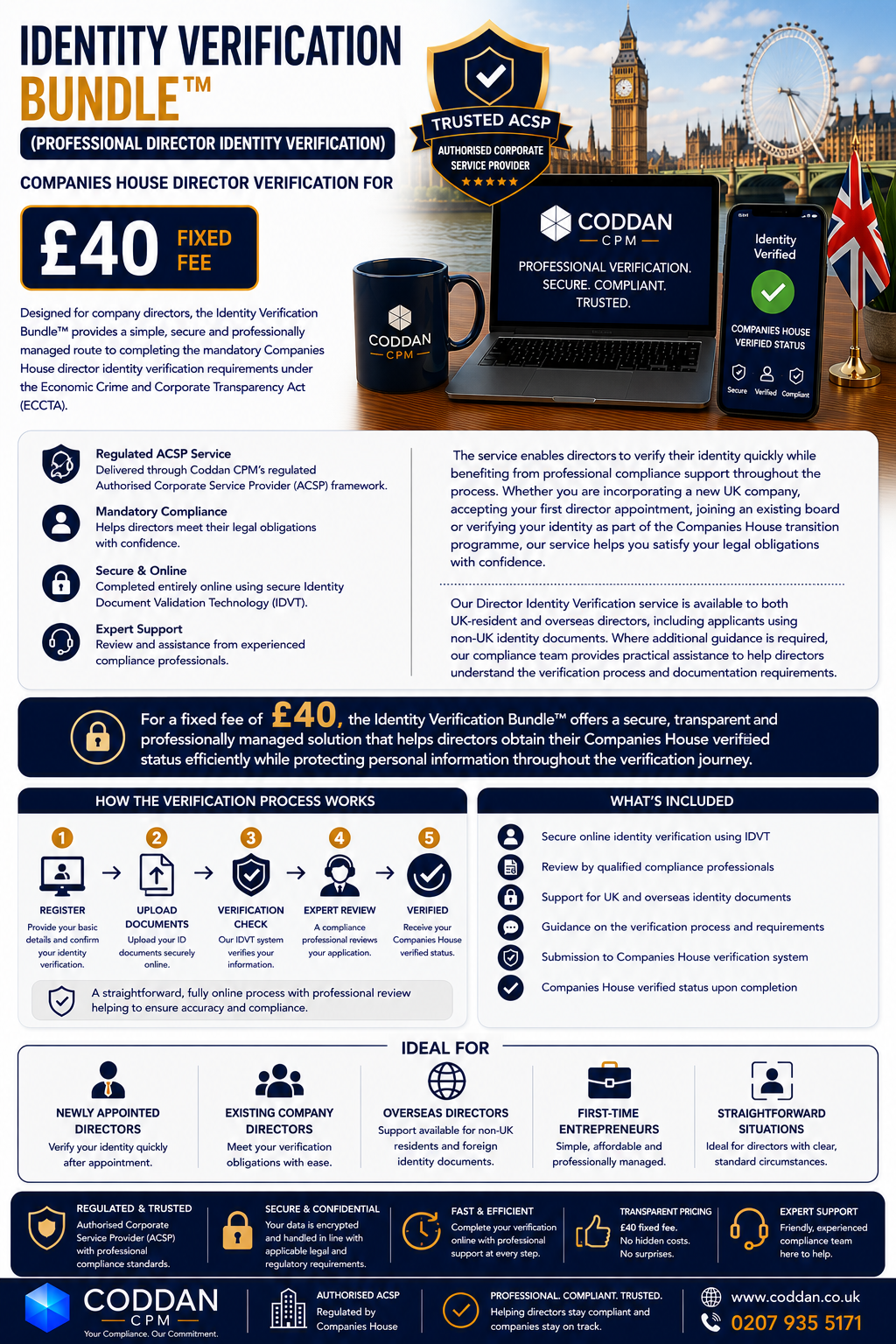
Buy Now Identity Verification Bundle™ (Professional Director Identity Verification) – International Companies House Director Identity Verification for £40.
The Identity Verification Bundle™ provides a fast, secure and professionally managed Standard International Route for a director whose eligible identity document and personal records present a straightforward verification case. It is suitable for many non-UK residents who are directors of UK companies, overseas founders preparing to join a UK board and international directors using eligible non-UK identity documents. The participant supplies the required identity information and evidence through the secure digital process, the technology performs the applicable identity and document checks, and Coddan reviews the resulting information through its Authorised Corporate Service Provider (ACSP) framework. Coddan then determines whether it is satisfied that the applicable Companies House identity-verification standard has been met. Residence outside the United Kingdom does not by itself make an application complex or require manual verification. Applicants with straightforward international circumstances can therefore begin with this economical digital pathway before considering a higher service level. If your case is ordinary rather than genuinely cross-border, review our overseas director identity-verification guidance.

The service costs a fixed £40 plus VAT and is intended for one director identity-verification application. It can provide a simple remote route for an international participant using a suitable document, but acceptance depends on the document, information supplied and outcome of the applicable checks. Coddan cannot direct the technology to produce a successful result or lower the Companies House verification standard. If Coddan becomes satisfied that the required standard has been met, it performs its applicable notification responsibility; Companies House separately issues the Personal Code. Verification does not itself appoint a director, connect every corporate role, complete a PSC obligation or file a Confirmation Statement. Where the evidence reveals a material name variation, transliteration issue, conflicting record or unusual document question, the applicant may need the individually assessed route instead. This package remains a quick, affordable starting point for the majority of straightforward international director applications, without implying that geography alone requires specialist treatment or that a successful outcome or Companies House timing can be guaranteed.


£65.00
+VAT

RapidVerify Pro™

Recommended for

2
package

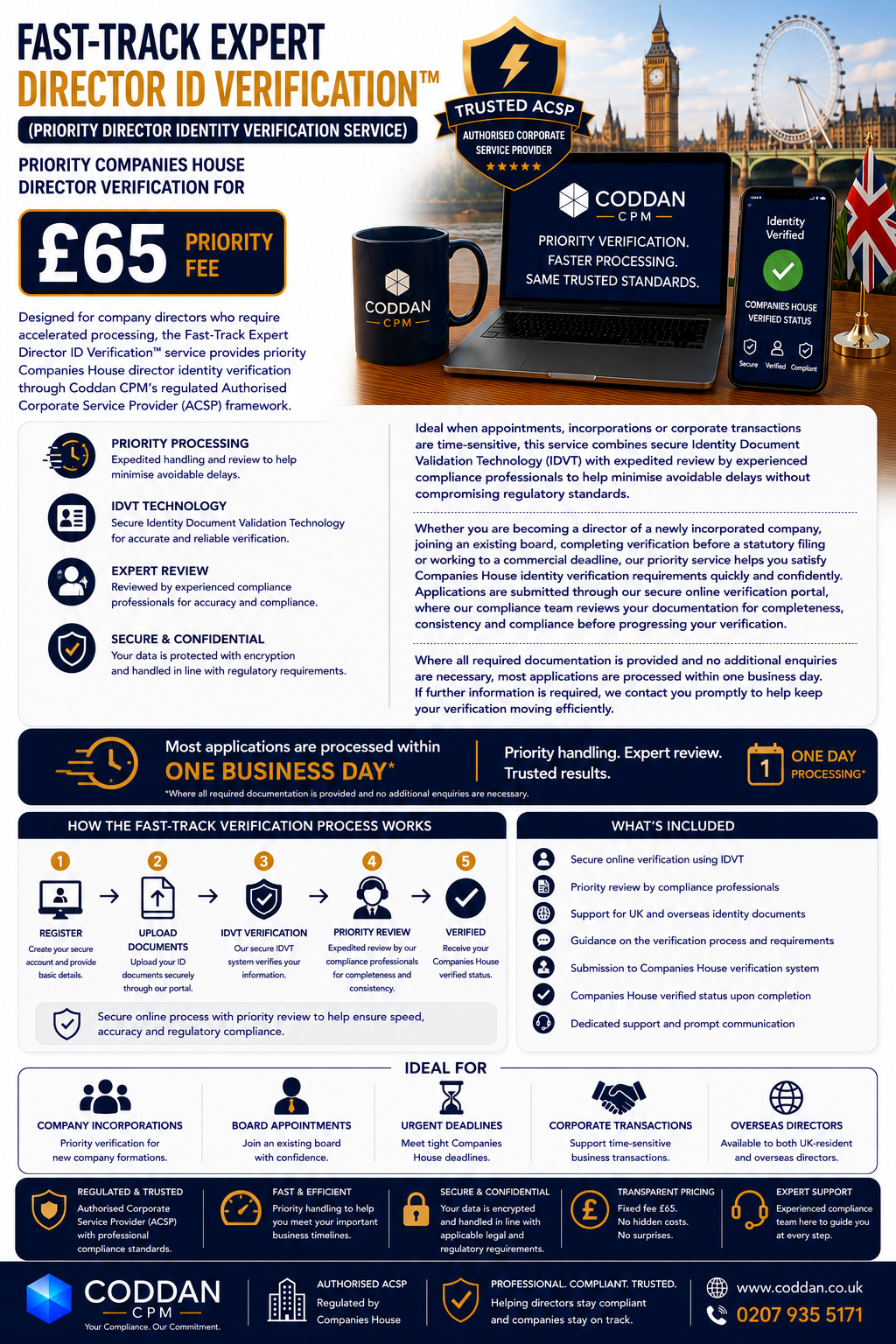
Buy Now Fast-Track Expert Director ID Verification™ (Priority Director Identity Verification Service) – Priority International Companies House Director Identity Verification for £65.
The Fast-Track Expert Director ID Verification™ service provides a professionally managed Priority International Route for directors who have suitable identity documents but require Coddan's application handling and review to receive priority attention. It is designed for international founders, non-UK resident directors and overseas participants working towards a genuine commercial or corporate deadline, including a proposed appointment, incorporation or connected statutory filing. The participant supplies the required information and evidence, secure technology performs the applicable checks, and Coddan reviews the resulting information through its regulated ACSP framework. Where the selected route is suitable, all required information has been received and no additional enquiry or verification issue arises, Coddan targets its applicable processing within one business day. This is Coddan's processing target rather than a guaranteed verification outcome, Companies House processing time or Personal Code delivery promise. Applicants without an urgent deadline may compare this package with the standard £40 route.

For £65 plus VAT, the package combines priority handling with practical support for a straightforward international director application. It may be useful where a director appointment, company formation, transaction or filing timetable makes avoidable delay commercially important. Priority handling does not alter the evidence requirements, override an unsuccessful technology result or require Companies House to accept a notification or issue a Personal Code within a particular period. If information is incomplete, inconsistent or requires clarification, Coddan explains what further evidence is needed before it can make its own satisfaction decision. The service is therefore faster in Coddan's handling queue, but it is not a back door or a reduced verification standard. An applicant whose circumstances require more than one possible evidence pathway should consider the two-pathway or manual options. For a fuller explanation of where priority treatment fits, see our standalone fast-track identity-verification solutions. Director-role linkage and any connected corporate filing remain separate tasks after verification.


£125.00
+VAT

VerifyFlex Solutions™

Recommended for

3
package

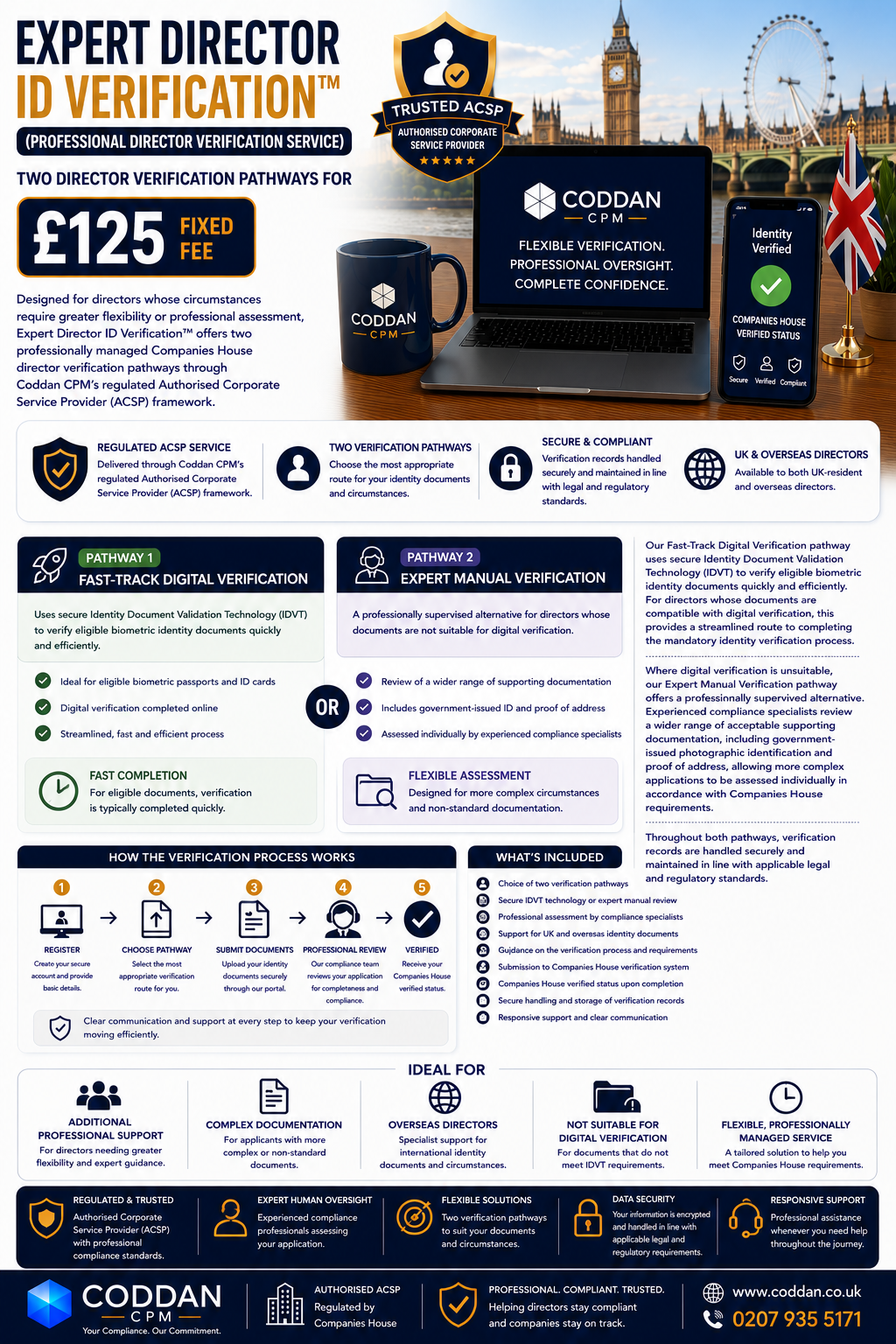
Buy Now Expert Director ID Verification™ (Professional Director Verification Service) – Two International Companies House Director Identity Verification Pathways for £125.
The Expert Director ID Verification™ service provides a flexible Two-Pathway International Route for a director whose documents or cross-border circumstances require a choice between digital verification and an alternative professionally managed evidence process. The digital pathway uses applicable identity-document validation technology where the participant and document are suitable. Where that pathway is not appropriate, the alternative route allows the relevant evidence to be examined under the applicable Companies House standard. This may assist international applicants dealing with material name differences, transliteration, records spanning more than one jurisdiction or identity documents that require closer consideration. It does not mean that every non-UK resident or overseas-issued document creates a complex case. Coddan reviews the information produced through the selected pathway and makes its own decision on whether it is satisfied that the required standard has been met. The package is intended for directors who value greater route flexibility before the evidence is progressed, rather than applicants who merely live outside the United Kingdom.

For £125 plus VAT, the applicant receives access to two professionally managed verification pathways for one international director application, with practical guidance on the route that appears appropriate to the documents and circumstances presented. The service can be relevant to a director of a UK company living abroad or, where the registered position requires separate consideration, an individual connected with an overseas company registered in the UK. It does not combine identity verification with every associated corporate task. Companies House separately issues any Personal Code, and the use of that code for a director or PSC role remains another stage. A proposed appointment, Confirmation Statement, correction, incorporation or restoration filing must also be identified and dealt with separately where required. Participants should use our identity-verification guidance by entity and role if the relevant capacity may instead be PSC, LLP member or another registered role. Where neither available pathway is suitable and individual manual assessment is necessary, proceed to the FlexiVerify Option™.


£220.00
+VAT

FlexiVerify Option™

Recommended for

4
package

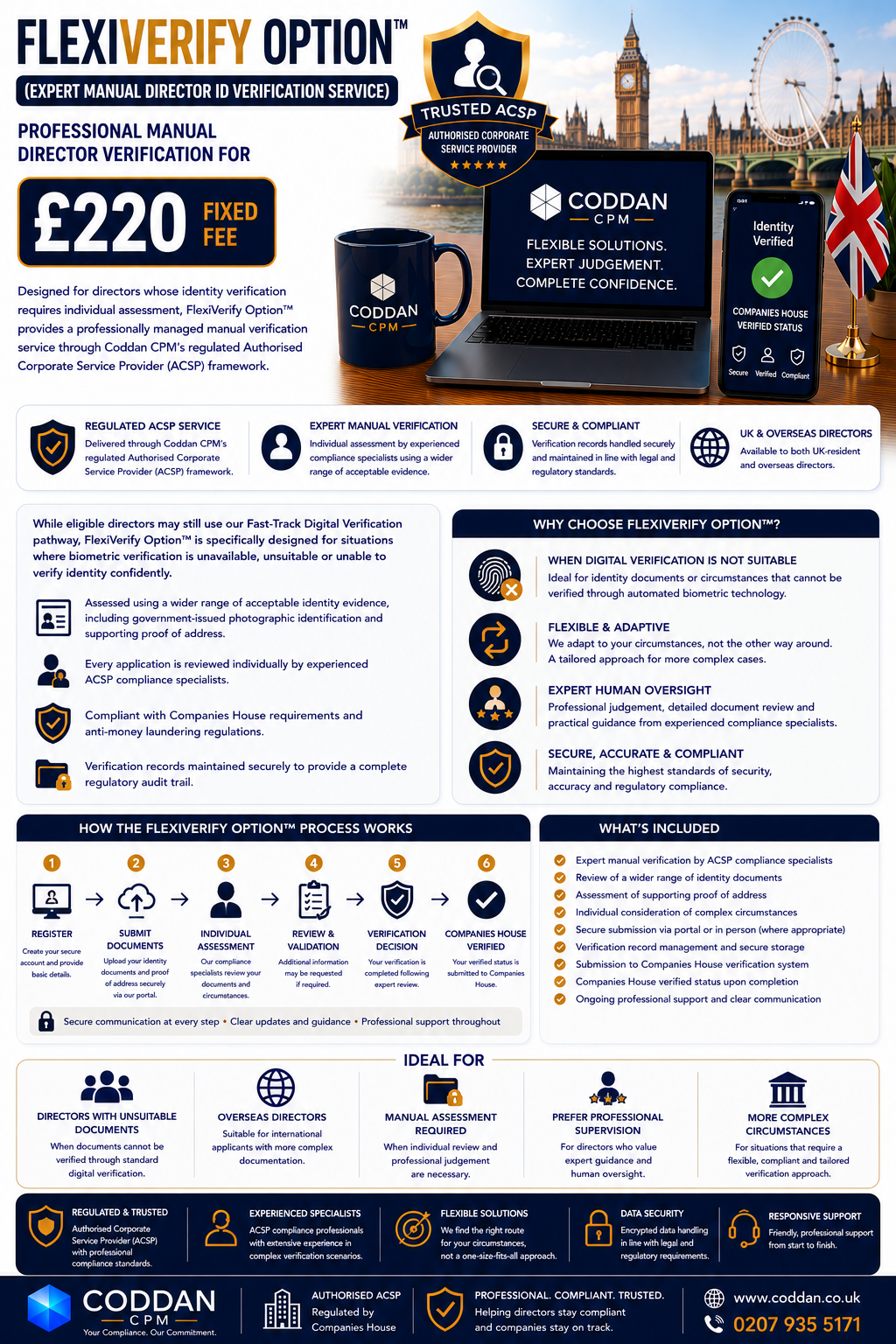
Buy Now FlexiVerify Option™ (Expert Manual Director ID Verification Service) – Individually Assessed International Companies House Director Identity Verification for £220.
The FlexiVerify Option™ provides an Individually Assessed International Route for directors whose identity evidence cannot appropriately be progressed through the standard digital pathway. It is intended for genuinely complex international circumstances, such as a material conflict between identity records, substantial name or transliteration differences, unusual document formats, evidence connected with several jurisdictions or the absence of a suitable biometric route. Experienced compliance professionals assess the available evidence under the applicable Companies House identity-verification standard rather than relying solely on an automated outcome. Depending on the prescribed route and evidence, the assessment may be conducted remotely or may require an appropriate in-person element; it should not be described as universally online. Coddan can request additional evidence and review it, but cannot order a technology provider to pass an application, overturn a previous GOV.UK or Post Office outcome or guarantee that the evidence will satisfy the required standard. This is the package's most flexible professional pathway, not a lower-standard alternative.

The fixed service fee is £220 plus VAT for one individually assessed director identity-verification application. The price reflects the professional attention required to evaluate a non-standard international evidence position and maintain the applicable verification record; it does not purchase a guaranteed result or influence Companies House. If Coddan becomes satisfied that the required standard has been met, it completes its applicable notification responsibility. Companies House then independently controls the issue of the Personal Code and its own processing. This package may also assist in establishing the identity-verification task where an international participant is involved in the restoration of a company or LLP, but restoration, overdue filings, appointments, PSC matters and role linkage remain separate corporate processes and services. If a suitable digital route becomes apparent, the applicant may instead use the two-pathway £125 package. Applicants whose real problem is a previous unsuccessful attempt, missing Personal Code or unresolved role should first consult our Companies House identity-verification support guidance so that the correct remaining job is identified before another application is started.


Establish your role and international circumstances

International identity-verification cases should begin with the person's actual Companies House position rather than their country of residence. Establish whether you are an existing or proposed director, a person with significant control (PSC), both a director and PSC, or a director of an overseas company registered in the UK.

Nationality, residence, the country that issued an identity document and the legal role connected with the UK company are separate facts. A cross-border case becomes specialist where those facts create a genuine identity, evidence, record or route-determination issue.

Decide whether the case is routine or genuinely cross-border

Routine overseas circumstances

If you are an individual director of a UK company, live outside the UK, have suitable evidence and your personal records are consistent, your case may be an ordinary overseas-director matter rather than a specialist international case.

Genuine international complexity

Specialist consideration may be appropriate where records materially conflict across jurisdictions, names or former names differ substantially, transliteration creates an identity question, evidence spans more than one jurisdiction, unusual document formats create uncertainty, or the person's corporate position itself requires separate treatment.

Residence alone is not complexity

Living outside the UK, holding a non-UK passport or managing a UK company remotely does not by itself make a case specialist or make professional support necessary.

Check personal information and evidence for consistency

Compare the information you intend to provide with the identity evidence and relevant Companies House information. Pay particular attention to your full name, former names, date of birth, home address and recent address history where applicable.

International cases can require additional consideration where names are presented differently between documents, scripts or jurisdictions. A transliteration difference, former name, address variation or conflicting record should be identified as an actual issue rather than assumed to be problematic simply because the document is foreign.

Companies House's current ACSP standard requires the applicable information and evidence to be checked to the required standard. Where technology is used, the ACSP remains responsible for deciding whether it is satisfied that the required standard has been met.

Consider the legitimate free Companies House route

The free GOV.UK One Login route remains a legitimate starting point where it is available and suitable. Current official guidance confirms that the Companies House verification service can be used by eligible applicants and that an eligible biometric passport from any country may be usable through the applicable online route.

Check the current GOV.UK identity-verification guidance before choosing an alternative route.

Support being available does not mean support is required. An ACSP is an optional alternative where selected, suitable and professionally relevant.

Consider an optional Coddan-supported ACSP route only where suitable

An ACSP route is an authorised alternative for a person who chooses professional assistance and where the provider can undertake the verification in accordance with the applicable Companies House requirements. A person living outside the UK may use an ACSP where the agent is registered with Companies House and suitable evidence can be provided for the applicable route.

Using an ACSP does not lower the Companies House standard, replace the free route or make professional support necessary merely because the case is international.

Understand what happens during Coddan-supported verification

1. Participant

You provide the required personal information and evidence for the selected verification route.

2. Technology

The applicable technology performs the identity and document checks required by the route.

3. Coddan

Coddan reviews the resulting information and determines whether it is satisfied that the Companies House standard has been met.

4. Notification

Following a successful outcome, Coddan performs its applicable notification responsibility.

Coddan cannot direct or override the technology provider's result, require evidence to pass, lower the Companies House standard or determine Companies House's decision or timing.

Separate verification from the Personal Code

Identity verification and the Companies House Personal Code are separate stages. Companies House issues the Personal Code after successful identity verification; it is an 11-character code personal to the individual, not to a company.

An ACSP does not create or independently issue the Companies House Personal Code. If you have already verified your identity, do not repeat verification merely because you have not yet identified the code or used it for the applicable corporate role. Use the dedicated Companies House Personal Code guide where understanding or locating the code is the remaining job.

Separate director linkage from PSC linkage

A person who is both a director and a PSC holds two separate corporate roles. Identity verification is not ordinarily repeated merely because the same individual holds both roles, but the applicable Personal Code and role-linkage requirements must still be completed for each relevant capacity.

The same distinction applies where a person has several directorships. The Personal Code belongs to the individual, while its use connects the verified identity to the applicable Companies House records.

Identify the LLP, partnership, restoration or corporate-event interface

Not every international corporate structure should be treated as a director identity-verification case. An individual LLP member may have a management role comparable in practical importance to a director, but an LLP member must not be described as a director. The requirements applicable to an individual LLP member must be considered as an equivalent role, while a corporate LLP member is a distinct category.

A general partner in a limited partnership may manage the partnership's affairs, but director requirements should not be mechanically transferred to a general partner. Current Companies House guidance states that identity verification for limited partnerships and corporate LLP members will be introduced at a later date. It should not be suggested that every general partnership is registered at Companies House or presently subject to Companies House identity verification.

Company restoration and LLP restoration are separate legal processes. Identity verification, use of a Personal Code or outstanding filing work may interface with a restoration case, but completing identity verification does not itself restore a company or LLP. Where restoration is the remaining professional job, use the appropriate company restoration guidance or LLP restoration destination rather than treating verification as the restoration process.

Separate identity verification from connected corporate events

Identity verification does not itself complete incorporation, a director appointment, a Confirmation Statement, correction of company records, restoration or another Companies House filing.

Identity stage

Establish whether the person has completed the applicable identity verification.

Role stage

Determine whether director or PSC role linkage remains.

Corporate event

Route any appointment, Confirmation Statement, correction, restoration or other filing to its own professional destination.

Distinguish the international evidence issue from the ordinary overseas route

International evidence can become specialist where materially different records need to be reconciled, identity information spans jurisdictions, substantial name or transliteration differences exist, or an unusual document format creates uncertainty about which verification route applies.

An overseas passport is not automatically a specialist document, and overseas residence does not automatically require an ACSP. The evidence must be considered against the requirements of the applicable route.

Where the case is simply an existing UK-company director living abroad with suitable evidence and consistent records, use the ordinary overseas-director identity-verification destination rather than this specialist page.

Keep the distinction between individual and corporate roles

Companies House identity verification concerns the individual where the applicable requirement applies to that person's role. It should not be treated as verification of a foreign parent company, corporate shareholder or other corporate entity.

Current official guidance states that identity verification for corporate directors and corporate LLP members will be introduced at a later date. Those later-phase requirements must not be presented as current obligations without a fresh official confirmation.

Separate current requirements from later implementation phases

Current Companies House guidance identifies directors or equivalent roles, directors of overseas companies registered in the UK and PSCs among the roles subject to the current identity-verification framework. Other categories, including limited partnerships, corporate directors and corporate LLP members, are identified for later implementation.

For an overseas company registered in the UK, current guidance says the company must confirm that all its directors have verified their identities by the anniversary of the UK establishment's registration. That specific rule must not be converted into a universal deadline for every international director.

Do not transfer a future requirement for people who file, a future presenter credential or another later implementation phase into a current obligation. Where a later phase may affect the person's structure, identify it as a future consideration and route the actual current task separately.

Understand what an unsuccessful route does and does not mean

An incomplete or unsuccessful verification outcome should be treated as a route-specific issue to be understood, not as evidence that every international applicant requires an ACSP or that the free GOV.UK route is unsuitable for overseas participants.

The cause may relate to the information provided, the evidence, the selected verification process or the circumstances presented. Coddan cannot overturn a GOV.UK, Post Office or technology outcome or require an evidence set to pass.

Where the remaining professional job is specifically failed-verification reconciliation, use the identity-verification issues destination rather than converting this international page into a failed-attempt guide.

Route the remaining international identity issue to the right professional job

A specialist international case may concern evidence, record reconciliation, an overseas-company director position, or another cross-border issue. The correct destination depends on the unresolved task rather than the person's nationality or location.

Do not use this page to absorb Personal Code work, failed-verification reconciliation, ordinary overseas preparation, appointment work, formation, restoration or other corporate filing responsibilities.

Identity verification is only one part of the Companies House journey

After identity verification, the participant may still need to use the Personal Code, connect the verified identity to a director or PSC role, or complete a separate company event.

A completed identity-verification result should therefore not be presented as completion of every Companies House obligation. Conversely, an outstanding corporate filing should not automatically be treated as a failed identity-verification issue.

Assess international identity documents against the applicable route

There is no single universal list of foreign documents that can be described as accepted for every verification route. Current Companies House ACSP guidance provides more than one evidence-checking option generally, with different evidence requirements applying to different options.

Within the Coddan-supported route described on this page, technology performs the applicable identity and document checks. This does not deny that official guidance allows other evidence-checking options for ACSPs generally, and it does not create a separate manual or human-performed Coddan verification proposition.

The appropriate route should therefore be determined from the current official requirements rather than from a generic country catalogue.

Prepare the information required for international verification

Preparation should focus on the actual evidence and information required by the selected route. Current Companies House ACSP guidance identifies full name and former names, date of birth, home address, address history and email address among the information that may be required for the identity-verification process.

Where international records contain different names, addresses or other personal information, identify the discrepancy before treating the case as routine. Do not manufacture a UK address, simplify a legal name or alter genuine information merely to make records appear identical.

Understand international name differences without assuming failure

Different scripts, transliterations, former names, compound names and ordering conventions can create genuine identity questions. They do not automatically mean that verification cannot be completed.

The relevant question is whether the identity information and evidence can be reconciled sufficiently to meet the applicable Companies House standard. Where a material discrepancy requires specialist consideration, route it as an international evidence issue rather than promising that an ACSP can simply correct or override the discrepancy.

Understand the role of an Authorised Corporate Service Provider

An ACSP is a Companies House authorised agent that can verify identity on a person's behalf. Current official guidance confirms that an ACSP must be registered with Companies House and must meet the applicable AML-supervision requirement. The ACSP's Companies House registration and its separate AML supervision should not be conflated.

An ACSP may charge for its services, but payment does not lower the identity-verification standard or create privileged access to Companies House.

Within the Coddan-supported route described here, technology performs the applicable checks while Coddan reviews the resulting information and determines whether it is satisfied that the required standard has been met.

Choose the right international identity-verification route for your circumstances

The correct route is determined by the unresolved professional job. Use the following sequence rather than treating every international case as a specialist or paid-support matter.

Routine overseas director

Use the ordinary overseas-director destination where residence is outside the UK but the evidence and records are suitable and consistent.

Free route suitable

Use the current GOV.UK One Login route where its requirements and available evidence fit your circumstances.

Genuine specialist issue

Consider specialist international route determination where records, evidence or corporate circumstances genuinely span jurisdictions.

Another task remains

Route Personal Code, role linkage, correction, appointment, formation, filing, failed-verification or restoration work to the destination that owns that task.

Keep identity verification separate from AML, KYC and CDD

Companies House identity verification is a defined statutory process. It should not be presented as interchangeable with wider anti-money-laundering, know-your-customer or customer-due-diligence work.

An ACSP may have separate obligations arising from its own regulated activities, but those obligations do not change the Companies House identity-verification standard or turn AML, KYC and CDD into the identity-verification result.

Nothing Further Required may be the correct outcome

If the applicable identity verification is complete, the Personal Code has been issued, the relevant director or PSC role step has been completed and there is no connected corporate event remaining, there may be Nothing Further Required for the identity-verification task.

This does not mean that every company obligation has disappeared. A separate filing, appointment, correction, restoration or other corporate event remains the responsibility of its own process and destination.

Use current official guidance for timing and implementation

There is no universal November 2026 deadline applying to every international director. Companies House states that identity-verification timing depends on the person's role and the applicable process, while some categories remain scheduled for later implementation.

Use the current Companies House guidance for the person's role rather than relying on a generic international deadline or assuming that every cross-border case follows the same timetable.

Official guidance reviewed: 13 September 2026.