We use cookies on this website, you can read about cookies and GDPR Privacy Policy here
Coddan CPM Ltd. – Company Registration Agent in the UK

Follow these six steps to identify your entity type, understand your verification obligations and choose the appropriate Companies House identity verification pathway.

Step 1
Identify Your Entity
Step 2
Confirm Your Obligations
Step 3
Review Required Documents
Step 4
Select Verification Route
Step 5
Complete Verification
Step 6
Maintain Compliance
Companies Registry's e-Services Portal Identity Verification Director ID Verification Director ID Verification Across Different UK Business Entity Types

Director ID Verification Across Different UK Business Entity Types


Stay ahead of the curve with our comprehensive overview of Director ID Verification under the ECCTA. Tailored insights for every UK business entity await you

Director ID Verification Across Different UK Business Entity Types: Understanding How the Rules Apply to Your Organisation
The introduction of mandatory Director ID Verification under the Economic Crime and Corporate Transparency Act (ECCTA) has transformed the way individuals responsible for managing UK registered organisations interact with Companies House. While the principle of identity verification is consistent across the corporate register, the practical application of the rules varies according to the legal structure of the organisation and the governance role performed by the individual.
Beyond Company Directors: The Full Scope of Identity Verification in the UK's Corporate Landscape
Many business owners assume that identity verification only applies to directors of private limited companies. In reality, the UK's corporate landscape is far more diverse. Depending on the legal entity involved, the individuals requiring identity verification may include company directors, designated LLP members, trustees of charitable companies, directors of Community Interest Companies (CICs), members of Public Limited Company (PLC) boards and other officers responsible for managing incorporated organisations. Each entity type has its own governance framework, statutory filing procedures and administrative lifecycle, meaning that understanding how identity verification applies is just as important as understanding that it applies.
Identity Verification Essentials: Best Practices for LLPs, Charitable Companies, and Social Enterprises
This knowledge centre has been developed to provide practical guidance for every major type of UK business entity registered within the Companies House framework. Rather than repeating statutory guidance, these articles explain how identity verification operates in real corporate environments—from newly incorporated private companies and start-ups to LLPs, charitable companies, social enterprises, PLCs and organisations with more specialised governance structures. They examine the responsibilities of directors, designated members, trustees, committee members and other office holders, while exploring how identity verification integrates with appointments, annual confirmation statements, company secretarial administration, corporate restructures and long-term governance.
Navigating Governance Challenges: Best Practices for Managing Multiple Board Appointments and Identity Verification
The guidance also addresses situations that many organisations encounter as they grow, including managing multiple board appointments, coordinating identity verification across corporate groups, supporting overseas officers, maintaining accurate statutory records and integrating identity verification into wider compliance programmes. By understanding the governance requirements associated with each legal structure, organisations can establish stronger administrative foundations, reduce avoidable compliance issues and maintain confidence in the accuracy of their Companies House records.
Understanding UK Business Entity Types: Insights from an Authorised Corporate Service Provider
Since 2005, Coddan CPM has supported entrepreneurs, charities, professional firms, overseas investors, social enterprises, corporate groups and membership organisations with company formations, company secretarial services and long-term corporate compliance. As an Authorised Corporate Service Provider (ACSP) and regulated Trust and Company Service Provider (TCSP), we help organisations registered in England and Wales, Scotland and Northern Ireland navigate the practical implementation of the Companies House identity verification framework across a wide range of UK business entity types.
Whether you are establishing a new organisation, managing an existing board, advising clients or reviewing your governance responsibilities, our experienced team can help you understand how identity verification fits within the wider lifecycle of corporate management. Our objective is not simply to assist with one statutory requirement, but to help organisations maintain accurate Companies House records, strengthen corporate governance and support compliant business growth regardless of the legal structure they choose.
i
Independent Verification Support

Registered Directly with Companies House? We Can Still Help.

Many directors choose to register their companies directly with Companies House. When a new compliance requirement such as Director Identity Verification arises, professional guidance can still be useful.

Whether your company was formed online through Companies House or by another provider, you are welcome to use our identity verification service on its own.

Our role is simple: help you understand the process, guide you through the available verification routes, and provide professional support where needed—without asking you to transfer any of your existing company services.


Start Your Business Today: Fast Formation Services to Meet All Compliance Standards

Ensure compliance with Companies House through rapid, secure ID verification for Directors and PSCs. Complete the process online with an authorized ACSP

treamline your compliance with Companies House using our fast, secure ID verification for Directors and PSCs, all completed online by an authorized ACSP
£40.00
+VAT

IdentityGuard Pro™

Recommended for

1
package

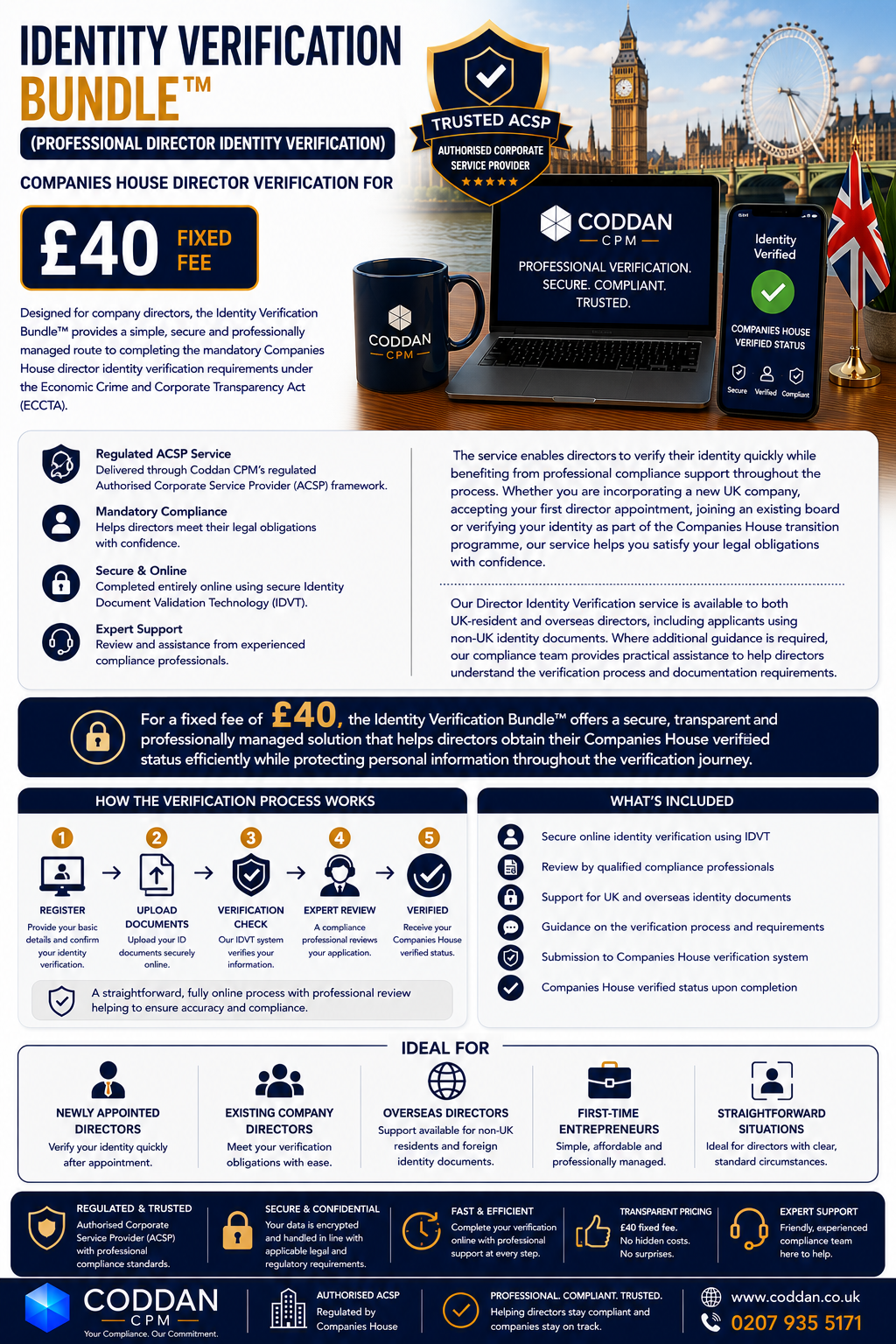
Buy Now Identity Verification Bundle™ (Professional Director Identity Verification) – Companies House Director Identity Verification for £40.
The Identity Verification Bundle™ provides a fast, secure and professionally managed solution for company directors and other individuals who need assistance completing mandatory Companies House director identity verification. Delivered through Coddan CPM's regulated Authorised Corporate Service Provider (ACSP) framework, this managed service helps applicants satisfy the identity verification requirements introduced under the Economic Crime and Corporate Transparency Act (ECCTA) while supporting accurate Companies House records and ongoing corporate compliance. Whether you are becoming a company director, updating your Companies House information, accepting a new appointment, completing identity verification during the Companies House transition period or simply require professional support with the verification process, our service offers a straightforward route to obtaining or maintaining verified director status where required. Verification is completed entirely online using secure Identity Document Validation Technology (IDVT), with every application supported by experienced compliance professionals who help ensure your identity verification is completed accurately and in accordance with Companies House requirements.

The service is available to both UK-based and overseas directors, including individuals using eligible non-UK identity documents. Where additional assistance is required, our compliance team provides practical guidance throughout the verification process, helping you understand the documentation requirements for your particular circumstances and reducing the likelihood of unnecessary delays. For a fixed fee of £40, the Identity Verification Bundle™ offers a secure, transparent and professionally managed route to obtaining or maintaining verified Companies House status through a regulated ACSP. It is ideally suited to newly appointed directors, existing company officers, overseas applicants and anyone seeking trusted professional support with Companies House director identity verification. Complete your verification with confidence and ensure your Companies House identity verification is supported by accurate, compliant and professionally managed guidance from start to finish. Ideal for the vast majority of straightforward applicants.


£65.00
+VAT

RapidVerify Pro™

Recommended for

2
package

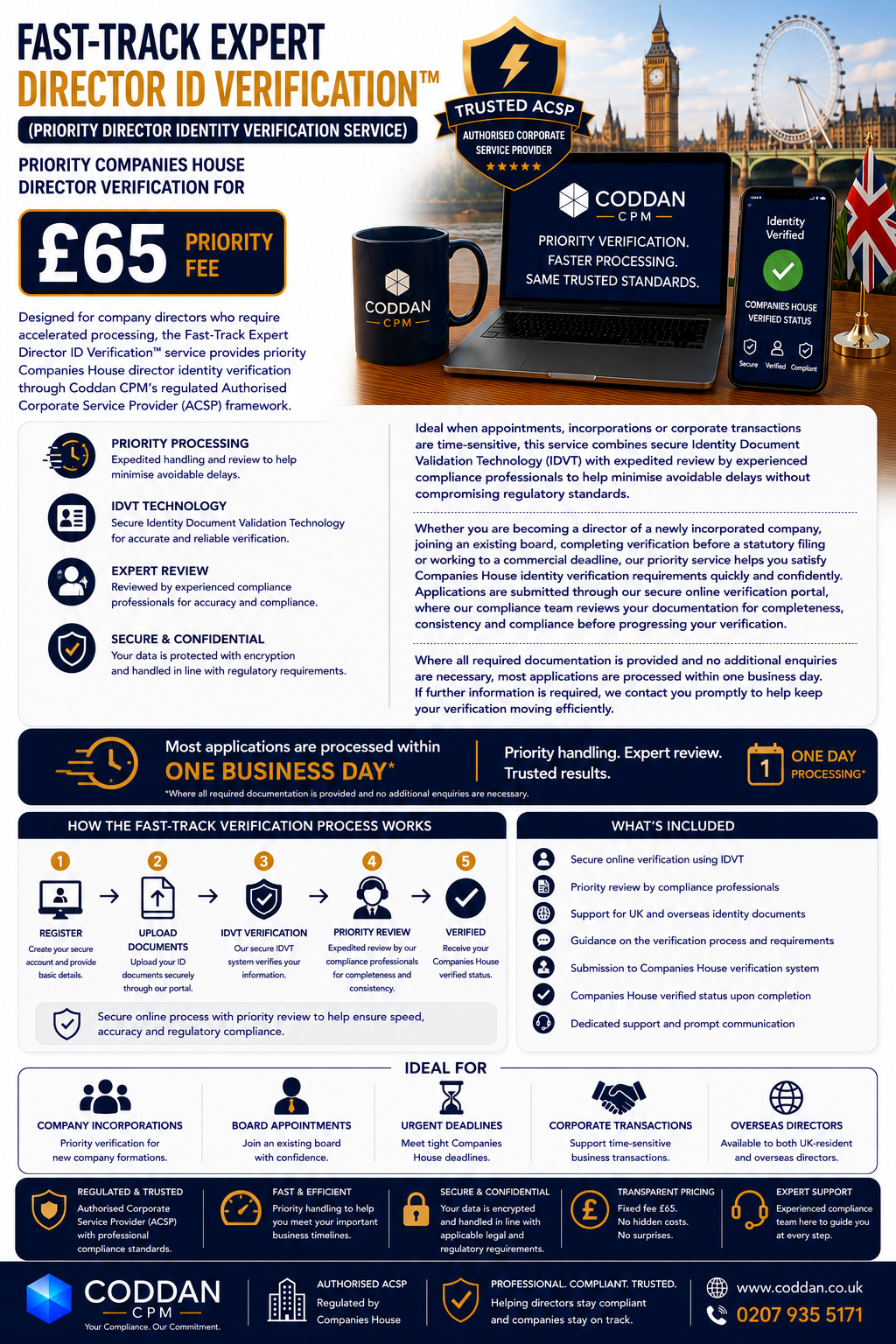
Buy Now Fast-Track Expert Director ID Verification™ (Priority Director Identity Verification Service) – Priority Companies House Director Identity Verification for £65.
The Fast-Track Expert Director ID Verification™ service is designed for company directors and other individuals who require priority Companies House director identity verification without compromising accuracy or compliance. Delivered through Coddan CPM's regulated Authorised Corporate Service Provider (ACSP) framework, this premium managed service combines secure Identity Document Validation Technology (IDVT) with expedited review by experienced compliance professionals to help you complete the verification process as quickly as possible. Ideal for urgent director appointments, Companies House filing deadlines, corporate transactions, business incorporations and applicants who simply require accelerated identity verification support, this service provides priority handling from the moment your application is received. Every submission is carefully reviewed to help ensure your documentation is complete, consistent and compliant before progressing through the identity verification process, reducing the likelihood of unnecessary delays. Where all required information is provided and no additional enquiries are needed, most applications are processed within one business day.

If further documentation is required, our compliance team contacts you promptly to help keep your verification progressing efficiently. The service is available to both UK-based and overseas directors, including individuals using eligible non-UK identity documents. For £65, the Fast-Track Expert Director ID Verification™ service provides a faster, professionally managed route to obtaining or maintaining verified Companies House status while meeting your identity verification obligations. It is ideally suited to newly appointed directors, existing company officers, overseas applicants and businesses working to urgent commercial or regulatory deadlines, as well as anyone requiring priority Companies House identity verification support. Complete your Companies House director identity verification quickly, securely and with the confidence of experienced ACSP professionals supporting your verification from start to finish.


£125.00
+VAT

VerifyFlex Solutions™

Recommended for

3
package

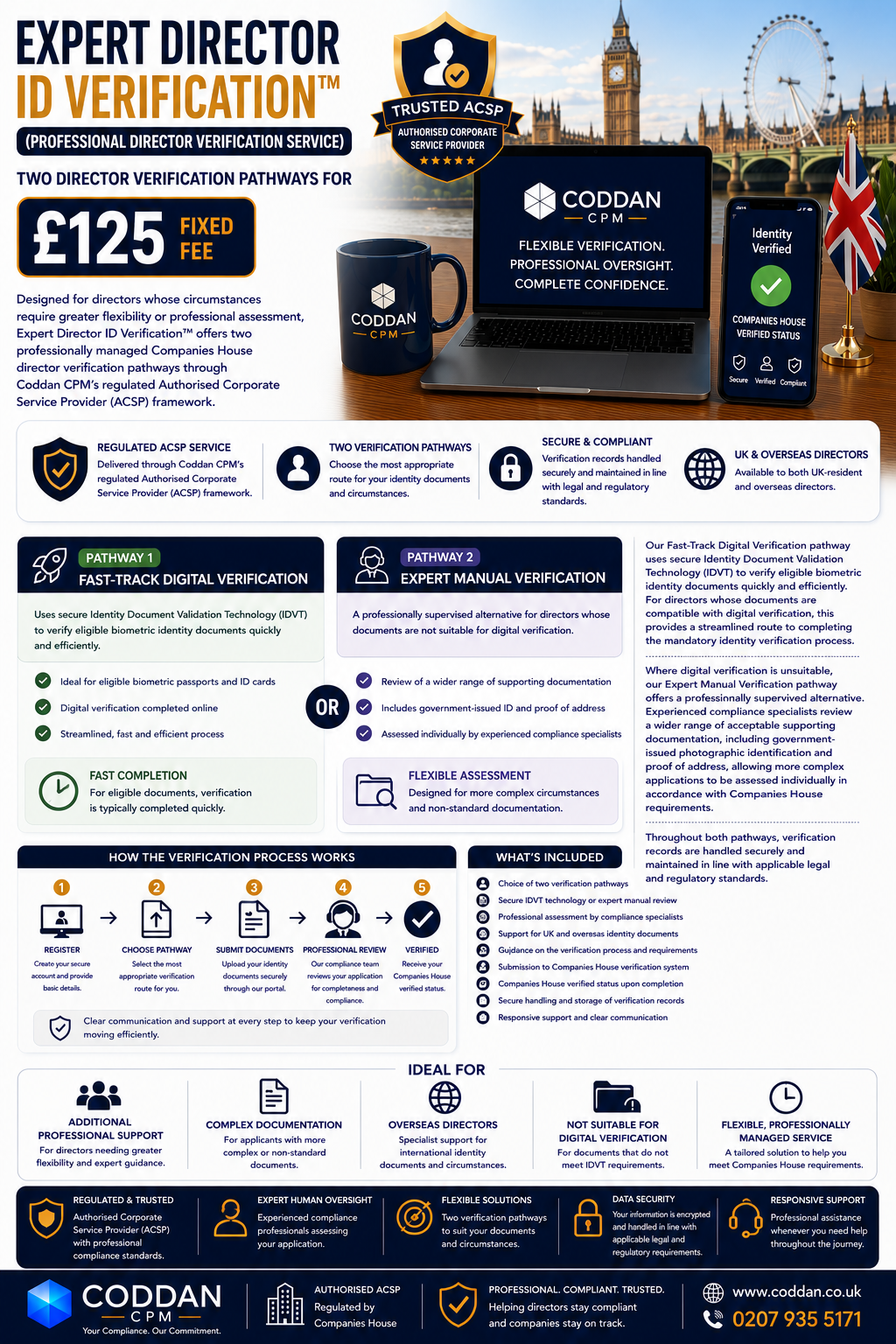
Buy Now Expert Director ID Verification™ (Professional Director Verification Service) – Two Companies House Director Identity Verification Pathways for £125.
The Expert Director ID Verification™ service is designed for company directors and other individuals who require greater flexibility when completing Companies House director identity verification. Delivered through Coddan CPM's regulated Authorised Corporate Service Provider (ACSP) framework, this professionally managed service offers two verification pathways, allowing applicants to choose the option that best matches their identity documents and individual circumstances while satisfying Companies House requirements. Our Fast-Track Digital Verification pathway uses secure Identity Document Validation Technology (IDVT) to verify eligible biometric identity documents quickly and efficiently. Where digital verification is not suitable, our Expert Manual Verification pathway provides a professionally supervised alternative, enabling experienced compliance specialists to review a broader range of acceptable identity documents and supporting evidence in accordance with applicable regulatory requirements. Both verification pathways are available to UK-based and overseas directors, including individuals using eligible non-UK identity documents.

Throughout the verification process, our compliance team provides practical guidance, carefully reviews every application and helps ensure all documentation satisfies Companies House requirements before your identity verification is completed, reducing the likelihood of delays caused by incomplete or unsuitable submissions. For £125, Expert Director ID Verification™ combines advanced verification technology with experienced professional oversight, providing a flexible and reliable managed solution for more complex verification circumstances. It is ideally suited to overseas directors, applicants whose identity documents are unsuitable for standard digital verification, newly appointed directors, existing company officers and anyone seeking experienced assistance with Companies House director identity verification through a trusted regulated ACSP. Complete your identity verification with confidence, supported by experienced compliance professionals who help guide you through the most appropriate verification pathway from start to finish.


£220.00
+VAT

FlexiVerify Option™

Recommended for

4
package

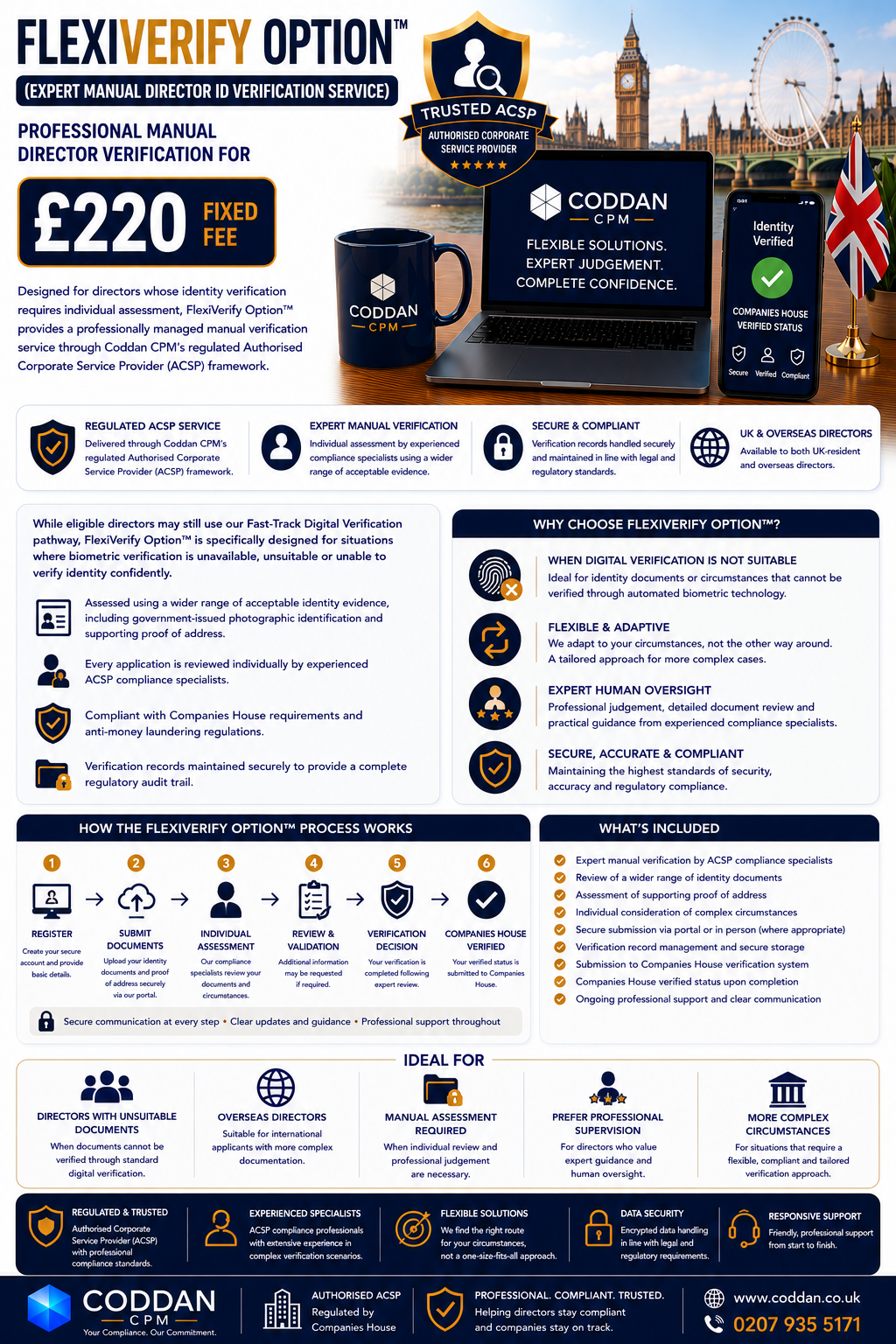
Buy Now FlexiVerify Option™ (Expert Manual Director ID Verification Service) – Professional Manual Companies House Director Identity Verification for £220.
The FlexiVerify Option™ is designed for company directors and other individuals whose Companies House director identity verification requires individual assessment beyond standard digital verification. Delivered through Coddan CPM's regulated Authorised Corporate Service Provider (ACSP) framework, this professionally managed manual verification service provides a flexible and compliant route for applicants whose circumstances are more complex or whose identity documents are unsuitable for automated verification. While eligible applicants may still use our Fast-Track Digital Verification pathway, FlexiVerify Option™ is specifically intended for situations where biometric verification is unavailable, unsuitable or unable to verify identity with sufficient confidence. Instead of relying solely on automated technology, experienced compliance specialists assess each application individually, reviewing a wider range of acceptable identity evidence, including government-issued photographic identification and supporting proof of address, in accordance with Companies House and anti-money laundering requirements. Applications can be submitted securely through our online verification portal or, where appropriate, completed in person.

Every application receives an individual review, with comprehensive verification records maintained to provide a secure regulatory audit trail and demonstrate compliance with applicable legal obligations. For £220, FlexiVerify Option™ offers the highest level of professionally managed support for complex director identity verification requirements. It is ideally suited to UK-based and overseas directors requiring manual assessment, individuals with non-standard identity documentation, and applicants seeking a fully supervised Companies House identity verification service supported by experienced ACSP compliance specialists and expert regulatory guidance throughout the verification process. Complete your Companies House identity verification with confidence, knowing your application is individually assessed and professionally managed to help achieve accurate, compliant and fully documented verification outcomes.


Existing Company Guidance

Need Help Choosing the Right Verification Route?

If your company is already registered with Companies House, you may only need support with completing your Director Identity Verification requirement.

The right solution depends on your individual circumstances. Some directors complete the process independently, while others prefer professional guidance to understand the requirements and avoid uncertainty.

If you are not sure which option suits your situation, contact our team for a straightforward discussion.

We will help you understand your choices without pressure to purchase additional services.

Every Company Begins with Verified Directors

Building a trusted UK company starts long before the Certificate of Incorporation is issued. Companies House identity verification has become one of the earliest regulatory milestones for directors, helping establish transparency and accountability from the outset. Understanding the available verification pathways before incorporating can reduce unnecessary delays and create a stronger compliance foundation for your business from day one.


Human-Vetted Security

Advanced IDVT technology paired with manual compliance reviews to prevent technical rejections.

Find the best identity verification strategy for your business type, whether it's a CIC, LLP, or PLC, and navigate compliance with confidence

Choosing the Right Identity Verification Approach for Your Business Structure
Although the Companies House identity verification framework is founded on a single legislative objective—to verify the identity of individuals responsible for managing UK registered organisations—the practical responsibilities differ significantly depending on the legal structure of the entity involved. A private limited company does not operate in the same way as a Limited Liability Partnership (LLP), a charitable company, a Community Interest Company (CIC), a Public Limited Company (PLC) or a member-owned cooperative. Each has its own governance model, statutory officers, filing obligations and administrative processes, all of which influence how identity verification should be managed.
Understanding Identity Verification: A Guide for Corporate Governance Roles
The articles in this knowledge centre examine these differences in detail. They explain how identity verification applies to executive and non-executive directors, designated LLP members, trustees of companies limited by guarantee, directors of Community Interest Companies, officers of Public Limited Companies and governance representatives within other incorporated business structures. They also explore how identity verification interacts with annual Confirmation Statements, director appointments, company secretarial administration, statutory record keeping and long-term corporate governance, enabling organisations to understand not only who must verify their identity, but also when, why and how those obligations fit into the wider compliance framework.
Harnessing the Power of Governance: Aligning Legal Structures with Companies House Identity Verification
Whether you operate a commercial business, a professional practice, a social enterprise, a charitable organisation or a complex corporate group, understanding the relationship between your legal structure and the Companies House identity verification regime is essential. By approaching identity verification as part of a broader governance strategy rather than a standalone compliance task, organisations can maintain accurate statutory records, simplify future corporate administration and build a stronger foundation for sustainable growth.

Verification That Adapts to Your Circumstances

No two directors have exactly the same circumstances. Some applicants complete digital verification within minutes, while others require additional documentation, overseas identity evidence or manual review. Our multi-tier verification services recognise these differences and provide solutions tailored to a wide range of verification scenarios.

Instead of expecting every applicant to fit a single automated process, we offer flexible verification pathways designed to accommodate both straightforward and more complex requirements.


Universal Entity Coverage

Director & Member ID Verification Across All Business Structures

Under ECCTA regulations, identity verification is mandatory for individuals controlling any official UK entity. Our packages are tailored to meet compliance standards across every corporate framework.

Director ID Verification Across Different UK Business Entity Types: Understanding the Universal Identity Verification Framework

The introduction of mandatory identity verification under the Economic Crime and Corporate Transparency Act (ECCTA) represents one of the most significant changes to UK company law in recent years. Its purpose is to improve the accuracy, transparency and reliability of the Companies House register by ensuring that individuals who establish, manage or control UK business entities can be linked to a verified identity.

Although businesses operate through many different legal structures, the underlying principle remains consistent.

Where the legislation requires an individual to verify their identity, that obligation is based on the person's corporate role rather than the size of the business, the industry in which it operates or whether the organisation is newly established or has traded for many years.

This means that identity verification has become a fundamental element of modern corporate governance across the UK business landscape.

One Legislative Framework, Many Different Business Structures
The United Kingdom offers a wide variety of legal structures through which organisations can operate.

These include, for example:

  • private companies limited by shares;
  • companies limited by guarantee;
  • limited liability partnerships (LLPs);
  • community interest companies (CICs);
  • charitable companies;
  • corporate groups;
  • overseas companies with UK registration requirements.

Although these organisations differ significantly in their legal purpose, ownership structure and governance arrangements, many are subject to the same Companies House regulatory framework.

Identity verification forms part of that wider framework.

Identity Verification Supports Confidence in the Companies House Register
The Companies House register performs an important public function.

It enables investors, customers, suppliers, financial institutions, regulators and members of the public to identify the individuals responsible for managing UK registered entities.

The introduction of identity verification strengthens this objective by increasing confidence that individuals connected with Companies House records have completed the required verification process where applicable.

This supports:

  • greater corporate transparency;
  • improved confidence in company information;
  • stronger corporate governance;
  • more reliable public records;
  • enhanced protection against misuse of corporate structures.

Identity verification therefore benefits not only individual businesses but also the wider UK corporate environment.

The Verification Requirement Is Broadly Consistent, but Corporate Roles Are Not
While the identity verification framework applies across many entity types, the responsibilities performed by individuals vary considerably.

For example, organisations may be managed by:

  • company directors;
  • designated members of a limited liability partnership;
  • people with significant control (PSCs);
  • company secretaries;
  • authorised corporate representatives;
  • other individuals performing statutory roles where required by the applicable legislation.

Each role carries its own governance responsibilities.

Understanding those responsibilities is just as important as completing the identity verification itself.

Every Business Structure Has Its Own Administrative Processes
Although the underlying verification framework is consistent, different entities operate under different administrative procedures.

Depending upon the organisation involved, businesses may need to consider:

  • appointment procedures;
  • Companies House filing requirements;
  • statutory registers;
  • governance documentation;
  • ongoing compliance obligations;
  • future changes to corporate officers.

Directors and other office holders should therefore understand both the identity verification requirements and the governance framework that applies to their particular organisation.

Verification Is Only One Stage of the Corporate Lifecycle
Identity verification should not be viewed as an isolated compliance exercise.

Throughout the life of an organisation, individuals may later experience:

  • new appointments;
  • resignations;
  • changes to personal information;
  • restructuring;
  • mergers;
  • expansion into additional companies;
  • changes in ownership or control.

Maintaining accurate company records as these events occur is an essential part of effective corporate governance.

Verification establishes the identity of the individual, while ongoing administration ensures that company records continue to reflect that identity accurately.

International Founder Guide

Based Overseas? Managing Cross-Border Administrative Requirements

International business leaders managing entities from abroad frequently encounter unique considerations:

  • How do non-residents satisfy corporate registry mandates remotely?
  • What documentation hurdles do international officers face?
  • Are there localized channels designed for foreign founders?

Operating a business across national borders requires clear insight into jurisdiction-specific expectations. Distance should not complicate your ability to maintain compliance.

Understanding remote compliance frameworks allows international directors to plan their administrative steps without confusion or geographic friction.

At Coddan, we specialize in bridging the gap for international officers, offering clear global guidance tailored to founders managing businesses from outside the country.

Understand your cross-border obligations first to ensure a smooth administrative process.

Different Organisations Require Different Governance Planning
A newly incorporated private company has different administrative needs from an established charitable company or a complex corporate group.

Similarly, an LLP operates differently from a company limited by shares.

Although identity verification provides a common foundation, the practical management of company records depends upon the organisation's legal structure and governance arrangements.

Businesses benefit from understanding these differences before important corporate events take place.

Professional Support Helps Businesses Navigate Different Entity Types
Many entrepreneurs establish more than one type of UK business during their careers.

For example, an individual may simultaneously be:

  • director of a trading company;
  • member of an LLP;
  • director of a charitable company;
  • director of several subsidiaries;
  • person with significant control across multiple organisations.

Limited Liability Partnerships (LLPs)

Streamlined verification pathways ensuring designated members and standard partners satisfy legal mandates.


Managing identity verification alongside these different corporate roles requires careful administration and an understanding of how the Companies House framework applies to each entity.

Professional guidance can help businesses coordinate these responsibilities while maintaining accurate corporate records.

Understanding Timing and Statutory Responsibilities
While the requirement to verify identity forms part of the overall Companies House framework, the practical administration surrounding appointments, notifications and statutory filings varies according to the legal structure involved.

Different entities may have different procedures governing:

  • the appointment of office holders;
  • Companies House filings;
  • internal governance documentation;
  • statutory record keeping;
  • ongoing compliance responsibilities.

For this reason, businesses should avoid assuming that every organisation follows identical administrative processes simply because identity verification applies across them.

Understanding the governance requirements of the specific entity is an important part of maintaining long-term compliance.

Why Businesses Choose Coddan CPM
Since 2005, Coddan CPM has supported entrepreneurs, SMEs, overseas investors, charitable organisations, professional advisers and corporate groups with company formation, company secretarial services and ongoing corporate compliance.

As an Authorised Corporate Service Provider (ACSP) and regulated Trust and Company Service Provider (TCSP), we recognise that the Companies House identity verification framework applies across many different UK business structures. At the same time, we also understand that each entity type has its own governance model, statutory responsibilities and administrative procedures.

Our role is not to replace the statutory guidance published by Companies House, but to help businesses apply that framework correctly within their own circumstances. Whether supporting a newly incorporated private company, assisting directors of an established corporate group, advising LLP members or helping overseas entrepreneurs establish a UK presence, we provide practical guidance that integrates identity verification with company formation, statutory filings, governance documentation and long-term compliance management.

One Verification Framework, Many Different Corporate Journeys
The identity verification requirements introduced under the Economic Crime and Corporate Transparency Act provide a common foundation for improving confidence in the UK's corporate register. However, the way those requirements interact with day-to-day company administration depends upon the legal structure of the organisation and the responsibilities of the individuals involved.

Understanding those differences helps businesses move beyond simple compliance and towards stronger corporate governance. By maintaining accurate records, recognising the responsibilities associated with different corporate roles and integrating identity verification into the wider lifecycle of business administration, organisations can build a more resilient foundation for future growth.

At Coddan CPM, we believe that effective identity verification is not defined solely by completing one statutory requirement. It is strengthened by understanding how that verified identity supports every stage of corporate management across every type of UK business entity.

Every Company Begins with Verified People

Before a company can build trust with customers, banks, suppliers and regulators, its directors must first establish trust with Companies House. Identity verification is now one of the earliest steps in creating a compliant UK business, helping confirm who is responsible for managing the company and supporting greater transparency throughout its corporate lifecycle.


Director ID Verification for Private Companies Limited by Shares (Ltd): Understanding Your Companies House Responsibilities

A private company limited by shares (Ltd) is the most common business structure in the United Kingdom. From first-time entrepreneurs and family businesses to technology start-ups, property companies and international trading groups, the majority of UK businesses registered at Companies House operate through this corporate structure.

The introduction of mandatory director ID verification for Companies House under the Economic Crime and Corporate Transparency Act (ECCTA) has made identity verification an important part of establishing and managing these companies. However, verification is only one element of a broader governance framework. Directors, Persons with Significant Control (PSCs) and those responsible for company administration must also understand their ongoing obligations to maintain accurate Companies House records throughout the life of the business.

Whether your company is registered in England and Wales, Scotland or Northern Ireland, the Companies House identity verification framework applies through the same national registrar, although companies continue to be incorporated under the laws applicable to their jurisdiction.

Understanding how these requirements apply to private limited companies helps directors build strong governance foundations from the very beginning.

Complete Your Companies House Verification Today: Fast and Compliant Services at £40

Wherever you're based, our registered ACSP service enables you to complete Companies House identity verification with confidence. As a registered Authorised Corporate Service Provider, Coddan delivers Companies House Director Identity Verification quickly and compliantly — a flat £40, completed today.

Begin Your Verification

Private Companies Limited by Shares Remain the UK's Most Popular Business Structure
A private company limited by shares provides shareholders with limited liability while creating a separate legal entity capable of entering into contracts, owning assets and conducting business in its own name.

This structure is widely used by:

  • start-up businesses;
  • family-owned companies;
  • consultants and professional practices;
  • online retailers;
  • technology companies;
  • overseas entrepreneurs establishing a UK presence;
  • property investment companies;
  • established SMEs.

Although businesses vary considerably in size and activity, their Companies House obligations are based upon the same statutory framework.

Director ID Verification Forms Part of Modern Corporate Governance
Identity verification strengthens confidence in the information maintained by Companies House.

Rather than simply identifying the company, the framework helps confirm the identity of individuals responsible for managing or controlling it.

For private limited companies, this supports:

  • greater corporate transparency;
  • improved public confidence;
  • more reliable company records;
  • stronger corporate governance;
  • better long-term administration.

Identity verification should therefore be viewed as part of responsible company management rather than as a standalone compliance requirement.

Ready to Complete Your Companies House Director Identity Verification?

Every director's circumstances are different. Some applicants only require straightforward digital identity verification, while others need priority processing, flexible verification pathways or professional manual assessment. Choosing the appropriate verification route from the outset can help reduce unnecessary delays and provide greater confidence throughout the Companies House identity verification process.

As a regulated Authorised Corporate Service Provider (ACSP), Coddan CPM offers four professionally managed verification pathways for UK and overseas directors, Persons with Significant Control (PSCs), LLP members and company officers. Whether you are forming a new company, accepting a directorship or updating your Companies House records, our experienced compliance team can help you identify the verification service that best matches your circumstances. :contentReference[oaicite:0]{index=0}

One verified identity. One Companies House Personal Code. The right verification pathway from the very beginning.


Executive and Non-Executive Directors
Private companies may appoint different types of directors depending upon their governance arrangements.

Executive directors are typically involved in the day-to-day management of the business and participate directly in operational decision-making.

Non-executive directors generally provide strategic oversight, independent judgement and governance support without managing the company's daily operations.

Although their responsibilities within the business may differ, Companies House obligations relating to identity verification apply according to the statutory requirements for the role they hold.

Businesses should ensure that every appointment is considered within the applicable Companies House framework.

Persons with Significant Control (PSCs)
Many private companies must also identify and maintain information relating to Persons with Significant Control (PSCs).

The PSC regime helps improve transparency by identifying individuals who exercise significant influence or control over the company.

Depending upon the circumstances, PSCs may include:

  • major shareholders;
  • individuals exercising significant influence or control;
  • persons holding voting rights above the applicable thresholds;
  • individuals controlling corporate ownership structures.

Where identity verification requirements apply, PSCs should understand their responsibilities alongside those of the company's directors.

Maintaining accurate PSC information remains an important element of ongoing corporate governance.

Maintaining Accurate Company Records Throughout the Year
Identity verification should not be viewed as the final administrative step after incorporation.

Private limited companies should continue reviewing:

  • director particulars;
  • PSC information;
  • statutory registers;
  • company secretarial records;
  • Companies House filings;
  • governance documentation.

Keeping these records accurate throughout the year supports efficient company administration and helps ensure that statutory information reflects the company's current position.

The Confirmation Statement Is an Important Governance Milestone
Every private company limited by shares must continue meeting its ongoing filing obligations with Companies House.

One of the most significant recurring requirements is the annual Confirmation Statement, which provides an opportunity to confirm that key company information held by Companies House remains accurate or has been updated where appropriate.

For many businesses, the Confirmation Statement serves as an important governance checkpoint, allowing directors to review:

  • director appointments;
  • PSC information;
  • registered office details;
  • share capital information where applicable;
  • statutory records;
  • wider corporate governance documentation.

Rather than treating the Confirmation Statement as a routine filing exercise, businesses benefit from using it as part of a wider annual compliance review.

Director Identity Verification Supports Future Company Changes
As businesses develop, directors often experience events such as:

  • appointing additional directors;
  • changes in share ownership;
  • accepting new board appointments;
  • corporate restructuring;
  • expansion into group companies;
  • changes to personal information.

Maintaining accurate identity verification alongside current company records helps businesses manage these developments more efficiently while supporting reliable Companies House information.

Private Companies Benefit from Early Governance Planning
Good governance begins long before statutory filings become due.

Businesses that establish clear administrative procedures from incorporation are often better prepared for future compliance obligations.

Early planning may include:

  • maintaining accurate statutory registers;
  • reviewing director information regularly;
  • monitoring PSC records;
  • coordinating Companies House filings;
  • updating governance documentation when changes occur.

This structured approach helps reduce unnecessary administrative corrections as the company grows.

Director ID Verification for Companies Registered Throughout the United Kingdom
The Companies House identity verification framework applies across the UK register.

Coddan CPM assists directors and PSCs connected with private companies registered in:

  • England and Wales;
  • Scotland; and
  • Northern Ireland.

Regardless of where the company is incorporated, we help clients understand how identity verification integrates with company formation, statutory filings, director appointments and ongoing corporate compliance.

Why Businesses Choose Coddan CPM
Since 2005, Coddan CPM has supported entrepreneurs, SMEs, overseas founders, investors and professional advisers with company formation, company secretarial services and long-term corporate compliance.

As an Authorised Corporate Service Provider (ACSP) and regulated Trust and Company Service Provider (TCSP), we understand that director ID verification for Companies House involves much more than confirming identity. We help businesses integrate identity verification with the wider management of private companies limited by shares, including director appointments, PSC administration, Confirmation Statements, statutory filings and ongoing governance obligations.

Our team assists companies registered in England and Wales, Scotland and Northern Ireland, providing professional support before, during and after identity verification. Whether you are incorporating your first company, managing an established business or overseeing multiple corporate entities, we help ensure that director information, company records and Companies House filings remain accurate throughout the company's lifecycle.

Strong Governance Begins with Accurate Director Records
Private companies limited by shares remain the foundation of the UK's business community, and effective governance starts with accurate information. Director identity verification strengthens confidence in the Companies House register, while ongoing administration ensures that company records continue to reflect the individuals responsible for managing the business.

By understanding the responsibilities of directors and Persons with Significant Control, maintaining accurate records throughout the year and reviewing company information as part of the annual Confirmation Statement process, businesses can build stronger governance and support long-term compliance.

At Coddan CPM, we believe that successful director ID verification for Companies House is only the beginning. Our objective is to help companies registered throughout England and Wales, Scotland and Northern Ireland maintain accurate corporate records, meet their statutory obligations and manage every stage of their corporate journey with confidence.

Not sure which route matches your situation? Select your profile:


Director ID Verification for Limited Liability Partnerships (LLPs): Identity Verification for LLP Members and Designated Members

A Limited Liability Partnership (LLP) combines many of the operational flexibilities associated with a traditional partnership with the separate legal personality and limited liability protections found in a company. As a result, LLPs are widely used by professional practices, investment businesses, property partnerships, consultancies and other organisations where members wish to manage the business collectively while benefiting from a recognised corporate structure.

Although an LLP differs legally from a private limited company, it remains registered at Companies House and is subject to many of the same transparency and corporate governance reforms introduced by the Economic Crime and Corporate Transparency Act (ECCTA).

For individuals involved in managing an LLP, identity verification has therefore become an important part of maintaining accurate Companies House records. While the terminology differs—LLPs have members rather than directors—the practical obligations relating to identity verification are closely aligned with those that apply to company directors.

Whether your LLP is registered in England and Wales, Scotland or Northern Ireland, understanding how identity verification applies to LLP members helps ensure that the partnership maintains accurate statutory records throughout its lifecycle.

What Is a Limited Liability Partnership?
An LLP is a separate legal entity that can own property, enter into contracts and conduct business in its own name.

Unlike a company, an LLP does not have shareholders or directors. Instead, ownership and management are undertaken by its members.

LLPs are commonly used by:

  • solicitors and legal practices;
  • accountants;
  • architects;
  • consultants;
  • surveyors;
  • investment businesses;
  • family partnerships;
  • property development businesses.

Although the governance model differs from a limited company, LLPs remain subject to Companies House registration and ongoing statutory filing obligations.

Members and Designated Members
Every LLP must have members, while certain members are appointed as designated members with additional statutory responsibilities.

Standard members generally participate in the ownership and management of the business.

Designated members undertake further administrative duties, which commonly include responsibility for statutory filings, maintaining compliance obligations and ensuring that information submitted to Companies House remains accurate.

Although their internal responsibilities may differ, both categories of members play important roles within the LLP's governance structure.

Identity Verification Applies to Individuals Managing the LLP
The Companies House identity verification framework is intended to increase confidence in the individuals responsible for managing registered UK entities.

For LLPs, this means that individuals acting as members should understand how identity verification forms part of their wider statutory responsibilities where the legislative requirements apply.

In practice, the identity verification framework places LLP members in a comparable position to company directors for the purposes of Companies House administration. Rather than creating a separate verification regime for LLPs, the legislation aligns many of the same transparency principles across different business structures.

Identity Verification Supports Accurate LLP Records
Maintaining accurate information about LLP members benefits both the partnership and those who rely upon Companies House information.

Accurate identity records help support:

  • reliable public information;
  • stronger corporate transparency;
  • effective governance;
  • accurate statutory filings;
  • confidence in the Companies House register.

Identity verification therefore complements the LLP's wider compliance responsibilities rather than replacing them.

Appointments and Ongoing Administration
An LLP's governance responsibilities continue throughout the life of the organisation.

As membership changes over time, partnerships may need to manage:

  • new member appointments;
  • changes to designated members;
  • resignations;
  • updates to personal information;
  • amendments to statutory records;
  • Companies House notifications.

Maintaining accurate identity information alongside these administrative events helps support effective long-term governance.

The Confirmation Statement Remains an Important Annual Review
Like companies, LLPs have ongoing filing obligations with Companies House.

One of the most significant recurring requirements is the annual Confirmation Statement, which provides an opportunity to review whether the information held on the public register remains accurate.

For LLPs, this review commonly includes consideration of:

  • member information;
  • designated member details;
  • registered office information;
  • people with significant control, where applicable;
  • statutory records;
  • governance documentation.

Businesses benefit from treating the Confirmation Statement as a comprehensive annual governance review rather than simply another filing deadline.

Planning for Membership Changes
Many LLPs experience changes in membership as the business develops.

Examples include:

  • admitting new partners;
  • appointing additional designated members;
  • member retirements;
  • restructuring ownership arrangements;
  • expanding into new business activities;
  • merging professional practices.

Preparing for these events helps partnerships maintain accurate Companies House information while supporting efficient administration.

LLPs Registered Across the United Kingdom
The Companies House identity verification framework applies to LLPs incorporated throughout the United Kingdom.

Coddan CPM assists LLPs registered in:

  • England and Wales;
  • Scotland; and
  • Northern Ireland.

Our support extends to identity verification, member appointments, Companies House filings, statutory administration and ongoing compliance throughout the life of the partnership.

Professional Administration Supports Effective Governance
As LLPs grow, administrative responsibilities often become more complex.

Professional support can help partnerships coordinate:

  • identity verification requirements;
  • member appointments;
  • designated member administration;
  • Confirmation Statement preparation;
  • statutory filings;
  • governance documentation.

Taking a structured approach allows LLPs to integrate identity verification into their wider compliance strategy while maintaining accurate corporate records.

Why Businesses Choose Coddan CPM
Since 2005, Coddan CPM has supported professional firms, investment partnerships, overseas businesses and UK entrepreneurs with company formations, LLP registrations, company secretarial services and long-term corporate compliance.

As an Authorised Corporate Service Provider (ACSP) and regulated Trust and Company Service Provider (TCSP), we understand that the identity verification framework introduced by Companies House extends beyond private limited companies. We assist Limited Liability Partnerships registered in England and Wales, Scotland and Northern Ireland, helping members understand how identity verification integrates with appointments, Confirmation Statements, statutory filings and wider governance responsibilities.

Whether you are establishing a new LLP, admitting additional members or maintaining compliance for an established partnership, we help ensure that identity verification and statutory records remain coordinated throughout the partnership's lifecycle.

Identity Verification Strengthens Confidence in LLP Governance
Limited Liability Partnerships provide a flexible and highly respected business structure for many professional organisations. As Companies House continues implementing the reforms introduced by the Economic Crime and Corporate Transparency Act, identity verification has become an increasingly important component of that governance framework.

By maintaining accurate information about members, reviewing statutory records throughout the year and using the annual Confirmation Statement as an opportunity to confirm that partnership information remains current, LLPs can support greater transparency and stronger corporate governance.

At Coddan CPM, we believe that identity verification is most effective when it forms part of a wider compliance strategy. By helping LLPs registered throughout England and Wales, Scotland and Northern Ireland coordinate identity verification with appointments, statutory administration and ongoing Companies House obligations, we support partnerships at every stage of their corporate journey.


Entity-Specific Compliance Router

Select Your Corporate Structure for Instant Verification Routing

Different corporate vehicles and executive appointments require tailored compliance workflows under ECCTA. Choose your exact structure below to access the correct ACSP verification pathway.

Official ACSP Framework Seamless data synchronization with Companies House.
Strict AML Adherence Rigorous anti-money laundering verification standards.
UK GDPR Compliant Secure, encrypted local data handling and storage.


Director ID Verification for Companies Limited by Guarantee: Identity Verification for Charities, Non-Profit Organisations and Community Groups

Many people associate Companies House identity verification with commercial businesses, entrepreneurs and private limited companies. However, one of the most common misconceptions is that charities, non-profit organisations, clubs and community associations are automatically exempt from the identity verification framework introduced under the Economic Crime and Corporate Transparency Act (ECCTA).

In reality, the legal structure of the organisation—not its purpose or whether it generates profit—is what determines its Companies House obligations.

Where an organisation is incorporated as a company limited by guarantee and registered at Companies House, the individuals responsible for governing that organisation may be subject to the same identity verification framework that applies to directors of commercial companies. Whether those individuals are described internally as directors, trustees, committee members or governors, their statutory role within the company is what matters.

Understanding this distinction helps charitable organisations and non-profit bodies maintain accurate Companies House records while continuing to fulfil their wider governance responsibilities.

What Is a Company Limited by Guarantee?
A company limited by guarantee is a corporate structure commonly chosen by organisations that do not distribute profits to shareholders.

Instead of shareholders, these organisations usually have members who agree to contribute a nominal amount if the company is wound up.

This structure is widely used by:

  • registered charities;
  • charitable companies;
  • sports clubs;
  • membership organisations;
  • professional associations;
  • educational organisations;
  • community interest groups;
  • residents' associations;
  • voluntary organisations.

Although these organisations may operate on a not-for-profit basis, they remain incorporated companies with statutory responsibilities under the Companies Act and Companies House framework.

Non-Profit Status Does Not Remove Companies House Responsibilities
Many trustees and committee members understandably assume that identity verification only affects commercial companies.

However, Companies House obligations are generally determined by the legal entity that has been incorporated, rather than by whether the organisation operates for profit.

If an organisation is incorporated as a company limited by guarantee, it remains part of the Companies House register and must continue meeting its statutory obligations.

Identity verification therefore forms part of the wider governance framework applicable to incorporated organisations where the legislative requirements apply.

Trustees, Directors and Management Committee Members
Terminology varies considerably across the voluntary sector.

Depending on the organisation, those responsible for governance may be known as:

  • directors;
  • charity trustees;
  • management committee members;
  • governors;
  • board members;
  • executive committee members.

Although organisations may use different internal titles, many incorporated companies limited by guarantee appoint individuals who serve as company directors for Companies House purposes.

It is the statutory office held within the incorporated company—not simply the title used internally—that determines the applicable Companies House responsibilities.

Strong Governance Benefits Every Organisation
Identity verification is intended to strengthen confidence in the individuals responsible for managing registered UK entities.

For companies limited by guarantee, this supports:

  • greater public transparency;
  • reliable Companies House records;
  • stronger governance practices;
  • increased confidence among members and stakeholders;
  • improved corporate accountability.

These principles benefit charitable and community organisations just as they benefit commercial businesses.

Identity Verification Supports Public Trust
Charities and non-profit organisations often depend upon public confidence.

Donors, grant providers, volunteers, regulators and beneficiaries all expect organisations to demonstrate responsible governance and effective administration.

Maintaining accurate Companies House information contributes to that wider objective by helping ensure that statutory records continue to reflect the individuals responsible for governing the organisation.

Identity verification therefore complements broader governance standards already expected throughout the charitable and voluntary sectors.

Ongoing Governance Responsibilities Continue Throughout the Organisation's Life
Identity verification should not be viewed as a one-time administrative exercise.

Companies limited by guarantee frequently experience governance changes, including:

  • appointment of new trustees;
  • election of committee members;
  • retirement of directors;
  • changes to registered office details;
  • updates to statutory records;
  • amendments to governance documentation.

Keeping Companies House information up to date alongside these changes helps maintain accurate public records throughout the organisation's lifecycle.

The Annual Confirmation Statement Remains an Important Governance Review
Companies limited by guarantee continue to have ongoing filing responsibilities with Companies House.

One of the most significant recurring obligations is the annual Confirmation Statement, which provides an opportunity to review whether company information remains accurate.

As part of this annual review, organisations commonly consider:

  • director or trustee appointments;
  • registered office information;
  • people with significant control, where applicable;
  • statutory registers;
  • governance documentation;
  • Companies House records.

Treating the Confirmation Statement as part of an annual governance review helps organisations maintain strong administrative practices throughout the year.

Companies Limited by Guarantee Registered Across the United Kingdom
The Companies House identity verification framework applies to companies limited by guarantee incorporated throughout the United Kingdom.

Coddan CPM assists organisations registered in:

  • England and Wales;
  • Scotland; and
  • Northern Ireland.

Our support includes identity verification, director and trustee appointments, Companies House filings, company secretarial administration and ongoing corporate compliance.

Professional Guidance for Charities and Non-Profit Organisations
Many charitable organisations rely heavily upon volunteers and part-time trustees who may have limited experience of Companies House procedures.

Professional support can help organisations coordinate:

  • identity verification requirements;
  • trustee and director appointments;
  • statutory filings;
  • Confirmation Statement preparation;
  • governance documentation;
  • ongoing Companies House administration.

Taking a structured approach helps charities and non-profit organisations focus on delivering their objectives while maintaining strong corporate governance.

Why Charitable Organisations Choose Coddan CPM
Since 2005, Coddan CPM has supported charities, membership organisations, community groups, professional associations and non-profit companies with incorporations, company secretarial services and long-term corporate compliance.

As an Authorised Corporate Service Provider (ACSP) and regulated Trust and Company Service Provider (TCSP), we understand that identity verification requirements apply according to the legal structure of the organisation rather than its commercial objectives. We assist companies limited by guarantee registered in England and Wales, Scotland and Northern Ireland, helping trustees, directors and management committee members integrate identity verification with appointments, statutory filings, Confirmation Statements and ongoing governance responsibilities.

Whether your organisation is newly established or has served its community for many years, we provide practical support that helps maintain accurate Companies House records while allowing your board to focus on fulfilling its charitable or non-profit mission.

Good Governance Strengthens Every Incorporated Organisation
Companies limited by guarantee play an essential role across the charitable, educational, professional and voluntary sectors. Although their objectives differ from those of commercial businesses, their statutory responsibilities as incorporated companies remain an important part of maintaining public confidence.

By understanding that identity verification applies according to the company's legal structure, maintaining accurate director and trustee information and reviewing governance records throughout the year, organisations can continue to demonstrate transparency, accountability and responsible management.

At Coddan CPM, we believe that effective director ID verification for Companies House supports every incorporated organisation—not only commercial enterprises. By helping charities and non-profit companies throughout England and Wales, Scotland and Northern Ireland integrate identity verification into their wider governance framework, we assist organisations in protecting both their statutory compliance and the trust placed in them by the communities they serve.


Entity-Specific ACSP Routing

Select Your Corporate Structure for Verification

Different legal entity types and roles require tailored ID verification pathways. Choose your structure below for instant routing, backed by strict institutional security.

Official ACSP Framework Direct sync with Companies House systems.
Strict AML Adherence Fully compliant anti-money laundering controls.
UK GDPR Compliant Secure, encrypted storage hosted within the UK.


Director ID Verification for Community Interest Companies (CICs): Identity Verification for Social Enterprises and Community Businesses

A Community Interest Company (CIC) is a special type of limited company created for organisations that wish to operate commercially while delivering clear social or community benefit. From social enterprises and community development projects to educational initiatives and environmental organisations, CICs provide a recognised corporate structure for businesses whose primary objective is to benefit society rather than maximise profits for private shareholders.

Because Community Interest Companies have a distinct social purpose, some founders mistakenly believe that they are exempt from the identity verification requirements introduced under the Economic Crime and Corporate Transparency Act (ECCTA).

This is not the case.

A Community Interest Company remains a company registered at Companies House. Although CICs are also subject to oversight within the Community Interest Company framework, the individuals responsible for governing the company continue to have Companies House responsibilities that apply alongside the wider regulatory requirements applicable to CICs.

Understanding how these two frameworks work together helps directors establish strong governance while protecting the organisation's long-term social mission.

What Is a Community Interest Company?
A Community Interest Company is designed for organisations that use their activities and profits to benefit the wider community.

Unlike traditional commercial businesses, CICs operate under additional rules intended to ensure that their assets and activities continue to serve community purposes.

Community Interest Companies are commonly established by:

  • social enterprises;
  • community development organisations;
  • educational initiatives;
  • environmental projects;
  • cultural organisations;
  • local regeneration programmes;
  • employment and training organisations;
  • health and wellbeing enterprises.

Although their objectives differ from conventional businesses, CICs remain incorporated companies within the Companies House framework.

Community Purpose Does Not Remove Companies House Responsibilities
The social objectives of a Community Interest Company do not alter its obligations as a registered company.

Like other incorporated entities, CICs must maintain accurate statutory records and comply with the applicable Companies House requirements.

Identity verification therefore forms part of the wider governance framework that supports transparency and confidence in the public register.

Rather than replacing the additional rules applicable to Community Interest Companies, the Companies House identity verification framework operates alongside them.

Directors of Community Interest Companies
Every Community Interest Company is managed by its directors.

These individuals are responsible for overseeing the organisation, ensuring that it operates in accordance with its constitutional documents and fulfilling its statutory obligations as a registered company.

Depending on the organisation, directors may include:

  • founder directors;
  • executive directors;
  • non-executive directors;
  • volunteer directors;
  • independent board members.

Although their experience and day-to-day responsibilities may vary, the Companies House identity verification framework applies according to the statutory office they hold.

Governance Extends Beyond Commercial Companies
Community Interest Companies demonstrate that good governance is not limited to private sector businesses.

Social enterprises also depend upon:

  • public confidence;
  • transparent management;
  • reliable statutory records;
  • responsible leadership;
  • effective board oversight.

Identity verification contributes to these objectives by helping strengthen confidence in the individuals responsible for governing registered organisations.

Asset Protection and Corporate Governance
One of the defining characteristics of a Community Interest Company is its commitment to preserving assets for community benefit through the statutory asset lock.

The asset lock helps ensure that company assets continue to be applied towards the organisation's community purposes and are managed in accordance with the legal framework governing CICs.

While the asset lock forms an important part of Community Interest Company governance, it operates alongside the broader Companies House framework. Directors remain responsible for maintaining accurate company records, and identity verification supports transparency regarding the individuals entrusted with managing the organisation and safeguarding its long-term objectives.

Identity Verification Supports Public Confidence
Community Interest Companies often work closely with:

  • grant providers;
  • local authorities;
  • investors with social objectives;
  • community organisations;
  • beneficiaries;
  • volunteers.

Maintaining accurate Companies House information supports confidence among all of these stakeholders by helping ensure that statutory records accurately identify the individuals responsible for governing the organisation.

Identity verification therefore strengthens transparency while complementing the wider governance standards expected of social enterprises.

Ongoing Administration Remains Essential
Identity verification represents only one stage of a Community Interest Company's governance lifecycle.

As the organisation develops, directors may later need to manage:

  • board appointments;
  • director resignations;
  • updates to personal information;
  • statutory filings;
  • governance documentation;
  • organisational restructuring.

Maintaining accurate Companies House records throughout these changes helps ensure that the company's public information continues to reflect its current governance arrangements.

The Confirmation Statement Supports Annual Governance Reviews
Like other incorporated companies, Community Interest Companies have continuing filing obligations with Companies House.

The annual Confirmation Statement provides an opportunity to review whether key statutory information remains accurate.

As part of this review, organisations commonly examine:

  • director appointments;
  • registered office information;
  • statutory registers;
  • people with significant control, where applicable;
  • governance documentation;
  • Companies House records.

Many CICs use this annual filing as an opportunity to review wider governance practices alongside their statutory responsibilities.

Community Interest Companies Across the United Kingdom
Community Interest Companies may be incorporated in:

  • England and Wales;
  • Scotland; and
  • Northern Ireland.

Coddan CPM assists CIC directors throughout the United Kingdom with identity verification, company secretarial services, statutory filings and ongoing Companies House compliance.

Our support helps organisations integrate identity verification into the wider governance responsibilities associated with managing a Community Interest Company.

Professional Support for Social Enterprises
Many Community Interest Companies rely upon directors whose expertise lies in delivering social impact rather than navigating company law and corporate administration.

Professional support can assist organisations with:

  • identity verification;
  • director appointments;
  • Confirmation Statement preparation;
  • statutory filings;
  • governance documentation;
  • ongoing Companies House administration.

This enables directors to focus on advancing their community objectives while maintaining effective corporate governance.

Why Community Interest Companies Choose Coddan CPM
Since 2005, Coddan CPM has supported entrepreneurs, charities, social enterprises, membership organisations and community businesses with incorporations, company secretarial services and long-term corporate compliance.

As an Authorised Corporate Service Provider (ACSP) and regulated Trust and Company Service Provider (TCSP), we understand that Community Interest Companies operate within two complementary governance frameworks. Alongside the additional requirements associated with the Community Interest Company regime, CIC directors continue to have Companies House responsibilities, including identity verification where applicable under the statutory framework.

We assist Community Interest Companies registered in England and Wales, Scotland and Northern Ireland, helping directors integrate identity verification with company formation, statutory filings, Confirmation Statements and ongoing governance. Our objective is to ensure that Companies House compliance supports—not distracts from—the organisation's social mission.

Strong Governance Protects Community Purpose
Community Interest Companies demonstrate that commercial activity and public benefit can work together. Maintaining that balance requires transparent leadership, accurate statutory records and effective governance throughout the life of the organisation.

By understanding that Companies House identity verification operates alongside the wider Community Interest Company regulatory framework, directors can better manage their statutory responsibilities while continuing to protect the organisation's long-term community objectives.

At Coddan CPM, we believe that effective director ID verification for Companies House is an important element of responsible governance for every incorporated organisation. By helping Community Interest Companies throughout England and Wales, Scotland and Northern Ireland coordinate identity verification with their broader compliance responsibilities, we support social enterprises as they grow, serve their communities and deliver lasting public benefit.

Official ACSP Commercial Package

IdentityGuard Pro™ Compliance Gateway

Secure your mandatory Companies House verification under the ECCTA framework. Fast-track your director status with human-led forensic checks and guaranteed personal code delivery.

All-Inclusive Verification Fee
£40 + VAT
No Hidden Government Surcharges
IDVT Forensic Review Advanced identity verification technology & expert checks.
ACSP Regulatory Attestation Authorized filing submission straight to Companies House.
11-Character Personal Code Instant generation of your mandatory verification reference.
AML & GDPR Compliant Fully encrypted data handling and regulatory compliance.
Start Verification & Get Code (£40)
Approved Authorised Corporate Service Provider (ACSP) Gateway. Safe, encrypted, and recognized directly by UK official registries.


Director ID Verification for Public Limited Companies (PLCs): Managing Identity Verification Across Complex Corporate Boards

A Public Limited Company (PLC) represents one of the most sophisticated corporate structures within the United Kingdom. PLCs often operate nationally or internationally, maintain extensive governance frameworks and are accountable to a broad range of shareholders, investors, regulators and other stakeholders.

Unlike many privately owned businesses, Public Limited Companies frequently have large and diverse boards comprising executive directors, non-executive directors, independent board members and specialist committee chairs. As organisations expand, it is also common for directors to hold appointments across several subsidiaries, holding companies or listed group entities simultaneously.

The introduction of mandatory identity verification under the Economic Crime and Corporate Transparency Act (ECCTA) has made accurate identity management an important component of modern corporate governance. For PLCs, identity verification extends beyond confirming the identity of individual board members—it becomes part of coordinating governance across complex corporate structures while maintaining accurate Companies House records.

Whether a Public Limited Company is registered in England and Wales, Scotland or Northern Ireland, directors remain subject to the Companies House identity verification framework applicable to their statutory appointments.

Public Limited Companies Operate Within Sophisticated Governance Frameworks
Public Limited Companies generally have governance arrangements that are considerably more complex than those of smaller private businesses.

A typical PLC may include:

  • executive directors;
  • non-executive directors;
  • independent directors;
  • board committee members;
  • audit committee chairs;
  • remuneration committee members;
  • nomination committee members.

Each individual contributes differently to the governance of the company, yet all statutory appointments require careful administration throughout the organisation's lifecycle.

Executive and Non-Executive Directors
PLCs commonly distinguish between executive and non-executive directors.

Executive directors are responsible for managing the company's daily operations and implementing its strategic objectives.

Non-executive directors provide independent oversight, challenge executive decision-making and contribute to effective corporate governance without participating in day-to-day management.

Although their operational responsibilities differ significantly, Companies House identity verification applies according to the statutory office they hold rather than the level of executive involvement within the business.

Transparency Supports Shareholder Confidence
Public Limited Companies depend heavily upon transparency.

Shareholders, institutional investors, lenders, regulators, analysts and the wider market expect accurate information regarding those responsible for directing the company.

Identity verification contributes to this objective by supporting:

  • confidence in Companies House records;
  • reliable corporate information;
  • transparent governance;
  • accountable leadership;
  • effective board administration.

Maintaining accurate identity information therefore complements the broader governance expectations placed upon Public Limited Companies.

Large Boards Require Careful Administrative Coordination
Unlike many smaller companies, PLCs frequently appoint numerous directors over the course of their development.

Corporate events may include:

  • new executive appointments;
  • independent director appointments;
  • board committee restructuring;
  • director retirements;
  • succession planning;
  • governance reviews.

Each appointment forms part of the company's wider governance framework and should be coordinated with accurate statutory administration.

As board structures become more sophisticated, maintaining consistency across Companies House records becomes increasingly important.

Multi-Board Appointments Are Increasingly Common
Senior executives and experienced non-executive directors often serve on several boards simultaneously.

A single individual may act as:

  • director of the parent PLC;
  • director of multiple subsidiaries;
  • non-executive director of another listed company;
  • director of joint venture companies;
  • board member of charitable organisations;
  • director of investment vehicles.

Although these appointments may involve different organisations, the individual's identity remains consistent across their wider corporate portfolio.

Coordinating identity verification alongside multiple appointments helps support accurate Companies House records while simplifying long-term corporate administration.

Identity Verification Supports Long-Term Governance
For Public Limited Companies, identity verification should not be viewed as a one-off compliance exercise.

Throughout the life of the business, directors may later experience:

  • additional appointments;
  • board restructuring;
  • corporate acquisitions;
  • group reorganisations;
  • international expansion;
  • changes to personal information.

Maintaining accurate identity records alongside these developments helps support efficient governance and reliable statutory information.

The Confirmation Statement Remains an Important Governance Milestone
Public Limited Companies continue to have ongoing filing obligations with Companies House.

The annual Confirmation Statement provides an important opportunity to review whether statutory information remains accurate.

As part of this governance review, companies commonly examine:

  • director appointments;
  • registered office information;
  • people with significant control, where applicable;
  • statutory registers;
  • governance documentation;
  • Companies House records.

For larger organisations, this review often forms part of a wider annual corporate governance programme.

Public Limited Companies Across the United Kingdom
Public Limited Companies may be incorporated in:

  • England and Wales;
  • Scotland; and
  • Northern Ireland.

Coddan CPM supports PLC directors throughout the United Kingdom with identity verification, company secretarial services, statutory filings and ongoing Companies House administration.

Our experience enables us to assist organisations ranging from newly established PLCs to mature corporate groups with complex governance structures.

Fast-Track ACSP Identity Verification for Corporate Boards
Managing identity verification across multiple directors can become a significant administrative exercise, particularly where individuals hold appointments across several companies or group structures.

As an Authorised Corporate Service Provider (ACSP), Coddan CPM provides a professionally managed identity verification service designed to support efficient coordination for businesses with more complex governance requirements.

Our service can assist organisations by:

  • coordinating identity verification for multiple directors;
  • supporting appointments across group companies;
  • reviewing identity documentation before submission;
  • helping integrate verification with company secretarial procedures;
  • assisting with ongoing Companies House administration;
  • reducing unnecessary administrative delays during board changes.

Rather than treating each director individually in isolation, we help organisations manage identity verification as part of a wider corporate governance strategy.

Why Public Limited Companies Choose Coddan CPM
Since 2005, Coddan CPM has supported entrepreneurs, corporate groups, listed businesses, professional advisers and international organisations with company formations, company secretarial services and long-term corporate compliance.

As an Authorised Corporate Service Provider (ACSP) and regulated Trust and Company Service Provider (TCSP), we understand the governance challenges faced by Public Limited Companies. Large boards, independent directors, executive leadership teams and directors serving across multiple organisations require careful coordination between identity verification, statutory appointments and ongoing Companies House administration.

We assist Public Limited Companies incorporated in England and Wales, Scotland and Northern Ireland, providing professional identity verification support that integrates with board appointments, company secretarial services, Confirmation Statements and wider corporate governance processes. Our managed ACSP verification service is particularly valuable for organisations seeking an efficient, structured approach to coordinating multiple director verifications while maintaining accurate Companies House records.

Strong Governance Begins with Trusted Leadership
Public Limited Companies operate within some of the most demanding governance environments in the UK corporate sector. Transparent leadership, reliable statutory records and effective board administration all contribute to maintaining shareholder confidence and supporting responsible corporate management.

Identity verification forms one important part of this wider governance framework. When integrated with board appointments, statutory filings and ongoing company secretarial administration, it helps organisations maintain accurate Companies House records throughout every stage of their corporate development.

At Coddan CPM, we believe that effective director ID verification for Companies House should strengthen—not complicate—corporate governance. By helping Public Limited Companies throughout England and Wales, Scotland and Northern Ireland coordinate identity verification across complex board structures and multi-company appointments, we support businesses in maintaining strong governance, regulatory confidence and long-term organisational resilience.


Identity Verification for Registered Societies, Cooperatives and Mutual Organisations: Governance Responsibilities for Committee Members and Officers

Registered societies, cooperatives and mutual organisations have long played an important role within the United Kingdom's business and community landscape. From agricultural cooperatives and community benefit societies to employee-owned organisations, housing societies and financial mutuals, these entities are founded on principles of shared ownership, democratic decision-making and collective responsibility.

Because these organisations differ from traditional companies limited by shares, many committee members and officers assume that the identity verification reforms introduced by the Economic Crime and Corporate Transparency Act (ECCTA) apply only to commercial companies.

In practice, organisations should carefully distinguish between their legal structure, the corporate register on which they are maintained and the statutory responsibilities attached to the offices held by the individuals managing them.

Where an organisation or its office holders become subject to identity verification requirements through the applicable legal framework or Companies House processes, those obligations should be considered alongside the organisation's wider governance responsibilities.

Understanding how identity verification interacts with cooperative and mutual governance helps organisations maintain accurate statutory records while preserving the principles upon which they were established.

Understanding Registered Societies and Mutual Organisations
Cooperatives and mutual organisations are established for a variety of economic and community purposes.

They commonly include:

  • cooperative societies;
  • community benefit societies;
  • employee-owned cooperatives;
  • agricultural cooperatives;
  • housing cooperatives;
  • retail cooperatives;
  • mutual associations;
  • member-owned organisations.

Unlike private limited companies, these organisations generally operate for the benefit of their members or the wider community rather than external shareholders.

Their governance structures also differ from those of conventional companies.

Governance Structures Vary Between Organisations
Depending upon the society's constitutional rules, those responsible for governance may be known as:

  • committee members;
  • board members;
  • officers;
  • society secretaries;
  • chairpersons;
  • elected governors;
  • management committee members.

Although the terminology differs from that used by companies limited by shares, these individuals frequently perform governance functions broadly comparable to those carried out by company directors.

Their responsibilities commonly include overseeing the organisation, maintaining governance standards and ensuring that statutory obligations are fulfilled under the applicable legal framework.

Governance Responsibilities Extend Beyond Titles
The title given to an office holder does not, by itself, determine the legal obligations that apply.

Instead, organisations should consider:

  • the legal structure of the entity;
  • the statutory register on which it is maintained;
  • the governing legislation;
  • the nature of the office held;
  • any applicable filing obligations.

Understanding these distinctions helps societies ensure that governance responsibilities are managed appropriately throughout the organisation's lifecycle.

Identity Verification Forms Part of Wider Corporate Transparency
The purpose of identity verification is to strengthen confidence in the individuals responsible for managing registered organisations where statutory verification requirements apply.

This supports:

  • reliable public records;
  • greater organisational transparency;
  • stronger governance practices;
  • confidence among members;
  • improved accountability.

For cooperative and mutual organisations, these principles complement the democratic values that already underpin member-owned governance.

Committee Members and Officers Play a Central Governance Role
Committee members and officers often carry significant responsibility for the administration of registered societies.

Their duties may include:

  • overseeing governance procedures;
  • maintaining statutory records;
  • coordinating annual filings;
  • recording committee appointments;
  • ensuring constitutional compliance;
  • supporting regulatory reporting.

Accurate administration helps ensure that governance records remain consistent as the organisation develops.

Governance Continues Throughout the Life of the Organisation
Registered societies frequently experience organisational change.

Examples include:

  • election of new committee members;
  • appointment of officers;
  • retirement of long-serving governors;
  • amendments to constitutional rules;
  • mergers with other societies;
  • expansion of community activities.

Managing these changes through accurate governance procedures supports continuity and long-term organisational stability.

Annual Reviews Help Maintain Accurate Records
Most registered societies operate within an ongoing cycle of statutory and constitutional administration.

Regular governance reviews commonly include consideration of:

  • committee membership;
  • officer appointments;
  • registered office information where applicable;
  • constitutional records;
  • governance documentation;
  • statutory filing obligations.

Conducting these reviews on a regular basis helps organisations maintain accurate information and good governance practices.

Professional Administration Supports Mutual Organisations
Many cooperative organisations rely upon elected volunteers who may serve for limited terms.

Professional administrative support can help organisations coordinate:

  • governance documentation;
  • officer appointments;
  • statutory filings where applicable;
  • constitutional administration;
  • record management;
  • ongoing compliance support.

This structured approach allows committee members to focus on delivering value for members while maintaining effective governance.

Organisations Throughout England, Wales, Scotland and Northern Ireland
Coddan CPM provides governance and corporate compliance support for organisations operating throughout:

  • England and Wales;
  • Scotland; and
  • Northern Ireland.

Where organisations interact with Companies House or require assistance understanding identity verification obligations connected with their governance arrangements, our experienced team provides practical guidance tailored to the organisation's legal structure and statutory responsibilities.

Why Cooperative and Mutual Organisations Choose Coddan CPM
Since 2005, Coddan CPM has supported entrepreneurs, membership organisations, community enterprises, professional advisers and corporate bodies with incorporations, company secretarial services and long-term corporate compliance.

As an Authorised Corporate Service Provider (ACSP) and regulated Trust and Company Service Provider (TCSP), we understand that governance structures vary significantly across the UK's corporate and mutual sectors. Committee members, officers, secretaries and board members often perform responsibilities similar to those undertaken by company directors, while operating within different legislative and regulatory frameworks.

Our role is to help organisations understand how identity verification requirements, where applicable, fit alongside their wider governance obligations. We assist with statutory administration, governance documentation, appointments, filing procedures and long-term compliance, helping organisations maintain accurate records while respecting the unique characteristics of cooperative and mutual governance.

Strong Governance Supports Strong Member-Owned Organisations
Registered societies, cooperatives and mutual organisations continue to play an important role within the UK's economic and community life. Their democratic governance structures depend upon transparency, accountability and accurate administration.

By understanding the responsibilities attached to committee members, officers and other governance roles, maintaining reliable organisational records and keeping statutory obligations under regular review, societies can continue to operate with confidence while protecting the interests of their members.

At Coddan CPM, we believe that effective governance begins with accurate administration. By helping organisations throughout England and Wales, Scotland and Northern Ireland understand how identity verification and corporate compliance apply within their own legal framework, we support cooperative and mutual organisations in maintaining strong governance for the long term.


Everything You Need to Complete Your Companies House Identity Verification

IdentityGuard Pro™ Compliance Gateway has been created for directors, Persons with Significant Control (PSCs), LLP members and company officers who require a straightforward, professionally managed identity verification service. Rather than relying entirely on a self-service process, your verification is completed through Coddan CPM's regulated Authorised Corporate Service Provider (ACSP) framework, combining secure Identity Document Validation Technology (IDVT) with experienced compliance oversight.

This service is designed to help eligible applicants satisfy the Companies House identity verification requirement efficiently while providing the reassurance of professional support throughout the process.

Fixed Professional Fee
£40
One Verification.
One Personal Code.
Professional ACSP Support.

Order IdentityGuard Pro™ →

What's Included

  • Professional identity verification through a regulated Authorised Corporate Service Provider (ACSP).
  • Secure Identity Document Validation Technology (IDVT).
  • Professional compliance review of your identity evidence.
  • Identity verification for eligible directors, PSCs and LLP members.
  • Submission through the Companies House ACSP verification framework.
  • Guidance throughout the verification process.
  • Secure handling of identity documentation.
  • Confirmation of successful identity verification.
  • Guidance on your official 11-character Companies House Personal Code.
  • Professional support from experienced compliance specialists.

Ideal For

  • Newly appointed company directors.
  • Existing directors completing mandatory identity verification.
  • Persons with Significant Control (PSCs).
  • Members of Limited Liability Partnerships (LLPs).
  • UK entrepreneurs.
  • International business owners.
  • Applicants seeking an alternative to the standard GOV.UK self-service route.
  • Individuals who prefer professional assistance from a regulated ACSP.

Why Choose IdentityGuard Pro™?

Professional Verification

Complete your identity verification through an experienced Authorised Corporate Service Provider rather than relying solely on self-service technology.

Transparent Pricing

A simple fixed fee of £40 with no unnecessary complexity or hidden administration charges.

Compliance Confidence

Receive professional support from experienced compliance specialists throughout your Companies House identity verification journey.


Professional Identity Verification Without Paying for Services You Don't Need

IdentityGuard Pro™ Compliance Gateway has been specifically developed for applicants whose identity verification is expected to proceed through the standard verification pathway. If your circumstances involve overseas documentation, previous verification difficulties, multiple directorships or more complex compliance requirements, our compliance specialists can recommend one of our enhanced verification or Governance Suite solutions. Our objective is always to recommend the level of professional support that best reflects your circumstances—not simply the highest-priced package.