We use cookies on this website, you can read about cookies and GDPR Privacy Policy here
Coddan CPM Ltd. – Company Registration Agent in the UK

Your Companies House Personal Code marks the beginning of your long-term relationship with Companies House—understand how to use it confidently throughout your corporate journey.

Step 1
Receive Personal Code
Step 2
Protect Your Identity
Step 3
Link Director Roles
Step 4
Complete Company Filings
Step 5
Manage Multiple Companies
Step 6
Maintain Lifetime Compliance
Companies Registry's e-Services Portal Identity Verification Director ID Verification The Director’s Digital Passport: Understanding Your Companies House Personal Code

The Director’s Digital Passport: Understanding Your Companies House Personal Code

Establish your role and international circumstances

International identity-verification cases should begin with the person's actual Companies House position rather than their country of residence. Establish whether you are an existing or proposed director, a person with significant control (PSC), both a director and PSC, or a director of an overseas company registered in the UK.

Nationality, residence, the country that issued an identity document and the legal role connected with the UK company are separate facts. A cross-border case becomes specialist where those facts create a genuine identity, evidence, record or route-determination issue.

Decide whether the case is routine or genuinely cross-border

Routine overseas circumstances

If you are an individual director of a UK company, live outside the UK, have suitable evidence and your personal records are consistent, your case may be an ordinary overseas-director matter rather than a specialist international case.

Genuine international complexity

Specialist consideration may be appropriate where records materially conflict across jurisdictions, names or former names differ substantially, transliteration creates an identity question, evidence spans more than one jurisdiction, unusual document formats create uncertainty, or the person's corporate position itself requires separate treatment.

Residence alone is not complexity

Living outside the UK, holding a non-UK passport or managing a UK company remotely does not by itself make a case specialist or make professional support necessary.

Check personal information and evidence for consistency

Compare the information you intend to provide with the identity evidence and relevant Companies House information. Pay particular attention to your full name, former names, date of birth, home address and recent address history where applicable.

International cases can require additional consideration where names are presented differently between documents, scripts or jurisdictions. A transliteration difference, former name, address variation or conflicting record should be identified as an actual issue rather than assumed to be problematic simply because the document is foreign.

Companies House's current ACSP standard requires the applicable information and evidence to be checked to the required standard. Where technology is used, the ACSP remains responsible for deciding whether the required standard has been met.

Consider the legitimate free Companies House route

The free GOV.UK One Login route remains a legitimate starting point where it is available and suitable. Current official guidance confirms that the Companies House verification service can be used by eligible applicants and that an eligible biometric passport from any country may be usable through the applicable online route.

Check the current GOV.UK identity-verification guidance before choosing an alternative route.

Support being available does not mean support is required. An ACSP is an optional alternative where selected, suitable and professionally relevant.

Consider an optional Coddan-supported ACSP route only where suitable

An ACSP route is an authorised alternative for a person who chooses professional assistance and where the provider can undertake the verification in accordance with the applicable Companies House requirements. Current GOV.UK guidance confirms that an ACSP can verify a person from any country, provided the agent is registered with Companies House and meets the applicable requirements.

Using an ACSP does not lower the Companies House standard, replace the free route or make professional support necessary merely because the case is international.

Understand what happens during Coddan-supported verification

1. Participant

You provide the required personal information and evidence for the selected verification route.

2. Technology

The applicable technology performs the identity and document checks required by the route.

3. Coddan

Coddan reviews the resulting information and determines whether it is satisfied that the Companies House standard has been met.

4. Notification

Following a successful outcome, Coddan performs its applicable notification responsibility.

Coddan cannot direct or influence the technology provider's result, require evidence to pass, lower the Companies House standard or override Companies House.

Separate verification from the Personal Code

Identity verification and the Companies House Personal Code are separate stages. Companies House issues the Personal Code after successful identity verification; it is an 11-character code personal to the individual, not to a company.

An ACSP does not create or independently issue the Companies House Personal Code. If you have already verified your identity, do not repeat verification merely because you have not yet identified the code or used it for the applicable corporate role.

Separate director linkage from PSC linkage

A person who is both a director and a PSC holds two separate corporate roles. Identity verification is not ordinarily repeated merely because the same individual holds both roles, but the applicable Personal Code and role-linkage requirements must still be completed for each relevant capacity.

The same distinction applies where a person has several directorships. The Personal Code belongs to the individual, while its use connects the verified identity to the applicable Companies House records.

Identify the LLP, partnership, restoration or corporate-event interface

Not every international corporate structure should be treated as a director identity-verification case. An individual LLP member may have a management role comparable in practical importance to a director, but an LLP member must not be described as a director. Corporate LLP members must also be distinguished from individual members.

A general partner in a limited partnership may manage the partnership's affairs, but director requirements should not be mechanically transferred to a general partner. Current Companies House guidance states that identity verification for limited partnerships and corporate LLP members will be introduced at a later date.

Company restoration and LLP restoration are separate legal processes. Identity verification, use of a Personal Code or outstanding filing work may interface with a restoration case, but completing identity verification does not itself restore a company or LLP. Where restoration or partnership work is the remaining professional job, use the destination that owns that work rather than expanding this page into a restoration guide.

Separate identity verification from connected corporate events

Identity verification does not itself complete incorporation, a director appointment, a Confirmation Statement, correction of company records, restoration or another Companies House filing.

Identity stage

Establish whether the person has completed the applicable identity verification.

Role stage

Determine whether director or PSC role linkage remains.

Corporate event

Route any appointment, Confirmation Statement, correction, restoration or other filing to its own professional destination.

Distinguish the international evidence issue from the ordinary overseas route

International evidence can become specialist where materially different records need to be reconciled, identity information spans jurisdictions, substantial name or transliteration differences exist, or an unusual document format creates uncertainty about which verification route applies.

An overseas passport is not automatically a specialist document, and overseas residence does not automatically require an ACSP. The evidence must be considered against the requirements of the applicable route.

Where the case is simply an existing UK-company director living abroad with suitable evidence and consistent records, use the ordinary overseas-director identity-verification destination rather than this specialist page.

Keep the distinction between individual and corporate roles

Companies House identity verification concerns the individual where the applicable requirement applies to that person's role. It should not be treated as verification of a foreign parent company, corporate shareholder or other corporate entity.

Current official guidance states that identity verification for corporate directors and corporate LLP members will be introduced at a later date. Those later-phase requirements must not be presented as current obligations without a fresh official confirmation.

Separate current requirements from later implementation phases

Current Companies House guidance identifies directors, equivalent directors, directors of overseas companies registered in the UK and PSCs among the roles subject to the current identity-verification framework. Other categories, including corporate directors and corporate LLP members, are identified as later-phase requirements.

Do not transfer a future presenter requirement into a current obligation. Where a later implementation phase affects the person's structure, identify it as a future-phase consideration and route the actual current task separately.

Understand what an unsuccessful route does and does not mean

An incomplete or unsuccessful verification outcome should be treated as a route-specific issue to be understood, not as evidence that every international applicant requires an ACSP or that the free GOV.UK route is unsuitable for overseas participants.

The cause may relate to the information provided, the evidence, the selected verification process or the circumstances presented. Coddan cannot overturn a GOV.UK, Post Office or technology outcome or require an evidence set to pass.

Where the remaining professional job is specifically failed-verification reconciliation, use the destination that owns that specialist task rather than converting this international page into a failed-attempt guide.

Route the remaining international identity issue to the right professional job

A specialist international case may concern evidence, record reconciliation, an overseas-company director position, or another cross-border issue. The correct destination depends on the unresolved task rather than the person's nationality or location.

Do not use this page to absorb Personal Code work, failed-verification reconciliation, ordinary overseas preparation, appointment work, formation, restoration or other corporate filing responsibilities.

Identity verification is only one part of the Companies House journey

After identity verification, the participant may still need to use the Personal Code, connect the verified identity to a director or PSC role, or complete a separate company event.

A completed identity-verification result should therefore not be presented as completion of every Companies House obligation. Conversely, an outstanding corporate filing should not automatically be treated as a failed identity-verification issue.

Assess international identity documents against the applicable route

There is no single universal list of foreign documents that can simply be described as accepted for every verification route. The current Companies House ACSP standard distinguishes between document-checking options and specifies different evidence requirements depending on the option used.

For example, the technology-based option includes biometric or machine-readable passports and other specified photographic identity documents. Where documents are checked by a person, different evidence combinations apply, and a person who does not live in the UK must provide at least one government-issued document.

The appropriate route should therefore be determined from the current official requirements rather than from a generic country catalogue.

Prepare the information required for international verification

Preparation should focus on the actual evidence and information required by the selected route. Current Companies House ACSP guidance identifies full name and former names, date of birth, home address, address history and email address among the information that may be required for the identity-verification process.

Where international records contain different names, addresses or other personal information, identify the discrepancy before treating the case as routine. Do not manufacture a UK address, simplify a legal name or alter genuine information merely to make records appear identical.

Understand international name differences without assuming failure

Different scripts, transliterations, former names, compound names and ordering conventions can create genuine identity questions. They do not automatically mean that verification cannot be completed.

The relevant question is whether the identity information and evidence can be reconciled sufficiently to meet the applicable Companies House standard. Where a material discrepancy requires specialist consideration, route it as an international evidence issue rather than promising that an ACSP can simply correct or override the discrepancy.

Understand the role of an Authorised Corporate Service Provider

An ACSP is an authorised Companies House agent that can verify identity on a person's behalf. Current official guidance confirms that an ACSP must be registered with Companies House and must meet the applicable AML-supervision requirement. The ACSP's Companies House registration and its separate AML supervision should not be conflated.

An ACSP may charge for its services, but payment does not lower the identity-verification standard or create privileged access to Companies House.

Where technology is used by the ACSP, the technology performs the applicable checks while the ACSP remains responsible for deciding whether the required standard has been met.

Choose the right international identity-verification route for your circumstances

The correct route is determined by the unresolved professional job. Use the following sequence rather than treating every international case as a specialist or paid-support matter.

Routine overseas director

Use the ordinary overseas-director destination where residence is outside the UK but the evidence and records are suitable and consistent.

Free route suitable

Use the current GOV.UK One Login route where its requirements and available evidence fit your circumstances.

Genuine specialist issue

Consider specialist international route determination where records, evidence or corporate circumstances genuinely span jurisdictions.

Another task remains

Route Personal Code, role linkage, correction, appointment, formation, filing, failed-verification or restoration work to the destination that owns that task.

Keep identity verification separate from AML, KYC and CDD

Companies House identity verification is a defined statutory process. It should not be presented as interchangeable with wider anti-money-laundering, know-your-customer or customer-due-diligence work.

An ACSP may have separate obligations arising from its own regulated activities, but those obligations do not change the Companies House identity-verification standard or turn AML, KYC and CDD into the identity-verification result.

Nothing Further Required may be the correct outcome

If the applicable identity verification is complete, the Personal Code has been issued, the relevant director or PSC role step has been completed and there is no connected corporate event remaining, there may be Nothing Further Required for the identity-verification task.

This does not mean that every company obligation has disappeared. A separate filing, appointment, correction, restoration or other corporate event remains the responsibility of its own process and destination.

Use current official guidance for timing and implementation

There is no universal November 2026 deadline to apply to every international director. Companies House states that identity-verification timing depends on the person's role and the applicable process, while some categories remain scheduled for later implementation.

Use the current official Companies House and GOV.UK guidance for the person's specific role and circumstances rather than relying on a generic international deadline or an assumption that every cross-border case follows the same timetable.


Start Your Business Today: Fast Formation Services to Meet All Compliance Standards

Ensure compliance with Companies House through rapid, secure ID verification for Directors and PSCs. Complete the process online with an authorized ACSP

treamline your compliance with Companies House using our fast, secure ID verification for Directors and PSCs, all completed online by an authorized ACSP
£40.00
+VAT

IdentityGuard Pro™

Recommended for

1
package

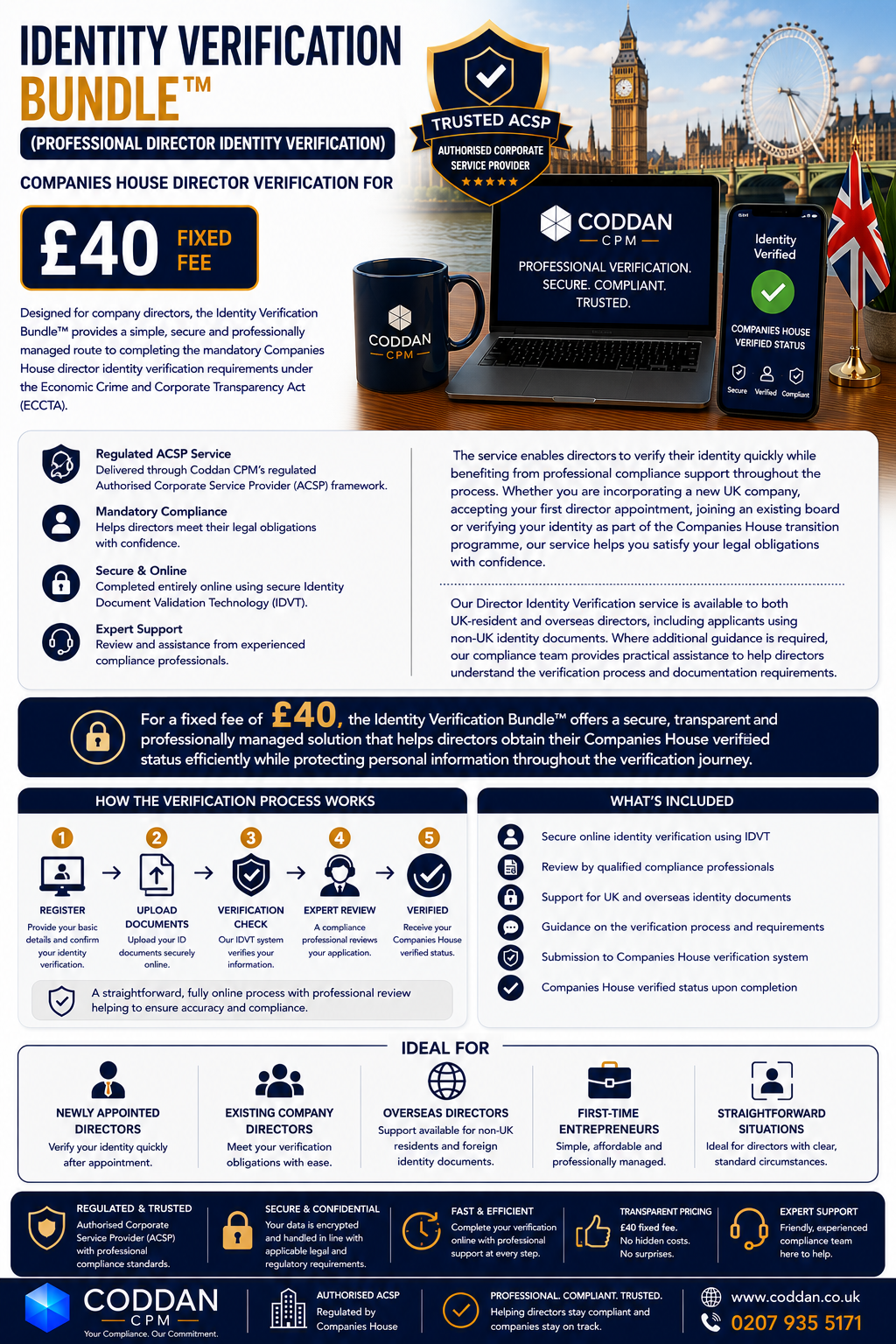
Buy Now Identity Verification Bundle™ (Professional Director Identity Verification) – Obtain Your Companies House Personal Code Through Remote Director Identity Verification for £40.
The Identity Verification Bundle™ provides a simple, secure and professionally managed solution for applicants who need to complete mandatory Companies House director identity verification and obtain their unique 11-character Companies House Personal Code without travelling to the United Kingdom. Delivered through Coddan CPM's regulated Authorised Corporate Service Provider (ACSP) framework, this service enables UK and overseas directors, international entrepreneurs and Persons with Significant Control (PSCs) to complete identity verification remotely while meeting the requirements introduced under the Economic Crime and Corporate Transparency Act (ECCTA) . Whether you are preparing to incorporate a UK company, accepting your first directorship, joining an existing company or completing identity verification during the Companies House transition period, this professionally managed service provides the first step towards establishing your verified corporate identity. Verification is completed using secure Identity Document Validation Technology (IDVT) , with every application supported by experienced compliance professionals who help ensure your submission is complete, accurate and compliant with Companies House requirements, enabling you to begin your long-term Companies House journey with confidence.

The service has been developed for both UK and international applicants, including directors using eligible non-UK identity documents and biometric passports. Once your identity has been successfully verified, you receive the Companies House Personal Code that becomes your permanent verified identifier throughout your corporate career. Where additional assistance is required, our compliance team provides practical guidance throughout the remote verification process, helping you understand the documentation requirements while reducing the likelihood of unnecessary delays. For a fixed fee of £40, the Identity Verification Bundle™ offers a secure, transparent and professionally managed route to obtaining your verified Companies House identity through a regulated ACSP. It is ideally suited to first-time directors, overseas entrepreneurs, non-UK resident directors, international investors and anyone seeking a trusted, professionally supported route to obtaining their Companies House Personal Code and building a strong foundation for long-term UK corporate compliance.


£65.00
+VAT

RapidVerify Pro™

Recommended for

2
package

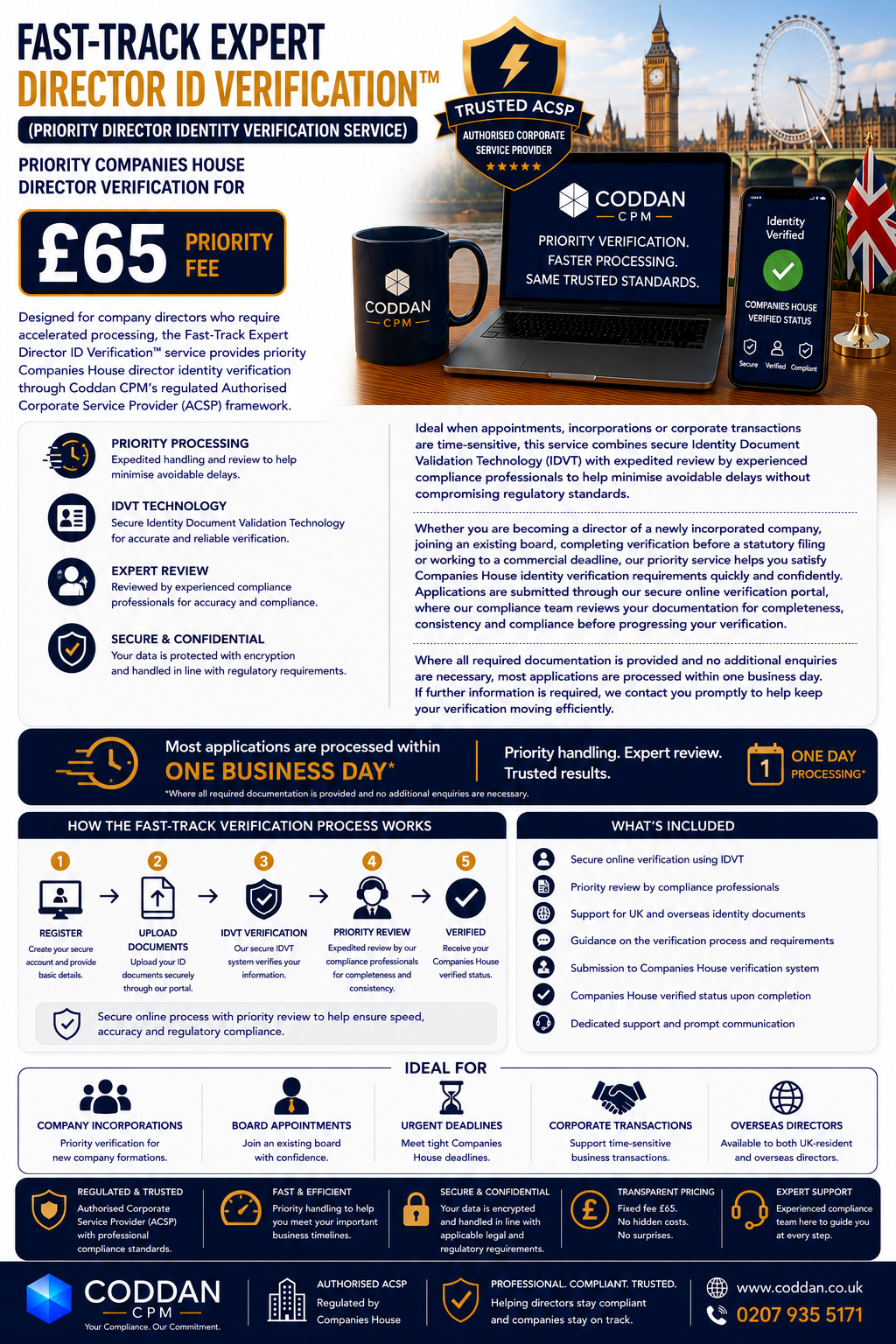
Buy Now Fast-Track Expert Director ID Verification™ (Priority Director Identity Verification Service) – Priority Remote Identity Verification to Obtain Your Companies House Personal Code for £65.
The Fast-Track Expert Director ID Verification™ service is designed for directors who require priority Companies House identity verification and rapid access to their 11-character Companies House Personal Code without compromising accuracy, security or regulatory compliance. Delivered through Coddan CPM's regulated Authorised Corporate Service Provider (ACSP) framework, this premium service combines secure Identity Document Validation Technology (IDVT) with priority review by experienced compliance professionals, enabling UK and overseas applicants to complete identity verification remotely and begin using their verified Companies House identity as quickly as possible. Ideal for urgent UK company incorporations, director appointments, corporate transactions and statutory filing deadlines, this service provides priority handling from the moment your application is received. Every submission is carefully reviewed to help ensure your documentation is complete, consistent and compliant before progressing through the verification process, reducing the likelihood of unnecessary delays and helping you obtain the Personal Code needed to support your future Companies House responsibilities. Where all required information is provided, and no additional enquiries are necessary, most applications are processed within one business day.

If additional documentation is required, our compliance team will contact you promptly to help keep your verification progressing efficiently. The service has been developed for UK and international directors, including applicants using eligible non-UK identity documents and biometric passports. Once your identity has been successfully verified, you receive the Companies House Personal Code that becomes your permanent verified identifier for future company formations, director appointments and ongoing Companies House compliance. For £65, the Fast-Track Expert Director ID Verification™ service provides a faster, professionally managed route to obtaining your verified Companies House identity through a regulated ACSP. It is ideally suited to entrepreneurs, non-UK resident directors, international investors and businesses working to urgent commercial or regulatory deadlines that require their Companies House Personal Code quickly, securely and with the reassurance of experienced ACSP compliance specialists—without travelling to the United Kingdom.


£125.00
+VAT

VerifyFlex Solutions™

Recommended for

3
package

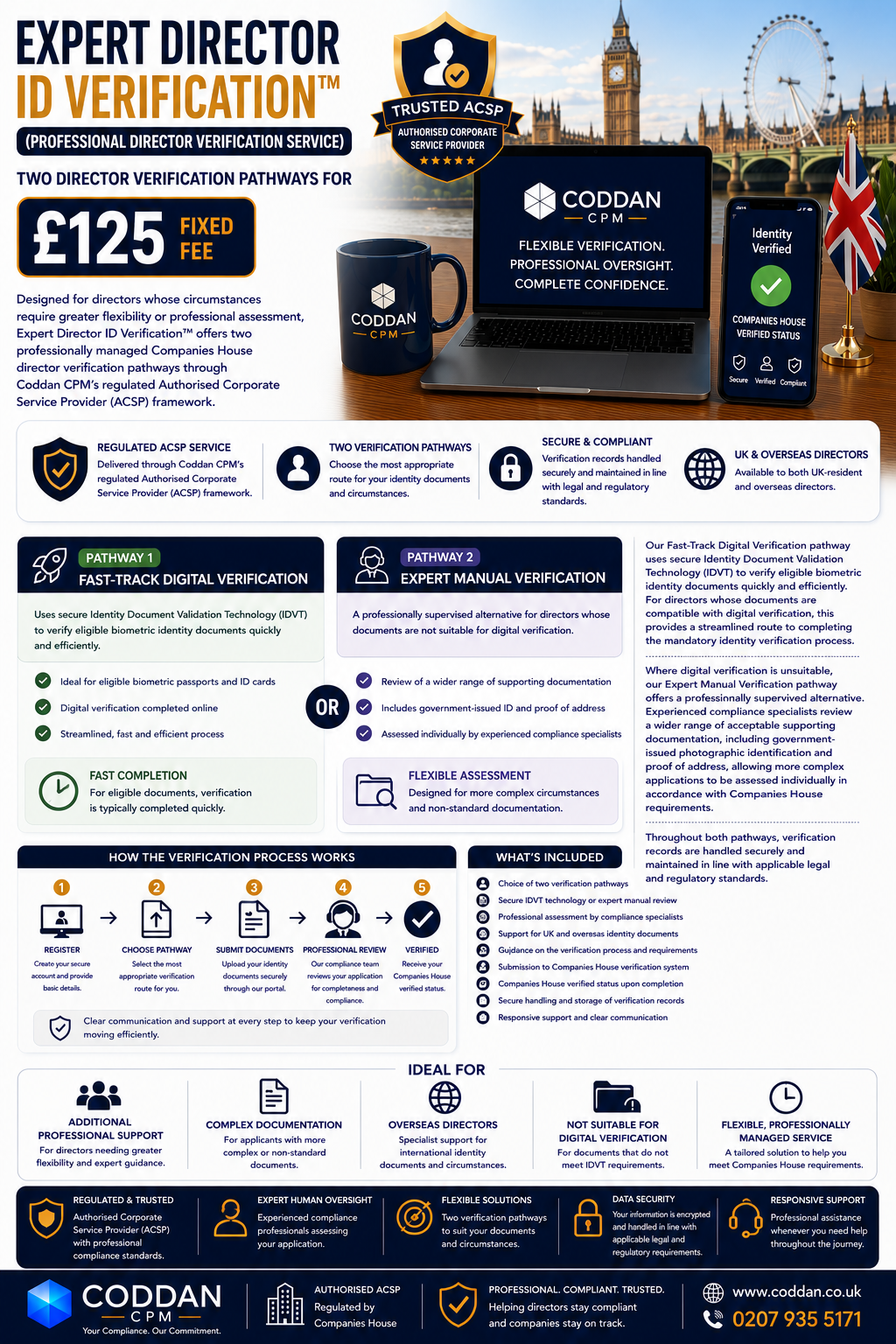
Buy Now Expert Director ID Verification™ (Professional Director Verification Service) – Two Remote Identity Verification Pathways to Obtain Your Companies House Personal Code for £125. The Expert Director ID Verification™ service is designed for directors, overseas entrepreneurs and international applicants who require greater flexibility when completing Companies House identity verification and obtaining their 11-character Companies House Personal Code. Delivered through Coddan CPM's regulated Authorised Corporate Service Provider (ACSP) framework, this professionally managed service offers two remote verification pathways, allowing applicants to choose the option that best matches their identity documents, country of residence and individual circumstances while meeting Companies House requirements. Our Fast-Track Digital Verification pathway uses secure Identity Document Validation Technology (IDVT) to verify eligible biometric identity documents quickly and efficiently. Where digital verification is not suitable, our Expert Manual Verification pathway provides a professionally supervised alternative, enabling experienced compliance specialists to review a broader range of acceptable identity documents and supporting evidence in accordance with applicable regulatory requirements. Both verification pathways have been developed to support UK and overseas applicants using eligible non-UK identity documents, biometric passports and other accepted forms of identification, helping them establish the verified identity that leads to the issue of their Companies House Personal Code.

Throughout the remote verification process, our compliance team provides practical guidance, carefully reviews every application and helps ensure all documentation satisfies Companies House requirements before identity verification is completed, reducing the likelihood of delays caused by incomplete or unsuitable submissions. We also help applicants determine which verification pathway is likely to be the most appropriate for their documentation before the process begins. For £125, the Expert Director ID Verification™ service combines advanced verification technology with experienced professional oversight, providing a flexible and reliable route to obtaining your verified Companies House identity through a regulated ACSP. It is ideally suited to overseas directors, non-UK resident applicants, individuals whose identity documents are unsuitable for straightforward digital verification and anyone seeking a trusted, professionally managed pathway to obtaining their Companies House Personal Code while building a secure foundation for future company formations, director appointments and long-term Companies House compliance.


£220.00
+VAT

FlexiVerify Option™

Recommended for

4
package

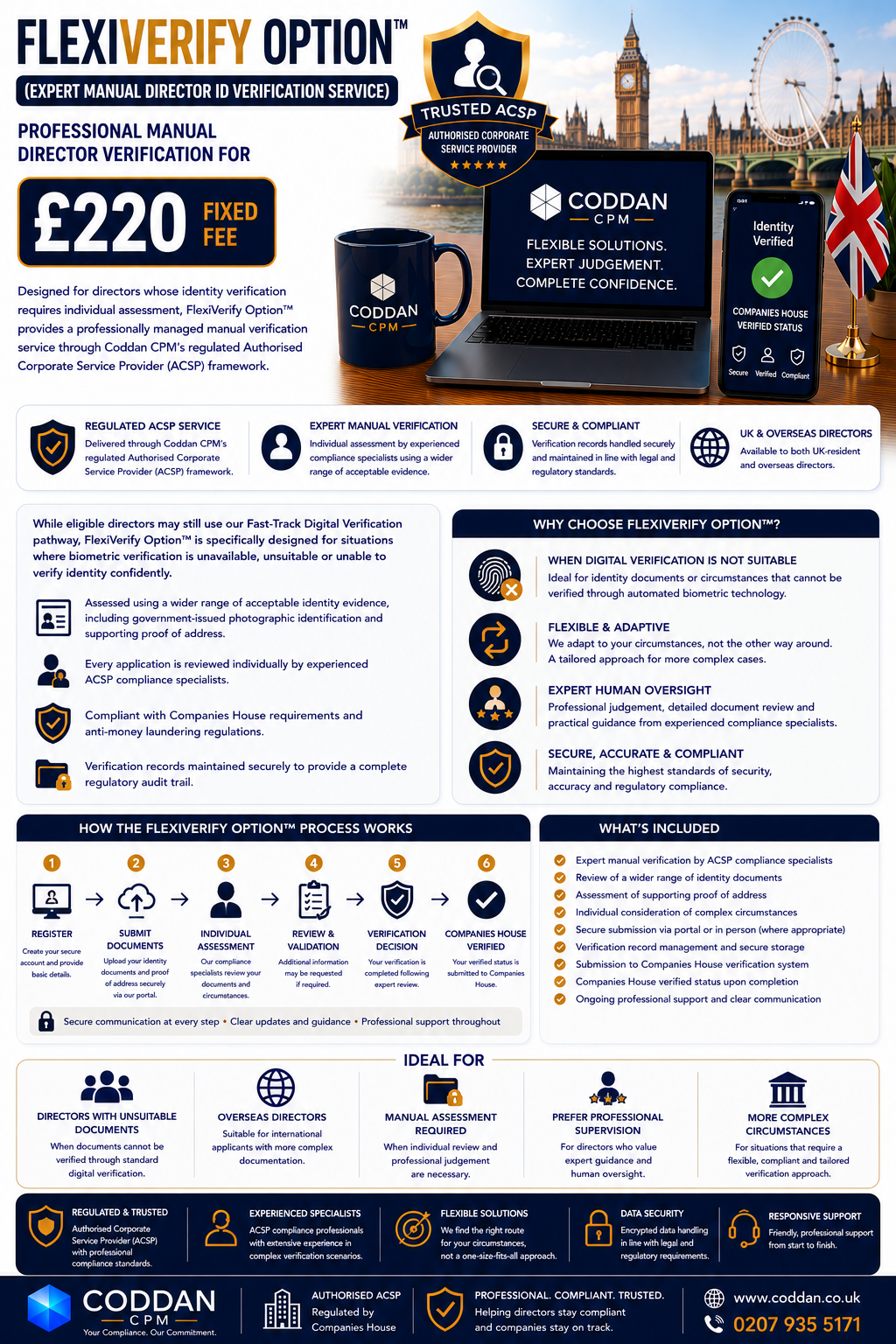
Buy Now FlexiVerify Option™ (Expert Manual Director ID Verification Service) – Professionally Managed Manual Identity Verification to Obtain Your Companies House Personal Code for £220.
The FlexiVerify Option™ is designed for directors whose Companies House identity verification requires individual assessment beyond standard digital verification in order to obtain their 11-character Companies House Personal Code. Delivered through Coddan CPM's regulated Authorised Corporate Service Provider (ACSP) framework, this professionally managed manual verification service provides a flexible and compliant solution for UK and overseas applicants whose circumstances are more complex or whose identity documents are unsuitable for automated verification. While eligible applicants may still use our Fast-Track Digital Verification pathway, FlexiVerify Option™ has been developed specifically for situations where biometric verification is unavailable, unsuitable or unable to verify identity with sufficient confidence. Rather than relying solely on automated technology, experienced compliance specialists assess every application individually, reviewing a broader range of acceptable identity evidence, including government-issued photographic identification, supporting proof of address and other documentation where appropriate, in accordance with applicable Companies House and anti-money laundering requirements. Applications are submitted securely through our online verification portal, with in-person verification available where appropriate, enabling even complex applicants to establish the verified identity that leads to the issue of their permanent Companies House Personal Code.

Every application receives an individual professional review, with comprehensive verification records maintained to support an appropriate regulatory audit trail and demonstrate compliance with applicable legal obligations. Where documentation requires additional clarification, our compliance professionals provide practical guidance throughout the verification process, helping applicants understand the most appropriate evidence for their individual circumstances while reducing unnecessary delays. For £220, FlexiVerify Option™ provides the highest level of professionally managed support for complex identity verification requirements and the secure establishment of your long-term Companies House identity through a regulated ACSP. It is ideally suited to directors requiring manual assessment, applicants using non-standard international identity documents, individuals with more complex verification circumstances and anyone seeking a fully supervised route to obtaining their Companies House Personal Code, providing a strong foundation for future director appointments, company formations and ongoing Companies House compliance throughout their corporate journey.


Understand What the Companies House Personal Code Is

What the code confirms—and what remains separate

If you have completed, or are completing, Companies House identity verification, the next important distinction is between identity verification and the Personal Code issued afterwards.

A Companies House Personal Code is an 11-character code given to an individual after successful identity verification. Companies House issues the code. It belongs to the verified individual, not to a company, employer, agent or professional adviser.

The same Personal Code is normally used whenever the individual needs to confirm that they are verified for an applicable appointment or role. Having more than one company or appointment does not, by itself, mean that identity verification must be repeated.

Current official guidance describes the Personal Code as personal to the individual and explains that it is issued after successful identity verification. Companies House personal codes for identity verification

Begin With Your Present Position

Verification is not complete

Your next job is identity verification itself. Use the appropriate Companies House route rather than treating the Personal Code as something that can be obtained separately.

Prepare for and complete identity verification

Verification was completed through GOV.UK One Login

Check your Companies House account and the email address used for the verification route to locate the Personal Code.

Verification was completed through an ACSP

Companies House sends the code to the email address supplied by the ACSP. If it is missing, first establish which email address was supplied.

The code has been received

You are at the understanding stage if you need to establish what the code means. Using it for a role is a separate step.

Continue to using your Personal Code

The code exists but cannot be connected

A Personal Code issue can be different from a director-role, PSC-role or Companies House record problem. Diagnose the remaining stage before taking another verification action.

Diagnose an unresolved verification or Personal Code issue

Another corporate event remains

Formation, appointment, Confirmation Statement, correction, restoration and other corporate events remain separate from simply receiving the Personal Code.

How Companies House Issues the Personal Code

The Personal Code follows successful identity verification. It is not a separate code that Coddan, another ACSP or the identity-checking technology creates.

Stage 1 — Identity verification

The applicable identity-verification route establishes that the individual has successfully met the Companies House identity-verification requirement.

Stage 2 — Companies House issues the code

Companies House issues the unique 11-character Personal Code to the verified individual.

Stage 3 — The individual receives or accesses it

Where and how you find the code depends on whether you verified through GOV.UK One Login or through an ACSP.

Important: receiving the Personal Code does not itself connect every role or complete a corporate filing. Those are separate processes.

Finding Your Code After GOV.UK One Login Verification

If you verified through GOV.UK One Login, current Companies House guidance says you can sign in to Companies House and open Manage account using the same email address used for verification.

  • If you verified after 8 July 2026, current guidance states that the Personal Code was also sent by email.
  • If you completed the GOV.UK One Login route at a Post Office, that is part of the same GOV.UK One Login verification route rather than a separate Companies House verification regime.
  • After a successful Post Office identity check, current guidance explains that you can access the Personal Code through your Companies House account.
  • The code should not be confused with your GOV.UK One Login credentials.

See the current Companies House Personal Code guidance if you need the official route-specific instructions.

Finding Your Code After Verification Through an ACSP

If an Authorised Corporate Service Provider verified your identity, Companies House sends your Personal Code to the email address supplied by the ACSP. The ACSP does not issue the code itself.

Code not received?

Check with the ACSP which email address was supplied for you before deciding that the verification itself needs to be repeated.

Incorrect information supplied?

The ACSP may need to contact Companies House through the appropriate process where incorrect information was supplied.

Want account access?

Current guidance explains that an ACSP-verified individual can save the Personal Code to a Companies House account and then access it through Manage account.

Coddan cannot manufacture the Personal Code, force Companies House to issue it or retrieve it from Companies House on demand.

The Code Belongs to the Verified Individual — Not the Company

Your Personal Code identifies you as the verified individual. It is not a company credential and does not transfer to another person when you change companies, leave an appointment or take on a different corporate role.

“Director's Digital Passport” is only a metaphor. It is not the official legal name of the code, a passport, a government identity document, a general GOV.UK credential, a company-owned credential, a general filing credential or evidence that every Companies House obligation has been completed.

The Personal Code also does not automatically connect itself to every company with which you are associated. The applicable role or corporate process must still be addressed through the appropriate Companies House route.

One Personal Code Across More Than One Company or Appointment

One verified individual

The Personal Code remains personal to the individual rather than becoming a separate code for each company.

Several appointments

The same Personal Code can be used where the individual needs to confirm that they are verified for an applicable appointment or role.

No automatic universal linkage

Possessing the code does not automatically complete the separate role or filing requirements for every company.

Director, PSC and Equivalent-Role Responsibilities Remain Separate

A person can hold more than one Companies House role. The Personal Code remains the same individual code, but the requirements applying to each role remain distinct.

Director

A verified director must address the applicable process for connecting their verified identity to the director record.

PSC

A PSC has a separate identity-verification and role-connection requirement. Holding both roles does not ordinarily mean repeating identity verification merely because there are two roles.

Equivalent roles

Official guidance also refers to a director or equivalent. The applicable legal role should be established before assuming that a particular partnership or entity position follows the director process.

Detailed instructions about using the Personal Code for a particular role belong to the appropriate role-linkage or corporate-event destination rather than this understanding page.

If the Code or Personal Details Do Not Match Companies House Records

A missing or apparently unusable Personal Code does not automatically mean that identity verification has failed or must be repeated. First identify which part of the record is actually inconsistent.

  • Incorrect Personal Code: check that the code has been entered exactly as issued.
  • Date of birth or other personal-data inconsistency: this may be a Companies House record issue rather than a new verification requirement.
  • Incorrect ACSP information: where an ACSP supplied incorrect information, the appropriate correction route may involve that ACSP.
  • Code-access problem: establish whether the issue concerns the Companies House account or the email route used to receive the code.
  • Director-role linkage: a verified identity and an associated director record are separate stages.
  • PSC-role linkage: PSC requirements are separate from the director requirement.
  • Separate filing problem: a corporate filing problem should not automatically be treated as an identity-verification problem.

Where the remaining job is diagnosis or correction of an identity-verification issue, use the appropriate failed-verification and reconciliation destination rather than repeating this page's general explanation.

If the Code Is Missing, Inaccessible, Shared or Compromised

Missing or inaccessible

Check the route used, the relevant email address and your Companies House account before assuming another verification is required.

Shared

The code should be kept secure, but it may be shared with a trusted person who legitimately needs it to file on your behalf.

Compromised

Companies House can change a Personal Code where it has been shared or compromised. That is a code-management issue, not an instruction to repeat identity verification automatically.

Detailed protection, replacement, access and continuing-administration instructions belong to the separate Personal Code management destination.

Identity Verification and Possession of the Code Are Not Role Linkage

There are several distinct stages between establishing who you are and completing a corporate role or event. They should not be collapsed into one “verification” step.

1. Identity verification

The individual completes the applicable identity-verification process.

2. Code issue

Companies House issues the Personal Code.

3. Code receipt

The individual receives or accesses the code.

4. Role connection

The code is provided for the applicable director, PSC or equivalent role.

5. Corporate event

Any appointment, filing, correction or other corporate event is dealt with separately.

Personal Code Use and Corporate Events Remain Separate

Receiving your Personal Code does not itself:

  • appoint you as a director;
  • connect you to a director role;
  • complete a separate PSC-role requirement;
  • incorporate a company or LLP;
  • update director particulars;
  • complete a Confirmation Statement;
  • restore a company or LLP;
  • complete an outstanding filing;
  • correct inconsistent Companies House records; or
  • satisfy separate AML, KYC or CDD obligations.

The detailed instructions for using the Personal Code belong to the separate Personal Code use destination. This page remains focused on understanding and receiving the code.

Distinguish Current Requirements from Later Implementation Phases

Identity-verification requirements depend on the person's role and when that role became subject to the applicable requirements. The Personal Code should therefore not be presented as a universal present-day presenter credential for every person who may interact with Companies House.

Current role questions

Directors, equivalent roles and PSCs must be considered according to the current Companies House requirements applicable to their circumstances.

Later implementation

Requirements for people who file on behalf of a company and certain other categories are subject to later implementation. They should not be presented as a universal current requirement without current official confirmation.

No universal November 2026 deadline

18 November 2025 marked the commencement of the phased rollout; it is not a universal deadline by which every Participant must have completed every applicable requirement.

Current official timing depends on the person's role and when they started that role. Later-phase categories should be treated separately from current director and PSC requirements.

Choose the Destination Matching the Next Professional Job

The correct next step depends on what remains unresolved. Support being available does not mean support is required.

Identity verification remains outstanding

Use the official free route where you meet its requirements.

Verify your identity for Companies House

You need to understand or provide the code

Continue to the separate Personal Code use destination for detailed instructions about when and how the code is provided.

Use your Companies House Personal Code

The code or records do not reconcile

Use the failed-verification or post-verification reconciliation destination when diagnosis or correction is the remaining professional job.

Resolve an identity-verification or Personal Code issue

A corporate event remains

Appointment, Confirmation Statement, director-details correction, formation, restoration and other company events have their own destinations and procedures.

Becoming or appointing a director
Confirmation Statement and director verification
Check the relevant entity and legal role

When Nothing Further Required May Apply

Nothing Further Required can be the correct outcome where the applicable identity-verification process has been completed, Companies House has issued the Personal Code, the code has been received or accessed, and any applicable role or corporate-event requirement has also been dealt with.

A completed identity-verification stage does not create additional work by itself

Do not repeat identity verification simply because you have another company or role unless Companies House requires it. Equally, do not assume that possession of the Personal Code completes a separate role linkage, filing or corporate event.

If nothing remains under the applicable Companies House requirements, the appropriate next step may simply be to retain the Personal Code securely and address any future requirement when it becomes applicable.

Official Companies House guidance checked: 13 September 2026.

If Coddan-supported verification is relevant to an outstanding identity-verification stage, it remains an optional ACSP route. Technology performs the applicable identity and document checks; Coddan reviews the resulting information and determines whether it is satisfied that the required Companies House standard has been met. Following a successful outcome, Coddan performs its applicable notification responsibility. Coddan cannot direct the technology's result, lower the Companies House standard or require Companies House to issue a Personal Code.

This page concerns Companies House identity verification and the Personal Code. Separate anti-money-laundering (AML), know-your-customer (KYC) and customer-due-diligence (CDD) obligations remain separate professional matters.