We use cookies on this website, you can read about cookies and GDPR Privacy Policy here
Coddan CPM Ltd. – Company Registration Agent in the UK

Follow these six stages to prepare your Companies House identity verification before filing your Confirmation Statement and maintaining your company's annual compliance.

Step 1
Review Filing Duties
Step 2
Confirm Verification Status
Step 3
Prepare Identity Documents
Step 4
Select Verification Route
Step 5
Submit Confirmation Statement
Step 6
Maintain Annual Compliance
Companies Registry's e-Services Portal Identity Verification Director ID Verification Filing the Confirmation Statement: Verification of Director Identification (Director ID)

Filing the Confirmation Statement: Verification of Director Identification (Director ID)


Secure Your Success: Unlocking the Essentials of Director Verification in the UK

For companies already incorporated and registered with Companies House, director identity verification is no longer optional. As a London-based Authorised Corporate Service Provider, Coddan supports existing UK companies through the full verification process — confirming director identities securely, whether your board is based in London or spread across multiple locations.

Start the Fast ID Check Takes minutes | Official ACSP Gateway

Simplify your annual compliance with our guide on the Confirmation Statement. Get insights on Director ID verification and the new filing framework

Filing the Confirmation Statement: Director ID Verification and the New Annual Compliance Framework
For many years, filing a Companies House Confirmation Statement was a relatively straightforward annual exercise. Directors reviewed the company's statutory information, confirmed that it remained accurate and submitted the filing before the statutory deadline. For businesses incorporated before the introduction of mandatory identity verification, this process became a familiar part of the annual compliance calendar and rarely extended beyond confirming director details, shareholder information and other corporate records.
Understanding Identity Verification Under the ECCTA: Enhancing Compliance Through Comprehensive Preparation
The introduction of the Economic Crime and Corporate Transparency Act (ECCTA) has fundamentally changed that approach. Identity verification has become an integral part of the wider Companies House compliance framework, meaning that annual Confirmation Statements are now closely connected with verified directors, verified Persons with Significant Control (PSCs) and the management of each individual's permanent 11-character Companies House Personal Code. Although many companies continue to file the same statutory document each year, the preparation required before submission has become significantly more comprehensive than under the previous system.
From Compliance to Governance: Integrating Identity Verification into Your Company's Annual Filing Strategy
This knowledge centre has been created to help directors understand how the annual Confirmation Statement process has evolved. Rather than simply explaining filing deadlines, the articles examine the practical relationship between identity verification and annual compliance. They explore how existing companies transition from the old filing model to the new identity verification framework, how historical Companies House records should be reviewed after successful verification, the importance of preparing well before the statutory filing window opens, and how businesses can integrate identity verification into their wider governance procedures. The guidance also explains why many long-established companies are now choosing professional support, not because they are unable to submit a Confirmation Statement themselves, but because the wider compliance environment has become more sophisticated and places greater emphasis on data accuracy, verified identities and proactive governance.
Building a Strong Compliance Framework: Essential Services for Entrepreneurs and SMEs
Since 2005, Coddan CPM has supported entrepreneurs, SMEs, overseas investors and established companies with company secretarial services and long-term Companies House compliance. As an Authorised Corporate Service Provider (ACSP) and regulated Trust and Company Service Provider (TCSP), we help businesses registered in England and Wales, Scotland and Northern Ireland integrate director identity verification with annual Confirmation Statement preparation, statutory record reviews and ongoing corporate administration. Our objective is not simply to assist with one annual filing, but to help companies build an efficient compliance framework that supports accurate Companies House records, stronger corporate governance and confident business growth in the years ahead.
Already Have a UK Company? You Can Use This Service Independently
If you only need assistance with Companies House identity verification for your Confirmation Statement, you're welcome to use this service on its own. There is no requirement to transfer your company to Coddan, change your accountant, replace your solicitor or move any of your existing company services in order to receive professional identity verification support.
Many of our clients already have established UK companies that were incorporated directly with Companies House or through another formation agent. Others continue to work with their own accountants, bookkeepers, company secretaries or legal advisers and simply require assistance with a specific Companies House compliance obligation. Our role is to help you complete the identity verification requirement accurately and in accordance with the current Companies House framework, while allowing you to continue working with your existing professional advisers.
Whether your Confirmation Statement is due soon or you simply want to ensure your identity verification is completed correctly before your next filing, professional guidance is available without any obligation to purchase additional services. The verification packages below are designed to help you choose the level of support that best matches your circumstances and annual Companies House compliance requirements.
Annual Compliance Integration

Filing Your Confirmation Statement? ID Verification is Now Mandatory

Under ECCTA rules, every director and PSC must provide their 11-character personal verification code before submitting their company's next annual confirmation statement. Select your filing path below.

Best Value
ID Check + Filing (£105)
Complete your director identity verification and file your confirmation statement together seamlessly.
Get Personal Code (£40)
Already filing yourself? Secure your mandatory 11-character code via our ACSP gateway first.
Check Your Deadline
Understand the 14-day compliance window following your company's anniversary date.
Overseas Directors
Specialized remote verification solutions for international directors with foreign passports.
Official ACSP Framework Direct sync with Companies House filings.
Strict AML Adherence Compliant anti-money laundering checks.
UK GDPR Compliant Secure, encrypted local data handling.

Start Your Business Today: Fast Formation Services to Meet All Compliance Standards

Ensure compliance with Companies House through rapid, secure ID verification for Directors and PSCs. Complete the process online with an authorized ACSP

treamline your compliance with Companies House using our fast, secure ID verification for Directors and PSCs, all completed online by an authorized ACSP
£40.00
+VAT

IdentityGuard Pro™

Recommended for

1
package

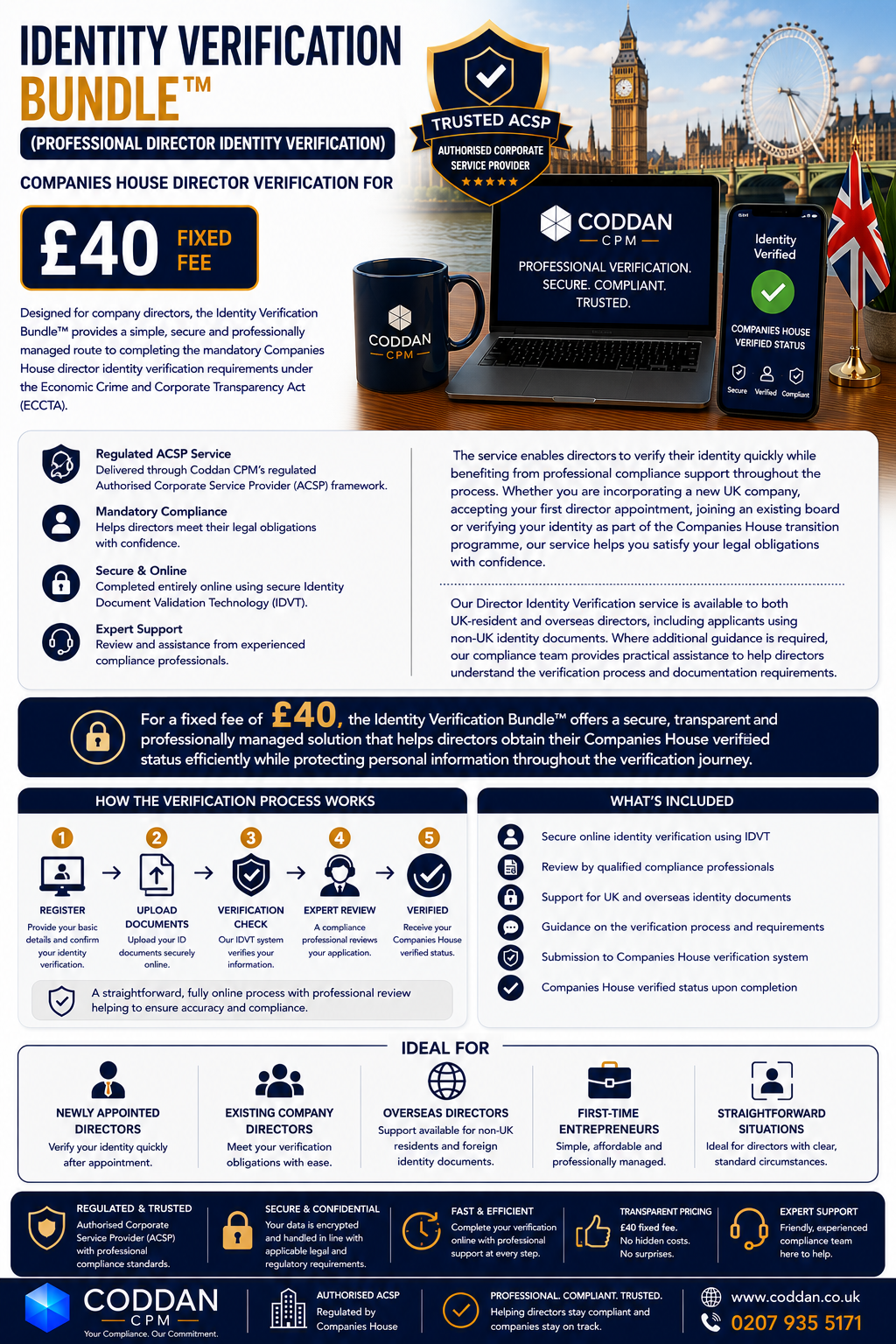
Buy Now Identity Verification Bundle™ (Professional Director Identity Verification) – Companies House Director Identity Verification for £40.
The Identity Verification Bundle™ provides a fast, secure and professionally managed solution for company directors and other individuals who need to complete mandatory Companies House director identity verification in connection with filing a Confirmation Statement. Delivered through Coddan CPM's regulated Authorised Corporate Service Provider (ACSP) framework, this managed service helps applicants satisfy the identity verification requirements introduced under the Economic Crime and Corporate Transparency Act (ECCTA) while supporting accurate Companies House records and ongoing annual compliance. Whether you are preparing to file your company's Confirmation Statement, verifying your identity during the Companies House transition period, updating company information before submission or ensuring your company remains compliant with current filing requirements, our service offers a straightforward route to obtaining or maintaining verified director status where required. Verification is completed entirely online using secure Identity Document Validation Technology (IDVT), with every application supported by experienced compliance professionals who help ensure your identity verification is completed accurately and in accordance with Companies House requirements.

The service is available to both UK-based and overseas directors, including individuals using eligible non-UK identity documents. Where additional assistance is required, our compliance team provides practical guidance throughout the verification process, helping you understand the documentation requirements before filing your Confirmation Statement and reducing the likelihood of unnecessary delays or rejected submissions. For a fixed fee of £40, the Identity Verification Bundle™ offers a secure, transparent and professionally managed route to obtaining or maintaining verified Companies House status through a regulated ACSP. It is ideally suited to directors preparing to file a Confirmation Statement, existing company officers, overseas applicants and anyone seeking trusted professional support with Companies House director identity verification. Complete your verification with confidence and help ensure your Confirmation Statement is supported by accurate, compliant and professionally managed identity verification from start to finish. Ideal for the vast majority of straightforward applicants.


£65.00
+VAT

RapidVerify Pro™

Recommended for

2
package

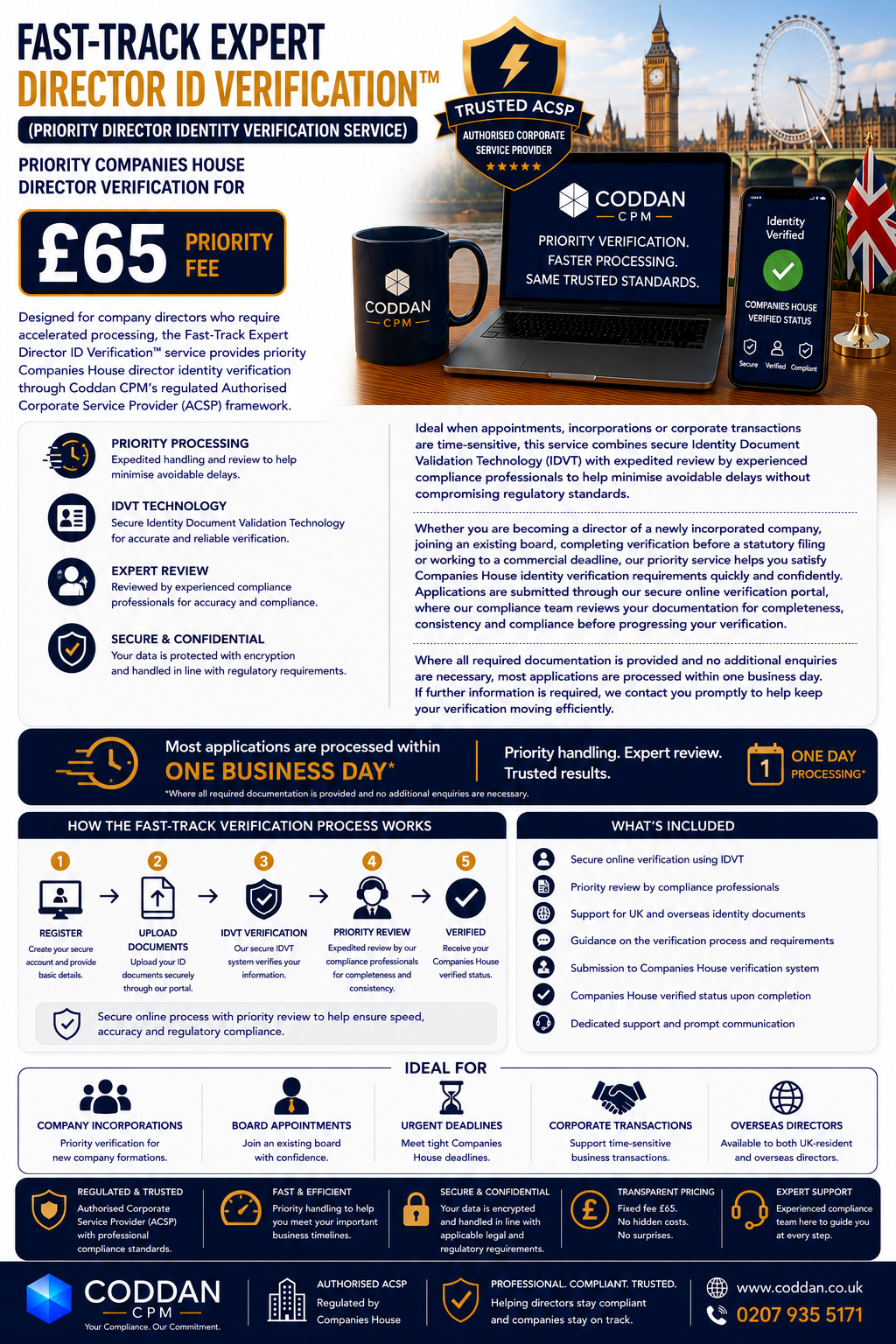
Buy Now Fast-Track Expert Director ID Verification™ (Priority Director Identity Verification Service) – Priority Companies House Director Identity Verification for £65.
The Fast-Track Expert Director ID Verification™ service is designed for company directors and other individuals who require priority Companies House director identity verification without compromising accuracy or compliance when preparing to file a Confirmation Statement. Delivered through Coddan CPM's regulated Authorised Corporate Service Provider (ACSP) framework, this premium managed service combines secure Identity Document Validation Technology (IDVT) with expedited review by experienced compliance professionals to help you complete the verification process as quickly as possible before your Confirmation Statement filing deadline. Ideal for urgent Confirmation Statement submissions, Companies House filing deadlines, corporate transactions, annual compliance obligations and applicants who simply require accelerated identity verification support, this service provides priority handling from the moment your application is received. Every submission is carefully reviewed to help ensure your documentation is complete, consistent and compliant before progressing through the identity verification process, reducing the likelihood of unnecessary delays. Where all required information is provided and no additional enquiries are needed, most applications are processed within one business day.

If further documentation is required, our compliance team contacts you promptly to help keep your verification progressing efficiently. The service is available to both UK-based and overseas directors, including individuals using eligible non-UK identity documents. For £65, the Fast-Track Expert Director ID Verification™ service provides a faster, professionally managed route to obtaining or maintaining verified Companies House status while helping you meet your Confirmation Statement filing obligations. It is ideally suited to existing company directors, newly appointed directors, overseas applicants, company officers approaching statutory filing deadlines and businesses working to urgent commercial or regulatory timescales, as well as anyone requiring priority Companies House identity verification support. Complete your Companies House director identity verification quickly, securely and with the confidence of experienced ACSP professionals supporting your annual compliance from start to finish.


£125.00
+VAT

VerifyFlex Solutions™

Recommended for

3
package

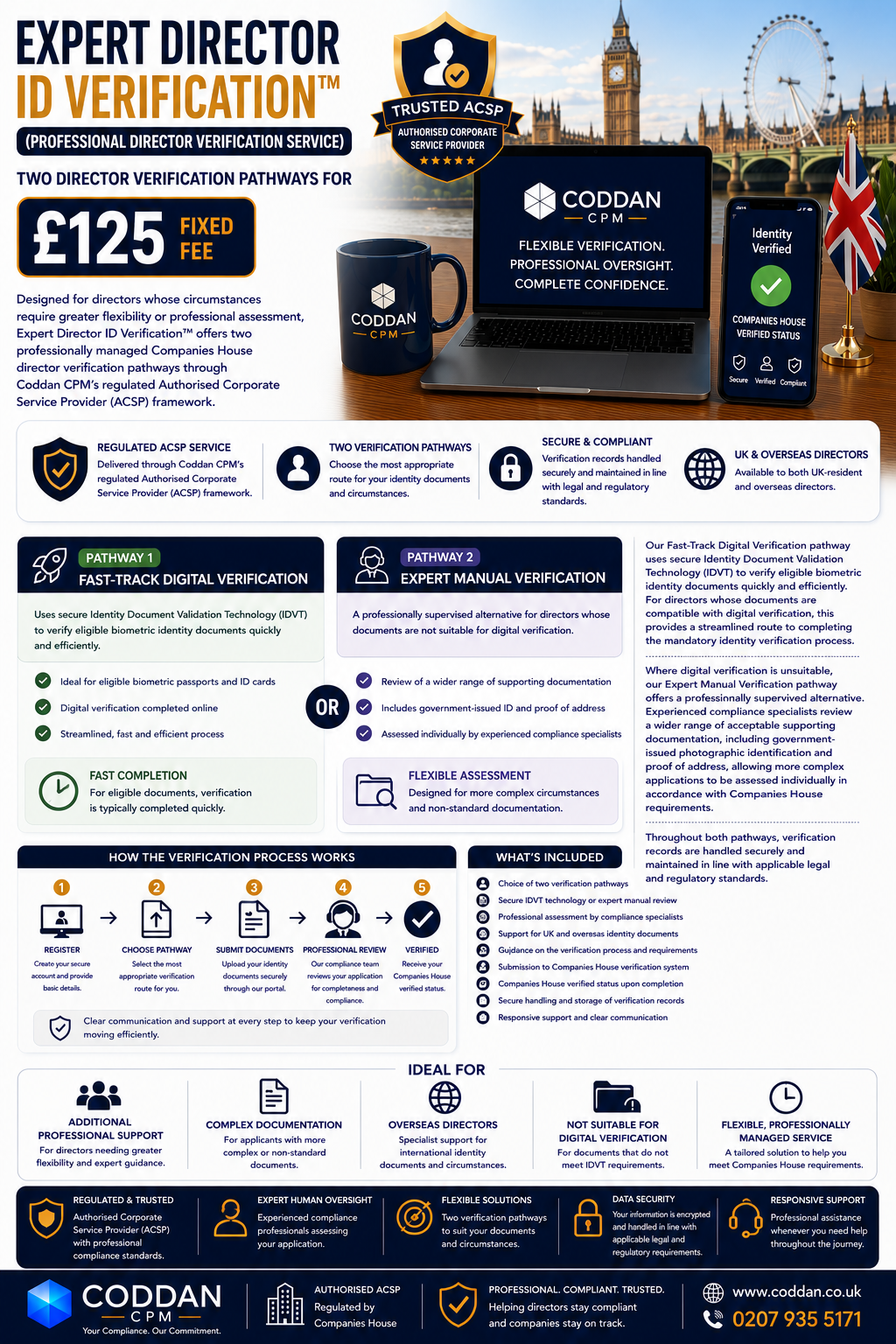
Buy Now Expert Director ID Verification™ (Professional Director Verification Service) – Two Companies House Director Identity Verification Pathways for £125.
The Expert Director ID Verification™ service is designed for company directors and other individuals who require greater flexibility when completing Companies House director identity verification in connection with filing a Confirmation Statement. Delivered through Coddan CPM's regulated Authorised Corporate Service Provider (ACSP) framework, this professionally managed service offers two verification pathways, allowing applicants to choose the option that best matches their identity documents and individual circumstances while satisfying Companies House requirements before submitting their Confirmation Statement. Our Fast-Track Digital Verification pathway uses secure Identity Document Validation Technology (IDVT) to verify eligible biometric identity documents quickly and efficiently. Where digital verification is not suitable, our Expert Manual Verification pathway provides a professionally supervised alternative, enabling experienced compliance specialists to review a broader range of acceptable identity documents and supporting evidence in accordance with applicable regulatory requirements. Both verification pathways are available to UK-based and overseas directors, including individuals using eligible non-UK identity documents.

Throughout the verification process, our compliance team provides practical guidance, carefully reviews every application and helps ensure all documentation satisfies Companies House requirements before your identity verification and Confirmation Statement obligations are completed, reducing the likelihood of delays caused by incomplete or unsuitable submissions. For £125, Expert Director ID Verification™ combines advanced verification technology with experienced professional oversight, providing a flexible and reliable managed solution for more complex verification circumstances. It is ideally suited to overseas directors, applicants whose identity documents are unsuitable for standard digital verification, existing company officers preparing their annual Confirmation Statement, newly appointed directors and anyone seeking experienced assistance with Companies House director identity verification through a trusted regulated ACSP. Complete your identity verification with confidence, supported by experienced compliance professionals who help guide you through the most appropriate verification pathway from start to finish.


£220.00
+VAT

FlexiVerify Option™

Recommended for

4
package

Buy Now FlexiVerify Option™ (Expert Manual Director ID Verification Service) – Professional Manual Companies House Director Identity Verification for £220.
The FlexiVerify Option™ is designed for company directors and other individuals whose Companies House director identity verification requires individual assessment beyond standard digital verification when preparing to file a Confirmation Statement. Delivered through Coddan CPM's regulated Authorised Corporate Service Provider (ACSP) framework, this professionally managed manual verification service provides a flexible and compliant route for applicants whose circumstances are more complex or whose identity documents are unsuitable for automated verification before meeting their annual Companies House filing obligations. While eligible applicants may still use our Fast-Track Digital Verification pathway, FlexiVerify Option™ is specifically intended for situations where biometric verification is unavailable, unsuitable or unable to verify identity with sufficient confidence. Instead of relying solely on automated technology, experienced compliance specialists assess each application individually, reviewing a wider range of acceptable identity evidence, including government-issued photographic identification and supporting proof of address, in accordance with Companies House and anti-money laundering requirements. Applications can be submitted securely through our online verification portal or, where appropriate, completed in person.

Every application receives an individual review, with comprehensive verification records maintained to provide a secure regulatory audit trail and demonstrate compliance with applicable legal obligations. For £220, FlexiVerify Option™ offers the highest level of professionally managed support for complex director identity verification requirements. It is ideally suited to UK-based and overseas directors requiring manual assessment, individuals with non-standard identity documentation, company officers preparing to file a Confirmation Statement, and applicants seeking a fully supervised Companies House identity verification service supported by experienced ACSP compliance specialists and expert regulatory guidance throughout the verification process. Complete your Companies House identity verification with confidence, knowing your application is individually assessed and professionally managed to help support accurate, compliant and fully documented Confirmation Statement filing outcomes.


Ongoing Corporate Maintenance

Managing an Established Company? Understanding Your Active Obligations

Directors and company secretaries running active enterprises often look at filing cycles with specific questions:

  • Do sitting board members need to take retroactive action?
  • How do statutory updates affect upcoming annual returns?
  • What happens if organizational profiles require synchronization?

Compliance updates roll out across corporate registry platforms to safeguard business transparency. Existing entities must align their administrative habits with these modern standards.

Uncertainty around filing triggers can cause unnecessary stress. Knowing your timeline helps prevent last-minute administrative blockages.

Coddan assists active management boards in clarifying corporate obligations, mapping out exact timelines, and maintaining smooth administrative operations year-round.

Review your active corporate position calmly before filing your next statement.


Why Trust Coddan for Your Director ID Verification?

As a registered Authorised Corporate Service Provider, Coddan delivers director identity verification for Companies House entirely remotely — no need to visit London in person. The service includes electronic address checks and supports a wide range of international documents, with verification available from £40.

Need Help Deciding?

Every company's compliance position is slightly different, and the most appropriate identity verification route will depend on your individual circumstances. Factors such as where you are based, the identity documents you hold, whether your verification has already started, your Confirmation Statement filing timetable and the level of professional assistance you would like can all influence which option is most suitable.

If you're uncertain after reviewing the available packages, you're welcome to speak with one of our compliance advisers before making a decision. We'll be happy to answer your questions, explain how each verification pathway works, discuss any documentation requirements and help you understand which level of support is likely to be the most appropriate for your particular situation. Our aim is to help you complete your Companies House identity verification and Confirmation Statement obligations confidently and with a clear understanding of the process.

No obligation to purchase — just practical, expert guidance. Speak With a Compliance Adviser

Master the new requirements for your Confirmation Statement under the ECCTA. Our guide covers identity verification and compliance for UK companies

Preparing Your Confirmation Statement Under the New Companies House Identity Verification Rules
The annual Confirmation Statement remains one of the most important statutory obligations for every UK company, but the way businesses prepare for this filing has changed significantly following the introduction of the Economic Crime and Corporate Transparency Act (ECCTA). What was once primarily an exercise in confirming company information has evolved into a broader annual compliance review that now includes director identity verification, the management of 11-character Companies House Personal Codes, accurate statutory records and stronger corporate governance.
Navigating the New Compliance Framework: A Comprehensive Guide for Newly Incorporated Businesses and Established Companies
The articles in this guidance centre explain how these reforms affect both newly incorporated businesses and companies that have been filing Confirmation Statements for many years. They examine the relationship between identity verification and annual filings, explain the transition from the previous Companies House filing process to the new compliance framework, explore what happens when verified identity information does not match historical company records, and provide practical guidance on planning ahead of the statutory filing deadline. They also demonstrate why many directors now treat the Confirmation Statement as an annual governance audit rather than simply another filing requirement, reviewing directors, Persons with Significant Control (PSCs), statutory registers and company records together to ensure everything remains accurate before submission.
Enhancing Corporate Governance: Adapting Your Filing Procedures to Recent Companies House Reforms
Whether you are preparing your first Confirmation Statement under the new identity verification regime or adapting long-established filing procedures to reflect the latest Companies House reforms, understanding these changes is essential. By integrating identity verification into your annual compliance programme, reviewing company records well before the filing window opens and maintaining consistent corporate information throughout the year, businesses can reduce administrative delays, strengthen governance and approach every Confirmation Statement with greater confidence.
Annual Compliance Integration

Filing Your Confirmation Statement? ID Verification Is Now Mandatory

Under ECCTA regulations, every UK director and PSC must link their 11-character personal verification code before submitting an annual confirmation statement. Choose your fast-track compliance route below.

Official ACSP Framework Direct synchronization with Companies House registries.
Strict AML Adherence Fully compliant anti-money laundering verification checks.
UK GDPR Compliant Secure, encrypted data protection and privacy handling.


Filing the Confirmation Statement: Why Director ID Verification Now Matters Before Your Annual Companies House Filing

For many years, the Confirmation Statement has served as one of the most important annual compliance obligations for UK companies. It enables businesses to confirm that key information held by Companies House remains accurate, including details relating to directors, registered offices, shareholders, share capital and Persons with Significant Control (PSCs).

The introduction of the Economic Crime and Corporate Transparency Act (ECCTA) has significantly expanded the compliance framework surrounding this annual filing. One of the most important changes is the introduction of mandatory identity verification for individuals who manage or control UK companies.

Identity verification is no longer simply a separate administrative exercise. It has become an integral part of the wider Companies House compliance process, creating a direct relationship between verified identities and the successful submission of future statutory filings.

Understanding this relationship is essential for every company preparing its annual Confirmation Statement.

The Confirmation Statement Is More Than an Annual Filing
Many businesses think of the Confirmation Statement as a routine annual form.

In reality, it serves a much broader purpose.

The Confirmation Statement provides Companies House with confirmation that the company's statutory information remains accurate at a particular point in time.

During this annual review, businesses typically confirm information relating to:

  • directors;
  • registered office address;
  • Persons with Significant Control (PSCs);
  • shareholder information;
  • share capital where applicable;
  • Standard Industrial Classification (SIC) codes;
  • statutory registers.

The filing therefore represents an important governance milestone rather than simply an administrative deadline.

ECCTA Has Changed the Annual Compliance Landscape
The Economic Crime and Corporate Transparency Act (ECCTA) introduced a series of reforms designed to improve the reliability of the Companies House register.

A central objective of these reforms is ensuring that the individuals responsible for managing and controlling UK companies can be connected to a verified identity.

As a result, identity verification has become an essential element of modern corporate administration.

Rather than existing independently from annual filing obligations, verified identity now supports the wider integrity of information submitted to Companies House throughout a company's lifecycle.

Identity Verification Is Now Linked to Confirmation Statement Compliance
One of the most significant practical changes introduced by the new framework is the relationship between identity verification and the Confirmation Statement.

Under the Companies House identity verification regime introduced through ECCTA, individuals who are required to verify their identity must do so before the relevant statutory filing requirements can be satisfied.

For many companies, this means that preparation for the annual Confirmation Statement should include reviewing whether the relevant directors and Persons with Significant Control have completed identity verification where required under the legislation.

Treating identity verification as part of the annual compliance review helps reduce the risk of last-minute administrative complications.

Secure Your Success: Unlocking the Essentials of Director Verification in the UK

For companies already incorporated and registered with Companies House, director identity verification is no longer optional when filing your annual confirmation statement. As a London-based Authorised Corporate Service Provider, Coddan supports existing UK companies through the full verification process — confirming director identities securely, whether your board is based in London or spread across multiple locations.

Start the Fast ID Check Takes minutes | Official ACSP Gateway

The One-Time Identity Verification Principle
One aspect of the new framework that often causes confusion is how frequently identity verification must be completed.

For most individuals, identity verification is not intended to become an annual requirement.

Instead, once an eligible director or Person with Significant Control successfully completes identity verification, Companies House issues a unique 11-character Personal Code linked to that individual's verified identity.

This creates a permanent identity reference that supports future interactions with Companies House.

The emphasis therefore shifts from repeating identity verification each year to ensuring that the verified identity remains properly connected with the individual's statutory appointments and Companies House records.

Facing a Confirmation Statement Block?

Under current UK regulations, your annual confirmation statement will be rejected or blocked if a director or Person with Significant Control (PSC) hasn't linked their unique personal verification code. If you are searching in a panic because standard government tools or the GOV.UK One Login process have stalled, you don't have to navigate it alone.

Coddan provides a straightforward, authorised alternative path to clear this compliance blocker quickly—handling complex documents, international directors, and remote identity validation seamlessly.

Authorized ACSP Alternative | Fast Resolution for Blocked Filings Clear Your Filing Block Now

Your Personal Code Supports Future Corporate Activities
Once issued, the Personal Code becomes an important part of the individual's wider Companies House identity profile.

It may subsequently support future corporate activities such as:

  • director appointments;
  • additional directorships;
  • company incorporations;
  • statutory filings;
  • updates to company records;
  • future governance changes.

Rather than obtaining a new code for every company, the verified identity continues with the individual throughout their corporate career, subject to the applicable Companies House framework.

Understanding this continuity helps directors plan future appointments more efficiently.

Why Companies Should Prepare Before the Confirmation Statement Is Due
Waiting until the Confirmation Statement deadline approaches may leave insufficient time to resolve administrative issues if identity verification has not yet been completed or company records require updating.

Good governance practice involves reviewing compliance well before the filing window opens.

An effective annual review may include:

  • confirming director information;
  • reviewing PSC records;
  • checking statutory registers;
  • ensuring company records remain current;
  • confirming identity verification status where applicable;
  • preparing Companies House filings.

Early preparation supports a smoother filing process while reducing unnecessary pressure close to statutory deadlines.

Directors and PSCs Should Review Their Information Together
Identity verification should not be considered separately from wider corporate governance.

Companies benefit from reviewing the information relating to directors and Persons with Significant Control at the same time.

This allows businesses to identify:

  • recent appointments;
  • resignations;
  • changes to personal information;
  • governance updates;
  • statutory record amendments;
  • Confirmation Statement preparation.

A coordinated review helps maintain consistency throughout the company's Companies House records.

Identity Verification Supports Better Corporate Governance
The objective of identity verification extends beyond satisfying a statutory requirement.

It contributes to:

  • more reliable Companies House information;
  • stronger corporate transparency;
  • improved governance standards;
  • greater confidence for investors and stakeholders;
  • accurate public records.

When integrated into the annual compliance cycle, identity verification becomes part of maintaining a well-governed company rather than simply completing an additional administrative process.

Companies Registered Throughout the United Kingdom
The Companies House identity verification framework applies to companies incorporated in:

  • England and Wales;
  • Scotland; and
  • Northern Ireland.

Regardless of where a company is registered, businesses should understand how identity verification interacts with their Confirmation Statement obligations and wider Companies House compliance responsibilities.

Looking for Individual Director Verification Solutions?

If you need to complete standard identity verification outside of an immediate annual filing, or want to explore our standalone compliance packages for multi-tier setups, visit our dedicated solutions hub. Compare flexible verification options designed for UK and international directors starting from £40.

Fully Remote Processing | Authorised ACSP Portal Explore Director ID Verification Hub

Why Businesses Choose Coddan CPM
Since 2005, Coddan CPM has supported entrepreneurs, SMEs, overseas founders, corporate groups and professional advisers with company formation, company secretarial services and ongoing Companies House compliance.

As an Authorised Corporate Service Provider (ACSP) and regulated Trust and Company Service Provider (TCSP), we understand that preparing a Confirmation Statement now involves more than reviewing company information. Identity verification has become an important part of the wider compliance process, and businesses increasingly need to ensure that directors and Persons with Significant Control have completed the necessary verification requirements before key statutory filings are made.

Our role is not to replace Companies House or interpret the legislation on its behalf. Instead, we help businesses prepare for annual compliance by supporting identity verification, reviewing director and PSC records, coordinating company secretarial administration and integrating verification with Confirmation Statement preparation. Whether assisting a newly incorporated company or a business with a long corporate history, we help clients maintain accurate Companies House records throughout the entire governance lifecycle.

Identity Verification Is Now Part of Every Company's Annual Governance Strategy
The Confirmation Statement remains one of the most important annual filings required by Companies House, but under the reforms introduced by the Economic Crime and Corporate Transparency Act, it now sits within a broader identity verification framework that strengthens the integrity of the UK's corporate register.

For most directors and Persons with Significant Control, identity verification is a one-time process that results in the issue of a permanent 11-character Personal Code. Once obtained, the focus shifts from repeating verification to ensuring that the verified identity remains correctly linked to the individual's Companies House records before important statutory filings are made.

By preparing well in advance of the Confirmation Statement deadline, reviewing company records carefully and integrating identity verification into the wider annual compliance programme, businesses can maintain accurate public records while supporting stronger corporate governance.

At Coddan CPM, we believe that successful director ID verification for Companies House is not simply about completing an identity check. It is about helping companies integrate verification into every stage of their corporate compliance programme—from incorporation to annual Confirmation Statements and every governance milestone thereafter.

Why Trust Coddan for Your Director ID Verification?

As a registered Authorised Corporate Service Provider, Coddan delivers director identity verification for Companies House entirely remotely — no need to visit London in person. The service includes electronic address checks and supports a wide range of international documents, with verification available from £40.


Filing the Confirmation Statement: Why Director ID Verification Now Matters Before Your Annual Companies House Filing

For many years, the Confirmation Statement has served as one of the most important annual compliance obligations for UK companies. It enables businesses to confirm that key information held by Companies House remains accurate, including details relating to directors, registered offices, shareholders, share capital and Persons with Significant Control (PSCs).

The introduction of the Economic Crime and Corporate Transparency Act (ECCTA) has significantly expanded the compliance framework surrounding this annual filing. One of the most important changes is the introduction of mandatory identity verification for individuals who manage or control UK companies.

Identity verification is no longer simply a separate administrative exercise. It has become an integral part of the wider Companies House compliance process, creating a direct relationship between verified identities and the successful submission of future statutory filings.

Understanding this relationship is essential for every company preparing its annual Confirmation Statement.

The Confirmation Statement Is More Than an Annual Filing
Many businesses think of the Confirmation Statement as a routine annual form.

In reality, it serves a much broader purpose.

The Confirmation Statement provides Companies House with confirmation that the company's statutory information remains accurate at a particular point in time.

During this annual review, businesses typically confirm information relating to:

  • directors;
  • registered office address;
  • Persons with Significant Control (PSCs);
  • shareholder information;
  • share capital where applicable;
  • Standard Industrial Classification (SIC) codes;
  • statutory registers.

The filing therefore represents an important governance milestone rather than simply an administrative deadline.

ECCTA Has Changed the Annual Compliance Landscape
The Economic Crime and Corporate Transparency Act (ECCTA) introduced a series of reforms designed to improve the reliability of the Companies House register.

A central objective of these reforms is ensuring that the individuals responsible for managing and controlling UK companies can be connected to a verified identity.

As a result, identity verification has become an essential element of modern corporate administration.

Rather than existing independently from annual filing obligations, verified identity now supports the wider integrity of information submitted to Companies House throughout a company's lifecycle.

Identity Verification Is Now Linked to Confirmation Statement Compliance
One of the most significant practical changes introduced by the new framework is the relationship between identity verification and the Confirmation Statement.

Under the Companies House identity verification regime introduced through ECCTA, individuals who are required to verify their identity must do so before the relevant statutory filing requirements can be satisfied.

For many companies, this means that preparation for the annual Confirmation Statement should include reviewing whether the relevant directors and Persons with Significant Control have completed identity verification where required under the legislation.

Treating identity verification as part of the annual compliance review helps reduce the risk of last-minute administrative complications.

The One-Time Identity Verification Principle
One aspect of the new framework that often causes confusion is how frequently identity verification must be completed.

For most individuals, identity verification is not intended to become an annual requirement.

Instead, once an eligible director or Person with Significant Control successfully completes identity verification, Companies House issues a unique 11-character Personal Code linked to that individual's verified identity.

This creates a permanent identity reference that supports future interactions with Companies House.

The emphasis therefore shifts from repeating identity verification each year to ensuring that the verified identity remains properly connected with the individual's statutory appointments and Companies House records.

Your Personal Code Supports Future Corporate Activities
Once issued, the Personal Code becomes an important part of the individual's wider Companies House identity profile.

It may subsequently support future corporate activities such as:

  • director appointments;
  • additional directorships;
  • company incorporations;
  • statutory filings;
  • updates to company records;
  • future governance changes.

Rather than obtaining a new code for every company, the verified identity continues with the individual throughout their corporate career, subject to the applicable Companies House framework.

Understanding this continuity helps directors plan future appointments more efficiently.

Why Companies Should Prepare Before the Confirmation Statement Is Due
Waiting until the Confirmation Statement deadline approaches may leave insufficient time to resolve administrative issues if identity verification has not yet been completed or company records require updating.

Good governance practice involves reviewing compliance well before the filing window opens.

An effective annual review may include:

  • confirming director information;
  • reviewing PSC records;
  • checking statutory registers;
  • ensuring company records remain current;
  • confirming identity verification status where applicable;
  • preparing Companies House filings.

Early preparation supports a smoother filing process while reducing unnecessary pressure close to statutory deadlines.

Directors and PSCs Should Review Their Information Together
Identity verification should not be considered separately from wider corporate governance.

Companies benefit from reviewing the information relating to directors and Persons with Significant Control at the same time.

This allows businesses to identify:

  • recent appointments;
  • resignations;
  • changes to personal information;
  • governance updates;
  • statutory record amendments;
  • Confirmation Statement preparation.

A coordinated review helps maintain consistency throughout the company's Companies House records.

Identity Verification Supports Better Corporate Governance
The objective of identity verification extends beyond satisfying a statutory requirement.

It contributes to:

  • more reliable Companies House information;
  • stronger corporate transparency;
  • improved governance standards;
  • greater confidence for investors and stakeholders;
  • accurate public records.

When integrated into the annual compliance cycle, identity verification becomes part of maintaining a well-governed company rather than simply completing an additional administrative process.

Companies Registered Throughout the United Kingdom
The Companies House identity verification framework applies to companies incorporated in:

  • England and Wales;
  • Scotland; and
  • Northern Ireland.

Regardless of where a company is registered, businesses should understand how identity verification interacts with their Confirmation Statement obligations and wider Companies House compliance responsibilities.

Why Businesses Choose Coddan CPM
Since 2005, Coddan CPM has supported entrepreneurs, SMEs, overseas founders, corporate groups and professional advisers with company formation, company secretarial services and ongoing Companies House compliance.

As an Authorised Corporate Service Provider (ACSP) and regulated Trust and Company Service Provider (TCSP), we understand that preparing a Confirmation Statement now involves more than reviewing company information. Identity verification has become an important part of the wider compliance process, and businesses increasingly need to ensure that directors and Persons with Significant Control have completed the necessary verification requirements before key statutory filings are made.

Our role is not to replace Companies House or interpret the legislation on its behalf. Instead, we help businesses prepare for annual compliance by supporting identity verification, reviewing director and PSC records, coordinating company secretarial administration and integrating verification with Confirmation Statement preparation. Whether assisting a newly incorporated company or a business with a long corporate history, we help clients maintain accurate Companies House records throughout the entire governance lifecycle.

Identity Verification Is Now Part of Every Company's Annual Governance Strategy
The Confirmation Statement remains one of the most important annual filings required by Companies House, but under the reforms introduced by the Economic Crime and Corporate Transparency Act, it now sits within a broader identity verification framework that strengthens the integrity of the UK's corporate register.

For most directors and Persons with Significant Control, identity verification is a one-time process that results in the issue of a permanent 11-character Personal Code. Once obtained, the focus shifts from repeating verification to ensuring that the verified identity remains correctly linked to the individual's Companies House records before important statutory filings are made.

By preparing well in advance of the Confirmation Statement deadline, reviewing company records carefully and integrating identity verification into the wider annual compliance programme, businesses can maintain accurate public records while supporting stronger corporate governance.

At Coddan CPM, we believe that successful director ID verification for Companies House is not simply about completing an identity check. It is about helping companies integrate verification into every stage of their corporate compliance programme—from incorporation to annual Confirmation Statements and every governance milestone thereafter.

Need Help Deciding?

Every company's compliance position is slightly different, and the most appropriate identity verification route will depend on your individual circumstances. Factors such as where you are based, the identity documents you hold, whether your verification has already started, your Confirmation Statement filing timetable and the level of professional assistance you would like can all influence which option is most suitable.

If you're uncertain after reviewing the available packages, you're welcome to speak with one of our compliance advisers before making a decision. We'll be happy to answer your questions, explain how each verification pathway works, discuss any documentation requirements and help you understand which level of support is likely to be the most appropriate for your particular situation. Our aim is to help you complete your Companies House identity verification and Confirmation Statement obligations confidently and with a clear understanding of the process.

No obligation to purchase — just practical, expert guidance. Speak With a Compliance Adviser


Filing Your Confirmation Statement After the ECCTA Reforms: What Has Changed for Existing UK Companies?

For many years, filing a Confirmation Statement was a familiar annual compliance task for UK companies. Directors or their company secretaries would review the information held by Companies House, confirm that it remained accurate—or update it where necessary—and submit the confirmation statement before the statutory deadline.

For companies incorporated before the introduction of mandatory identity verification, this process was relatively straightforward. There was no requirement for directors or Persons with Significant Control (PSCs) to prove their identity before the filing could proceed, provided the company met its normal statutory obligations.

The introduction of the Economic Crime and Corporate Transparency Act (ECCTA) has fundamentally changed that position.

Today, the Confirmation Statement is no longer viewed as an isolated annual filing. Instead, it forms part of a much broader corporate transparency framework in which the identity of the individuals managing and controlling UK companies plays an increasingly important role.

For directors who have filed Confirmation Statements for many years without ever completing identity verification, understanding what has changed is essential.

How the Previous Confirmation Statement Process Worked
Before the implementation of the new Companies House identity verification framework, the annual Confirmation Statement focused almost entirely on company information.

Businesses would typically review:

  • registered office details;
  • director information;
  • shareholder information;
  • Persons with Significant Control (PSCs);
  • share capital (where applicable);
  • SIC codes;
  • statutory registers.

If the information remained correct, the Confirmation Statement could be submitted without requiring directors to prove their identity.

The filing confirmed the accuracy of company information rather than the verified identity of the individuals responsible for that information.

For many companies, this process remained largely unchanged for years.

Why the Law Changed
The Economic Crime and Corporate Transparency Act introduced one of the most significant reforms to UK company administration in decades.

The objective was not simply to modernise Companies House procedures.

The wider purpose is to strengthen:

  • corporate transparency;
  • confidence in the public register;
  • accuracy of company information;
  • protection against misuse of UK corporate structures;
  • accountability of company officers.

Identity verification forms an important part of these reforms by helping ensure that individuals connected with Companies House records can be linked to a verified identity where required by the legislation.

The Confirmation Statement Is Now Part of a Wider Compliance Framework
Although the Confirmation Statement continues to perform the same essential function of confirming company information, it now operates within a different regulatory environment.

Rather than existing independently from identity verification, annual filings increasingly depend upon the wider Companies House identity framework introduced through ECCTA.

For existing companies, this means that preparing the Confirmation Statement now involves reviewing not only company information but also whether the relevant directors and Persons with Significant Control have satisfied any applicable identity verification requirements.

The annual compliance process has therefore become broader than it was previously.

Existing Companies Must Adapt to the New Requirements
One of the most common misconceptions is that long-established companies are unaffected because they have filed Confirmation Statements successfully for many years.

Unfortunately, previous compliance under the old framework does not remove obligations introduced under the new legislation.

Companies incorporated before ECCTA must now transition from the previous filing model to the updated Companies House identity verification framework.

This means that businesses should review:

  • current directors;
  • Persons with Significant Control;
  • future appointments;
  • identity verification status where applicable;
  • statutory records;
  • governance procedures.

The transition represents an evolution of the compliance process rather than a continuation of historic filing practices.

Identity Verification Is Normally Completed Once
A significant advantage of the new framework is that identity verification is generally designed as a one-time process.

Once an individual successfully completes identity verification, Companies House issues a unique 11-character Personal Code linked to their verified identity.

That code supports future interactions with Companies House throughout the individual's corporate career.

For most directors and PSCs, the objective is not to repeat identity verification every year but to ensure that their verified identity remains properly connected with future Companies House activities.

The Annual Confirmation Statement Has Become a Better Governance Review
Under the previous system, many companies treated the Confirmation Statement as an administrative obligation that simply had to be completed before the deadline.

The new framework encourages businesses to use the annual filing as an opportunity to review their wider corporate governance.

An effective annual review now commonly includes:

  • director information;
  • PSC information;
  • identity verification status;
  • statutory registers;
  • registered office details;
  • company secretarial records;
  • governance documentation.

This broader approach helps businesses identify issues before statutory filings become due.

Preparing Early Has Become More Important
Under the previous system, many businesses waited until shortly before the Confirmation Statement deadline before reviewing company information.

The new identity verification framework makes early preparation increasingly valuable.

Reviewing compliance in advance provides time to:

  • confirm director details;
  • review PSC information;
  • identify governance changes;
  • prepare statutory records;
  • address administrative issues where necessary;
  • complete any outstanding compliance requirements before filing.

Early preparation reduces unnecessary pressure and supports a smoother Companies House filing process.

Existing Companies Should Review Their Corporate Records
Companies that have traded successfully for many years may have experienced numerous corporate changes over time.

Examples include:

  • director appointments;
  • director resignations;
  • legal name changes;
  • changes to service addresses;
  • ownership changes;
  • group restructures.

The transition to the new Companies House framework provides an excellent opportunity to review whether all statutory records continue to reflect the company's current governance arrangements accurately.

Companies Throughout the United Kingdom Are Affected
The Companies House identity verification reforms apply to companies incorporated in:

  • England and Wales;
  • Scotland; and
  • Northern Ireland.

Regardless of when the company was formed, businesses should understand how the updated identity verification framework now interacts with their annual Confirmation Statement obligations.

Why Businesses Choose Coddan CPM
Since 2005, Coddan CPM has helped thousands of entrepreneurs, SMEs, overseas investors and established businesses manage their Companies House obligations through professional company secretarial services and long-term corporate compliance.

As an Authorised Corporate Service Provider (ACSP) and regulated Trust and Company Service Provider (TCSP), we have supported companies both before and after the introduction of the Companies House identity verification reforms. We understand that many existing businesses are now encountering identity verification requirements for the first time, despite having submitted Confirmation Statements successfully for many years under the previous regulatory framework.

Our role is to help businesses transition confidently from the historic filing process to the new compliance environment. We assist directors and Persons with Significant Control with identity verification, review company records before annual filings, coordinate Confirmation Statement preparation and help ensure that statutory information remains aligned with the updated Companies House requirements. By integrating identity verification with ongoing company secretarial services, we help businesses adapt to regulatory change without disrupting their day-to-day operations.

The Confirmation Statement Has Evolved Alongside Companies House
For many years, the Confirmation Statement was primarily an annual confirmation of company information. Today, it remains an essential filing, but it now forms part of a much wider corporate transparency framework established by the Economic Crime and Corporate Transparency Act.

The most significant change is not the Confirmation Statement itself—it is the environment in which it now operates. Identity verification has become an integral component of Companies House compliance, meaning that directors and Persons with Significant Control must think beyond simply confirming company details each year.

Businesses that understand these changes, prepare early and maintain accurate corporate records will be better positioned to meet their ongoing statutory obligations while strengthening governance for the future.

At Coddan CPM, we help companies bridge the gap between the old Companies House filing process and the new identity verification framework, providing practical support that reflects how UK corporate compliance has evolved—and how it will continue to develop in the years ahead.


Confirmation Statement Deadlines, Identity Verification Timelines and Companies House Compliance: Understanding the Critical Filing Windows

For every UK company, the annual Confirmation Statement represents one of the most important statutory compliance events of the year. It confirms that the information held by Companies House remains accurate and provides an opportunity to review the company's governance records before another compliance cycle begins.

Since the introduction of the Economic Crime and Corporate Transparency Act (ECCTA), however, the Confirmation Statement is no longer simply a routine annual filing. Identity verification has become an integral part of the wider Companies House compliance framework, meaning businesses must now consider not only when their Confirmation Statement is due, but also whether the individuals connected with that filing have completed the required identity verification where the legislation requires it.

For many companies, the greatest compliance risk is not the filing itself—it is waiting until the statutory deadline approaches before reviewing director identity verification and corporate records.

Understanding how these timelines work together helps businesses prepare well in advance and reduce the likelihood of unnecessary delays.

The Confirmation Statement Operates Within a Fixed Statutory Filing Cycle
Every company registered with Companies House has a statutory obligation to deliver its Confirmation Statement within the prescribed filing period.

The filing allows the company to confirm or update information relating to:

  • directors;
  • Persons with Significant Control (PSCs);
  • registered office address;
  • shareholder information;
  • share capital where applicable;
  • other statutory company information.

Rather than viewing this as a simple administrative formality, many businesses now use the Confirmation Statement as an annual corporate governance review.

Identity Verification Should Be Completed Before the Filing Window Becomes Critical
One of the practical consequences of ECCTA is that identity verification should no longer be treated as a last-minute task.

Directors and Persons with Significant Control who are required to verify their identity should complete that process before the company reaches the stage where statutory filings depend upon verified corporate records.

Leaving verification until the final days before an important filing creates unnecessary pressure and limits the opportunity to resolve administrative issues should they arise.

Forward planning has therefore become an important part of good corporate governance.

The Importance of the 14-Day Filing Window
Following the company's confirmation date (sometimes referred to as the made-up date), there is generally a 14-day statutory window in which the Confirmation Statement must be delivered to Companies House.

Although this period may appear generous, it can pass quickly if outstanding governance matters still require attention.

For example, businesses may discover shortly before filing that they still need to:

  • review director records;
  • confirm Persons with Significant Control information;
  • update statutory registers;
  • resolve discrepancies in corporate records;
  • complete required identity verification;
  • coordinate company secretarial documentation.

Completing these activities well before the filing window opens provides considerably greater flexibility than attempting to manage them during the statutory deadline itself.

Why Early Preparation Reduces Compliance Risk
Successful Confirmation Statement preparation rarely begins two weeks before the filing deadline.

Many well-governed businesses review their statutory information several weeks—or even months—in advance.

This allows sufficient time to:

  • confirm board appointments;
  • review governance documentation;
  • verify statutory registers;
  • assess identity verification status;
  • identify historical inconsistencies;
  • prepare any necessary corporate updates.

Early preparation helps transform the Confirmation Statement from a reactive deadline into a planned governance exercise.

Identity Verification and Confirmation Statements Should Be Planned Together

The Companies House identity verification framework now forms part of the wider compliance environment in which Confirmation Statements are prepared.

Rather than considering identity verification separately, businesses increasingly review:

  • director identity;
  • PSC information;
  • corporate records;
  • statutory registers;
  • governance documentation;
  • annual filing obligations

as part of one coordinated compliance programme.

This integrated approach helps reduce duplication while supporting more accurate Companies House records.

What Happens If Compliance Requirements Remain Outstanding?
Where statutory obligations are not satisfied, companies may experience a range of compliance consequences depending upon the circumstances.

Potential issues can include:

  • delays in completing statutory filings;
  • additional administrative work before filings can proceed;
  • compliance concerns requiring further attention;
  • Companies House taking action in accordance with its statutory powers;
  • greater scrutiny of corporate records where inconsistencies exist.

Businesses should therefore avoid assuming that outstanding identity verification or governance issues can simply be resolved after the Confirmation Statement deadline has passed.

Preparing in advance remains the most effective approach.

Understanding the Wider Consequences of Late Compliance
Failure to meet statutory filing obligations may have consequences beyond the immediate filing itself.

Depending upon the nature of the non-compliance and the applicable legal provisions, businesses and their officers may face matters such as:

  • statutory late filing consequences where relevant;
  • enforcement action available under company law;
  • offences that may apply to company officers in particular circumstances;
  • public records indicating overdue filings or outstanding compliance matters;
  • increased attention from banks, investors, lenders or professional advisers conducting due diligence.

The exact consequences depend on the facts of each case and the applicable legislation, but maintaining timely and accurate compliance helps minimise avoidable regulatory risk.

Public Company Records Influence Commercial Confidence
The Companies House register is relied upon by far more than regulators.

Information published on the register is frequently reviewed by:

  • banks;
  • lenders;
  • investors;
  • suppliers;
  • professional advisers;
  • prospective customers;
  • corporate counterparties.

An organisation that consistently maintains accurate records and fulfils its statutory obligations demonstrates strong governance and administrative discipline.

Conversely, repeated compliance issues may prompt additional questions during commercial due diligence.

The Confirmation Statement Is an Annual Governance Checkpoint
Many organisations now use the Confirmation Statement as an opportunity to undertake a comprehensive governance review.

This commonly includes:

  • confirming director appointments;
  • reviewing PSC information;
  • checking identity verification status;
  • examining statutory registers;
  • reviewing historical company records;
  • confirming Companies House information;
  • planning future governance changes.

Approaching the filing in this way helps reduce the likelihood of discovering important issues immediately before statutory deadlines.

Why Businesses Choose Coddan CPM
Since 2005, Coddan CPM has helped UK companies, overseas entrepreneurs, professional advisers and corporate groups manage their Companies House obligations through company secretarial services and long-term compliance support.

As an Authorised Corporate Service Provider (ACSP) and regulated Trust and Company Service Provider (TCSP), we understand that the annual Confirmation Statement has evolved into much more than a routine filing. Today, businesses must coordinate identity verification, director records, Persons with Significant Control information and statutory documentation before important filing deadlines arrive.

Our team assists companies registered in England and Wales, Scotland and Northern Ireland by reviewing governance records, supporting director identity verification, preparing Confirmation Statements and helping ensure that statutory information remains accurate before filing windows open. By integrating these activities into a single compliance programme, we help clients reduce administrative pressure and maintain stronger long-term corporate governance.

Good Compliance Begins Long Before the Filing Deadline
The introduction of mandatory identity verification has fundamentally changed the way businesses should prepare for their annual Confirmation Statement. Successful compliance is no longer measured solely by filing within the statutory period—it also depends on maintaining verified identities, accurate corporate records and well-managed governance throughout the year.

Businesses that review their records early, coordinate identity verification with annual filing obligations and treat the Confirmation Statement as part of a wider governance strategy are better positioned to meet their statutory responsibilities while strengthening confidence in their Companies House records.

At Coddan CPM, we believe that effective compliance is built through preparation rather than last-minute administration. By helping companies integrate identity verification with Confirmation Statement planning, we support organisations in maintaining accurate records, meeting statutory deadlines and navigating the evolving Companies House compliance framework with confidence.


Step-by-Step Confirmation Statement Filing Workflow: Preparing Your Director ID Verification Before Submission

The annual Confirmation Statement has always been an important part of maintaining a UK company's statutory compliance. Under the Economic Crime and Corporate Transparency Act (ECCTA), however, preparing this annual filing now involves more than reviewing company information. Directors and Persons with Significant Control (PSCs) who are required to complete identity verification should ensure that this process has been completed before the company reaches its annual filing deadline.

For many businesses, the most effective approach is to treat identity verification as the first stage of the annual compliance cycle rather than the final task completed immediately before submission.

A structured workflow helps directors avoid unnecessary administrative delays, provides time to resolve any record discrepancies and ensures that the company's annual filing is supported by accurate identity information.

The following three-phase approach reflects how many professionally managed Companies House compliance programmes are organised.

Phase 1 – Complete Identity Verification and Secure Your Companies House Personal Code
The first stage begins well before the Confirmation Statement becomes due.

Directors and PSCs who are required to verify their identity should complete that process early enough to allow any administrative questions to be resolved before the company's filing window opens.

Once identity verification has been successfully completed through an approved verification route, Companies House issues a unique 11-character Personal Code linked to the individual's verified identity.

This code becomes an important element of future Companies House interactions and supports subsequent statutory activities involving that individual.

Rather than waiting until the Confirmation Statement deadline approaches, businesses benefit from confirming that:

  • all relevant directors have completed identity verification where required;
  • applicable PSCs have satisfied the verification requirements;
  • Personal Codes have been received;
  • company records accurately reflect the verified individuals;
  • governance documentation remains current.

Completing these checks early creates a stronger foundation for the remainder of the annual filing process.

Professional Identity Verification Through an ACSP
Many businesses choose to complete identity verification through an Authorised Corporate Service Provider (ACSP), particularly where:

  • directors are based overseas;
  • several directors require verification;
  • the company operates as part of a group structure;
  • identity records require careful review;
  • businesses prefer professional support throughout the compliance process.

An experienced ACSP can help integrate identity verification with wider company secretarial administration and annual Companies House compliance.

Phase 2 – Prepare the Confirmation Statement and Ensure Identity Information Is Correctly Linked
Once identity verification has been completed, businesses should review the information that will form part of the Confirmation Statement.

This annual governance review commonly includes confirming:

  • current directors;
  • Persons with Significant Control;
  • registered office details;
  • statutory registers;
  • shareholder information where applicable;
  • company secretarial records.

Where Companies House processes require a verified identity to be associated with a statutory filing, businesses should ensure that the relevant Personal Code is correctly associated with the appropriate individual during the filing process, using the software or submission method applicable to the company.

This stage is also an ideal opportunity to identify any inconsistencies between:

  • verified identity information;
  • historical Companies House records;
  • statutory registers;
  • internal governance documentation.

Resolving these matters before submission helps reduce avoidable administrative complications.

Phase 3 – Complete and Submit the Confirmation Statement
With identity verification completed and company information reviewed, the business can proceed with preparing and submitting its Confirmation Statement.

A well-prepared filing process typically includes confirming that:

  • statutory information has been reviewed;
  • director records are accurate;
  • PSC information has been updated where necessary;
  • governance documentation is current;
  • identity verification requirements have been satisfied where applicable.

Preparing each stage in sequence helps create a smoother submission process while supporting accurate Companies House records.

Rather than relying upon last-minute corrections immediately before the statutory deadline, businesses benefit from approaching annual compliance as a planned governance exercise.

Why a Structured Workflow Matters
Many compliance issues do not arise because businesses misunderstand the law.

They occur because important administrative tasks are completed in the wrong order.

For example:

  • identity verification begins after the filing window opens;
  • historical company records are reviewed too late;
  • director information is updated immediately before submission;
  • governance documentation is not reviewed until the filing deadline approaches.

A structured workflow helps reduce these risks by ensuring that every stage supports the next.

Identity verification becomes the starting point rather than the final obstacle.

Planning Ahead Creates Better Corporate Governance
The annual Confirmation Statement provides an opportunity to review far more than statutory information.

Businesses can also evaluate:

  • board composition;
  • director appointments;
  • governance procedures;
  • statutory registers;
  • future compliance obligations;
  • corporate record accuracy.

Using the Confirmation Statement as part of a wider annual governance review strengthens long-term corporate administration.

Companies Registered Throughout the United Kingdom
This structured filing approach can be adopted by companies incorporated in:

  • England and Wales;
  • Scotland; and
  • Northern Ireland.

Regardless of jurisdiction, preparing identity verification and company records before the statutory filing window opens helps support more efficient Companies House compliance.

Why Businesses Choose Coddan CPM
Since 2005, Coddan CPM has supported entrepreneurs, established businesses, overseas founders and corporate groups with company secretarial services, statutory filings and long-term Companies House compliance.

As an Authorised Corporate Service Provider (ACSP) and regulated Trust and Company Service Provider (TCSP), we help businesses integrate identity verification into the wider Confirmation Statement process rather than treating it as a separate administrative task. Our team assists clients with professionally managed identity verification, reviews director and PSC information, supports company record maintenance and coordinates annual statutory filings as part of a structured compliance programme.

Whether your company is preparing its first Confirmation Statement under the new identity verification framework or transitioning from many years of filing under the previous system, we help ensure that identity verification, corporate records and annual filings work together efficiently throughout the compliance cycle.

A Well-Planned Filing Process Reduces Future Compliance Risks
The introduction of mandatory identity verification has changed the preparation required before submitting a Confirmation Statement. Businesses now benefit from viewing annual compliance as a sequence of connected governance activities rather than a single filing event.

By completing identity verification early, ensuring that verified identity information is correctly associated with the company's statutory records and carrying out a thorough governance review before submission, companies can approach the Confirmation Statement with greater confidence and minimise avoidable administrative disruption.

At Coddan CPM, we believe that successful director ID verification for Companies House is most effective when it forms the first step in a carefully planned annual compliance workflow—supporting accurate records, efficient filings and stronger corporate governance year after year.


Why Established Companies Are Turning to Professional Confirmation Statement Services After the Introduction of Director Identity Verification

For many years, thousands of UK company directors completed their own annual Confirmation Statements without professional assistance. The process was generally predictable, the filing requirements remained relatively stable and many companies simply treated the annual return as another routine administrative obligation.

For long-established businesses, the filing process often became familiar.

The company reviewed its statutory information, confirmed that nothing significant had changed and submitted the Confirmation Statement to Companies House before the deadline.

The introduction of the Economic Crime and Corporate Transparency Act (ECCTA) has changed that landscape.

While the Confirmation Statement itself continues to exist, the environment in which it is prepared has evolved significantly. Companies are now operating within a broader compliance framework that includes mandatory identity verification, enhanced Companies House powers, greater scrutiny of corporate records and higher expectations regarding the accuracy of information held on the public register.

As a result, many businesses that previously managed annual filings entirely in-house are now choosing to work with experienced corporate service providers—not because the Confirmation Statement has become impossible to complete, but because the consequences of getting company records wrong have become more significant.

The Confirmation Statement Has Changed From an Administrative Task Into a Governance Review
Historically, many directors viewed the Confirmation Statement as little more than an annual administrative requirement.

Its purpose was largely to confirm that the company's existing information remained accurate.

Today, the Confirmation Statement has become part of a wider corporate governance process.

Businesses increasingly use the annual filing to review:

  • director appointments;
  • Persons with Significant Control (PSCs);
  • identity verification status;
  • statutory registers;
  • company secretarial records;
  • historical Companies House information;
  • wider governance procedures.

The filing itself has therefore become an opportunity to evaluate the overall health of the company's corporate records.

Identity Verification Introduced an Entirely New Layer of Compliance
One of the most significant changes introduced by ECCTA is that directors and PSCs are no longer viewed solely as names appearing on a register.

Where required by law, they must now also be connected to a verified identity.

For companies incorporated years before identity verification existed, this represents an entirely new compliance consideration.

Many directors now find themselves asking questions that simply did not arise under the previous Companies House framework:

  • Has every director completed identity verification where required?
  • Do our historic records still match our verified identities?
  • Are our statutory registers fully aligned?
  • Will future filings reflect the correct identity information?
  • Have we overlooked historical inconsistencies that previously had no practical consequence?

These questions extend well beyond the Confirmation Statement itself.

Directors Are Managing More Than One Filing
The Confirmation Statement is now only one element of a company's wider annual compliance programme.

Businesses frequently coordinate:

  • identity verification;
  • Confirmation Statements;
  • director appointments;
  • PSC updates;
  • statutory registers;
  • Companies House filings;
  • company secretarial records.

Many directors recognise that these activities are increasingly interconnected.

Professional administration allows them to manage these obligations together rather than treating each filing as a separate task.

Existing Companies Often Discover Historical Inconsistencies
Companies that have operated successfully for many years sometimes discover differences between historic company records and current identity documents.

Examples include:

  • previous legal names;
  • abbreviated first names;
  • omitted middle names;
  • historic address changes;
  • long-forgotten administrative errors.

These differences may have existed for many years without affecting annual filings.

The introduction of identity verification encourages businesses to review those historic records more carefully.

Professional advisers frequently assist companies in examining their corporate history before future filings are submitted.

Directors Value Independent Review
One of the principal reasons established businesses engage professional corporate service providers is not because they are unable to complete a Confirmation Statement.

It is because they value an independent review of their statutory records.

A professional review can help identify:

  • incomplete records;
  • governance inconsistencies;
  • historical filing issues;
  • director record discrepancies;
  • administrative risks;
  • opportunities to improve long-term compliance.

Many directors view this independent oversight as an investment in stronger corporate governance rather than simply outsourcing a filing.

Time Has Become an Important Commercial Consideration
Modern businesses operate in a far more demanding environment than they did even a decade ago.

Directors are increasingly responsible for:

  • regulatory compliance;
  • financial management;
  • business development;
  • staff management;
  • digital transformation;
  • commercial strategy.

While many directors remain perfectly capable of preparing statutory filings themselves, they often conclude that their time is better spent managing the business while experienced professionals oversee specialist compliance work.

The decision is frequently one of efficiency rather than necessity.

Companies House Expectations Continue to Evolve
Another reason businesses seek professional support is the pace of regulatory change.

The Companies House reforms introduced under ECCTA represent an ongoing programme rather than a single legislative event.

Companies increasingly recognise the value of working with advisers who monitor developments in:

  • identity verification;
  • company secretarial practice;
  • filing procedures;
  • governance requirements;
  • corporate transparency reforms.

Keeping pace with regulatory evolution has become an important consideration for many established businesses.

Professional Services Provide Continuity Throughout the Corporate Lifecycle
Perhaps the greatest difference between completing a Confirmation Statement independently and working with an experienced corporate service provider is continuity.

Professional support rarely ends once one filing has been submitted.

Instead, businesses receive assistance with:

  • future director appointments;
  • identity verification;
  • changes to personal information;
  • company restructures;
  • Confirmation Statements;
  • statutory filings;
  • long-term governance planning.

This continuity helps companies build stronger compliance processes over time rather than approaching each annual filing as an isolated event.

The Real Reason the Market Has Changed
Many people assume that businesses now use professional providers because the Confirmation Statement itself has become significantly more complicated.

That is only part of the picture.

The real change is that Companies House has evolved from being primarily a registrar of company information into a more active corporate gatekeeper with enhanced regulatory responsibilities. Identity verification, stronger powers to question information, increased expectations around data accuracy and a greater emphasis on corporate transparency have collectively transformed the compliance environment.

As a result, directors are no longer asking only, "How do I file my Confirmation Statement?"

They are increasingly asking:

  • Is all of my company information still accurate?
  • Does my verified identity align with my historic Companies House record?
  • Are there governance issues that should be addressed before filing?
  • Is my business prepared for future Companies House reforms?

Professional corporate support helps answer these broader questions.

Why Businesses Choose Coddan CPM
Since 2005, Coddan CPM has supported entrepreneurs, established companies, overseas investors, charities and corporate groups with company formations, company secretarial services and ongoing Companies House compliance.

As an Authorised Corporate Service Provider (ACSP) and regulated Trust and Company Service Provider (TCSP), we have witnessed the transition from the traditional Confirmation Statement process to today's identity verification framework. We understand why many directors who comfortably managed their own annual filings for years are now looking for professional guidance—not because they lack the ability to file, but because the wider compliance environment has fundamentally changed.

Our role extends far beyond submitting a Confirmation Statement. We review director and PSC information, assist with Companies House identity verification, examine statutory registers, identify historical inconsistencies, coordinate company secretarial records and help businesses prepare for future governance obligations. By integrating these activities into one managed compliance programme, we help clients reduce administrative risk while maintaining accurate Companies House records throughout the company's lifecycle.

The Shift Is About Confidence, Not Convenience
The move towards professional Confirmation Statement services is not simply about saving time or outsourcing paperwork. It reflects a broader change in how UK companies approach governance. As identity verification, data integrity and regulatory scrutiny become increasingly important, directors are looking for assurance that their company records are accurate, consistent and ready for future interactions with Companies House.

For businesses that have filed Confirmation Statements independently for many years, the new framework represents an opportunity to reassess historic records, strengthen governance and build more resilient compliance processes for the future.

At Coddan CPM, we believe that professional support adds the greatest value when it helps directors understand the bigger picture. A Confirmation Statement is no longer just an annual filing—it is an opportunity to confirm that every part of the company's governance framework is working together, from verified identities and statutory registers to future Companies House compliance.


How to Legally Add a Pro-Company Secretary.

How to Simplify Your Business Expert Corporate Secretarial & Compliance

Launch, expand, or manage your business, with Coddan CPM’s Named Expert Governance™, integrating compliance, identity verification, and expert support seamlessly.
Ensure your business thrives with Coddan CPM’s Named Expert Governance™, a complete solution for company secretarial services and ongoing compliance management.

Learn the importance of structured governance for growing companies, providing predictable support and easing compliance amidst corporate changes.

Explore how predictable annual governance support helps companies manage compliance efficiently, avoiding the pitfalls of ad hoc administrative tasks.

Understand the benefits of structured governance as companies grow, ensuring budget-friendly compliance and minimising uncertainty during corporate transitions.

Find out how structured governance can streamline compliance for expanding businesses, offering predictable support and reducing the need for ad hoc solutions.

Coddan CPM’s Named Expert Governance™ model offers proactive support for statutory records and compliance, ensuring your business stays on track all year.

Stay compliant with Coddan CPM’s Named Expert Governance™ model, providing ongoing support for statutory records, governance documentation, and Companies House submissions.
Experience Coddan CPM’s Named Expert Governance™ model, designed for proactive compliance and expert assistance with statutory records and governance documentation.

Explore the vital role of identity verification in modern corporate governance. Partner with an ACSP for authorised verification and compliance guidance.

Understand the importance of identity verification in today’s business landscape. Collaborate with an ACSP for expert support on compliance and documentation.

Identity verification is key to corporate governance. Find out how working with an ACSP can streamline your compliance and documentation processes.

Enhance your business’s corporate governance with effective identity verification. Learn how an ACSP can provide authorised routes and compliance assistance.

Key Takeaway

That depends on the Companies House identity verification requirements applicable to your company and the implementation stage of the new regime. If a director or other relevant individual is required to complete identity verification before a filing can be accepted, the outstanding verification should normally be completed first. Reviewing your company's compliance position before the Confirmation Statement is due can help avoid delays, rejected filings or additional correspondence from Companies House.
In most cases, identity verification is intended to verify an individual's identity rather than become an annual exercise. Once successfully completed, you would not normally repeat the verification simply because another Confirmation Statement is due. However, if Companies House requirements change, your verification status cannot be confirmed or further checks become necessary, additional action may be required. It is sensible to confirm your verification status before submitting important statutory filings.
Yes, this is generally good practice. Before filing a Confirmation Statement, directors should review the information held by Companies House, including registered office details, director information, Persons with Significant Control (PSC) records and share capital. Completing any required identity verification before submitting the statement helps ensure the filing process proceeds more smoothly and reduces the likelihood of last-minute compliance issues.
Time-sensitive situations should be addressed as early as possible. If your Confirmation Statement deadline is close, delaying identity verification could create additional compliance risks where verification is required before filing. Priority verification services may be appropriate where deadlines are tight, particularly if documentation is already available. Planning ahead helps reduce unnecessary pressure and allows sufficient time to resolve any unexpected issues.
Yes. Eligible overseas directors can complete Companies House identity verification through an authorised verification route, provided they have acceptable identity documentation. Depending on the documents available, applicants may use either digital verification or a professionally managed manual process. Completing verification well before the Confirmation Statement deadline is particularly helpful for overseas applicants, as additional document reviews occasionally take longer than straightforward digital checks.
Companies House may issue notifications where statutory requirements have not been satisfied, but directors should not rely solely on receiving reminders. Responsibility for ensuring that all applicable filing and identity verification requirements have been met ultimately rests with the company and its officers. Checking your compliance position before submitting a Confirmation Statement is usually the safest approach.

The Process for Appointing a Secretary.

Impact Beyond Filing the AP03 Form

Learn about the impact of the ECCTA on company administration, emphasizing the need for comprehensive governance support beyond basic filing services.
Uncover the changes brought by the Economic Crime and Corporate Transparency Act, enhancing corporate governance and requiring more than just filing services.

Enhance your business’s compliance with Coddan CPM’s Named Expert Governance™ service, offering identity verification and structured governance support.

Coddan CPM’s Named Expert Governance™ service combines identity verification and compliance administration, ensuring your business thrives in the Companies House landscape.

Streamline your business governance with Coddan CPM’s Named Expert Governance™ service, integrating identity verification and ongoing compliance support.

Navigate the modern Companies House environment with Coddan CPM’s Named Expert Governance™ service, ensuring robust governance and compliance for your business.

Learn why digital verification systems may fall short in complex scenarios and how professional assistance can bridge the gap for successful verification.

Explore the limitations of digital verification systems in handling intricate ownership structures and international documents, and the value of expert support.

Understand the challenges of digital verification for complex cases and how professional help can ensure accurate verification when standard processes fail.

Find out how professional support enhances digital verification systems, especially for complex ownership structures and international documentation challenges.

Learn about the significant changes in UK company administration with the introduction of identity verification and its effects on Companies House interactions.

Explore the implications of identity verification for UK companies, including its role in company formations and ongoing obligations with Companies House.

Understand the new identity verification requirements for UK companies and how they will affect your dealings with Companies House moving forward.

Stay informed on the identity verification changes in UK company administration and their importance for your company’s compliance with Companies House.

Discover the Details

Where identity verification requirements apply, each individual director is responsible for completing their own verification. One director cannot complete the process on behalf of another. Companies with multiple directors should therefore ensure that every relevant individual understands their own obligations before the Confirmation Statement is prepared, helping to avoid delays affecting the company's annual compliance.
Yes. If you discover incorrect director details, service addresses, PSC information or other statutory information, it is generally advisable to update the relevant records before filing the Confirmation Statement where appropriate. Keeping Companies House information accurate supports legal compliance and helps ensure that the Confirmation Statement accurately reflects the company's current position.
The appropriate route depends on several factors, including the type of identity documents you hold, your country of residence, whether biometric verification is available and whether additional evidence is likely to be required. Straightforward cases may be suitable for digital verification, while more complex circumstances may benefit from professionally managed manual verification. If you are uncertain, discussing your situation before starting the process can help you choose the most appropriate option.
Yes. Identity verification and Confirmation Statement filing do not necessarily have to be handled by the same professional adviser. Many companies continue working with their existing accountant, solicitor or company secretary while using a regulated Authorised Corporate Service Provider (ACSP) solely for identity verification. This allows businesses to obtain specialist verification assistance without changing their existing professional relationships.
A failed digital verification does not necessarily prevent you from completing Companies House identity verification. Some applicants require a manual review because of the type of identity documents they hold or other individual circumstances. Professionally managed manual verification allows experienced compliance specialists to assess additional supporting evidence in accordance with Companies House and anti-money laundering requirements where appropriate.
Professional assistance can be particularly valuable if your Confirmation Statement deadline is approaching, you are an overseas director, your identity documents are not suitable for automated verification, your company's records require updating or you are unsure how the new Companies House requirements apply to your circumstances. Coddan's regulated ACSP framework enables applicants to receive practical guidance, understand the available verification pathways and complete the process with greater confidence while meeting their annual Companies House compliance obligations.