We use cookies on this website, you can read about cookies and GDPR Privacy Policy here
Coddan CPM Ltd. – Company Registration Agent in the UK

Understand how your Companies House Personal Code becomes the secure digital identifier that supports your relationship with Companies House throughout your career as a UK company director or PSC.

Step 1
Complete Identity Verification
Step 2
Receive Personal Code
Step 3
Understand Its Purpose
Step 4
Connect Your Directorship
Step 5
Support Corporate Lifecycle
Step 6
Maintain Long-Term Compliance
Companies Registry's e-Services Portal Identity Verification Director ID Verification The Director’s Digital Passport: Using Your Companies House Personal Code

The Director’s Digital Passport: Using Your Companies House Personal Code


Master the use of your Companies House Personal Code for your UK company.Ensure secure identity verification and navigate statutory requirements with ease

Using Your Companies House Personal Code Throughout the Life of Your UK Company
Receiving your 11-character Companies House Personal Code is an important milestone, but it is only the beginning of your long-term relationship with Companies House. Once your identity has been verified, your Personal Code becomes the secure digital identifier that supports many of the statutory processes you may encounter throughout the life of your UK company.
Putting Your Director's Digital Passport into Practice
The first step is obtaining your Personal Code. The next step is understanding how and when to use it. Whether you are forming a new company, joining the board of an existing business, filing an annual confirmation statement, changing your company name, restructuring your business or updating statutory information, your Personal Code forms part of the evolving Companies House identity verification framework introduced by the Economic Crime and Corporate Transparency Act (ECCTA).
From Theory to Practice: Unlocking the Power of Your Personal Code in Business
This page has been created to help directors move beyond the theory of identity verification and understand the practical operation of their Personal Code during real Companies House processes. Rather than focusing solely on obtaining the code, we explain how it supports ongoing corporate governance, director appointments, statutory filings and long-term compliance throughout your business journey.
Empowering Directors: Mastering Identity Verification for a Thriving Corporate Journey
At Coddan, we believe identity verification is only the first stage of responsible company management. Our role extends beyond helping directors obtain a Personal Code. We help UK and international directors understand how that verified identity is applied throughout the corporate lifecycle, enabling them to navigate Companies House requirements with greater confidence while maintaining accurate company records over the years ahead.
ECCTA Compliance Framework

The Director's Digital Passport: Understanding Your Companies House Personal Code

Receiving your 11-character Companies House Personal Code is more than completing identity verification. It becomes your secure digital identifier, connecting your verified identity to every future interaction you have with Companies House throughout your career as a UK company director or Person with Significant Control (PSC).

What It Is
A unique Companies House identifier issued after successful identity verification
Who It Supports
Directors and PSCs in the UK and internationally throughout their Companies House journey
Why It Matters
It remains with you throughout your corporate lifecycle, supporting future Companies House compliance

Start Your Business Today: Fast Formation Services to Meet All Compliance Standards

Ensure compliance with Companies House through rapid, secure ID verification for Directors and PSCs. Complete the process online with an authorized ACSP

treamline your compliance with Companies House using our fast, secure ID verification for Directors and PSCs, all completed online by an authorized ACSP
£40.00
+VAT

IdentityGuard Pro™

Recommended for

1
package

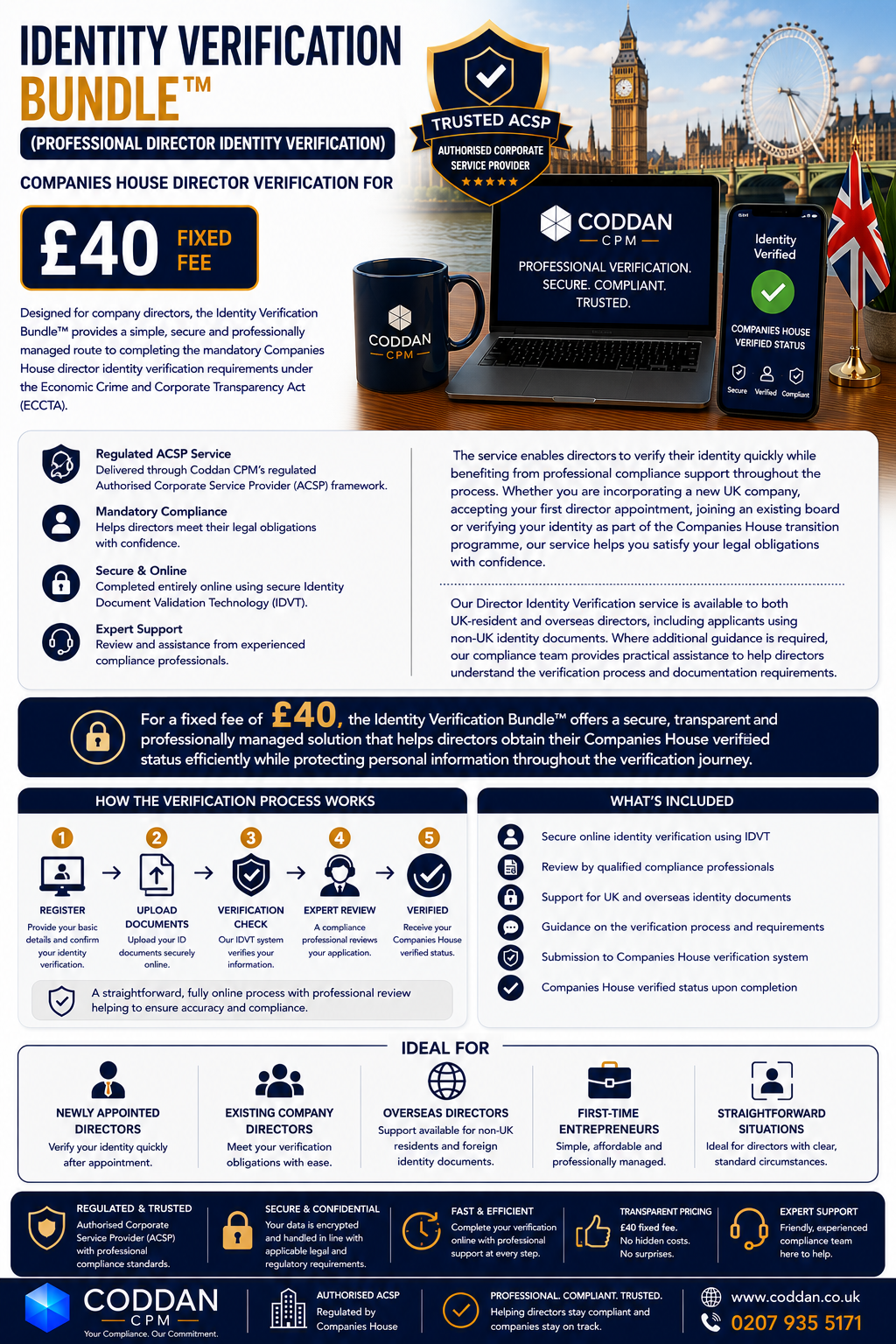
Buy Now Identity Verification Bundle™ (Professional Director Identity Verification) – Obtain Your Companies House Personal Code Through Remote Director Identity Verification for £40.
The Identity Verification Bundle™ provides a simple, secure and professionally managed solution for applicants who need to complete mandatory Companies House director identity verification and obtain their unique 11-character Companies House Personal Code without travelling to the United Kingdom. Delivered through Coddan CPM's regulated Authorised Corporate Service Provider (ACSP) framework, this service enables UK and overseas directors, international entrepreneurs and Persons with Significant Control (PSCs) to complete identity verification remotely while meeting the requirements introduced under the Economic Crime and Corporate Transparency Act (ECCTA) . Whether you are preparing to incorporate a UK company, accepting your first directorship, joining an existing company or completing identity verification during the Companies House transition period, this professionally managed service provides the first step towards establishing your verified corporate identity. Verification is completed using secure Identity Document Validation Technology (IDVT) , with every application supported by experienced compliance professionals who help ensure your submission is complete, accurate and compliant with Companies House requirements, enabling you to begin your long-term Companies House journey with confidence.

The service has been developed for both UK and international applicants, including directors using eligible non-UK identity documents and biometric passports. Once your identity has been successfully verified, you receive the Companies House Personal Code that becomes your permanent verified identifier throughout your corporate career. Where additional assistance is required, our compliance team provides practical guidance throughout the remote verification process, helping you understand the documentation requirements while reducing the likelihood of unnecessary delays. For a fixed fee of £40, the Identity Verification Bundle™ offers a secure, transparent and professionally managed route to obtaining your verified Companies House identity through a regulated ACSP. It is ideally suited to first-time directors, overseas entrepreneurs, non-UK resident directors, international investors and anyone seeking a trusted, professionally supported route to obtaining their Companies House Personal Code and building a strong foundation for long-term UK corporate compliance.


£65.00
+VAT

RapidVerify Pro™

Recommended for

2
package

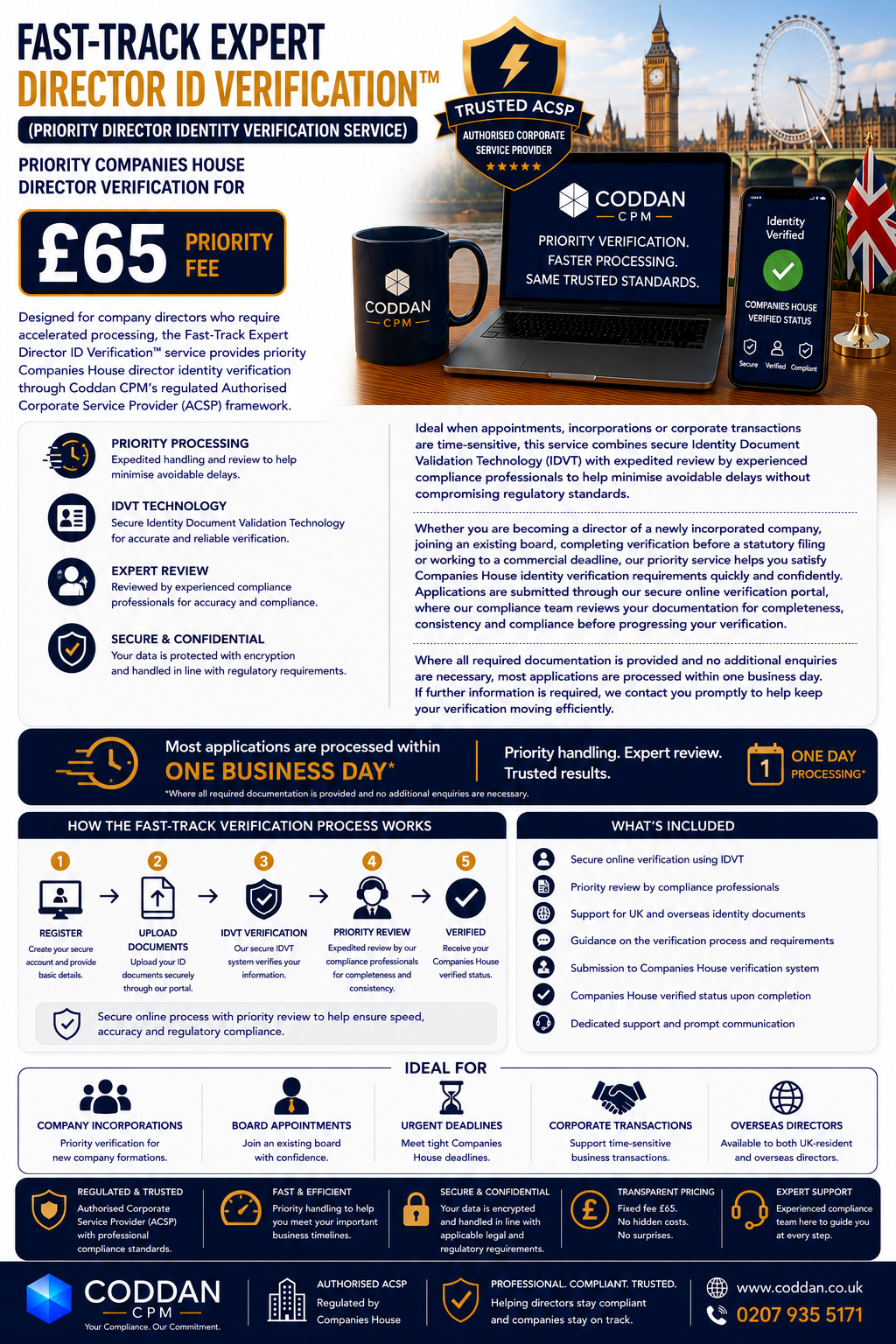
Buy Now Fast-Track Expert Director ID Verification™ (Priority Director Identity Verification Service) – Priority Remote Identity Verification to Obtain Your Companies House Personal Code for £65.
The Fast-Track Expert Director ID Verification™ service is designed for directors who require priority Companies House identity verification and rapid access to their 11-character Companies House Personal Code without compromising accuracy, security or regulatory compliance. Delivered through Coddan CPM's regulated Authorised Corporate Service Provider (ACSP) framework, this premium service combines secure Identity Document Validation Technology (IDVT) with priority review by experienced compliance professionals, enabling UK and overseas applicants to complete identity verification remotely and begin using their verified Companies House identity as quickly as possible. Ideal for urgent UK company incorporations, director appointments, corporate transactions and statutory filing deadlines, this service provides priority handling from the moment your application is received. Every submission is carefully reviewed to help ensure your documentation is complete, consistent and compliant before progressing through the verification process, reducing the likelihood of unnecessary delays and helping you obtain the Personal Code needed to support your future Companies House responsibilities. Where all required information is provided, and no additional enquiries are necessary, most applications are processed within one business day.

If additional documentation is required, our compliance team will contact you promptly to help keep your verification progressing efficiently. The service has been developed for UK and international directors, including applicants using eligible non-UK identity documents and biometric passports. Once your identity has been successfully verified, you receive the Companies House Personal Code that becomes your permanent verified identifier for future company formations, director appointments and ongoing Companies House compliance. For £65, the Fast-Track Expert Director ID Verification™ service provides a faster, professionally managed route to obtaining your verified Companies House identity through a regulated ACSP. It is ideally suited to entrepreneurs, non-UK resident directors, international investors and businesses working to urgent commercial or regulatory deadlines that require their Companies House Personal Code quickly, securely and with the reassurance of experienced ACSP compliance specialists—without travelling to the United Kingdom.


£125.00
+VAT

VerifyFlex Solutions™

Recommended for

3
package

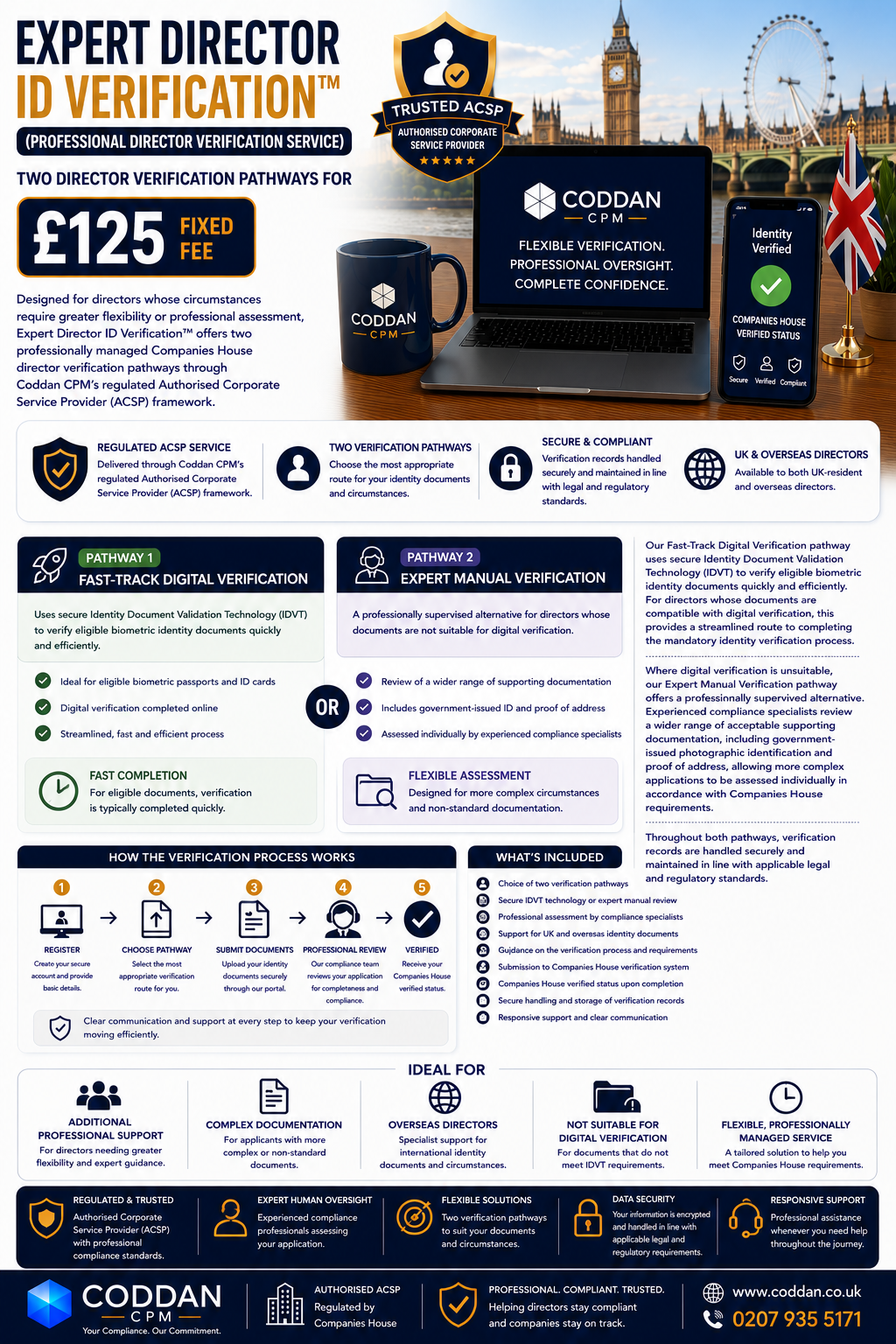
Buy Now Expert Director ID Verification™ (Professional Director Verification Service) – Two Remote Identity Verification Pathways to Obtain Your Companies House Personal Code for £125. The Expert Director ID Verification™ service is designed for directors, overseas entrepreneurs and international applicants who require greater flexibility when completing Companies House identity verification and obtaining their 11-character Companies House Personal Code. Delivered through Coddan CPM's regulated Authorised Corporate Service Provider (ACSP) framework, this professionally managed service offers two remote verification pathways, allowing applicants to choose the option that best matches their identity documents, country of residence and individual circumstances while meeting Companies House requirements. Our Fast-Track Digital Verification pathway uses secure Identity Document Validation Technology (IDVT) to verify eligible biometric identity documents quickly and efficiently. Where digital verification is not suitable, our Expert Manual Verification pathway provides a professionally supervised alternative, enabling experienced compliance specialists to review a broader range of acceptable identity documents and supporting evidence in accordance with applicable regulatory requirements. Both verification pathways have been developed to support UK and overseas applicants using eligible non-UK identity documents, biometric passports and other accepted forms of identification, helping them establish the verified identity that leads to the issue of their Companies House Personal Code.

Throughout the remote verification process, our compliance team provides practical guidance, carefully reviews every application and helps ensure all documentation satisfies Companies House requirements before identity verification is completed, reducing the likelihood of delays caused by incomplete or unsuitable submissions. We also help applicants determine which verification pathway is likely to be the most appropriate for their documentation before the process begins. For £125, the Expert Director ID Verification™ service combines advanced verification technology with experienced professional oversight, providing a flexible and reliable route to obtaining your verified Companies House identity through a regulated ACSP. It is ideally suited to overseas directors, non-UK resident applicants, individuals whose identity documents are unsuitable for straightforward digital verification and anyone seeking a trusted, professionally managed pathway to obtaining their Companies House Personal Code while building a secure foundation for future company formations, director appointments and long-term Companies House compliance.


£220.00
+VAT

FlexiVerify Option™

Recommended for

4
package

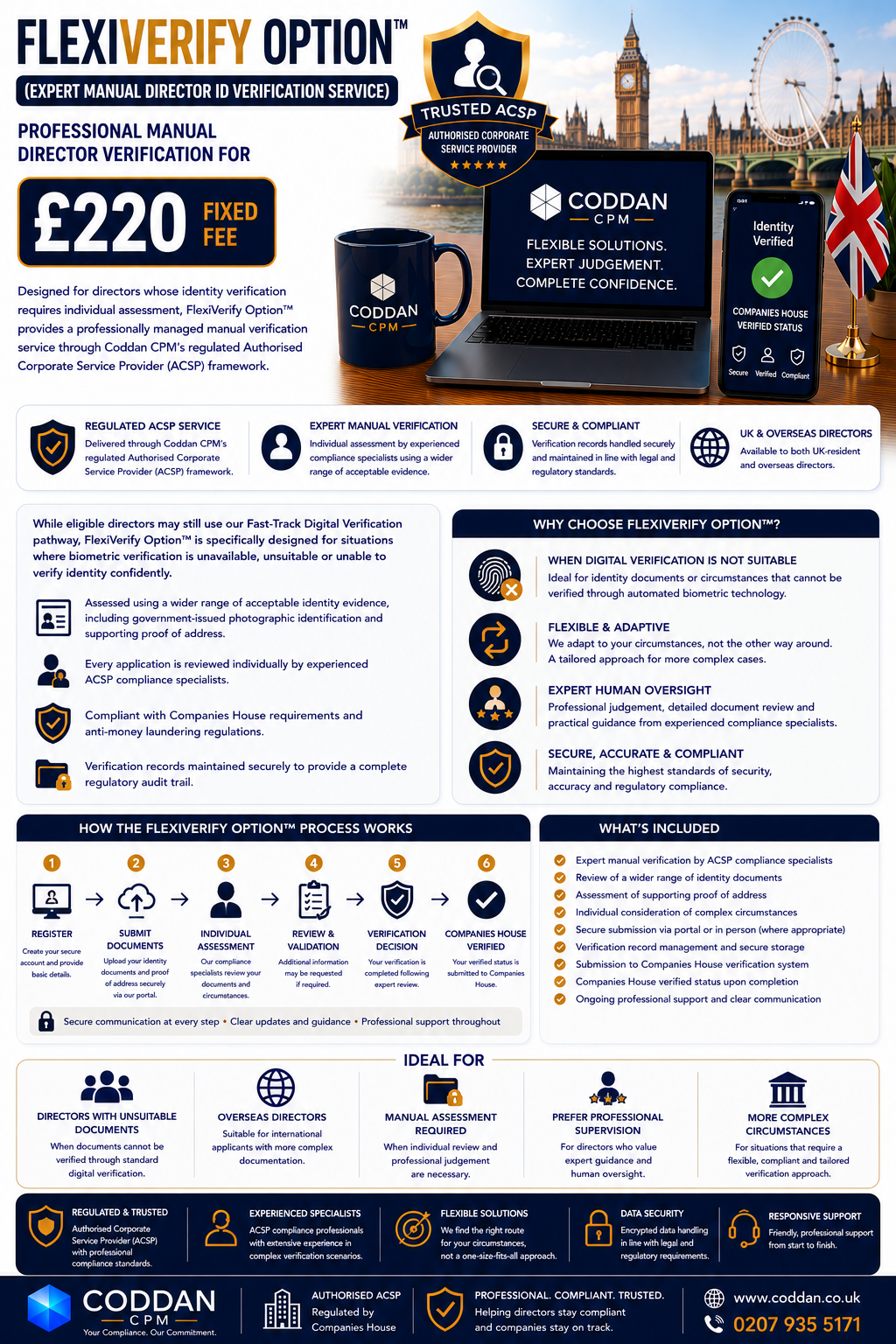
Buy Now FlexiVerify Option™ (Expert Manual Director ID Verification Service) – Professionally Managed Manual Identity Verification to Obtain Your Companies House Personal Code for £220.
The FlexiVerify Option™ is designed for directors whose Companies House identity verification requires individual assessment beyond standard digital verification in order to obtain their 11-character Companies House Personal Code. Delivered through Coddan CPM's regulated Authorised Corporate Service Provider (ACSP) framework, this professionally managed manual verification service provides a flexible and compliant solution for UK and overseas applicants whose circumstances are more complex or whose identity documents are unsuitable for automated verification. While eligible applicants may still use our Fast-Track Digital Verification pathway, FlexiVerify Option™ has been developed specifically for situations where biometric verification is unavailable, unsuitable or unable to verify identity with sufficient confidence. Rather than relying solely on automated technology, experienced compliance specialists assess every application individually, reviewing a broader range of acceptable identity evidence, including government-issued photographic identification, supporting proof of address and other documentation where appropriate, in accordance with applicable Companies House and anti-money laundering requirements. Applications are submitted securely through our online verification portal, with in-person verification available where appropriate, enabling even complex applicants to establish the verified identity that leads to the issue of their permanent Companies House Personal Code.

Every application receives an individual professional review, with comprehensive verification records maintained to support an appropriate regulatory audit trail and demonstrate compliance with applicable legal obligations. Where documentation requires additional clarification, our compliance professionals provide practical guidance throughout the verification process, helping applicants understand the most appropriate evidence for their individual circumstances while reducing unnecessary delays. For £220, FlexiVerify Option™ provides the highest level of professionally managed support for complex identity verification requirements and the secure establishment of your long-term Companies House identity through a regulated ACSP. It is ideally suited to directors requiring manual assessment, applicants using non-standard international identity documents, individuals with more complex verification circumstances and anyone seeking a fully supervised route to obtaining their Companies House Personal Code, providing a strong foundation for future director appointments, company formations and ongoing Companies House compliance throughout their corporate journey.


Tailor your Companies House identity verification experience. Select the pathway that best matches your identity documents and compliance requirements for success

Choose the Verification Pathway That Matches Your Circumstances
Completing Companies House identity verification and obtaining your 11-character Personal Code is not about selecting the cheapest or the most expensive package. It is about choosing the verification pathway that best reflects your individual circumstances, identity documents, timescales and long-term compliance needs.
Unlock Your Business Potential: Discover the Right Verification Pathway for You
Every one of Coddan's verification packages is delivered through our regulated Authorised Corporate Service Provider (ACSP) framework and includes the essential services required to complete your Companies House identity verification professionally. The differences between the packages are not based on removing core services or limiting support. Instead, they provide alternative verification pathways designed for different types of applicants, levels of complexity and operational requirements.
Empowering Your Business: Navigating the Path to Effortless Digital Identity Verification
Whether you require straightforward digital identity verification, priority processing, greater document flexibility or a professionally supervised manual verification route, the objective remains the same: to help you obtain your Companies House Personal Code accurately, securely and in accordance with current regulatory requirements.
From Startup to Success: Leverage Your Personal Code for Lasting Compliance and Growth
The articles below build on that foundation by explaining how your Personal Code is used after identity verification is complete. From forming a new UK company and joining an existing board to filing annual confirmation statements, managing corporate restructures and maintaining long-term compliance, you will discover how your Personal Code supports every stage of your relationship with Companies House. At Coddan, we believe obtaining your Personal Code is only the beginning—the real value comes from understanding how to use it confidently throughout the life of your UK company.

Understanding Your Personal Code

Understanding How Your Companies House Personal Code Works

Your Companies House Personal Code becomes a permanent part of your verified identity. Understanding how it works helps directors and PSCs manage future Companies House requirements with greater confidence.

Your Unique 11-Character Identifier Code

Every successfully verified director or Person with Significant Control (PSC) receives a unique 11-character Companies House Personal Code. The code belongs to the individual rather than to any particular company and remains with them throughout their corporate journey.

Personal Code vs Company Authentication Code

Your Companies House Personal Code identifies you as a verified individual. A company's authentication code identifies the company for filing purposes. They perform different functions and should never be confused with one another.

Supporting Your Corporate Lifecycle

Once issued, the same Personal Code accompanies you throughout your relationship with Companies House. It supports future appointments, company formations and other statutory processes as identity verification requirements continue to develop.

Coddan Insight: Understanding the difference between your Personal Code and your company's authentication code helps prevent common filing errors. As a regulated Authorised Corporate Service Provider (ACSP), Coddan helps directors and PSCs understand how their Personal Code supports ongoing Companies House compliance throughout the corporate lifecycle.


How to Use Your Personal Code When Forming a Company

Personal Code Checkpoint

Corporate Stage: Forming a New UK Company
Is Your Personal Code Required?
Yes. Every proposed director must complete Companies House identity verification and obtain their Personal Code before the company incorporation application can be submitted successfully.
Who Uses the Code?
Each individual who is being appointed as a director of the new company.
When Is It Used?
During the preparation and submission of the company incorporation application, before Companies House registers the company.
Typical Companies House Process:
Company incorporation (Form IN01) and the appointment of the company's first directors.

Receiving your 11-character Companies House Personal Code is only the first step. The next stage is knowing how and when to use it correctly. One of the earliest occasions you will use your Personal Code is when incorporating a new UK company. Under the Economic Crime and Corporate Transparency Act (ECCTA), identity verification is no longer something that happens after incorporation. Instead, it has become part of the company formation process itself, helping Companies House ensure that every new director has been verified before joining the public register.

Whether you are establishing your first UK company or adding another business to an existing portfolio, understanding how your Personal Code is used during incorporation helps avoid delays, rejected applications and unnecessary compliance issues.

Your Personal Code Becomes Part of the Incorporation Process
Before ECCTA reforms, company incorporations could often be submitted using basic director information that was verified later, if at all. Today, Companies House expects every proposed director to have completed identity verification before their appointment can be accepted.

Your Personal Code forms the secure connection between your verified identity and your new directorship. When the incorporation documents are prepared, your Personal Code is supplied alongside your statutory appointment details, allowing Companies House to confirm that a verified individual is accepting legal responsibility for the company from the moment it is formed.

If the required Personal Code is missing or cannot be matched to a verified identity, the incorporation cannot proceed until the issue has been resolved.

Why Timing Matters for International Founders
For overseas entrepreneurs, the timing of identity verification can have a significant impact on company formation.

Many founders begin preparing incorporation documents before realising that every proposed director must already possess a valid Personal Code. If verification is left until the final stages of incorporation, the entire application may be delayed while identity checks are completed.

This becomes even more important where several directors are being appointed simultaneously.

Multi-Founder Company Formations
Many international businesses are established by two or more founders located in different countries.

Although each director completes identity verification individually, the incorporation application depends upon every proposed director being ready at the same time. One outstanding verification can delay the entire company formation.

This is particularly relevant where founders live in different jurisdictions, use different identity documents or complete verification on different dates.

Planning verification before incorporation helps ensure the company can be registered without unnecessary interruptions.

Verify Once, Use Your Personal Code for Future Companies
One of the major advantages of the Personal Code is that it belongs to you, not to any individual company.

Once your identity has been successfully verified, you continue using the same Personal Code whenever you establish another UK company or accept a further directorship.

There is no need to repeat identity verification every time you launch a new business, provided your verified status remains valid under Companies House requirements. Your Personal Code becomes your permanent digital identifier across your entire UK corporate portfolio, allowing Companies House to recognise you consistently as the same verified individual.

For entrepreneurs building several businesses, this significantly simplifies future incorporations and director appointments.

Your Personal Code Continues to Support Future Corporate Changes
Although incorporation is usually the first occasion when many directors use their Personal Code, it certainly will not be the last.

As your company develops, the same verified identity continues to support a range of Companies House activities, including:

  • appointing additional directors;
  • accepting appointments to other UK companies;
  • updating Persons with Significant Control (PSC) information where applicable;
  • supporting certain structural or governance changes;
  • maintaining compliance during annual filing obligations.

The Personal Code therefore becomes part of your company's long-term governance framework rather than a one-off incorporation requirement.

Protecting Your Personal Code
Because your Personal Code permanently identifies you within the Companies House system, it should always be treated as confidential.

Unlike your company registration number, which is publicly available, your Personal Code belongs exclusively to you as an individual. It should be stored securely and only shared where genuinely necessary during authorised Companies House processes.

Many directors compare it to a Unique Taxpayer Reference (UTR) or another confidential business identifier. While it may need to be provided during legitimate compliance activities, it should never be published publicly or disclosed unnecessarily.

Taking sensible precautions helps reduce the risk of administrative errors or unauthorised use.

What Happens If You Lose Your Personal Code?
Misplacing your Personal Code does not mean you must complete identity verification again.

Companies House provides procedures for recovering access to your verified identity. However, if the issue arises shortly before an important incorporation or statutory filing deadline, delays may occur while access is restored.

For directors managing multiple companies or working to commercial deadlines, resolving these issues early is always preferable to waiting until a filing becomes urgent.

Avoiding Common Mistakes During Company Formation
Most incorporation delays are caused by simple administrative issues rather than complex legal problems.

Examples include:

  • attempting to incorporate before every proposed director has completed identity verification;
  • confusing the 11-character Personal Code with the company's separate authentication code;
  • using incomplete or inconsistent director information;
  • delaying verification until incorporation documents are ready for submission.

Preparing these requirements in advance helps Companies House process incorporations more efficiently and reduces the likelihood of avoidable queries.

How Professional Support Can Help
Forming a UK company involves much more than obtaining a Personal Code. Directors must ensure that identity verification, statutory appointments and incorporation documents all work together correctly within the Companies House framework.

Many founders—particularly international entrepreneurs and those establishing companies with several directors—choose to work with an Authorised Corporate Service Provider (ACSP) to coordinate this process. Rather than focusing solely on identity verification, professional support helps ensure that Personal Codes, director appointments and incorporation documents are aligned before the application is submitted, reducing the risk of delays and providing a stronger foundation for the company's future compliance journey.

At Coddan, we view incorporation as the beginning of a long-term relationship with Companies House. Our role is not simply to help directors obtain a Personal Code, but to support its correct use throughout the lifetime of their UK companies as new appointments, corporate changes and ongoing compliance requirements arise.

The Same Personal Code Supports Directors Worldwide
Your Companies House Personal Code operates in exactly the same way whether you are establishing a UK company from London or managing your business from overseas. Once your identity has been successfully verified, the Personal Code becomes your permanent digital identifier for Companies House regardless of where you live or where your business operates.

At Coddan, we assist directors throughout the United Kingdom as well as international entrepreneurs, overseas investors and non-UK residents establishing and managing UK companies from Europe, North America, Latin America, the Middle East, Africa, Asia-Pacific and Australasia. Although identity verification may involve different identity documents or practical considerations depending on your country of residence, the Personal Code issued by Companies House performs the same function for every verified director. It provides a single, secure identifier that supports your relationship with Companies House throughout your corporate journey.


International Directors

Supporting Directors in the UK and Around the World

Companies House applies the same identity verification requirements to directors regardless of where they live. While the legal standard remains consistent, the practical verification journey may vary depending on an applicant's country of residence and identity documents.

Different Documents, Same Requirements

International applicants may use different passports, national identity cards and supporting documentation depending on their country of residence. Understanding which verification route is appropriate helps reduce unnecessary delays and supports a smoother verification experience.

Professional ACSP Guidance

As a regulated Authorised Corporate Service Provider (ACSP), Coddan supports UK and overseas applicants by helping them choose an appropriate verification pathway, prepare suitable documentation and complete identity verification in accordance with Companies House requirements.

One Personal Code Worldwide: Whether you are based in the United Kingdom, Europe, North America, Latin America, the Middle East, Africa, Asia-Pacific or Australasia, the Companies House Personal Code issued after successful identity verification performs the same function. It remains your unique digital identifier throughout your relationship with Companies House, regardless of where you live or where your UK company operates.


Using Your Personal Code When Joining an Existing UK Company

Personal Code Checkpoint

Corporate Stage: Joining an Existing UK Company
Is Your Personal Code Required?
Yes. If you are being appointed as a director of an existing UK company, you must have completed Companies House identity verification and obtained your Personal Code before your appointment can be submitted.
Who Uses the Code?
The incoming director who is joining the company's board.
When Is It Used?
When your appointment as a director is being prepared and submitted to Companies House as part of the director appointment process.
Typical Companies House Process:
Director appointment (Form AP01) and, where applicable, related Person with Significant Control (PSC) notifications.

Joining the board of an existing UK company is different from forming a new business, but one requirement remains the same: your identity must already have been verified before your appointment can be registered with Companies House. Under the Economic Crime and Corporate Transparency Act (ECCTA), your 11-character Companies House Personal Code provides the secure link between your verified identity and your new directorship, helping Companies House confirm that every officer on the public register has completed the required identity verification process.

Whether you are becoming an executive director, a non-executive board member, an overseas investor joining an established business or accepting an additional directorship within a corporate group, understanding how your Personal Code is used will help your appointment proceed smoothly.

Identity Verification Comes Before Your Appointment
One of the biggest changes introduced by ECCTA is the order in which events now take place.

Previously, an individual could often be appointed as a director before identity verification became an immediate consideration. Today, Companies House expects directors to complete identity verification first and obtain their Personal Code before their appointment is submitted.

Your Personal Code is therefore not created during the appointment process. It should already exist and be available when the appointment documentation is prepared.

This simple change helps Companies House ensure that every new director joining the register is a verified individual from the outset.

How Your Personal Code Is Used During an Appointment
When a company appoints a new director, the appointment information submitted to Companies House includes details that identify the incoming officer.

As part of this process, your Personal Code allows Companies House to connect your verified identity with your new director record. Rather than creating a new identity every time you join another company, the register recognises you as the same verified individual.

This creates a consistent regulatory record throughout your career, regardless of how many UK companies you join.

What Happens If a Personal Code Is Not Available?
If an individual has not completed identity verification before their appointment is prepared, the appointment cannot proceed in the normal way until the verification requirements have been satisfied.

In practical terms, this may delay:

  • director appointments;
  • corporate reorganisations;
  • investment transactions requiring board changes;
  • company administration that depends upon the new director being formally registered.

For businesses working to commercial deadlines, ensuring every incoming director already holds a valid Personal Code helps avoid unnecessary interruptions.

One Personal Code for Every Directorship
Many entrepreneurs, investors and experienced directors serve on the boards of several UK companies.

Fortunately, there is no requirement to complete identity verification every time a new appointment is accepted.

Your Personal Code belongs to you as an individual, not to a particular company.

Once your identity has been verified, the same Personal Code can be used whenever you join another UK company, whether you are accepting your second directorship or your twentieth.

This significantly reduces administration for directors managing multiple appointments while helping Companies House maintain one verified identity across every company record.

Coordinating Multiple Director Appointments
Some companies appoint several directors at the same time, particularly during acquisitions, investment rounds, management buy-outs or wider corporate restructuring.

Although every incoming director uses their own Personal Code, the overall appointment process often depends upon each proposed director completing the necessary verification requirements before the filings can be finalised.

Where one appointment is delayed because identity verification remains outstanding, the wider board transition may also be affected.

Planning verification before the appointment process begins helps reduce these avoidable delays.

Additional Considerations for International Directors
For overseas entrepreneurs and international investors, joining the board of an existing UK company can involve additional practical considerations.

Many international directors do not possess the UK digital credentials commonly used by domestic online verification systems, such as established UK credit records or locally recognised identity data. As a result, some applicants experience delays when attempting to complete verification independently.

Completing identity verification through a regulated Authorised Corporate Service Provider (ACSP) offers an alternative route that enables eligible overseas applicants to satisfy Companies House requirements without relying solely on standard self-service verification methods.

When You Become Both a Director and a Person with Significant Control
Some individuals join an existing company in two different capacities.

For example, an investor may become:

  • a company director responsible for helping manage the business; and
  • a Person with Significant Control (PSC) because they acquire more than 25% of the company's shares or voting rights.

Although these appointments may occur at the same time, they represent separate statutory responsibilities.

Your Personal Code supports your verified identity across both roles, while the company must also ensure that the relevant PSC notifications are completed within the applicable Companies House timescales. Understanding that these obligations operate alongside one another helps avoid missed deadlines and incomplete filings.

Protecting Your Personal Code During Appointments
Your Personal Code should always remain confidential.

It is important not to confuse it with the company's authentication code, which is used to authorise certain Companies House filings on behalf of the company.

These two codes serve completely different purposes.

  • The authentication code belongs to the company.
  • The Personal Code belongs to you as an individual.

During a director appointment, you may need to provide your Personal Code to the authorised person preparing the filing. However, it should not be circulated unnecessarily, included in board papers, shared through unsecured email chains or disclosed publicly. Treating it as a confidential personal credential helps protect both your identity and the integrity of your Companies House record.

How Professional Support Can Help
Joining the board of an existing company often involves more than submitting a single appointment form. Director appointments frequently coincide with shareholder changes, governance updates, statutory register amendments and wider corporate transactions.

Many UK companies therefore choose to work with an Authorised Corporate Service Provider (ACSP) to coordinate these processes. By ensuring that identity verification has already been completed, Personal Codes are available when required and appointment documentation is prepared accurately, professional support can help directors join existing boards with greater confidence and fewer administrative delays.

At Coddan, we support directors throughout the entire appointment process—not only by helping eligible applicants complete identity verification where required, but also by assisting companies in integrating verified directors into their ongoing Companies House compliance framework. This reflects our wider philosophy that the Personal Code is not simply the outcome of identity verification; it is a practical tool used throughout the lifetime of a director's corporate journey.

Joining a UK Company from Anywhere in the World
Accepting an appointment as a director of a UK company follows the same Companies House identity verification framework whether you live in the United Kingdom or overseas. Once you have successfully completed identity verification and received your 11-character Companies House Personal Code, that single code can be used whenever you join the board of a UK company, regardless of your country of residence.

At Coddan, we assist UK-based directors as well as international entrepreneurs, overseas investors and non-UK residents joining the boards of UK companies from Europe, North America, Latin America, the Middle East, Africa, Asia-Pacific and Australasia. While identity documents, local naming conventions and practical verification considerations may vary between jurisdictions, the legal requirements for becoming a verified UK company director remain the same. Your Personal Code provides the secure digital link between your verified identity and every current or future directorship you hold with Companies House.


Corporate Lifecycle

Your Personal Code Supports Every Stage of Your Corporate Journey

Receiving your Companies House Personal Code is not the end of identity verification. It becomes the secure digital identifier that accompanies you throughout your relationship with Companies House as your responsibilities evolve.

Starting a Company

Your Personal Code supports the identity verification requirements associated with becoming a verified director of a new UK company.

Managing Directorships

The same Personal Code remains with you throughout future appointments, board changes and other Companies House interactions.

Meeting Compliance

As Companies House identity verification requirements continue to develop, your Personal Code supports ongoing corporate compliance.

Growing Your Business

Whether you become involved with one company or several, your Personal Code continues to identify you as the same verified individual.

Looking Ahead: Understanding what your Personal Code is represents the first step. Knowing when and how to use it during company formations, director appointments, annual confirmation statements and other Companies House processes is the next stage of your corporate compliance journey. Coddan helps directors understand both.


Using Your Personal Code When Filing Your Annual Confirmation Statement

Personal Code Checkpoint

Corporate Stage: Filing an Annual Confirmation Statement
Is Your Personal Code Required?
Yes. Directors must have completed Companies House identity verification and have a valid Personal Code linked to their verified identity before the company's confirmation statement can be completed where identity verification requirements apply.
Who Uses the Code?
Verified company directors whose identity is required to support the company's ongoing compliance with Companies House requirements.
When Is It Used?
During the company's annual confirmation statement process and whenever identity verification requirements need to be satisfied before the filing can proceed.
Typical Companies House Process:
Annual Confirmation Statement (Form CS01) and, where applicable, related director and Person with Significant Control (PSC) compliance requirements.

For many directors, the annual Confirmation Statement (Form CS01) will become the most frequent occasion on which their 11-character Companies House Personal Code supports ongoing compliance. While identity verification only needs to be completed once, your verified status continues to play an important role throughout the life of your company. Under the Economic Crime and Corporate Transparency Act (ECCTA), the Confirmation Statement is no longer simply an annual administrative update. It has become one of the key points at which Companies House expects company records and director identity verification to remain fully aligned.

Understanding how your Personal Code fits into this annual process helps directors avoid unnecessary delays while maintaining accurate Companies House records.

Annual Confirmation Statements Are Now Part of the Identity Verification Framework
Historically, many companies regarded the Confirmation Statement as a routine annual filing that confirmed existing company information.

The ECCTA reforms have significantly strengthened this process.

Today, Companies House expects the information submitted within the Confirmation Statement to reflect a register of verified directors and, where applicable, verified Persons with Significant Control (PSCs). Identity verification is therefore no longer separate from annual compliance—it has become part of the wider framework supporting accurate and trusted company records.

Where director verification requirements have not been satisfied, Companies House may be unable to process filings until outstanding compliance issues have been addressed.

Understanding the Confirmation Statement Timeline
One common misunderstanding is that every company shares the same deadline for identity verification.

In reality, each company follows its own Confirmation Statement cycle.

For companies already on the register when the new verification requirements were introduced, the relevant compliance timetable is linked to that company's individual Confirmation Statement due date during the transition period.

This means that two directors serving on different companies may reach their verification milestones at different times, depending on each company's statutory filing schedule.

Understanding your own filing calendar is therefore essential for maintaining compliance.

Managing Confirmation Statements Across Multiple Companies
Many entrepreneurs are directors of more than one UK company.

Although they use the same Personal Code across every directorship, each company retains its own Confirmation Statement anniversary date.

For example:

  • Company A may file in February.
  • Company B may file in June.
  • Company C may file in November.

While the Personal Code remains constant, the filing timetable changes from company to company.

Keeping track of multiple statutory deadlines becomes increasingly important as a corporate portfolio grows, particularly where companies have different shareholders, directors and governance structures.

Every Director Matters
Where several directors sit on the same board, annual compliance depends upon every director meeting the relevant Companies House requirements.

If one director has not completed identity verification or their verified status cannot be confirmed when required, resolving that issue may delay the company's ability to complete its annual compliance activities.

This is particularly relevant for businesses with international boards, where directors may live in different countries and complete verification through different routes.

Planning well before the Confirmation Statement deadline helps companies identify outstanding issues early rather than discovering them shortly before filing.

Additional Considerations for International Directors
Companies with overseas directors often require additional coordination.

Although the legal identity verification requirements are identical regardless of where a director lives, international applicants sometimes need additional time to complete verification because they use overseas identity documents or different verification pathways.

Where directors are located across several countries and time zones, confirming that every board member has completed verification before the Confirmation Statement becomes due can help reduce unnecessary pressure during the filing period.

Early preparation is particularly valuable for international corporate groups with geographically dispersed management teams.

Directors and Persons with Significant Control Have Different Responsibilities
Some individuals appear on the Companies House register in more than one capacity.

For example, a founder may be:

  • a company director; and
  • a Person with Significant Control (PSC) because they own more than 25% of the company.

Although these roles often belong to the same individual, they remain legally distinct.

Maintaining your verified identity as a director does not automatically replace the company's separate obligations relating to PSC information. Companies should therefore ensure that director verification, Confirmation Statement requirements and PSC records all remain accurate and up to date throughout the year.

Avoiding Confirmation Statement Problems
Most annual filing difficulties arise because preparation begins too late.

Common issues include:

  • assuming identity verification has already been completed for every director;
  • overlooking directors who recently joined the company;
  • confusing the Personal Code with the company's authentication code;
  • leaving verification until immediately before the Confirmation Statement deadline;
  • failing to coordinate filings across several companies within a corporate group.

Reviewing these matters before the filing window opens allows sufficient time to resolve any outstanding issues without unnecessary pressure.

Why Annual Compliance Deserves Ongoing Attention
The Confirmation Statement is much more than an annual formality.

It confirms that the company's public information remains accurate and demonstrates that the business continues to meet its statutory obligations. Failure to complete required filings or maintain Companies House records can lead to increasing regulatory attention, financial penalties and, in serious cases, action by the Registrar that may affect the company's standing on the public register.

Maintaining accurate verification records alongside timely annual filings therefore forms an important part of good corporate governance.

How Professional Support Can Help
For companies with several directors, overseas board members or multiple UK entities, coordinating annual Confirmation Statements can quickly become a significant administrative responsibility.

Many businesses therefore appoint an Authorised Corporate Service Provider (ACSP) or professional company secretarial adviser to oversee annual Companies House compliance. Rather than focusing solely on the Confirmation Statement itself, professional support helps ensure that director verification, Personal Codes, statutory registers and filing deadlines remain aligned well before the filing window opens.

At Coddan, we help directors view the Confirmation Statement as part of a wider corporate compliance lifecycle rather than a once-a-year obligation. By monitoring key deadlines, reviewing verification status and coordinating Companies House filings, we help businesses maintain accurate company records and reduce the risk of avoidable delays as their companies continue to grow.


Authorised Corporate Service Provider (ACSP)

Begin Your Companies House Personal Code Journey with Confidence

Understanding your Companies House Personal Code is the first step. Completing identity verification through a regulated Authorised Corporate Service Provider (ACSP) helps establish the verified identity that supports your future relationship with Companies House.

Professional Identity Verification

Complete Companies House identity verification through Coddan's regulated ACSP framework with practical guidance throughout the process.

Support Beyond Verification

Learn how your Personal Code supports future Companies House requirements with ongoing corporate compliance and company secretarial assistance where required.


Using Your Personal Code When Changing Your Company Name

Personal Code Checkpoint

Corporate Stage: Changing Your Company Name
Is Your Personal Code Required?
Yes. Where Companies House identity verification requirements apply, verified directors must have a valid Personal Code linked to their identity before authorised company name change filings can be completed.<
Who Uses the Code?
The verified director or authorised individual responsible for submitting the company name change through the appropriate Companies House process.<
When Is It Used?
When preparing and submitting the company name change after the necessary board or shareholder approvals have been obtained.<
Typical Companies House Process:
Company name change following the appropriate corporate resolution and submission of the relevant Companies House filing.

Changing the name of a UK company is an important corporate decision that often reflects business growth, a new commercial strategy or a wider group restructuring. While selecting a new name is a commercial decision, registering that change with Companies House is a statutory process that now operates within the enhanced identity verification framework introduced by the Economic Crime and Corporate Transparency Act (ECCTA).

Your 11-character Companies House Personal Code helps ensure that significant changes to a company's public record are carried out by verified individuals with the legal authority to act on behalf of the company. Understanding how your Personal Code supports this process can help directors prepare for a smoother company name change while maintaining compliance with Companies House requirements.

Company Name Changes Now Form Part of a Stronger Verification Framework<
Before the introduction of ECCTA reforms, changing a company name was largely viewed as an administrative filing supported by the company's existing authority.

Today, Companies House places much greater emphasis on confirming both:

  • that the company has properly authorised the proposed change; and
  • that the individuals responsible for submitting the filing are verified directors or authorised persons acting within the statutory framework.

Your Personal Code helps Companies House connect the filing to a verified individual, strengthening confidence that significant changes to the public register are being made by those who are legally entitled to act.

Understanding the Difference Between the Two Company Codes<
One of the most common areas of confusion involves the two different codes used during Companies House filings.

The Company Authentication Code<
The authentication code belongs to the company itself. It allows authorised users to access certain Companies House online filing services.

Your Personal Code<
Your Personal Code belongs only to you as an individual.

It confirms your verified identity rather than providing access to company filing services.

Although both codes may be relevant during different Companies House processes, they perform completely different functions and should never be confused with one another.

Understanding this distinction helps directors avoid one of the most common administrative mistakes during statutory filings.

Director Authority Remains Central to the Process<
Changing a company name is not simply an online filing.

Before any application reaches Companies House, the company must first approve the change through the appropriate corporate decision-making process.

Depending on the company's Articles of Association, this may involve:

  • a special resolution passed by shareholders;
  • a board decision where the Articles permit directors to change the company name; or
  • another procedure authorised by company law and the company's constitutional documents.

Once the appropriate authority has been obtained, the filing submitted to Companies House forms part of a clear audit trail connecting the approved corporate decision with verified individuals responsible for implementing it.

Stronger Identity Verification Helps Protect Companies<
The enhanced identity verification framework also provides greater protection for businesses.

By linking important Companies House filings to verified directors, ECCTA makes it significantly more difficult for unauthorised individuals to attempt fraudulent changes to company records.

This additional layer of verification supports:

  • stronger corporate governance;
  • improved confidence in Companies House data;
  • greater protection against unauthorised filings;
  • increased transparency across the UK company register.

For genuine directors, this means that important structural changes can be supported by a stronger system of identity assurance.

Additional Considerations for International Companies<
International corporate groups frequently change the names of UK subsidiaries to reflect mergers, acquisitions, global brand updates or wider organisational restructuring.

Where overseas directors are responsible for approving or overseeing these changes, identity verification should be completed well before the proposed filing date.

If key directors have not yet completed the required verification process, wider commercial projects may also be delayed while Companies House requirements are satisfied.

Early planning helps international businesses coordinate legal, operational and branding activities more effectively.

Companies House Reviews More Than the Proposed Name<
Under ECCTA, Companies House has wider powers to examine company names before they are accepted onto the public register.

Applications may receive additional scrutiny where proposed names could:

  • mislead the public;
  • suggest inappropriate links with government or public authorities;
  • include prohibited or restricted expressions;
  • raise concerns regarding potential misuse of the register.

While the choice of company name remains subject to the relevant statutory rules, submitting filings through verified directors supports the wider objective of maintaining an accurate and trustworthy company register.

What Happens After the Name Change?<
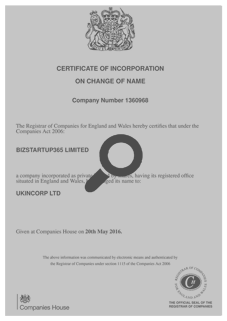
Once Companies House accepts the application, it issues a Certificate of Incorporation on Change of Name, confirming the company's new legal identity.

However, changing the company name is usually only the beginning of a wider administrative process.

Businesses may also need to update:

  • banking arrangements;
  • contracts and commercial agreements;
  • VAT and tax records where appropriate;
  • licences and regulatory registrations;
  • websites and digital assets;
  • customer communications;
  • supplier records;
  • marketing materials.

Planning these updates alongside the Companies House filing helps ensure a smoother transition to the company's new identity.

Avoiding Common Filing Mistakes<
Most delays arise from relatively simple administrative errors.

Common examples include:

  • confusing the Personal Code with the company authentication code;
  • submitting inconsistent director information;
  • using outdated officer records;
  • failing to obtain the appropriate corporate approval before filing;
  • leaving identity verification until immediately before the proposed name change.

Reviewing these matters before submission reduces the likelihood of avoidable delays.

How Professional Support Can Help
Changing a company name often forms part of a much wider corporate project involving governance decisions, shareholder approvals, regulatory updates and ongoing Companies House compliance.

Many businesses therefore choose to work with an Authorised Corporate Service Provider (ACSP) to coordinate these activities. Professional support helps ensure that company approvals, director verification, statutory filings and post-registration updates are managed in the correct sequence, reducing the risk of unnecessary administrative issues.

At Coddan, we view a company name change as one step within a broader corporate lifecycle. By helping directors manage Companies House filings alongside wider governance responsibilities, we support businesses through significant structural changes while maintaining accurate public records and long-term compliance.


Personal Code Security

Keeping Your Companies House Personal Code Secures

Your Companies House Personal Code is unique to you and forms part of your verified identity. It should be stored securely and treated with the same level of care as other important business credentials.

Store It Securely

Keep your Personal Code in a secure location and avoid including it in publicly accessible documents or unsecured communications. Treat it as confidential information that identifies you as a verified director or PSC.

Share It Responsibly

Only provide your Personal Code when it is genuinely required for Companies House purposes, such as to a trusted Authorised Corporate Service Provider (ACSP) or another authorised professional assisting with your statutory compliance.

Need Assistance?

If you are unsure how your Personal Code should be used, stored or managed as part of your Companies House responsibilities, professional guidance can help you avoid unnecessary delays and filing mistakes.

Good Practice: Your Companies House Personal Code remains associated with your verified identity throughout your corporate journey. Keeping it secure and using it appropriately helps support accurate Companies House records and ongoing corporate compliance.


Using Your Personal Code During a Corporate Restructure or Share Transfer

Personal Code Checkpoint

Corporate Stage: Corporate Restructure or Share Transfer
Is Your Personal Code Required?
Yes. Where a corporate restructure or share transfer results in Companies House filings involving verified directors or Persons with Significant Control (PSCs), the relevant individuals must have completed identity verification and hold a valid Personal Code.
Who Uses the Code?
Verified directors and, where applicable, verified Persons with Significant Control involved in statutory filings arising from the restructuring or ownership changes.
When Is It Used?
During Companies House filing processes associated with director appointments, PSC updates and other statutory changes that form part of a corporate restructure or share transfer.
Typical Companies House Process:
Share transfers, corporate restructures, director appointments, PSC notifications and related Companies House filings.

Corporate restructures and share transfers are often among the most significant events in the life of a UK company. Whether introducing new investors, reorganising a group structure, transferring shares between shareholders or preparing for a business sale, these transactions frequently involve updates to directors, ownership and statutory registers.

Under the Economic Crime and Corporate Transparency Act (ECCTA), Companies House places greater emphasis on ensuring that the individuals responsible for significant corporate changes are verified. While your 11-character Companies House Personal Code does not replace the legal documents required for a restructuring or share transfer, it helps connect verified individuals to the wider compliance framework that supports these important corporate events.

Understanding how your Personal Code fits into this process helps directors prepare for structural changes with greater confidence.

Corporate Restructures Now Operate Within a Stronger Identity Framework
Historically, many restructures focused primarily on legal documentation such as:

  • stock transfer forms;
  • shareholder resolutions;
  • board minutes;
  • updated statutory registers.

These documents remain essential.

However, ECCTA has introduced a stronger emphasis on the identity of the individuals responsible for managing corporate change.

Where restructures involve changes to directors, Persons with Significant Control (PSCs) or other information recorded at Companies House, verified identities now play an increasingly important role in maintaining the integrity of the public register.

Your Personal Code Supports Verified Corporate Decision-Making
During a restructuring, Companies House may receive a series of filings over several weeks or months.

These might include:

  • appointing new directors;
  • resigning existing directors;
  • updating PSC information;
  • altering the company's ownership structure;
  • recording changes arising from mergers or acquisitions.

Although the Personal Code is not attached to every document within the transaction, it supports the verified identity of directors responsible for filings that require identity verification under the Companies House framework.

This creates a clearer audit trail linking important corporate changes to verified individuals.

Share Transfers Can Affect More Than Ownership
A share transfer does not always involve only shareholders.

In many companies, directors are also major shareholders and may qualify as Persons with Significant Control (PSCs).

For example, a transaction may result in an individual:

  • becoming a director;
  • resigning as a director;
  • acquiring significant control;
  • ceasing to qualify as a PSC;
  • increasing or reducing their voting rights.

Although these changes may arise from the same commercial transaction, they often create separate Companies House obligations that must be managed carefully.

Understanding how director verification, PSC requirements and share ownership interact helps reduce the likelihood of incomplete or inconsistent company records.

Additional Considerations for Corporate Groups
Large corporate groups often carry out internal restructures involving several companies at the same time.

Examples include:

  • transferring subsidiaries;
  • reorganising holding company structures;
  • moving intellectual property between companies;
  • redesignating shares;
  • reducing or increasing share capital.

These projects frequently involve directors across multiple companies.

Ensuring that directors have already completed identity verification before significant filings begin helps support smoother coordination throughout the wider restructuring programme.

Identity Verification Helps Protect High-Value Transactions
One of the wider objectives of ECCTA is to strengthen confidence in the UK company register.

By connecting important Companies House filings to verified directors, the legislation helps reduce opportunities for:

  • fraudulent changes to company records;
  • unauthorised director appointments;
  • misuse of corporate identities;
  • inaccurate ownership information.

For companies undertaking high-value transactions, verified identities contribute to stronger corporate governance alongside the legal documentation supporting the transaction itself.

Understanding PSC Reporting During Share Transfers
Many share transfers affect who exercises significant control over the company.

Where an individual crosses the relevant statutory thresholds, the company may need to update its Person with Significant Control (PSC) information.

These obligations operate separately from share transfer documentation itself.

For that reason, companies should review:

  • director appointments;
  • PSC status;
  • shareholder records;
  • statutory registers;
  • Companies House filing requirements

as part of one coordinated compliance exercise rather than treating each obligation independently.

Preparing for Statutory Filing Deadlines
Corporate restructures often involve several Companies House filings taking place within relatively short periods.

Leaving identity verification until transactions are already underway can create unnecessary pressure, particularly where several directors or companies are involved.

Planning ahead allows businesses to confirm:

  • director verification has already been completed;
  • Personal Codes are available where required;
  • statutory registers remain consistent;
  • Companies House filings can proceed in the correct sequence.

Early preparation helps avoid unnecessary interruptions during commercially sensitive transactions.

Common Administrative Mistakes
Many restructuring delays result from straightforward administrative issues rather than legal complexity.

Examples include:

  • overlooking Companies House updates while focusing only on legal documentation;
  • confusing company authentication codes with Personal Codes;
  • failing to review director and PSC information together;
  • submitting inconsistent officer details across different filings;
  • leaving verification until immediately before filing deadlines.

Taking time to review the company's statutory records before major restructuring work begins helps reduce the likelihood of avoidable compliance issues.

How Professional Support Can Help
Corporate restructures and share transfers rarely involve a single Companies House filing. They often require careful coordination between directors, shareholders, legal advisers and company secretarial professionals to ensure that statutory obligations are completed accurately and in the correct order.

Many businesses therefore work with an Authorised Corporate Service Provider (ACSP) when managing significant structural changes. Professional support helps coordinate director verification, Companies House filings, statutory register updates and ongoing compliance alongside the wider commercial transaction.

At Coddan, we help directors understand how their Personal Code fits into the broader governance framework that supports corporate restructures. By coordinating identity verification with director appointments, PSC reporting and Companies House obligations, we help businesses complete structural changes while maintaining accurate records and long-term regulatory compliance.