 Send us an e-mail












Does living abroad require an ACSP?
No. Use the free GOV.UK One Login route where you are eligible. An ACSP is an optional alternative, not a requirement created by overseas residence.













 9.30 am – 6.00 pm GMT
 Monday-Friday
 info@coddan.co.uk








Establish whether your Companies House identity verification is still outstanding, whether an ordinary remote route may be available with the evidence you hold, and what separate step may remain afterwards. Living outside the UK does not, by itself, make your case complex or mean that professional support is required.
You are an existing director of a UK company and live outside the United Kingdom. Your residence, nationality and the country that issued your identity document are separate facts from your legal role as a director.
First establish whether identity verification has already been completed. If it has, the remaining issue may instead concern your Personal Code, connection of your verified identity to the director role, or a separate company filing or corporate event.
Eligible directors may be able to verify online through the free GOV.UK One Login route. Under the current official options, a biometric or machine-readable passport can be used with the applicable identity-validation technology, subject to the route and evidence requirements.
Eligibility depends on the current official requirements and the evidence available; overseas residence alone does not make the GOV.UK route unavailable.
Use the official GOV.UK identity-verification route where it is available to you. It is a legitimate free route and does not require you to use Coddan.
Support being available does not mean support is required. Coddan-supported verification through an Authorised Corporate Service Provider (ACSP) is an optional alternative where selected, suitable and available.
You provide the information and evidence required for the applicable route. Verification technology performs the relevant identity and document checks.
Coddan reviews the resulting information and, when acting as an ACSP, determines whether it is satisfied that the Companies House identity-verification standard has been met.
Following a successful Coddan outcome, Coddan performs its applicable notification responsibility. Companies House independently issues the Personal Code.
The Personal Code belongs to you as an individual. It is not created or issued by Coddan.
Companies House issues the code after successful verification.
The applicable process may still need to connect the verified identity to the director role.
A Confirmation Statement, correction, appointment or another filing remains separate where applicable.
If all applicable identity, code and role steps are complete and no connected event remains, there may be no further identity-verification task.
If you are also a PSC, the applicable PSC requirement is separate from your director role. Holding both roles does not ordinarily mean repeating identity verification merely because you hold two roles. Identity verification also remains separate from AML, KYC and CDD work and from other corporate obligations.
An overseas case does not automatically require specialist international treatment. Where the issue involves conflicting or materially different international records, name variations, multiple jurisdictions, specialist evidence-route questions or another non-standard circumstance, it should be routed to the appropriate specialist destination rather than assumed to be an ordinary remote case.


£40.00+VATIdentityGuard Pro™ Recommended for 1
package
Buy Now
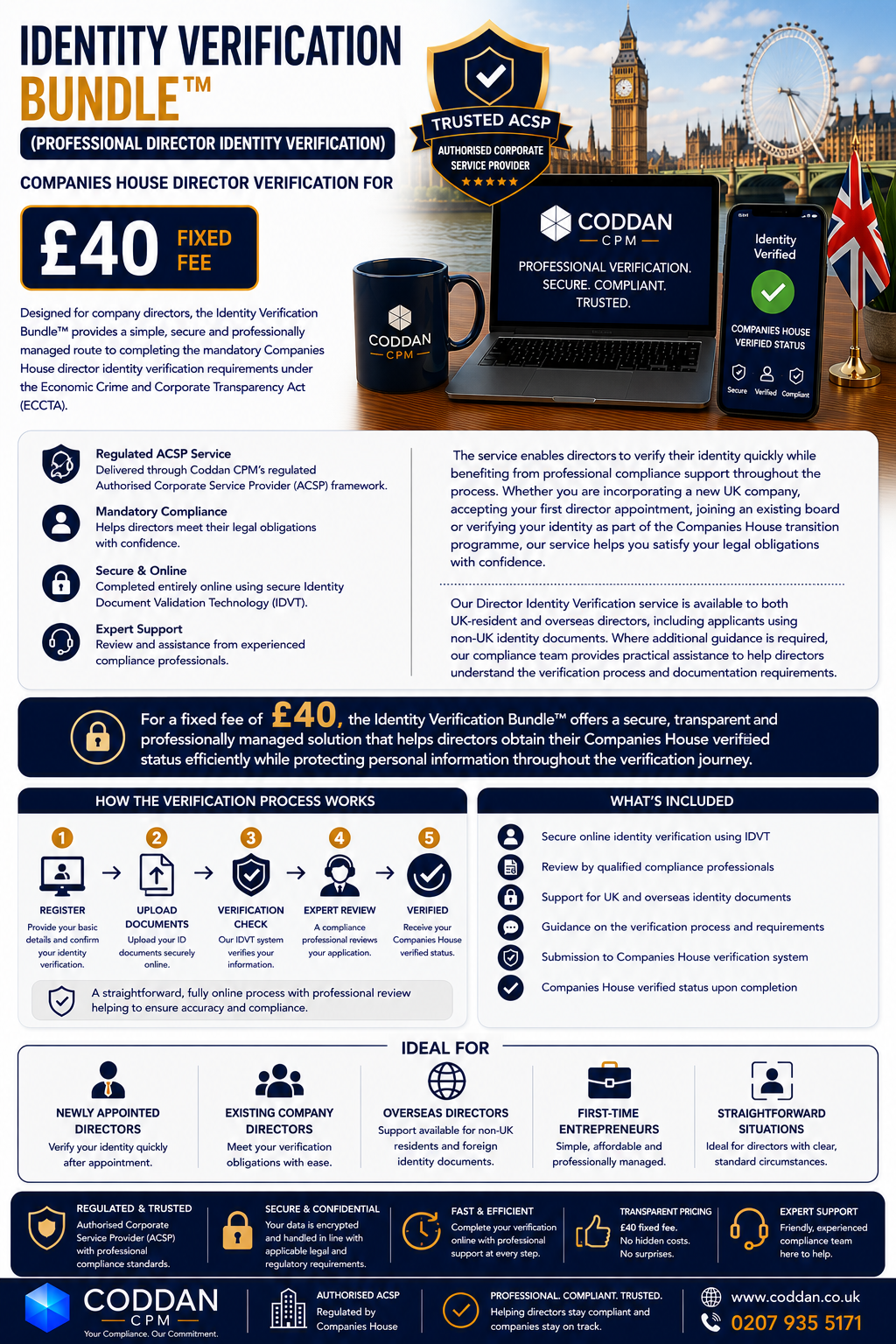
For a fixed fee of £40, this package provides a simple remote verification process with professional ACSP support, without requiring the applicant to travel to the United Kingdom where the available digital route and documents are suitable. Eligibility depends on the applicant's identity evidence and circumstances, not overseas residence alone. The service may assist a proposed or existing director of a UK company, but an overseas-resident director of a UK company should not be confused with a director of an overseas company registered in the UK. Following successful verification, Coddan performs its applicable notification responsibility, while Companies House separately issues the Personal Code. Review our entity and legal-role guidance. |
£65.00+VATRapidVerify Pro™ Recommended for 2
package
Buy Now
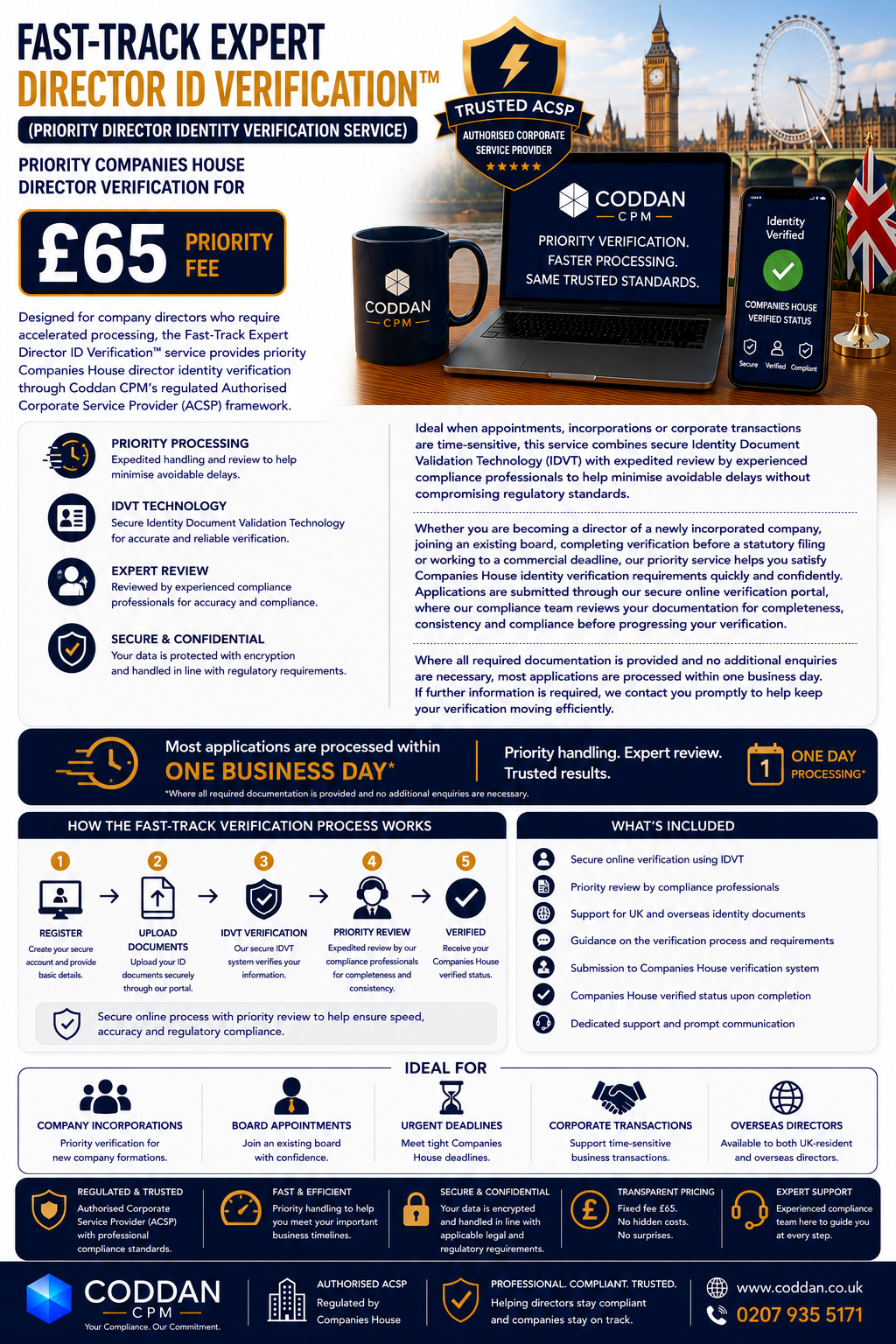
For £65, eligible overseas applicants receive priority review and prompt contact if further suitable information is required. The service provides a fast remote route where the documents and circumstances support digital verification. Priority handling cannot make an ineligible identity document acceptable or allow Coddan to control the technology provider or Companies House decision. The free GOV.UK One Login route may also be available, depending on the applicant's answers and circumstances. Applicants without an urgent timetable can return to the standard £40 overseas route. Those working towards a genuine deadline can review our standalone fast-track verification guidance. |
£125.00+VATVerifyFlex Solutions™ Recommended for 3
package
Buy Now
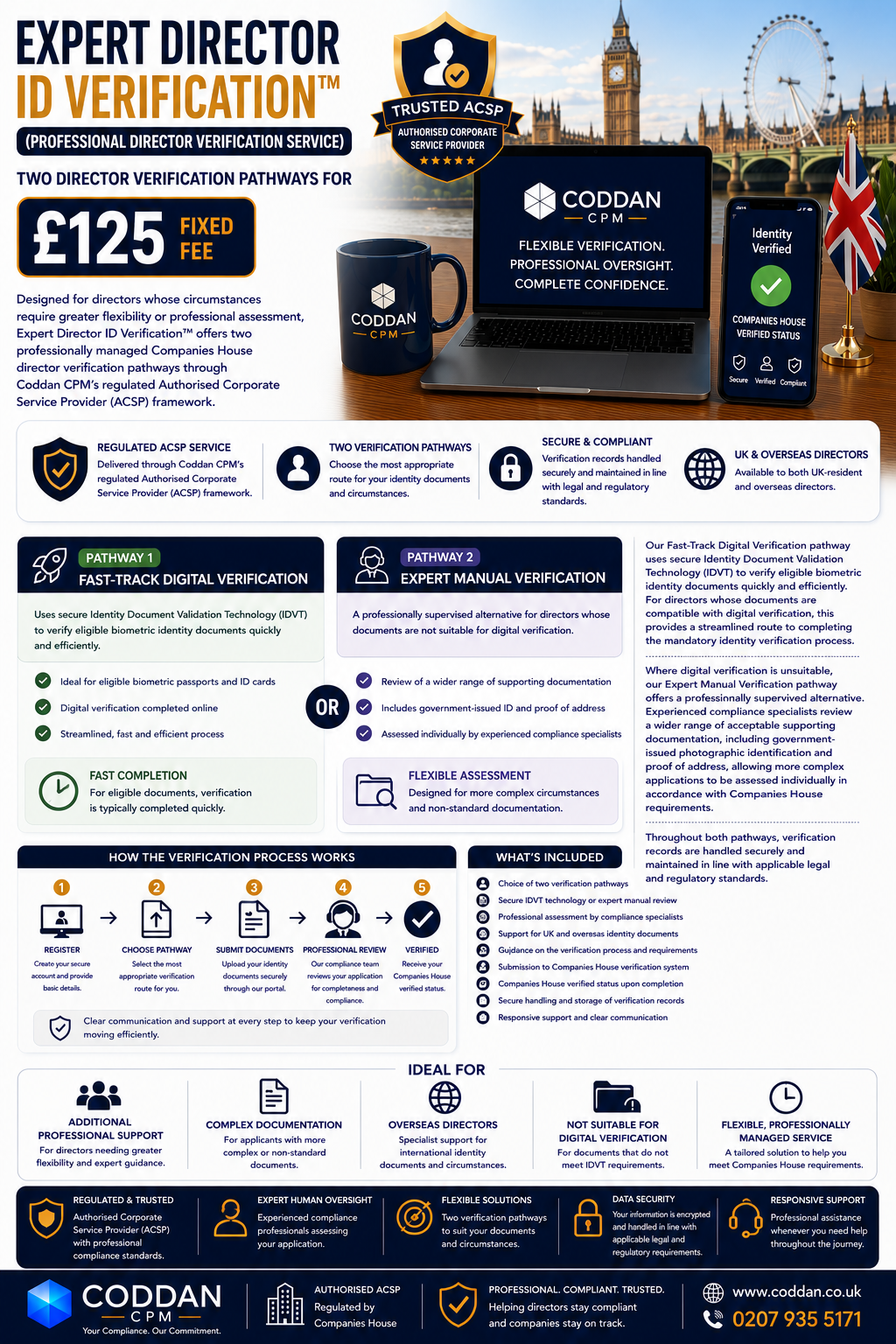
For £125, eligible overseas applicants receive access to two verification pathways and practical guidance concerning suitable identity evidence. The package offers flexibility without assuming that a non-UK passport, overseas address or incomplete attempt automatically requires manual verification. Coddan cannot overturn an earlier outcome, but it may conduct a separate authorised ACSP process where that route is suitable. Verification remains distinct from company formation, director appointment, Personal Code use, PSC linkage and other corporate filings. Applicants should also distinguish residence overseas from acting for an overseas company registered in the UK. Further international and organisational context is available in our international director-verification guidance. |
£220.00+VATFlexiVerify Option™ Recommended for 4
package
Buy Now
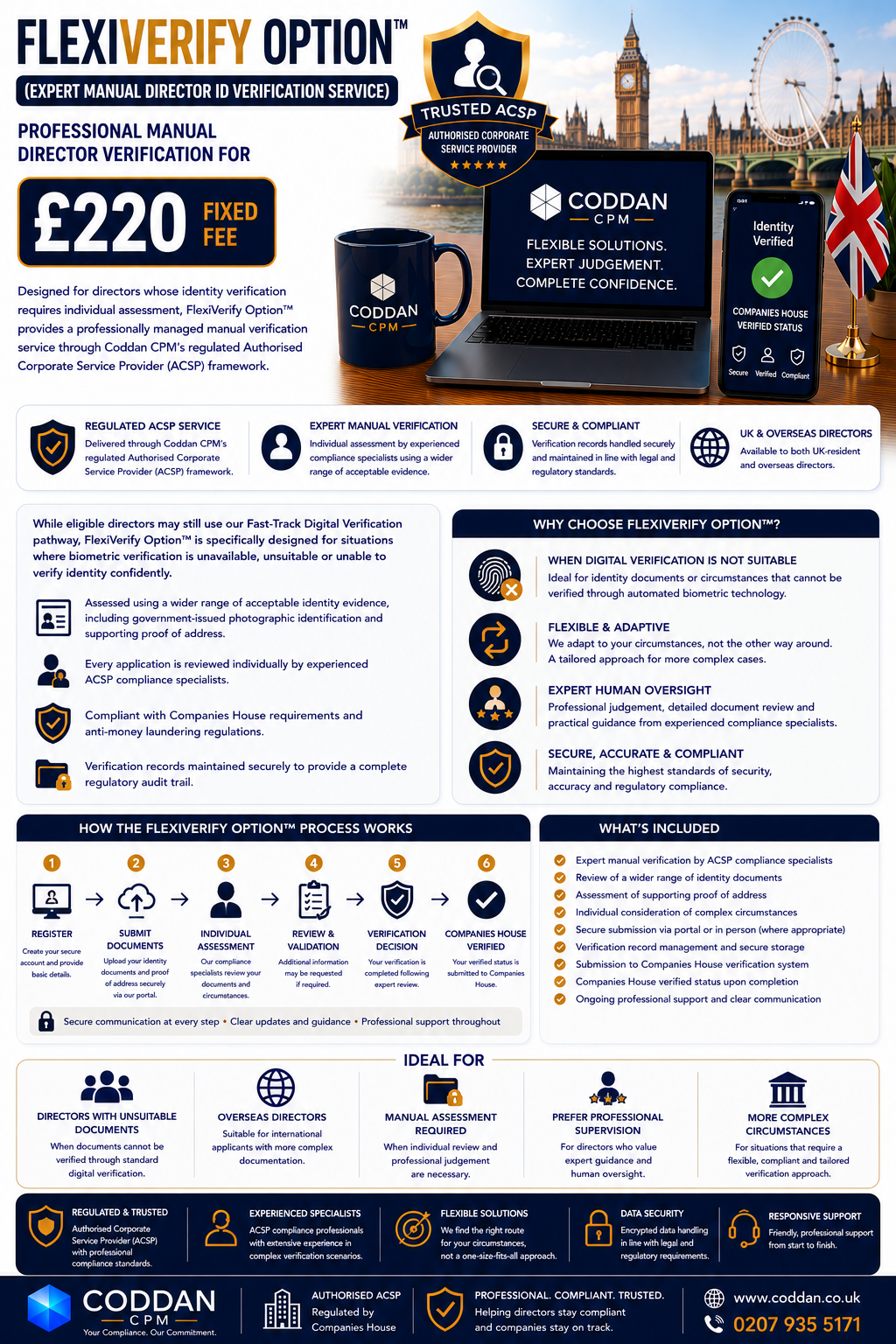
For £220, this package provides Coddan's highest level of individual support for an eligible overseas applicant requiring manual assessment. It may suit a person with non-standard documents, technology difficulties or an earlier digital attempt that did not complete successfully. Payment does not guarantee that the evidence will satisfy the Companies House identity-verification standard or that the process can be completed through every preferred method. Following a successful outcome, Coddan performs its applicable notification responsibility, while Companies House separately issues the Personal Code. Role linkage, company incorporation, director appointment, restoration and other corporate events remain separate processes. Applicants who may suit either a digital or alternative pathway should first compare the two-pathway overseas package or consult our verification-support guidance. |
You already hold a director role in a UK company and live outside the United Kingdom. The first question is not which paid service to choose; it is what, if anything, remains to be completed in your Companies House identity-verification journey.
Start by establishing whether your identity has already been verified, whether Companies House has issued your Personal Code, and whether the applicable director-role connection has been completed. Your nationality, country of residence and the country that issued your identity document are separate facts and should not be treated as interchangeable.
If identity verification is complete and the Personal Code and applicable role step are also complete, the correct outcome may be Nothing Further Required for the identity-verification task. A separate Confirmation Statement, correction or other corporate event may still be outstanding.
An overseas address does not, by itself, create a separate Companies House identity-verification standard. Establish your actual corporate position first: existing director, proposed director, PSC, or a person holding more than one role.
Check whether you have already completed identity verification and whether you already have an 11-character Companies House Personal Code. Companies House guidance states that an individual normally verifies once unless Companies House asks for verification again. The Personal Code is personal to the individual rather than to a particular company.
If you are both a director and a PSC, treat those as separate corporate roles. Completing identity verification does not itself complete every role-related step, and holding both roles does not ordinarily mean repeating identity verification merely because there are two capacities.
Living outside the UK, holding a non-UK nationality and using an identity document issued outside the UK are different circumstances. None should be used as a shortcut for deciding whether a verification route is available.
For the ordinary GOV.UK One Login route, current official guidance says an eligible biometric passport from any country can be used. The route and evidence available to you still depend on the current official requirements and the circumstances of the verification process.
Do not create UK personal details simply because you live overseas. Use your genuine residential and identity information. A company registered office or another person's address should not be substituted for your own residential details.
An eligible overseas director may be able to complete the applicable process online without attending a Coddan office. Remote means that the selected process can be completed without that attendance where the route, evidence and circumstances permit; it does not mean every overseas case is fully remote.
The free GOV.UK One Login verification service is a legitimate first route where you are eligible. Overseas residence does not automatically require an ACSP, and support being available does not mean support is required.
If the ordinary free route is suitable, there is no need to purchase Coddan support merely because you live outside the UK. An ACSP route is an optional alternative where it is selected, suitable and available.
Preparation should focus on your actual circumstances rather than a universal overseas document checklist. Establish the exact name and personal information you intend to use, check that it is consistent with the evidence you hold, and confirm that the selected route accepts that evidence.
Before proceeding, establish whether the relevant document is usable for the route, whether its images or document information can be read by the applicable checking process, whether you can access the relevant email account, and whether verification has already been completed.
Do not assume that every overseas document qualifies, or that every route has the same expiry, certification, translation, notarisation or legalisation rules. Those matters depend on the selected verification route and the circumstances. If the evidence does not fit the ordinary route, identify the appropriate specialist destination rather than treating the difference as an automatic reason for paid support.
Where the selected route permits remote completion, an overseas director can proceed from outside the UK without treating travel to the UK as an inherent part of identity verification.
For the free route, follow the current GOV.UK instructions and the eligibility requirements presented there. For an ACSP route, provide the information and evidence requested for that route and follow its process. Neither route should be described as universally available to every overseas participant.
Remote completion does not promise a successful outcome. The result remains dependent on the applicable identity checks, the evidence supplied and the requirements of the selected route.
If you prefer professional support, Coddan may provide an optional ACSP route where the case is suitable and the service is available. Choosing that route does not lower the Companies House identity-verification standard and does not make paid support mandatory.
In the described Coddan-supported route, the participant supplies the required information and evidence. Verification technology performs the applicable identity and document checks. Coddan then reviews the resulting information and determines whether it is satisfied that the Companies House standard has been met.
Following a successful outcome, Coddan performs its applicable notification responsibility. Coddan cannot direct or override the technology provider's result, compel Companies House to issue a Personal Code, or promise a successful verification outcome. Companies House independently issues the Personal Code.
The ordinary overseas route is intended to help an existing UK-company director establish whether the evidence they hold can be used for the selected verification process. It should not become a universal international-document assessment service.
If your documents are usable for the selected route and your personal information is consistent, continue with that route. If the case involves materially conflicting international records, significant transliteration or name-variation issues, multiple jurisdictions, unusual document formats or other specialist evidence questions, use the dedicated International Director Identity Verification destination.
This page can identify that distinction and route you onwards; it does not perform the specialist international evidence analysis itself.
Identity verification and the Companies House Personal Code are connected but separate stages. Successful identity verification results in Companies House issuing the Personal Code; the code is personal to you rather than to your company.
Companies House currently describes the Personal Code as an 11-character code. If you have already received it, do not treat its existence as proof that every director or PSC role-related step has automatically been completed.
For further code-specific questions, use the dedicated Companies House Personal Code guidance rather than expanding this page into a Personal Code guide.
Once identity verification and the Personal Code position are established, determine which corporate role-related step remains. A verified identity, a Personal Code and a connection to a corporate role are not interchangeable concepts.
If you are a director of more than one company, the same Personal Code belongs to you as an individual and may be used for the applicable director appointments. If you are also a PSC, the PSC role has its own applicable requirements. The two roles should be considered separately.
If your remaining issue is specifically role linkage, use the relevant director or PSC role-linkage guidance rather than repeating identity verification unnecessarily.
The remaining task may be a role-linkage step, a separate PSC requirement or a company event. Do not treat those tasks as additional identity verification unless Companies House requires verification again.
Completing your identity verification does not itself complete a company filing or corporate event. The next task may instead concern a Confirmation Statement, a director appointment, a correction, incorporation or another Companies House event.
For an existing director preparing for a Confirmation Statement, the applicable Personal Code and filing requirements should be considered separately from the fact that identity verification has already occurred. Likewise, a correction to company or personal information is a separate task.
If the remaining job is the company's Confirmation Statement and identity verification is not the unresolved issue, use the dedicated Confirmation Statement identity-verification guidance.
The authority chain should remain clear. You provide the information and evidence. Verification technology performs the applicable checks. Where Coddan is acting as the ACSP, Coddan reviews the resulting information and makes the ACSP decision on whether the Companies House standard has been met.
Coddan can perform its applicable notification responsibility following a successful outcome. Companies House remains the authority that issues the Personal Code and controls its own register and filing processes.
Coddan cannot lower the Companies House standard, force technology to accept evidence, overturn an unsuccessful GOV.UK or other route, compel a Personal Code to be issued, or promise acceptance of a later filing. Identity verification is also separate from AML, KYC and CDD work.
If the ordinary route has not been completed successfully, do not assume that overseas residence itself is the problem or that paid support is automatically required. Establish what actually remains unresolved.
A substantive failed-attempt diagnosis may involve the personal information, evidence, Companies House record or selected route. That is a different professional job from ordinary overseas preparation.
For a failed or incomplete verification that requires reconciliation, use the verified Resolving Identity Verification Issues destination. An unsuccessful direct or Post Office pathway does not automatically require an ACSP or paid support.
The applicable requirement depends on the person's role, circumstances and the current Companies House implementation position. Do not treat every future identity-verification presenter category as a current obligation for an existing overseas director.
Keep the following distinctions clear: existing directors; proposed or new directors; former directors; PSCs; people holding both roles; and directors of overseas companies registered in the UK. A director of an overseas company registered in the UK may require a different specialist route from an individual director of a UK company who simply lives abroad.
There is no universal November 2026 deadline to insert into this page. Use the current official Companies House timing guidance for the specific role and circumstances instead.
An overseas director can have an ordinary remote verification case even when their residence and identity documents are outside the UK. International complexity should be identified from the circumstances, not assumed from geography alone.
Specialist international treatment may become relevant where records materially conflict, names differ substantially across jurisdictions, transliteration creates a significant identity question, multiple jurisdictions interact, or the evidence route requires specialist analysis. Directors of overseas companies registered in the UK can also fall within a different specialist context.
Where one of those circumstances is genuinely present, route to the dedicated International Director Identity Verification destination rather than expanding this page into a specialist international guide.
Companies House identity verification is a defined process. It should not be merged with broader customer due diligence, anti-money-laundering checks or general corporate onboarding.
An ACSP may have separate legal or regulatory obligations when providing services, but those obligations do not change the Companies House identity-verification standard or turn AML, KYC and CDD into part of the director's identity-verification result.
The practical question on this page is whether the existing overseas director can establish and complete the applicable Companies House identity-verification route. Other compliance work should be dealt with under the destination that owns it.
The correct next step is determined by the unresolved task, not by the fact that you live outside the UK. Use this decision sequence to avoid repeating work that is already complete.
If verification is outstanding and the free route is suitable, start with GOV.UK One Login. If you want optional professional ACSP support and the route is suitable, Coddan may be considered. If a failed attempt needs diagnosis, use the resolving-issues destination. If specialist international evidence analysis is needed, use the International Director destination.
If verification is complete, the Personal Code has been received, the applicable director-role step is complete, any separate PSC requirement is complete, and no connected corporate event remains, the correct identity-verification outcome is Nothing Further Required.
This page helps an existing individual director of a UK company who lives abroad determine whether identity verification remains, prepare for an ordinary remote route and identify the next separate task. It does not become a general company-formation, governance or international-document service.
Use the following checks only to identify the next destination. They are not additional stages that every overseas director must complete.
Stay on this page where residence abroad is the main circumstance and the information and evidence fit an available ordinary route.
Use the international specialist destination for material cross-border inconsistencies, transliteration issues, multiple jurisdictions or unusual evidence questions.
Use the dedicated Personal Code guidance if verification succeeded and the remaining job concerns receiving, understanding or using the code.
Treat director and PSC roles separately. A person holding both roles ordinarily verifies once but must address the applicable code step for each role.
Incorporation, appointment, Confirmation Statement filing, correction and restoration are separate professional jobs and should use their own destinations.
Stop the identity-verification journey where verification, the Personal Code and every applicable role step are complete and no connected event remains.
No. Use the free GOV.UK One Login route where you are eligible. An ACSP is an optional alternative, not a requirement created by overseas residence.
Current GOV.UK guidance says an eligible biometric passport from any country may be used with GOV.UK One Login. Eligibility and evidence requirements still depend on the route.
No. Remote describes how an available route may be completed. It does not guarantee document acceptance, verification, Personal Code issue or later filing acceptance.
Identify the failed stage before repeating the submission or changing route. An unsuccessful attempt does not automatically require paid support.
Companies House issues the Personal Code following successful identity verification. Coddan does not create the code or control when Companies House issues it.
Nothing Further Required may be the correct identity-verification outcome, provided no role-related step or separate corporate event remains.
The answer must follow the Participant's real position, the evidence available and the professional job that remains.
Overseas residence alone does not remove the legitimate GOV.UK One Login option where the individual is eligible.
Coddan support may be selected where suitable, but support being available does not mean support is required.
An eligible remote route may be completed from abroad; availability depends on the route, evidence and circumstances.
Do not publish one universal checklist for passports, identity cards, translations, certification or supporting evidence.
A route-access problem, unreadable evidence, data mismatch and an ACSP satisfaction decision are different issues.
If the same person holds both roles, address each applicable role step without describing it as repeated identity verification.
Do not state that future requirements for other filing or entity categories have commenced unless current official guidance confirms it.
No. Nationality, residence and the country issuing an identity document are separate facts.
No. Use genuine personal and residential information. Do not substitute company or third-party details for the individual's residential details.
No. Technology performs the applicable checks. Coddan reviews the resulting information and makes its own ACSP satisfaction decision.
No. Verification, Personal Code issue, role linkage and the relevant company filing remain separate stages.
No. Companies House ACSP registration and anti-money-laundering supervision are distinct. Companies House identity verification is also separate from AML, KYC and CDD.
No. Coddan cannot guarantee a technology result, its own satisfaction decision, Companies House action, Personal Code issue, filing acceptance or timing.
Use the free Companies House route where eligible, or consider optional Coddan-supported ACSP verification where selected and suitable. Do not purchase support merely because you live overseas.
If identity verification, Personal Code issue, every applicable director or PSC role step and any connected corporate event are complete, Nothing Further Required may be the correct outcome.


Coddan CPM LTD™ Business One-Stop Shop since 2005 Doing Business Made Easier!
