We use cookies on this website, you can read about cookies and GDPR Privacy Policy here
Coddan CPM Ltd. – Company Registration Agent in the UK

Follow the practical journey of your Companies House Personal Code as you manage key corporate changes and maintain compliance throughout your company's lifecycle.

Step 1
Understand Compliance Duties
Step 2
Review Corporate Changes
Step 3
Protect Verified Identity
Step 4
Complete Statutory Updates
Step 5
Secure Company Records
Step 6
Maintain Ongoing Compliance
Companies Registry's e-Services Portal Identity Verification Director ID Verification The Director’s Digital Passport: Managing Your Companies House Personal Code

The Director’s Digital Passport: Managing Your Companies House Personal Code


Unlock the secrets to managing your Companies House Personal Code!Ensure compliance and streamline corporate governance for your evolving business

Managing Your Companies House Personal Code with Confidence
Receiving your 11-character Companies House Personal Code is only the beginning of your compliance journey. As your company evolves, your Personal Code becomes part of many important corporate events, from appointing and resigning directors to changing your registered office, updating Persons with Significant Control (PSC), managing share transfers and maintaining accurate Companies House records. Understanding these responsibilities helps reduce unnecessary delays, protects your company's compliance position and supports effective corporate governance throughout the business lifecycle.
Building a Strong Foundation: Empowering Your Business Journey with Expert Corporate Services
Our professionally managed Authorised Corporate Service Provider (ACSP) packages are designed to support directors, shareholders and business owners at every stage of that journey. Whether you simply need straightforward identity verification, priority processing, greater flexibility for more complex circumstances or a fully supervised manual verification route, each package provides the essential services required to establish and maintain your verified Companies House identity. By combining secure identity verification with experienced compliance guidance, Coddan helps UK and international directors build a strong foundation for the ongoing management of their Companies House responsibilities.
International Director Compliance

Managing Your Personal Code Wherever You Manage Your UK Companies

Directors, shareholders and key officers based outside the United Kingdom have the same Companies House responsibilities as UK-based directors. Managing your Personal Code correctly helps support director appointments, registered office changes, share transfers, PSC updates and other statutory obligations, regardless of where you live or conduct business.

Managing Compliance Across Borders

International directors often manage UK companies from different jurisdictions while coordinating multiple advisers, statutory deadlines and corporate changes. Understanding when your Personal Code is required helps reduce unnecessary delays and supports accurate Companies House filings throughout your business lifecycle.

Professional ACSP Support

As a regulated Authorised Corporate Service Provider (ACSP), Coddan helps UK and overseas directors manage identity verification, Personal Code requirements and Companies House compliance through professionally supported services designed for both straightforward and more complex corporate circumstances.

Supporting International Directors: Whether you manage a single UK company, oversee multiple group companies or join boards from overseas, understanding how your Personal Code supports ongoing Companies House compliance helps you maintain accurate corporate records and confidently manage future statutory responsibilities.


Start Your Business Today: Fast Formation Services to Meet All Compliance Standards

Ensure compliance with Companies House through rapid, secure ID verification for Directors and PSCs. Complete the process online with an authorized ACSP

treamline your compliance with Companies House using our fast, secure ID verification for Directors and PSCs, all completed online by an authorized ACSP
£40.00
+VAT

IdentityGuard Pro™

Recommended for

1
package

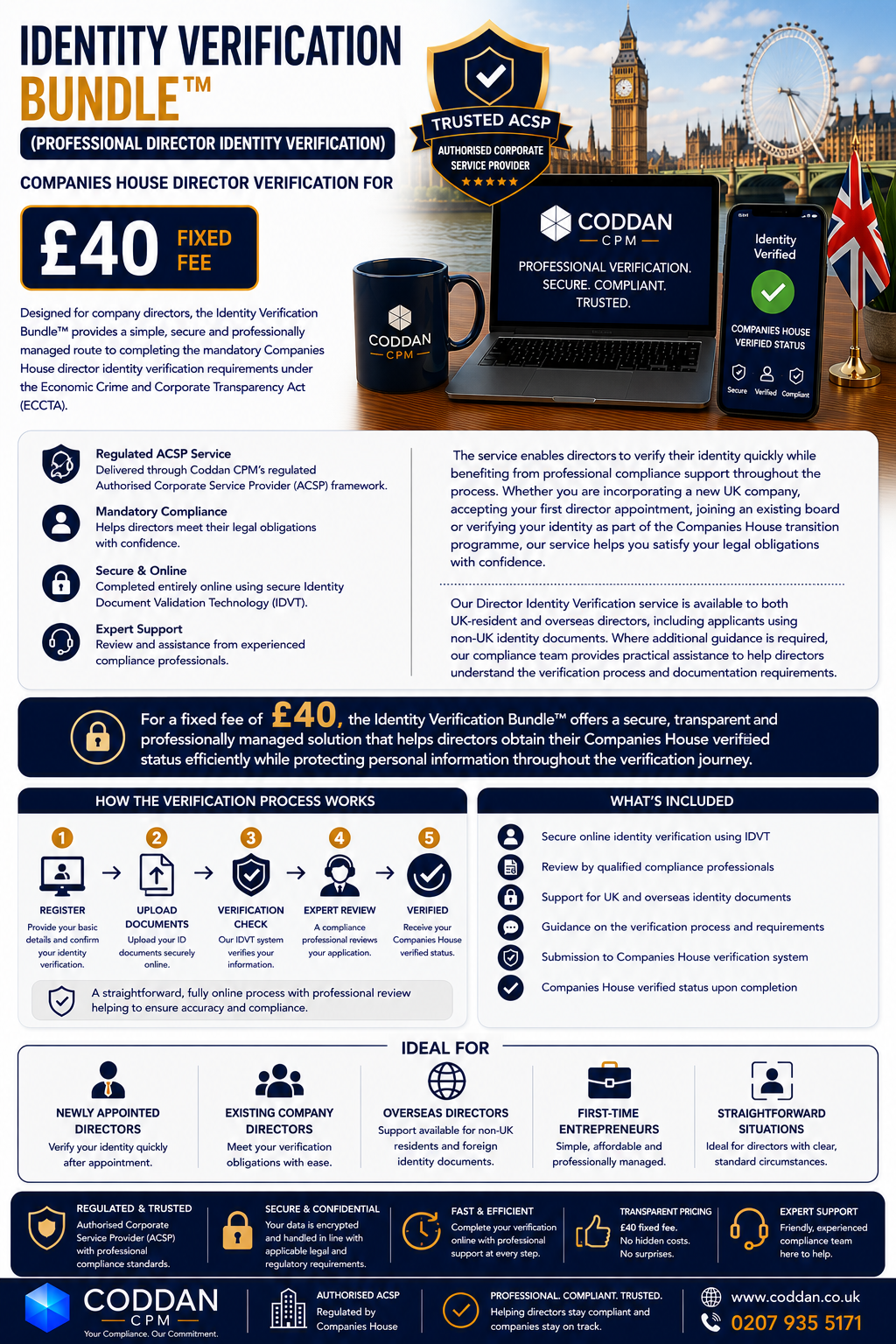
Buy Now Identity Verification Bundle™ (Professional Director Identity Verification) – Obtain Your Companies House Personal Code Through Remote Director Identity Verification for £40.
The Identity Verification Bundle™ provides a simple, secure and professionally managed solution for applicants who need to complete mandatory Companies House director identity verification and obtain their unique 11-character Companies House Personal Code without travelling to the United Kingdom. Delivered through Coddan CPM's regulated Authorised Corporate Service Provider (ACSP) framework, this service enables UK and overseas directors, international entrepreneurs and Persons with Significant Control (PSCs) to complete identity verification remotely while meeting the requirements introduced under the Economic Crime and Corporate Transparency Act (ECCTA) . Whether you are preparing to incorporate a UK company, accepting your first directorship, joining an existing company or completing identity verification during the Companies House transition period, this professionally managed service provides the first step towards establishing your verified corporate identity. Verification is completed using secure Identity Document Validation Technology (IDVT) , with every application supported by experienced compliance professionals who help ensure your submission is complete, accurate and compliant with Companies House requirements, enabling you to begin your long-term Companies House journey with confidence.

The service has been developed for both UK and international applicants, including directors using eligible non-UK identity documents and biometric passports. Once your identity has been successfully verified, you receive the Companies House Personal Code that becomes your permanent verified identifier throughout your corporate career. Where additional assistance is required, our compliance team provides practical guidance throughout the remote verification process, helping you understand the documentation requirements while reducing the likelihood of unnecessary delays. For a fixed fee of £40, the Identity Verification Bundle™ offers a secure, transparent and professionally managed route to obtaining your verified Companies House identity through a regulated ACSP. It is ideally suited to first-time directors, overseas entrepreneurs, non-UK resident directors, international investors and anyone seeking a trusted, professionally supported route to obtaining their Companies House Personal Code and building a strong foundation for long-term UK corporate compliance.


£65.00
+VAT

RapidVerify Pro™

Recommended for

2
package

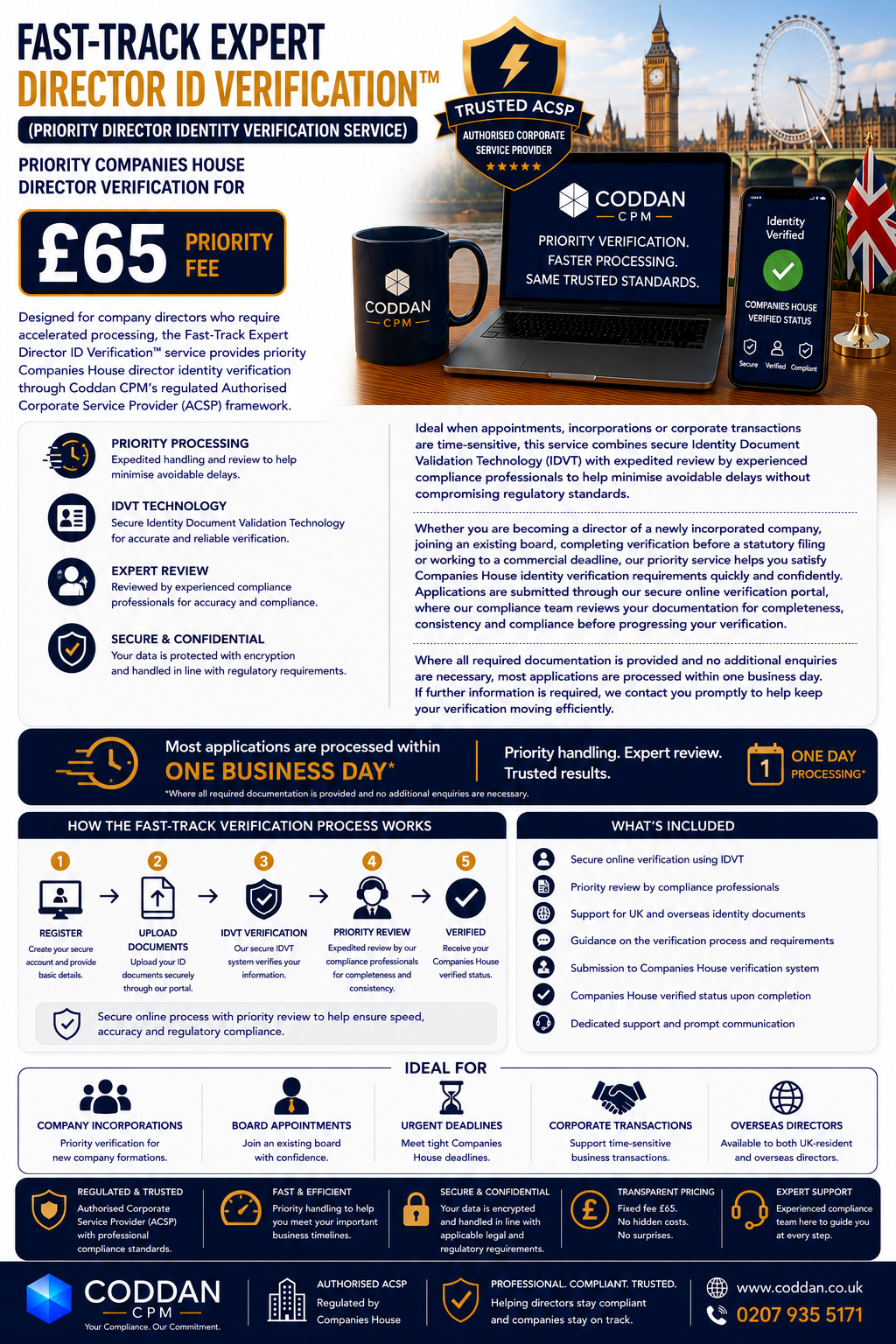
Buy Now Fast-Track Expert Director ID Verification™ (Priority Director Identity Verification Service) – Priority Remote Identity Verification to Obtain Your Companies House Personal Code for £65.
The Fast-Track Expert Director ID Verification™ service is designed for directors who require priority Companies House identity verification and rapid access to their 11-character Companies House Personal Code without compromising accuracy, security or regulatory compliance. Delivered through Coddan CPM's regulated Authorised Corporate Service Provider (ACSP) framework, this premium service combines secure Identity Document Validation Technology (IDVT) with priority review by experienced compliance professionals, enabling UK and overseas applicants to complete identity verification remotely and begin using their verified Companies House identity as quickly as possible. Ideal for urgent UK company incorporations, director appointments, corporate transactions and statutory filing deadlines, this service provides priority handling from the moment your application is received. Every submission is carefully reviewed to help ensure your documentation is complete, consistent and compliant before progressing through the verification process, reducing the likelihood of unnecessary delays and helping you obtain the Personal Code needed to support your future Companies House responsibilities. Where all required information is provided, and no additional enquiries are necessary, most applications are processed within one business day.

If additional documentation is required, our compliance team will contact you promptly to help keep your verification progressing efficiently. The service has been developed for UK and international directors, including applicants using eligible non-UK identity documents and biometric passports. Once your identity has been successfully verified, you receive the Companies House Personal Code that becomes your permanent verified identifier for future company formations, director appointments and ongoing Companies House compliance. For £65, the Fast-Track Expert Director ID Verification™ service provides a faster, professionally managed route to obtaining your verified Companies House identity through a regulated ACSP. It is ideally suited to entrepreneurs, non-UK resident directors, international investors and businesses working to urgent commercial or regulatory deadlines that require their Companies House Personal Code quickly, securely and with the reassurance of experienced ACSP compliance specialists—without travelling to the United Kingdom.


£125.00
+VAT

VerifyFlex Solutions™

Recommended for

3
package

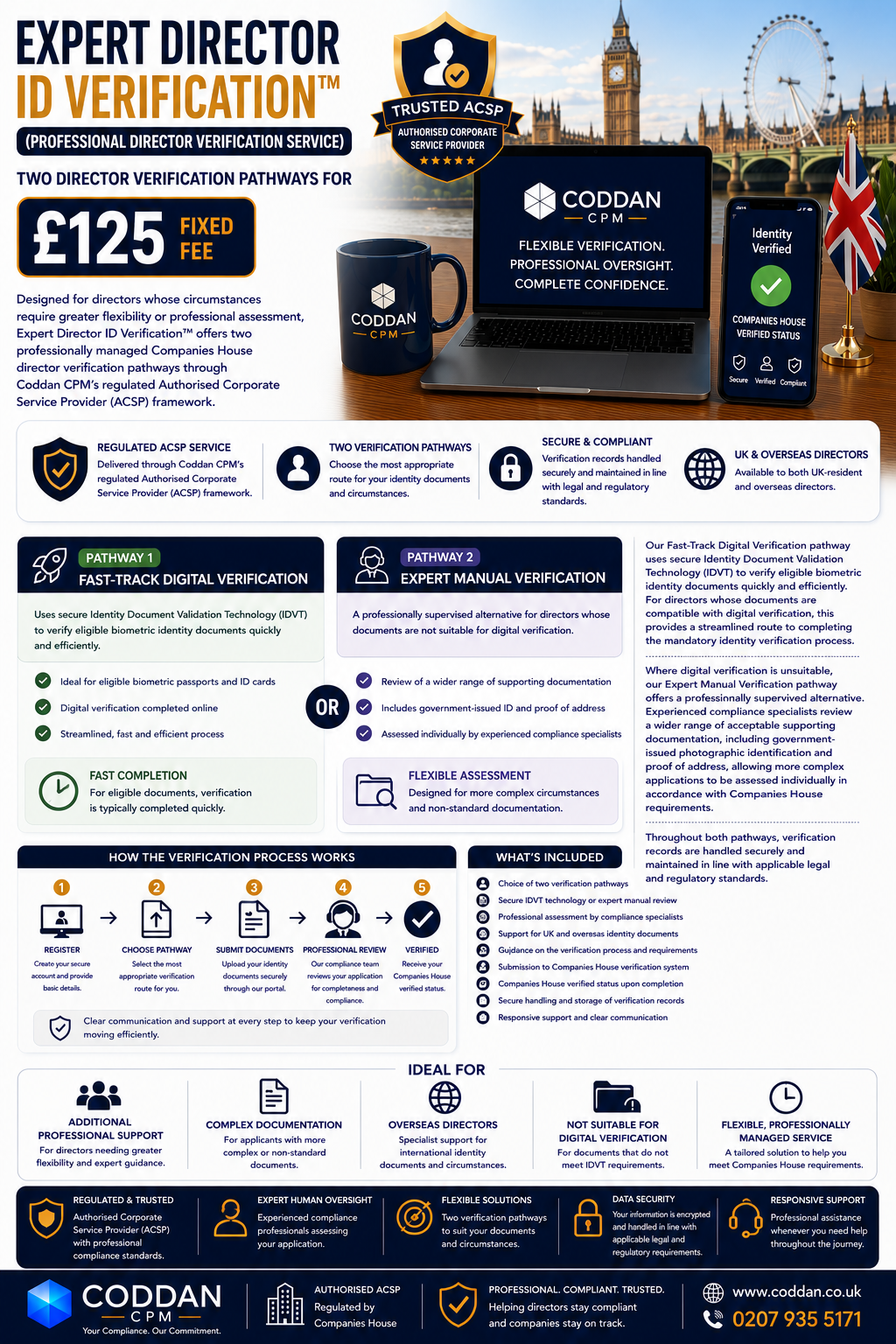
Buy Now Expert Director ID Verification™ (Professional Director Verification Service) – Two Remote Identity Verification Pathways to Obtain Your Companies House Personal Code for £125. The Expert Director ID Verification™ service is designed for directors, overseas entrepreneurs and international applicants who require greater flexibility when completing Companies House identity verification and obtaining their 11-character Companies House Personal Code. Delivered through Coddan CPM's regulated Authorised Corporate Service Provider (ACSP) framework, this professionally managed service offers two remote verification pathways, allowing applicants to choose the option that best matches their identity documents, country of residence and individual circumstances while meeting Companies House requirements. Our Fast-Track Digital Verification pathway uses secure Identity Document Validation Technology (IDVT) to verify eligible biometric identity documents quickly and efficiently. Where digital verification is not suitable, our Expert Manual Verification pathway provides a professionally supervised alternative, enabling experienced compliance specialists to review a broader range of acceptable identity documents and supporting evidence in accordance with applicable regulatory requirements. Both verification pathways have been developed to support UK and overseas applicants using eligible non-UK identity documents, biometric passports and other accepted forms of identification, helping them establish the verified identity that leads to the issue of their Companies House Personal Code.

Throughout the remote verification process, our compliance team provides practical guidance, carefully reviews every application and helps ensure all documentation satisfies Companies House requirements before identity verification is completed, reducing the likelihood of delays caused by incomplete or unsuitable submissions. We also help applicants determine which verification pathway is likely to be the most appropriate for their documentation before the process begins. For £125, the Expert Director ID Verification™ service combines advanced verification technology with experienced professional oversight, providing a flexible and reliable route to obtaining your verified Companies House identity through a regulated ACSP. It is ideally suited to overseas directors, non-UK resident applicants, individuals whose identity documents are unsuitable for straightforward digital verification and anyone seeking a trusted, professionally managed pathway to obtaining their Companies House Personal Code while building a secure foundation for future company formations, director appointments and long-term Companies House compliance.


£220.00
+VAT

FlexiVerify Option™

Recommended for

4
package

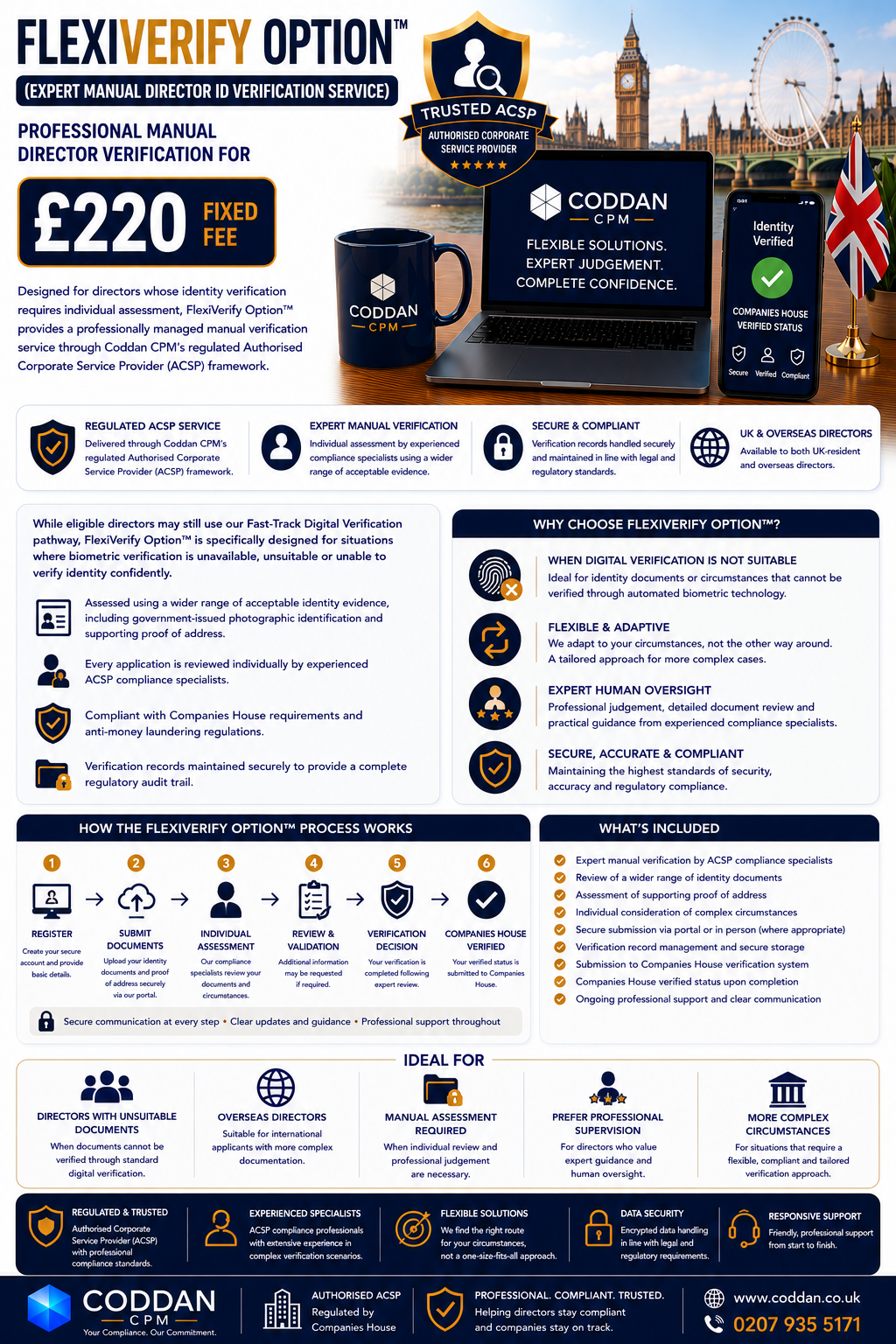
Buy Now FlexiVerify Option™ (Expert Manual Director ID Verification Service) – Professionally Managed Manual Identity Verification to Obtain Your Companies House Personal Code for £220.
The FlexiVerify Option™ is designed for directors whose Companies House identity verification requires individual assessment beyond standard digital verification in order to obtain their 11-character Companies House Personal Code. Delivered through Coddan CPM's regulated Authorised Corporate Service Provider (ACSP) framework, this professionally managed manual verification service provides a flexible and compliant solution for UK and overseas applicants whose circumstances are more complex or whose identity documents are unsuitable for automated verification. While eligible applicants may still use our Fast-Track Digital Verification pathway, FlexiVerify Option™ has been developed specifically for situations where biometric verification is unavailable, unsuitable or unable to verify identity with sufficient confidence. Rather than relying solely on automated technology, experienced compliance specialists assess every application individually, reviewing a broader range of acceptable identity evidence, including government-issued photographic identification, supporting proof of address and other documentation where appropriate, in accordance with applicable Companies House and anti-money laundering requirements. Applications are submitted securely through our online verification portal, with in-person verification available where appropriate, enabling even complex applicants to establish the verified identity that leads to the issue of their permanent Companies House Personal Code.

Every application receives an individual professional review, with comprehensive verification records maintained to support an appropriate regulatory audit trail and demonstrate compliance with applicable legal obligations. Where documentation requires additional clarification, our compliance professionals provide practical guidance throughout the verification process, helping applicants understand the most appropriate evidence for their individual circumstances while reducing unnecessary delays. For £220, FlexiVerify Option™ provides the highest level of professionally managed support for complex identity verification requirements and the secure establishment of your long-term Companies House identity through a regulated ACSP. It is ideally suited to directors requiring manual assessment, applicants using non-standard international identity documents, individuals with more complex verification circumstances and anyone seeking a fully supervised route to obtaining their Companies House Personal Code, providing a strong foundation for future director appointments, company formations and ongoing Companies House compliance throughout their corporate journey.


Keep your business compliant! Learn how your Personal Code continues to support vital corporate activities long after your Companies House identity verification

Your Personal Code Continues Working Long After Identity Verification
Completing your Companies House identity verification is an important milestone, but it is not the end of your compliance journey. Once issued, your 11-character Personal Code becomes part of many routine and significant corporate activities throughout the life of your business. Whether you update your registered office, appoint or resign directors, transfer shares, record changes to Persons with Significant Control (PSC), or simply work to keep your company compliant, understanding how your Personal Code fits into each process helps you make informed decisions and maintain accurate Companies House records.
Unlocking Success: How the Right Verification Pathway Can Transform Your Corporate Compliance
Our four verification packages are not designed on a simple good, better, best pricing model. Instead, each package provides a complete identity verification service that satisfies different practical requirements. The right choice depends on your individual circumstances, the identity documents you hold, the level of professional support you require and the verification pathway most appropriate for your situation. Once your identity has been successfully verified, the guidance below explains how your Personal Code supports your ongoing Companies House responsibilities and how professional compliance support can help you manage your corporate obligations with confidence throughout your business lifecycle.

Companies House Compliance Lifecycle

Managing Your Personal Code Throughout Your Corporate Journey

Your Companies House Personal Code supports far more than identity verification. As your company evolves, it helps connect your verified identity to important corporate changes and ongoing statutory responsibilities throughout the business lifecycle.

Registered Office Changess

Support compliant changes to your registered office while maintaining accurate Companies House records and reliable communication channels.

Board Changes

Understand how your Personal Code supports director appointments, resignations and changes to company leadership.

Ownership Changes

Keep director, shareholder and PSC information aligned during share transfers and significant control changes.

Compliance Protection

Protect your Personal Code, reduce compliance risks and help safeguard your company against avoidable filing issues and strike-off action.

Professional Compliance Support: Managing a Companies House Personal Code extends beyond identity verification. Coddan's regulated ACSP and corporate secretarial services help directors and business owners manage corporate changes, maintain accurate statutory records and support ongoing Companies House compliance throughout the life of the company.


Managing Your Personal Code During Registered Office Changes

Changing your company's registered office address is more than an administrative update. Under the Economic Crime and Corporate Transparency Act (ECCTA), Companies House places increasing emphasis on ensuring that company information is accurate, reliable and supported by verified individuals. While your 11-character Companies House Personal Code is not the registered office itself, it forms part of the trusted identity framework that supports many statutory filings submitted throughout your company's lifetime.

Understanding how your Personal Code, verified identity and registered office work together helps directors maintain accurate Companies House records and reduces the risk of unnecessary filing delays or compliance issues.

Registered Office Changes Are Now Part of a Wider Compliance Framework
A registered office address is the official legal address of a UK company. It is where Companies House, HMRC and other public authorities send statutory correspondence, notices and legal documents.

When a company changes its registered office, Companies House is not simply recording a new address. The filing forms part of a broader compliance framework designed to ensure that company information remains accurate and that filings originate from authorised individuals or authorised representatives acting on the company's behalf.

Your Personal Code supports this wider framework by confirming the verified identity of directors and other relevant individuals involved in the company's ongoing governance.

Verified Identity Supports Reliable Companies House Records
The introduction of director identity verification means Companies House is building a more reliable register based on verified individuals rather than anonymous filings.

When registered office information is updated, Companies House expects the filing to be submitted through the appropriate authorised process. Where identity verification requirements apply, verified directors and regulated Authorised Corporate Service Providers (ACSPs) help provide confidence that statutory information is being updated by legitimate individuals acting with proper authority.

Rather than viewing your Personal Code as something used only once during identity verification, it should be understood as part of the trusted identity that underpins your continuing relationship with Companies House.

Choosing an Appropriate Registered Office Address
The Economic Crime and Corporate Transparency Act introduced stronger requirements for registered office addresses.

Every UK company must maintain an appropriate registered office address, meaning an address where:

  • official correspondence can be delivered;
  • documents are capable of coming to the attention of someone acting for the company; and
  • delivery can be acknowledged where appropriate.

Addresses that fail to satisfy these legal requirements may be challenged by Companies House.

For many businesses—particularly overseas entrepreneurs, non-UK resident directors and companies without permanent UK premises—using a professionally managed registered office service helps ensure these statutory requirements continue to be met.

Why Many Directors Use an ACSP Registered Office Service
A regulated Authorised Corporate Service Provider (ACSP) can support more than identity verification.

Professional registered office services provide:

  • an address designed to satisfy Companies House requirements;
  • secure handling of statutory correspondence;
  • prompt notification of important government communications;
  • coordinated support between registered office services and ongoing corporate compliance.

For directors managing Companies House obligations from outside the United Kingdom, having identity verification, Personal Code support and registered office administration managed through the same professional provider can simplify ongoing compliance.

Managing Registered Office Changes Across Multiple Companies
Many entrepreneurs act as directors of more than one UK company.

When multiple companies relocate their registered offices, each company maintains its own statutory records and filing obligations, even though the same verified director may be involved.

Because your Personal Code belongs to you, rather than to any individual company, it continues to identify you consistently across every directorship. This provides continuity as companies update their registered office details, appoint new directors or make other statutory changes.

Coordinating these changes carefully helps maintain consistent Companies House records across an entire corporate portfolio.

Why Accurate Registered Office Information Matters
The registered office remains the official point of contact between Companies House and your company.

If statutory correspondence cannot be delivered, Companies House has powers to investigate whether the registered office remains appropriate. Failure to maintain accurate company information may result in additional compliance action and can create significant administrative difficulties for directors.

Keeping both your registered office details and your verified identity information up to date helps ensure that important notices reach the company promptly and that statutory deadlines are not missed.

Professional Support Throughout the Company Lifecycle
Updating a registered office is only one of many events that occur during the life of a UK company.

Directors may also need to:

  • appoint or resign directors;
  • update Persons with Significant Control (PSCs);
  • file annual Confirmation Statements;
  • change the company name;
  • restructure share ownership;
  • manage multiple directorships.

Each of these activities forms part of the company's continuing compliance journey.

Rather than viewing identity verification as a one-off requirement, many directors choose ongoing professional support to help coordinate their Personal Code, registered office services and Companies House filings throughout the lifetime of their companies.

For UK-based businesses as well as directors located in Europe, North America, the Middle East, Asia-Pacific, Africa and other international jurisdictions, this integrated approach can help maintain accurate statutory records, reduce administrative complexity and provide greater confidence that Companies House obligations continue to be managed effectively.

Personal Code Checkpoint

Stage: Registered Office Address Change
Is the Personal Code Required? Supports the verified identity framework used throughout ongoing Companies House compliance.
Who Uses It? Verified directors and, where appointed, an Authorised Corporate Service Provider (ACSP).
When? When managing ongoing Companies House obligations connected with maintaining accurate company information.
Typical Filing: Registered Office Address Change.


Managing Your Personal Code During Director Appointments

Appointing a new director has become a more structured compliance process under the Economic Crime and Corporate Transparency Act (ECCTA). Identity verification is now an important part of joining the board of a UK company, helping Companies House improve the accuracy and reliability of the public register.

Your 11-character Companies House Personal Code is central to this process. Rather than being created for a particular company, it permanently identifies you as a verified individual and accompanies you throughout your career as a UK company director or Person with Significant Control (PSC).

Understanding how your Personal Code fits into the appointment process helps companies plan director appointments efficiently while reducing the risk of unnecessary delays.

Identity Verification Comes Before Director Appointments
Historically, companies could appoint directors and complete the associated Companies House filing shortly afterwards, with relatively little emphasis on verifying the director's identity beforehand.

Under the modern Companies House identity verification framework, identity verification becomes an important step before an individual begins acting as a director. The Personal Code issued after successful verification provides the trusted digital identity that supports future Companies House interactions.

For new appointments, it is therefore sensible to complete identity verification as early as possible rather than waiting until corporate deadlines are approaching.

Planning verification in advance allows companies to appoint directors more efficiently and helps avoid delays when important filings need to be submitted.

Why Preparation Makes Director Appointments Easier
Director appointments often occur during important business events, including:

  • incorporating new companies;
  • expanding management teams;
  • attracting outside investment;
  • appointing overseas executives;
  • restructuring corporate boards;
  • replacing retiring directors.

These events frequently involve multiple statutory filings taking place within a relatively short period.

Ensuring that incoming directors have already completed identity verification and received their Personal Codes allows the appointment process to proceed more smoothly when Companies House filings are prepared.

Rather than treating identity verification as a last-minute administrative task, many businesses now include it as an early stage of their board planning process.

Coordinating Multiple Director Appointments
Many growing companies appoint several directors at the same time.

This commonly occurs when:

  • investment rounds complete;
  • overseas parent companies establish UK subsidiaries;
  • management buy-outs take place;
  • businesses expand internationally;
  • group companies appoint new executive teams.

Where several directors are joining simultaneously, careful coordination helps prevent unnecessary delays.

Although every director receives their own Personal Code, each individual must complete their own identity verification. Planning these verification activities together helps companies keep board appointments on schedule and reduces the likelihood that one outstanding verification will delay wider corporate changes.

Supporting International Director Appointments
Many UK companies appoint directors who live outside the United Kingdom.

These may include:

  • overseas entrepreneurs;
  • foreign investors;
  • multinational executives;
  • international group company directors;
  • non-UK resident shareholders joining the board.

Although Companies House applies the same identity verification requirements regardless of where a director lives, the practical verification process may vary depending on identity documents, country of residence and available verification methods.

International applicants sometimes require additional guidance when preparing acceptable identity documents or selecting the most appropriate verification route.

Using a regulated Authorised Corporate Service Provider (ACSP) enables overseas directors to complete identity verification remotely while ensuring that Companies House requirements are properly satisfied before their appointment proceeds.

When a Director Also Becomes a Person with Significant Control (PSC)

A newly appointed director may also acquire significant ownership or voting rights within the company, making them a Person with Significant Control (PSC).

Although both roles may involve the same individual, they represent different legal responsibilities.

Your Personal Code identifies you as the verified individual across your Companies House relationship, but director appointments and PSC notifications each have their own statutory requirements, filing procedures and reporting obligations.

Understanding the distinction helps companies ensure that both director and PSC information remains accurate on the Companies House register.

One Personal Code Throughout Your Directorship
One of the key advantages of the Companies House Personal Code is that it belongs to you, not to any particular company.

Once identity verification has been completed successfully, the same Personal Code accompanies you throughout your corporate career.

Whether you:

  • join your first UK company;
  • accept appointments to additional boards;
  • become a non-executive director;
  • establish further companies;
  • serve as a director across multiple corporate groups,

your verified identity remains consistent through a single Personal Code.

This creates greater continuity across Companies House records while reducing the need to repeat identity verification unnecessarily.

Professional Support for Director Appointments
Director appointments often form part of wider corporate changes that include shareholder updates, registered office changes, Confirmation Statements, PSC notifications and other statutory filings.

Managing these activities together requires careful planning to ensure Companies House records remain accurate and consistent.

Many companies therefore choose to work with a regulated Authorised Corporate Service Provider (ACSP) that can coordinate identity verification alongside director appointments and wider compliance responsibilities.

For UK companies as well as businesses appointing directors from Europe, North America, the Middle East, Asia-Pacific, Africa and other international jurisdictions, professional support can simplify the appointment process while helping directors begin their new roles with confidence that their Companies House obligations have been properly addressed.

Personal Code Checkpoint

Stage: Director Appointment
Is the Personal Code Required? Yes, identity verification should be completed before or as part of the appointment process in accordance with Companies House requirements.
Who Uses It? Incoming company directors and, where appointed, an Authorised Corporate Service Provider (ACSP).
When? Before or during the Companies House director appointment process.
Typical Filing: Form AP01 (Appointment of Director).


Authorised Corporate Service Provider (ACSP)

Manage Your Companies House Personal Code with Professional Compliance Support

Identity verification is only the beginning of your Companies House journey. Whether you are updating company information, appointing directors or managing long-term corporate compliance, our regulated ACSP services help you navigate every stage with confidence.

Ongoing Compliance Supportn

Professional assistance with Companies House filings, director changes, registered office services and other statutory obligations throughout your company's lifecycle.

Identity & Corporate Services

Combine regulated identity verification with corporate secretarial services to help maintain accurate Companies House records as your business grows.


The Exit Protocol: Managing Your Personal Code and Liabilities During Director Resignations

Resigning as a director is more than notifying the company that you are stepping down. Under the Economic Crime and Corporate Transparency Act (ECCTA), Companies House is creating a corporate register built around verified individuals rather than anonymous filings. Although your directorship may come to an end, your 11-character Companies House Personal Code continues to form part of your permanent identity within the Companies House register.

Understanding what happens to your Personal Code after resignation helps ensure your responsibilities are properly concluded while protecting the integrity of your long-term corporate record.

Resigning Does Not Remove Your Personal Code
One of the most common misconceptions is that resigning as a director somehow removes your verified identity from Companies House records.

It does not.

Your Personal Code belongs to you as an individual, not to any particular company. Once your identity has been verified, that verified identity remains part of your Companies House profile throughout your corporate career.

Submitting a director resignation ends your authority to act on behalf of that company, but it does not erase the historical record showing that you previously served as one of its directors.

This permanent audit trail supports the wider objectives of ECCTA by improving corporate transparency and helping maintain accurate historical records of company management.

Your Historic Directorship Remains Part of the Public Record
Companies House maintains records showing when directors were appointed and when they resigned.

Your verified identity remains associated with the period during which you legally acted as a director.

This historical record benefits both regulators and legitimate businesses by providing a clear chronology of corporate governance over time.

It also means that your Personal Code continues to represent your verified identity should you later:

  • join another UK company;
  • establish a new business;
  • become a non-executive director;
  • accept appointments across multiple organisations.

Identity verification is therefore designed to support your entire corporate career rather than a single directorship.

Managing Director Resignations Across Multiple Companies
Many entrepreneurs and professional directors serve on several company boards simultaneously.

You may resign from:

  • one subsidiary while remaining on the parent company board;
  • one investment company while joining another;
  • one group entity during a corporate restructuring;
  • one directorship while continuing several others.

In these situations, careful administration becomes particularly important.

Each company maintains its own statutory records, officer appointments and Companies House filings. Resigning from one company does not affect your appointments elsewhere.

Because your Personal Code remains linked to you personally, maintaining accurate records across every company helps ensure Companies House information remains consistent throughout your corporate portfolio.

Resigning as a Director Does Not Always End Your Companies House Responsibilities
Another common misunderstanding arises when directors are also Persons with Significant Control (PSCs).

A founder, investor or shareholder may resign from the board while continuing to own more than 25% of the company's shares or voting rights.

In this situation:

  • the director resignation and
  • the PSC position

are separate legal matters.

Resigning as a director does not automatically remove PSC status.

Likewise, continuing as a PSC does not prevent someone from resigning as a director.

Companies should therefore ensure that both director records and PSC information remain accurate following any board changes.

Understanding this distinction helps avoid unnecessary confusion and supports accurate Companies House reporting.

Maintaining Accurate Companies House Records During Board Changes
Director resignations often occur alongside wider corporate changes, including:

  • appointing replacement directors;
  • changing shareholder structures;
  • updating Persons with Significant Control;
  • reorganising company management;
  • restructuring corporate groups.

Managing these events together helps maintain a consistent Companies House record.

Where multiple changes occur simultaneously, careful planning reduces the likelihood of filing delays and helps ensure that statutory registers accurately reflect the company's current governance arrangements.

Protecting Your Corporate Identity After Resignation
A properly recorded resignation provides clarity for both the departing director and the company.

Once Companies House records have been updated correctly, the public register accurately reflects that the individual no longer holds office.

Maintaining accurate records helps reduce confusion regarding former directors and supports the integrity of the Companies House register.

Because your Personal Code remains your permanent verified identity, it continues to support future appointments without being affected by previous resignations.

Whether you later establish another company or join a different board, the same Personal Code continues to identify you throughout your future Companies House interactions.

Professional Support for Director Resignations
Although resigning from a company may appear straightforward, it often forms part of a wider governance process involving new appointments, shareholder changes, PSC updates and other statutory filings.

Professional corporate secretarial support helps ensure these changes are coordinated accurately so that Companies House records remain complete and consistent.

For companies with complex ownership structures, international directors or multiple group entities, working with a regulated Authorised Corporate Service Provider (ACSP) can simplify the resignation process while helping maintain accurate statutory records across the entire corporate portfolio.

Rather than viewing a resignation as the end of your Companies House relationship, it should be seen as one stage in your continuing corporate journey. Your Personal Code remains your permanent verified identity, ready to support future directorships while preserving a transparent and reliable historical record of your previous appointments.

Personal Code Checkpoint

Stage: Director Resignation
Is the Personal Code Required? Your Personal Code remains permanently linked to your verified identity, although a director resignation updates your office held rather than creating a new Personal Code.
Who Uses It? Resigning directors, the company and, where appointed, an Authorised Corporate Service Provider (ACSP).
When? When updating Companies House records to reflect the end of a directorship and managing any related compliance changes.
Typical Filing: Form TM01 (Termination of Appointment of Director).


Authorised Corporate Service Provider (ACSP)

Professional Support for Managing Your Companies House Personal Code

Your Personal Code continues to support important Companies House activities long after identity verification is complete. Our regulated ACSP services help directors, PSCs and business owners manage corporate changes, statutory filings and ongoing compliance with confidence.

Corporate Compliance Support

Receive professional assistance with director appointments, resignations, registered office changes, PSC updates and other Companies House filing requirements.

Integrated Identity & Compliance

Combine identity verification with ongoing corporate secretarial services to help maintain accurate Companies House records throughout your company's lifecycle.


Managing Your Personal Code During Share Transfers

Share transfers are among the most important corporate events in the life of a company. Whether shares are transferred between existing shareholders, issued to new investors or reorganised as part of a wider restructuring, changes in ownership often trigger additional Companies House obligations beyond the commercial transaction itself.

Under the Economic Crime and Corporate Transparency Act (ECCTA), Companies House is building a register founded on verified identities and accurate corporate information. While your 11-character Companies House Personal Code is not used to transfer shares directly, it supports the verified identity framework that underpins many of the statutory filings associated with changes in ownership and corporate control.

Understanding how your Personal Code fits into the wider compliance process helps companies manage share transfers more effectively while maintaining accurate Companies House records.

Share Transfers Now Form Part of a Wider Compliance Framework
Traditionally, many share transfers focused primarily on the commercial documentation.

Companies prepared:

  • stock transfer forms;
  • board resolutions;
  • share certificates;
  • updates to the register of members.

Today, ownership changes frequently interact with additional Companies House reporting requirements.

Where changes in ownership affect company officers or Persons with Significant Control (PSCs), Companies House expects information to remain accurate and supported by verified individuals where identity verification requirements apply.

Rather than treating ownership changes as isolated transactions, companies increasingly view them as part of an integrated corporate governance process.

When Share Transfers Create New PSC Responsibilities
Not every share transfer changes the company's PSC register.

However, some transactions alter the level of ownership or voting rights sufficiently to create new Persons with Significant Control or to change existing PSC information.

For example, a shareholder may:

  • acquire more than 25% of the shares;
  • exceed 25% of the voting rights;
  • gain significant influence or control;
  • reduce their holding below a reporting threshold.

In these situations, the commercial share transfer and the statutory PSC obligations become closely connected.

Although your Personal Code identifies you as a verified individual, Companies House records relating to PSCs must also remain accurate and up to date whenever significant ownership changes occur.

Coordinating Share Transfers and Companies House Records
Ownership changes often involve more than updating shareholder records.

Companies may also need to:

  • appoint new directors;
  • record director resignations;
  • update PSC information;
  • amend statutory registers;
  • prepare future Confirmation Statements.

Managing these activities together helps ensure that company information remains consistent across all Companies House records.

Where changes are coordinated carefully, businesses reduce the likelihood of administrative delays and avoid inconsistencies between shareholder information and officer records.

Share Transfers Within Corporate Groups

Many companies operate as part of larger corporate groups.

Internal reorganisations may involve:

  • transferring shares between holding companies;
  • restructuring subsidiary ownership;
  • reorganising investment vehicles;
  • simplifying group structures.

Although these transactions often occur within the same corporate family, each company maintains its own statutory records and reporting obligations.

Directors involved in approving these transactions continue to use the same Personal Code throughout their corporate careers, providing continuity across multiple companies while supporting accurate Companies House information.

Careful planning helps ensure that ownership changes across several companies remain coordinated and accurately reflected throughout the group.

Identity Verification Helps Strengthen Corporate Transparency
One objective of ECCTA is to improve confidence in the Companies House register.

Identity verification helps support this objective by ensuring that directors and other relevant individuals can be linked to verified identities rather than anonymous filings.

While the Personal Code does not replace commercial share transfer documentation, it forms part of the wider framework that helps Companies House maintain reliable records of the people responsible for managing UK companies.

This contributes to greater transparency, strengthens corporate governance and supports confidence in the UK's business environment.

Professional Support During Ownership Changes
Share transfers frequently occur alongside significant business events such as:

  • investment rounds;
  • mergers and acquisitions;
  • management buy-outs;
  • succession planning;
  • corporate restructures;
  • international expansion.

Each of these transactions may involve multiple statutory requirements extending beyond the commercial documentation itself.

Many companies therefore choose to work with a regulated Authorised Corporate Service Provider (ACSP) to help coordinate identity verification, director information, PSC updates and wider Companies House compliance throughout the transaction.

For companies with international shareholders, complex ownership structures or multiple UK entities, professional support can help ensure that corporate records remain accurate while allowing the commercial transaction to progress efficiently.

Maintaining Your Corporate Identity Throughout Ownership Changes
Your Personal Code belongs to you, not to the shares you own or the company in which you invest.

Whether you:

  • buy additional shares;
  • sell part of your holding;
  • become a new shareholder;
  • cease to hold shares;
  • become or cease to be a PSC;
  • participate in wider corporate restructures,

your verified identity remains the same.

The Personal Code provides continuity throughout your corporate journey, while Companies House records evolve to reflect changes in ownership, management and corporate structure.

Understanding this distinction helps directors, shareholders and investors manage ownership changes with greater confidence and maintain accurate Companies House records over the long term.

Personal Code Checkpoint

Stage: Share Transfer
Is the Personal Code Required? The Personal Code supports the verified identity framework that accompanies ownership changes where related Companies House compliance obligations apply.
Who Uses It? Directors, Persons with Significant Control (PSCs) where applicable, and an Authorised Corporate Service Provider (ACSP) when acting on the company's behalf.
When? During ownership changes that affect Companies House records, particularly where director or PSC information also requires updating.
Typical Filing: Stock Transfer Documentation, PSC Notifications (where applicable) and related Companies House filings.


The Dissolution Shield: Managing Your Personal Code to Help Protect Against Compulsory Strike-Off

For every UK company, maintaining accurate Companies House records is an ongoing legal responsibility. Filing annual accounts and Confirmation Statements remains essential, but under the Economic Crime and Corporate Transparency Act (ECCTA), Companies House is also placing greater emphasis on verified identities, accurate officer information and reliable corporate records.

Your 11-character Companies House Personal Code is one part of this wider compliance framework. Although the Personal Code does not, by itself, prevent a company from being struck off, keeping director identity verification up to date supports the accurate records that Companies House increasingly expects throughout a company's lifecycle.

Understanding how your Personal Code fits into ongoing compliance can help directors reduce administrative risks and maintain their company's good standing.

Strike-Off Protection Begins with Continuous Compliance
Historically, many businesses viewed Companies House filing obligations as annual administrative tasks.

Today, Companies House is evolving into a more proactive registrar with greater powers to question inaccurate information, investigate anomalies and maintain the integrity of the public register.

Rather than assessing compliance only once a year, Companies House increasingly relies on accurate, up-to-date information throughout the life of a company.

This means directors should think of compliance as a continuous process that includes:

  • maintaining verified director identities;
  • keeping statutory registers accurate;
  • filing Confirmation Statements on time;
  • updating company information promptly;
  • responding to Companies House correspondence.

The Personal Code supports this wider identity framework by linking verified individuals to the Companies House register.

Identity Verification Supports Successful Statutory Filings
Many statutory filings now depend upon information relating to verified directors.

Where identity verification requirements have not been satisfied, certain Companies House filings may be delayed or rejected until the necessary compliance requirements have been met.

Repeated delays can have wider consequences if important statutory deadlines are missed.

For this reason, maintaining an active, verified identity should be viewed as part of normal corporate governance rather than a one-off administrative exercise completed at incorporation.

A Reliable Registered Office Remains Essential
Your registered office continues to play a critical role in protecting your company.

Companies House and other public authorities rely upon the registered office to deliver official correspondence, statutory notices and legal documents.

Under ECCTA, Companies House has stronger powers to question whether a registered office satisfies the legal requirement to be an appropriate address.

If official correspondence cannot be delivered or remains unanswered, Companies House may begin making further enquiries.

For directors, this means identity verification and registered office compliance work together.

Maintaining both helps ensure that:

  • official notices reach the company;
  • directors remain contactable;
  • statutory deadlines are not overlooked;
  • Companies House records remain accurate.

Managing Multiple Companies Requires Coordinated Compliance
Many entrepreneurs serve as directors of several UK companies.

Some businesses may trade actively, while others operate as holding companies, investment vehicles or dormant subsidiaries.

Each company has its own statutory obligations, filing dates and Companies House record.

Although one Personal Code follows the director throughout every appointment, compliance responsibilities remain separate for each company.

Without proper oversight, directors may unintentionally overlook:

  • Confirmation Statement deadlines;
  • changes to registered offices;
  • director appointments or resignations;
  • PSC updates;
  • company-specific filing obligations.

A coordinated compliance strategy helps directors maintain accurate records across every company within their portfolio.

The Cost of Administrative Oversight
Most compulsory strike-offs begin with unresolved compliance issues rather than deliberate wrongdoing.

Common causes include:

  • missed statutory filing deadlines;
  • inaccurate Companies House information;
  • failure to respond to official correspondence;
  • outdated officer records;
  • incomplete corporate information.

When several administrative issues accumulate, Companies House may begin the statutory strike-off process.

Maintaining accurate director verification, up-to-date company information and timely filings significantly reduces the likelihood of these issues developing.

Restoring a Struck-Off Company Can Be Complex
If a company has already been dissolved, restoring it to the register can involve lengthy legal and administrative procedures.

Depending on the circumstances, restoration may require:

  • court applications;
  • additional Companies House documentation;
  • updated statutory filings;
  • payment of outstanding penalties or fees;
  • restoration of company records.

For many businesses, preventing strike-off is considerably simpler and less expensive than attempting to reverse it after dissolution.

A proactive approach to compliance helps avoid unnecessary disruption to trading, banking arrangements and commercial relationships.

Professional Support Can Reduce Long-Term Compliance Risk
Many directors choose professional support because Companies House compliance now extends well beyond submitting occasional forms.

Corporate records must remain accurate throughout the company's lifecycle, particularly where directors:

  • manage several companies;
  • appoint or remove directors;
  • change registered offices;
  • restructure ownership;
  • update PSC information;
  • operate internationally.

As a regulated Authorised Corporate Service Provider (ACSP), Coddan assists directors with maintaining accurate Companies House records, coordinating statutory filings and supporting identity verification throughout the life of the company.

Rather than reacting to missed deadlines, many businesses prefer an ongoing compliance strategy that helps identify potential issues before they become more significant.

Your Personal Code Supports Long-Term Corporate Governance
Your Personal Code should not be viewed as protection against strike-off on its own.

Instead, it forms part of a broader compliance framework that helps demonstrate that the people responsible for managing the company have verified identities and accurate Companies House records.

Combined with timely filings, an appropriate registered office, accurate statutory registers and ongoing corporate governance, it contributes to maintaining a healthy company record throughout the business lifecycle.

Protecting your company from compulsory strike-off is rarely about one document or one filing. It is the result of consistently managing every aspect of Companies House compliance before problems arise.

Personal Code Checkpoint

Stage: Ongoing Compliance and Strike-Off Prevention
Is the Personal Code Required? It supports the verified identity framework that underpins many Companies House compliance obligations throughout the company's lifecycle.
Who Uses It? Directors, Persons with Significant Control (where applicable) and an Authorised Corporate Service Provider (ACSP) acting on the company's behalf.
When? Throughout the life of the company whenever statutory filings, identity verification or Companies House record updates are required.
Typical Filing: Confirmation Statement (CS01), Director Updates, Registered Office Changes, PSC Notifications and other Companies House filings where identity verification requirements apply.


Managing the Security of Your Personal Code

Your 11-character Companies House Personal Code is much more than a login credential. It forms part of the identity verification framework introduced under the Economic Crime and Corporate Transparency Act (ECCTA), linking your verified identity to your role as a UK company director or Person with Significant Control (PSC).

Because the Personal Code is connected to your verified identity, it should be protected with the same care you would give to other confidential personal credentials. While Companies House and regulated Authorised Corporate Service Providers (ACSPs) operate secure verification processes, directors also have an important role in safeguarding their own identity information.

Understanding how to protect your Personal Code helps reduce the risk of administrative errors, unauthorised access and disruption to your Companies House compliance.

Your Personal Code Is Part of Your Corporate Identity
Many people mistakenly think of their Personal Code as simply another password.

In reality, it serves a very different purpose.

Unlike a password used to access an online account, your Personal Code is permanently associated with your verified identity. It helps demonstrate that the individual involved in Companies House processes has completed the required identity verification.

For this reason, your Personal Code should always be treated as confidential information.

Although possessing a Personal Code alone does not allow someone to take control of your company, it forms part of the wider identity verification framework that supports Companies House filings and corporate governance.

Protecting it helps maintain the integrity of your verified identity throughout your corporate career.

Who Should Have Access to Your Personal Code?
One of the biggest misconceptions is that every employee or adviser involved with company administration needs unrestricted access to a director's Personal Code.

In practice, access should be carefully controlled.

Most directors only need to share relevant information with trusted professionals who are legitimately assisting with Companies House compliance.

Good corporate governance generally includes:

  • limiting access to authorised individuals;
  • avoiding unnecessary circulation of Personal Codes within the business;
  • storing confidential information securely;
  • maintaining clear internal responsibilities for statutory filings.

Where professional advisers are appointed, directors should understand how their information will be handled and protected throughout the compliance process.

Protecting Personal Codes Within Growing Businesses As businesses expand, more people often become involved in corporate administration.

Finance teams, company secretaries, legal advisers and external consultants may all participate in Companies House filings.

Without appropriate internal procedures, confidential information can easily become accessible to more people than necessary.

Many organisations therefore introduce simple governance measures, including:

  • defining who is responsible for statutory filings;
  • restricting access to sensitive identity information;
  • reviewing internal permissions regularly;
  • using secure methods to exchange confidential information.

These practices help reduce the likelihood of accidental disclosure while supporting effective corporate governance.

Recognising Possible Security Concerns
Although most Companies House interactions proceed without difficulty, directors should remain alert to unexpected activity involving their company.

Examples that may warrant further investigation include:

  • receiving Companies House notifications you were not expecting;
  • becoming aware of filings you did not authorise;
  • discovering unexpected changes to company records;
  • receiving requests for your Personal Code from unknown individuals;
  • suspicious emails or messages requesting identity information.

Not every unexpected notification indicates fraud, but unusual activity should always be reviewed promptly.

Early investigation often helps prevent more significant administrative problems developing.

What Should You Do If You Believe Your Personal Code Has Been Compromised?
If you believe your Personal Code or related identity information may have been exposed, it is important to act quickly.

Depending on the circumstances, appropriate steps may include:

  • reviewing recent Companies House activity;
  • checking whether any unauthorised filings have been submitted;
  • contacting Companies House where appropriate;
  • speaking with your Authorised Corporate Service Provider (ACSP);
  • obtaining professional advice if fraudulent activity is suspected.

Acting promptly helps minimise disruption and allows any irregularities to be investigated before they affect future statutory filings.

Protecting Yourself Against Phishing and Social Engineering
Most attempts to obtain confidential information do not involve sophisticated technical attacks.

Instead, criminals frequently rely on phishing emails, fraudulent telephone calls or fake websites designed to persuade individuals to disclose confidential information voluntarily.

Directors should therefore remain cautious whenever someone requests:

  • their Personal Code;
  • identity documents;
  • login credentials;
  • verification information;
  • confidential company records.

Always verify the identity of anyone requesting sensitive information before responding.

When in doubt, contact the organisation directly using independently verified contact details rather than those provided within an unexpected email or message.

Professional Support Can Strengthen Information Security
Many directors choose to work with a regulated Authorised Corporate Service Provider (ACSP) because managing Companies House compliance increasingly involves both regulatory knowledge and secure handling of sensitive identity information.

Professional support may include:

  • secure identity verification processes;
  • controlled handling of Companies House submissions;
  • assistance with statutory filings;
  • guidance if identity concerns arise;
  • ongoing compliance administration.

Rather than relying on multiple informal channels, directors benefit from having clearly defined processes for managing confidential corporate information throughout the company's lifecycle.

As a regulated ACSP, Coddan follows established compliance procedures when assisting clients with identity verification and Companies House filings, helping directors manage sensitive information within an organised and professionally supervised framework.

Good Security Supports Good Corporate Governance
Your Personal Code is designed to support trust in the Companies House register by linking verified individuals to their corporate responsibilities.

Protecting that information is therefore an important part of responsible company management.

Simple practices—such as limiting access, remaining alert to suspicious requests, using trusted professional advisers and responding promptly to unexpected activity—can significantly reduce security risks while helping maintain accurate Companies House records.

Strong security is not simply about protecting a code. It is about protecting your verified corporate identity throughout your career as a UK company director.

Personal Code Checkpoint

Stage: Protecting Your Verified Identity
Is the Personal Code Required? Yes. It forms part of your verified Companies House identity and should be kept confidential.
Who Uses It? The verified director or PSC, and where appropriate, a regulated Authorised Corporate Service Provider (ACSP) acting with proper authority.
When? Throughout your corporate lifecycle whenever identity verification or Companies House filings require your verified identity.
Typical Filing: Director appointments, Confirmation Statements, company record updates and other Companies House processes linked to identity verification.